Towards Effective Waste Segmentation for Automated Waste Recycling in Cluttered Background
Pith reviewed 2026-06-27 07:02 UTC · model grok-4.3
The pith
A cascaded spatial-spectral network plus auxiliary feature enhancement module segments waste objects more effectively in cluttered scenes.
A machine-rendered reading of the paper's core claim, the machinery that carries it, and where it could break.
Core claim
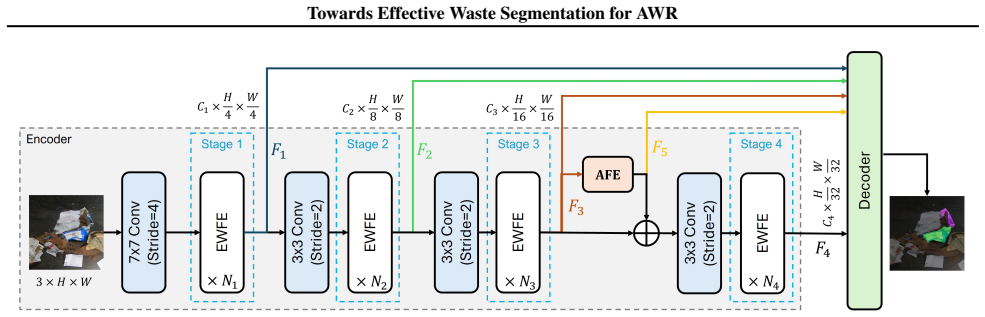
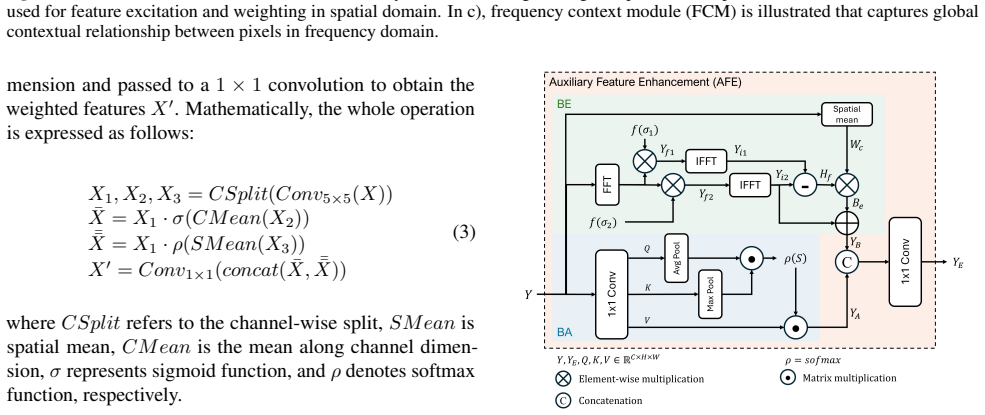
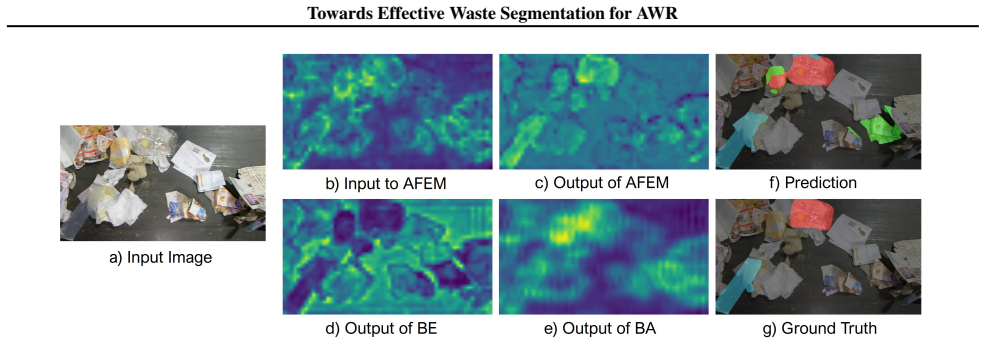
An optimal waste segmentation network is introduced which effectively utilizes the spatial domain to capture localized structural dependencies and the spectral domain to efficiently extract global contextual relationships. This cascaded design allows the network to progressively leverage both local and global representations across complementary domains to highlight the semantic information necessary for effective segmentation of various waste objects. Furthermore, auxiliary feature enhancement module (AFEM) is introduced to enhance the target objects' boundaries and blob amplification for better segmentation in cluttered scenarios.
What carries the argument
Cascaded spatial-spectral processing combined with the auxiliary feature enhancement module (AFEM) that amplifies boundaries and object blobs.
If this is right
- Segmentation performance improves for waste objects surrounded by background clutter without relying on oversized backbone networks.
- Local structural cues and global contextual cues are combined progressively rather than in parallel.
- Target boundaries become sharper and object regions are amplified before final mask prediction.
- The method runs efficiently enough for deployment in automated waste recycling pipelines.
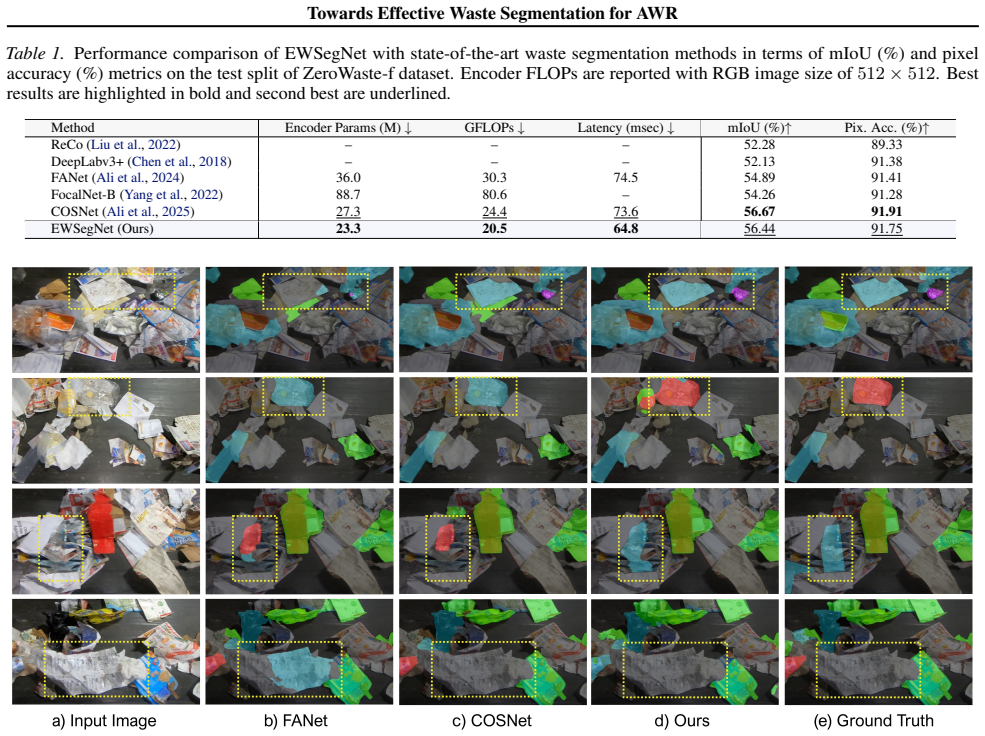
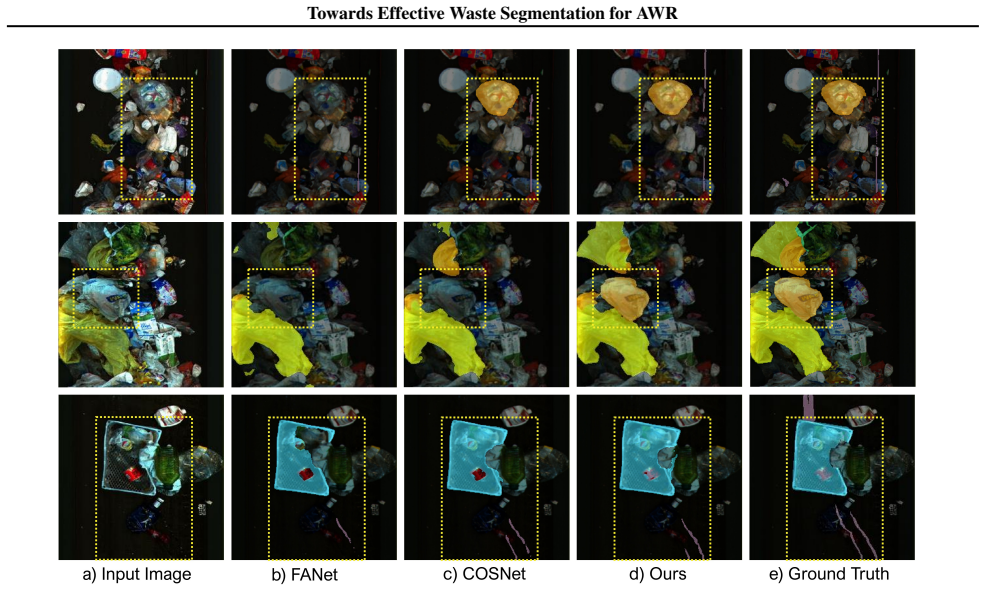
- Results hold across the ZeroWaste-aug, ZeroWaste-f, and SpectralWaste collections.
Where Pith is reading between the lines
- The same cascade pattern could be tested on other cluttered segmentation problems such as debris detection or food sorting.
- If the efficiency claim holds, the network could be embedded directly on sorting-line cameras with modest hardware.
- Removing either the spectral branch or the AFEM would provide a minimal ablation to isolate which component drives the reported gains.
- The design invites direct measurement of end-to-end recycling throughput when the masks are fed to a robotic picker.
Load-bearing premise
The specific cascaded spatial-spectral design together with AFEM will deliver higher segmentation accuracy on cluttered waste images than large-backbone alternatives without raising computation cost or eroding fine detail.
What would settle it
A direct comparison on the ZeroWaste-aug, ZeroWaste-f, or SpectralWaste test sets in which the proposed network shows no gain in mean intersection-over-union or requires substantially more FLOPs or runtime than the strongest existing backbone method.
Figures

read the original abstract
Rapid expansion of urban areas and population growth is causing an immense increase in waste production, which demands the need for efficient and automated waste management. In this scenario, automated waste recycling (AWR) using deep learning methods can assist humans in optimal waste management. Recent deep learning approaches for AWR provide promising waste segmentation performance, however, these methods rely on large backbone networks that are inefficient for AWR systems and suffer from performance deterioration in cluttered scenes. To this end, an optimal waste segmentation network is introduced which effectively utilizes the spatial domain to capture localized structural dependencies and the spectral domain to efficiently extract global contextual relationships. This cascaded design allows the network to progressively leverage both local and global representations across complementary domains to highlight the semantic information necessary for effective segmentation of various waste objects. Furthermore, auxiliary feature enhancement module (AFEM) is introduced to enhance the target objects' boundaries and blob amplification for better segmentation in cluttered scenarios. Extensive experimentation on ZeroWaste-aug, ZeroWaste-f and SpectralWaste datasets reveals the merits of the proposed method.
Editorial analysis
A structured set of objections, weighed in public.
Referee Report
Summary. The manuscript proposes a cascaded spatial-spectral waste segmentation network that leverages spatial domain for localized structural dependencies and spectral domain for global contextual relationships, supplemented by an auxiliary feature enhancement module (AFEM) to enhance boundaries and blob amplification in cluttered scenes. It claims that extensive experiments on ZeroWaste-aug, ZeroWaste-f, and SpectralWaste datasets demonstrate the merits of this approach over existing methods relying on large backbones.
Significance. If the performance claims hold with appropriate metrics and comparisons, the work could contribute to more efficient automated waste recycling systems by reducing reliance on computationally heavy backbone networks while improving segmentation in challenging cluttered environments. The dual-domain cascaded design and AFEM represent potentially useful architectural innovations for semantic segmentation tasks.
major comments (1)
- [Abstract] Abstract: The abstract asserts that 'extensive experimentation on ZeroWaste-aug, ZeroWaste-f and SpectralWaste datasets reveals the merits of the proposed method,' yet provides no quantitative metrics, baseline comparisons, ablation studies, error bars, or implementation details. This omission prevents evaluation of the central performance claims and the assertion of superiority in cluttered scenarios.
minor comments (1)
- The title and abstract use 'optimal' which may be overstated without comparative evidence; consider rephrasing to 'proposed' or 'efficient'.
Simulated Author's Rebuttal
We thank the referee for the detailed review and constructive feedback on our manuscript. We address the major comment point-by-point below.
read point-by-point responses
-
Referee: [Abstract] Abstract: The abstract asserts that 'extensive experimentation on ZeroWaste-aug, ZeroWaste-f and SpectralWaste datasets reveals the merits of the proposed method,' yet provides no quantitative metrics, baseline comparisons, ablation studies, error bars, or implementation details. This omission prevents evaluation of the central performance claims and the assertion of superiority in cluttered scenarios.
Authors: We agree that the abstract would benefit from including key quantitative results to better substantiate the performance claims upfront. The full manuscript provides these details in the Experiments section (including tables with mIoU, comparisons to baselines, and ablations), but the abstract itself is currently qualitative. In the revised version, we will update the abstract to include specific metrics such as mIoU gains on the three datasets and brief baseline comparisons, while keeping it concise. Implementation details and error bars remain in the main text as is conventional. revision: yes
Circularity Check
No significant circularity
full rationale
The paper introduces an architectural proposal (cascaded spatial-spectral network plus AFEM) whose performance is asserted via empirical results on external datasets. No equations, parameter fittings, derivations, or self-citation chains appear in the supplied text. The central claim reduces to experimental validation rather than any self-referential reduction or renamed input, satisfying the criteria for a self-contained empirical contribution.
Axiom & Free-Parameter Ledger
Reference graph
Works this paper leans on
-
[1]
and Bhada-Tata, Perinaz and Van Woerden, Frank , title=
Kaza, Silpa and Yao, Lisa C. and Bhada-Tata, Perinaz and Van Woerden, Frank , title=. Urban Development , organization=. 2018 , url=
2018
-
[2]
CVPR , pages=
Zerowaste dataset: Towards deformable object segmentation in cluttered scenes , author=. CVPR , pages=
-
[3]
2016 , eprint=
SegNet: A Deep Convolutional Encoder-Decoder Architecture for Image Segmentation , author=. 2016 , eprint=
2016
-
[4]
2020 , eprint=
Segmenting Transparent Objects in the Wild , author=. 2020 , eprint=
2020
-
[5]
A review on automated sorting of source-separated municipal solid waste for recycling , journal =. 2017 , note =. doi:https://doi.org/10.1016/j.wasman.2016.09.015 , url =
-
[6]
2021 , eprint=
Swin Transformer: Hierarchical Vision Transformer using Shifted Windows , author=. 2021 , eprint=
2021
-
[7]
2021 , eprint=
Segmentation Transformer: Object-Contextual Representations for Semantic Segmentation , author=. 2021 , eprint=
2021
-
[8]
2017 , eprint=
Pyramid Scene Parsing Network , author=. 2017 , eprint=
2017
-
[9]
2017 , eprint=
Rethinking Atrous Convolution for Semantic Image Segmentation , author=. 2017 , eprint=
2017
-
[10]
ECCV , pages=
Encoder-decoder with atrous separable convolution for semantic image segmentation , author=. ECCV , pages=
-
[11]
International Conference on Learning Representations , year=
Bootstrapping Semantic Segmentation with Regional Contrast , author=. International Conference on Learning Representations , year=
-
[12]
The Essential Guide to Image Processing , publisher =
Chapter 19 - Gradient and Laplacian Edge Detection , editor =. The Essential Guide to Image Processing , publisher =. 2009 , isbn =. doi:https://doi.org/10.1016/B978-0-12-374457-9.00019-6 , url =
-
[13]
CVPR , year=
Scene Parsing through ADE20K Dataset , author=. CVPR , year=
-
[14]
CVPR , month =
Zhao, Hengshuang and Shi, Jianping and Qi, Xiaojuan and Wang, Xiaogang and Jia, Jiaya , title =. CVPR , month =
-
[15]
IEEE Transactions on Pattern Analysis and Machine Intelligence , year=
DeepLab: Semantic Image Segmentation with Deep Convolutional Nets, Atrous Convolution, and Fully Connected CRFs , author=. IEEE Transactions on Pattern Analysis and Machine Intelligence , year=
-
[16]
ECCV , pages=
Unified perceptual parsing for scene understanding , author=. ECCV , pages=
-
[17]
Advances in Neural Information Processing Systems , volume=
Focal modulation networks , author=. Advances in Neural Information Processing Systems , volume=
-
[18]
MMSegmentation Contributors , howpublished =
-
[19]
International Conference on Learning Representations , year=
Decoupled Weight Decay Regularization , author=. International Conference on Learning Representations , year=
-
[20]
ImageNet: A large-scale hierarchical image database , year=
Deng, Jia and Dong, Wei and Socher, Richard and Li, Li-Jia and Kai Li and Li Fei-Fei , booktitle=. ImageNet: A large-scale hierarchical image database , year=
-
[21]
Semi-Supervised Semantic Segmentation With Cross-Consistency Training , year=
Ouali, Yassine and Hudelot, Céline and Tami, Myriam , booktitle=. Semi-Supervised Semantic Segmentation With Cross-Consistency Training , year=
-
[22]
CVPR , year =
Zhuang Liu and Hanzi Mao and Chao-Yuan Wu and Christoph Feichtenhofer and Trevor Darrell and Saining Xie , title =. CVPR , year =
-
[23]
ArXiv , year=
Focal Self-attention for Local-Global Interactions in Vision Transformers , author=. ArXiv , year=
-
[24]
2024 IEEE/RSJ International Conference on Intelligent Robots and Systems (IROS) , pages=
Spectralwaste dataset: Multimodal data for waste sorting automation , author=. 2024 IEEE/RSJ International Conference on Intelligent Robots and Systems (IROS) , pages=. 2024 , organization=
2024
-
[25]
Waste Management , volume=
A robust framework combined saliency detection and image recognition for garbage classification , author=. Waste Management , volume=. 2022 , publisher=
2022
-
[26]
Signal, Image and Video Processing , volume=
YOLO-MTG: a lightweight YOLO model for multi-target garbage detection , author=. Signal, Image and Video Processing , volume=. 2024 , publisher=
2024
-
[27]
arXiv preprint arXiv:2209.15159 , year=
Mobilevitv3: Mobile-friendly vision transformer with simple and effective fusion of local, global and input features , author=. arXiv preprint arXiv:2209.15159 , year=
-
[28]
Resources, Conservation and Recycling , volume=
Recycling waste classification using optimized convolutional neural network , author=. Resources, Conservation and Recycling , volume=. 2021 , publisher=
2021
-
[29]
Proceedings of the IEEE conference on computer vision and pattern recognition , pages=
Densely connected convolutional networks , author=. Proceedings of the IEEE conference on computer vision and pattern recognition , pages=
-
[30]
Convolutional neural networks with swift for Tensorflow: image recognition and dataset categorization , pages=
EfficientNet , author=. Convolutional neural networks with swift for Tensorflow: image recognition and dataset categorization , pages=. 2021 , publisher=
2021
-
[31]
International Journal of Environmental Research and Public Health , volume=
An intelligent waste-sorting and recycling device based on improved EfficientNet , author=. International Journal of Environmental Research and Public Health , volume=. 2022 , publisher=
2022
-
[32]
, journal=
Alonso, Iñigo and Riazuelo, Luis and Murillo, Ana C. , journal=. MiniNet: An Efficient Semantic Segmentation ConvNet for Real-Time Robotic Applications , year=
-
[33]
and Luo, Ping , booktitle =
Xie, Enze and Wang, Wenhai and Yu, Zhiding and Anandkumar, Anima and Alvarez, Jose M. and Luo, Ping , booktitle =. SegFormer: Simple and Efficient Design for Semantic Segmentation with Transformers , volume =
-
[34]
MobileNets: Efficient Convolutional Neural Networks for Mobile Vision Applications
Mobilenets: Efficient convolutional neural networks for mobile vision applications , author=. arXiv preprint arXiv:1704.04861 , year=
work page internal anchor Pith review Pith/arXiv arXiv
-
[35]
Journal of Electrical Engineering & Technology , volume=
A mobilenet-SSD model with FPN for waste detection , author=. Journal of Electrical Engineering & Technology , volume=. 2022 , publisher=
2022
-
[36]
IEEE Access , volume=
Garbage classification algorithm based on improved mobilenetv3 , author=. IEEE Access , volume=. 2024 , publisher=
2024
-
[37]
Proceedings of the IEEE/CVF International Conference on Computer Vision , pages=
Searching for mobilenetv3 , author=. Proceedings of the IEEE/CVF International Conference on Computer Vision , pages=
-
[38]
ECCV , pages=
Cbam: Convolutional block attention module , author=. ECCV , pages=
-
[39]
IEEE Access , year=
A reliable and robust deep learning model for effective recyclable waste classification , author=. IEEE Access , year=
-
[40]
Multimedia Tools and Applications , pages=
NUNI-Waste: novel semi-supervised semantic segmentation waste classification with non-uniform data augmentation , author=. Multimedia Tools and Applications , pages=. 2024 , publisher=
2024
-
[41]
Fanet: Feature Amplification Network for Semantic Segmentation in Cluttered Background , year=
Ali, Muhammad and Javaid, Mamoona and Noman, Mubashir and Fiaz, Mustansar and Khan, Salman , booktitle=. Fanet: Feature Amplification Network for Semantic Segmentation in Cluttered Background , year=
-
[42]
Engineering Applications of Artificial Intelligence , volume=
Hierarchical waste detection with weakly supervised segmentation in images from recycling plants , author=. Engineering Applications of Artificial Intelligence , volume=. 2024 , publisher=
2024
-
[43]
Journal of Marine Science and Engineering , volume=
Real-time instance segmentation for detection of underwater litter as a plastic source , author=. Journal of Marine Science and Engineering , volume=. 2023 , publisher=
2023
-
[44]
Proceedings of the IEEE International Conference on Computer Vision , pages=
Mask r-cnn , author=. Proceedings of the IEEE International Conference on Computer Vision , pages=
-
[45]
arXiv preprint arXiv:2310.19407 , year=
Resource Constrained Semantic Segmentation for Waste Sorting , author=. arXiv preprint arXiv:2310.19407 , year=
-
[46]
arXiv preprint arXiv:2401.15175 , year=
Kitchen Food Waste Image Segmentation and Classification for Compost Nutrients Estimation , author=. arXiv preprint arXiv:2401.15175 , year=
-
[47]
CVPR , pages=
Internimage: Exploring large-scale vision foundation models with deformable convolutions , author=. CVPR , pages=
-
[48]
Proceedings of the IEEE/CVF International Conference on Computer Vision , pages=
Scale-aware modulation meet transformer , author=. Proceedings of the IEEE/CVF International Conference on Computer Vision , pages=
-
[49]
IEEE Transactions on Pattern Analysis and Machine Intelligence , year=
Conv2former: A simple transformer-style convnet for visual recognition , author=. IEEE Transactions on Pattern Analysis and Machine Intelligence , year=
-
[50]
CVPR , month =
Fan, Mingyuan and Lai, Shenqi and Huang, Junshi and Wei, Xiaoming and Chai, Zhenhua and Luo, Junfeng and Wei, Xiaolin , title =. CVPR , month =. 2021 , pages =
2021
-
[51]
ECCV , pages=
Bisenet: Bilateral segmentation network for real-time semantic segmentation , author=. ECCV , pages=. 2018 , organization=
2018
-
[52]
2020 , eprint=
The Devil is in the Boundary: Exploiting Boundary Representation for Basis-based Instance Segmentation , author=. 2020 , eprint=
2020
-
[53]
Wang and J
W. Wang and J. Dai and Z. Chen and Z. Huang and Z. Li and X. Zhu and X. Hu and T. Lu and L. Lu and H. Li and X. Wang and Y. Qiao , booktitle =. InternImage: Exploring Large-Scale Vision Foundation Models with Deformable Convolutions , year =
-
[54]
GD-YOLO: A lightweight model for household waste image detection , journal =. 2025 , issn =. doi:https://doi.org/10.1016/j.eswa.2025.127525 , url =
-
[55]
Proceedings of the Winter Conference on Applications of Computer Vision (WACV) , month =
Ali, Muhammad and Javaid, Mamoona and Noman, Mubashir and Fiaz, Mustansar and Khan, Salman , title =. Proceedings of the Winter Conference on Applications of Computer Vision (WACV) , month =. 2025 , pages =
2025
-
[56]
and Woods, R.E
Gonzalez, R.C. and Woods, R.E. , chapter=. Intensity Transformations and Spatial Filtering , booktitle=. 2018 , publisher=
2018
-
[57]
and Woods, R.E
Gonzalez, R.C. and Woods, R.E. , chapter=. Filtering in the Frequency Domain , booktitle=. 2018 , publisher=
2018
-
[58]
Proceedings of the IEEE/CVF International Conference on Computer Vision , pages=
Scale-aware trident networks for object detection , author=. Proceedings of the IEEE/CVF International Conference on Computer Vision , pages=
-
[59]
Leveraging machine learning for sustainable solid waste management: A global perspective , journal =. 2025 , issn =. doi:https://doi.org/10.1016/j.sftr.2025.101098 , url =
-
[60]
Lightweight context-awareness hybrid-attention network for waste segmentation in cluttered scenes , journal =. 2026 , issn =. doi:https://doi.org/10.1016/j.displa.2025.103213 , url =
-
[61]
Taco: Trash annotations in context for litter detection,
Taco: Trash annotations in context for litter detection , author=. arXiv preprint arXiv:2003.06975 , year=
-
[62]
CVPR , pages=
PIDNet: A real-time semantic segmentation network inspired by PID controllers , author=. CVPR , pages=
-
[63]
Proceedings of the AAAI conference on artificial intelligence , volume=
Head-free lightweight semantic segmentation with linear transformer , author=. Proceedings of the AAAI conference on artificial intelligence , volume=
-
[64]
CVPR , pages=
Topformer: Token pyramid transformer for mobile semantic segmentation , author=. CVPR , pages=
-
[65]
The eleventh international conference on learning representations , year=
Seaformer: Squeeze-enhanced axial transformer for mobile semantic segmentation , author=. The eleventh international conference on learning representations , year=
-
[66]
Proceedings of the AAAI conference on artificial intelligence , volume=
FeedFormer: Revisiting transformer decoder for efficient semantic segmentation , author=. Proceedings of the AAAI conference on artificial intelligence , volume=
-
[67]
IEEE Transactions on Intelligent Transportation Systems , volume=
Deep dual-resolution networks for real-time and accurate semantic segmentation of traffic scenes , author=. IEEE Transactions on Intelligent Transportation Systems , volume=. 2022 , publisher=
2022
discussion (0)
Sign in with ORCID, Apple, or X to comment. Anyone can read and Pith papers without signing in.