Cosmological Dynamics of the Thermal Scalar Near the Hagedorn Temperature
Pith reviewed 2026-06-27 05:50 UTC · model grok-4.3
The pith
The thermal scalar shows that quadratic effective theory cannot resolve the Hagedorn exit problem in string cosmology.
A machine-rendered reading of the paper's core claim, the machinery that carries it, and where it could break.
Core claim
Within the quadratic effective theory the thermal scalar generates static balancing configurations below the Hagedorn temperature that are not attractors, and enables null-energy-condition-preserving branch changes above it that nevertheless fail to connect the Hagedorn phase to standard cosmological evolution; the theory itself ceases to be valid at the transition temperature.
What carries the argument
The thermal scalar (winding string mode that becomes massless at the Hagedorn transition) coupled to the string-frame gravi-dilaton effective action.
If this is right
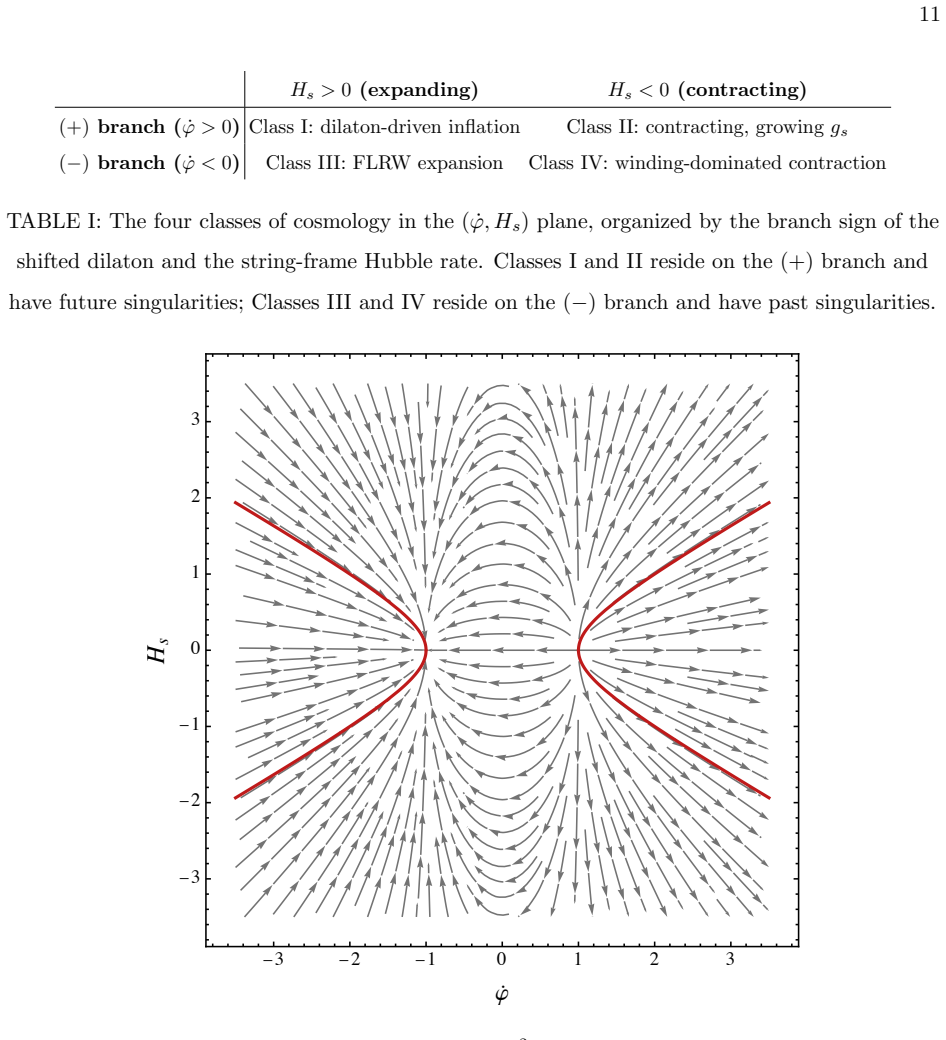
- Static configurations in which the thermal scalar balances the shifted dilaton evolution exist below the Hagedorn temperature but function only as boundary states, not attractors.
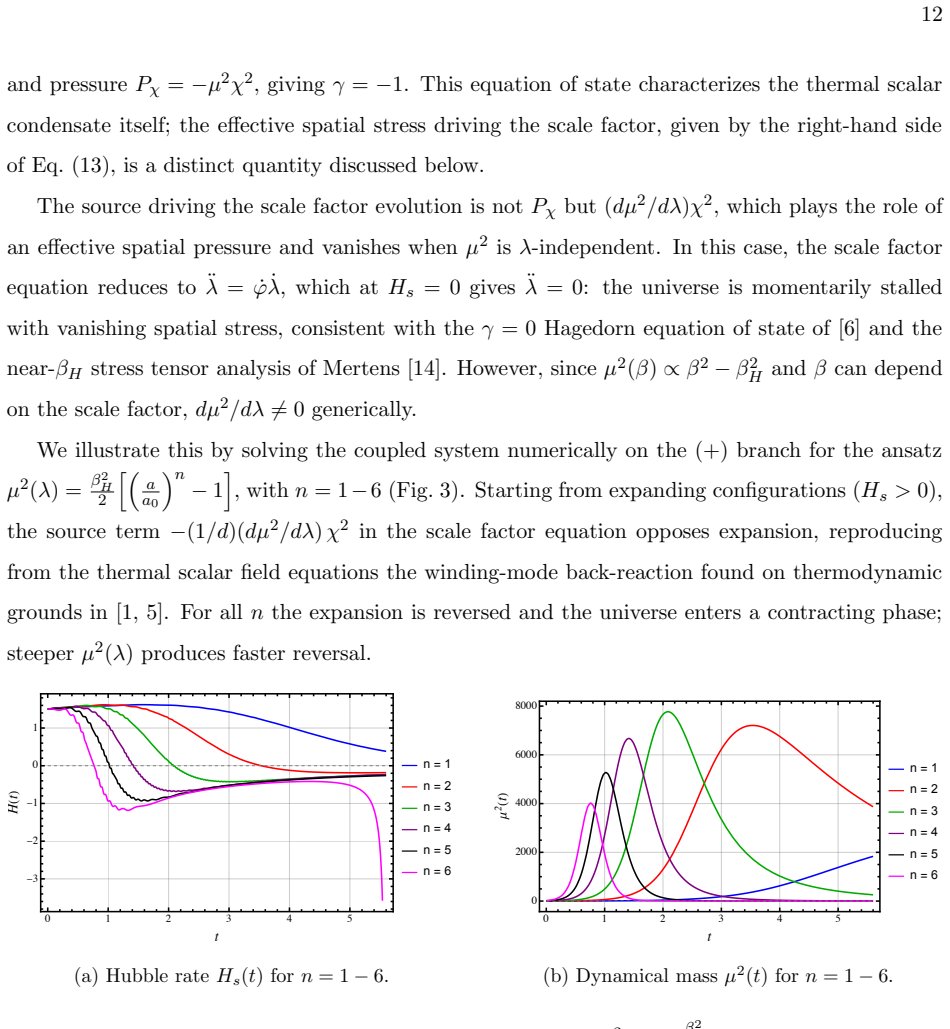
- When the thermal scalar mass depends on the scale factor, winding-mode backreaction opposes expansion and can reverse it.
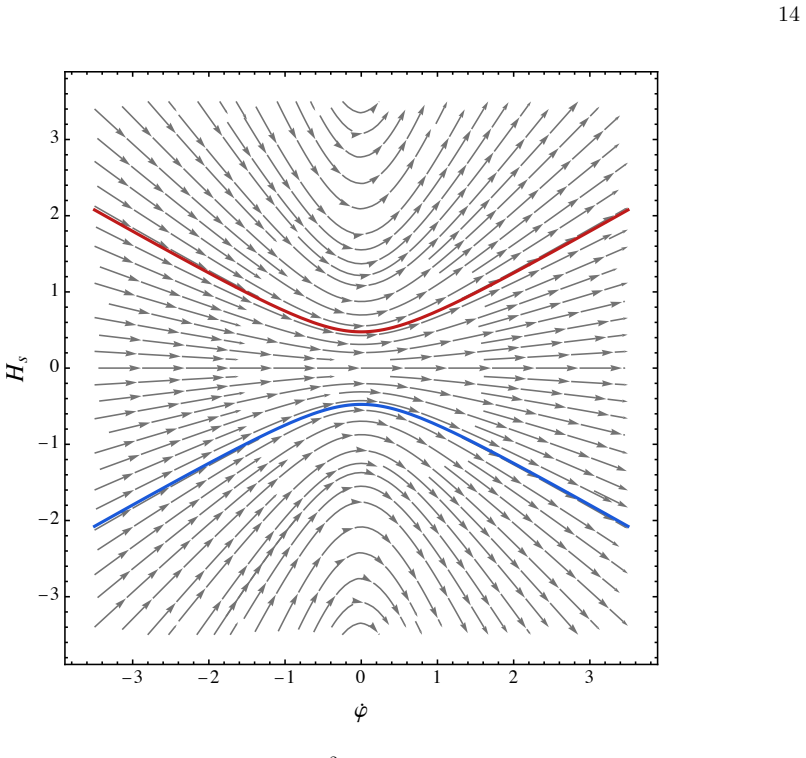
- Above the Hagedorn temperature the tachyonic thermal scalar generates negative effective energy density while preserving the null energy condition.
- Brustein-Veneziano type branch changes become possible but do not provide the graceful exit required to reach standard cosmological evolution.
- The quadratic effective theory breaks down at the Hagedorn temperature, so higher-order interactions are required.
Where Pith is reading between the lines
- Resolving the Hagedorn exit will require including non-quadratic interaction terms in the effective action for the thermal scalar.
- The same limitation may appear in other string-cosmology constructions that rely on winding-mode condensation near the Hagedorn temperature.
- Quantitative study of how the scale-factor dependence of the thermal scalar mass affects the reversal of expansion could be performed within the present framework.
Load-bearing premise
The Lorentzian dynamics obtained by coupling the thermal scalar to the string-frame gravi-dilaton effective action constitute a valid effective dynamical model of the Hagedorn transition even though the scalar originates as a Euclidean order parameter.
What would settle it
A computation of the cubic and quartic terms in the thermal scalar effective potential followed by numerical solution of the resulting equations to determine whether any stable trajectory exits the Hagedorn regime into radiation-dominated expansion.
Figures
read the original abstract
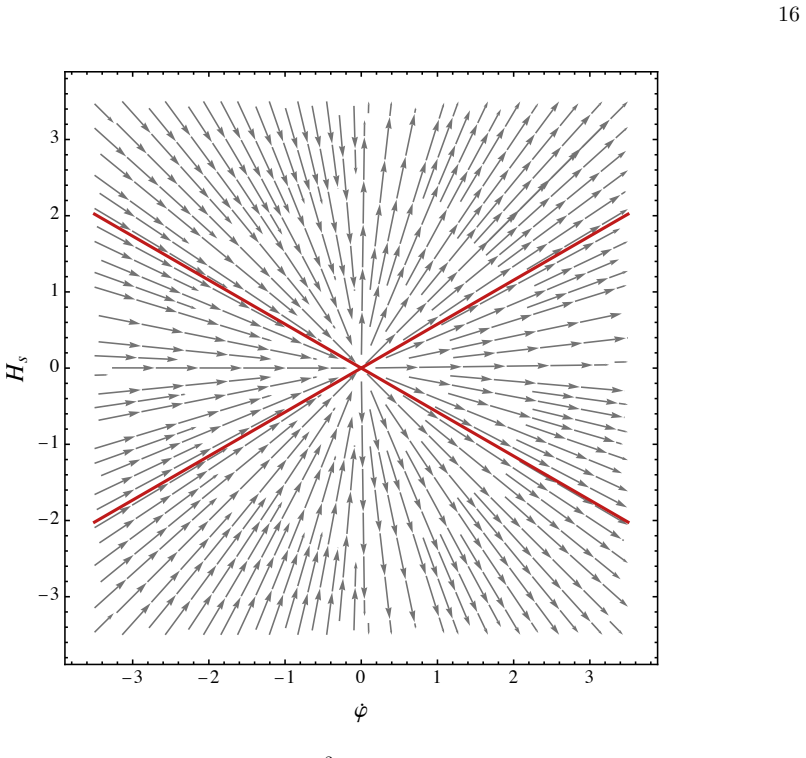
We study the cosmological dynamics of the thermal scalar the winding string mode that becomes massless at the Hagedorn transition by coupling it to the string-frame gravi dilaton effective action. This provides a field-theoretic framework for investigating winding mode dynamics near the Hagedorn temperature and their role in string cosmology. Below the Hagedorn temperature, the phase space contains static configurations in which the thermal scalar balances the shifted dilaton evolution. These configurations are boundary states rather than attractors, and when the thermal scalar mass depends on the scale factor, winding mode back reaction opposes expansion and can reverse it. Above the Hagedorn temperature, the tachyonic thermal scalar generates negative effective energy density while preserving the null energy condition, enabling branch changes of the Brustein Veneziano type. These transitions do not provide the graceful exit required to connect the Hagedorn phase to standard cosmological evolution. At the Hagedorn temperature itself, the quadratic effective theory breaks down and higher order interactions become essential. Because the thermal scalar originates as a Euclidean order parameter, our Lorentzian treatment should be viewed as an effective dynamical model of the Hagedorn transition. Within this framework, the thermal scalar clarifies the dynamical structure surrounding the Hagedorn transition and shows how the Hagedorn exit problem cannot be resolved within the quadratic effective theory alone.
Editorial analysis
A structured set of objections, weighed in public.
Referee Report
Summary. The manuscript analyzes the cosmological dynamics of the thermal scalar (winding mode) by coupling it to the string-frame gravi-dilaton effective action. Below the Hagedorn temperature, static configurations exist in which the thermal scalar balances the shifted dilaton evolution; these are boundary states rather than attractors, and scale-factor-dependent mass leads to backreaction that can oppose or reverse expansion. Above T_H the tachyonic thermal scalar produces negative effective energy density while preserving the null energy condition, permitting Brustein-Veneziano-type branch changes. These transitions nevertheless fail to furnish a graceful exit to standard cosmology. At T_H the quadratic effective theory breaks down and higher-order interactions are required. The Lorentzian treatment is presented as an effective dynamical model of the Euclidean thermal scalar.
Significance. If the effective-model identification holds, the work supplies a concrete field-theoretic framework for winding-mode dynamics near the Hagedorn transition and demonstrates that the quadratic approximation is insufficient to resolve the Hagedorn exit problem, thereby highlighting the necessity of higher-order stringy interactions in early-universe string cosmology.
major comments (1)
- [Abstract, final paragraph] Abstract, final paragraph: The central claim that quadratic effective theory cannot resolve the Hagedorn exit rests on the un-derived identification of the Euclidean winding-mode condensate with a real Lorentzian scalar possessing the quoted potential and stress tensor. No explicit map (Wick rotation, mode truncation, or stress-tensor construction) is supplied; this assumption is load-bearing for the conclusions that tachyonic negative energy density preserves the NEC, that branch changes fail to provide a graceful exit, and that the quadratic theory breaks down at T_H.
minor comments (1)
- [Abstract] Abstract: 'gravi dilaton' should read 'gravi-dilaton'; 'Brustein Veneziano' should read 'Brustein-Veneziano'.
Simulated Author's Rebuttal
We thank the referee for their careful reading of the manuscript and for highlighting the foundational assumption underlying our effective model. We address this point directly below.
read point-by-point responses
-
Referee: [Abstract, final paragraph] Abstract, final paragraph: The central claim that quadratic effective theory cannot resolve the Hagedorn exit rests on the un-derived identification of the Euclidean winding-mode condensate with a real Lorentzian scalar possessing the quoted potential and stress tensor. No explicit map (Wick rotation, mode truncation, or stress-tensor construction) is supplied; this assumption is load-bearing for the conclusions that tachyonic negative energy density preserves the NEC, that branch changes fail to provide a graceful exit, and that the quadratic theory breaks down at T_H.
Authors: We agree that the manuscript does not supply an explicit first-principles derivation (via Wick rotation, mode truncation, or direct stress-tensor construction) of the Lorentzian scalar from the Euclidean winding-mode condensate. The paper instead presents the Lorentzian treatment explicitly as an effective dynamical model, as stated in the final paragraph of the abstract and reinforced in the introduction. Within this standard effective framework—widely employed in the string-cosmology literature for the thermal scalar near the Hagedorn temperature—the potential, mass term, and stress tensor are the conventional ones. The dynamical conclusions (negative effective energy density while preserving the NEC, absence of a graceful exit, and breakdown of the quadratic theory at T_H) follow directly from the equations of motion inside this effective description. We maintain that the effective-model framing is sufficient for the scope of the work, which is to explore the cosmological dynamics rather than to derive the effective action from string theory. revision: no
Circularity Check
No significant circularity in derivation chain
full rationale
The paper couples the thermal scalar to the standard string-frame gravi-dilaton effective action and analyzes phase-space configurations, back-reaction, tachyonic behavior above T_H, and breakdown of the quadratic theory at T_H. No parameters are fitted to a data subset and then relabeled as predictions. No self-citations appear as load-bearing for uniqueness theorems or ansatze. The explicit statement that the Lorentzian treatment is an effective model of the Euclidean origin is an acknowledged modeling choice, not a self-definitional reduction of the central claim (that quadratic theory cannot furnish a graceful exit) to its own inputs by construction. The dynamical conclusions follow from the coupled equations within the adopted framework and remain independent of the target result.
Axiom & Free-Parameter Ledger
axioms (2)
- domain assumption The thermal scalar can be consistently coupled to the string-frame gravi-dilaton effective action to produce a Lorentzian dynamical model
- domain assumption The quadratic truncation of the effective theory is sufficient to derive the listed dynamical conclusions away from the Hagedorn temperature
Reference graph
Works this paper leans on
-
[1]
R. H. Brandenberger and C. Vafa, Superstrings in the Early Universe, Nucl. Phys. B316, 391 (1989)
1989
-
[2]
T. Battefeld and S. Watson, String gas cosmology, Rev. Mod. Phys.78, 435 (2006), arXiv:hep- th/0510022
arXiv 2006
-
[3]
Hagedorn, Statistical thermodynamics of strong interactions at high-energies, Nuovo Cim
R. Hagedorn, Statistical thermodynamics of strong interactions at high-energies, Nuovo Cim. Suppl.3, 147 (1965)
1965
-
[4]
B. Melcher, A. Pradhan, and S. Watson, Waiting for inflation: A new initial state for the Universe, Phys. Rev. D110, 063517 (2024), arXiv:2310.06019 [hep-th]
arXiv 2024
-
[5]
Brandenberger, D
R. Brandenberger, D. A. Easson, and D. Kimberly, Loitering phase in brane gas cosmology, Nuclear Physics B623, 421–436 (2002)
2002
-
[6]
N. Kaloper and S. Watson, Geometric precipices in string cosmology, Phys. Rev. D77, 066002 (2008), arXiv:0712.1820 [hep-th]
Pith/arXiv arXiv 2008
-
[7]
Brustein and G
R. Brustein and G. Veneziano, The graceful exit problem in string cosmology, Physics Letters B329, 429–434 (1994)
1994
-
[8]
J. J. Atick and E. Witten, The Hagedorn Transition and the Number of Degrees of Freedom of String Theory, Nucl. Phys. B310, 291 (1988)
1988
-
[9]
G. T. Horowitz and J. Polchinski, Self-gravitating fundamental strings, Physical Review D57, 2557–2563 (1998). 20
1998
-
[10]
K. R. Dienes, M. Lennek, and M. Sharma, Strings at finite temperature: Wilson lines, free energies, and the thermal landscape, Physical Review D86, 10.1103/physrevd.86.066007 (2012)
-
[11]
B. Melcher, A. Pradhan, and S. Watson, Cosmological perturbations from a new approach to inflation, Phys. Rev. D112, 063542 (2025), arXiv:2501.04669 [astro-ph.CO]
arXiv 2025
-
[12]
R. Brustein and Y. Zigdon, Effective field theory for closed strings near the hagedorn temperature, Journal of High Energy Physics2021, 10.1007/jhep04(2021)107 (2021)
-
[13]
J. L. F. BARB ´ON and E. RABINOVICI, Touring the hagedorn ridge, inFrom Fields to Strings: Circumnavigating Theoretical Physics(WORLD SCIENTIFIC, 2005) p. 1973–2008
2005
-
[14]
T. G. Mertens, Hagedorn string thermodynamics in curved spacetimes and near black hole horizons (2016), arXiv:1506.07798 [hep-th]
Pith/arXiv arXiv 2016
discussion (0)
Sign in with ORCID, Apple, or X to comment. Anyone can read and Pith papers without signing in.