To Cool, or Not to Cool? Displacement Sensing with Hot Quantum States
Pith reviewed 2026-06-27 06:16 UTC · model grok-4.3
The pith
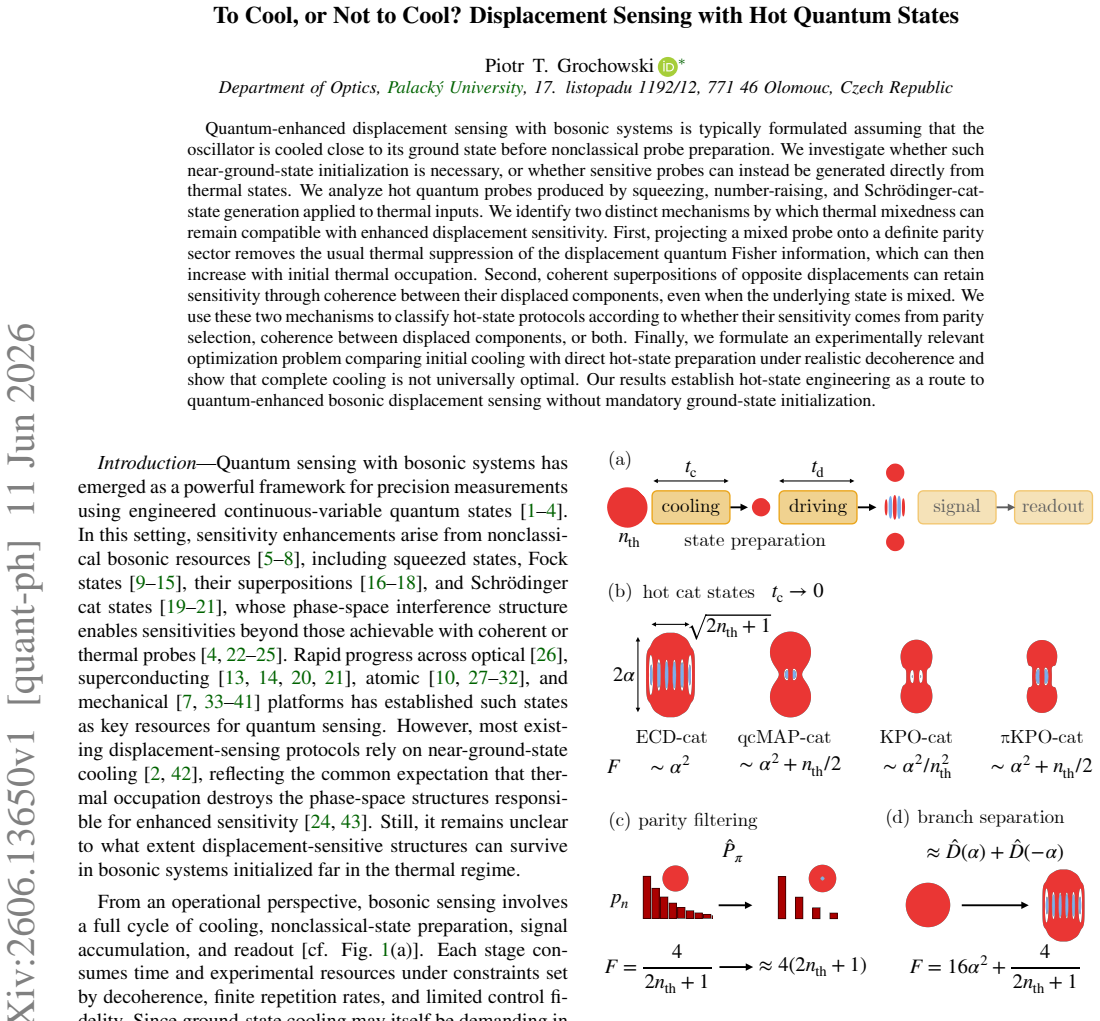
Hot thermal states can achieve quantum-enhanced displacement sensing without mandatory ground-state cooling, and direct hot preparation can outperform cooling under realistic decoherence.
A machine-rendered reading of the paper's core claim, the machinery that carries it, and where it could break.
Core claim
Quantum-enhanced displacement sensing does not require near-ground-state initialization of the oscillator. Hot probes produced by applying squeezing, number-raising, and Schrödinger-cat-state generation to thermal inputs remain compatible with enhanced sensitivity. Parity projection eliminates thermal suppression so that the displacement quantum Fisher information can increase with initial thermal occupation. Coherent superpositions retain sensitivity through coherence between their displaced components even when the underlying state is mixed. These mechanisms allow classification of hot-state protocols and lead to an experimentally relevant optimization showing that complete cooling is not
What carries the argument
Two mechanisms that keep thermal mixedness compatible with enhanced sensitivity: parity selection that removes thermal suppression of the quantum Fisher information, and coherence between displaced components in superpositions.
If this is right
- Parity-projected hot states can exhibit displacement quantum Fisher information that increases with initial thermal occupation.
- Coherent cat states generated from thermal inputs retain sensitivity through coherence between displaced components.
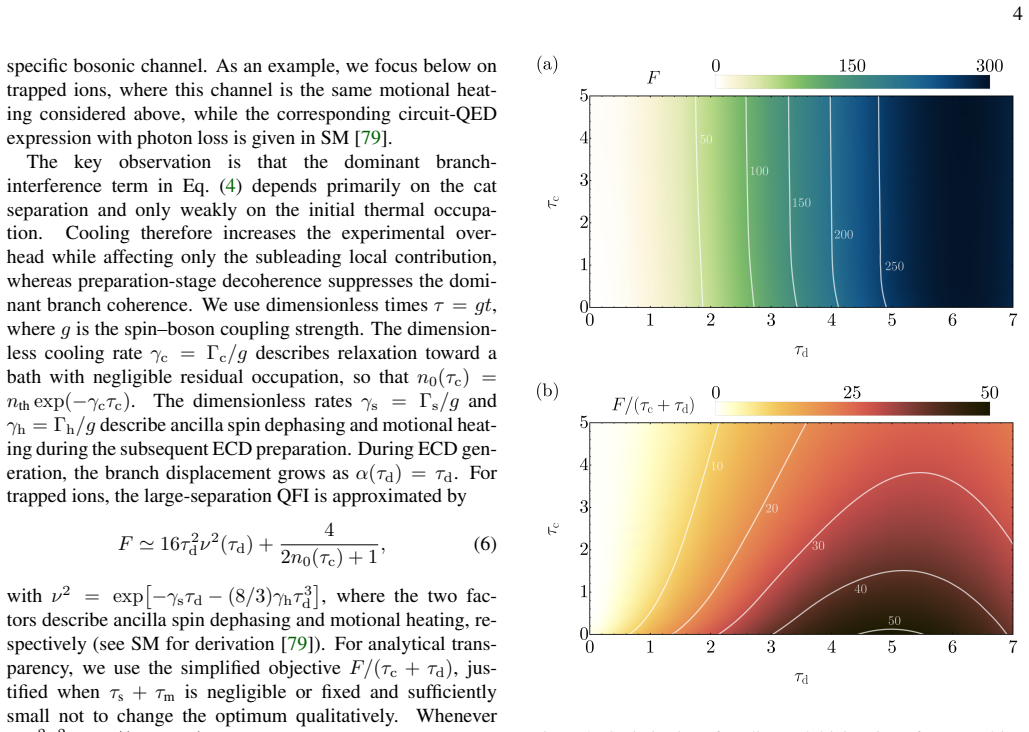
- Hot-state preparation can be preferable to ground-state cooling once realistic decoherence during squeezing and cat generation is included.
- Protocols fall into three classes depending on whether sensitivity arises from parity selection, coherence between displaced components, or both.
Where Pith is reading between the lines
- The result suggests that some sensing experiments could reduce overhead by skipping cryogenic cooling steps when the parity or coherence mechanism dominates.
- The same parity and coherence mechanisms might extend to other bosonic metrology tasks such as phase or force estimation.
- The crossover point where hot preparation wins depends on the relative rates of decoherence versus state-preparation operations, pointing to hardware-specific optimization rather than a universal rule.
- Measuring sensitivity as a function of initial temperature in a single setup could directly locate the regime where hot preparation becomes advantageous.
Load-bearing premise
The optimization that compares initial cooling with direct hot preparation assumes the chosen decoherence model and the specific rates for squeezing, number-raising, and cat-state generation on thermal inputs accurately represent laboratory conditions without additional unmodeled loss channels.
What would settle it
Run the optimization for a concrete experimental platform using measured decoherence rates for the three operations on thermal states and check whether the optimal initial temperature is above zero for at least one protocol.
Figures
read the original abstract
Quantum-enhanced displacement sensing with bosonic systems is typically formulated assuming that the oscillator is cooled close to its ground state before nonclassical probe preparation. We investigate whether such near-ground-state initialization is necessary, or whether sensitive probes can instead be generated directly from thermal states. We analyze hot quantum probes produced by squeezing, number-raising, and Schr\"odinger-cat-state generation applied to thermal inputs. We identify two distinct mechanisms by which thermal mixedness can remain compatible with enhanced displacement sensitivity. First, projecting a mixed probe onto a definite parity sector removes the usual thermal suppression of the displacement quantum Fisher information, which can then increase with initial thermal occupation. Second, coherent superpositions of opposite displacements can retain sensitivity through coherence between their displaced components, even when the underlying state is mixed. We use these two mechanisms to classify hot-state protocols according to whether their sensitivity comes from parity selection, coherence between displaced components, or both. Finally, we formulate an experimentally relevant optimization problem comparing initial cooling with direct hot-state preparation under realistic decoherence and show that complete cooling is not universally optimal. Our results establish hot-state engineering as a route to quantum-enhanced bosonic displacement sensing without mandatory ground-state initialization.
Editorial analysis
A structured set of objections, weighed in public.
Referee Report
Summary. The paper claims that near-ground-state cooling is not always required for quantum-enhanced displacement sensing in bosonic systems. It analyzes hot probes generated via squeezing, number-raising, and cat-state generation applied to thermal inputs, identifying two mechanisms—parity projection that removes thermal suppression of the displacement quantum Fisher information, and retention of sensitivity via coherence between displaced components in superpositions—that allow enhanced performance despite mixedness. Protocols are classified according to whether sensitivity arises from parity selection, coherence, or both. An optimization problem is then formulated comparing initial cooling versus direct hot-state preparation under a decoherence model, concluding that complete cooling is not universally optimal.
Significance. If the optimization result holds under the stated decoherence model, the work is significant because it establishes hot-state engineering as a viable route to quantum-enhanced bosonic sensing without mandatory ground-state initialization, potentially lowering experimental barriers. The two-mechanism classification framework is a clear conceptual contribution that organizes existing and future protocols. The explicit comparison under realistic decoherence (with credit for formulating an experimentally relevant optimization) strengthens the practical relevance.
major comments (2)
- [Optimization section] Optimization section (final part of the manuscript): the central claim that complete cooling is not universally optimal rests on the specific decoherence rates and functional forms assumed for squeezing, number-raising, and cat-state generation applied to thermal inputs. The abstract provides no numerical rates or explicit equations for these rates or the loss channels, so the load-bearing step is whether the model accurately captures relative performance; an explicit statement of the rates, the optimization objective function, and a sensitivity analysis to rate variations are needed to substantiate the crossover result.
- [Mechanisms and classification] The classification of protocols by the two mechanisms (parity selection vs. coherence between displaced components) is used to support the broader claim, but without explicit derivations or error analysis for the quantum Fisher information under each mechanism (as noted in the reader's soundness assessment), it is unclear whether the classification fully supports the optimization conclusion across all cases.
minor comments (2)
- [Mechanisms section] Notation for the quantum Fisher information under thermal inputs could be clarified with an explicit equation early in the mechanisms section to aid readability.
- Figure captions for any plots of sensitivity vs. thermal occupation should explicitly state the decoherence parameters used.
Simulated Author's Rebuttal
We thank the referee for the constructive comments and positive assessment of the work's significance. We address each major comment below and will revise the manuscript accordingly.
read point-by-point responses
-
Referee: [Optimization section] Optimization section (final part of the manuscript): the central claim that complete cooling is not universally optimal rests on the specific decoherence rates and functional forms assumed for squeezing, number-raising, and cat-state generation applied to thermal inputs. The abstract provides no numerical rates or explicit equations for these rates or the loss channels, so the load-bearing step is whether the model accurately captures relative performance; an explicit statement of the rates, the optimization objective function, and a sensitivity analysis to rate variations are needed to substantiate the crossover result.
Authors: We agree that the optimization section requires greater explicitness to make the central claim robust. In the revised manuscript we will state the specific numerical decoherence rates employed, give the explicit mathematical form of the optimization objective, and add a sensitivity analysis with respect to rate variations. These additions will be placed in the optimization section (and referenced from the abstract if space permits) to substantiate the reported crossover. revision: yes
-
Referee: [Mechanisms and classification] The classification of protocols by the two mechanisms (parity selection vs. coherence between displaced components) is used to support the broader claim, but without explicit derivations or error analysis for the quantum Fisher information under each mechanism (as noted in the reader's soundness assessment), it is unclear whether the classification fully supports the optimization conclusion across all cases.
Authors: The manuscript already derives the displacement QFI for each protocol in the main text and appendices. To address the request for greater transparency, we will expand those derivations with additional intermediate steps and include explicit error bounds or sensitivity statements for the QFI under each mechanism. This will clarify how the parity-selection and coherence mechanisms underpin the optimization results. revision: partial
Circularity Check
No circularity detected; derivation is self-contained
full rationale
The paper derives its classification of hot-state protocols from explicit quantum Fisher information calculations on squeezed, number-raised, and cat states starting from thermal inputs, identifying parity projection and inter-component coherence as the two mechanisms. The final optimization compares cooling versus hot preparation by inserting a chosen decoherence model (with stated rates for the operations) as an external input; the result that complete cooling is not universally optimal follows directly from those equations rather than reducing to a fit or self-definition. No self-citations are invoked as load-bearing uniqueness theorems, no ansatz is smuggled, and no parameter is fitted to data then relabeled a prediction. The derivation therefore remains independent of its own outputs.
Axiom & Free-Parameter Ledger
axioms (1)
- standard math Standard quantum mechanics and bosonic mode descriptions apply to thermal inputs under the listed operations.
Reference graph
Works this paper leans on
-
[1]
De Palma, D
G. De Palma, D. Trevisan, and V . Giovannetti,Gaussian States Minimize the Output Entropy of One-Mode Quantum Gaus- sian Channels, Phys. Rev. Lett.118, 160503 (2017)
2017
-
[2]
X. Pan, J. Schwinger, N.-N. Huang, P. Song, W. Chua, F. Hanamura, A. Joshi, F. Valadares, R. Filip, and Y . Y . Gao, Protecting the Quantum Interference of Cat States by Phase- Space Compression, Phys. Rev. X13, 021004 (2023)
2023
-
[3]
Górecki, F
W. Górecki, F. Albarelli, S. Felicetti, R. Di Candia, and L. Maccone,Interplay Between Time and Energy in Bosonic Noisy Quantum Metrology, PRX Quantum6, 020351 (2025)
2025
-
[4]
L. J. Fiderer, J. Schuff, and D. Braun,Neural-Network Heuris- tics for Adaptive Bayesian Quantum Estimation, PRX Quan- tum2, 020303 (2021)
2021
-
[5]
O’Connor, S
E. O’Connor, S. Campbell, and G. T. Landi,Fisher informa- tion rates in sequentially measured quantum systems, New J. Phys.26, 033048 (2024)
2024
-
[6]
Zanardi and M
P. Zanardi and M. Rasetti,Noiseless Quantum Codes, Phys. Rev. Lett.79, 3306 (1997)
1997
-
[7]
D. A. Lidar, I. L. Chuang, and K. B. Whaley,Decoherence- Free Subspaces for Quantum Computation, Phys. Rev. Lett. 81, 2594 (1998)
1998
-
[8]
Knill, R
E. Knill, R. Laflamme, and L. Viola,Theory of Quantum Er- ror Correction for General Noise, Phys. Rev. Lett.84, 2525 (2000)
2000
-
[9]
D. A. Lidar and K. Birgitta Whaley, inIrreversible Quantum Dynamics, edited by F. Benatti and R. Floreanini (Springer, Berlin, Heidelberg, 2003) pp. 83–120
2003
-
[10]
S. D. Bartlett, T. Rudolph, and R. W. Spekkens,Reference frames, superselection rules, and quantum information, Rev. Mod. Phys.79, 555 (2007)
2007
-
[11]
M. J. Millican, V . G. Matsos, C. H. Valahu, T. Navickas, L. J. Bond, and T. R. Tan,Engineering Continuous-Variable En- tanglement in Mechanical Oscillators with Optimal Control, Phys. Rev. Lett.135, 233604 (2025)
2025
-
[12]
V . G. Matsos, C. H. Valahu, T. Navickas, A. D. Rao, M. J. Mil- lican, X. C. Kolesnikow, M. J. Biercuk, and T. R. Tan,Robust and Deterministic Preparation of Bosonic Logical States in a Trapped Ion, Phys. Rev. Lett.133, 050602 (2024)
2024
-
[13]
von Lüpke, I
U. von Lüpke, I. C. Rodrigues, Y . Yang, M. Fadel, and Y . Chu, Engineering multimode interactions in circuit quantum acous- todynamics, Nat. Phys.20, 564 (2024)
2024
-
[14]
Mercadé, R
L. Mercadé, R. Ortiz, A. Grau, A. Griol, D. Navarro-Urrios, and A. Martínez,Engineering Multiple GHz Mechanical Modes in Optomechanical Crystal Cavities, Phys. Rev. Appl. 19, 014043 (2023)
2023
-
[15]
Madiot, M
G. Madiot, M. Albrechtsen, S. Stobbe, C. M. Sotomayor- Torres, and G. Arregui,Multimode optomechanics with a two-dimensional optomechanical crystal, APL Photonics8, 116107 (2023)
2023
-
[16]
Chakram, A
S. Chakram, A. E. Oriani, R. K. Naik, A. V . Dixit, K. He, A. Agrawal, H. Kwon, and D. I. Schuster,Seamless High-$Q$ Microwave Cavities for Multimode Circuit Quantum Electro- dynamics, Phys. Rev. Lett.127, 107701 (2021)
2021
-
[17]
Krisnanda, C
T. Krisnanda, C. Y . Fontaine, A. Copetudo, P. Song, K. X. Lee, N.-N. Huang, F. Valadares, T. C. Liew, and Y . Y . Gao,Demon- strating Efficient and Robust Bosonic State Reconstruction via Optimized Excitation Counting, PRX Quantum6, 010303 (2025)
2025
-
[18]
P. T. Grochowski, M. Fadel, and R. Filip,Distributed Phase- Insensitive Displacement Sensing, arXiv:2602.03727 (2026)
arXiv 2026
-
[19]
Casulleras, P
S. Casulleras, P. T. Grochowski, and O. Romero-Isart,Opti- mization of static potentials for large delocalization and non- Gaussian quantum dynamics of levitated nanoparticles under decoherence, Phys. Rev. A110, 033511 (2024)
2024
-
[20]
P. T. Grochowski, H. Pichler, C. A. Regal, and O. Romero- Isart,Quantum control of continuous systems via nonharmonic potential modulation, Quantum9, 1824 (2025)
2025
-
[21]
P. T. Grochowski and O. Romero-Isart,Quantum Non- Gaussian State Preparation of Levitated Particles via Time- Dependent Control of Weakly Nonharmonic Hybrid Poten- tials, arXiv:2606.10042 (2026)
Pith/arXiv arXiv 2026
-
[22]
J. R. Johansson, P. D. Nation, and F. Nori,QuTiP: An open- source Python framework for the dynamics of open quantum systems, Comput. Phys. Commun.183, 1760 (2012)
2012
-
[23]
J. R. Johansson, P. D. Nation, and F. Nori,QuTiP 2: A Python framework for the dynamics of open quantum systems, Com- 8 put. Phys. Commun.184, 1234 (2013)
2013
-
[24]
N. Lambert, E. Giguère, P. Menczel,et al.,QuTiP 5: The Quantum Toolbox in Python, arXiv:2412.04705 (2024)
Pith/arXiv arXiv 2024
-
[25]
All data and simulation codes are available at https://doi.org/10.5281/zenodo.xxxxx
-
[26]
Crameri, G
F. Crameri, G. E. Shephard, and P. J. Heron,The misuse of colour in science communication, Nat. Commun.11, 5444 (2020)
2020
-
[27]
Crameri, Scientific colour maps, Zenodo (2023)
F. Crameri, Scientific colour maps, Zenodo (2023). Supplemental Material: To Cool, or Not to Cool? Displacement Sensing with Hot Quantum States Piotr T. Grochowski ∗ Department of Optics, Palacký University, 17. listopadu 1192/12, 771 46 Olomouc, Czech Republic CONTENTS SI. Squeezed thermal states 10 SI.1. Parity-filtered squeezed thermal states 10 SII. H...
2023
-
[28]
(a) loss ECD-cat KPO-cat πKPO-cat add-Fock πadd-Fock SG-Fock πSG-Fock qcMAP-catsq
0.1 0.2 0.3 0.4 0.5 0.6 0.7 0.8 0.9 1. (a) loss ECD-cat KPO-cat πKPO-cat add-Fock πadd-Fock SG-Fock πSG-Fock qcMAP-catsq. th
-
[29]
(b)diffusion ECD-cat KPO-cat πKPO-cat add-Fock πadd-Fock SG-Fock πSG-Fock qcMAP-catsq.th
0.1 0.2 0.3 0.4 0.5 0.6 0.7 0.8 0.9 1. (b)diffusion ECD-cat KPO-cat πKPO-cat add-Fock πadd-Fock SG-Fock πSG-Fock qcMAP-catsq.th
-
[30]
(c)dephasing ECD-cat KPO-cat πKPO-cat add-Fock πadd-Fock SG-Fock πSG-Fock qcMAP-catsq.th
0.1 0.2 0.3 0.4 0.5 0.6 0.7 0.8 0.9 1. (c)dephasing ECD-cat KPO-cat πKPO-cat add-Fock πadd-Fock SG-Fock πSG-Fock qcMAP-catsq.th. Figure S5. Numerical verification of the noise susceptibility of dif- ferent hot-state metrological resources. Shown is the normalized displacement QFI,F(t)/F(0), under (a) bosonic loss, (b) phase- insensitive motional heating, ...
discussion (0)
Sign in with ORCID, Apple, or X to comment. Anyone can read and Pith papers without signing in.