Spin-Polarized Oxygen Evolution in Chiral-Molecule-Modified Plasmonic Photoanodes
Pith reviewed 2026-06-27 04:57 UTC · model grok-4.3
The pith
Chiral cysteine functionalization on plasmonic TiO2 photoanodes raises photocurrent by 130% and boosts local oxygen evolution via spin selectivity.
A machine-rendered reading of the paper's core claim, the machinery that carries it, and where it could break.
Core claim
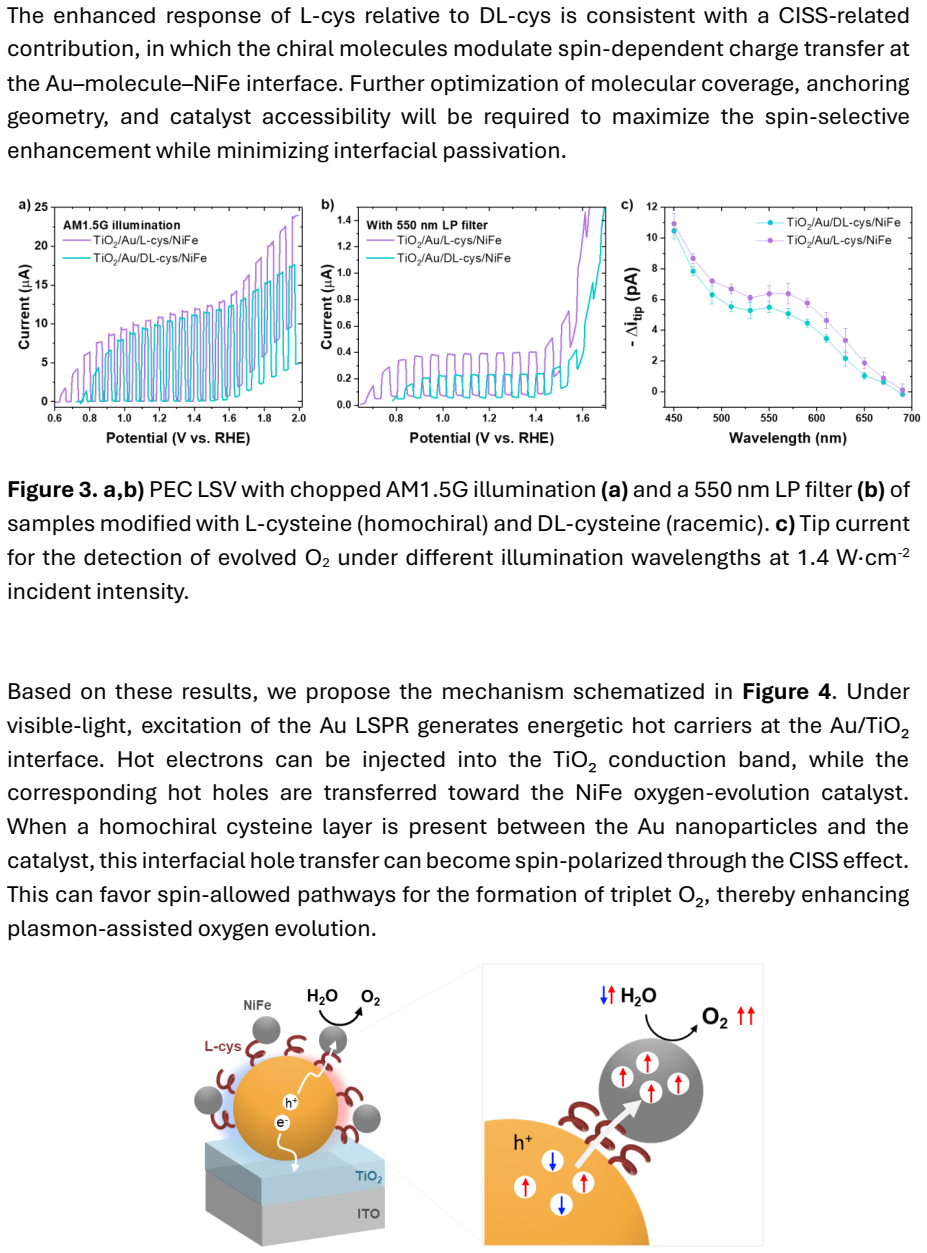
By coating TiO2 photoanodes with achiral Au nanoparticles for visible plasmon absorption, functionalizing the surface with cysteine, and adding a NiFe oxygen-evolution catalyst, the authors find that homochiral L-cysteine produces higher photocurrents and greater local O2 evolution than racemic DL-cysteine controls. The chirality-dependent gain is largest under plasmon-resonant wavelengths and reaches a 130% photocurrent increase, supplying evidence that the chiral molecular layer modulates plasmon hot-carrier transfer through the chiral induced spin selectivity effect.
What carries the argument
The chiral induced spin selectivity effect in the cysteine molecular layer, which filters the spin of plasmon-generated hot holes before they reach the oxygen-evolution catalyst.
If this is right
- Plasmon hot-carrier transfer can be made spin-selective by a chiral molecular interface without external magnets.
- Spin polarization at the electrode improves the rate of triplet oxygen formation in the oxygen-evolution reaction.
- The wavelength dependence isolates the plasmon contribution to the chirality-driven gain.
- A single hybrid architecture can couple hot-carrier generation, molecular spin filtering, and catalytic water oxidation.
Where Pith is reading between the lines
- Chiral molecular layers could be tested on other multi-electron, spin-constrained reactions such as CO2 reduction.
- The same platform might be used to compare chiral molecules of different lengths or structures to map how CISS strength scales with layer thickness.
- If the effect persists in the absence of the NiFe catalyst, it would indicate that spin selectivity can operate directly at the chiral-molecule/electrolyte interface.
Load-bearing premise
Observed differences in photocurrent and oxygen evolution between L-cysteine and DL-cysteine electrodes arise from spin selectivity rather than unequal surface coverage, molecular orientation, or other non-spin electronic effects at the interface.
What would settle it
Finding identical photocurrent and local O2 signals for L-cysteine and DL-cysteine electrodes after precise matching of surface coverage, or observing the enhancement at wavelengths that do not excite the gold plasmon resonance.
Figures
read the original abstract
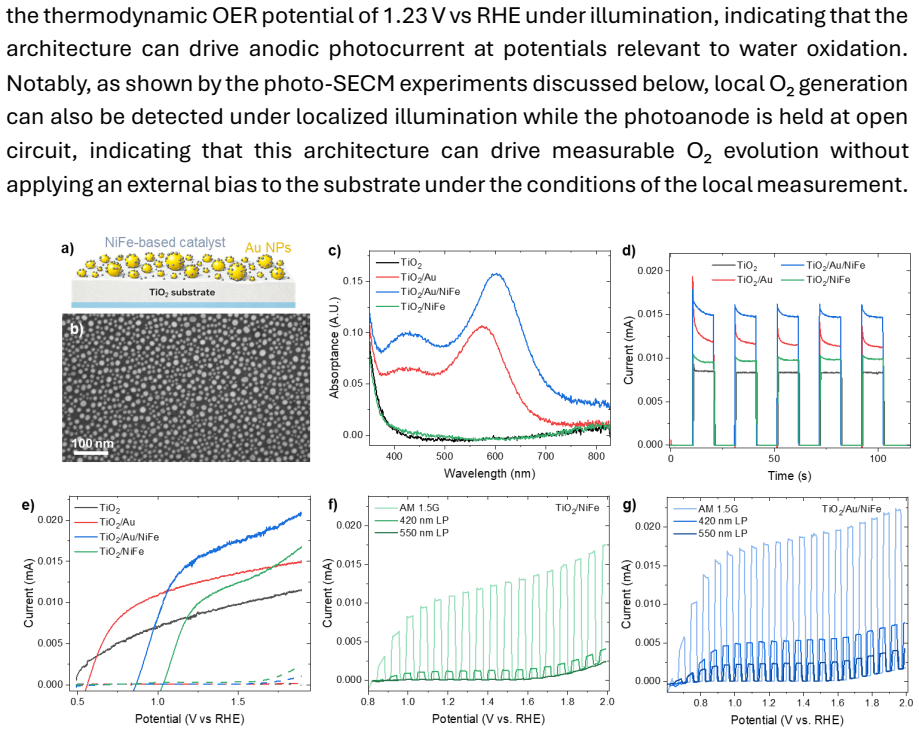
Photoelectrochemical oxygen evolution is limited not only by multi-electron charge-transfer kinetics but also by the spin constraints associated with forming triplet O2. Here, we integrate plasmonic hot-carrier generation, chiral molecular spin selectivity, and oxygen-evolution catalysis within a single hybrid photoanode architecture demonstrating enhanced O2 generated via spin-polarized plasmonic hot holes. TiO2 photoanodes were modified with achiral Au nanoparticles to introduce visible-light plasmonic absorption, functionalized with cysteine as a chiral molecular interface, and coated with a NiFe-based oxygen-evolution catalyst. Wavelength-resolved photo-scanning electrochemical microscopy was used to directly detect locally evolved O2 under operando illumination while simultaneously monitoring the photoanode current. Chiral functionalization with homochiral L-cysteine enhanced both photocurrent and local O2 evolution relative to racemic DL-cysteine controls. The chirality-dependent enhancement was most pronounced under visible excitation overlapping the Au plasmon resonance, including a 130% photocurrent increase. These results provide evidence that chiral molecular layers, often used for chiral nanoparticle synthesis, can directly modulate plasmon-derived hot-carrier transfer through the chiral induced spin selectivity effect. This work establishes a chiral plasmonic photoelectrochemical platform for coupling hot-carrier generation to spin-dependent water oxidation.
Editorial analysis
A structured set of objections, weighed in public.
Referee Report
Summary. The manuscript describes TiO2 photoanodes incorporating achiral Au nanoparticles for plasmonic absorption, functionalized with either homochiral L-cysteine or racemic DL-cysteine as a molecular interface, and coated with a NiFe oxygen-evolution catalyst. Wavelength-resolved photo-scanning electrochemical microscopy is used to monitor both photocurrent and locally evolved O2 under operando illumination. The central experimental finding is a chirality-dependent enhancement, most pronounced under visible excitation overlapping the Au plasmon resonance, with a reported 130% photocurrent increase for L-cysteine relative to DL-cysteine controls; this is interpreted as evidence that the chiral molecular layer modulates plasmon-derived hot-carrier transfer via the chiral-induced spin selectivity (CISS) effect to favor spin-polarized oxygen evolution.
Significance. If the observed differences can be unambiguously attributed to spin selectivity rather than other interfacial variables, the work would establish a hybrid platform that couples plasmonic hot-carrier generation directly to spin-dependent multi-electron catalysis. The operando local O2 detection provides a direct observable beyond integrated current measurements, which is a methodological strength. The approach also repurposes a common chiral ligand (cysteine) in a new functional context.
major comments (3)
- [electrode preparation and characterization section] The central attribution to CISS-mediated spin-polarized hot-hole transfer rests on the assumption that photocurrent and O2 differences between L-cysteine and DL-cysteine arise specifically from spin selectivity. The manuscript should include quantitative surface-coverage data (e.g., XPS, ellipsometry, or electrochemical desorption) and any available orientation information for the two cysteine layers to exclude differences in molecular density or packing as alternative explanations. This comparison is load-bearing for the claim and is not addressed by the racemic control alone.
- [photoelectrochemical and operando O2 measurements] The reported 130% photocurrent enhancement lacks accompanying error bars, replicate counts, or statistical tests. The wavelength-dependent data should be presented with full statistical controls (standard deviation across multiple electrodes or scans) to establish that the L vs. DL difference is significant and reproducible, particularly under plasmon-resonant illumination.
- [discussion of mechanism] No quantitative estimate or model is provided for the expected magnitude of spin polarization or its effect on hot-carrier injection efficiency. A simple rate-equation or spin-filtering calculation linking the observed enhancement to plausible CISS transmission probabilities would make the interpretation more falsifiable.
minor comments (2)
- [abstract and results] The abstract states a '130% photocurrent increase' without specifying the exact baseline condition or wavelength; this numerical claim should be restated with the precise comparison (e.g., at 532 nm vs. dark or vs. racemic control) when first introduced in the main text.
- [methods] Figure captions and methods should explicitly state the illumination intensity, spot size, and scan parameters used in the photo-SECM measurements to allow reproduction of the local O2 maps.
Simulated Author's Rebuttal
We thank the referee for their constructive comments and positive assessment of the work's significance. We have revised the manuscript to incorporate additional surface characterization and statistical details. For the mechanistic modeling request, we provide an expanded discussion with estimates while noting inherent limitations.
read point-by-point responses
-
Referee: [electrode preparation and characterization section] The central attribution to CISS-mediated spin-polarized hot-hole transfer rests on the assumption that photocurrent and O2 differences between L-cysteine and DL-cysteine arise specifically from spin selectivity. The manuscript should include quantitative surface-coverage data (e.g., XPS, ellipsometry, or electrochemical desorption) and any available orientation information for the two cysteine layers to exclude differences in molecular density or packing as alternative explanations. This comparison is load-bearing for the claim and is not addressed by the racemic control alone.
Authors: We agree that confirming comparable surface coverage is essential to support the CISS interpretation over packing differences. The L- and DL-cysteine layers were deposited under identical conditions (same concentration, solvent, and immersion time), and the racemic control uses the same molecular species. To directly address this, the revised manuscript includes new XPS data quantifying surface coverage: the S 2p and N 1s atomic percentages are equivalent within experimental error (~8% variation) for L-cysteine and DL-cysteine samples, consistent with similar molecular densities. No direct orientation data (e.g., from NEXAFS) is available from our measurements, but the coverage equivalence rules out density as the dominant variable. revision: yes
-
Referee: [photoelectrochemical and operando O2 measurements] The reported 130% photocurrent enhancement lacks accompanying error bars, replicate counts, or statistical tests. The wavelength-dependent data should be presented with full statistical controls (standard deviation across multiple electrodes or scans) to establish that the L vs. DL difference is significant and reproducible, particularly under plasmon-resonant illumination.
Authors: We appreciate this point on statistical rigor. The 130% figure represents the mean enhancement observed across multiple devices. The revised manuscript now includes error bars as standard deviations from n=5 independent electrodes per condition. We have added explicit replicate counts in the methods and results sections, along with a statistical analysis (two-tailed t-test) showing p<0.01 for the L- vs. DL-cysteine photocurrent difference under plasmon-resonant illumination (450-550 nm), confirming reproducibility. revision: yes
-
Referee: [discussion of mechanism] No quantitative estimate or model is provided for the expected magnitude of spin polarization or its effect on hot-carrier injection efficiency. A simple rate-equation or spin-filtering calculation linking the observed enhancement to plausible CISS transmission probabilities would make the interpretation more falsifiable.
Authors: We concur that a quantitative model would improve falsifiability. However, reliable CISS transmission probabilities for hot holes through cysteine layers in contact with plasmonic Au and NiFe are not established in the literature, and a full rate-equation treatment would require additional parameters (e.g., hot-carrier generation cross-sections and spin-dependent injection barriers) not measured here. In the revised discussion, we include a semi-quantitative estimate: using reported CISS spin polarizations of 20-60% for amino-acid layers and accounting for the spin constraints in OER, the observed 130% enhancement falls within the plausible range for spin-selective hot-hole transfer. A complete computational model remains beyond the scope of this experimental study. revision: partial
Circularity Check
No significant circularity
full rationale
The manuscript is an experimental study reporting photocurrent and operando O2 measurements on TiO2/Au/NiFe photoanodes functionalized with L-cysteine versus DL-cysteine controls. No equations, fitted parameters, or derivation steps appear in the provided text; the central claim rests on direct wavelength-dependent comparisons against the racemic internal control. No self-citation chain, ansatz smuggling, or renaming of known results is present that would reduce any reported enhancement to an input by construction. The work is therefore self-contained against external benchmarks.
Axiom & Free-Parameter Ledger
axioms (1)
- domain assumption The chiral induced spin selectivity effect filters carrier spin at chiral molecular interfaces.
Reference graph
Works this paper leans on
-
[1]
A., Polman, A
Tagliabue, G., Atwater, H. A., Polman, A. & Cortés, E. Photonic solutions help fight climate crisis. Nat. Photon. 18, 879–882 (2024)
2024
-
[2]
(Springer International Publishing, Cham, 2016)
Photoelectrochemical Solar Fuel Production. (Springer International Publishing, Cham, 2016). doi:10.1007/978-3-319-29641-8
-
[3]
& van de Krol, R
Sivula, K. & van de Krol, R. Semiconducting materials for photoelectrochemical energy conversion. Nat Rev Mater 1, 1–16 (2016)
2016
-
[4]
van der Minne, E. et al. Spin Matters: A Multidisciplinary Roadmap to Understanding Spin Effects in Oxygen Evolution Reaction During Water Electrolysis. Advanced Energy Materials e03556 (2025) doi:10.1002/aenm.202503556
-
[5]
Yu, A., Zhang, Y ., Zhu, S., Wu, T. & Xu, Z. J. Spin-related and non-spin-related effects of magnetic fields on water oxidation. Nat Energy 10, 435–447 (2025)
2025
-
[6]
& Waldeck, D
Naaman, R., Paltiel, Y . & Waldeck, D. H. Chiral Induced Spin Selectivity Gives a New Twist on Spin-Control in Chemistry. Acc. Chem. Res. 53, 2659–2667 (2020)
2020
-
[7]
P ., Paltiel, Y ., Naaman, R
Bloom, B. P ., Paltiel, Y ., Naaman, R. & Waldeck, D. H. Chiral Induced Spin Selectivity. Chem. Rev. 124, 1950–1991 (2024)
1950
-
[8]
Vadakkayil, A. et al. Chiral electrocatalysts eclipse water splitting metrics through spin control. Nat Commun 14, 1067 (2023)
2023
-
[9]
Liang, Y . et al. Enhancement of electrocatalytic oxygen evolution by chiral molecular functionalization of hybrid 2D electrodes. Nat Commun 13, 3356 (2022)
2022
-
[10]
Vensaus, P . et al. Hybrid mesoporous electrodes evidence CISS effect on water oxidation. The Journal of Chemical Physics 160, 111103 (2024)
2024
-
[11]
& Naaman, R
Zhang, W., Banerjee-Ghosh, K., Tassinari, F . & Naaman, R. Enhanced Electrochemical Water Splitting with Chiral Molecule-Coated Fe3O4 Nanoparticles. ACS Energy Lett. 3, 2308–2313 (2018)
2018
-
[12]
& Naaman, R
Mtangi, W., Kiran, V ., Fontanesi, C. & Naaman, R. Role of the Electron Spin Polarization in Water Splitting. J. Phys. Chem. Lett. 6, 4916–4922 (2015)
2015
-
[13]
Zhang, X. et al. Recent Advances in TiO2-based Photoanodes for Photoelectrochemical Water Splitting. Chemistry – An Asian Journal 17, e202200668 (2022)
2022
-
[14]
& Tatsuma, T
Tian, Y . & Tatsuma, T. Mechanisms and Applications of Plasmon-Induced Charge Separation at TiO2 Films Loaded with Gold Nanoparticles. J. Am. Chem. Soc. 127, 7632–7637 (2005)
2005
-
[15]
Tian, Y . & Tatsuma, T. Plasmon-induced photoelectrochemistry at metal nanoparticles supported on nanoporous TiO2. Chem. Commun. 1810–1811 (2004) doi:10.1039/B405061D
-
[16]
& Won Jang, H
Woo Moon, C., Choi, M.-J., Kartham Hyun, J. & Won Jang, H. Enhancing photoelectrochemical water splitting with plasmonic Au nanoparticles. Nanoscale Advances 3, 5981–6006 (2021)
2021
-
[17]
Ezendam, S. et al. Hybrid Plasmonic Nanomaterials for Hydrogen Generation and Carbon Dioxide Reduction. ACS Energy Lett. 7, 778–815 (2022)
2022
-
[18]
Nishijima, Y . et al. Near-Infrared Plasmon-Assisted Water Oxidation. J. Phys. Chem. Lett. 3, 1248–1252 (2012)
2012
-
[19]
Wang, Z. et al. Boosting the Selectivity in Oxygen Electrocatalysis Using Chiral Nanoparticles as Electron-Spin Filters. J. Am. Chem. Soc. https://doi.org/10.1021/jacs.5c03394 (2025) doi:10.1021/jacs.5c03394. 13
-
[20]
Chae, K. et al. Spin-polarized Acidic Water Electrolysis with Antenna-Reactor Plasmonic Electrocatalysts. Advanced Materials 37, 2507658 (2025)
2025
-
[21]
Zhou, H. et al. Spin-Polarization Tailored Oxygen Evolution of Chiral Gold Nanocrystals Probed by Single-Particle Electrochemistry. ACS Nano 20, 15697– 15705 (2026)
2026
-
[22]
& Strasser, P
Dionigi, F . & Strasser, P . NiFe-Based (Oxy)hydroxide Catalysts for Oxygen Evolution Reaction in Non-Acidic Electrolytes. Advanced Energy Materials 6, 1600621 (2016)
2016
-
[23]
Kiani, F . et al. Transport and Interfacial Injection of d-Band Hot Holes Control Plasmonic Chemistry. ACS Energy Lett. 8, 4242–4250 (2023)
2023
-
[24]
Scanning Electrochemical Microscopy. (CRC Press, Boca Raton, 2012). doi:10.1201/b11850
-
[25]
Ye, H., Park, H. S. & Bard, A. J. Screening of Electrocatalysts for Photoelectrochemical Water Oxidation on W-Doped BiVO 4 Photocatalysts by Scanning Electrochemical Microscopy. J. Phys. Chem. C 115, 12464–12470 (2011)
2011
-
[26]
Vensaus, P . et al. Ni nanoclusters as oxygen evolution catalysts on porous supports for electro- and photocatalysis. Nanotechnology 37, 045401 (2026)
2026
-
[27]
L., Ranney, J
Trotochaud, L., Young, S. L., Ranney, J. K. & Boettcher, S. W. Nickel–Iron Oxyhydroxide Oxygen-Evolution Electrocatalysts: The Role of Intentional and Incidental Iron Incorporation. J. Am. Chem. Soc. 136, 6744–6753 (2014)
2014
-
[28]
Friebel, D. et al. Identification of Highly Active Fe Sites in (Ni,Fe)OOH for Electrocatalytic Water Splitting. J. Am. Chem. Soc. 137, 1305–1313 (2015)
2015
-
[29]
Khan, M. A. et al. Importance of Oxygen Measurements during Photoelectrochemical Water-Splitting Reactions. ACS Energy Lett. 4, 2712–2718 (2019)
2019
-
[30]
Tiwari, C. K. & Geletii, Y . V . Measurements of Dioxygen Formation in Catalytic Electrochemical Water Splitting. Catalysts 14, 13 (2024)
2024
-
[31]
Chen, X., Botz, A. J. R., Masa, J. & Schuhmann, W. Characterisation of bifunctional electrocatalysts for oxygen reduction and evolution by means of SECM. J Solid State Electrochem 20, 1019–1027 (2016)
2016
-
[32]
A., López, J
Minguzzi, A., Alpuche-Aviles, M. A., López, J. R., Rondinini, S. & Bard, A. J. Screening of Oxygen Evolution Electrocatalysts by Scanning Electrochemical Microscopy Using a Shielded Tip Approach. Anal. Chem. 80, 4055–4064 (2008)
2008
-
[33]
H., Nepomnyashchii, A
Bae, J. H., Nepomnyashchii, A. B., Wang, X., Potapenko, D. V . & Mirkin, M. V . Photo-Scanning Electrochemical Microscopy on the Nanoscale with Through-Tip Illumination. Anal. Chem. 91, 12601–12605 (2019)
2019
discussion (0)
Sign in with ORCID, Apple, or X to comment. Anyone can read and Pith papers without signing in.