A model of local and global reciprocity
Pith reviewed 2026-06-27 04:45 UTC · model grok-4.3
The pith
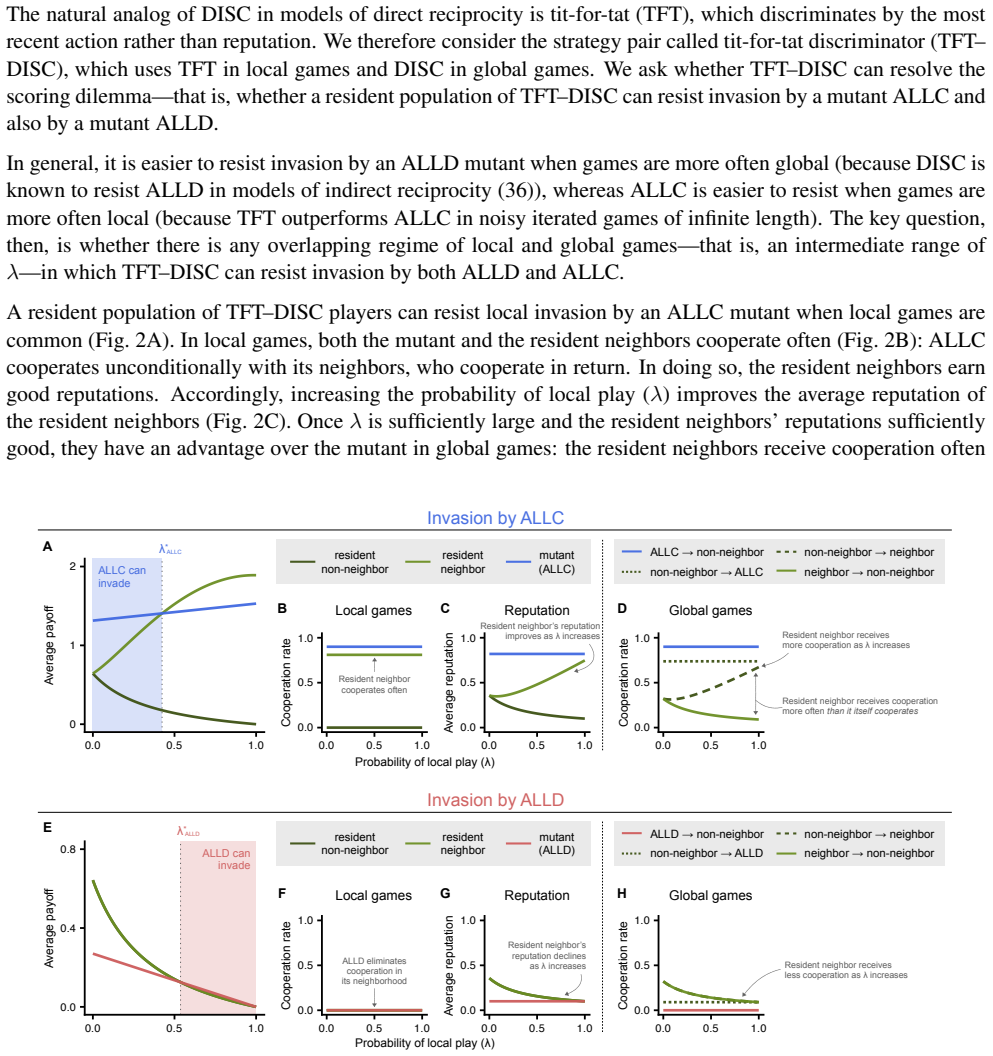
Combining direct reciprocity among friends with indirect reciprocity among strangers allows conditional cooperators to resist invasion by both unconditional cooperators and unconditional defectors.
A machine-rendered reading of the paper's core claim, the machinery that carries it, and where it could break.
Core claim
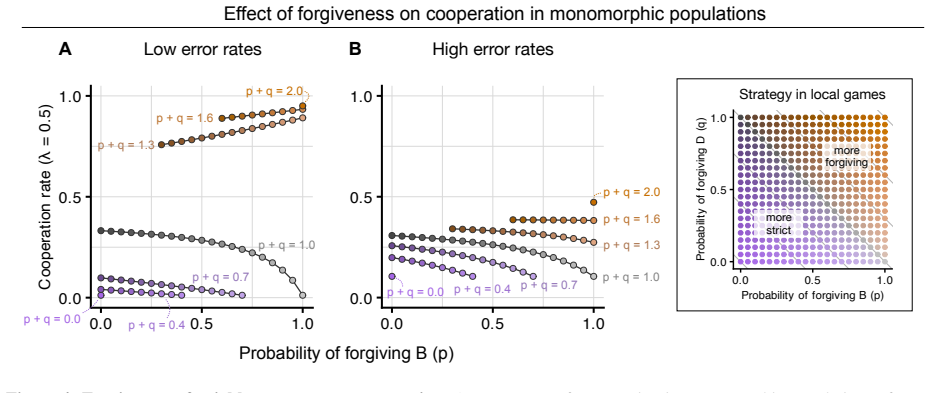
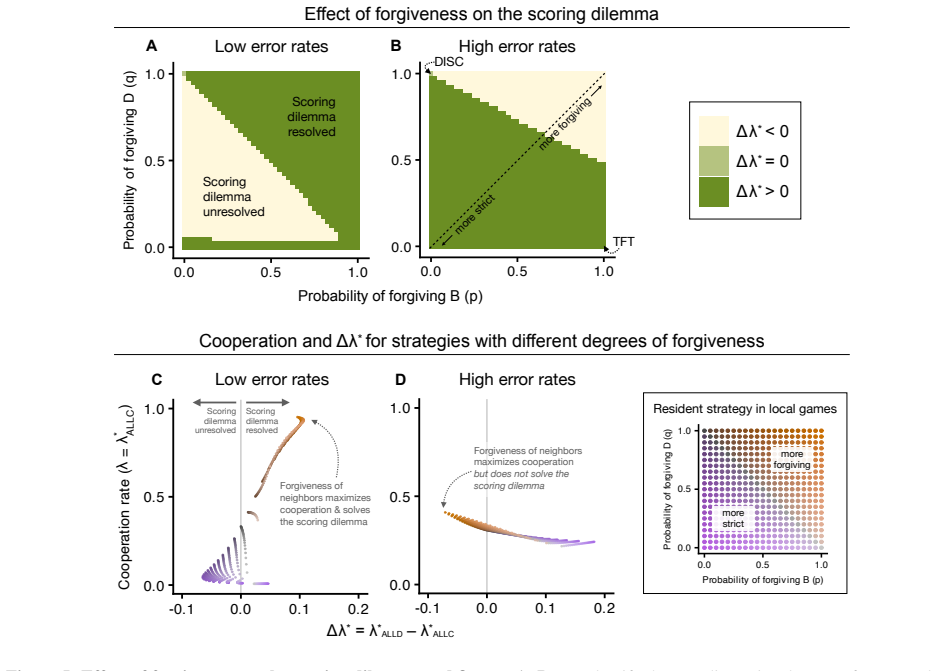
Separating local games with direct observation of friends from global games with reputation-based strangers allows conditional cooperators to persist against invasion by both unconditional cooperators and unconditional defectors. This combination resolves the scoring dilemma of indirect reciprocity alone. The strategies that maximize cooperation are forgiving ones that overlook whichever source of information is unfavorable when the two conflict.
What carries the argument
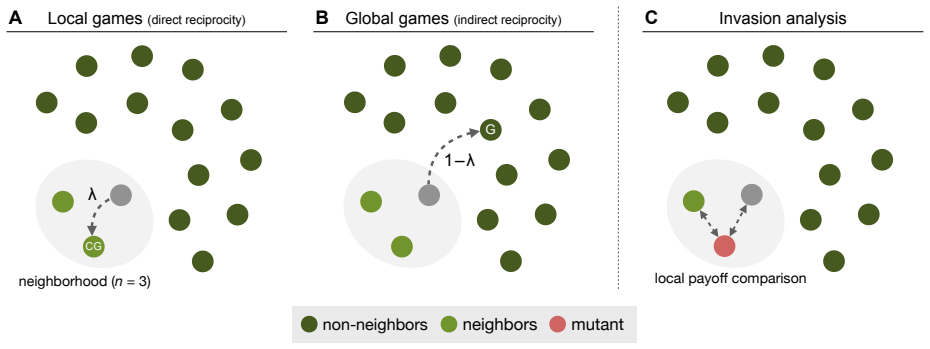
Separation of local direct-reciprocity games (finite neighborhood with direct action observation) from global indirect-reciprocity games (large population judged by public reputation).
If this is right
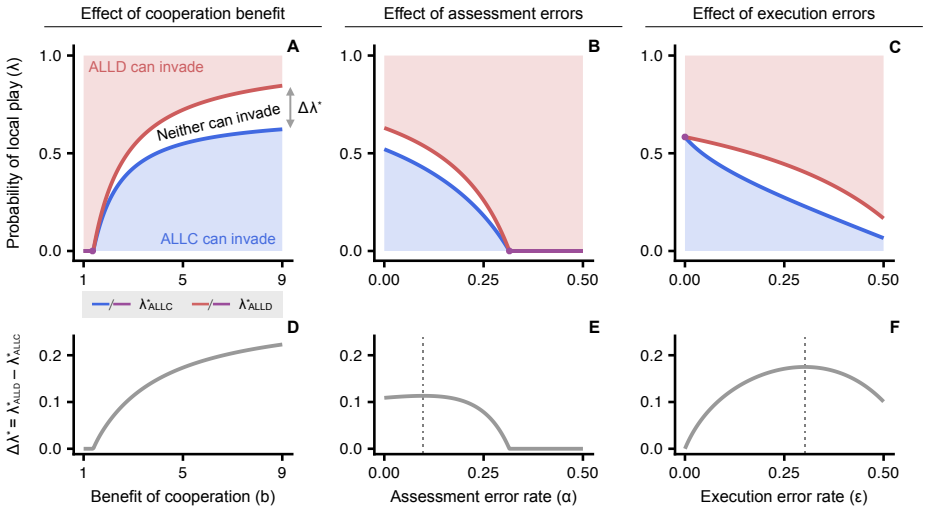
- Conditional cooperators resist invasion by unconditional cooperators.
- Conditional cooperators resist invasion by unconditional defectors.
- Forgiving strategies that overlook unfavorable information maximize overall cooperation.
- Forgiving strategies remain robust to invasion in many parameter regimes.
Where Pith is reading between the lines
- The model predicts that small, observable social circles paired with broad reputation systems can sustain cooperation even when pure reputation systems fail.
- Experiments could test whether humans apply forgiving rules when local observations conflict with public reputation information.
- The separation may explain why real populations maintain both tight friendship networks and diffuse reputation tracking.
Load-bearing premise
Individuals can directly observe the past actions of only a small finite neighborhood of friends while relying solely on public reputations for the much larger pool of strangers.
What would settle it
A simulation or experiment that removes the separation (for example by allowing direct observation of strangers or eliminating local observation) would show whether conditional cooperators lose their resistance to invasion by unconditional strategies.
Figures
read the original abstract
We often decide how to treat friends based on observations of their past behavior, whereas actions toward strangers are typically guided by their public reputations. These two kinds of information underlie two classical mechanisms for the evolution of cooperation$\unicode{x2014}$direct and indirect reciprocity$\unicode{x2014}$which have largely been studied in isolation. They are not interchangeable: we can recall the past actions of only a small circle of close contacts, whereas for the far larger pool of strangers we must rely on public reputations. Here we develop a mathematical framework built on this distinction. Each individual engages in direct reciprocity in local games within a finite neighborhood of friends, whose actions they observe directly, and in indirect reciprocity in global games with a large population of strangers, known only by reputation. Separating local and global interactions allows us to address two questions. First, can cooperation persist under a cognitively simple norm of judgment? We show that combining direct and indirect reciprocity resolves the scoring dilemma: conditional cooperators resist invasion by both unconditional cooperators and unconditional defectors, where indirect reciprocity alone would fail. Second, how should one treat a friend whose past behavior conflicts with their public reputation? We find that the strategies that maximize cooperation are forgiving$\unicode{x2014}$overlooking whichever piece of information is unfavorable$\unicode{x2014}$and that these forgiving strategies can often remain robust to invasion. By distinguishing between local and global scales of interaction and integrating information across them, our framework offers a more cognitively realistic account of how reciprocity sustains cooperation.
Editorial analysis
A structured set of objections, weighed in public.
Referee Report
Summary. The paper develops a mathematical framework separating local direct reciprocity (finite neighborhoods with direct observation of actions) from global indirect reciprocity (public reputations for strangers). It claims that integrating the two resolves the scoring dilemma, enabling conditional cooperators to resist invasion by both unconditional cooperators and unconditional defectors (unlike indirect reciprocity alone). It further shows that forgiving strategies—overlooking unfavorable information when local and global observations conflict—maximize cooperation and remain robust to invasion.
Significance. If the derivations and simulation results hold, the work provides a cognitively plausible account of reciprocity by explicitly distinguishing scales of interaction and information sources. This addresses a known limitation in standalone indirect reciprocity models and identifies robust forgiving norms, which could inform studies of cooperation in mixed local-global social settings.
minor comments (3)
- The abstract states that the model is built on the distinction between local and global games, but the full text should include an explicit section defining the neighborhood size, observation limits, and how public reputations are updated to allow replication of the invasion-resistance results.
- Clarify in the methods or results section how the forgiving judgment rule is formalized when local observations conflict with global reputation; an equation or pseudocode example would improve reproducibility.
- The claim that forgiving strategies 'can often remain robust' would benefit from a table or figure summarizing invasion thresholds across parameter ranges (e.g., neighborhood size, population size) rather than qualitative statements.
Simulated Author's Rebuttal
We thank the referee for their careful reading and positive assessment of the manuscript. The summary accurately reflects our framework and results. No specific major comments were provided in the report, and the recommendation is for minor revision. We will incorporate any minor editorial or presentational improvements in the revised version.
Circularity Check
No significant circularity identified
full rationale
The provided abstract and framework description state the model's premise as an explicit separation of local direct reciprocity (finite neighborhood with direct observation) from global indirect reciprocity (public reputations), then derive that their combination resolves the scoring dilemma under forgiving judgment rules. No equations, fitted parameters, or self-citations are quoted that reduce any prediction or uniqueness claim to the inputs by construction. The central result follows from integrating the two scales as defined, without evidence of self-definitional loops, renamed empirical patterns, or load-bearing self-citation chains. The derivation is therefore self-contained against the stated assumptions.
Axiom & Free-Parameter Ledger
Reference graph
Works this paper leans on
-
[1]
Robert M. Axelrod and William D. Hamilton. The evolution of cooperation.Science, 211(4489):1390–1396, 1981. doi: 10.1126/science.7466396
-
[2]
Axelrod.Evolution of cooperation
Robert M. Axelrod.Evolution of cooperation. Basic Books, 1984
1984
-
[3]
Alexander.The biology of moral systems
Richard D. Alexander.The biology of moral systems. Aldine de Gruyter, New York, NY , 1987
1987
-
[4]
The nature of human altruism.Nature, 425(6960):785–791, 2003
Ernst Fehr and Urs Fischbacher. The nature of human altruism.Nature, 425(6960):785–791, 2003. doi: 10.1038/ nature02043
2003
-
[5]
Robert Boyd and Peter J. Richerson. The evolution of indirect reciprocity.Social Networks, 11(3):213–236, 1989. doi: 10.1016/0378-8733(89)90003-8
-
[6]
Effect of private information on indirect reciprocity.Physical Review E, 82(3):036111, 2010
Satoshi Uchida. Effect of private information on indirect reciprocity.Physical Review E, 82(3):036111, 2010. doi: 10.1103/PhysRevE.82.036111
-
[7]
Satoshi Uchida and Tatsuya Sasaki. Effect of assessment error and private information on stern-judging in indirect reciprocity.Chaos, Solitons & Fractals, 56:175–180, 2013. doi: 10.1016/j.chaos.2013.08.006
-
[8]
The evolution of conditional moral assessment in indirect reciprocity
Tatsuya Sasaki, Isamu Okada, and Yutaka Nakai. The evolution of conditional moral assessment in indirect reciprocity. Scientific Reports, 7(1):1–8, 2017. doi: 10.1038/srep41870
-
[9]
Arunas L. Radzvilavicius, Alexander J. Stewart, and Joshua B. Plotkin. Evolution of empathetic moral evaluation. eLife, 8:e44269, 2019. doi: 10.7554/eLife.44269
-
[10]
Arunas L. Radzvilavicius, Taylor A. Kessinger, and Joshua B. Plotkin. Adherence to public institutions that foster cooperation.Nature Communications, 12(1):3567, 2021. doi: 10.1038/s41467-021-23783-9
-
[11]
Sebasti ´an Michel-Mata, Mari Kawakatsu, Joseph Sartini, Taylor A. Kessinger, Joshua B. Plotkin, and Corina E. Tar- nita. The evolution of private reputations in information-abundant landscapes.Nature, 634(8035):883–889, 2024. doi: 10.1038/s41586-024-07977-x
-
[13]
Laura Schmid, Pouya Shati, Christian Hilbe, and Krishnendu Chatterjee. The evolution of indirect reciprocity under action and assessment generosity.Scientific Reports, 11(1):17443, 2021. doi: 10.1038/s41598-021-96932-1
-
[14]
Quantitative assessment can stabi- lize indirect reciprocity under imperfect information.Nature Communications, 14(1):2086, 2023
Laura Schmid, Farbod Ekbatani, Christian Hilbe, and Krishnendu Chatterjee. Quantitative assessment can stabi- lize indirect reciprocity under imperfect information.Nature Communications, 14(1):2086, 2023. doi: 10.1038/ s41467-023-37817-x
2086
-
[15]
Laura Schmid, Krishnendu Chatterjee, Christian Hilbe, and Martin A. Nowak. A unified framework of direct and indirect reciprocity.Nature Human Behaviour, 5(10):1292–1302, 2021. doi: 10.1038/s41562-021-01114-8
-
[16]
Cedric Perret, Marcus Krellner, and The Anh Han. The evolution of moral rules in a model of indirect reciprocity with private assessment.Scientific Reports, 11(1):23581, 2021. doi: 10.1038/s41598-021-02677-2
-
[17]
Tolerant indirect reciprocity can boost social welfare through sol- idarity with unconditional cooperators in private monitoring.Scientific Reports, 7(1):9737, 2017
Isamu Okada, Tatsuya Sasaki, and Yutaka Nakai. Tolerant indirect reciprocity can boost social welfare through sol- idarity with unconditional cooperators in private monitoring.Scientific Reports, 7(1):9737, 2017. doi: 10.1038/ s41598-017-09935-2
2017
-
[18]
Isamu Okada, Tatsuya Sasaki, and Yutaka Nakai. A solution for private assessment in indirect reciprocity using solitary observation.Journal of Theoretical Biology, 455:7–15, 2018. doi: 10.1016/j.jtbi.2018.06.018
-
[19]
Evolutionary stability of cooperation in indirect reciprocity under noisy and private assessment.Proceedings of the National Academy of Sciences, 120(20):e2300544120, 2023
Yuma Fujimoto and Hisashi Ohtsuki. Evolutionary stability of cooperation in indirect reciprocity under noisy and private assessment.Proceedings of the National Academy of Sciences, 120(20):e2300544120, 2023. doi: 10.1073/ pnas.2300544120
2023
-
[20]
Reputation structure in indirect reciprocity under noisy and private assessment
Yuma Fujimoto and Hisashi Ohtsuki. Reputation structure in indirect reciprocity under noisy and private assessment. Scientific Reports, 12(1):10500, 2022. doi: 10.1038/s41598-022-14171-4. Page 21 of 45
-
[21]
Olof Leimar and Peter Hammerstein. Evolution of cooperation through indirect reciprocity.Proceedings of the Royal Society B: Biological Sciences, 268(1468):745–753, 2001. doi: 10.1098/rspb.2000.1573
-
[22]
How should we define goodness? - reputation dynamics in indirect reciprocity
Hisashi Ohtsuki and Yoh Iwasa. How should we define goodness? - reputation dynamics in indirect reciprocity. Journal of Theoretical Biology, 231(1):107–120, 2004. doi: 10.1016/j.jtbi.2004.06.005
-
[23]
The leading eight: social norms that can maintain cooperation by indirect reciprocity
Hisashi Ohtsuki and Yoh Iwasa. The leading eight: social norms that can maintain cooperation by indirect reciprocity. Journal of Theoretical Biology, 239(4):435–44, 2006. doi: 10.1016/j.jtbi.2005.08.008
-
[24]
Pacheco, Francisco C
Jorge M. Pacheco, Francisco C. Santos, and Fabio A.C.C. Chalub. Stern-judging: a simple, successful norm which promotes cooperation under indirect reciprocity.PLoS Computational Biology, 2(12):1634–1638, 2006. doi: 10.1371/ journal.pcbi.0020178
2006
-
[25]
Fernando P. Santos, Francisco C. Santos, and Jorge M. Pacheco. Social norms of cooperation in small-scale societies. PLOS Computational Biology, 12(1):e1004709, 2016. doi: 10.1371/journal.pcbi.1004709
-
[26]
Fernando P. Santos, Francisco C. Santos, and Jorge M. Pacheco. Social norm complexity and past reputations in the evolution of cooperation.Nature, 555(7695):242–245, 2018. doi: 10.1038/nature25763
-
[27]
Social norms in indirect reciprocity with ternary reputations
Yohsuke Murase, Minjae Kim, and Seung Ki Baek. Social norms in indirect reciprocity with ternary reputations. Scientific Reports, 12(1):455, 2022. doi: 10.1038/s41598-021-04033-w
-
[28]
Yohsuke Murase and Christian Hilbe. Indirect reciprocity with stochastic and dual reputation updates.PLOS Compu- tational Biology, 19(7):e1011271, 2023. doi: 10.1371/journal.pcbi.1011271
-
[29]
The evolution of cooperation and diversity under integrated indirect reciprocity.Games, 15(2), 2024
Tatsuya Sasaki, Satoshi Uchida, Isamu Okada, and Hitoshi Yamamoto. The evolution of cooperation and diversity under integrated indirect reciprocity.Games, 15(2), 2024. doi: 10.3390/g15020015
-
[30]
Glynatsi, Christian Hilbe, and Yohsuke Murase
Nikoleta E. Glynatsi, Christian Hilbe, and Yohsuke Murase. Exact conditions for evolutionary stability in indirect reciprocity under noise.PLOS Computational Biology, 21(10):e1013584, 2025. doi: 10.1371/journal.pcbi.1013584
-
[31]
Saptarshi Pal, Christian Hilbe, and Nikoleta E. Glynatsi. The co-evolution of direct, indirect and generalized reci- procity.arXiv:2411.03488, 2024. doi: 10.48550/arXiv.2411.03488
-
[32]
Valentin H ¨ubner, Laura Schmid, Christian Hilbe, and Krishnendu Chatterjee. Stable strategies of direct and indirect reciprocity across all social dilemmas.PNAS Nexus, 4(5):pgaf154, 2025. doi: 10.1093/pnasnexus/pgaf154
-
[33]
Hitoshi Yamamoto, Isamu Okada, and Takahisa Suzuki. Tolerant integrated reciprocity sustains cooperation in a noisy environment.Scientific Reports, 15(1):28912, 2025. doi: 10.1038/s41598-025-14538-3
-
[34]
Cooperation through image scoring in humans.Science, 288(5467):850–852,
Claus Wedekind and Manfred Milinski. Cooperation through image scoring in humans.Science, 288(5467):850–852,
-
[35]
doi: 10.1126/science.288.5467.850
-
[36]
Hannelore Brandt and Karl Sigmund. Indirect reciprocity, image scoring, and moral hazard.Proceedings of the National Academy of Sciences, 102(7):2666–2670, 2005. doi: 10.1073/pnas.0407370102
-
[37]
Princeton University Press, 2010
Karl Sigmund.The calculus of selfishness. Princeton University Press, 2010
2010
-
[38]
A review of theoretical studies on indirect reciprocity.Games, 11(3):27, 2020
Isamu Okada. A review of theoretical studies on indirect reciprocity.Games, 11(3):27, 2020. doi: 10.3390/g11030027
-
[39]
Isamu Okada. Two ways to overcome the three social dilemmas of indirect reciprocity.Scientific Reports, 10(1): 16799, 2020. doi: 10.1038/s41598-020-73564-5
-
[40]
Learning to cooperate via indirect reciprocity.Games and Economic Behavior, 72(1):30–37, 2011
Ulrich Berger. Learning to cooperate via indirect reciprocity.Games and Economic Behavior, 72(1):30–37, 2011. doi: 10.1016/j.geb.2010.08.009
-
[41]
On the stability of cooperation under indirect reciprocity with first-order information
Ulrich Berger and Ansgar Gr ¨une. On the stability of cooperation under indirect reciprocity with first-order information. Games and Economic Behavior, 98:19–33, 2016. doi: 10.1016/j.geb.2016.05.003
-
[42]
Yohsuke Murase and Christian Hilbe. Indirect reciprocity under opinion synchronization.Proceedings of the National Academy of Sciences, 121(48):e2418364121, 2024. doi: 10.1073/pnas.2418364121
-
[43]
The logic of reprobation: assessment and action rules for indirect reciprocation
Hannelore Brandt and Karl Sigmund. The logic of reprobation: assessment and action rules for indirect reciprocation. Journal of Theoretical Biology, 231(4):475–486, 2004. doi: 10.1016/j.jtbi.2004.06.032. Page 22 of 45
-
[44]
Karthik Panchanathan and Robert Boyd. A tale of two defectors: the importance of standing for evolution of indirect reciprocity.Journal of Theoretical Biology, 224(1):115–126, 2003. doi: 10.1016/S0022-5193(03)00154-1
-
[45]
Jeff Bezanson, Alan Edelman, Stefan Karpinski, and Viral B. Shah. Julia: a fresh approach to numerical computing. SIAM Review, 59(1):65–98, 2017. doi: 10.1137/141000671
-
[46]
Hye Jin Park, Beom Jun Kim, and Hyeong-Chai Jeong. Role of generosity and forgiveness: return to a cooperative society.Physical Review E, 95(4):042314, 2017. doi: 10.1103/PhysRevE.95.042314
-
[47]
Alina Glaubitz and Feng Fu. The other side of the coin: Recipient norms and their impact on indirect reciprocity and cooperation.Applied Mathematics and Computation, 513:129790, 2026. doi: 10.1016/j.amc.2025.129790
-
[48]
Taylor A. Kessinger, Corina E. Tarnita, and Joshua B. Plotkin. Evolution of norms for judging social behavior. Proceedings of the National Academy of Sciences, 120(24):e2219480120, 2023. doi: 10.1073/pnas.2219480120
-
[49]
The training process of many deep networks explores the same low-dimensional manifold
Yohsuke Murase and Christian Hilbe. Computational evolution of social norms in well-mixed and group-structured populations.Proceedings of the National Academy of Sciences, 121(33):e2406885121, 2024. doi: 10.1073/pnas. 2406885121
-
[50]
Evolution of rumours that discriminate lying defectors.Evolutionary Ecology Research, 6(2):261–283, 2004
Mayuko Nakamaru and Masakado Kawata. Evolution of rumours that discriminate lying defectors.Evolutionary Ecology Research, 6(2):261–283, 2004
2004
-
[51]
Motohide Seki and Mayuko Nakamaru. A model for gossip-mediated evolution of altruism with various types of false information by speakers and assessment by listeners.Journal of Theoretical Biology, 407:90–105, 2016. doi: 10.1016/j.jtbi.2016.07.001
-
[52]
Taylor A. Kessinger and Joshua B. Plotkin. Institutions of public judgment established by social contract and taxation. Proceedings of the National Academy of Sciences, 122(26):e2506537122, 2025. doi: 10.1073/pnas.2506537122
-
[53]
Manfred Milinski, Dirk Semmann, Theo C. M. Bakker, and Hans-J ¨urgen Krambeck. Cooperation through indirect reciprocity: image scoring or standing strategy?Proceedings of the Royal Society B: Biological Sciences, 268(1484): 2495–2501, 2001. doi: 10.1098/rspb.2001.1809
-
[54]
Hitoshi Yamamoto, Takahisa Suzuki, and Ryohei Umetani. Justified defection is neither justified nor unjustified in indirect reciprocity.PLOS ONE, 15(6):e0235137, 2020. doi: 10.1371/journal.pone.0235137
-
[55]
Social norms and group-bounded indirect reciprocity.Evolutionary Human Sciences, 8:e13, 2026
Wakaba Tateishi and Hirotaka Imada. Social norms and group-bounded indirect reciprocity.Evolutionary Human Sciences, 8:e13, 2026. doi: 10.1017/ehs.2026.10045. Page 23 of 45 Supplementary Information Contents S1 Full model description 24 S1.1 Setup . . . . . . . . . . . . . . . . . . . . . . . . . . . . . . . . . . . . . . . . . . . . . . . . . . . . . . ....
-
[56]
(S8) into Eq
(S9) Substituting Eq. (S8) into Eq. (S9) yields E[h AR(k+ 1)|h(k)] =λ (1) z }| {X A1R1 X A2R2 hA1R1(k)h A2R2(k) X A′ 2R′ 2 P local AR|A2R2 ·P local A′ 2R′ 2|A1R1 + (1−λ) X A1R1 X A2R2 hA1R1(k)h A2R2(k) X A′ 2R′ 2 δA2,A′ 2 P global R|R2 ·δ A1,A P global R′ 2|R1 | {z } (2) . Page 27 of 45 SinceP A′ 2R′ 2 P local A′ 2R′ 2|A1R1 = 1and P A1R1 hA1R1 = 1, expres...
discussion (0)
Sign in with ORCID, Apple, or X to comment. Anyone can read and Pith papers without signing in.