CANUCS/Technicolor Data Release 2: A Catalogue of Galaxy Structural Parameters in up to 29 HST+JWST bands and a Multi-Wavelength Exploration of the Galaxy Size-Mass Relation at 0.6 < z leq 4
Pith reviewed 2026-06-27 06:06 UTC · model grok-4.3
The pith
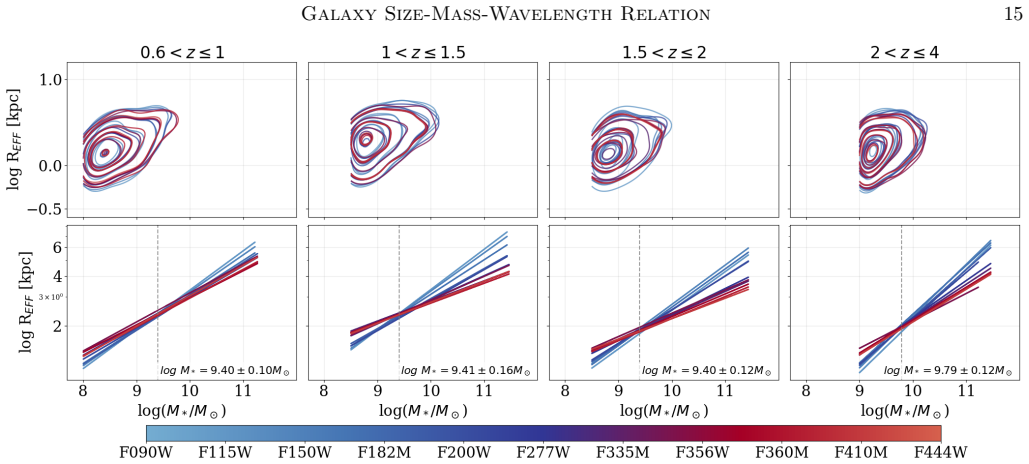
The slope of the galaxy size-mass relation changes with rest-frame wavelength and crosses over at a stellar mass of about 10^9.5 solar masses, proposed as the transition point between diffuse and compact morphologies.
A machine-rendered reading of the paper's core claim, the machinery that carries it, and where it could break.
Core claim
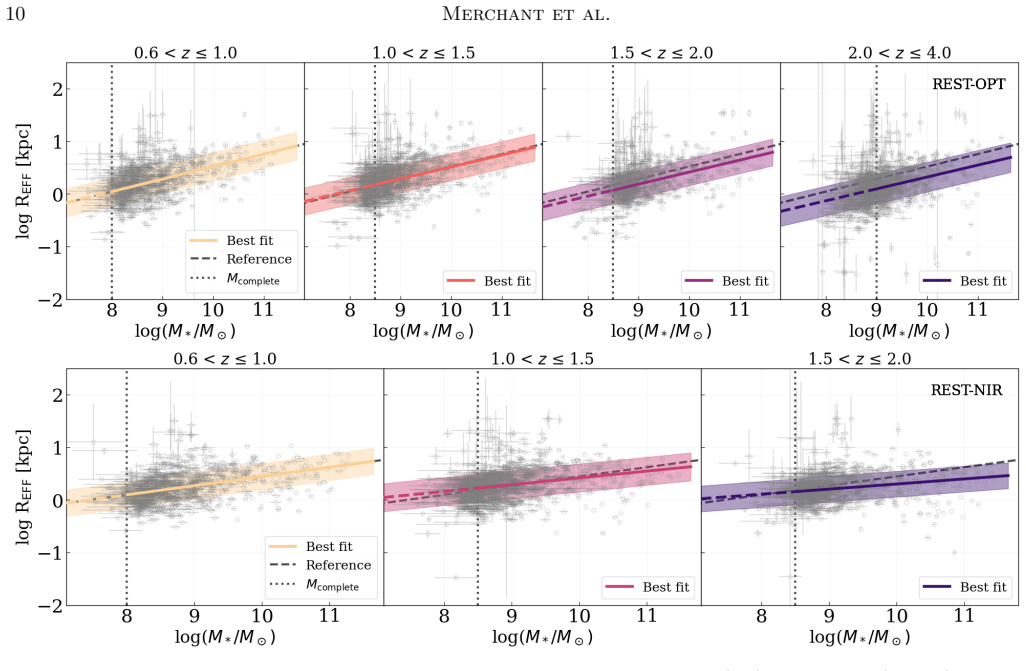
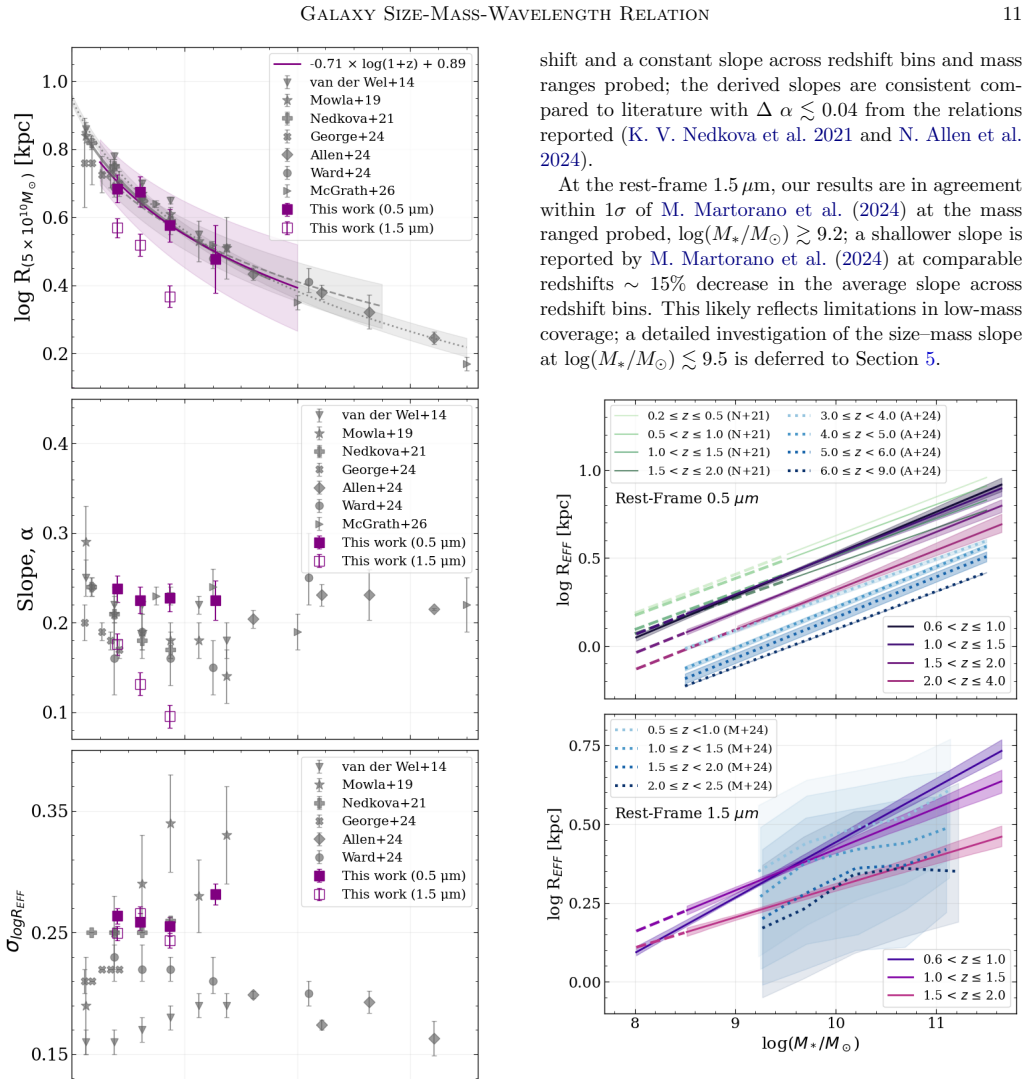
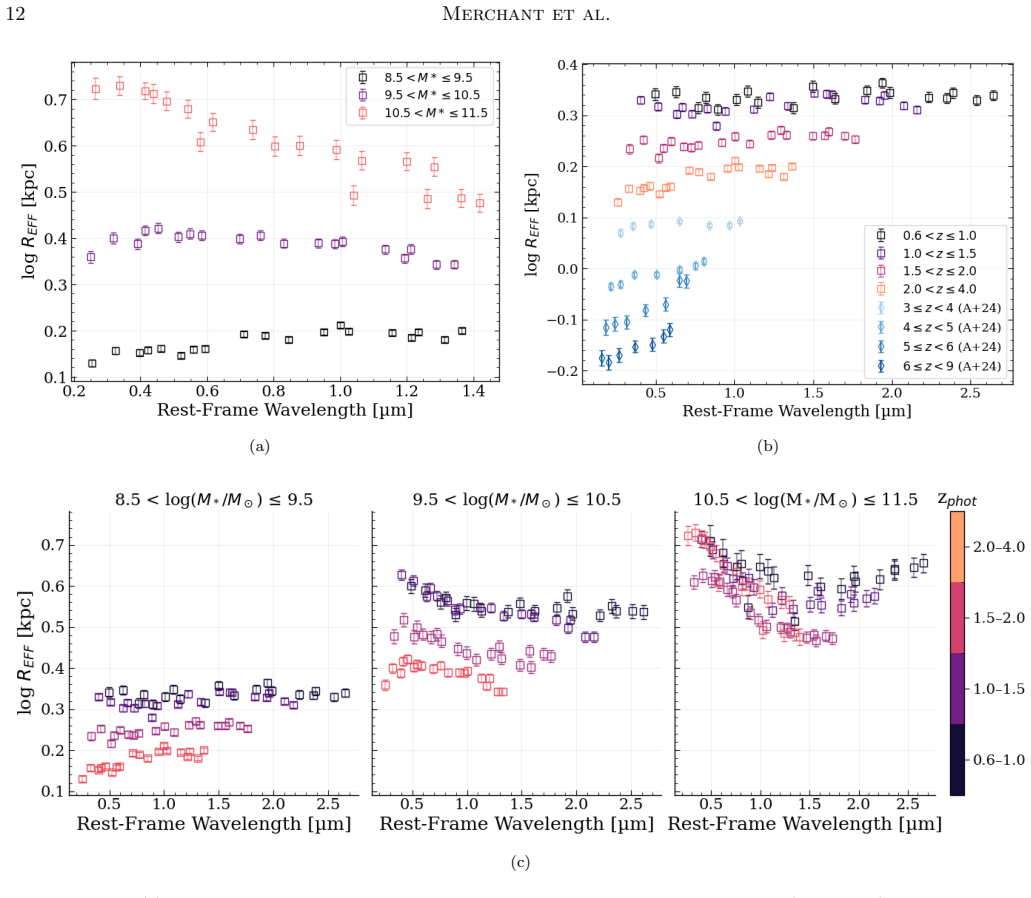
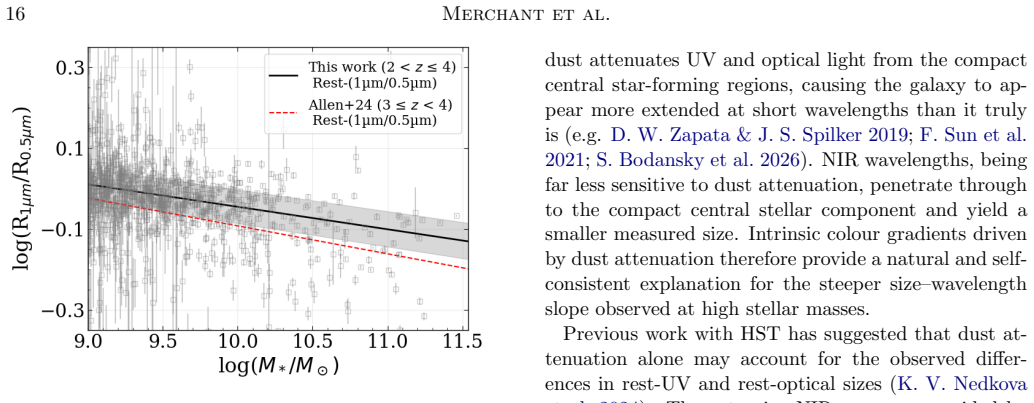
Independent GALFIT structural fits in 19 NIRCam bands (plus HST filters) for star-forming galaxies with 8.5 < log(M*/M⊙) ≤ 11.5 show a gradient in the slope of the size-mass relation as a function of rest-frame wavelength, with a critical crossover mass at ∼10^9.5 M⊙ that is proposed as the stellar mass separating diffuse from compact galaxy morphologies.
What carries the argument
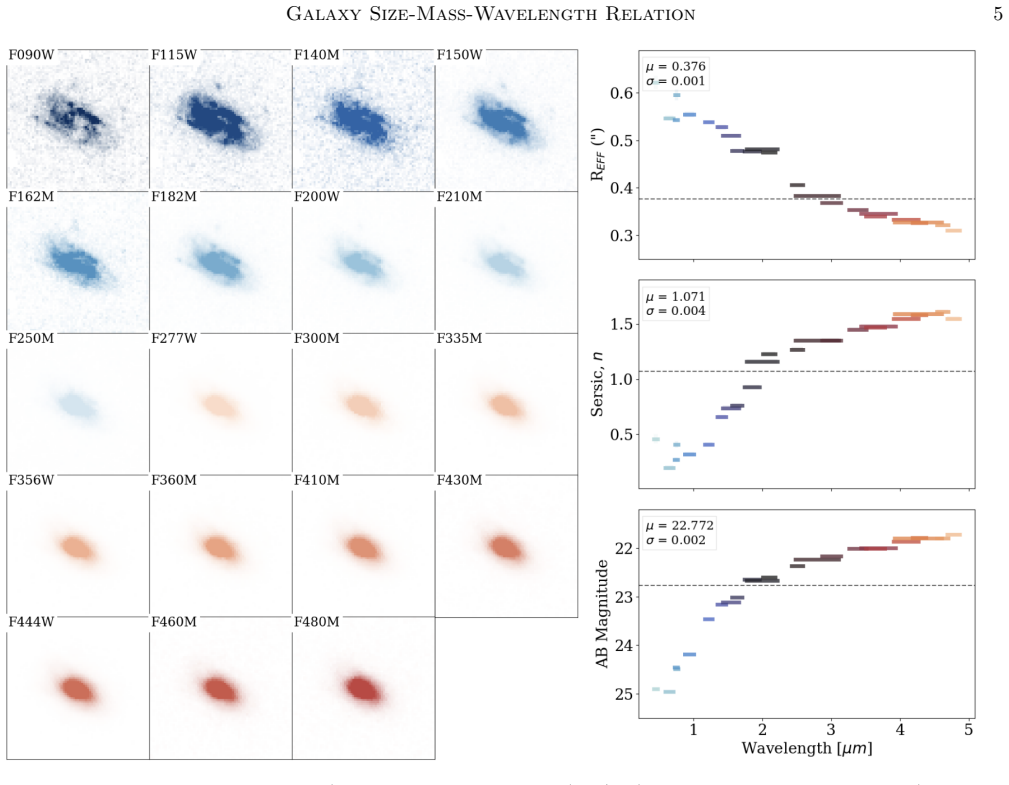
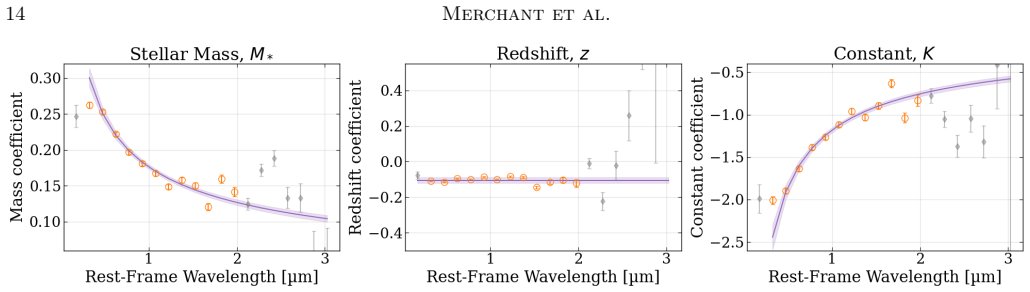
Multi-band size-mass relation with wavelength treated as a free parameter, derived from independent GALFIT measurements in each of up to 29 filters.
If this is right
- Below the crossover mass, galaxy sizes appear more extended at shorter wavelengths; above it, sizes appear more compact across wavelengths.
- The size-mass relation can be written as a single function of both mass and wavelength rather than separate relations at fixed wavelength.
- The characteristic mass may mark a shift in the dominant structural component or assembly process.
- The public catalog allows the same wavelength-dependent analysis to be repeated in other fields or with additional filters.
Where Pith is reading between the lines
- This mass scale might align with other known transitions in galaxy properties, such as changes in star-formation efficiency or bulge-to-disk ratio.
- Extending the analysis to rest-frame UV or mid-infrared bands could test whether the slope gradient continues or saturates.
- If the crossover is physical, targeted observations of galaxies near 10^9.5 solar masses could reveal whether morphological change coincides with changes in kinematics or gas content.
Load-bearing premise
GALFIT sizes measured separately in each band accurately reflect intrinsic galaxy sizes without major systematic errors from wavelength-dependent effects such as dust attenuation or stellar population gradients.
What would settle it
Re-measuring the same galaxies with a size estimator that explicitly corrects for dust and stellar-population gradients across wavelengths and finding no remaining slope gradient with wavelength.
Figures
read the original abstract
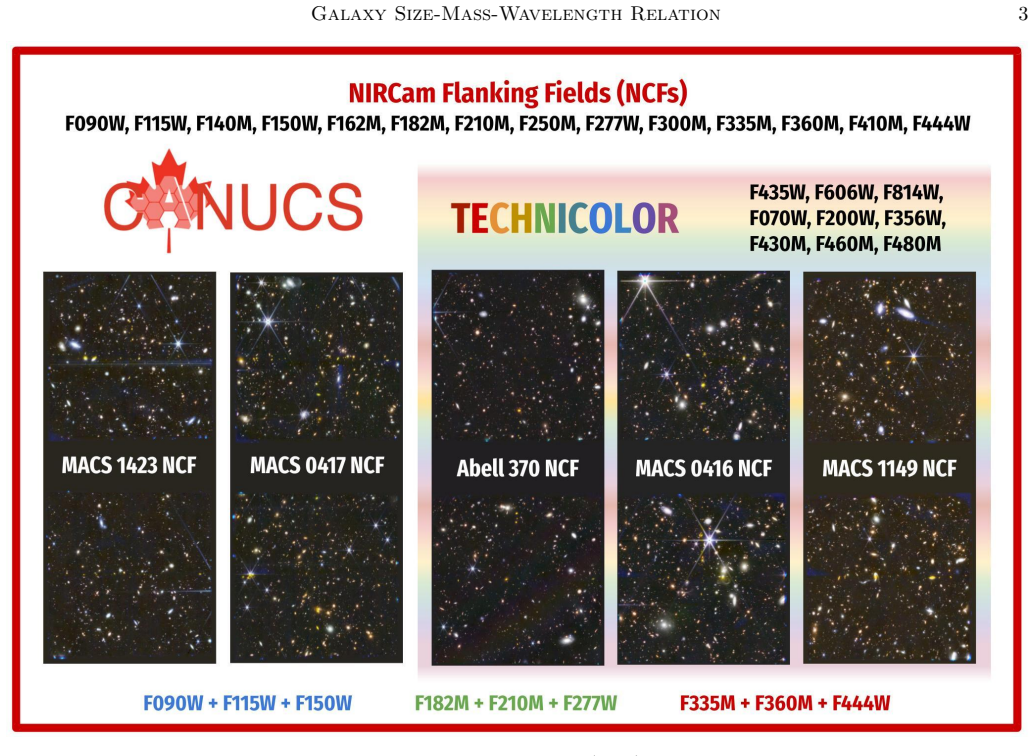
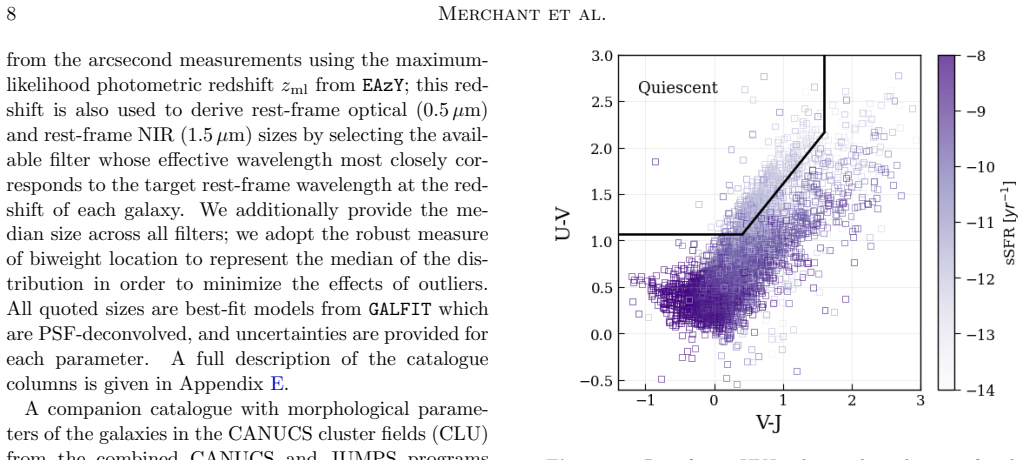
We present James Webb Space Telescope (JWST) results of a morphological study of galaxies in the CAnadian NIRISS Unbiased Cluster (CANUCS) and Technicolor surveys, observed in 19 medium- and broadband NIRCam filters in five CANUCS NIRCam Flanking Fields with rest-frame wavelength coverage between $\sim 0.2 - 3.2\mu m$. Using GALFIT, we measure the morphological parameters of $\sim$ 4,100 star-forming galaxies at $0.6 < z \leq 4$ with stellar masses of $8.5 < \text{log}(M_*/M_\odot) \leq 11.5$. This enables us to concurrently examine how galaxy size varies as a function of stellar mass, redshift, and rest-frame wavelength to provide a novel parametrization of the galaxy size-wavelength relation. Additionally, we analyze the evolution of the galaxy size-mass relation in the rest-frame optical and NIR with the introduction of wavelength as a free parameter. We report a gradient in the slope of the size-mass relation with respect to rest-frame wavelength with a critical crossover mass at $\sim 10^{9.5} M_\odot$. We propose this characteristic mass as the stellar mass at which galaxies transition between diffuse and compact morphologies. We concurrently present the data release of morphological measurements of the five CANUCS-Technicolor NIRCam Flanking Fields in which we provide structural parameters for $\sim$ 41,000 galaxies in up to 29 JWST+HST filters.
Editorial analysis
A structured set of objections, weighed in public.
Referee Report
Summary. The paper releases a catalog of galaxy structural parameters measured with GALFIT for ~41,000 galaxies across up to 29 HST+JWST bands in the CANUCS/Technicolor NIRCam Flanking Fields. For a subsample of ~4,100 star-forming galaxies at 0.6 < z ≤ 4 (8.5 < log(M*/M⊙) ≤ 11.5), it parametrizes the size-mass relation as a function of stellar mass, redshift, and rest-frame wavelength (0.2–3.2 μm), reporting a gradient in the size-mass slope with wavelength and a crossover mass of ~10^9.5 M⊙ interpreted as the transition between diffuse and compact morphologies.
Significance. If the wavelength-dependent size measurements are shown to be free of major systematic biases, the work supplies a new empirical parametrization of the size-wavelength relation and identifies a characteristic mass scale potentially linked to morphological transitions. The public release of multi-band structural parameters for a large sample is a concrete contribution to the community.
major comments (2)
- [GALFIT structural-parameter measurements (methods section describing per-band fits)] The central result (wavelength gradient in size-mass slope and crossover mass at ~10^9.5 M⊙) rests on the assumption that independent single-component GALFIT fits performed separately in each of the 19 NIRCam bands return effective radii that faithfully trace intrinsic galaxy size at that rest-frame wavelength. No joint multi-band fitting, explicit color-gradient modeling, or quantitative tests for dust attenuation or stellar-population effects are described; such biases are expected to be stronger below the reported crossover mass and could artificially steepen the reported slope gradient.
- [Results on size-mass relation and wavelength dependence] The manuscript provides no quantitative assessment of sample completeness as a function of mass and wavelength, GALFIT convergence criteria, or robustness checks (e.g., comparison of r_e across adjacent bands or against mock galaxies with known gradients). These omissions make it impossible to evaluate whether the reported slope gradient and crossover mass are robust or driven by selection or fitting artifacts.
minor comments (2)
- [Abstract] The abstract states the main result but omits any mention of uncertainties on the crossover mass, sample size per redshift bin, or fitting-quality metrics.
- [Data Release] Clarify in the data-release section how many of the ~41,000 galaxies have converged fits in all 29 bands versus subsets, and provide a table summarizing the wavelength coverage per object.
Simulated Author's Rebuttal
We thank the referee for their constructive and detailed comments. We address each major comment below, agreeing that additional validation is needed, and will incorporate the suggested improvements in the revised manuscript.
read point-by-point responses
-
Referee: [GALFIT structural-parameter measurements (methods section describing per-band fits)] The central result (wavelength gradient in size-mass slope and crossover mass at ~10^9.5 M⊙) rests on the assumption that independent single-component GALFIT fits performed separately in each of the 19 NIRCam bands return effective radii that faithfully trace intrinsic galaxy size at that rest-frame wavelength. No joint multi-band fitting, explicit color-gradient modeling, or quantitative tests for dust attenuation or stellar-population effects are described; such biases are expected to be stronger below the reported crossover mass and could artificially steepen the reported slope gradient.
Authors: We agree that the manuscript relies on independent per-band GALFIT fits without joint multi-band modeling or explicit tests for dust/stellar-population biases, which is a limitation. While such fits follow standard practice for wavelength-dependent studies, we will add a new methods subsection discussing these potential systematics and include quantitative tests (adjacent-band r_e comparisons and mock galaxies with known gradients) to assess their impact, particularly below the crossover mass. This will better support the interpretation of the slope gradient. revision: yes
-
Referee: [Results on size-mass relation and wavelength dependence] The manuscript provides no quantitative assessment of sample completeness as a function of mass and wavelength, GALFIT convergence criteria, or robustness checks (e.g., comparison of r_e across adjacent bands or against mock galaxies with known gradients). These omissions make it impossible to evaluate whether the reported slope gradient and crossover mass are robust or driven by selection or fitting artifacts.
Authors: We acknowledge that the current manuscript omits explicit quantitative assessments of completeness (vs. mass/wavelength), GALFIT convergence statistics, and robustness checks. In revision we will expand the results and methods sections to include these: completeness simulations, convergence criteria, band-to-band r_e comparisons, and mock-galaxy tests. These additions will enable readers to evaluate the robustness of the size-mass parametrization and crossover mass. revision: yes
Circularity Check
No circularity: empirical catalog trends from independent multi-band fits
full rationale
The paper extracts structural parameters via independent GALFIT fits per band on observed imaging, then reports measured trends in the size-mass slope versus rest-frame wavelength and a crossover mass scale. No equations, fitted parameters, or self-citations are shown that reduce the reported gradient or 10^9.5 M_⊙ crossover back to the input data by construction. The derivation chain consists of direct observational measurements and statistical trends on the catalog; it remains self-contained against external benchmarks with no load-bearing self-definition or renaming of known results.
Axiom & Free-Parameter Ledger
free parameters (1)
- crossover mass =
~10^{9.5} M_⊙
axioms (1)
- domain assumption GALFIT provides reliable structural parameters across a wide rest-frame wavelength range
invented entities (1)
-
characteristic mass as morphological transition point
no independent evidence
Reference graph
Works this paper leans on
-
[1]
Bahcall, Neta A. , title =. , year = 1988, month = jan, volume =. doi:10.1146/annurev.aa.26.090188.003215 , adsurl =
-
[2]
Using the Evolution of Clusters to Constrain Omega
Cluster evolution as a diagnostic for Omega. , keywords =. doi:10.1093/mnras/282.1.263 , archivePrefix =. astro-ph/9601088 , primaryClass =
work page internal anchor Pith review Pith/arXiv arXiv doi:10.1093/mnras/282.1.263
-
[3]
, keywords =
X-ray clusters in open universes. , keywords =
-
[4]
, year = 1994, month = feb, volume =
X-Ray Clusters and Gravitational Instability Theories. , year = 1994, month = feb, volume =. doi:10.1086/173740 , adsurl =
-
[5]
Ana Laura Serra and Antonaldo Diaferio , title =. 2013 , month =. doi:10.1088/0004-637X/768/2/116 , url =
-
[6]
Johansson and Jeremiah P
Thorsten Naab and Peter H. Johansson and Jeremiah P. Ostriker , title =. The Astrophysical Journal Letters , volume =. 2009 , month =
2009
-
[7]
H. J. Mo and Shude Mao and Simon D M. White , title =. Monthly Notices of the Royal Astronomical Society , volume =. 1998 , month =
1998
-
[8]
Kravtsov , title =
Andrey V. Kravtsov , title =. The Astrophysical Journal Letters , volume =. 2013 , month =
2013
-
[9]
Primack and Sandra M
Fangzhou Jiang and Avishai Dekel and Omer Kneller and Sharon Lapiner and Daniel Ceverino and Joel R. Primack and Sandra M. Faber and others , title =. Monthly Notices of the Royal Astronomical Society , volume =. 2019 , month =
2019
-
[10]
The Assembly of Milky-Way-like Galaxies Since z 2.5 , journal =
Pieter G. The Assembly of Milky-Way-like Galaxies Since z 2.5 , journal =. 2013 , month =
2013
-
[11]
Boquien and V
Guang Yang and M. Boquien and V. Buat and D. Burgarella and L. Ciesla and F. Suras and M. Stalevski and W. N. Brandt and Casey Papovich , title =. Monthly Notices of the Royal Astronomical Society , volume =. 2019 , month =
2019
-
[12]
and Springel, Volker and Vogelsberger, Mark and Genel, Shy and Torrey, Paul and Nelson, Dylan and Sijacki, Debora and Hernquist, Lars , title =
Sparre, Martin and Hayward, Christopher C. and Springel, Volker and Vogelsberger, Mark and Genel, Shy and Torrey, Paul and Nelson, Dylan and Sijacki, Debora and Hernquist, Lars , title =. Monthly Notices of the Royal Astronomical Society , volume =. 2015 , month =
2015
-
[14]
Joshua S. Speagle and Charles L. Steinhardt and Peter L. Capak and John D. Silverman , title =. The Astrophysical Journal Supplement Series , year =. doi:10.1088/0067-0049/214/2/15 , eprint =
-
[16]
STRUCTURAL PARAMETERS OF GALAXIES IN CANDELS , journal =
Arjen van der Wel and. STRUCTURAL PARAMETERS OF GALAXIES IN CANDELS , journal =. 2012 , month =. doi:10.1088/0067-0049/203/2/24 , url =
-
[17]
Evolution of the Sérsic index up to z = 2.5 from JWST and HST , DOI= "10.1051/0004-6361/202452919", url= "https://doi.org/10.1051/0004-6361/202452919", journal =
-
[18]
Conselice, Christopher J. , title =. Monthly Notices of the Royal Astronomical Society , volume =. 2006 , month =. doi:10.1111/j.1365-2966.2006.11114.x , url =
-
[19]
Restframe Optical Spectroscopic Classifications for Submillimeter Galaxies
Rest-Frame Optical Spectroscopic Classifications for Submillimeter Galaxies. , keywords =. doi:10.1086/507985 , archivePrefix =. astro-ph/0607580 , primaryClass =
work page internal anchor Pith review Pith/arXiv arXiv doi:10.1086/507985
-
[21]
and Doyon, René and Albert, Loic and Brammer, Gabriel B
Willott, Chris J. and Doyon, René and Albert, Loic and Brammer, Gabriel B. and Dixon, William V. and Muzic, Koraljka and Ravindranath, Swara and Scholz, Aleks and Abraham, Roberto and Artigau, Étienne and Bradač, Maruša and Goudfrooij, Paul and Hutchings, John B. and Iyer, Kartheik G. and Jayawardhana, Ray and LaMassa, Stephanie and Martis, Nicholas and M...
-
[25]
doi:10.5479/ADS/bib/2012ivoa.rept.1015R , adsurl =
SVO Filter Profile Service Version 1.0. doi:10.5479/ADS/bib/2012ivoa.rept.1015R , adsurl =
-
[27]
Proceedings of the 9th Python in Science Conference , year =
Statsmodels: Econometric and Statistical Modeling with Python , author =. Proceedings of the 9th Python in Science Conference , year =
-
[29]
2024 , eprint=
Size Growth on Short Timescales of Star-Forming Galaxies: Insights from Size Variation with Rest-Frame Wavelength with JADES , author=. 2024 , eprint=
2024
-
[30]
Arjen van der Wel and Franx, M. and van Dokkum, P. G. and Skelton, R. E. and Momcheva, I. G. and Whitaker, K. E. and Brammer, G. B. and Bell, E. F. and Rix, H.-W. and Wuyts, S. and Ferguson, H. C. and Holden, B. P. and Barro, G. and Koekemoer, A. M. and Chang, Yu-Yen and McGrath, E. J. and Häussler, B. and Dekel, A. and Behroozi, P. and Fumagalli, M. and ...
-
[32]
and Kriek, Mariska and Price, Sedona H
Suess, Katherine A. and Kriek, Mariska and Price, Sedona H. and Barro, Guillermo , title =. 2019 , month =. doi:10.3847/2041-8213/ab4db3 , url =
-
[34]
and Bezanson, Rachel and Nelson, Erica J
Suess, Katherine A. and Bezanson, Rachel and Nelson, Erica J. and Setton, David J. and Price, Sedona H. and Dokkum, Pieter van and Brammer, Gabriel and Labbé, Ivo and Leja, Joel and Miller, Tim B. and Robertson, Brant and Wel, Arjen van der and Weaver, John R. and Whitaker, Katherine E. , title =. 2022 , month =. doi:10.3847/2041-8213/ac8e06 , url =
-
[35]
Stellar Half-mass Radii of 0.5 z < 2.3 Galaxies: Comparison with JWST/NIRCam Half-light Radii
Arjen van der Wel and. Stellar Half-mass Radii of 0.5 z < 2.3 Galaxies: Comparison with JWST/NIRCam Half-light Radii. , keywords =. doi:10.3847/1538-4357/ad02ee , archivePrefix =. 2307.03264 , primaryClass =
-
[36]
Revisiting the Integrated Star Formation Law
Kennicutt, Jr and Reyes, Mithi , year =. Revisiting the Integrated Star Formation Law. II. Starbursts and the Combined Global Schmidt Law , doi =
-
[38]
RELICS: Reionization Lensing Cluster Survey. , keywords =. doi:10.3847/1538-4357/ab412b , archivePrefix =. 1903.02002 , primaryClass =
-
[39]
Postman, Marc and Coe, Dan and Ben. Astrophys. Journal, Suppl. Ser. , keywords =. doi:10.1088/0067-0049/199/2/25 , file =
-
[41]
Monthly Notices of the Royal Astronomical Society , volume =
Roper, William J and Lovell, Christopher C and Vijayan, Aswin P and Irodotou, Dimitrios and Kuusisto, Jussi K and Matharu, Jasleen and Seeyave, Louise T C and Thomas, Peter A and Wilkins, Stephen M , title =. Monthly Notices of the Royal Astronomical Society , volume =. 2023 , month =. doi:10.1093/mnras/stad2746 , url =
-
[42]
Dutton, Aaron A. and Bosch, Frank C. van den and Faber, Sandra M. and Simard, Luc and Kassin, Susan A. and Koo, David C. and Bundy, Kevin and Huang, Jiasheng and Weiner, Benjamin J. and Cooper, Michael C. and Newman, Jeffrey A. and Mozena, Mark and Koekemoer, Anton M. , title =. Monthly Notices of the Royal Astronomical Society , volume =. 2011 , month =....
-
[43]
Cibinel, A. and Floc’h, E. Le and Perret, V. and Bournaud, F. and Daddi, E. and Pannella, M. and Elbaz, D. and Amram, P. and Duc, P.-A. , title =. 2015 , month =. doi:10.1088/0004-637X/805/2/181 , url =
-
[44]
and Genzel, Reinhard and Guo, Yicheng and Barro, Guillermo and Bell, Eric F
Wuyts, Stijn and Förster Schreiber, Natascha M. and Genzel, Reinhard and Guo, Yicheng and Barro, Guillermo and Bell, Eric F. and Dekel, Avishai and Faber, Sandra M. and Ferguson, Henry C. and Giavalisco, Mauro and Grogin, Norman A. and Hathi, Nimish P. and Huang, Kuang-Han and Kocevski, Dale D. and Koekemoer, Anton M. and Koo, David C. and Lotz, Jennifer ...
-
[45]
Marian, V. and Ziegler, B. and. Color gradients reflect an inside-out growth in early-type galaxies of the cluster MACS J1206.2-0847 , DOI= "10.1051/0004-6361/201832750", url= "https://doi.org/10.1051/0004-6361/201832750", journal =
-
[46]
Häußler, Boris and Vika, Marina and Bamford, Steven P. and Johnston, Evelyn J. and Brough, Sarah and Casura, Sarah and Holwerda, Benne W. and Kelvin, Lee S. and Popescu, Cristina , year=. Galapagos-2/Galfitm/Gama – Multi-wavelength measurement of galaxy structure: Separating the properties of spheroid and disk components in modern surveys , volume=. doi:1...
-
[47]
MegaMorph - multiwavelength measurement of galaxy structure. S \'e rsic profile fits to galaxies near and far. , keywords =. doi:10.1093/mnras/stt1320 , archivePrefix =. 1307.4996 , primaryClass =
work page internal anchor Pith review Pith/arXiv arXiv doi:10.1093/mnras/stt1320
-
[49]
, file =
Kron, Richard G. , file =
-
[50]
Brammer, Gabriel B and
-
[51]
Astrophys
Larson, Rebecca L and Hutchison, Taylor A and Bagley, Micaela and Finkelstein, Steven L and Yung, L Y Aaron and Morales, Alexa M and Wilkins, Stephen M , doi =. Astrophys. J. , keywords =
-
[53]
J. Krywult and. The VIMOS Public Extragalactic Redshift Survey (VIPERS)⋆⋆⋆ - The coevolution of galaxy morphology and colour to z 1 , DOI= "10.1051/0004-6361/201628953", url= "https://doi.org/10.1051/0004-6361/201628953", journal =
-
[54]
2024 , eprint=
Two Distinct Classes of Quiescent Galaxies at Cosmic Noon Revealed by JWST PRIMER and UNCOVER , author=. 2024 , eprint=
2024
-
[55]
Signal, noise and detection , url=
Hainaut, Olivier , year=. Signal, noise and detection , url=. Signal and Noises , publisher=
-
[56]
Constraining the Low-Mass Slope of the Star Formation Sequence at 0.5<z<2.5 , volume =
Whitaker, Katherine and Franx, Marijn and Leja, Joel and Dokkum, Pieter and Henry, Alaina and Skelton, Rosalind and Fumagalli, Marcus and Momcheva, Ivelina and Brammer, Gabriel and Labbe, Ivo and Nelson, Erica and Rigby, Jane , year =. Constraining the Low-Mass Slope of the Star Formation Sequence at 0.5<z<2.5 , volume =. The Astrophysical Journal , doi =
-
[57]
The Herschel view of the dominant mode of galaxy growth from z=4 to the present day
The Herschel view of the dominant mode of galaxy growth from z = 4 to the present day. , keywords =. doi:10.1051/0004-6361/201425017 , archivePrefix =. 1409.5433 , primaryClass =
work page internal anchor Pith review Pith/arXiv arXiv doi:10.1051/0004-6361/201425017
-
[58]
Star Formation at 4 < z < 6 from the Spitzer Large Area Survey with Hyper-Suprime-Cam (SPLASH). , keywords =. doi:10.1088/2041-8205/791/2/L25 , archivePrefix =. 1407.7030 , primaryClass =
-
[59]
Nadolny, Jakub and Michałowski, Michał Jerzy and Rizzo, J. Ricardo and Karska, Agata and Rasmussen, Jesper and Sollerman, Jesper and Hjorth, Jens and Rossi, Andrea and Solar, Martín and Wróblewski, Radosław and Leśniewska, Aleksandra , year=. Main Sequence to Starburst Transitioning Galaxies: Gamma-Ray Burst Hosts at z ∼ 2 , volume=. The Astrophysical Jou...
-
[60]
Lin, Lihwai and Hsieh, Bau-Ching and Pan, Hsi-An and Rembold, Sandro B. and Sánchez, Sebastián F. and Argudo-Fernández, Maria and Rowlands, Kate and Belfiore, Francesco and Bizyaev, Dmitry and Lacerna, Ivan and Riffel, Rogréio and Rong, Yu and Yuan, Fangting and Drory, Niv and Maiolino, Roberto and Wilcots, Eric , year=. SDSS-IV MaNGA: Inside-out versus O...
-
[61]
Peng, Y. and Maiolino, R. and Cochrane, R. , date =. Strangulation as the primary mechanism for shutting down star formation in galaxies , url =. Nature , number =. 2015 , bdsk-url-1 =. doi:10.1038/nature14439 , id =
-
[62]
Monthly Notices of the Royal Astronomical Society , volume =
Simmonds, C and Tacchella, S and Hainline, K and Johnson, B D and McClymont, W and Robertson, B and Saxena, A and Sun, F and Witten, C and Baker, W M and Bhatawdekar, R and Boyett, K and Bunker, A J and Charlot, S and Curtis-Lake, E and Egami, E and Eisenstein, D J and Hausen, R and Maiolino, R and Maseda, M V and Scholtz, J and Williams, C C and Willott,...
-
[63]
Monthly Notices of the Royal Astronomical Society , volume =
Trussler, James and Maiolino, Roberto and Maraston, Claudia and Peng, Yingjie and Thomas, Daniel and Goddard, Daniel and Lian, Jianhui , title =. Monthly Notices of the Royal Astronomical Society , volume =. 2019 , month =. doi:10.1093/mnras/stz3286 , url =
-
[64]
Mehta, Vihang and Teplitz, Harry I. and Scarlata, Claudia and Wang, Xin and Alavi, Anahita and Colbert, James and Rafelski, Marc and Grogin, Norman and Koekemoer, Anton and Prichard, Laura and Windhorst, Rogier and Barber, Justin M. and Conselice, Christopher J. and Dai, Y. Sophia and Gardner, Jonathan P. and Gawiser, Eric and Guo, Yicheng and Hathi, Nimi...
-
[67]
The host galaxies of active galactic nuclei. , keywords =. doi:10.1111/j.1365-2966.2003.07154.x , archivePrefix =. astro-ph/0304239 , primaryClass =
-
[68]
and Häußler, Boris and Vika, Marina and Rojas, Alex and Agius, Nicola K
Vulcani, Benedetta and Bamford, Steven P. and Häußler, Boris and Vika, Marina and Rojas, Alex and Agius, Nicola K. and Baldry, Ivan and Bauer, Amanda E. and Brown, Michael J. I. and Driver, Simon and Graham, Alister W. and Kelvin, Lee S. and Liske, Jochen and Loveday, Jon and Popescu, Cristina C. and Robotham, Aaron S. G. and Tuffs, Richard J. , year=. Ga...
-
[73]
Ribeiro, B. and Le Fèvre, O. and Tasca, L. A. M. and Lemaux, B. C. and Cassata, P. and Garilli, B. and Maccagni, D. and Zamorani, G. and Zucca, E. and Amorín, R. and Bardelli, S. and Fontana, A. and Giavalisco, M. and Hathi, N. P. and Koekemoer, A. and Pforr, J. and Tresse, L. and Dunlop, J. , year=. Size evolution of star-forming galaxies with 2 <z<...
-
[74]
Chen, Xinkai and Lin, Zesen and Kong, Xu and Liang, Zhixiong and Chen, Guangwen and Zhang, Hong-Xin , title =. 2022 , month =. doi:10.3847/1538-4357/ac75b4 , url =
-
[75]
Near-infrared counterparts and multi-wavelength morphology
Sub-millimetre galaxies with Webb. Near-infrared counterparts and multi-wavelength morphology. , keywords =. doi:10.1051/0004-6361/202346531 , archivePrefix =. 2303.17246 , primaryClass =
-
[76]
The Identification of a Dusty Multiarm Spiral Galaxy at z = 3.06 with JWST and ALMA. , keywords =. doi:10.3847/2041-8213/aca652 , archivePrefix =. 2208.08473 , primaryClass =
-
[77]
Cloning Dropouts: Implications for Galaxy Evolution at High Redshift
Bouwens, Rychard and Broadhurst, Tom and Illingworth, Garth , year=. “Cloning Dropouts: Implications for Galaxy Evolution at High Redshift” (ApJ, 593, 640 [2003]) , volume=. The Astrophysical Journal , publisher=. doi:10.1086/379229 , number=
doi:10.1086/379229 2003
-
[80]
Franx, Marijn and van Dokkum, Pieter G. and Schreiber, Natascha M. Förster and Wuyts, Stijn and Labbé, Ivo and Toft, Sune , year=. Structure and Star Formation in Galaxies out toz= 3: Evidence for Surface Density Dependent Evolution and Upsizing , volume=. The Astrophysical Journal , publisher=. doi:10.1086/592431 , number=
-
[82]
Paspaliaris, E.-D. and Xilouris, E. M. and Nersesian, A. and Bianchi, S. and Georgantopoulos, I. and Masoura, V. A. and Magdis, G. E. and Plionis, M. , title =. doi:10.1051/0004-6361/202244796
-
[83]
Passively Evolving Early-type Galaxies at 1.4<z<2.5 in the Hubble Ultra Deep Field
Passively Evolving Early-Type Galaxies at 1.4 < -0.5ex z < -0.5ex 2.5 in the Hubble Ultra Deep Field. , keywords =. doi:10.1086/430104 , archivePrefix =. astro-ph/0503102 , primaryClass =
work page internal anchor Pith review Pith/arXiv arXiv doi:10.1086/430104
-
[84]
Confirmation of the Remarkable Compactness of Massive Quiescent Galaxies at z -0.5ex 2.3: Early-Type Galaxies Did not Form in a Simple Monolithic Collapse. , keywords =. doi:10.1086/587874 , archivePrefix =. 0802.4094 , primaryClass =
work page internal anchor Pith review Pith/arXiv arXiv doi:10.1086/587874
-
[85]
Colour Gradients In Galaxies | COSMOS , publisher=
Colour gradients in galaxies: Cosmos , url=. Colour Gradients In Galaxies | COSMOS , publisher=
-
[86]
and Ostlie, Dale A
Carroll, Bradley W. and Ostlie, Dale A. , biburl =
-
[87]
, keywords =
A new method of determining distances to galaxies. , keywords =
-
[88]
The Origin of the Mass-Metallicity Relation: Insights from 53,000 Star-forming Galaxies in the Sloan Digital Sky Survey. , keywords =. doi:10.1086/423264 , archivePrefix =. astro-ph/0405537 , primaryClass =
-
[89]
The Global Schmidt Law in Star-forming Galaxies. , keywords =. doi:10.1086/305588 , archivePrefix =. astro-ph/9712213 , primaryClass =
-
[90]
Annales d'Astrophysique , year = 1948, month = jan, volume =
Recherches sur les Nebuleuses Extragalactiques. Annales d'Astrophysique , year = 1948, month = jan, volume =
1948
-
[91]
, year = 1976, month = nov, volume =
The structure of elliptical and cD galaxies. , year = 1976, month = nov, volume =. doi:10.1086/154769 , adsurl =
-
[92]
, keywords =
Detailed surface photometry of 36 E-SO galaxies. , keywords =
-
[93]
The structure of star clusters. III. Some simple dynamical models. , year = 1966, month = feb, volume =. doi:10.1086/109857 , adsurl =
-
[95]
Galaxy And Mass Assembly (GAMA): Structural Investigation of Galaxies via Model Analysis. , keywords =. doi:10.1111/j.1365-2966.2012.20355.x , archivePrefix =. 1112.1956 , primaryClass =
-
[96]
Liske, J. and Baldry, I. K. and Driver, S. P. and Tuffs, R. J. and Alpaslan, M. and Andrae, E. and Brough, S. and Cluver, M. E. and Grootes, M. W. and Gunawardhana, M. L. P. and Kelvin, L. S. and Loveday, J. and Robotham, A. S. G. and Taylor, E. N. and Bamford, S. P. and Bland-Hawthorn, J. and Brown, M. J. I. and Drinkwater, M. J. and Hopkins, A. M. and M...
-
[97]
Galaxy and Mass Assembly (GAMA): survey diagnostics and core data release. , keywords =. doi:10.1111/j.1365-2966.2010.18188.x , archivePrefix =. 1009.0614 , primaryClass =
-
[98]
, year = 1994, month = jan, volume =
The variation of the scalelengths of galaxies at different wavelengths. , year = 1994, month = jan, volume =. doi:10.1093/mnras/266.2.511 , adsurl =
-
[99]
La Barbera, F. and Busarello, G. and Merluzzi, P. and Massarotti, M. and Capaccioli, M. , title =. 2002 , month =. doi:10.1086/340021 , url =
-
[100]
Ward, Ethan and de la Vega, Alexander and Mobasher, Bahram and McGrath, Elizabeth J. and Iyer, Kartheik G. and Calabrò, Antonello and Costantin, Luca and Dickinson, Mark and Holwerda, Benne W. and Huertas-Company, Marc and Hirschmann, Michaela and Lucas, Ray A. and Pandya, Viraj and Wilkins, Stephen M. and Yung, L. Y. Aaron and Arrabal Haro, Pablo and Bag...
-
[101]
and Rudnick, Gregory and Barden, Marco and Franx, Marijn and Rix, Hans-Walter and Caldwell, J
Trujillo, Ignacio and Förster Schreiber, Natascha M. and Rudnick, Gregory and Barden, Marco and Franx, Marijn and Rix, Hans-Walter and Caldwell, J. A. R. and McIntosh, Daniel H. and Toft, Sune and Häussler, Boris and Zirm, Andrew and van Dokkum, Pieter G. and Labbé, Ivo and Moorwood, Alan and Röttgering, Huub and van der Wel, Arjen and van der Werf, Paul ...
-
[102]
Oesch, P. A. and Bouwens, R. J. and Carollo, C. M. and Illingworth, G. D. and Trenti, M. and Stiavelli, M. and Magee, D. and Labbé, I. and Franx, M. , title =. 2009 , month =. doi:10.1088/2041-8205/709/1/L21 , url =
-
[104]
2025 , eprint=
CANUCS/Technicolor Data Release 1: Imaging, Photometry, Slit Spectroscopy, and Stellar Population Parameters , author=. 2025 , eprint=
2025
-
[106]
and Haberland, Matt and Reddy, Tyler and Cournapeau, David and Burovski, Evgeni and Peterson, Pearu and Weckesser, Warren and Bright, Jonathan and
Virtanen, Pauli and Gommers, Ralf and Oliphant, Travis E. and Haberland, Matt and Reddy, Tyler and Cournapeau, David and Burovski, Evgeni and Peterson, Pearu and Weckesser, Warren and Bright, Jonathan and. Nature Methods , year =
discussion (0)
Sign in with ORCID, Apple, or X to comment. Anyone can read and Pith papers without signing in.