REVIEW 5 major objections 6 minor 3 references
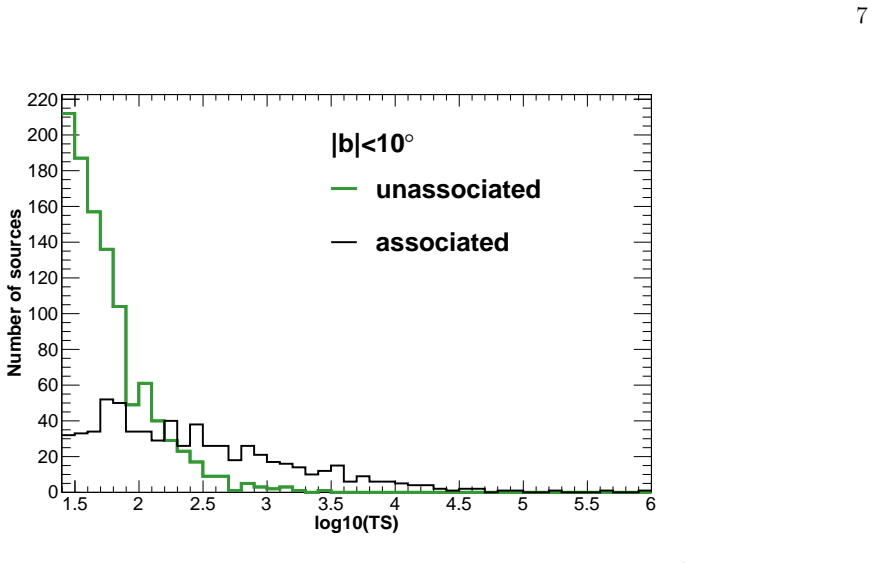
About 53% of unassociated Fermi-LAT sources near the Galactic plane form a population whose spectra match no known gamma-ray emitter class.
Reviewed by Pith at T0; open to challenge. T0 means a machine referee read the full paper against a public rubric. the ladder, T0–T4 →
T0 review · deepseek-v4-flash
2026-08-02 11:29 UTC pith:MA3AQFGD
load-bearing objection A thorough, honest Fermi collaboration paper; the descriptive SGU phenomenon is solid, but the quantitative ML fraction and clump-width claims are model-dependent and should not be taken at face value. the 5 major comments →
Exploring the nature of Galactic unassociated sources detected by the Fermi-LAT
The pith
A machine-rendered reading of the paper's core claim, the machinery that carries it, and where it could break.
Core claim
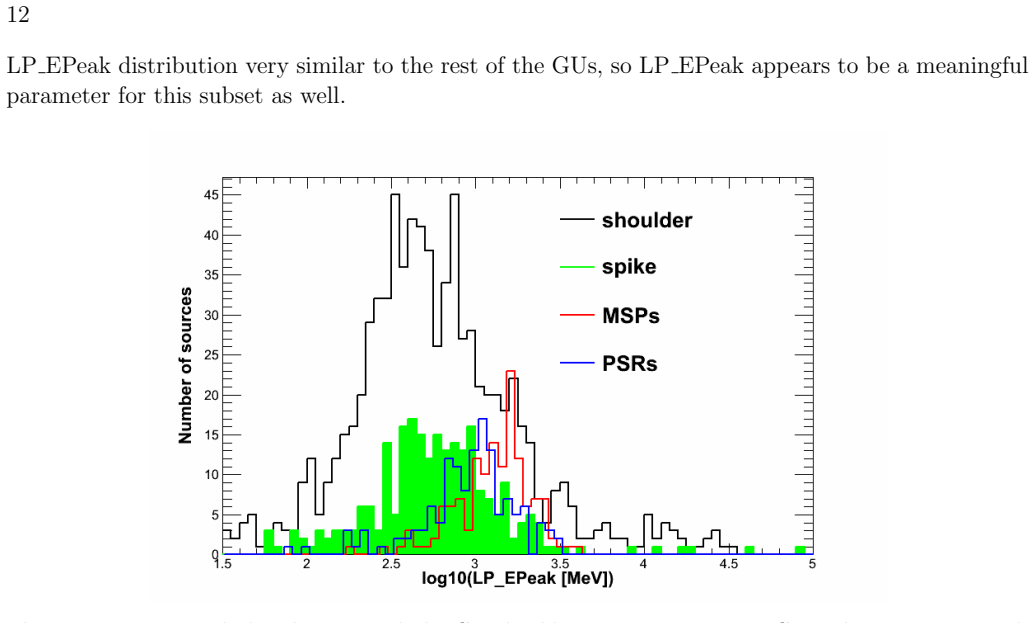
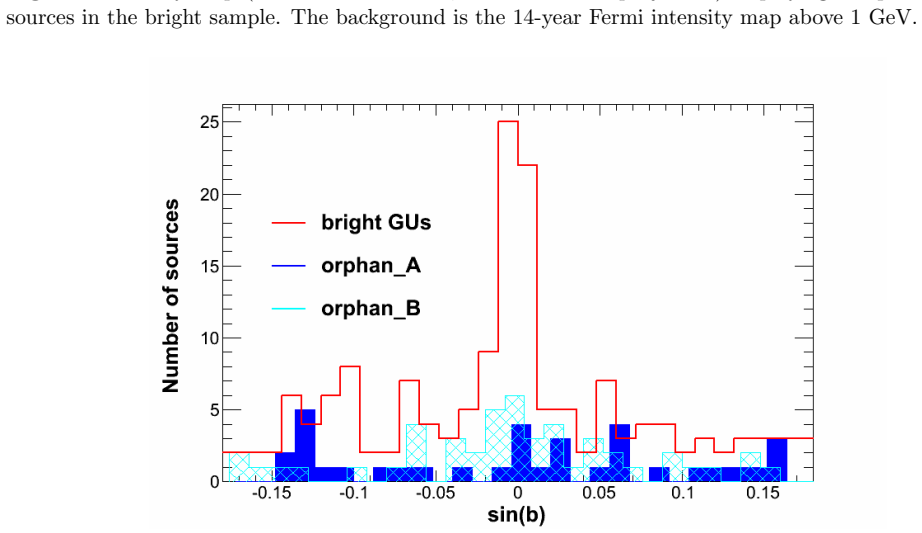
The paper argues that the majority of the 1129 unassociated sources within 10 degrees of the Galactic plane—about 623 of them—form a population (SGU-like) with LogParabola spectra peaking near 500 MeV and curvature parameter beta near 0.3, placing them between FSRQs and pulsars/blazars in spectral parameter space. This population splits into a narrow 'spike' toward |b|<1 degree and a broader 'shoulder' extending to 10 degrees, and its members cluster along the plane. The paper finds that known classes account for only about 30% of the GUs; star-forming regions contribute at most 10%; and for the spike, Monte Carlo simulations show that mismodeled diffuse emission in the form of ~0.1-degree c
What carries the argument
The load-bearing tool is a flux-dependent prior-shift machine-learning model (Appendix A). It assumes unassociated sources share the spectral distributions of associated sources in each known class, then fits the leftover excess as a new Gaussian component in the space of LogParabola peak energy (LP EPeak) and curvature (LP beta). That component—center LP EPeak ~500 MeV, beta ~0.3—is the 'SGU-like' class. A second mechanism is Monte Carlo simulation of point-like and Gaussian-extended sources with the interstellar emission model's spectrum, which shows that 0.1-degree clumps, fit as point sources, reproduce the observed curvature and peak energies. The paper also uses extension fitting of br
Load-bearing premise
The classification result hinges on the assumption that faint, hard-to-associate members of known source classes have the same spectral distributions as the bright associated sources used for training; if low-flux pulsars or FSRQs look different in curvature and peak energy, the 'SGU-like' component could be a statistical artifact rather than a new class.
What would settle it
Allow small-scale (0.1-degree) clumps in the interstellar emission model to vary freely during the construction of the next Fermi catalog; if the spike SGUs largely disappear without degrading fit quality, the new-class interpretation is falsified, while if they persist and remain point-like at 0.05-degree resolution, the diffuse-clump explanation is falsified.
If this is right
- The 4FGL catalog contains hundreds of low-latitude sources that are not pulsars or blazars; class-based population studies of the inner Galaxy must treat them as a separate component.
- If the diffuse-clump interpretation is right for the spike, the next interstellar emission model should absorb most of those sources, shrinking the unassociated fraction and changing derived source-count slopes.
- If the SGU-like class is physically real, the 83 bright 'orphan' sources become the best targets for deep multiwavelength follow-up and pulsation searches.
- Star-forming regions are a real but minor contributor: at most about 10% of the unassociated population, concentrated in the spike.
- A future telescope with better point-spread function in the 0.1–1 GeV range would directly test the predicted 0.1-degree spatial scale.
Where Pith is reading between the lines
- Applying the same prior-shift Gaussian decomposition to unassociated sources at |b|>10 degrees would test whether a soft, curved excess exists off the plane; if it does, a Galactic-diffuse origin is harder to sustain.
- The steep log N-log S of the shoulder implies that a modest sensitivity gain should reveal many more SGU-like sources; measuring their growth rate against an improved diffuse model would discriminate artifact from population.
- If the 500 MeV peak reflects truly new emitters, their luminosity at typical 4FGL distances would place them below the pulsar luminosity range, suggesting a low-power class such as compact cosmic-ray illuminated clouds; this is a testable prediction for the orphans.
Editorial analysis
A structured set of objections, weighed in public.
Referee Report
Summary. The paper studies the 1129 Fermi-LAT 4FGL-DR4 sources within |b|<10 deg that lack associations ('GUs'), focusing on the soft, curved subset ('SGUs') whose log-parabola spectra peak near 500 MeV. It documents distinctive spatial and spectral properties, uses a flux-dependent prior-shift machine-learning model with an added Gaussian component to conclude that ~53% of GUs are 'SGU-like' and not attributable to known classes, explores star-forming regions and other new-class candidates, searches for eROSITA counterparts, and tests whether mismodeled diffuse emission could produce such sources. Monte Carlo simulations show that Gaussian clumps with an ad hoc width ~0.1 deg, fit as point sources, can reproduce the SGU spectral parameters; an extension search finds significant extension mostly in bright spike sources. A MOPRA 13CO analysis finds no evidence for 'missing gas'. The paper concludes that the SGU origin remains unresolved: diffuse-emission artifacts are plausible for the spike, less so for the shoulder, and a new class of gamma-ray emitters cannot be excluded.
Significance. If its central quantitative claim is sound, the paper is important: it would mean that more than half of the low-latitude unassociated 4FGL sources form either a new population of gamma-ray emitters or a population of diffuse-model artifacts, with direct consequences for the next Fermi-LAT catalog. The paper's descriptive phenomenology — the low LP EPeak distribution, the spike/shoulder latitude structure, the clusters, and the soft curved spectra — is independently supported by KS tests and is a genuine step forward. The authors are also commendably explicit about limitations: the abstract itself calls the 0.1 deg clump width 'ad hoc', Section 8/Appendix C states that the TS>100 'cannot be mismodeled diffuse' hypothesis is 'not proven', and the discussion acknowledges both scenarios. The public release of classification probabilities and the detailed multiwavelength work on bright GUs increase the paper's value. However, the 53% SGU-like estimate relies on a prior-shift assumption that is not adequately stress-tested, and the simulation route to the SGU spectral properties involves a hand-tuned spatial scale. These issues are load-bearing for the paper's headline claims and requir
major comments (5)
- [Appendix A, Eq. (A3); Section 3; Table 4] The 53% SGU-like fraction rests on the prior-shift identity p_unas(x|k)=p_assoc(x|k), with class-conditional spectral densities fixed from associated sources and only class prevalences allowed to vary with flux. If faint unassociated members of known classes (e.g., low-flux pulsars or FSRQs) have systematically different LP beta/EPeak distributions from their bright associated counterparts, the Gaussian component G(x) will absorb them and be misidentified as a new class. The covariate-shift check in Fig. 22 mitigates but does not settle this, because it uses the same spectral-feature domain and the same transferability problem. Table 4 shows the symptom concretely: in the psr+ row, 175 of 266 covariate-shift pulsar candidates are relabeled SGU-like by the prior-shift model, and the msp+ row shows 176 of 274 similarly relabeled. A decisive test would inject simulated faint pulsars/FSRQs w
- [Section 6.2, Figure 16] The reproduction of SGU spectra by diffuse clumps is not an independent test: the clump width sigma=0.1 deg is introduced ad hoc to make the simulated LP EPeak match the observed one, as the abstract acknowledges. The simulations also match only the mean/peak of the EPeak-beta plane and do not reproduce the full observed spread; the text notes that 'a distribution of widths would be required' but does not fit such a distribution. To make the claim quantitative, the authors should either derive the width distribution from an independent observable or show that a physically motivated clump-size model (from CO/HI/dust structure) predicts the observed EPeak distribution. Without this, the statement that 'the SGU spectra can be reproduced' is a consistency check of a one-parameter toy model, not a falsifiable test of the diffuse-clump origin.
- [Section 3; Appendix A] The paper reports that the expected number of SGU-like sources is within ±100 across several model variants, but it does not give a confidence interval, bootstrap, or profile-likelihood range for the 623 estimate. Given that the count depends on a 7-parameter Gaussian component, four flux-dependent sigmoid priors, and the choice of input features, the quoted 53% needs an explicit uncertainty. Moreover, the boundary between SGU-like and known classes is sensitive to the arbitrary probability threshold used in Table 4 (710 classified sources vs. 623 expected). Please provide a systematic error budget for the headline fraction, including the choice of classes, the treatment of unk sources, and the GMM kernel counts.
- [Section 6.3 and Section 9] The extension analysis is limited to 60 bright sources; 20 show TS_ext>4, and 16 of those are in the |b|<1 deg spike. The paper correctly concludes that the diffuse-clump scenario is not very likely for the shoulder, but this qualification is absent from the abstract's general statement about reproducing SGU spectra. The claim that diffuse clumps can explain 'the SGU spectra' should be explicitly scoped to the spike component, or the shoulder should be demonstrated to be consistent with a broader (non-clump) origin. This is a presentation issue that affects the paper's central narrative.
- [Appendix C and Section 8] The bright-sample investigation assumes that TS>100 sources have probability ≪0.0001 of being spurious, but the appendix itself states that this hypothesis 'is not proven' and that 'there is no known boundary in any parameter space such that sources to one side ... are immune'. Since the 175-source sample is used to draw conclusions about the nature of the whole GU population, the working hypothesis should be explicitly flagged as an untested prior in the main text (not only in an appendix), and the conclusions drawn from the bright sample should be correspondingly hedged. The current Section 8 text presents the sample as 'more likely to be real point sources' without emphasizing the circularity in using the same catalog analysis that is under scrutiny.
minor comments (6)
- [Abstract and Section 3] The abstract says 'the bulk of these sources' exhibit properties not found in known classes, while the quantitative ML result is ~53% of GUs. Consider using 'a substantial fraction' or quoting the 53% with its uncertainty in the abstract to avoid overstatement.
- [Section 2.1] The text describes the spike as having 'a width of about 2 deg' while the two-Gaussian fit gives sigma_sin(b)=0.008 (~0.46 deg). Please clarify whether the 2 deg refers to FWHM, a range in |b|, or something else, and reconcile the numbers.
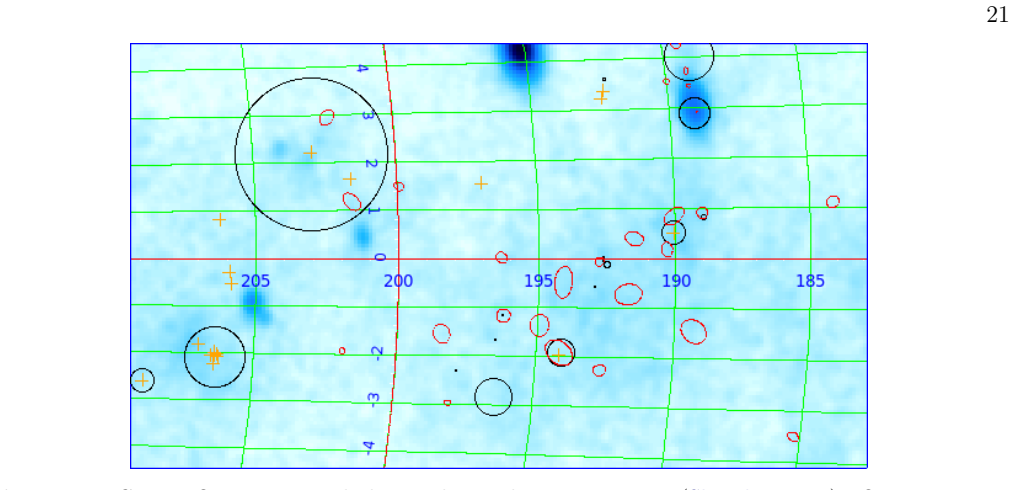
- [Section 2.4] The clusters are said to be 'found by eye and are thus largely arbitrary'. This is transparent, but a quantitative clustering algorithm (e.g., DBSCAN on positional uncertainties) would strengthen the claim of 'notable clusters' and remove the arbitrariness.
- [Section 6.2] In the final simulation, the fake sources are placed at SGU positions with a flux chosen to match median TS. It would be useful to state explicitly how the flux was chosen and whether the resulting TS distribution matches the observed GU TS distribution, not just the median.
- [Section 6.1, Table 2] The reduction in SGU count when freeing IEM components is attributed partly to their lower TS. The paper notes this, but a direct comparison of the TS distribution of removed vs surviving SGUs would make the interpretation crisper.
- [Appendix C] The appendix contains a few informal phrases ('the other way around', 'blank sky regions') and typos ('locii', 'conterpart'). These do not affect the science but should be cleaned up.
Circularity Check
One fitted parameter (clump width) is tuned to reproduce the observed EPeak and then cited as a reproduction; the ML 'SGU-like' component is model-dependent but not definitionally circular, and the paper's central claim has independent support.
specific steps
-
fitted input called prediction
[Section 6.2, simulations of underestimated diffuse emission (Figure 16, middle-right to bottom-left panels)]
"Our first attempt was with σ= 0.2 ◦. ... This definitely goes in the right direction, but a little too far (peak energy is a little too small). We then reduced σ to 0.1 ◦. ... The peak energy increased indeed, and became similar to the average peak energy of GUs."
The Gaussian width σ is the free parameter that controls the simulated peak energy when extended sources are fitted as point sources. The paper first tried σ=0.2°, found EPeak 'a little too small', then tuned σ=0.1° until the simulated EPeak matched the GU average. The later statement that 'the SGU spectral properties (curvature and peak energies) can be recovered reasonably well' (Sec. 9) is thus a report of the tuned input, not an independent prediction. The paper does label the condition ad hoc, and the extension search in Sec. 6.3 offers some independent evidence, so this is partial, not complete, circularity.
full rationale
The paper's strongest central claim—that the SGU population has spectral and spatial properties not found in known classes—rests on direct data comparisons (KS tests on LP EPeak, Figure 6; latitude decomposition into spike/shoulder, Figure 2; cluster analysis) that are independent of the ML model and the simulations. The ML 'SGU-like' component in Eq. (A3) is a Gaussian added to absorb residual differences after the known-class mixture; reporting the fitted component's center (LP EPeak ~500 MeV, beta ~0.3) and membership count (623) is a description of the fit rather than a circular derivation, and the covariate-shift check in Fig. 22, while using a domain chosen near the fitted Gaussian, is computed from a different classifier. The main concrete reduction-to-input is the clump-width tuning in Sec. 6.2: σ=0.1° is selected to make simulated EPeak match the GUs, so the subsequent 'reproduction' is partly forced. The paper is transparent about the ad hoc nature and partially redeems the diffuse-clump scenario with the independent extension search (Sec. 6.3). Self-citations to Malyshev (2024, 2025) provide the ML machinery but the present analysis re-fits the model, so they are not load-bearing. Overall circularity is mild-to-moderate, not a wholesale reduction.
Axiom & Free-Parameter Ledger
free parameters (4)
- SGU-like Gaussian component G(x) =
center ~ log10(EPeak/GeV)=-0.3, LP beta ~0.3 (7 parameters)
- Flux-dependent prior-shift sigmoid parameters (a,b,c,d) per class =
not tabulated
- Clump spatial width sigma =
0.1 deg
- Spike/shoulder boundary |b|=1 deg =
1 deg
axioms (5)
- domain assumption Prior shift assumption p_unas(x|k) = p_assoc(x|k): spectral PDFs of each class are the same for associated and unassociated sources.
- domain assumption The 4FGL-DR4 catalog and its likelihood analysis correctly localize and characterize sources as point-like against the v07 interstellar emission model.
- domain assumption The standard IEM v07 components (CO, HI, IC, DNM, patch) are a valid baseline, so residual clumps can be modeled as an additive Gaussian spatial excess with the IEM spectrum.
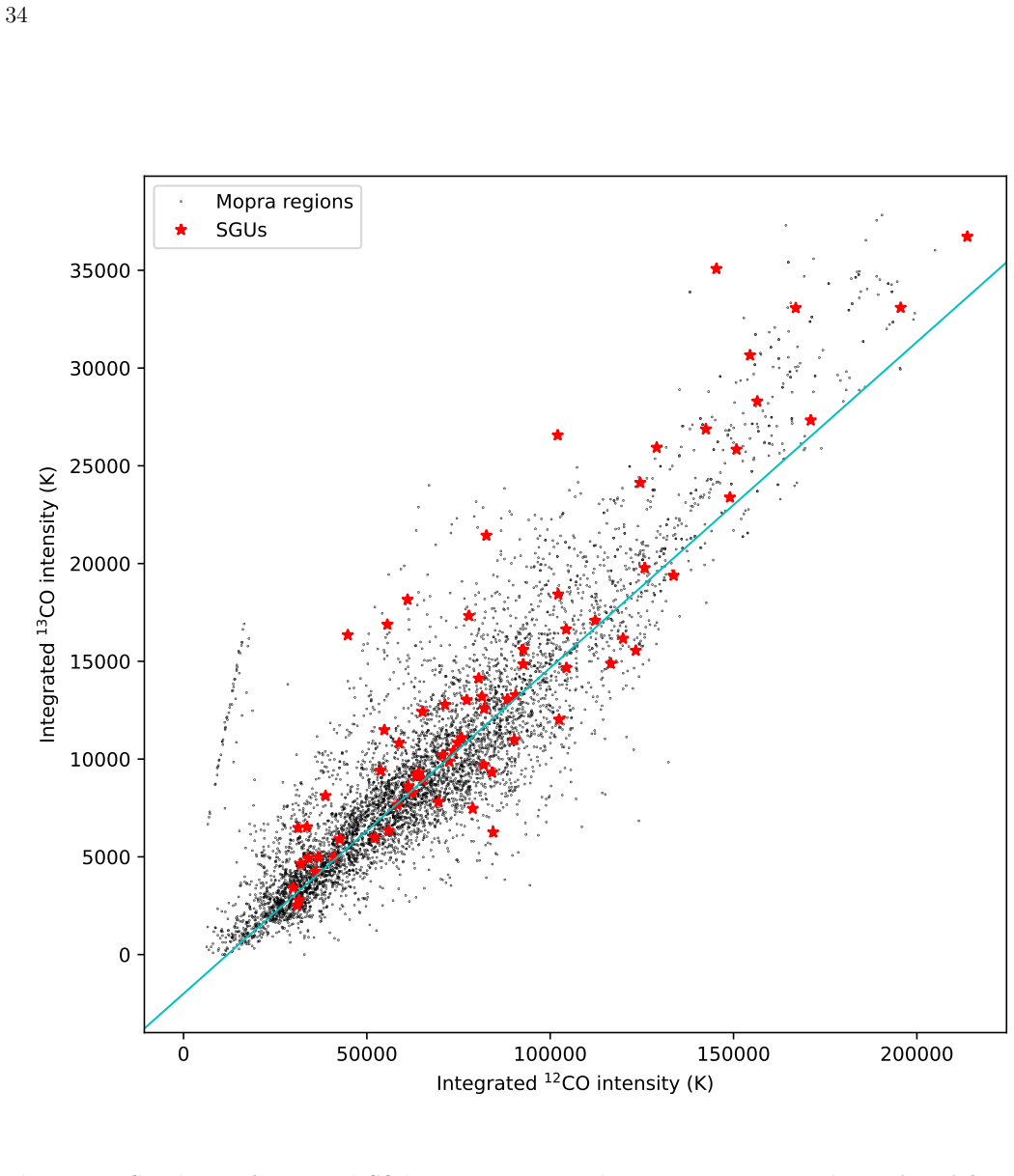
- domain assumption MOPRA 13CO data and the background-region integration method can reveal a preference of SGUs for optically thick gas.
- standard math Gaussian mixture densities and the Bayesian likelihood in Eq. A5 are adequate for density estimation of the four associated classes.
invented entities (2)
-
SGU-like source class (statistical population)
no independent evidence
-
~0.1 deg clumps of underestimated diffuse emission
independent evidence
read the original abstract
We investigate the nature of the unassociated sources detected by the Fermi-LAT close (|b|<10{\deg}) to the Galactic plane, representing 16% of all sources in the 4FGL-DR4 catalog. The bulk of these sources (referred to as soft Galactic unassociated sources, SGUs) exhibit properties not found in known classes of gamma-ray emitters, as confirmed by a machine-learning classification approach. In particular, these properties include a steep, curved spectrum peaking below 1 GeV and a specific Galactic-latitude distribution with both a narrow and a broad component (dubbed the spike and the shoulder, respectively). Some source clusters are highlighted. New plausible source classes are explored, but only star-forming regions are found to account for a significant fraction (at most 10%) of the unassociated population. A thorough search for counterparts to the 175 brightest sources brings out a number of plausible counterparts but does not reveal clues about the nature of the whole population. We investigate the possibility that SGUs originate from mismodeled clumps of diffuse emission. Using Monte Carlo simulations, the SGU spectra can be reproduced in this scenario under an ad hoc condition concerning the clump spatial extension. The possible connection between the SGUs and gas not accounted for by the 12CO tracer is explored using the 13CO MOPRA data but leads to inconclusive results. The origin of SGUs being related to diffuse emission remains plausible. However, a scenario whereby SGUs represent a new class of gamma-ray emitters cannot be fully excluded.
Figures









Reference graph
Works this paper leans on
-
[1]
Abdollahi, S., Acero, F., Acharyya, A., et al. 2024, arXiv e-prints, arXiv:2411.07162, doi: 10.48550/arXiv.2411.07162 Abdollahi, S., Acero, F., Ackermann, M., et al. 2020, ApJS, 247, 33, doi: 10.3847/1538-4365/ab6bcb —. 2022a, ApJ, 933, 204, doi: 10.3847/1538-4357/ac704f Abdollahi, S., Acero, F., Baldini, L., et al. 2022b, ApJS, 260, 53, doi: 10.3847/1538...
-
[5]
orphan A
Gamma-ray properties of the bright GU sample Source Name‡ L B TS ⋄ PL Indexσ Curv LP beta† LP EPeak† Var. Flags △ ML class (◦) ( ◦) (MeV) Index ⋆ J0034.6+6438⋆ 121.13 1.83 114 2.45±0.08 2.62 0.15±0.08 508±488 16.9 3 SGU J0039.1+6257⋆ 121.54 0.12 845 2.36±0.03 9.31 0.46±0.08 1585±175 11.3 SGU J0057.9+6326 123.66 0.58 125 1.79±0.12 0.6· · · · · ·16.0 bll+ J...
2005
-
[6656]
as SPP with SNR G021.8-03.0 J1847.2−0141 ass
J1840.4−1139 now ass. as SPP with SNR G021.8-03.0 J1847.2−0141 ass. with HESS J1848−018, corresponding to W43?, Yang20 coinc. with WISE G030.796+00.183 J1852.6+0203 searched for pulsations E@H J1855.2+0456 ass. with PSR J1855+0455g? searched for pulsations E@H J1857.1+0056 searched for pulsations PSC, E@H J1858.0+0354 ass. with a MSFR?, search. for radio ...
2024
discussion (0)
Sign in with ORCID, Apple, or X to comment. Anyone can read and Pith papers without signing in.