LLM-Based Synthetic Ground Truth Generation for Audio-Based Emotion Classification via In-Context Learning
Pith reviewed 2026-06-27 08:12 UTC · model grok-4.3
The pith
Large language models generate synthetic ground truth for team emotions from VR speech using in-context learning.
A machine-rendered reading of the paper's core claim, the machinery that carries it, and where it could break.
Core claim
The central claim is that an LLM-driven, agentic inference workflow produces automated emotion-related synthetic ground truth from streaming speech data in multi-user VR environments by leveraging In-Context Learning with few-shot demonstrations of paired audio samples and transcriptions, combined with retrieval-based selection of demonstrations according to similarity in the acoustic feature space.
What carries the argument
The agentic inference workflow that dynamically constructs in-context prompts by retrieving relevant audio demonstrations based on similarity in the acoustic feature space.
If this is right
- Enables continuous and reliable inference of latent team-level cognitive and affective states from multi-modal sensor data such as speech signals.
- Achieves task adaptation comparable to model fine-tuning while avoiding the computational overhead of parameter updates.
- Addresses challenges of sensor-induced noise and contextual variability through dynamic prompt construction.
- Supports evaluation of team collaboration states including performance and resilience without relying on static self-reports.
Where Pith is reading between the lines
- The workflow could support real-time applications in monitoring collaborative dynamics once validated.
- Similar retrieval-based in-context approaches might apply to label generation tasks in other multi-user interaction settings.
- Integration with additional data streams could extend the method to fuller models of team states.
Load-bearing premise
LLMs can produce reliable emotion labels for latent team states from audio features and transcripts via in-context learning without any fine-tuning, expert validation, or handling of sensor noise and contextual variability.
What would settle it
A comparison of LLM-generated labels against independent expert human annotations on the same VR speech recordings that shows low agreement would falsify the central claim.
Figures




read the original abstract
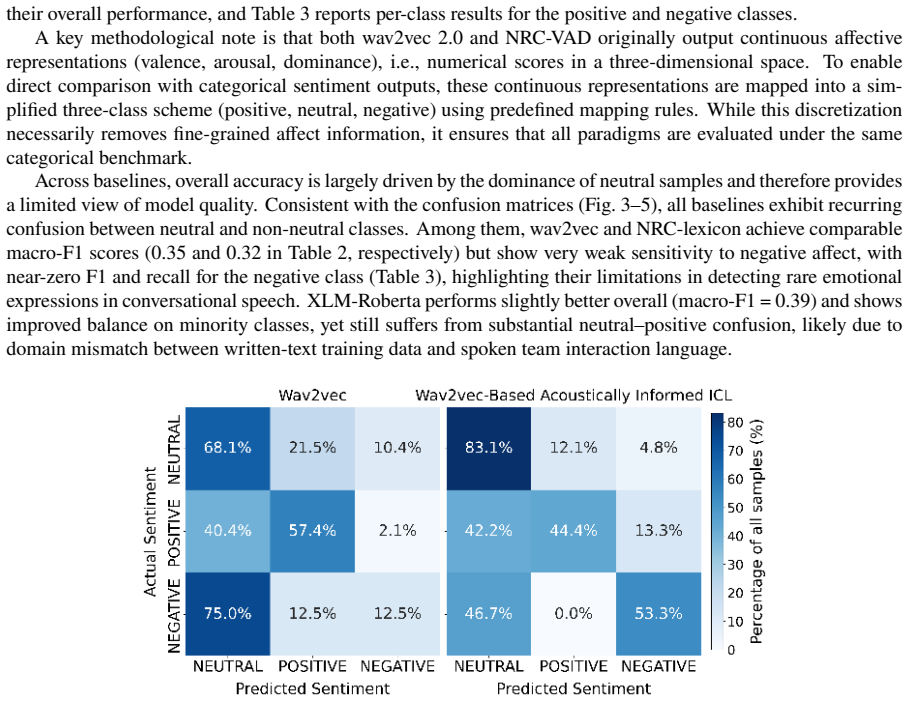
Understanding human states and interaction dynamics is a core goal of human-computer interaction (HCI). As interaction paradigms become more immersive, virtual reality (VR) has emerged as a powerful platform for studying collaborative work. In such settings, evaluating team collaboration states, including team performance and team resilience, requires continuous and reliable inference of latent team-level cognitive and affective states from multi-modal sensor data, such as speech signals. However, generating ground truth labels for these latent states remains challenging due to sensor-induced noise, contextual variability, and sparse expert annotations. Traditional self-reporting approaches provide only static and delayed measurements and are therefore insufficient for capturing dynamic team processes reflected in continuous speech data. In this work, we propose a large language model (LLM)-driven, agentic inference workflow for automated emotion-related synthetic ground truth generation from streaming speech data in multi-user VR environments. Leveraging the generalization capabilities of LLMs, we use In-Context Learning (ICL) with few-shot demonstrations of paired audio-based samples and their corresponding transcriptions. ICL tends to achieve task adaptation comparable to model fine-tuning while circumventing the computational overhead of parameter updates. To construct informative and robust in-context prompts, we adopt a retrieval-based selection strategy that dynamically identifies relevant audio demonstrations based on similarity in the acoustic feature space.
Editorial analysis
A structured set of objections, weighed in public.
Referee Report
Summary. The manuscript proposes an LLM-driven agentic workflow that uses in-context learning (ICL) with retrieval-based few-shot selection of audio-transcript pairs to generate synthetic ground-truth emotion labels from streaming multi-user VR speech data, addressing limitations of self-reports for capturing dynamic team affective states.
Significance. If the workflow were shown to produce labels with usable accuracy and robustness, it would offer a scalable alternative to expert annotation or self-report for continuous labeling of latent states in immersive HCI settings. The paper receives credit for identifying a concrete application domain (multi-user VR collaboration) and for framing ICL as a low-overhead adaptation strategy, but the complete absence of any empirical component means these remain untested hypotheses rather than demonstrated advances.
major comments (2)
- [Abstract and §1] Abstract and §1 (Introduction): The central claim that the proposed ICL workflow can produce 'reliable' synthetic ground truth is unsupported because the manuscript contains no experiments, no held-out test set, no inter-rater agreement statistics with human experts, and no ablation on retrieval or prompt design. This absence directly undermines the reliability assertion that the work is intended to advance.
- [§3] §3 (Proposed Method): The description of the retrieval-based selection strategy and agentic inference loop is presented as sufficient for robust label generation, yet no quantitative measure of acoustic-feature similarity thresholds, retrieval precision, or downstream label consistency is supplied; without such metrics the claim that the method handles 'sensor-induced noise' and 'contextual variability' remains an untested assumption.
minor comments (1)
- [§3] Notation for acoustic features and transcript embeddings is introduced without an explicit definition table or reference to standard feature sets (e.g., eGeMAPS, Wav2Vec), which would improve reproducibility.
Simulated Author's Rebuttal
We thank the referee for the detailed feedback. The manuscript presents a methodological proposal for an LLM-based workflow rather than an empirically validated system. We agree that several claims require qualification and will revise the text accordingly to ensure all assertions are appropriately scoped to the proposed design.
read point-by-point responses
-
Referee: [Abstract and §1] Abstract and §1 (Introduction): The central claim that the proposed ICL workflow can produce 'reliable' synthetic ground truth is unsupported because the manuscript contains no experiments, no held-out test set, no inter-rater agreement statistics with human experts, and no ablation on retrieval or prompt design. This absence directly undermines the reliability assertion that the work is intended to advance.
Authors: We agree that the current wording overstates the contribution. The manuscript is a design proposal, and the term 'reliable' was intended to describe the design goal rather than a demonstrated result. In revision we will rewrite the abstract and §1 to state that the workflow is proposed to generate synthetic labels with the potential for reliability, explicitly note the absence of empirical validation, and add a new subsection describing planned experiments (including human-expert comparisons and ablations). revision: yes
-
Referee: [§3] §3 (Proposed Method): The description of the retrieval-based selection strategy and agentic inference loop is presented as sufficient for robust label generation, yet no quantitative measure of acoustic-feature similarity thresholds, retrieval precision, or downstream label consistency is supplied; without such metrics the claim that the method handles 'sensor-induced noise' and 'contextual variability' remains an untested assumption.
Authors: We concur that no quantitative metrics are provided because the section describes a proposed architecture. We will revise §3 to label the handling of noise and variability as hypothesized benefits of the retrieval and agentic design, remove any implication that robustness is already achieved, and include a forward-looking paragraph specifying candidate evaluation metrics (e.g., acoustic similarity thresholds, retrieval precision@K, and label-consistency statistics) for subsequent empirical work. revision: yes
Circularity Check
No circularity: high-level methodological proposal with no derivations or self-referential reductions
full rationale
The manuscript is a descriptive proposal for an LLM-driven workflow using in-context learning and retrieval-based selection for synthetic emotion label generation. It contains no equations, no fitted parameters, no predictions derived from inputs, and no self-citations invoked to justify uniqueness or ansatzes. The central claim is an architectural description rather than a derivation that reduces to its own inputs by construction; therefore the work is self-contained against external benchmarks with no load-bearing circular steps.
Axiom & Free-Parameter Ledger
Reference graph
Works this paper leans on
-
[1]
Effective affective EEG-based indicators in emotion-evoking VR environments: An evidence from machine learning,
I. A. Castiblanco Jimenez, E. C. Olivetti, E. Vezzetti, S. Moos, A. Celeghin, and F. Marcolin, “Effective affective EEG-based indicators in emotion-evoking VR environments: An evidence from machine learning,”Neural Computing and Applications, vol. 36, pp. 22245–22263, 2024
2024
-
[2]
Investigatingthereliabilityofself-reportdatainthewild: Thequest for ground truth,
N.Gao,M.S.Rahaman,W.Shao,andF.D.Salim,“Investigatingthereliabilityofself-reportdatainthewild: Thequest for ground truth,” inProc. ACM International Joint Conference on Pervasive and Ubiquitous Computing (UbiComp Adjunct), pp. 237–242, 2021
2021
-
[3]
Few-shot personalizationviain-contextlearningforspeechemotionrecognitionbasedonspeech-languagemodel,
M. Ihori, T. Yamane, N. Kawata, N. Makishima, T. Tanaka, S. Suzuki, S. Orihashi, and R. Masumura, “Few-shot personalizationviain-contextlearningforspeechemotionrecognitionbasedonspeech-languagemodel,”arXiv preprint arXiv:2509.08344, 2025
-
[4]
Few-shot fine-tuning vs. in-context learning: A fair comparison and evaluation,
M. Mosbach, T. Pimentel, S. Ravfogel, D. Klakow, and Y. Elazar, “Few-shot fine-tuning vs. in-context learning: A fair comparison and evaluation,” inFindings of the Association for Computational Linguistics: ACL 2023, Toronto, ON, Canada, pp. 12284–12314, 2023
2023
-
[5]
Robust Speech Recognition via Large-Scale Weak Supervision
A. Radford, J. W. Kim, T. Xu, G. Brockman, C. McLeavey, and I. Sutskever, “Robust speech recognition via large-scale weaksupervision,”inProc. 40th International Conference on Machine Learning (ICML 2023),Honolulu,HI,USA,pp. 28492–28518, 2023, [Online]. Available:https://doi.org/10.48550/arXiv.2212.04356
work page internal anchor Pith review Pith/arXiv arXiv doi:10.48550/arxiv.2212.04356 2023
-
[6]
A. H. Liu, A. Ehrenberg, L. A. Lo, C. Denoix, C. Barreau, G. Lample, J.-M. Delignon, K. R. Chandu, P. von Platen, and P. R. Muddireddy, “Voxtral,”arXiv preprint arXiv:2507.13264, 2025
work page Pith review arXiv 2025
-
[7]
Dawn of the transformer era in speech emotion recognition: Closing the valence gap,
J. Wagner, A. Triantafyllopoulos, H. Wierstorf, M. Schmitt, F. Burkhardt, F. Eyben, and B. W. Schuller, “Dawn of the transformer era in speech emotion recognition: Closing the valence gap,”IEEE Transactions on Pattern Analysis and Machine Intelligence, vol. 45, no. 9, pp. 10745–10759, 2023
2023
-
[8]
Sentimentanalysis: Automaticallydetectingvalence,emotions,andotheraffectualstatesfromtext,
S.M.Mohammad,“Sentimentanalysis: Automaticallydetectingvalence,emotions,andotheraffectualstatesfromtext,” inEmotion Measurement, 2nd ed., H. L. Meiselman, Ed. Cambridge, U.K.: Woodhead Publishing, 2021, pp. 323–379
2021
-
[9]
Crowdsourcingaword–emotionassociationlexicon,
S.M.MohammadandP.D.Turney,“Crowdsourcingaword–emotionassociationlexicon,”Computational Intelligence, vol. 29, no. 3, pp. 436–465, 2012
2012
-
[10]
NRC V AD Lexicon v2: norms for valence, arousal, and dominance for over 55k English terms,
S. M. Mohammad, “NRC VAD lexicon v2: Norms for valence, arousal, and dominance for over 55k English terms,” 2025, doi: 10.48550/arXiv.2503.23547
-
[11]
Employinglargelanguagemodelsforemotiondetectioninpsychotherapytranscripts,
C. Lalk, K. Targan, T. Steinbrenner, J. Schaffrath, S. Eberhardt, B. Schwartz, A. Vehlen, W. Lutz, and J. Rubel, “Employinglargelanguagemodelsforemotiondetectioninpsychotherapytranscripts,”Frontiers in Psychiatry,vol.16, Art. no. 1504306, 2025
2025
discussion (0)
Sign in with ORCID, Apple, or X to comment. Anyone can read and Pith papers without signing in.