REVIEW 4 major objections 5 minor 50 references
Unlocking Latent Dimensions: Exploring Representations of Large-Scale X-ray Scattering Data using Variational Autoencoders
T0 review · 4 major / 5 minor · reviewed 2026-08-02 · deepseek-v4-flash
Pith's one-line read A domain-specific variational autoencoder trained on 1.5 million X-ray scattering images learns a facility-independent latent representation that supports zero-shot on-the-fly analysis at a new synchrotron.
desk verdict Large-scale VAE for scattering is a real systems contribution, but the 'physics' claim is under-evidenced and the live demo is offline. read the letter →
The pith
A machine-rendered reading of the paper's core claim, the machinery that carries it, and where it could break.
The reading
What carries the argument
The load-bearing object is the C-VAE, a convolutional variational autoencoder augmented with windowed self-attention blocks, trained to map 512x512 scattering images into a 512-dimensional latent space with a diagonal-Gaussian variational objective. The encoder compresses raw detector images while suppressing irrelevant intensity-level variation, so that structural similarity becomes proximity in latent space and experimental progression becomes smooth trajectory; the decoder turns arbitrary latent points back into physically plausible scattering images, enabling conditioned synthetic generation. Nonlinear projection and density-based clustering are then used to expose the latent organizatio
What would settle it
Embed frames from a structurally static sample while varying beam intensity, detector gain, or background: if the C-VAE moves these frames along a trajectory comparable in extent to the film-formation trajectory, the physics interpretation fails. Alternatively, align the two facilities' drying trajectories using an independent structural clock such as measured domain spacing from peak positions; if the trajectories do not line up when time is replaced by that clock, the facility-independence claim is falsified.
Extended reading notes
Core claim
The central discovery, on the paper's own terms, is that the dominant structural variation in large-scale X-ray scattering data is low-dimensional and can be captured by a convolutional variational autoencoder with windowed self-attention. Trained on 1.5 million SAXS/WAXS images, the 512-dimensional latent space shows well-separated clusters for independent experiments, line-like trajectories for temporal evolution within a run, and continuous transitions between scattering regimes; direct projection of raw pixels does not recover this organization. The same pretrained encoder, applied with no retraining to film-formation experiments at a different synchrotron facility, organizes the data in
Load-bearing premise
The load-bearing premise is that the observed latent clusters and trajectories reflect the sample's physical structure rather than beamline-specific or model-introduced artifacts; the paper grounds this reading in qualitative agreement with expected film-formation stages (Discussion, first paragraph; Section 3.2) but supplies no independent ground-truth labels or quantitative measure of physical correspondence.
Editorial extensions
If this is right
- A pretrained encoder can be deployed before a beamtime begins, with per-image inference fast enough (about 0.05 s) to keep pace with live detector streams, turning real-time monitoring into a standard workflow.
- Latent trajectories separate kinetically active from kinetically stable stages without labels or manual feature selection, giving experimentalists an immediate readout of structural transitions.
- The generative side of the latent space can produce realistic scattering images for underrepresented states, support rehearsal of on-the-fly pipelines before beamtime, and aid experiment planning.
- Domain-specific training on scattering images can yield more interpretable latent organization than a far larger general-purpose vision foundation model, implying that facility-scale datasets justify their own representation-learning investments.
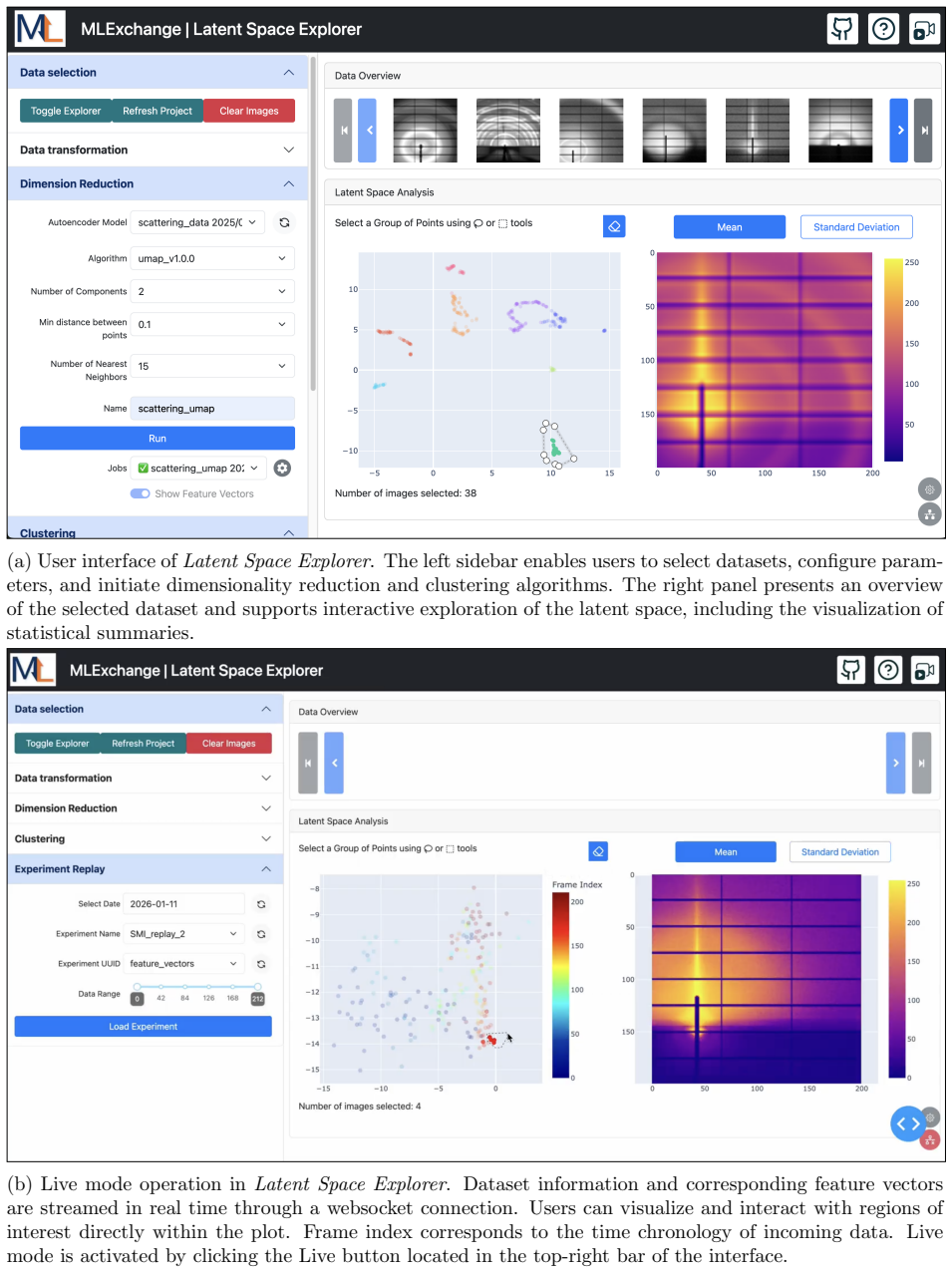
- The same representation serves both offline archive exploration and live streaming experiments within an interactive web environment, making the learned structure accessible during data collection.
Reading between the lines
- If facility-independence holds, the latent axes are plausibly approximating invariant structural order parameters — such as peak position, ring curvature, or azimuthal anisotropy — and regressing latent coordinates against known q-space features would turn the representation from a visualization aid into a quantitative metrology tool; the paper does not run that calibration.
- The comparison with the general-purpose foundation model is based on visual interpretability and trajectory smoothness; a natural next test is a quantitative downstream benchmark, such as phase classification or transition-detection accuracy, which is not reported.
- Adding experimental metadata (temperature, humidity, deposition speed) to the latent representation — a direction the paper lists for future work — could disentangle structurally similar but chemically distinct states that scattering alone cannot separate.
- A controlled negative experiment, varying beam intensity or detector gain on a structurally static sample, would directly test whether the latent trajectories are physical rather than instrumental; the current evidence does not include such a control.
Editorial analysis
A structured set of objections, weighed in public.
Referee Report
Summary. The paper presents a domain-specific attention-based convolutional variational autoencoder (C-VAE) trained on 1.5 million Advanced Light Source SAXS/WAXS images, yielding a 512-dimensional latent space explored with UMAP and HDBSCAN. The authors report that the latent space organizes into clusters and continuous temporal trajectories, that the pretrained encoder transfers without retraining to PFSA ionomer film-formation experiments at ALS 7.3.3 and NSLS-II SMI, that C-VAE embeddings are more interpretable than DINOv3 (ViT-7B) embeddings, and that two latent-sampling strategies (UMAP-guided PCA and conditional flow matching) generate realistic synthetic scattering images. The workflows are integrated into MLExchange's Latent Space Explorer for offline and on-the-fly analysis. The central claim is that the domain-specific VAE learns facility-independent, physics-relevant scattering representations enabling zero-shot transfer.
Significance. If substantiated, this would be a practically important demonstration: a single compact encoder trained on a large heterogeneous archive can organize new experimental data from a different beamline in real time, potentially supporting autonomous experiment control and data augmentation. The paper's strengths are its scale (1.5M images, 80 GPUs), the open software infrastructure, the two-facility deployment scenario, and the quantitative comparison of generation strategies in Supplementary Note 2. However, the physics-interpretability claim is currently supported mainly by qualitative visual evidence and rests on a partly circular cluster definition; the transfer test covers one material system without stated exclusion from the training archive; and the DINOv3 advantage is not quantified. These gaps are fixable and should be addressed before publication.
major comments (4)
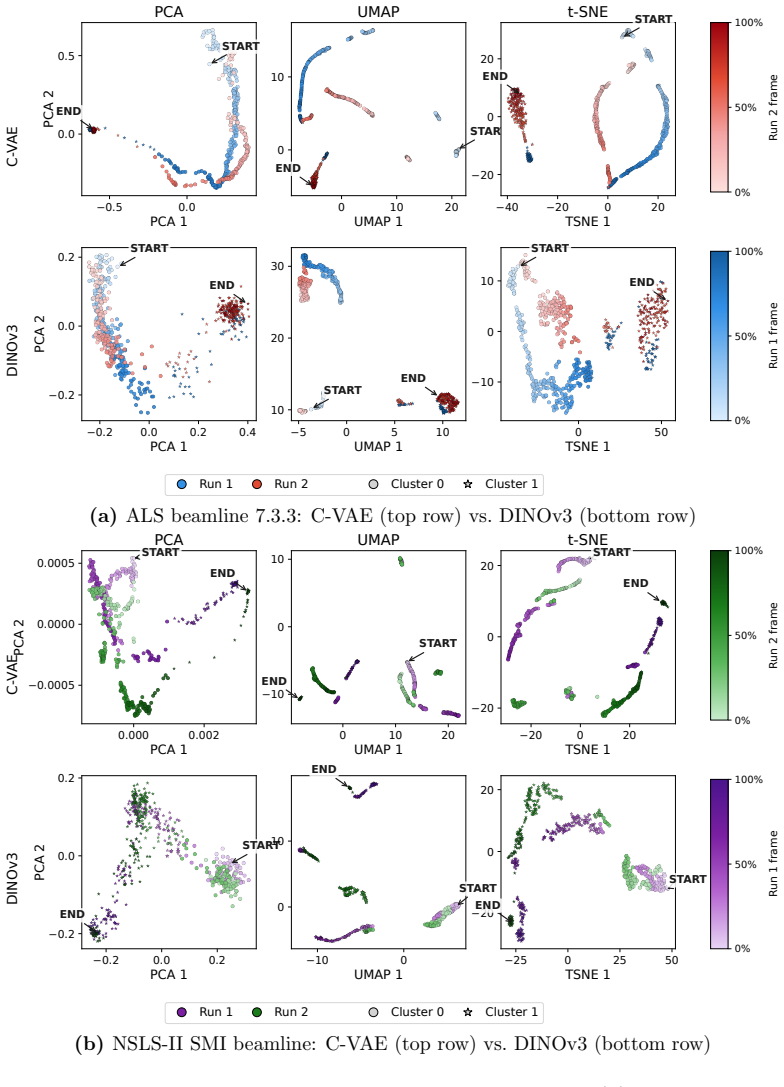
- [Discussion, first paragraph; §3.2, Case Study 2] The sentence 'Successful deployment at NSLS-II without retraining indicates that the dominant structural variation captured by the C-VAE is facility-independent, likely reflecting the physics of scattering rather than detector or beamline-specific artifacts' is not supported by the evidence presented. The NSLS-II transfer is demonstrated only for PFSA ionomer film formation, a material class likely present in the ALS training archive (the paper does not state otherwise). Physical interpretation rests on qualitative inspection of representative images, with no quantitative correlation between latent coordinates and independently measured physical quantities such as ionomer peak q-position or domain spacing from calibrated 1D profiles. Smooth temporal trajectories are expected for any continuously varying image sequence and are also produced by DINOv3 (Fig. 8), so trajectory smoothness and
- [§3.2, 'Comparison with a General-Purpose Vision Model'] The central benchmarking claim that 'domain-specific training yields more interpretable latent organization' is based on qualitative visual comparison of Figures 8a and 8b. Statements such as 'more fragmented,' 'more distributed,' and 'less smooth' are not quantified. Since this comparison is a stated contribution, the authors should report quantitative metrics computed on the same embeddings, e.g., trajectory smoothness (path length, monotonicity, tangent continuity), cluster quality (Silhouette, Davies–Bouldin, Calinski–Harabasz), or agreement with known physical stage boundaries. Without such metrics, the DINOv3 comparison does not support the claimed advantage.
- [§3.1; Supplementary Notes 1.1 and 1.2] The claim that HDBSCAN clusters correspond to 'distinct scattering regimes' and that PC0/PC1 reflect 'interpretable physical variation' is partly circular: clusters are defined by HDBSCAN on the model's own latent space, and no independent labels or physical measurements are used to validate the assignment. The pixel-UMAP comparison in Supplementary Note 1.2 shows that C-VAE produces different groups than raw-pixel UMAP, but differentness is not physical correctness. I recommend validating cluster-to-regime correspondence on a small labeled subset, e.g., manually annotated images or experiments with known phase progression, and reporting agreement.
- [Supplementary Note 2, Table S2] The generation metrics use 'a real scattering image ... selected from the training dataset' as ground truth, so the evaluation measures reconstruction/memorization of training images rather than generalization to held-out conditional queries. Moreover, Table S2 reports pixel MSE with very large standard deviations (e.g., conditional flow matching (7.6±27.2)×10^-3), and the 'retrieval upper bound' by PCA k-NN is not an upper bound in the generative sense, since it averages real latents rather than producing novel samples. Please clarify whether evaluation points were held out from training of the flow-matching velocity network and from the C-VAE, and report per-cluster medians and error bars.
minor comments (5)
- [Throughout] The abbreviation is set inconsistently as C-VAE and C-V AE; please standardize.
- [§3.2] The text says the comparisons 'were generated offline' but the abstract and Section 1 emphasize live on-the-fly analysis. Please clarify exactly which components were exercised live versus post-hoc.
- [Fig. 8] Please state whether the same HDBSCAN parameters were used for C-VAE and DINOv3 embeddings; differences in clustering thresholds could explain apparent fragmentation.
- [Table S2] For pixel MSE, the standard deviation exceeds the mean by a factor of roughly 3.6 for flow matching; per-cluster medians or box plots would be more informative than mean±s.d.
- [§3.3] The generated images are called 'physically realistic' and 'physically plausible,' but no quantitative validation (e.g., peak positions, azimuthal profiles) is provided. Consider comparing generated patterns to simulated or independently measured scattering profiles.
Circularity Check
No significant circularity: the VAE representation, held-out transfer, and generative evaluations are empirical demonstrations rather than derivations that reduce to their inputs; the physics interpretation is under-supported but that is a validity gap, not circularity.
full rationale
The paper's central chain is empirical rather than derivational: a C-VAE is trained on 1.5M ALS scattering images and then deployed without retraining on PFSA film-formation data at ALS and NSLS-II, so the NSLS-II result is a genuine held-out transfer test and no NSLS-II fitted parameter is renamed as a prediction. The claim that latent clusters 'correspond to distinct scattering regimes' is an interpretation supported by overlaying detector images onto latent positions; clusters are computed by HDBSCAN on the model's own embeddings, but the correspondence to physical regimes is not defined into the cluster labels, so it is not self-definitional in the prohibited sense. The DINOv3 comparison is an external baseline and does not presuppose the paper's conclusions. The generative sampling evaluation is benchmarked against a retrieval baseline (PCA k-NN) and an unconditional baseline, so the reported conditioning-fidelity numbers are not forced by construction. Self-citations to MLExchange, Data Clinic, and Latent Space Explorer concern software infrastructure and are not load-bearing for the physics or transfer claims. The Discussion's inference that the latent space is 'facility-independent, likely reflecting the physics of scattering rather than detector or beamline-specific artifacts' is underdetermined: it rests on qualitative trajectory smoothness, and the paper itself notes the compared analyses 'were generated offline' — but underdetermination and missing quantitative ground-truth controls are correctness or validity concerns, not circularity. No equation or fitted parameter in the paper reduces to the claim it is used to support.
Assumptions & free parameters
free parameters (8)
- latent_dim =
512
- KL_weight_beta =
0.5
- UMAP_n_neighbors =
30
- UMAP_min_dist =
0.1
- HDBSCAN_membership_threshold_PCA =
0.8
- HDBSCAN_membership_threshold_CFM =
0.5
- flow_matching_guidance_scale =
5.0
- PCA_sampling_k =
2
assumptions (5)
- domain assumption X-ray scattering images vary across samples, geometries, and conditions, and this variation can be captured by a low-dimensional latent space.
- domain assumption The historical ALS dataset is representative of the diversity of scattering patterns encountered at other facilities.
- domain assumption Resizing images to 512×512 preserves the structural information needed for scattering analysis.
- ad hoc to paper HDBSCAN clusters in the learned latent space correspond to distinct physical scattering regimes.
- standard math Standard VAE reparameterization and attention softmax are valid.
Cite this review
Pith. "Pith review of Unlocking Latent Dimensions: Exploring Representations of Large-Scale X-ray Scattering Data using Variational Autoencoders." pith.science (2026). https://pith.science/paper/2AUVD3AI
@misc{pith2026260614999,
  author       = {Pith},
  title        = {Pith review of: Unlocking Latent Dimensions: Exploring Representations of Large-Scale X-ray Scattering Data using Variational Autoencoders},
  year         = {2026},
  howpublished = {\url{https://pith.science/paper/2AUVD3AI}},
  note         = {Machine review of arXiv:2606.14999}
}
read the original abstract
Scientific user facilities generate X-ray scattering data faster than traditional workflows can process them. We address this challenge across two settings, offline dataset exploration and live on-the-fly analysis. We train a domain-specific attention-based Convolutional Variational Autoencoder (C-VAE) on 1.5 million X-ray scattering images to learn low-dimensional representations capturing structural variation across diverse experimental conditions. The learned latent space reveals well-organized clusters and smooth trajectories reflecting experimental progression. It further supports controlled synthetic scattering image generation across diverse structural states. When deployed without retraining, the model organizes time-resolved film formation experiments at two synchrotron facilities into interpretable latent structures. Benchmarking against DINOv3 (ViT-7B), a general-purpose vision foundation model, demonstrates that domain-specific training yields more interpretable latent organization for scattering data. Both workflows are integrated within Latent Space Explorer, a component of the MLExchange platform, supporting interactive structural exploration across archived datasets and live experiments.
Figures


Figures from the paper (7 more)




Reference graph
Works this paper leans on
-
[1]
Bluesky’s ahead: A multi-facility collaboration for an a la carte software project for data acquisition and manage- ment.Synchrotron Radiation News, 32(3):19–22, 2019
Daniel Allan, Thomas Caswell, Stuart Campbell, and Maksim Rakitin. Bluesky’s ahead: A multi-facility collaboration for an a la carte software project for data acquisition and manage- ment.Synchrotron Radiation News, 32(3):19–22, 2019
2019
-
[2]
Advancing discovery with artificial intelligence and machine learning at nsls-ii.Synchrotron Radiation News, 35(4):44–50, 2022
Andi Barbour, Stuart Campbell, Thomas Caswell, Masafumi Fukuto, Marcus Hanwell, Andrew Kiss, Tatiana Konstantinova, Ricarda Laasch, Phillip Maffettone, Bruce Ravel, et al. Advancing discovery with artificial intelligence and machine learning at nsls-ii.Synchrotron Radiation News, 35(4):44–50, 2022
2022
-
[3]
Learning metal microstructural heterogeneity through spatial mapping of diffraction latent space features.npj Computational Materials, 11(1):284, 2025
Mathieu Calvat, Chris Bean, Dhruv Anjaria, Hyoungryul Park, Haoren Wang, Kenneth Vec- chio, and JC Stinville. Learning metal microstructural heterogeneity through spatial mapping of diffraction latent space features.npj Computational Materials, 11(1):284, 2025
2025
-
[4]
Density-based clustering based on hierarchical density estimates
Ricardo JGB Campello, Davoud Moulavi, and J¨ org Sander. Density-based clustering based on hierarchical density estimates. InPacific-Asia conference on knowledge discovery and data mining, pages 160–172. Springer, 2013
2013
-
[5]
Emerging properties in self-supervised vision transformers
Mathilde Caron, Hugo Touvron, Ishan Misra, Herv´ e J´ egou, Julien Mairal, Piotr Bojanowski, and Armand Joulin. Emerging properties in self-supervised vision transformers. InProceedings of the IEEE/CVF international conference on computer vision, pages 9650–9660, 2021
2021
-
[6]
Data augmentation with variational autoen- coders and manifold sampling
Cl´ ement Chadebec and St´ ephanie Allassonni` ere. Data augmentation with variational autoen- coders and manifold sampling. InMICCAI Workshop on Deep Generative Models, pages 184–
-
[7]
Zwart, Daniel B
Tanny Chavez, Zhuowen Zhao, Runbo Jiang, Wiebke Koepp, Dylan McReynolds, Petrus H. Zwart, Daniel B. Allan, Eliot H. Gann, Nicholas Schwarz, Daniela Ushizima, Edward S. Barnard, Apurva Mehta, Subramanian Sankaranarayanan, and Alexander Hexemer. A machine-learning-driven data labeling pipeline for scientific analysis in mlexchange.Journal of Applied Crystal...
2024
-
[8]
A machine- learning-driven data labeling pipeline for scientific analysis in mlexchange.Applied Crystallog- raphy, 58(3), 2025
Tanny Chavez, Zhuowen Zhao, Runbo Jiang, Wiebke Koepp, Dylan McReynolds, Petrus H Zwart, Daniel B Allan, Eliot H Gann, Nicholas Schwarz, Daniela Ushizima, et al. A machine- learning-driven data labeling pipeline for scientific analysis in mlexchange.Applied Crystallog- raphy, 58(3), 2025. 21
2025
Show all 50 references
-
[9]
Unsupervised machine learning via transfer learning and k-means clustering to classify materials image data.Integrating Materials and Manufacturing Innovation, 10(2):231–244, 2021
Ryan Cohn and Elizabeth Holm. Unsupervised machine learning via transfer learning and k-means clustering to classify materials image data.Integrating Materials and Manufacturing Innovation, 10(2):231–244, 2021
2021
-
[10]
An image is worth 16x16 words: Transformers for image recognition at scale
Alexey Dosovitskiy, Lucas Beyer, Alexander Kolesnikov, Dirk Weissenborn, Xiaohua Zhai, Thomas Unterthiner, Mostafa Dehghani, Matthias Minderer, Georg Heigold, Sylvain Gelly, et al. An image is worth 16x16 words: Transformers for image recognition at scale. InInter- national Co...
2021
-
[11]
Evolution of ionomer morphology from dispersion to film: an in situ x-ray study.Macromolecules, 52(20):7779–7785, 2019
Peter J Dudenas and Ahmet Kusoglu. Evolution of ionomer morphology from dispersion to film: an in situ x-ray study.Macromolecules, 52(20):7779–7785, 2019
2019
-
[12]
A saxs/waxs/gisaxs beamline with multilayer monochromator
Alexander Hexemer, Wim Bras, James Glossinger, Eric Schaible, Eliot Gann, Rick Kirian, Alastair MacDowell, Matthew Church, Bruce Rude, and Howard Padmore. A saxs/waxs/gisaxs beamline with multilayer monochromator. InJournal of Physics: Conference Series, volume 247, page 012007, 2010
2010
-
[13]
Burgess, Xavier Glorot, Matthew M
Irina Higgins, Lo ¨ ıc Matthey, Arka Pal, Christopher P. Burgess, Xavier Glorot, Matthew M. Botvinick, Shakir Mohamed, and Alexander Lerchner.β-vae: Learning basic visual concepts with a constrained variational framework. InInternational Conference on Learning Represen- tations, 2017
2017
-
[14]
Classifier-free diffusion guidance.arXiv preprint arXiv:2207.12598, 2022
Jonathan Ho and Tim Salimans. Classifier-free diffusion guidance.arXiv preprint arXiv:2207.12598, 2022
2022 arXiv
-
[15]
Ai-nerd: Elucidation of relaxation dynamics beyond equilibrium through ai-informed x-ray photon correlation spectroscopy.Nature Communications, 15(1):5945, 2024
James P Horwath, Xiao-Min Lin, Hongrui He, Qingteng Zhang, Eric M Dufresne, Miaoqi Chu, Subramanian KRS Sankaranarayanan, Wei Chen, Suresh Narayanan, and Mathew J Cherukara. Ai-nerd: Elucidation of relaxation dynamics beyond equilibrium through ai-informed x-ray photon correla...
2024
-
[16]
Interactive visual study of multiple attributes learning model of x-ray scattering images
Xinyi Huang, Suphanut Jamonnak, Ye Zhao, Boyu Wang, Minh Hoai, Kevin Yager, and Wei Xu. Interactive visual study of multiple attributes learning model of x-ray scattering images. IEEE Transactions on Visualization and Computer Graphics, 27(2):1312–1321, 2020
2020
-
[17]
Exploring order pa- rameters and dynamic processes in disordered systems via variational autoencoders.Science Advances, 7(17):eabd5084, 2021
Sergei V Kalinin, Ondrej Dyck, Stephen Jesse, and Maxim Ziatdinov. Exploring order pa- rameters and dynamic processes in disordered systems via variational autoencoders.Science Advances, 7(17):eabd5084, 2021
2021
-
[18]
Exploration of optimal microstructure and mechanical properties in continuous microstructure space using a variational autoencoder.Ma- terials & Design, 202:109544, 2021
Yongju Kim, Hyung Keun Park, Jaimyun Jung, Peyman Asghari-Rad, Seungchul Lee, Jin You Kim, Hwan Gyo Jung, and Hyoung Seop Kim. Exploration of optimal microstructure and mechanical properties in continuous microstructure space using a variational autoencoder.Ma- terials & Desig...
2021
-
[19]
Auto-encoding variational bayes
Diederik P Kingma and Max Welling. Auto-encoding variational bayes. InInternational Conference on Learning Representations (ICLR), 2014
2014
-
[20]
Imagenet classification with deep convolutional neural networks.Advances in neural information processing systems, 25, 2012
Alex Krizhevsky, Ilya Sutskever, and Geoffrey E Hinton. Imagenet classification with deep convolutional neural networks.Advances in neural information processing systems, 25, 2012
2012
-
[21]
New insights into perfluorinated sulfonic-acid ionomers
Ahmet Kusoglu and Adam Z Weber. New insights into perfluorinated sulfonic-acid ionomers. Chemical reviews, 117(3):987–1104, 2017. 22
2017
-
[22]
Latent space explorer: Visual analytics for multi- modal latent space exploration.arXiv preprint arXiv:2312.00857, 2023
Bum Chul Kwon, Samuel Friedman, Kai Xu, Steven A Lubitz, Anthony Philippakis, Puneet Batra, Patrick T Ellinor, and Kenney Ng. Latent space explorer: Visual analytics for multi- modal latent space exploration.arXiv preprint arXiv:2312.00857, 2023
2023 arXiv
-
[23]
A deep- learning technique for phase identification in multiphase inorganic compounds using synthetic xrd powder patterns.Nature communications, 11(1):86, 2020
Jin-Woong Lee, Woon Bae Park, Jin Hee Lee, Satendra Pal Singh, and Kee-Sun Sohn. A deep- learning technique for phase identification in multiphase inorganic compounds using synthetic xrd powder patterns.Nature communications, 11(1):86, 2020
2020
-
[24]
Flow matching for generative modeling.arXiv preprint arXiv:2210.02747, 2022
Yaron Lipman, Ricky TQ Chen, Heli Ben-Hamu, Maximilian Nickel, and Matt Le. Flow matching for generative modeling.arXiv preprint arXiv:2210.02747, 2022
2022 arXiv
-
[25]
Swin transformer: Hierarchical vision transformer using shifted windows
Ze Liu, Yutong Lin, Yue Cao, Han Hu, Yixuan Wei, Zheng Zhang, Stephen Lin, and Baining Guo. Swin transformer: Hierarchical vision transformer using shifted windows. InProceedings of the IEEE/CVF International Conference on Computer Vision (ICCV), pages 10012–10022, 2021
2021
-
[26]
Donut: physics-aware machine learning for real-time x-ray nanodiffraction analysis.npj Com- putational Materials, 11(1):380, 2025
Aileen Luo, Tao Zhou, Ming Du, Martin V Holt, Andrej Singer, and Mathew J Cherukara. Donut: physics-aware machine learning for real-time x-ray nanodiffraction analysis.npj Com- putational Materials, 11(1):380, 2025
2025
-
[27]
Principal components analysis (pca).Comput- ers & Geosciences, 19(3):303–342, 1993
Andrzej Ma´ ckiewicz and Waldemar Ratajczak. Principal components analysis (pca).Comput- ers & Geosciences, 19(3):303–342, 1993
1993
-
[28]
Umap: Uniform manifold approximation and projection for dimension reduction.arXiv preprint arXiv:1802.03426, 2018
Leland McInnes, John Healy, and James Melville. Umap: Uniform manifold approximation and projection for dimension reduction.arXiv preprint arXiv:1802.03426, 2018
2018 arXiv
-
[29]
Nersc perlmutter archi- tecture.https://docs.nersc.gov/systems/perlmutter/architecture/, 2024
National Energy Research Scientific Computing Center (NERSC). Nersc perlmutter archi- tecture.https://docs.nersc.gov/systems/perlmutter/architecture/, 2024. Accessed: 2026-01-25
2024
-
[30]
A kriging-based approach to autonomous experimentation with applications to x-ray scattering.Scientific reports, 9(1):11809, 2019
Marcus M Noack, Kevin G Yager, Masafumi Fukuto, Gregory S Doerk, Ruipeng Li, and James A Sethian. A kriging-based approach to autonomous experimentation with applications to x-ray scattering.Scientific reports, 9(1):11809, 2019
2019
-
[31]
Dinov2: Learning robust visual features without supervision.arXiv preprint arXiv:2304.07193, 2023
Maxime Oquab, Timoth´ ee Darcet, Th´ eo Moutakanni, Huy Vo, Marc Szafraniec, Vasil Khalidov, Pierre Fernandez, Daniel Haziza, Francisco Massa, Alaaeldin El-Nouby, et al. Dinov2: Learning robust visual features without supervision.arXiv preprint arXiv:2304.07193, 2023
2023 arXiv
-
[32]
Ai@ als workshop report: machine learning needs at the advanced light source, 2024
Dilworth Y Parkinson, Tanny Chavez, Monika Choudhary, Damon English, Guanhua Hao, Thorsten Hellert, Simon C Leemann, Slavomir Nemsak, Eli Rotenberg, Andrea L Taylor, et al. Ai@ als workshop report: machine learning needs at the advanced light source, 2024
2024
-
[33]
Closing the loop: autonomous experiments enabled by machine-learning-based online data analysis in synchrotron beamline environments.Synchrotron Radiation, 30(6):1064– 1075, 2023
Linus Pithan, Vladimir Starostin, David Mareˇ cek, Lukas Petersdorf, Constantin V¨ olter, Valentin Munteanu, Maciej Jankowski, Oleg Konovalov, Alexander Gerlach, Alexander Hin- derhofer, et al. Closing the loop: autonomous experiments enabled by machine-learning-based online d...
2023
-
[34]
On-the-fly segmen- tation approaches for x-ray diffraction datasets for metallic glasses.MRS Communications, 7(3):613–620, 2017
Fang Ren, Travis Williams, Jason Hattrick-Simpers, and Apurva Mehta. On-the-fly segmen- tation approaches for x-ray diffraction datasets for metallic glasses.MRS Communications, 7(3):613–620, 2017. 23
2017
-
[35]
Auto- mated classification of big x-ray diffraction data using deep learning models.npj Computational Materials, 9(1):214, 2023
Jerardo E Salgado, Samuel Lerman, Zhaotong Du, Chenliang Xu, and Niaz Abdolrahim. Auto- mated classification of big x-ray diffraction data using deep learning models.npj Computational Materials, 9(1):214, 2023
2023
-
[36]
Featureforest: the power of foundation models, the usability of random forests.npj Imaging, 3(1):32, 2025
Mehdi Seifi, Damian Dalle Nogare, Juan Manuel Battagliotti, Vera Galinova, Ananya Kedige Rao, Pierre-Henri Jouneau, Anwai Archit, Constantin Pape, Johan Decelle, et al. Featureforest: the power of foundation models, the usability of random forests.npj Imaging, 3(1):32, 2025
2025
-
[37]
Vo, Maximilian Seitzer, Federico Baldassarre, Maxime Oquab, Cijo Jose, Vasil Khalidov, Marc Szafraniec, Seungeun Yi, Michael Ramamonjisoa, et al
Oriane Simeoni, Huy V. Vo, Maximilian Seitzer, Federico Baldassarre, Maxime Oquab, Cijo Jose, Vasil Khalidov, Marc Szafraniec, Seungeun Yi, Michael Ramamonjisoa, et al. Dinov3: A family of large self-supervised vision foundation models.arXiv preprint arXiv:2508.10104, 2025
2025 arXiv
-
[38]
Tracking perovskite crystallization via deep learning-based feature detection on 2d x-ray scattering data
Vladimir Starostin, Valentin Munteanu, Alessandro Greco, Ekaterina Kneschaurek, Alina Pleli, Florian Bertram, Alexander Gerlach, Alexander Hinderhofer, and Frank Schreiber. Tracking perovskite crystallization via deep learning-based feature detection on 2d x-ray scattering dat...
2022
-
[39]
Can unsupervised machine learning boost the on-site analysis of in situ synchrotron diffraction data?Scripta materialia, 226:115238, 2023
Tobias Strohmann, Pere Barriobero-Vila, Joachim Gussone, David Melching, Andreas Stark, Norbert Schell, and Guillermo Requena. Can unsupervised machine learning boost the on-site analysis of in situ synchrotron diffraction data?Scripta materialia, 226:115238, 2023
2023
-
[40]
Au- tosas: A new human-aside-the-loop paradigm for automated sas fitting for high throughput and autonomous experimentation.APL Machine Learning, 3(3), 2025
Duncan R Sutherland, Rachel Ford, Yun Liu, Tyler B Martin, and Peter A Beaucage. Au- tosas: A new human-aside-the-loop paradigm for automated sas fitting for high throughput and autonomous experimentation.APL Machine Learning, 3(3), 2025
2025
-
[41]
Adaptively driven x-ray diffraction guided by machine learning for au- tonomous phase identification.npj Computational Materials, 9(1):31, 2023
Nathan J Szymanski, Christopher J Bartel, Yan Zeng, Mouhamad Diallo, Haegyeom Kim, and Gerbrand Ceder. Adaptively driven x-ray diffraction guided by machine learning for au- tonomous phase identification.npj Computational Materials, 9(1):31, 2023
2023
-
[42]
Physics and chemistry from parsimonious representations: image analysis via invariant variational autoencoders.npj Computational Materials, 10(1):183, 2024
Mani Valleti, Maxim Ziatdinov, Yongtao Liu, and Sergei V Kalinin. Physics and chemistry from parsimonious representations: image analysis via invariant variational autoencoders.npj Computational Materials, 10(1):183, 2024
2024
-
[43]
Visualizing data using t-sne.Journal of machine learning research, 9(11), 2008
Laurens Van der Maaten and Geoffrey Hinton. Visualizing data using t-sne.Journal of machine learning research, 9(11), 2008
2008
-
[44]
Attention is all you need.Advances in neural information processing systems, 30, 2017
Ashish Vaswani, Noam Shazeer, Niki Parmar, Jakob Uszkoreit, Llion Jones, Aidan N Gomez, Lukasz Kaiser, and Illia Polosukhin. Attention is all you need.Advances in neural information processing systems, 30, 2017
2017
-
[45]
Accelerating the machine learning lifecycle with mlflow.IEEE Data Eng
Matei Zaharia, Andrew Chen, Aaron Davidson, Ali Ghodsi, Sue Ann Hong, Andy Konwinski, Siddharth Murching, Tomas Nykodym, Paul Ogilvie, Mani Parkhe, et al. Accelerating the machine learning lifecycle with mlflow.IEEE Data Eng. Bull., 41(4):39–45, 2018
2018
-
[46]
Chemnav: An interactive visual tool to navigate in the latent space for chemical molecules discovery.Visual Informatics, 8(4):60–70, 2024
Yang Zhang, Jie Li, and Xu Chao. Chemnav: An interactive visual tool to navigate in the latent space for chemical molecules discovery.Visual Informatics, 8(4):60–70, 2024
2024
-
[47]
To- wards full-stack deep learning-empowered data processing pipeline for synchrotron tomography experiments.The Innovation, 5(1), 2024
Zhen Zhang, Chun Li, Wenhui Wang, Zheng Dong, Gongfa Liu, Yuhui Dong, and Yi Zhang. To- wards full-stack deep learning-empowered data processing pipeline for synchrotron tomography experiments.The Innovation, 5(1), 2024. 24
2024
-
[48]
Mlexchange: A web-based platform enabling exchangeable machine learning workflows for scientific studies
Zhuowen Zhao, Tanny Chavez, Elizabeth A Holman, Guanhua Hao, Adam Green, Harinarayan Krishnan, Dylan McReynolds, Ronald J Pandolfi, Eric J Roberts, Petrus H Zwart, et al. Mlexchange: A web-based platform enabling exchangeable machine learning workflows for scientific studies. ...
2022
-
[49]
Generating realistic x- ray scattering images using stable diffusion and human-in-the-loop annotations.arXiv preprint arXiv:2408.12720, 2024
Zhuowen Zhao, Xiaoya Chong, Tanny Chavez, and Alexander Hexemer. Generating realistic x- ray scattering images using stable diffusion and human-in-the-loop annotations.arXiv preprint arXiv:2408.12720, 2024
2024 arXiv
-
[50]
A machine learning model for textured x-ray scattering and diffraction image denoising.npj Computational Materials, 9(1):58, 2023
Zhongzheng Zhou, Chun Li, Xiaoxue Bi, Chenglong Zhang, Yingke Huang, Jian Zhuang, Wen- qiang Hua, Zheng Dong, Lina Zhao, Yi Zhang, et al. A machine learning model for textured x-ray scattering and diffraction image denoising.npj Computational Materials, 9(1):58, 2023. 25 Suppl...
2023
Reviewed August 2, 2026 · model on record in the stance chip above.
Discussion (0). Continue with ORCID to comment.