REGRID-QAOA: A Resource-Efficient Hybrid QAOA Framework for Physics-Constrained Power System Islanding
Pith reviewed 2026-06-30 10:24 UTC · model grok-4.3
The pith
A hybrid QAOA framework matches Gurobi-optimal quality for power system islanding while using fewer quantum resources than standard QAOA.
A machine-rendered reading of the paper's core claim, the machinery that carries it, and where it could break.
Core claim
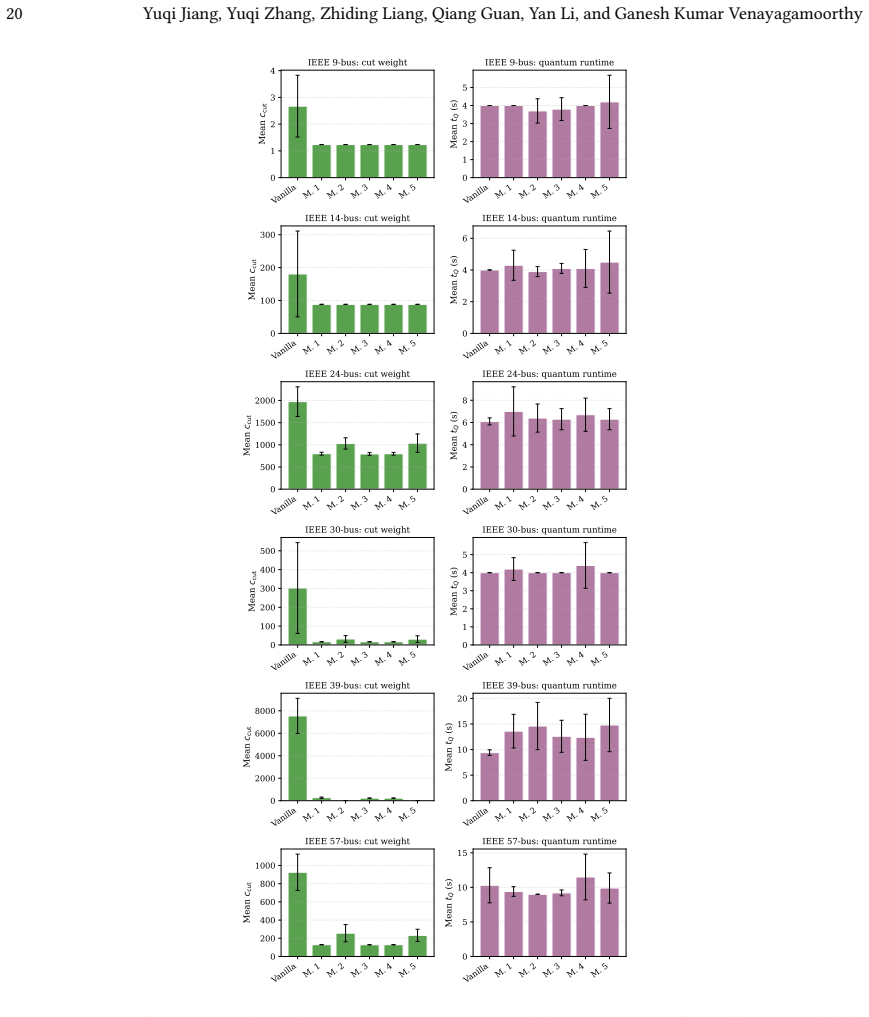
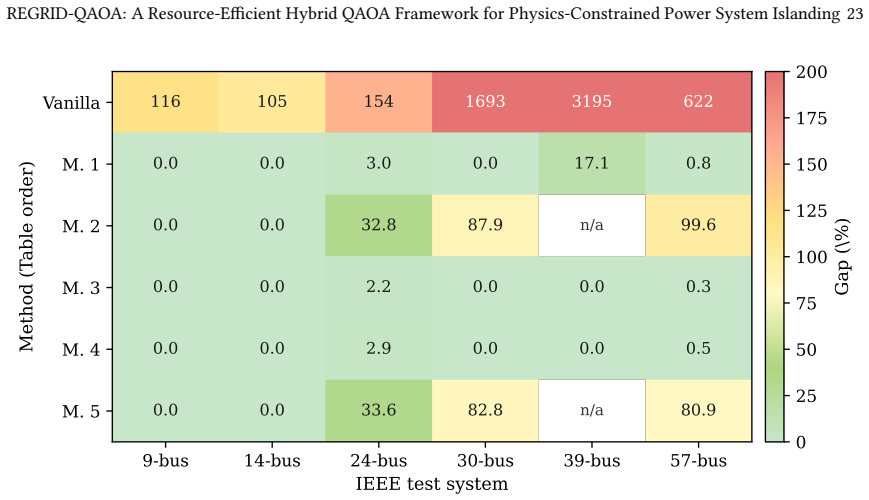
The hybrid REGRID-QAOA workflow achieves Gurobi-optimal solution quality on standard IEEE benchmark systems with a clear quantum resource advantage over vanilla QAOA by combining coherency-informed graph reduction, physics-aware constraint modeling, and structured post-processing that converts shallow-circuit samples into high-quality feasible islanding decisions while satisfying all physical feasibility requirements after network separation.
What carries the argument
Structured post-processing that converts QAOA samples into feasible high-quality islanding solutions without deep circuits or large shot budgets.
If this is right
- The approach scales islanding to network sizes where pure classical solvers become prohibitive.
- Shallow-circuit QAOA becomes practical for critical infrastructure optimization tasks.
- All produced islanding solutions remain physically feasible after separation.
- Quantum resource requirements stay low enough for near-term devices.
Where Pith is reading between the lines
- The same reduction-plus-post-processing pattern could apply to other NP-hard power-system problems such as optimal power flow or contingency analysis.
- If the post-processing generalizes across topologies, it reduces the circuit depth needed for quantum advantage in combinatorial grid problems.
- Real-time operating-point data could be used to test whether solution quality holds under varying load and generation conditions.
Load-bearing premise
The structured post-processing step can always convert QAOA samples into high-quality feasible solutions without systematically excluding the true optimum or introducing bias that depends on network topology or operating point.
What would settle it
Run the framework on an IEEE test case or larger network where the post-processed QAOA solutions have strictly lower objective value than Gurobi or violate a physical constraint such as power balance or line limits.
Figures
read the original abstract
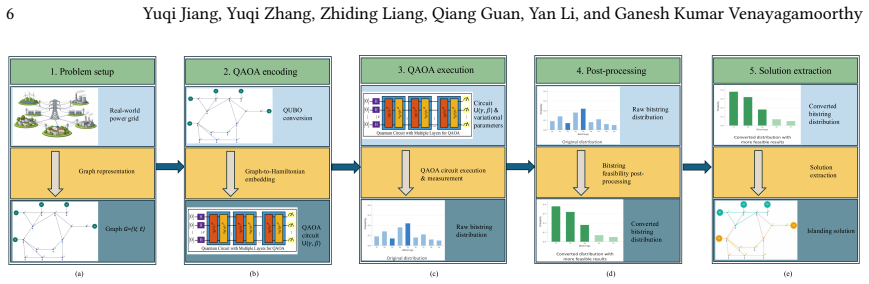
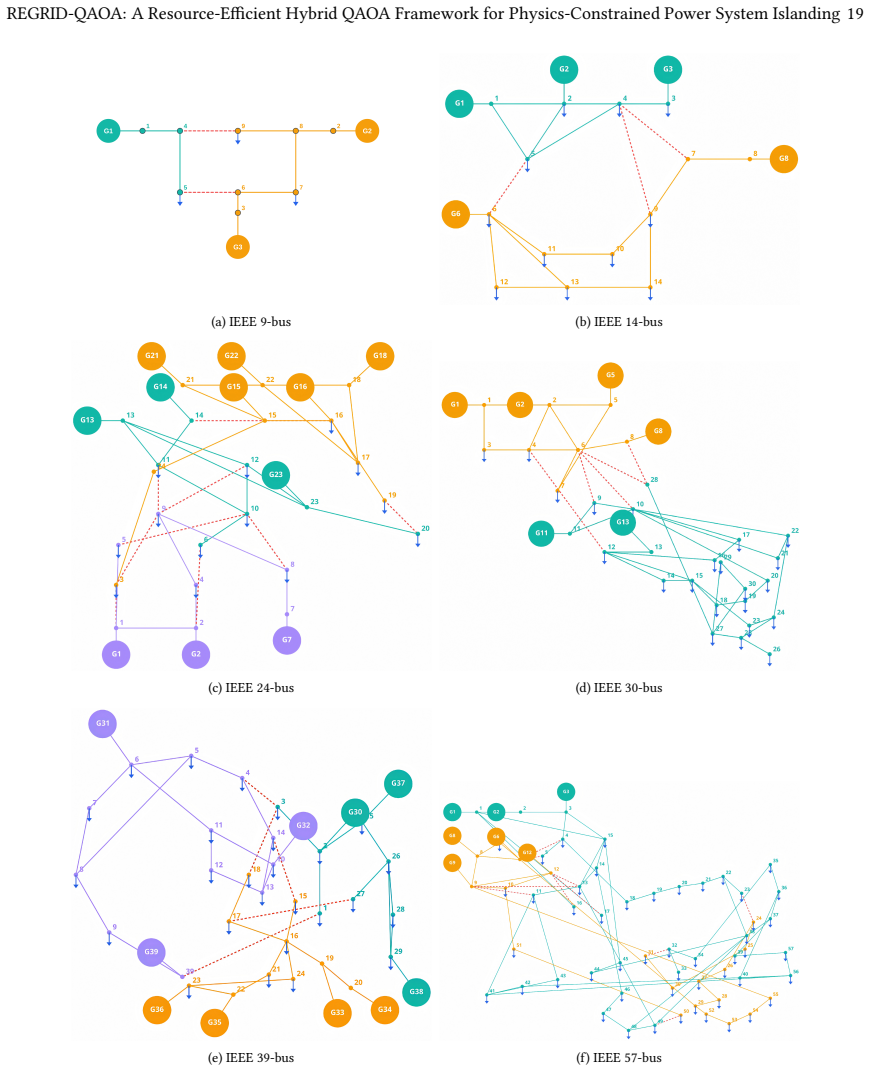
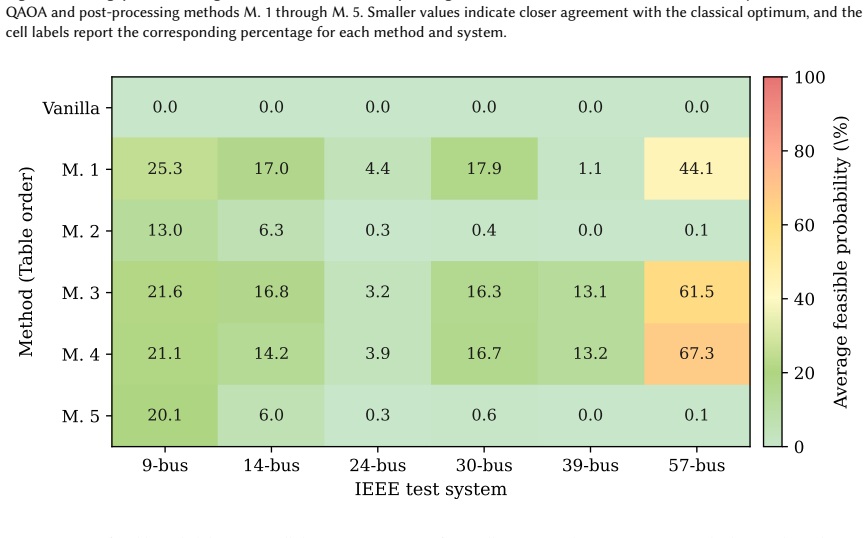
Quantum computing has rapidly emerged as a powerful paradigm for tackling computationally demanding problems. In particular, quantum optimization shows strong promise for hard combinatorial problems in power systems, where increasing distributed energy penetration heightens the need for intentional islanding to maintain grid reliability and resilience. However, power system islanding is an NP-hard combinatorial optimization problem that becomes computationally prohibitive for classical solvers as network size grows, motivating the use of quantum computing as a promising alternative pipeline. This study develops a resource-efficient hybrid QAOA islanding framework that brings physics-constrained power-system partitioning into the quantum optimization workflow. The framework combines coherency-informed graph reduction, physics-aware constraint modeling, and structured post-processing to efficiently convert shallow-circuit QAOA samples into high-quality feasible islanding decisions without deep circuits or large shot budgets. The proposed framework is validated on the standard IEEE benchmark systems (9-, 14-, 24-, 30-, 39-, and 57-bus), demonstrating that the hybrid workflow achieves Gurobi-optimal solution quality with a clear quantum resource advantage over vanilla QAOA, while the resulting islanding solutions satisfy all physical feasibility requirements after network separation. This study establishes QAOA-based islanding as a viable quantum approach for critical infrastructure, with structured post-processing as the key enabler of quantum resource efficiency.
Editorial analysis
A structured set of objections, weighed in public.
Referee Report
Summary. The manuscript introduces REGRID-QAOA, a hybrid QAOA framework for physics-constrained power system islanding. It integrates coherency-informed graph reduction, physics-aware constraint modeling, and structured post-processing to convert samples from shallow QAOA circuits into feasible islanding partitions. Validation is reported on the IEEE 9-, 14-, 24-, 30-, 39-, and 57-bus systems, with the central claim that the approach matches Gurobi solution quality, satisfies all physical feasibility constraints after separation, and provides a quantum resource advantage over vanilla QAOA.
Significance. If the performance claims are substantiated with quantitative evidence, the work would demonstrate a practical hybrid quantum-classical pipeline for a real-world NP-hard infrastructure problem. The emphasis on domain-informed reduction and post-processing to achieve resource efficiency on standard test cases could inform similar approaches in other constrained combinatorial optimization domains.
major comments (2)
- [Abstract and validation description] Abstract and validation description: the assertion that the hybrid workflow 'achieves Gurobi-optimal solution quality' on the six IEEE cases is presented without any accompanying quantitative data (objective values, optimality gaps, shot counts, circuit depths, or statistical comparisons). This evidence is load-bearing for the central claim.
- [Structured post-processing description] Structured post-processing description: no theorem, completeness argument, bias analysis, or ablation is supplied showing that the coherency-informed graph reduction plus physics-aware mapping is surjective onto the optimal solution set or free of topology/operating-point-dependent bias when applied to shallow-circuit QAOA samples. This assumption directly supports the optimality claim.
minor comments (1)
- The abstract would be strengthened by briefly stating the circuit depths and shot budgets used in the reported experiments.
Simulated Author's Rebuttal
We thank the referee for the constructive and detailed report. The two major comments identify substantive gaps in evidence and analysis that we agree require attention. We address each point below and outline the revisions we will make.
read point-by-point responses
-
Referee: [Abstract and validation description] Abstract and validation description: the assertion that the hybrid workflow 'achieves Gurobi-optimal solution quality' on the six IEEE cases is presented without any accompanying quantitative data (objective values, optimality gaps, shot counts, circuit depths, or statistical comparisons). This evidence is load-bearing for the central claim.
Authors: We agree that the abstract and validation description state the optimality claim without supporting numerical data. The full manuscript contains per-instance results, but these are not summarized with the requested metrics in the abstract or highlighted in the validation overview. In the revised version we will (i) add a compact table or set of key statistics to the abstract, (ii) expand the validation section with objective values, optimality gaps relative to Gurobi, shot counts, circuit depths, and basic statistical comparisons (mean and variance over multiple runs) for all six IEEE systems, and (iii) include a short paragraph quantifying the resource savings versus vanilla QAOA. These additions will make the central claim directly verifiable from the abstract and validation description. revision: yes
-
Referee: [Structured post-processing description] Structured post-processing description: no theorem, completeness argument, bias analysis, or ablation is supplied showing that the coherency-informed graph reduction plus physics-aware mapping is surjective onto the optimal solution set or free of topology/operating-point-dependent bias when applied to shallow-circuit QAOA samples. This assumption directly supports the optimality claim.
Authors: The referee is correct that the manuscript provides no formal completeness argument, surjectivity proof, or systematic bias analysis for the reduction-plus-post-processing pipeline. The current support is empirical, resting on the six tested IEEE cases. We will add (i) an ablation study that compares solution quality obtained with and without the coherency-informed reduction on the same QAOA samples, (ii) a short discussion of possible topology- or operating-point-dependent biases together with the empirical evidence that no such bias appeared on the benchmark set, and (iii) a concise completeness argument showing that the physics-aware mapping preserves all feasible islanding partitions that respect the coherency clusters. A general proof of surjectivity onto the global optimum for arbitrary networks is beyond the scope of the present work and will be noted as a limitation; the revision will therefore be partial on this specific request. revision: partial
Circularity Check
No circularity; claims benchmarked against external solver on public test cases
full rationale
The paper presents a hybrid QAOA framework with graph reduction and post-processing, validated by direct comparison of solution quality and resource use against the external classical solver Gurobi on standard IEEE bus systems. No equations, parameters, or predictions are defined in terms of themselves or fitted to a subset and then re-labeled as output. No load-bearing uniqueness theorems or ansatzes are imported via self-citation. The derivation chain remains self-contained because the optimality reference and feasibility checks originate outside the paper's own fitted quantities.
Axiom & Free-Parameter Ledger
Reference graph
Works this paper leans on
-
[1]
Maximilian Adler, Jonas Stein, and Michael Lachner. 2025. Scaling Quantum Simulation-Based Optimization: Demonstrating Efficient Power Grid Management with Deep QAOA Circuits.arXiv preprint arXiv:2505.16444(2025)
work page internal anchor Pith review Pith/arXiv arXiv 2025
-
[2]
Rhonda Au-Yeung, Nicholas Chancellor, and Pascal Halffmann. 2023. NP-hard but no longer hard to solve? Using quantum computing to tackle optimization problems.Frontiers in Quantum Science and Technology2 (2023), 1128576. doi:10.3389/frqst.2023.1128576
-
[3]
Tarique Aziz, Zhenzhi Lin, Muhammad Waseem, and Shengyuan Liu. 2021. Review on optimization methodologies in transmission network reconfiguration of power systems for grid resilience.International Transactions on Electrical Energy Systems31, 3 (2021), e12704
2021
-
[4]
Kishor Bharti, Alba Cervera-Lierta, Thi Ha Kyaw, Tobias Haug, Sumner Alperin-Lea, Abhinav Anand, Matthias Degroote, Hermanni Heimonen, Jakob S Kottmann, Tim Menke, et al. 2022. Noisy intermediate-scale quantum algorithms.Reviews of Modern Physics94, 1 (2022), 015004
2022
-
[5]
Kostas Blekos, Dean Brand, Andrea Ceschini, Chiao-Hui Chou, Rui-Hao Li, Komal Pandya, and Alessandro Summer. 2024. A review on Quantum Approximate Optimization Algorithm and its variants.Physics Reports1068 (2024), 1–66. doi:10.1016/j.physrep.2024.03.002
-
[6]
Alan Bundy and Lincoln Wallen. 1984. Breadth-first search. InCatalogue of artificial intelligence tools. Springer, 13–13
1984
-
[7]
M Cerezo, Andrew Arrasmith, Ryan Babbush, Simon C Benjamin, Suguru Endo, Keisuke Fujii, Jarrod R McClean, Kosuke Mitarai, Xiao Yuan, Lukasz Cincio, and Patrick J Coles. 2021. Variational quantum algorithms.Nature Reviews Physics3, 9 (2021), 625–644
2021
-
[8]
Liang Che, Xuan Liu, and Zuyi Li. 2018. Preventive mitigation strategy for the hidden Nk line contingencies in power systems.IEEE Transactions on Reliability67, 3 (2018), 1060–1070
2018
-
[9]
Francisco Chicano, Gabriel Luque, Zakaria Abdelmoiz Dahi, and Rodrigo Gil-Merino. 2024. Combinatorial Optimization with Quantum Computers. Engineering Optimization(2024). doi:10.1080/0305215X.2024.2435538
-
[10]
1982.Time-scale modeling of dynamic networks with applications to power systems
Joe H Chow. 1982.Time-scale modeling of dynamic networks with applications to power systems. Springer
1982
-
[11]
Ibrahim Dincer. 2000. Renewable energy and sustainable development: a crucial review.Renewable and sustainable energy reviews4, 2 (2000), 157–175
2000
-
[12]
Tao Ding, Kai Sun, Can Huang, Zhaohong Bie, and Fangxing Li. 2018. Mixed-integer linear programming-based splitting strategies for power system islanding operation considering network connectivity.IEEE Systems Journal12, 1 (2018), 350–359
2018
-
[13]
Edward Farhi, Jeffrey Goldstone, and Sam Gutmann. 2014. A Quantum Approximate Optimization Algorithm. arXiv:1411.4028 [quant-ph]
work page internal anchor Pith review Pith/arXiv arXiv 2014
-
[14]
Felix Gemeinhardt, Antonio Garmendia, Manuel Wimmer, Benjamin Weder, and Frank Leymann. 2024. Quantum Combinatorial Optimization in the NISQ Era: A Systematic Mapping Study.Comput. Surveys56, 3 (2024), 70:1–70:36. doi:10.1145/3620668
-
[15]
Hengdao Guo, Ciyan Zheng, Herbert Ho-Ching Iu, and Tyrone Fernando. 2017. A critical review of cascading failure analysis and modeling of power system.Renewable and Sustainable Energy Reviews80 (2017), 9–22
2017
-
[16]
Gonzalez Calaza, Thiemo Pesch, Kristel Michielsen, and Andrea Benigni
Carsten Hartmann, Junjie Zhang, Carlos D. Gonzalez Calaza, Thiemo Pesch, Kristel Michielsen, and Andrea Benigni. 2025. Quantum Annealing Based Power Grid Partitioning for Parallel Simulation.IEEE Transactions on Power Systems40, 6 (2025), 4958–4970. doi:10.1109/TPWRS.2025.3578243
-
[17]
Lei Huang, Yuanzhang Sun, Jian Xu, Wenzhong Gao, Jun Zhang, and Ziping Wu. 2014. Optimal PMU placement considering controlled islanding of power system.IEEE Transactions on Power Systems29, 2 (2014), 742–755
2014
-
[18]
IBM Quantum. 2026. Compute resources. https://quantum.cloud.ibm.com/computers Accessed: 2026-04-12
2026
-
[19]
IBM Quantum. 2026. FakeMarrakesh. https://quantum.cloud.ibm.com/docs/en/api/qiskit-ibm-runtime/fake-provider-fake-marrakesh Accessed: 2026-06-01
2026
-
[20]
IBM Quantum. 2026. Processor types. https://quantum.cloud.ibm.com/docs/en/guides/processor-types Accessed: 2026-04-12
2026
-
[21]
Yuqi Jiang, Zhiding Liang, Yan Li, Qiang Guan, and Ganesh Kumar Venayagamoorthy. 2025. Quantum Computing-Enabled Contingency Analysis for Power Systems. In2025 IEEE International Conference on Quantum Computing and Engineering (QCE), Vol. 01. 1938–1944. doi:10.1109/QCE65121. 2025.00211
-
[22]
Yuqi Jiang, Zhiding Liang, Yan Li, and Thomas Morstyn. 2025. Optimal PMU Placement via Quantum Optimization.IEEE Transactions on Smart Grid 16, 4 (2025), 3125–3141. doi:10.1109/TSG.2025.3564889
-
[23]
Alexis Kyriacou, Panayiotis Demetriou, Christos Panayiotou, and Elias Kyriakides. 2017. Controlled islanding solution for large-scale power systems. IEEE Transactions on Power Systems33, 2 (2017), 1591–1602
2017
-
[24]
Juan Li, Chen-Ching Liu, and Kevin Schneider. 2010. Controlled Partitioning of a Power Network Considering Real and Reactive Power Balance. IEEE Transactions on Smart Grid1, 3 (2010), 261–269. doi:10.1109/TSG.2010.2082577
-
[25]
Ashley Montanaro. 2016. Quantum algorithms: an overview.npj Quantum Information2 (2016), 15023. doi:10.1038/npjqi.2015.23
-
[26]
Thomas Morstyn and Xingyu Wang. 2024. Opportunities for quantum computing within net-zero power system optimization.Joule8, 6 (2024), 1619–1640. doi:10.1016/j.joule.2024.03.020
-
[27]
Hasan Mustafa, Sai Nandan Morapakula, Prateek Jain, and Srinjoy Ganguly. 2022. Variational quantum algorithms for chemical simulation and drug discovery. In2022 International Conference on Trends in Quantum Computing and Emerging Business Technologies (TQCEBT). IEEE, 1–8. Manuscript submitted to ACM 28 Yuqi Jiang, Yuqi Zhang, Zhiding Liang, Qiang Guan, Ya...
2022
-
[28]
Pradeep Niroula, Ruslan Shaydulin, Romina Yalovetzky, Pierre Minssen, Dylan Herman, Shaohan Hu, and Marco Pistoia. 2022. Constrained Quantum Optimization for Extractive Summarization on a Trapped-ion Quantum Computer.Scientific Reports12 (2022), 17171. doi:10.1038/s41598-022-20853-w
-
[29]
John Preskill. 2018. Quantum computing in the NISQ era and beyond.Quantum2 (2018), 79
2018
-
[30]
Tatsuhiko Shirai and Nozomu Togawa. 2024. Postprocessing Variationally Scheduled Quantum Algorithm for Constrained Combinatorial Optimiza- tion Problems.IEEE Transactions on Quantum Engineering5 (2024), 1–14. doi:10.1109/TQE.2024.3376721
-
[31]
Kai Sun, Da-Zhong Zheng, and Qiang Lu. 2003. Splitting strategies for islanding operation of large-scale power systems using OBDD-based methods. IEEE transactions on Power Systems18, 2 (2003), 912–923
2003
-
[32]
Robert Tarjan. 1972. Depth-first search and linear graph algorithms.SIAM journal on computing1, 2 (1972), 146–160
1972
- [33]
-
[34]
Haibo You, Vijay Vittal, and Xiaoming Wang. 2004. Slow coherency-based islanding.IEEE Transactions on power systems19, 1 (2004), 483–491
2004
-
[35]
independent constraints
Kamila Zaman, Alberto Marchisio, Muhammad Kashif, and Muhammad Shafique. 2024. Po-qa: A framework for portfolio optimization using quantum algorithms. In2024 IEEE International Conference on Quantum Computing and Engineering (QCE), Vol. 1. IEEE, 1397–1403. A Formal Analysis of Post-Processing Methods This appendix provides rigorous proofs of the descent, ...
2024
discussion (0)
Sign in with ORCID, Apple, or X to comment. Anyone can read and Pith papers without signing in.