When Cognitive Graphs Meet LLMs: BDEI Cognitive Pathways for Panic Emotional Arousal Prediction
Pith reviewed 2026-06-27 04:43 UTC · model grok-4.3
The pith
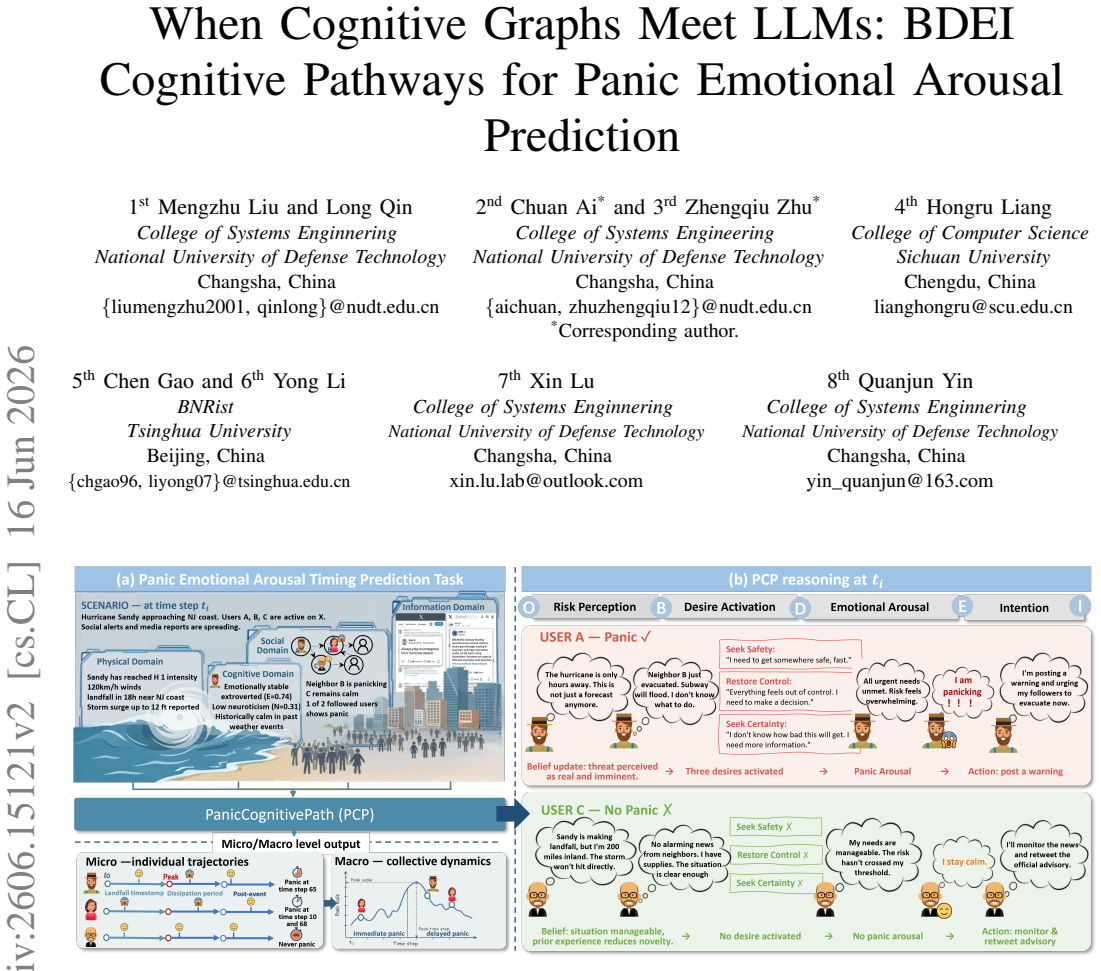
PCP framework predicts panic emotional arousal timing by fusing four-domain signals into a risk metric and routing through a BDEI pathway with LLM limited to one transition.
A machine-rendered reading of the paper's core claim, the machinery that carries it, and where it could break.
Core claim
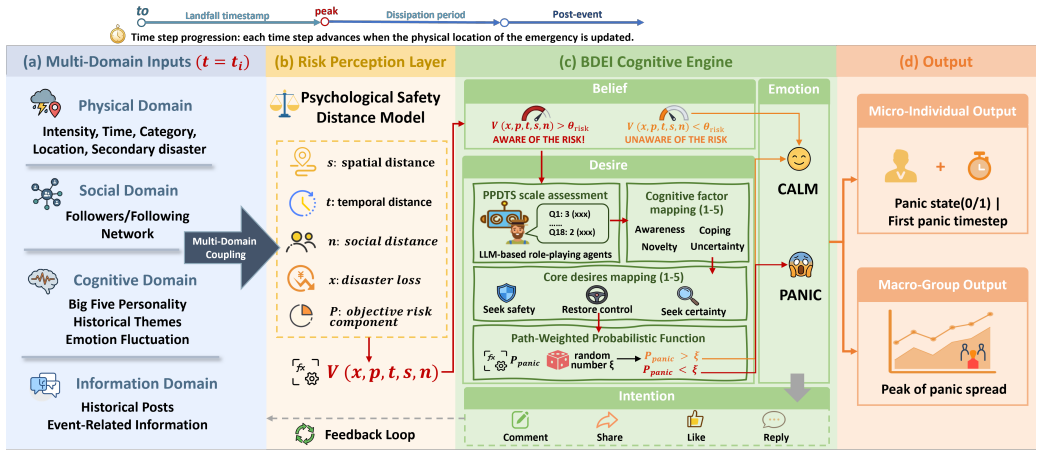
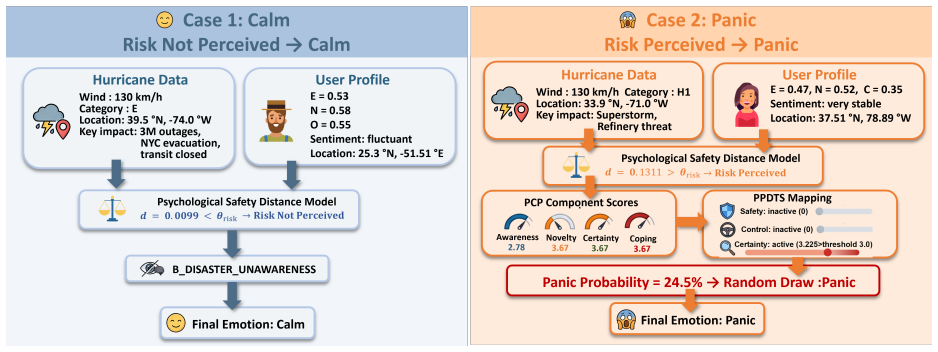
The paper claims that the PCP framework solves the three identified problems by mapping four-domain signals via the Psychological Safety Distance model into a risk metric that triggers entry into the BDEI pathway, where an explicit Emotion node grounded in appraisal emotion theory directly links threat appraisal to emotional arousal, all state transitions are governed by BDEI, and the LLM is confined to the Belief-to-Desire transition to prevent hallucination propagation, resulting in more accurate prediction of panic emotional arousal timing.
What carries the argument
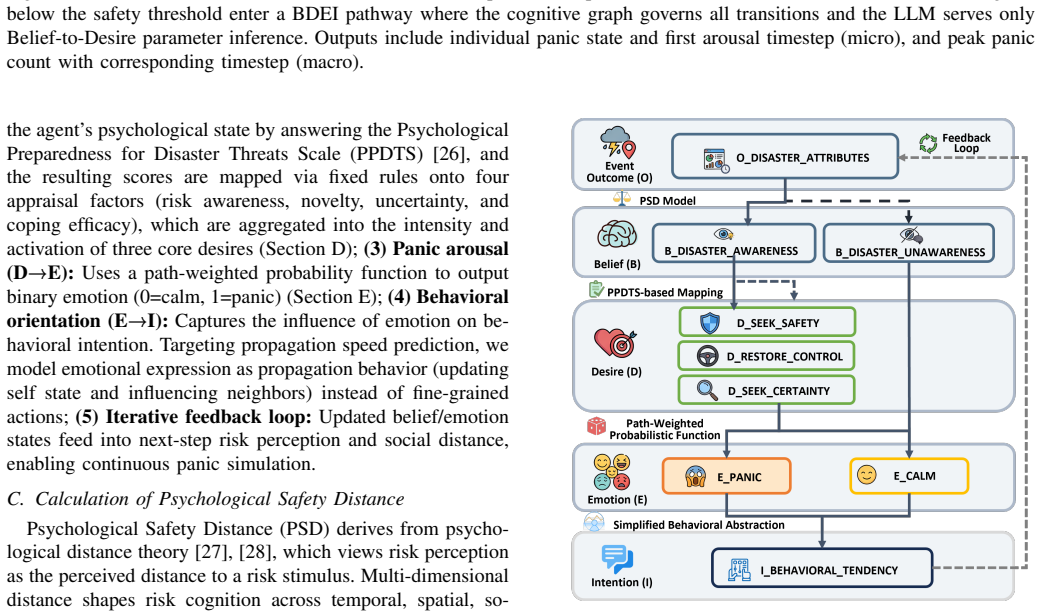
The BDEI pathway, an extension of BDI that inserts an explicit Emotion node to couple appraisal directly to arousal, with the LLM restricted to Belief-to-Desire parameter estimation.
If this is right
- Agents whose risk metric exceeds the PSD threshold enter the BDEI pathway for direct coupling of appraisal to emotional arousal.
- The LLM is confined to a single transition step, preventing error propagation through the cognitive graph.
- All state transitions in the model are governed by the BDEI pathway rather than LLM outputs.
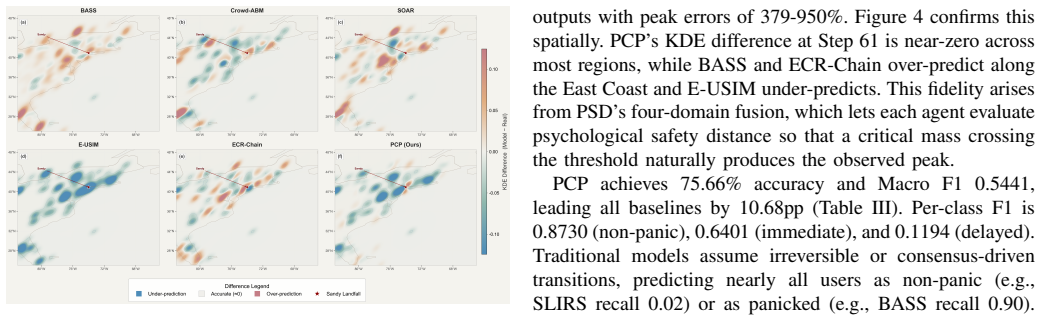
- Experiments demonstrate a 10.68% gain in arousal timing accuracy and reduction of peak count error to 7.07% on Hurricane Sandy data.
Where Pith is reading between the lines
- The hybrid structure could be adapted to predict timing of other emotions in non-emergency settings such as mental health monitoring.
- Testing the PSD fusion step independently on additional signal sources would clarify whether the risk metric generalizes beyond the four domains used here.
- Real-time deployment in emergency systems might allow earlier interventions if the threshold reliably precedes observable arousal peaks.
Load-bearing premise
The Psychological Safety Distance model correctly fuses four-domain signals into a risk metric that serves as a valid entry condition for the BDEI pathway, and the BDEI structure with LLM limited to Belief-to-Desire accurately models the direct link from appraisal to emotional arousal.
What would settle it
If applying the PCP framework to datasets from other panic-inducing events yields no improvement in arousal timing accuracy or peak count error over the same baselines, the performance advantage would be falsified.
Figures
read the original abstract
Predicting individual panic emotional arousal timing before manifestation is essential for proactive emergency intervention. Existing methods incorporate cognitive elements but none explicitly model the emotional arousal process, making them ill-suited for emotional arousal timing prediction. We argue that grounding prediction in appraisal emotion theory is necessary because it explicitly models this process, but three problems must be solved. (1) Appraisal theory posits that emotion arises from simultaneous evaluation across multiple threat dimensions, yet no prior work fuses these inputs into risk perception. (2) Existing cognitive models lack an Emotion node, decoupling threat appraisal from emotional arousal and forcing emotions to be inferred indirectly from behaviors. (3) Given their generalizable cognitive reasoning, current approaches adopt LLMs as the primary decision-maker, yet overlook the fragility and hallucination-proneness of their outputs. To address these issues, we introduce PanicCognitivePath (PCP), a framework that addresses all three. A Psychological Safety Distance (PSD) model, grounded in psychological distance theory, maps four-domain signals into a unified risk metric as the entry condition for subsequent cognitive reasoning. An explicit Emotion node grounded in appraisal emotion theory is introduced into BDI, forming a Belief-Desire-Emotion-Intention (BDEI) pathway. Agents whose risk metric exceeds the PSD threshold enter this pathway, coupling threat appraisal directly to emotional arousal. The BDEI pathway governs all state transitions while the LLM is confined to parameter estimation for the Belief-to-Desire transition, confining hallucinations to a single step and preventing error propagation. Experiments on Hurricane Sandy show PCP improves arousal timing accuracy by 10.68% over baselines, reduces peak count error to 7.07%.
Editorial analysis
A structured set of objections, weighed in public.
Referee Report
Summary. The manuscript introduces the PanicCognitivePath (PCP) framework for predicting individual panic emotional arousal timing. It proposes a Psychological Safety Distance (PSD) model, grounded in psychological distance theory, to fuse four-domain signals into a unified risk metric that gates entry into a Belief-Desire-Emotion-Intention (BDEI) pathway; an explicit Emotion node is added to the classic BDI structure so that threat appraisal couples directly to emotional arousal. The LLM is restricted to parameter estimation only in the Belief-to-Desire transition. Experiments on the Hurricane Sandy dataset report that PCP improves arousal timing accuracy by 10.68% over baselines and reduces peak-count error to 7.07%.
Significance. If the PSD risk metric can be shown to function as a psychologically grounded gate rather than a post-hoc threshold and if the reported gains can be attributed to the explicit Emotion node and the restricted LLM role, the work would supply a concrete mechanism for embedding appraisal theory inside cognitive-agent architectures that use LLMs. This could be relevant for proactive intervention systems where the timing of emotional arousal must be anticipated from multi-domain signals.
major comments (3)
- [Abstract] Abstract: the headline claims of a 10.68% gain in arousal timing accuracy and a 7.07% peak-count error are presented without any definition of the baselines, the exact metric used for “arousal timing accuracy,” statistical significance tests, confidence intervals, or error analysis. Because these numbers are the sole empirical support for the central claim that the BDEI pathway improves prediction, their unverifiability is load-bearing.
- [PSD model description] PSD model: the manuscript states that the PSD model “maps four-domain signals into a unified risk metric as the entry condition” for the BDEI pathway, yet supplies neither the fusion equation, the definitions of the four domains, nor any separate validation (e.g., correlation between threshold crossings and observed arousal onsets). Without this, it is impossible to confirm that the reported performance originates from the claimed appraisal-to-arousal coupling rather than from an arbitrary detector.
- [Experiments] Experiments section: evaluation is performed on a single dataset (Hurricane Sandy) with no cross-validation, no sensitivity analysis on the PSD threshold (listed as a free parameter), and no comparison against alternative threshold-based or non-cognitive baselines. This leaves open the possibility that the 10.68% figure is not independent of post-hoc choices.
minor comments (1)
- [BDEI pathway] The precise state-transition rules inside the BDEI pathway (how the Emotion node alters Desire and Intention) are described at a high level but lack the formal specification or pseudocode that would be needed for replication.
Simulated Author's Rebuttal
We thank the referee for the constructive and detailed comments. We address each major comment point by point below, indicating where revisions will be made to improve clarity and verifiability.
read point-by-point responses
-
Referee: [Abstract] Abstract: the headline claims of a 10.68% gain in arousal timing accuracy and a 7.07% peak-count error are presented without any definition of the baselines, the exact metric used for “arousal timing accuracy,” statistical significance tests, confidence intervals, or error analysis. Because these numbers are the sole empirical support for the central claim that the BDEI pathway improves prediction, their unverifiability is load-bearing.
Authors: We agree that the abstract would benefit from greater specificity on these elements to make the claims immediately verifiable. In the revised manuscript we will expand the abstract to define arousal timing accuracy (as the proportion of correctly predicted arousal onsets within a tolerance window), name the primary baselines, and note that statistical significance was assessed via paired t-tests with reported p-values. Full confidence intervals and error breakdowns will remain in the Experiments section due to length constraints, but the abstract will now direct readers to them. revision: yes
-
Referee: [PSD model description] PSD model: the manuscript states that the PSD model “maps four-domain signals into a unified risk metric as the entry condition” for the BDEI pathway, yet supplies neither the fusion equation, the definitions of the four domains, nor any separate validation (e.g., correlation between threshold crossings and observed arousal onsets). Without this, it is impossible to confirm that the reported performance originates from the claimed appraisal-to-arousal coupling rather than from an arbitrary detector.
Authors: This observation is correct; the current description is high-level. We will add an explicit subsection that (1) defines the four domains drawn from psychological distance theory, (2) presents the fusion equation used to compute the unified PSD risk metric, and (3) reports a validation analysis correlating PSD threshold crossings with observed arousal onsets on the Hurricane Sandy data. These additions will allow readers to evaluate whether the performance gain stems from the intended appraisal mechanism. revision: yes
-
Referee: [Experiments] Experiments section: evaluation is performed on a single dataset (Hurricane Sandy) with no cross-validation, no sensitivity analysis on the PSD threshold (listed as a free parameter), and no comparison against alternative threshold-based or non-cognitive baselines. This leaves open the possibility that the 10.68% figure is not independent of post-hoc choices.
Authors: We acknowledge the limitations of the reported experimental design. In the revision we will (1) add k-fold cross-validation results, (2) include a sensitivity analysis sweeping the PSD threshold and showing that performance remains stable across a reasonable range, and (3) introduce comparisons against both simple threshold detectors and standard non-cognitive baselines (e.g., LSTM and random forest on the same features). These changes will better isolate the contribution of the explicit Emotion node and restricted LLM role. revision: yes
Circularity Check
No circularity in derivation chain
full rationale
The paper presents a descriptive framework (PSD model + BDEI pathway) grounded in existing psychological theories and reports empirical results on the Hurricane Sandy dataset. No equations, parameter-fitting steps, or self-citations are visible in the provided text that would reduce any claimed prediction or result to an input by construction. The performance metrics are presented as experimental outcomes rather than derived quantities, and the central claims rest on the introduction of new nodes and thresholds without evidence of self-referential definition or load-bearing self-citation chains. This is a standard case of a self-contained empirical proposal against external benchmarks.
Axiom & Free-Parameter Ledger
free parameters (1)
- PSD threshold
axioms (1)
- domain assumption Appraisal emotion theory provides an accurate simultaneous multi-dimension evaluation that produces emotional arousal
invented entities (2)
-
Psychological Safety Distance (PSD) model
no independent evidence
-
Emotion node in BDEI pathway
no independent evidence
Reference graph
Works this paper leans on
-
[1]
Looting and antisocial behavior after disasters: a systematic review,
R. A. Sheikhi, R. Javanbakhtian, and M. Heidari, “Looting and antisocial behavior after disasters: a systematic review,”BMC Public Health, vol. 25, no. 1, p. 309, 2025
2025
-
[2]
Exposure to rapid succession disasters: a study of residents at the epicenter of the chilean b ´ıo b´ıo earthquake.,
D. R. Garfin, R. C. Silver, F. J. Ugalde, H. Linn, and M. Inostroza, “Exposure to rapid succession disasters: a study of residents at the epicenter of the chilean b ´ıo b´ıo earthquake.,”Journal of abnormal psychology, vol. 123, no. 3, p. 545, 2014
2014
-
[3]
A novel agent- based approach for dynamic emotion modeling in social networks,
X. Wu, L. Lu, M. Dotoli, G. Fortino, and M. Chen, “A novel agent- based approach for dynamic emotion modeling in social networks,” IEEE Transactions on Cybernetics, 2025
2025
-
[4]
Bdi agents in social simulations: a survey,
C. Adam and B. Gaudou, “Bdi agents in social simulations: a survey,” The Knowledge Engineering Review, vol. 31, no. 3, pp. 207–238, 2016
2016
-
[5]
Purple: Making a large language model a better sql writer,
T. Ren, Y . Fan, Z. He, R. Huang, J. Dai, C. Huang, Y . Jing, K. Zhang, Y . Yang, and X. S. Wang, “Purple: Making a large language model a better sql writer,” in2024 IEEE 40th International Conference on Data Engineering (ICDE), pp. 15–28, IEEE, 2024
2024
-
[6]
Lego-graphrag: Modularizing graph-based retrieval-augmented generation for design space exploration,
Y . Cao, Z. Gao, Z. Li, X. Xie, S. K. Zhou, and J. Xu, “Lego-graphrag: Modularizing graph-based retrieval-augmented generation for design space exploration,”Proceedings of the VLDB Endowment, vol. 18, p. 3269–3283, June 2025
2025
-
[7]
In-depth analysis of graph-based rag in a unified framework,
Y . Zhou, Y . Su, Y . Sun, S. Wang, T. Wang, R. He, Y . Zhang, S. Liang, X. Liu, Y . Ma, and Y . Fang, “In-depth analysis of graph-based rag in a unified framework,”Proc. VLDB Endow., vol. 18, p. 5623–5637, Sept. 2025
2025
-
[8]
Multirag: a knowledge-guided framework for mitigating hallucination in multi- source retrieval augmented generation,
W. Wu, H. Wang, B. Li, P. Huang, X. Zhao, and L. Liang, “Multirag: a knowledge-guided framework for mitigating hallucination in multi- source retrieval augmented generation,” in2025 IEEE 41st International Conference on Data Engineering (ICDE), pp. 3070–3083, IEEE, 2025
2025
-
[9]
Computational models of emotion inference in theory of mind: A review and roadmap,
D. C. Ong, J. Zaki, and N. D. Goodman, “Computational models of emotion inference in theory of mind: A review and roadmap,”Topics in cognitive science, vol. 11, no. 2, pp. 338–357, 2019
2019
-
[10]
Some: A realistic benchmark for llm-based social media agents,
D. Xue, J. Cui, S. Qian, C. Hu, and C. Xu, “Some: A realistic benchmark for llm-based social media agents,” inProceedings of the AAAI Conference on Artificial Intelligence, vol. 40, pp. 1391–1399, 2026
2026
-
[11]
Computational models and optimal control strategies for emotion contagion in the human population in emergencies,
X. Wang, L. Zhang, Y . Lin, Y . Zhao, and X. Hu, “Computational models and optimal control strategies for emotion contagion in the human population in emergencies,”Knowledge-Based Systems, vol. 109, pp. 35– 47, 2016
2016
-
[12]
Modeling the spread of negative emotions in social networks during sudden public crisis events: Dual mechanisms of social reinforcement and individual regulation,
T. W ANG, T. LIU, and C. LI, “Modeling the spread of negative emotions in social networks during sudden public crisis events: Dual mechanisms of social reinforcement and individual regulation,”Journal of Tsinghua University (Science and Technology), vol. 65, no. 6, pp. 1040–1049, 2025
2025
-
[13]
Emotional contagion on social media and the simulation of intervention strategies after a disaster event: A modeling study,
M. Chu, W. Song, Z. Zhao, T. Chen, and Y .-c. Chiang, “Emotional contagion on social media and the simulation of intervention strategies after a disaster event: A modeling study,”Humanities and Social Sciences Communications, vol. 11, no. 1, 2024
2024
-
[14]
Improved crowd dynamics analysis considering physical contact force and panic emotional propagation,
R. Zhao, B. Wei, C. Han, P. Jia, W. Zhu, C. Li, and Y . Ma, “Improved crowd dynamics analysis considering physical contact force and panic emotional propagation,”IEEE Transactions on Intelligent Transportation Systems, vol. 26, no. 2, pp. 1840–1851, 2024
2024
-
[15]
Generative agents: Interactive simulacra of human behavior,
J. S. Park, J. O’Brien, C. J. Cai, M. R. Morris, P. Liang, and M. S. Bernstein, “Generative agents: Interactive simulacra of human behavior,” inProceedings of the 36th annual acm symposium on user interface software and technology, pp. 1–22, 2023
2023
-
[16]
Agentsociety: Large-scale simulation of llm- driven generative agents advances understanding of human behaviors and society,
J. Piao, Y . Yan, J. Zhang, N. Li, J. Yan, X. Lan, Z. Lu, Z. Zheng, J. Y . Wang, D. Zhou,et al., “Agentsociety: Large-scale simulation of llm- driven generative agents advances understanding of human behaviors and society,” 2025
2025
-
[17]
An llm-enhanced agent-based simulation tool for information propagation.,
Y . Hu, G. Sherpa, L. Zhang, W. Li, Q. Bai, Y . Wang, and X. Wang, “An llm-enhanced agent-based simulation tool for information propagation.,” inIJCAI, pp. 8679–8682, 2024
2024
-
[18]
Yulan-onesim: Towards the next generation of social simulator with large language models,
L. Wang, H. Gao, X. Bo, X. Chen, and J.-R. Wen, “Yulan-onesim: Towards the next generation of social simulator with large language models,” inWorkshop on Scaling Environments for Agents, 2025
2025
-
[19]
Coe: A clue of emotion framework for emotion recognition in conversations,
Z. Shen, Y . Pang, Y . Rao, and J. Yu, “Coe: A clue of emotion framework for emotion recognition in conversations,” inProceedings of the 63rd Annual Meeting of the Association for Computational Linguistics (Volume 1: Long Papers), pp. 23548–23563, 2025
2025
-
[20]
Ortony, G
A. Ortony, G. L. Clore, and A. Collins,The cognitive structure of emotions. Cambridge university press, 2022
2022
-
[21]
On the logic of agent’s emotions,
Y . Wang, Z. Liu, T. Liu, A. V . Samsonovich, and V . V . Klimov, “On the logic of agent’s emotions,”Cognitive Systems Research, vol. 88, p. 101281, 2024
2024
-
[22]
Modeling Multi-Dimensional Cognitive States in Large Language Models under Cognitive Crowding
L. Zhong, S. Zhu, Z. Yuan, J. Cui, X. Zhao, L. Wang, H. Chen, and Q. Liao, “Modeling multi-dimensional cognitive states in large language models under cognitive crowding,”arXiv preprint arXiv:2604.17174, 2026
work page internal anchor Pith review Pith/arXiv arXiv 2026
-
[23]
Bdi agents: from theory to practice.,
A. S. Rao, M. P. Georgeff,et al., “Bdi agents: from theory to practice.,” inIcmas, vol. 95, pp. 312–319, 1995
1995
-
[24]
Bdi agent architectures: A survey,
L. De Silva, F. Meneguzzi, and B. Logan, “Bdi agent architectures: A survey,” in29th International Joint Conference on Artificial Intelligence, IJCAI 2020, International Joint Conferences on Artificial Intelligence, 2020
2020
-
[25]
Emotional contagion,
E. Hatfield, J. T. Cacioppo, and R. L. Rapson, “Emotional contagion,” Current directions in psychological science, vol. 2, no. 3, pp. 96–100, 1993
1993
-
[26]
Conceptualising and measuring psychological preparedness for disaster: The psychological preparedness for disaster threat scale,
J. McLennan, M. D. Marques, and D. Every, “Conceptualising and measuring psychological preparedness for disaster: The psychological preparedness for disaster threat scale,”Natural Hazards, vol. 101, no. 1, pp. 297–307, 2020
2020
-
[27]
Psychical distance
E. Bullogh, “Psychical distance” as a factor in art and an aesthetic principle,”Journal of Psychology, vol. 5, no. 2, pp. 87–118, 1912
1912
-
[28]
Construal-level theory of psychological distance.,
Y . Trope and N. Liberman, “Construal-level theory of psychological distance.,”Psychological review, vol. 117, no. 2, p. 440, 2010
2010
-
[29]
Construal levels and psycho- logical distance: Effects on representation, prediction, evaluation, and behavior,
Y . Trope, N. Liberman, and C. Wakslak, “Construal levels and psycho- logical distance: Effects on representation, prediction, evaluation, and behavior,”Journal of consumer psychology, vol. 17, no. 2, pp. 83–95, 2007
2007
-
[30]
Recipient syringe sharing and its relation- ship to social proximity, perception of risk and preparedness to share,
B. P. Smyth and A. Roche, “Recipient syringe sharing and its relation- ship to social proximity, perception of risk and preparedness to share,” Addictive Behaviors, vol. 32, no. 9, pp. 1943–1948, 2007
1943
-
[31]
Judgmental discounting and environmen- tal risk perception: Dimensional similarities, domain differences, and implications for sustainability,
A. Gattig and L. Hendrickx, “Judgmental discounting and environmen- tal risk perception: Dimensional similarities, domain differences, and implications for sustainability,”Journal of Social Issues, vol. 63, no. 1, pp. 21–39, 2007
2007
-
[32]
Psychological distance model for environmental risk communication,
S. She, M. Chao-Qun, L. Qiang, and C. Xie, “Psychological distance model for environmental risk communication,”Syst. Eng, vol. 9, 2012
2012
-
[33]
Psychological distance,
N. Liberman, Y . Trope, E. Stephan,et al., “Psychological distance,” Social psychology: Handbook of basic principles, vol. 2, no. 2, pp. 353– 383, 2007
2007
-
[34]
Psychological stress and the coping process,
R. S. Lazarus, “Psychological stress and the coping process,”The American Journal of Psychology, vol. 83, no. 4, 1966
1966
-
[35]
Motivated closing of the mind:
A. W. Kruglanski and D. M. Webster, “Motivated closing of the mind:” seizing” and” freezing.”,”Psychological review, vol. 103, no. 2, p. 263, 1996
1996
-
[36]
Pychoagent: Psychology-driven llm agents for explainable panic prediction on social media during sudden disaster events,
M. Liu, Z. Zhu, C. Ai, C. Gao, X. Li, L. He, K. Lai, Y . Chen, X. Lu, Y . Li,et al., “Pychoagent: Psychology-driven llm agents for explainable panic prediction on social media during sudden disaster events,” in Proceedings of the 2025 Conference on Empirical Methods in Natural Language Processing, pp. 17127–17145, 2025
2025
-
[37]
Performance of social network sensors during hurricane sandy,
Y . Kryvasheyeu, H. Chen, E. Moro, P. Van Hentenryck, and M. Cebrian, “Performance of social network sensors during hurricane sandy,”PLoS one, vol. 10, no. 2, p. e0117288, 2015
2015
-
[38]
A new product growth for model consumer durables,
F. M. Bass, “A new product growth for model consumer durables,” Management science, vol. 15, no. 5, pp. 215–227, 1969
1969
-
[39]
Mass media and its impact on opinion dynamics of the nonlinear q-voter model,
R. Muslim, R. A. Nqz, and M. A. Khalif, “Mass media and its impact on opinion dynamics of the nonlinear q-voter model,”Physica A: Statistical Mechanics and its Applications, vol. 633, p. 129358, 2024
2024
-
[40]
Agent-based modeling of covid-19 vaccine uptake in new york state: Information diffusion in hy- brid spaces,
F. Yin, N. Jiang, A. Crooks, and L. Laurian, “Agent-based modeling of covid-19 vaccine uptake in new york state: Information diffusion in hy- brid spaces,” inProceedings of the 7th ACM SIGSPATIAL International Workshop on GeoSpatial Simulation, pp. 11–20, 2024
2024
-
[41]
Crowd: A social network simulation framework,
A. N. N. Rende, T. Yilmaz, and O. Ulusoy, “Crowd: A social network simulation framework,”IEEE Transactions on Computational Social Systems, 2025
2025
-
[42]
Modelling internet users’ negative emotion based on soar model,
P. Wu, S. Qiang, and Q. Gao, “Modelling internet users’ negative emotion based on soar model,”Chin J Manag Sci, vol. 26, no. 3, pp. 126–138, 2018
2018
-
[43]
Predicting emotion dynamics sequence on twitter via deep learning approach,
D. Naskar, E. Onaindia, M. Rebollo, and S. R. Singh, “Predicting emotion dynamics sequence on twitter via deep learning approach,” in Proceedings of the 18th International Conference on Advances in Mobile Computing & Multimedia, pp. 20–24, 2020
2020
-
[44]
Information diffusion prediction with graph neural ordinary differential equation network,
D. Wang, W. Zhou, and S. Hu, “Information diffusion prediction with graph neural ordinary differential equation network,” inProceedings of the 32nd ACM International Conference on Multimedia, pp. 9699–9708, 2024
2024
-
[45]
Z. Huang, J. Zhao, and Q. Jin, “Ecr-chain: Advancing generative language models to better emotion-cause reasoners through reasoning chains,”arXiv preprint arXiv:2405.10860, 2024
-
[46]
Modeling cognitive-affective processes with appraisal and reinforcement learning,
J. E. Zhang, J. Broekens, and J. P. Jokinen, “Modeling cognitive-affective processes with appraisal and reinforcement learning,”IEEE Transactions on Affective Computing, vol. 16, no. 2, pp. 771–782, 2024
2024
discussion (0)
Sign in with ORCID, Apple, or X to comment. Anyone can read and Pith papers without signing in.