Underscreening and related phenomena in concentrated electrolytes
Pith reviewed 2026-06-27 03:28 UTC · model grok-4.3
The pith
Mutual binding of charge carriers in concentrated electrolytes creates diffusion barriers that suppress mobile particle concentration and increase screening length.
A machine-rendered reading of the paper's core claim, the machinery that carries it, and where it could break.
Core claim
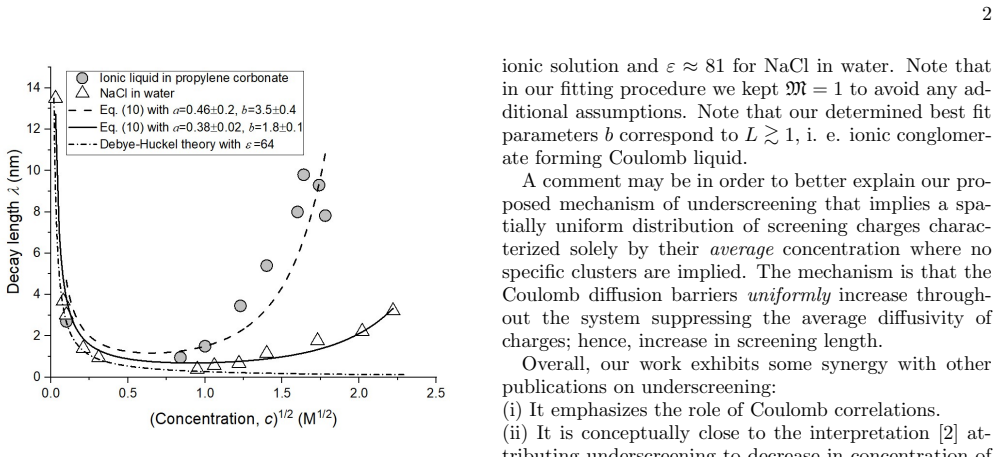
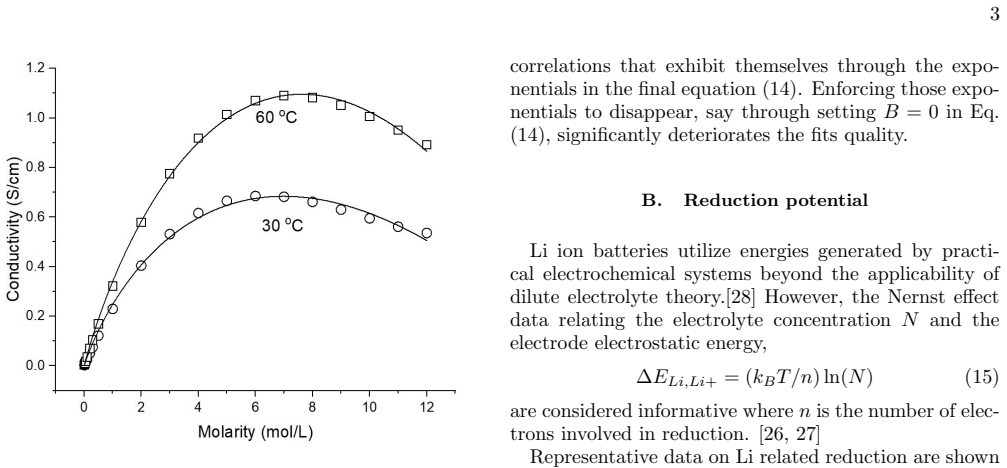
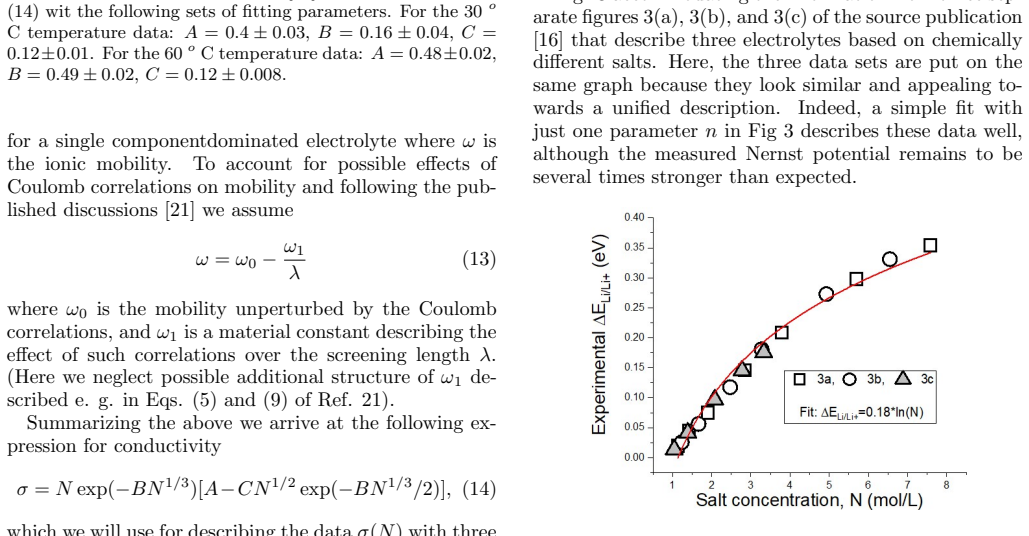
The central claim is that underscreening arises because mutual binding among charge carriers generates diffusion barriers, which suppress the effective concentration of mobile particles and thereby increase the screening length L. The model supplies a unified account of the observed growth of L with particle concentration, the conductivity and reduction potential of concentrated electrolytes, and the analogous behavior of electron-hole systems under ultra-high dose rate irradiation.
What carries the argument
Heuristic model in which mutual binding creates diffusion barriers that suppress mobile particle concentration
If this is right
- Screening length increases rather than decreases as charge-particle concentration rises.
- Conductivity drops because fewer particles remain mobile.
- Chemical reaction rates that produce biologically active radicals slow down, accounting for the sparing effect under ultra-high dose rate radiation.
Where Pith is reading between the lines
- The barrier mechanism may apply to other dense ionic fluids such as molten salts or room-temperature ionic liquids.
- Quantitative estimates of barrier height from binding energies could yield parameter-free predictions for screening lengths.
- Similar trapping of carriers under high injection may occur in semiconductor plasmas or photoexcited solids.
Load-bearing premise
Mutual binding in high-density Coulomb systems creates diffusion barriers that substantially suppress the concentration of mobile particles.
What would settle it
Direct measurement or simulation showing that the fraction of mobile particles remains constant or increases with total concentration in concentrated electrolytes.
Figures
read the original abstract
We propose a heuristic model of underscreening phenomenon in high density Coulomb systems, such as concentrated electrolytes and electron hole conglomerates under ultra high dose rate (UHDR) radiation in biological tissues. It explains the data on screening length $L$ increasing with charge particle concentration and offers additional insights in understanding the conductivity and reduction potential of concentrated electrolytes. Also, it validates our current understanding of the FLASH radiation treatment of tumors (FLASH-RT) perceived as an analogous system. The underlying physics is that mutual binding creates diffusion barriers which suppress the concentration of mobile particles thus increasing the screening length. Also, they slow down the rates of chemical reactions responsible for generation of biologically active radicals which explains the sparing effect observed under UHDR.
Editorial analysis
A structured set of objections, weighed in public.
Referee Report
Summary. The manuscript proposes a heuristic model for underscreening in concentrated electrolytes (and analogous systems such as electron-hole conglomerates under UHDR radiation). The model asserts that mutual binding creates diffusion barriers that suppress the concentration of mobile particles, thereby causing the screening length L to increase with total particle concentration; the same mechanism is invoked to explain reduced conductivity and reduction potential in electrolytes and the sparing effect in FLASH radiotherapy.
Significance. If the heuristic were equipped with a quantitative derivation linking binding barriers to mobile-density suppression and shown to reproduce the observed L(c) dependence, it could supply a compact physical picture for underscreening in dense Coulomb fluids and a possible bridge to radiation-biology observations. In its present form the absence of any such link restricts the result to an untested assertion.
major comments (2)
- [Abstract] Abstract: the central claim that 'mutual binding creates diffusion barriers which suppress the concentration of mobile particles thus increasing the screening length' is advanced without any derivation, mass-action relation, scaling estimate, or numerical example that converts a barrier height into a reduction factor for mobile density or that recovers the functional form and magnitude of the reported L versus concentration data.
- [Abstract] Abstract: no comparison to specific experimental L(c) datasets, no error analysis, and no parameter-free or fitted prediction is supplied, so the statement that the model 'explains the data' remains unsupported.
minor comments (1)
- The manuscript would benefit from an explicit definition of the screening length L and a brief statement of the experimental signature of underscreening for readers outside the immediate subfield.
Simulated Author's Rebuttal
We thank the referee for the detailed review and constructive feedback. Our manuscript presents a heuristic model intended to supply a compact physical picture for underscreening rather than a quantitative theory with derivations or fits. We respond point-by-point to the major comments below.
read point-by-point responses
-
Referee: [Abstract] Abstract: the central claim that 'mutual binding creates diffusion barriers which suppress the concentration of mobile particles thus increasing the screening length' is advanced without any derivation, mass-action relation, scaling estimate, or numerical example that converts a barrier height into a reduction factor for mobile density or that recovers the functional form and magnitude of the reported L versus concentration data.
Authors: We agree that no derivation, mass-action law, scaling estimate, or numerical example is provided. The model is explicitly heuristic and is offered as a conceptual mechanism: binding raises diffusion barriers that reduce the effective mobile-ion density, thereby lengthening the screening length. A full quantitative link would require additional modeling choices (e.g., specific binding energies or lattice assumptions) that lie outside the scope of the present work. The manuscript therefore advances the idea as a physically motivated hypothesis rather than a completed theory. revision: no
-
Referee: [Abstract] Abstract: no comparison to specific experimental L(c) datasets, no error analysis, and no parameter-free or fitted prediction is supplied, so the statement that the model 'explains the data' remains unsupported.
Authors: The abstract uses 'explains the data' to mean that the proposed mechanism supplies a consistent physical rationale for the experimentally observed increase of screening length with concentration. We acknowledge that the manuscript contains neither direct comparisons to particular L(c) curves, error bars, nor any fitted or parameter-free predictions. As a heuristic, the work does not attempt quantitative reproduction. We are prepared to revise the abstract wording to 'offers a possible explanation for the observed trend' if the editor deems this clarification necessary. revision: partial
Circularity Check
Heuristic equates binding-induced mobile-density suppression with increased L by construction, without independent derivation
specific steps
-
self definitional
[Abstract]
"The underlying physics is that mutual binding creates diffusion barriers which suppress the concentration of mobile particles thus increasing the screening length."
Screening length L scales as 1/sqrt(n_mobile) in standard electrostatics. Asserting that binding suppresses n_mobile and therefore increases L simply invokes this known relation; no independent derivation or quantitative mapping from binding energy to the required n_mobile reduction is given.
full rationale
The paper's central explanation states that mutual binding creates diffusion barriers suppressing mobile-particle concentration and thereby increases screening length L. Because L is known from standard Debye-Hückel theory to increase when mobile charge density falls, the posited mechanism directly restates this dependence. No mass-action law, barrier-height estimate, or scaling relation is supplied that converts binding energy into a quantitative reduction factor or reproduces the observed L(c) form. The step therefore reduces to re-labeling the observed trend as its own cause. No self-citations, fitted parameters, or uniqueness theorems appear in the provided text, so the circularity is limited to this single definitional link.
Axiom & Free-Parameter Ledger
invented entities (1)
-
diffusion barriers from mutual binding
no independent evidence
Reference graph
Works this paper leans on
-
[1]
Mq2 εkBT 4πN 3 1/3# where we have taken into account Eqs. (1) and (7). That energy significantly exceedsk BT. Usingε∼10,N∼ 1021 cm−3 andM∼1, one gets 1 n = exp
that describe three electrolytes based on chemically different salts. Here, the three data sets are put on the same graph because they look similar and appealing to- wards a unified description. Indeed, a simple fit with just one parameternin Fig 3 describes these data well, although the measured Nernst potential remains to be several times stronger than ...
-
[2]
Wikipedia article ”Debye length” available athttps:// en.wikipedia.org/wiki/Debye_length
-
[3]
Long-range electrostatic screen- ing in ionic liquids
M. A. Gebbie, H. A. Dobbs, M. Valtiner, and J. N. Israelachvili, “Long-range electrostatic screen- ing in ionic liquids”, PNAS112, 7432 (2015); www.pnas.org/cgi/doi/10.1073/pnas.1508366112
-
[4]
A. M. Smith, A. A. Lee, and S. Perkin, ”The Electro- static Screening Length in Concentrated Electrolytes In- creases with Concentration”, J. Phys. Chem. Lett.7, 2157, (2016). DOI: 10.1021/acs.jpclett.6b00867
-
[5]
A. A. Lee, C. S. Perez-Martinez, A. M. Smith, and S. Perkin, ”Underscreening in concentrated elec- trolytes”, Faraday Discuss.,199, 239 (2017); DOI: 10.1039/c6fd00250a
-
[6]
Electrostatic Screening Length in Concentrated Salt Solutions
P. Gaddam and W. Ducker, “Electrostatic Screening Length in Concentrated Salt Solutions”, Langmuir35 5719 (2019); DOI: 10.1021/acs.langmuir.9b00375
-
[7]
Underscreening and hidden ion structures in large scale simulations of concentrated electrolytes
E. Krucker-Velasquez and J. W. Swan, “Underscreening and hidden ion structures in large scale simulations of concentrated electrolytes”, J. Chem. Phys.155, 134903 (2021); doi: 10.1063/5.0061230
-
[8]
Anomalous Underscreening in the Restricted Primitive Model
A. Hartel , M. Baltmann , and F. Coupette, “Anomalous Underscreening in the Restricted Primitive Model”, Phys. Rev. Lett.,130, 108202 (2023); DOI: 10.1103/PhysRevLett.130.108202
-
[9]
Re- expansion of charged nanoparticle assemblies in concen- trated electrolytes
Reinertsen RJE, Kewalramani S, Jim´ enez- ´Angeles F, Weigand SJ, Bedzyk MJ, Olvera de la Cruz M. “Re- expansion of charged nanoparticle assemblies in concen- trated electrolytes”. Proc Natl Acad Sci U S A. 2024 Feb 6;121(6):e2316537121. doi: 10.1073/pnas.2316537121
-
[10]
The known- unknowns of anomalous underscreening in concentrated electrolytes
G. R. Elliott, K. P. Gregory, H. Robertson, V.S.J. Craig, G. B. Webber, E.J. Wanless, A. J. Page, “The known- unknowns of anomalous underscreening in concentrated electrolytes”, Chemical Physics Letters843, 141190 (2024); https://doi.org/10.1016/j.cplett.2024.141190
-
[11]
F. Rondepierre, P-F. Brevet, and J. Duboisset, “Asymp- totic Underscreening in Concentrated Electrolytes Mea- sured by Optical Second Harmonic Scattering of Water”, J. Phys. Chem. Lett.16, 2690 (2025); https://doi.org/10.1021/acs.jpclett.5c00037
-
[12]
Cross, L
B. Cross, L. Garcia, E. Charlaix & P. K´ ekicheff. ‘Short- range electrostatic screening in ionic liquids as inferred 5 by direct force measurements”. Proc. Natl. Acad. Sci. U.S.A. 123 (7), e2517939123 (2026)
2026
-
[13]
T. Tilger, E. Ohnesorge, M. Tsintsaris, K.Kurihara, H. Robertson, and R. von Klitzing, “Colloidal Probe Atomic Force Microscopy Reveals Anomalous Under- screening: A Matter of Experimental Conditions”, arXiv:2603.08326v1, 9 Mar 2026
arXiv 2026
-
[14]
A multimodal screen- ing length analysis of concentrated electrolytes
S. Baker, G.R. Elliott, E. J. Wanless, G. B. Web- ber, V.S.J. Craig, A. J. Page, “A multimodal screen- ing length analysis of concentrated electrolytes”, Journal of Colloid and Interface Science bf 709 139953 (2026); https://doi.org/10.1016/j.jcis.2026.139953
-
[15]
Kittel,Introduction to Solid State Physics, 7th Ed
C. Kittel,Introduction to Solid State Physics, 7th Ed. , Wiley (1996)
1996
-
[16]
Wikipedia article ”Madelung constant” available at https://en.wikipedia.org/w/index.php?title= Madelung_constant&oldid=1282359272
-
[17]
N. Takenaka, S. Ko, A. Kitada, and A. Yamada, ”Liquid Madelung energy accounts for the huge potential shift in electrochemical systems”, Nature Comm.,15, 1319 (2024); https://doi.org/10.1038/s41467-023-44582-4
-
[18]
B. Subedi, D. Niraula, and V. G. Karpov ”The stochastic growth of metal whiskers”, Appl. Phys. Lett. 110, 251604 (2017); https://doi.org/10.1063/1.4989852
-
[19]
I. V. Karpov, M. Mitra, G. Spadini, U. Kau, Y. A. Kryukov, and V. G. Karpov, ”Fundamen- tal drift of parameters in nano-glasses of phase change memory”, J. Appl. Phys.102, 124503 (2007). https://doi.org/10.1063/1.2825650
-
[20]
Anoma- lous low-temperature thermal properties of glasses and spin glasses
P. W. Anderson, B. I. Halperin & C. M. Varma, “Anoma- lous low-temperature thermal properties of glasses and spin glasses”, Philosophical Magazine25, 1 (1972); doi 10.1080/14786437208229210
-
[21]
R.J. Gilliam, J.W. Graydon, D.W. Kirk, S.J. Thorpe, ”A review of specific conductivities of potassium hy- droxide solutions for various concentrations and temper- atures”, International Journal of Hydrogen Energy32, 359 (2007); doi:10.1016/j.ijhydene.2006.10.062
-
[22]
J. Vila, E. Rilo, L. Segade, O. Cabeza, and L. M. Varela, ”Electrical conductivity of aqueous solutions of aluminum salts”, Phys. Rev. E71, 031201 (2005); DOI: 10.1103/PhysRevE.71.031201
-
[23]
Weitao Zhang, Xia Chen, Yan Wang, Liany- ing Wu, and Yangdong Hu, ”Experimental and Modeling of Conductivity for Electrolyte Solu- tion Systems”, ACS Omega,522465 (2020); https://dx.doi.org/10.1021/acsomega.0c03013
-
[24]
O.Bernard, M. Jardat, B. Rotenberg, P. Illien, ”On an- alytical theories for conductivity and self-diffusion in concentrated electrolytes”, J. Chem. Phys.159, 164105 (2023); https://doi.org/10.1063/5.0165533
-
[25]
Silkina, ”Conductivity of concen- trated salt solutions”, J
O.Vinogradova, E. Silkina, ”Conductivity of concen- trated salt solutions”, J. Chem. Phys. 163, 044501 (2025); https://doi.org/10.1063/5.0278320
-
[26]
Yu. A. Budkov, N. N. Kalikin, ”Conductivity of elec- trolyte solutions: self-consistent Debye–H¨ uckel–Onsager theory”, Phys. Chem. Chem. Phys.,28, 6756 (2026); https://doi.org/10.1039/D5CP04521E
-
[27]
Wikipedia article ”Nernst equation”, available athttps: //en.wikipedia.orgwikiNernst_equation
-
[28]
M. V. Orna, J. Stock,Electrochemistry, past and present. Columbus, OH: American Chemical Soci- ety.(1989) ISBN 978-0-8412-1572-6. OCLC 19124885 (https://search.worldcat.org/oclc/19124885)
arXiv 1989
-
[29]
Seongjae Ko, Norio Takenaka, Atsushi Ki- tada, Atsuo Yamada, ”Electrolyte science, what’s next”, Next Energy1100014 (2023); https://doi.org/10.1016/j.nxener.2023.100014
-
[30]
FLASH: New intersection of physics, chemistry, biology, and can- cer medicine
M.-C. Vozenin, B. W. Loo Jr., S. Tantawi, P. G. Maxim, D. R. Spitz, C. Bailat, and C.L. Limoli, “FLASH: New intersection of physics, chemistry, biology, and can- cer medicine”, Rev. Mod. Phys.96, 035002 (2024); htps://doi.org/10.1103/RevModPhys.96.035002
-
[31]
D. Shvydka and V. G. Karpov, ”Electron-hole liquid in biological tissues under ultra high dose rate ioniz- ing radiation” Physical Review Applied,25, (2026); doi: https://doi.org/10.1103/3ly7-yswy
-
[32]
Shvydka, V
D. Shvydka, V. Karpov, and N. Gupta, ”The FLASH enigma”, March 2026;https://arxiv.org/pdf/2603. 15913
2026
-
[33]
O. Borodin, J. Self, K. A. Persson, C. Wang, K. Xu, ”Uncharted Waters: Super-Concentrated Electrolytes”; Joule4, 69 (2020); DOI: 10.1016/j.joule.2019.12.007
-
[34]
De Paula Atkins;Physical Chemistry(8th ed.). (2006). Oxford university press. ISBN 0-7167-8759-8
2006
discussion (0)
Sign in with ORCID, Apple, or X to comment. Anyone can read and Pith papers without signing in.