A Unified Constant-Time Switch Rule for Constructing Edge-Disjoint Hamiltonian Cycles in Gaussian Networks
Pith reviewed 2026-06-30 11:22 UTC · model grok-4.3
The pith
A constant-time local switch at fixed columns partitions any Gaussian network into two edge-disjoint Hamiltonian cycles.
A machine-rendered reading of the paper's core claim, the machinery that carries it, and where it could break.
Core claim
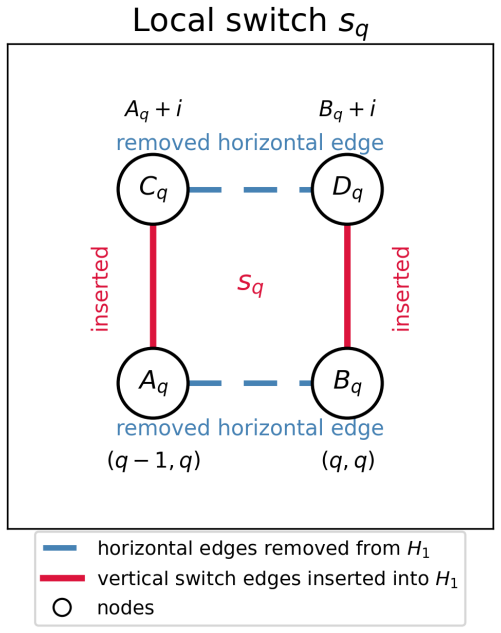
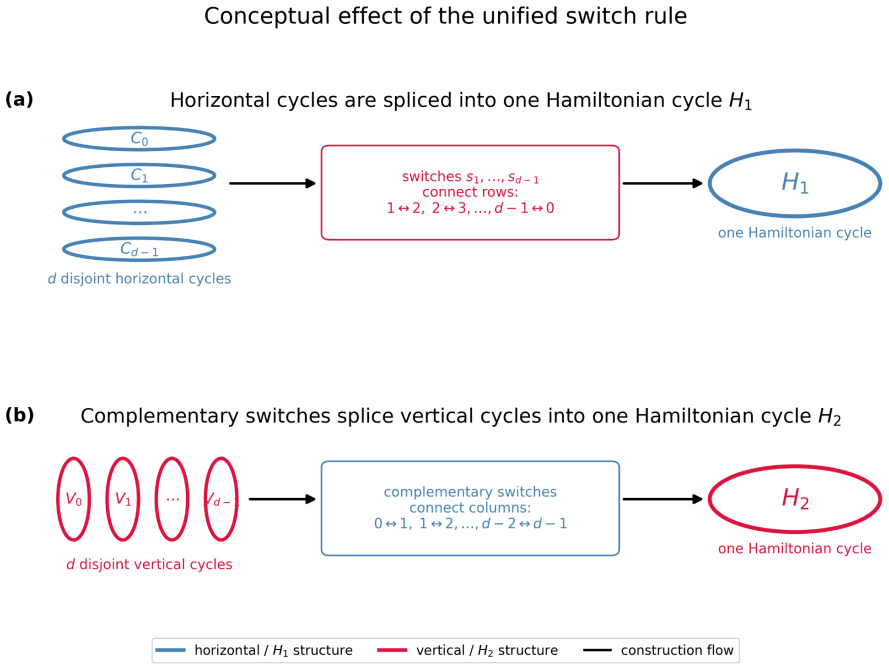
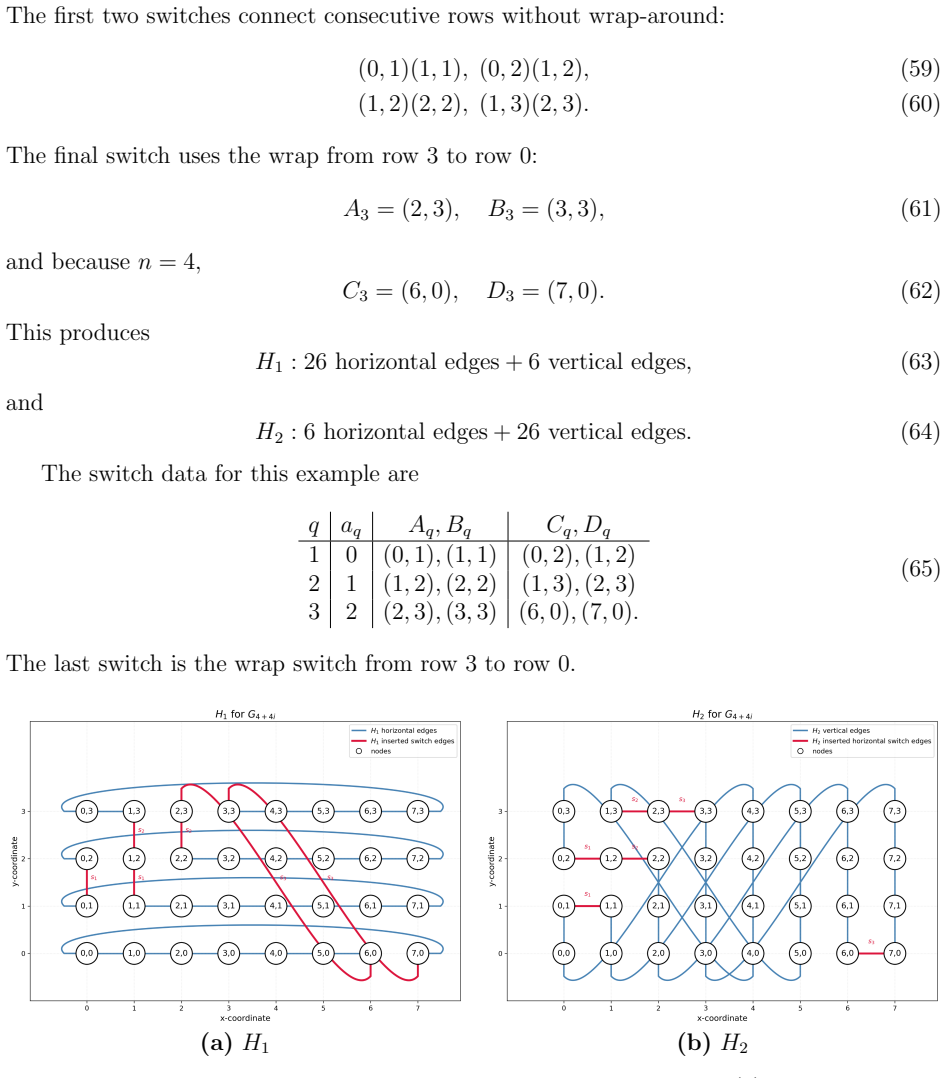
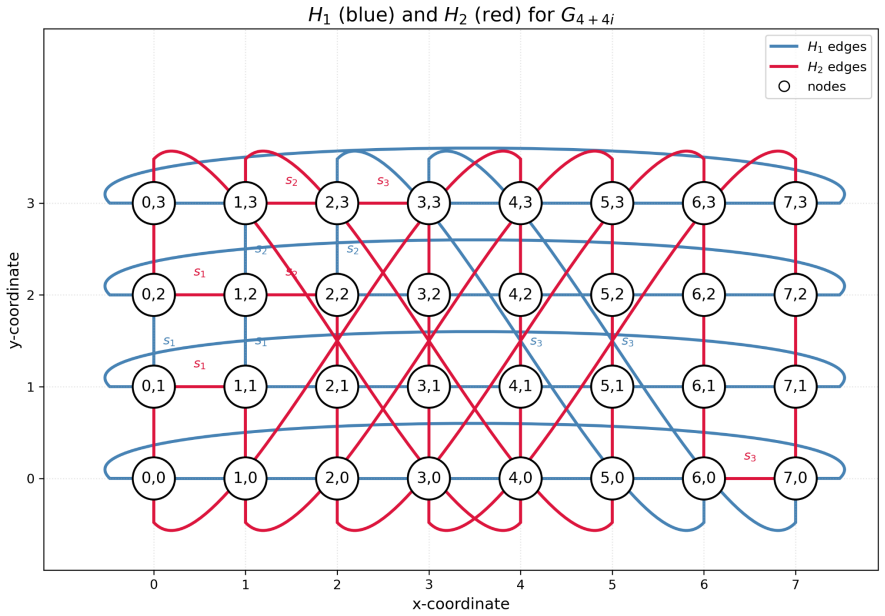
In the rectangular representation with d rows and r = (a squared plus b squared) divided by d columns, a constant-time local switch rule applied for each q from 1 to d-1 at column a_q equals q minus 1 removes two horizontal edges and inserts two vertical edges. The switched horizontal structure forms the first Hamiltonian cycle while its edge complement forms the second Hamiltonian cycle, partitioning the full edge set of the Gaussian network into two edge-disjoint Hamiltonian cycles. The same rule applies uniformly when d equals 1 and when d is greater than 1, and for both odd and even d.
What carries the argument
The local switch rule at column q-1 for each q=1 to d-1, which replaces two horizontal edges with two vertical edges to connect paths into a single cycle.
If this is right
- The construction works for every generator without separate proofs for coprime and non-coprime cases.
- Generating the switches takes O(d) time and listing the cycles takes O(N) time where N equals a squared plus b squared.
- The two cycles together use every edge of the network exactly once.
- The same rule covers both odd and even values of d.
Where Pith is reading between the lines
- The local-switch approach may extend to finding more than two edge-disjoint cycles when the network degree permits.
- Because the rule is fully local, it could be executed in a distributed fashion on the network itself.
- The rectangular layout plus switches gives an explicit embedding that might help with fault-tolerant routing or deadlock-free communication.
Load-bearing premise
The chosen switch positions always produce one connected cycle rather than several separate cycles.
What would settle it
Any pair a, b where applying the switches at columns 0 through d-2 yields more than one disjoint cycle in the rectangular layout.
Figures
read the original abstract
Gaussian networks are degree-four symmetric interconnection networks defined over residue classes of Gaussian integers. Earlier work showed that when the generator $\alpha=a+bi$ satisfies $\gcd(a,b)=1$, the real and imaginary dimensions directly form two edge-disjoint Hamiltonian cycles. A later construction extended the result to the non-coprime case $\gcd(a,b)=d>1$, but its proof used long node-sequence tables and separate odd/even cases for $d$. This paper gives a unified closed-form construction that covers both $d=1$ and $d>1$, and also covers both odd and even $d$, without separate case tables. In the rectangular representation with $d$ rows and $r=(a^2+b^2)/d$ columns, the construction uses a constant-time local switch rule for each $q=1,2,\ldots,d-1$ at column $a_q=q-1$. Each switch removes two horizontal edges and inserts two vertical edges. The switched horizontal structure forms the first Hamiltonian cycle, while its edge-complement in the Gaussian network forms the second Hamiltonian cycle. Thus, the full edge set is partitioned into two edge-disjoint Hamiltonian cycles. The construction requires $O(d)$ switch-generation time and $O(N)$ time to list the two cycles, where $N=a^2+b^2$. Exhaustive validation for all $1\leq a\leq b\leq 100$, excluding only the degenerate $N=2$ network, and large-scale validation up to $N=3{,}250{,}000$ confirm the construction.
Editorial analysis
A structured set of objections, weighed in public.
Referee Report
Summary. The paper presents a unified construction for two edge-disjoint Hamiltonian cycles in Gaussian networks generated by α = a + bi (with d = gcd(a,b)), using a d-by-r rectangular layout (r = (a² + b²)/d) and a constant-time local switch rule applied at columns a_q = q-1 for q = 1 to d-1. Each switch replaces two horizontal edges with two vertical edges; the resulting switched graph is claimed to be one Hamiltonian cycle whose complement in the network is the second. The construction is O(d) to generate switches and O(N) to list the cycles (N = a² + b²), with exhaustive validation for all 1 ≤ a ≤ b ≤ 100 (except N=2) plus sampling to N = 3,250,000.
Significance. If the central claim holds, the result supplies a simple, case-free algorithmic rule that unifies prior constructions for both d=1 and d>1 (odd and even), replacing long node-sequence tables. The extensive computational validation (exhaustive small cases plus large-scale sampling) is a concrete strength that supports practical use and reduces the risk of counterexamples.
major comments (2)
- [Construction description (abstract and §3)] The assertion that the d-1 local switches at columns a_q = q-1 always produce a single connected N-cycle (rather than multiple disjoint 2-regular components) is load-bearing for the partition claim, yet the manuscript provides no explicit connectivity invariant or inductive argument; the result rests on the algebraic properties of the Gaussian integer generator and rectangular embedding, which are asserted but not derived in detail.
- [Validation section] Table of validation results (or equivalent section reporting exhaustive checks): while the checks cover all a,b ≤ 100 and large N, they do not constitute a proof for arbitrary d; a counterexample at some composite d > 100 would falsify the unified claim for the infinite family.
minor comments (2)
- [§2 or §3] Notation for the rectangular layout (d rows, r columns) and the precise definition of a_q should be introduced with an equation or diagram early in the construction section to improve readability.
- [Construction section] The time complexity statements (O(d) switch generation, O(N) cycle listing) are stated in the abstract but would benefit from a short complexity paragraph or pseudocode in the main text.
Simulated Author's Rebuttal
We thank the referee for the positive assessment of the significance of our work and for the detailed comments. We address each major comment below and indicate whether revisions will be made.
read point-by-point responses
-
Referee: [Construction description (abstract and §3)] The assertion that the d-1 local switches at columns a_q = q-1 always produce a single connected N-cycle (rather than multiple disjoint 2-regular components) is load-bearing for the partition claim, yet the manuscript provides no explicit connectivity invariant or inductive argument; the result rests on the algebraic properties of the Gaussian integer generator and rectangular embedding, which are asserted but not derived in detail.
Authors: We acknowledge that the current manuscript asserts the connectivity based on the properties of the Gaussian integers and the rectangular layout without providing a detailed derivation or invariant. The construction is designed such that each switch connects the structure in a manner consistent with the group structure of the network. However, to address this, we will add a short paragraph in the revised version explaining the connectivity argument using the fact that the switches are applied at positions that preserve the overall cycle structure due to the symmetry of the embedding. This will make the reasoning more explicit without altering the core result. revision: partial
-
Referee: [Validation section] Table of validation results (or equivalent section reporting exhaustive checks): while the checks cover all a,b ≤ 100 and large N, they do not constitute a proof for arbitrary d; a counterexample at some composite d > 100 would falsify the unified claim for the infinite family.
Authors: We agree that the extensive computational validation, while covering all cases up to a,b ≤ 100 and sampling to much larger N, does not provide a mathematical proof for all d. Our paper presents the construction as a practical, unified rule supported by this validation, rather than claiming a complete proof. We believe the sampling to N=3,250,000 provides strong evidence against counterexamples, but we do not dispute that a formal proof would be desirable. No revision is planned for this point as the validation section accurately reports the checks performed. revision: no
- We do not have a formal proof of the single-cycle property for arbitrary d beyond the computational evidence provided.
Circularity Check
No circularity; direct algorithmic construction with external validation
full rationale
The paper defines an explicit local switch rule at columns a_q = q-1 for q=1 to d-1 in the d-by-r rectangular layout derived from Gaussian integer generator α=a+bi. It asserts the resulting switched graph and its complement are Hamiltonian cycles, justified by the algebraic properties of the embedding plus exhaustive computational checks (all 1≤a≤b≤100 except N=2, plus sampling to N=3.25M). No step reduces a claimed result to a fitted parameter, self-definition, or self-citation chain; the construction is presented as a closed-form rule whose correctness is externally verified rather than tautological. The connectivity claim is a substantive assertion, not a renaming or redefinition of inputs.
Axiom & Free-Parameter Ledger
axioms (1)
- domain assumption Gaussian networks are degree-four symmetric interconnection networks defined over residue classes of Gaussian integers when gcd(a,b)=d.
Reference graph
Works this paper leans on
-
[1]
Modeling toroidal networks with the Gaussian integers.IEEE Trans
Mart´ ınez, C.; Beivide, R.; Stafford, E.; Moret´ o, M.; Gabidulin, E.M. Modeling toroidal networks with the Gaussian integers.IEEE Trans. Comput.2008,57, 1046–1056
2008
-
[2]
The topology of Gaussian and Eisenstein–Jacobi interconnection networks.IEEE Trans
Flahive, M.; Bose, B. The topology of Gaussian and Eisenstein–Jacobi interconnection networks.IEEE Trans. Parallel Distrib. Syst.2010,21, 1132–1142
2010
-
[3]
Edge disjoint Hamiltonian cycles in Gaussian networks.IEEE Trans
Albader, B.; Bose, B. Edge disjoint Hamiltonian cycles in Gaussian networks.IEEE Trans. Comput.2016,65, 315–321. https://doi.org/10.1109/TC.2015.2409843
-
[4]
Edge-disjoint Hamiltonian cycles ink-aryn-cubes and hypercubes
Bae, M.M.; Bose, B. Edge-disjoint Hamiltonian cycles ink-aryn-cubes and hypercubes. IEEE Trans. Comput.2003,52, 1271–1284
2003
-
[5]
Two edge-disjoint Hamiltonian cycles in butterfly graphs.Inf
Barth, D.; Raspaud, A. Two edge-disjoint Hamiltonian cycles in butterfly graphs.Inf. Process. Lett.1994,51, 175–179
1994
-
[6]
Constructing two edge-disjoint Hamiltonian cycles in twisted cubes
Hung, R.-W. Constructing two edge-disjoint Hamiltonian cycles in twisted cubes. Theor. Comput. Sci.2011,412, 4523–4531
2011
-
[7]
Constructing two edge-disjoint Hamiltonian cycles in locally twisted cubes.Theor
Hung, R.-W. Constructing two edge-disjoint Hamiltonian cycles in locally twisted cubes.Theor. Comput. Sci.2011,412, 2246–2254
2011
-
[8]
Edge-disjoint Hamiltonian cycles in augmented cubes.Theor
Hung, J.-H. Edge-disjoint Hamiltonian cycles in augmented cubes.Theor. Comput. Sci.2015,575, 1–9
2015
-
[9]
Three edge-disjoint Hamiltonian cycles in folded locally twisted cubes and folded crossed cubes with applications to all-to-all broad- casting.Mathematics2023,11, 3384
Pai, K.-J.; Wu, R.-Y.; Tan, J.M. Three edge-disjoint Hamiltonian cycles in folded locally twisted cubes and folded crossed cubes with applications to all-to-all broad- casting.Mathematics2023,11, 3384
-
[10]
Edge-disjoint Hamiltonian cycles in balanced hy- percubes with applications to fault-tolerant data broadcasting.Appl
Cheng, B.-L.; Tan, J.M.; Pai, K.-J. Edge-disjoint Hamiltonian cycles in balanced hy- percubes with applications to fault-tolerant data broadcasting.Appl. Sci.2024,14, 3232
2024
-
[11]
Constructing two edge-disjoint Hamiltonian cycles and two equal node-disjoint cycles in BCube.Mathematics2026,14, 232
Pai, K.-J.; Tan, J.M.; Hsu, L.-H. Constructing two edge-disjoint Hamiltonian cycles and two equal node-disjoint cycles in BCube.Mathematics2026,14, 232
-
[12]
Symmetric property and edge-disjoint Hamiltonian cycles in Cayley graphs.Appl
Yang, D.-W.; Chen, X.-B. Symmetric property and edge-disjoint Hamiltonian cycles in Cayley graphs.Appl. Math. Comput.2023,455, 128113
2023
-
[13]
Embedding spanning disjoint cycles in hypercube-like networks.Axioms2023,12, 861
Wu, W.; Chen, Y.; Fan, J. Embedding spanning disjoint cycles in hypercube-like networks.Axioms2023,12, 861. 18
-
[14]
Duato, J.; Yalamanchili, S.; Ni, L.Interconnection Networks: An Engineering Ap- proach; Morgan Kaufmann: San Francisco, CA, USA, 2003
2003
-
[15]
Leighton, F.T.Introduction to Parallel Algorithms and Architectures: Arrays, Trees, Hypercubes; Morgan Kaufmann: San Mateo, CA, USA, 1992. 19
1992
discussion (0)
Sign in with ORCID, Apple, or X to comment. Anyone can read and Pith papers without signing in.