Experimental quantum state learning with pairs of photons
Pith reviewed 2026-06-27 04:00 UTC · model grok-4.3
The pith
Pairs of photons prepared in the same pure polarization state allow recovery of both pure states and their mixing weights, not just the overall density matrix.
A machine-rendered reading of the paper's core claim, the machinery that carries it, and where it could break.
Core claim
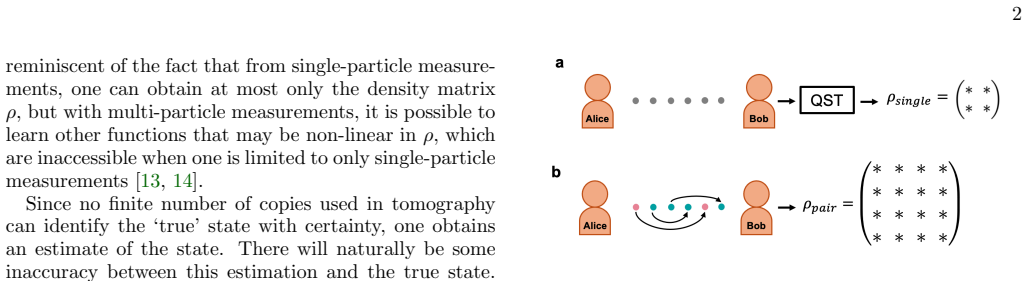
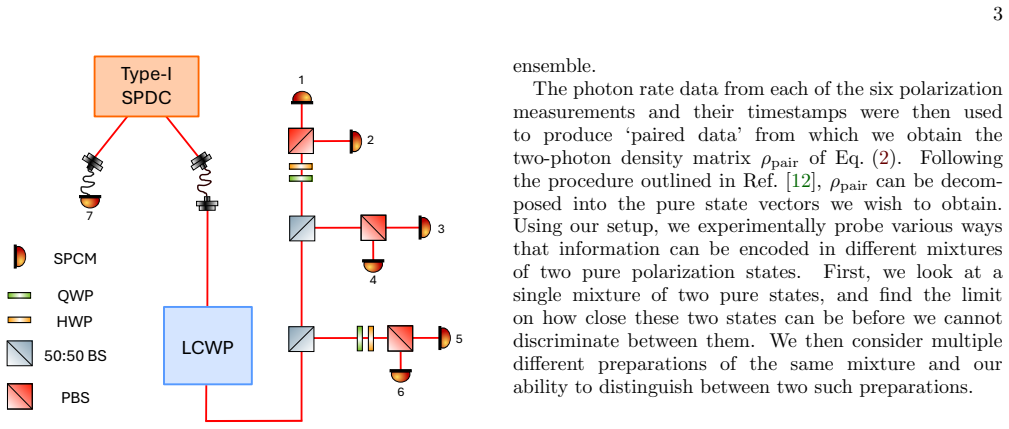
When qubits arrive in pairs where both members of each pair are prepared in the identical pure state, post-selection on time-of-arrival information permits inference of the two specific pure states and their weights in addition to the density matrix. The authors implement this with polarization-encoded photons, measure sequences of single photons, pair them after the fact, and recover the states and probabilities for various choices of polarization states and mixing ratios. The same data set also allows discrimination between two different equal mixtures of orthogonal polarization states that differ by small angles between their pure components.
What carries the argument
Time-of-arrival pairing of photons, each pair prepared in the same pure polarization state, which adds the constraint needed to identify the two pure states and their weights.
If this is right
- The density matrix of a two-component qubit mixture can be decomposed into its exact pure-state constituents and their probabilities.
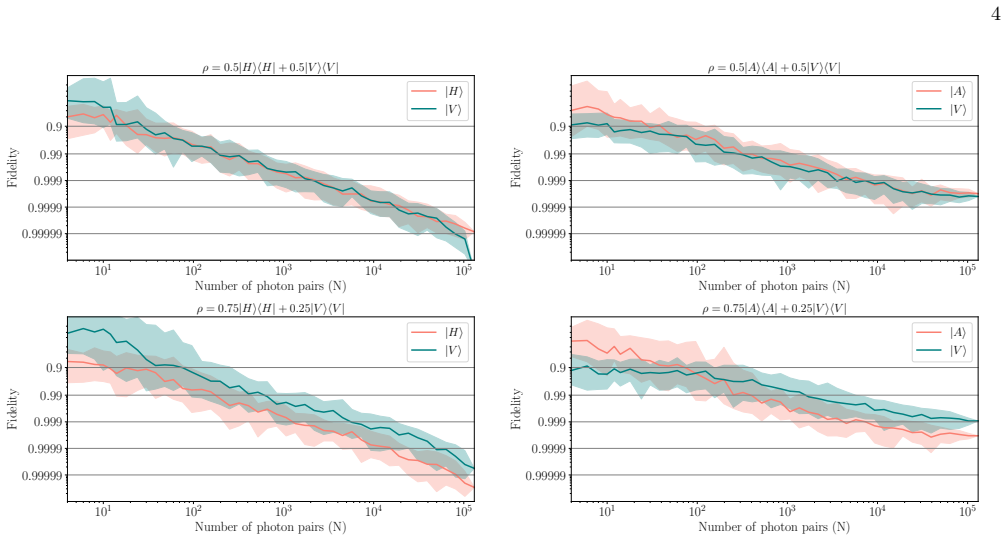
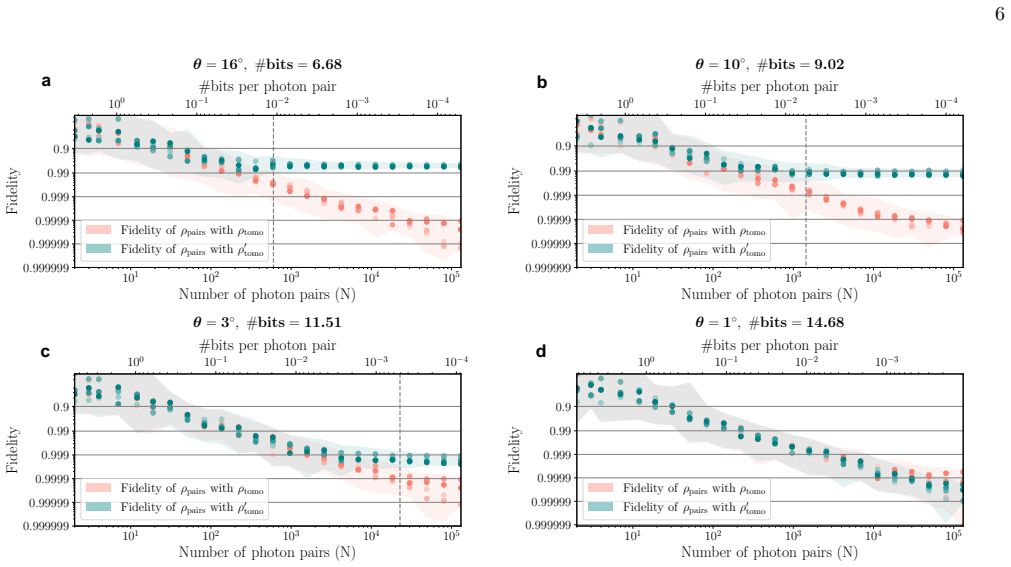
- Fidelities of approximately 0.9999 are reached with on the order of 10,000 photons for a range of polarization states and mixing ratios.
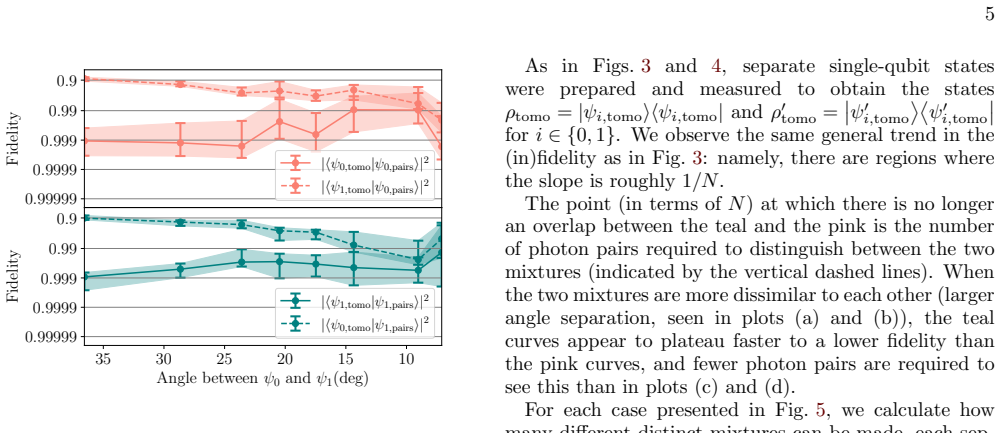
- Two different preparations of the same mixed state can be distinguished when their pure-state components differ by angles less than 5 degrees.
- The approach works for arbitrary pairs of pure states and arbitrary weights provided the pairing condition holds.
Where Pith is reading between the lines
- The same pairing principle could be tested in other photonic degrees of freedom such as path or orbital angular momentum to see whether the required photon numbers remain comparable.
- If the arrival statistics deviate from perfect pairing, the method might still yield partial information about the dominant pure state.
- Combining this technique with existing single-photon sources could enable on-the-fly verification of state preparation in quantum networks.
Load-bearing premise
The photons truly arrive as pairs of identical pure states and timing information pairs them accurately without errors from resolution limits, background, or multi-photon events.
What would settle it
Repeating the experiment with deliberately broadened timing windows that mix photons from different pairs and finding that the recovered pure states no longer match the prepared ones or that discrimination between the close mixtures fails.
Figures
read the original abstract
Tomography allows one to estimate the density matrix describing the state an ensemble of quantum systems are prepared in (for example, polarization tomography determines the polarization state of a beam of identically prepared photons). In general, it is not possible to uniquely decompose the density matrix into its pure state components. Agarwal et al. proposed a protocol which, for a mixture composed of any two pure states of a qubit (with arbitrary probabilities), allows an observer to infer not only the density matrix but the identity of those specific pure states and their weights - the additional requirement being that the qubits arrive in pairs, where both qubits in each pair are in the same state. We experimentally demonstrate this learning-from-pairs concept using photons in the polarization degree of freedom. We use tomography to measure a sequence of single photons and make use of their time-of-arrival information to 'pair up' the photons after the measurement. From here we are able to infer the photons' polarization states and their respective probabilities, and we demonstrate this for various different choices of polarization states and ratios. Finally, we investigate our ability to discriminate between two equal mixtures of distinct pairs of orthogonal polarization states. We find that on the order of approx. 10e4 photons is typically enough to achieve tomography fidelities of approximately 0.9999. This is sufficient to discriminate between two different preparations of the same mixed state, differing by angles of less than 5 degrees between the pure states used in the two preparations.
Editorial analysis
A structured set of objections, weighed in public.
Referee Report
Summary. The manuscript experimentally demonstrates the Agarwal et al. protocol for decomposing a two-pure-state qubit mixture into its components and weights. Photons in polarization are measured via single-photon tomography; post-measurement pairing via time-of-arrival coincidence is used to reconstruct the two pure states and their probabilities. The authors report that ~10^4 photons typically yield tomography fidelities of ~0.9999 and enable discrimination between otherwise identical mixtures whose pure-state components differ by angles <5°.
Significance. If the pairing step is shown to be accurate, the work supplies the first experimental validation of state learning from pairs, a capability that augments standard tomography when only paired arrivals are available. The photonic implementation and reported resource scaling are directly relevant to quantum information experiments that require pure-state decomposition of mixtures.
major comments (2)
- [abstract and experimental-method paragraph] The central experimental claim rests on the assumption that time-of-arrival information permits accurate post-selection of photon pairs that were prepared in identical pure states. The abstract and experimental-method paragraph supply no quantitative bound on the mispairing fraction arising from timing jitter, background counts, or multi-photon events, nor any propagation of such errors into the reconstructed states and weights; this omission directly affects the support for the reported 0.9999 fidelities and <5° discrimination.
- [abstract] The discrimination result (abstract) asserts that ~10^4 photons suffice to resolve <5° differences, yet no statistical analysis, error bars on the reconstructed angles, or Monte-Carlo assessment of how finite statistics and possible mispairing affect angle resolution is presented; without these, the discrimination power cannot be evaluated.
minor comments (1)
- [introduction] The citation to Agarwal et al. appears only in the abstract; the introduction should include the full reference and a brief recap of the protocol's assumptions.
Simulated Author's Rebuttal
We thank the referee for their careful reading and for identifying points that require clarification and strengthening. We address each major comment below and will revise the manuscript accordingly.
read point-by-point responses
-
Referee: [abstract and experimental-method paragraph] The central experimental claim rests on the assumption that time-of-arrival information permits accurate post-selection of photon pairs that were prepared in identical pure states. The abstract and experimental-method paragraph supply no quantitative bound on the mispairing fraction arising from timing jitter, background counts, or multi-photon events, nor any propagation of such errors into the reconstructed states and weights; this omission directly affects the support for the reported 0.9999 fidelities and <5° discrimination.
Authors: We agree that an explicit quantitative bound on the mispairing fraction is needed to fully support the reported fidelities. The experimental section describes the coincidence window and timing resolution, but does not propagate the resulting error. In the revised manuscript we will add a calculation of the expected mispairing probability from the measured timing jitter, background rate, and multi-photon probability, together with a first-order error propagation into the reconstructed states and weights. This addition will be placed in the experimental-methods section and referenced from the abstract. revision: yes
-
Referee: [abstract] The discrimination result (abstract) asserts that ~10^4 photons suffice to resolve <5° differences, yet no statistical analysis, error bars on the reconstructed angles, or Monte-Carlo assessment of how finite statistics and possible mispairing affect angle resolution is presented; without these, the discrimination power cannot be evaluated.
Authors: We acknowledge that the discrimination claim in the abstract would be stronger with statistical support. The current text reports the observed fidelity and angle separation but does not include error bars or Monte-Carlo results. In the revision we will add (i) bootstrap-derived error bars on the reconstructed angles and weights for the ~10^4-photon data sets and (ii) a Monte-Carlo simulation that incorporates both finite statistics and the mispairing fraction derived in response to the first comment. These will be presented in a new subsection of the results and will directly quantify the <5° discrimination capability. revision: yes
Circularity Check
No circularity: experimental demonstration of externally cited protocol
full rationale
The paper is an experimental implementation of a state-learning protocol proposed by Agarwal et al. (cited in the abstract and introduction). No derivation chain exists within the manuscript; the core method, pairing requirement, and reconstruction procedure are imported from prior work rather than derived or fitted here. Time-of-arrival pairing is an experimental technique whose accuracy is an empirical question, not a self-referential definition or prediction. No self-citations are load-bearing, no parameters are fitted then relabeled as predictions, and no ansatz or uniqueness claim reduces to the paper's own inputs. The reported fidelities and discrimination results are direct experimental outcomes.
Axiom & Free-Parameter Ledger
axioms (1)
- domain assumption The theoretical protocol proposed by Agarwal et al. correctly allows recovery of the two pure states and weights from paired identical-state qubits.
Reference graph
Works this paper leans on
-
[1]
Hradil, Quantum state estimation, Phys
Z. Hradil, Quantum state estimation, Phys. Rev. A55, R1561 (1997)
1997
-
[2]
C. W. Helstrom, Quantum detection and estimation the- ory, J. Stat. Phys.1, 231 (1969). 7
1969
-
[3]
Wigner, On the quantum correction for thermody- namic equilibrium, Phys
E. Wigner, On the quantum correction for thermody- namic equilibrium, Phys. Rev.40, 749 (1932)
1932
-
[4]
D. H. Mahler, L. A. Rozema, A. Darabi, C. Ferrie, R. Blume-Kohout, and A. M. Steinberg, Adaptive quan- tum state tomography improves accuracy quadratically, Phys. Rev. Lett.111, 183601 (2013)
2013
-
[5]
Husz´ ar and N
F. Husz´ ar and N. M. T. Houlsby, Adaptive Bayesian quantum tomography, Phys. Rev. A85, 052120 (2012)
2012
-
[6]
Garberoglio, M
G. Garberoglio, M. Dapor, D. Maragnano, M. Liscidini, and D. Binosi, Enhanced compressive threshold quantum state tomography for qudit systems, Phys. Rev. A111, 032436 (2025)
2025
-
[7]
W. K. Wootters and B. D. Fields, Optimal state- determination by mutually unbiased measurements, Ann. Phys. (NY)191, 363 (1989)
1989
-
[8]
R. B. A. Adamson and A. M. Steinberg, Improving quantum state estimation with mutually unbiased bases, Phys. Rev. Lett.105, 030406 (2010)
2010
-
[9]
Aaronson, Shadow tomography of quantum states (Proceedings of the 50th annual ACM SIGACT sympo- sium on theory of computing, 2018) pp
S. Aaronson, Shadow tomography of quantum states (Proceedings of the 50th annual ACM SIGACT sympo- sium on theory of computing, 2018) pp. 325–338
2018
-
[10]
Huang, R
H.-Y. Huang, R. Kueng, and J. Preskill, Predicting many properties of a quantum system from very few measure- ments, Nat. Phys.16, 1050 (2020)
2020
-
[11]
Diamanti, H.-K
E. Diamanti, H.-K. Lo, B. Qi, and Z. Yuan, Practical challenges in quantum key distribution, npj Quantum Inf.2, 16025 (2016)
2016
-
[12]
Agarwal, N
P. Agarwal, N. Ali, C. Polvara, M.-I. Trappe, B.-G. Eng- lert, and M. Hillery, State learning from pairs of states, Phys. Rev. A111, 062428 (2025)
2025
-
[13]
T. A. Brun, Measuring polynomial functions of states, arXiv preprint quant-ph/0401067 (2004)
Pith/arXiv arXiv 2004
-
[14]
Adamson, L
R. Adamson, L. Shalm, and A. Steinberg, Preparation of pure and mixed polarization qubits and the direct mea- surement of figures of merit, Phys. Rev. A75, 012104 (2007)
2007
-
[15]
W. K. Wootters, Statistical distance and Hilbert space, Phys. Rev. D23, 357 (1981)
1981
-
[16]
Jozsa, Fidelity for mixed quantum states, J
R. Jozsa, Fidelity for mixed quantum states, J. Mod. Opt. 41, 2315 (1994)
1994
-
[17]
M. J. Evans, I. Guttman, and T. Swartz, Optimally and computations for relative surprise inferences, Canadian J. Statistics34, 113 (2006)
2006
-
[18]
Shang, H
J. Shang, H. K. Ng, A. Sehrawat, X. Li, and B.-G. Eng- lert, Optimal error regions for quantum state estimation, New J. Phys.15, 123026 (2013)
2013
-
[19]
Englert, Lectures on Quantum State Estimation (World Scientific Publishing Company, 2025)
B.-G. Englert, Lectures on Quantum State Estimation (World Scientific Publishing Company, 2025)
2025
-
[20]
Herzog and J
U. Herzog and J. A. Bergou, Distinguishing mixed quan- tum states: Minimum-error discrimination versus op- timum unambiguous discrimination, Phys. Rev. A70, 022302 (2004)
2004
-
[21]
Ivanovic, How to differentiate between non-orthogonal states, Phys
I. Ivanovic, How to differentiate between non-orthogonal states, Phys. Lett. A123, 257 (1987)
1987
-
[22]
Dieks, Overlap and distinguishability of quantum states, Phys
D. Dieks, Overlap and distinguishability of quantum states, Phys. Lett. A126, 303 (1988)
1988
-
[23]
Peres, How to differentiate between non-orthogonal states, Phys
A. Peres, How to differentiate between non-orthogonal states, Phys. Lett. A128, 19 (1988)
1988
-
[24]
Huttner, A
B. Huttner, A. Muller, J. D. Gautier, H. Zbinden, and N. Gisin, Unambiguous quantum measurement of nonorthogonal states, Phys. Rev. A54, 3783 (1996)
1996
-
[25]
S. M. Barnett, A. Chefles, and I. Jex, Comparison of two unknown pure quantum states, Phys. Lett. A307, 189 (2003)
2003
-
[26]
Rudolph, R
T. Rudolph, R. W. Spekkens, and P. S. Turner, Unam- biguous discrimination of mixed states, Phys. Rev. A68, 010301 (2003)
2003
-
[27]
Herzog and J
U. Herzog and J. A. Bergou, Optimum unambiguous dis- crimination of two mixed quantum states, Phys. Rev. A 71, 050301 (2005)
2005
-
[28]
R. B. M. Clarke, A. Chefles, S. M. Barnett, and E. Riis, Experimental demonstration of optimal unambiguous state discrimination, Phys. Rev. A63, 040305 (2001)
2001
-
[29]
Herzog and J
U. Herzog and J. A. Bergou, Minimum-error discrimi- nation between subsets of linearly dependent quantum states, Phys. Rev. A65, 050305 (2002)
2002
-
[30]
Y. Sun, J. A. Bergou, and M. Hillery, Optimum unam- biguous discrimination between subsets of nonorthogonal quantum states, Phys. Rev. A66, 032315 (2002)
2002
-
[31]
Mohseni, A
M. Mohseni, A. M. Steinberg, and J. A. Bergou, Op- tical realization of optimal unambiguous discrimination for pure and mixed quantum states, Phys. Rev. Lett.93, 200403 (2004)
2004
-
[32]
The use of pulsed laser light as the pump is not strictly necessary; our experiment only requires timing informa- tion for the purpose of the pairing process, for which the heralding should suffice so long as the photon detection rate is not too high
-
[33]
We note that the calculation of the number of states with a given angular separation that can be spread over the surface of a sphere is a non-trivial problem
Our estimate of 8/θ 2 is an upper bound on the number of distinct mixtures that can be employed in this protocol. We note that the calculation of the number of states with a given angular separation that can be spread over the surface of a sphere is a non-trivial problem. However, for the angles we present in this work, no analytical solutions have been f...
-
[34]
X. Lai, D. Yue, J.-K. Hao, F. Glover, and Z. Lu, Iterated dynamic neighborhood search for packing equal circles on a sphere, Comp. Oper. Res.151, 106121 (2023)
2023
discussion (0)
Sign in with ORCID, Apple, or X to comment. Anyone can read and Pith papers without signing in.