A Fixed Representation Probe Reveals Morphology-Space Organization in Non-Gaussian Elastic Transients
Pith reviewed 2026-06-28 07:16 UTC · model grok-4.3
The pith
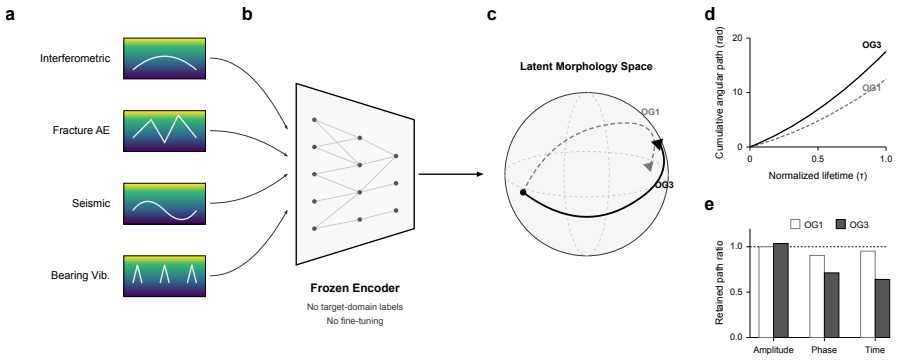
A frozen convolutional encoder trained on interferometric noise maps granite acoustic emissions to a latent hypersphere where localized rupture traces a longer angular path than distributed damage.
A machine-rendered reading of the paper's core claim, the machinery that carries it, and where it could break.
Core claim
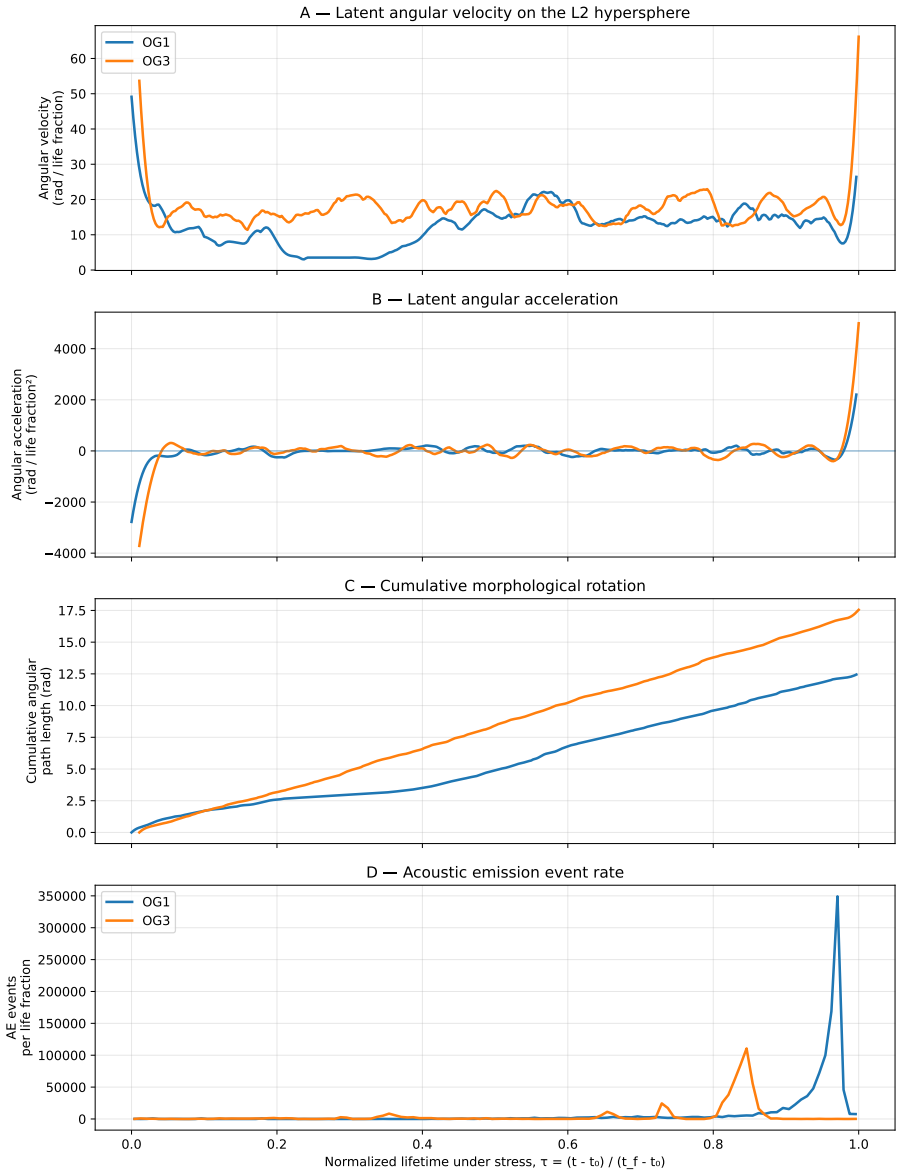
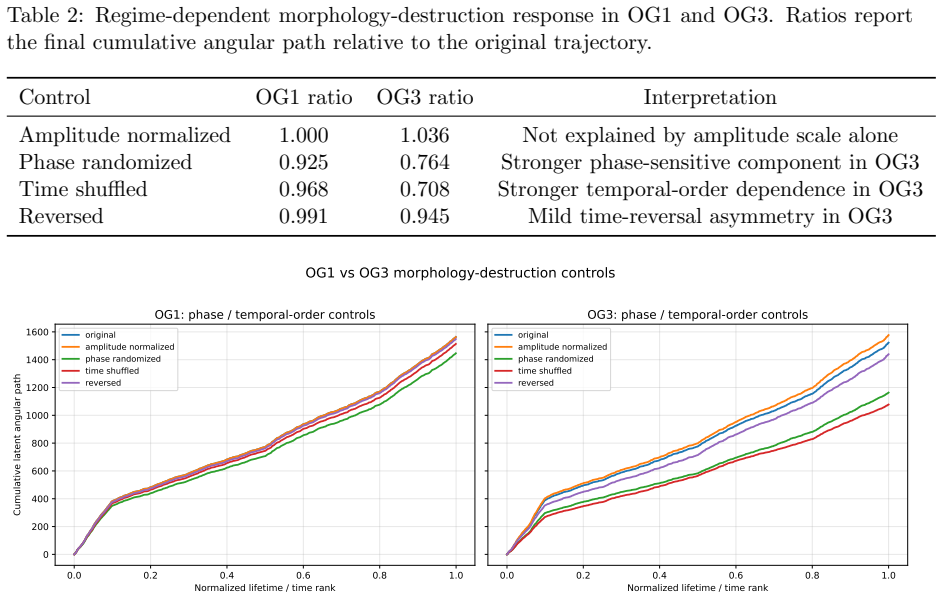
In granite acoustic-emission experiments, L2-normalized embeddings from the frozen encoder define trajectories on a latent hypersphere. The cumulative angular path distinguishes a more distributed damage evolution from a more localized rupture regime. The localized regime accumulates a larger angular path and degrades more strongly under phase randomization and temporal-order perturbation, consistent with a more phase-sensitive and sequence-dependent rupture morphology.
What carries the argument
A frozen convolutional encoder used as a fixed probe that maps signals to L2-normalized latent embeddings whose trajectories on the unit hypersphere are quantified by cumulative angular path.
If this is right
- The cumulative angular path acts as a derivative-free observable of morphological reorganization during fracture.
- Localized rupture exhibits greater sensitivity to phase randomization and temporal-order perturbation than distributed damage.
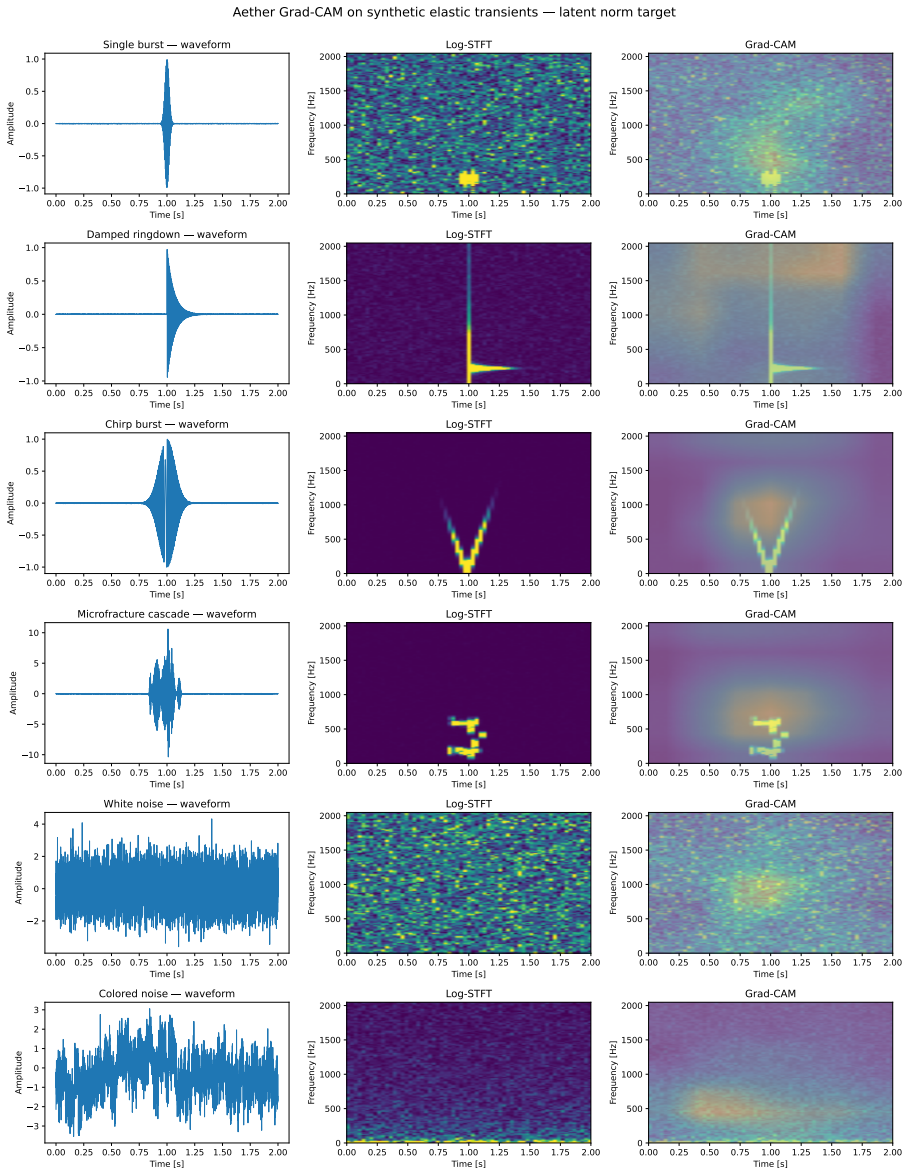
- Synthetic controls confirm the distinction is not reducible to marginal spectral energy alone.
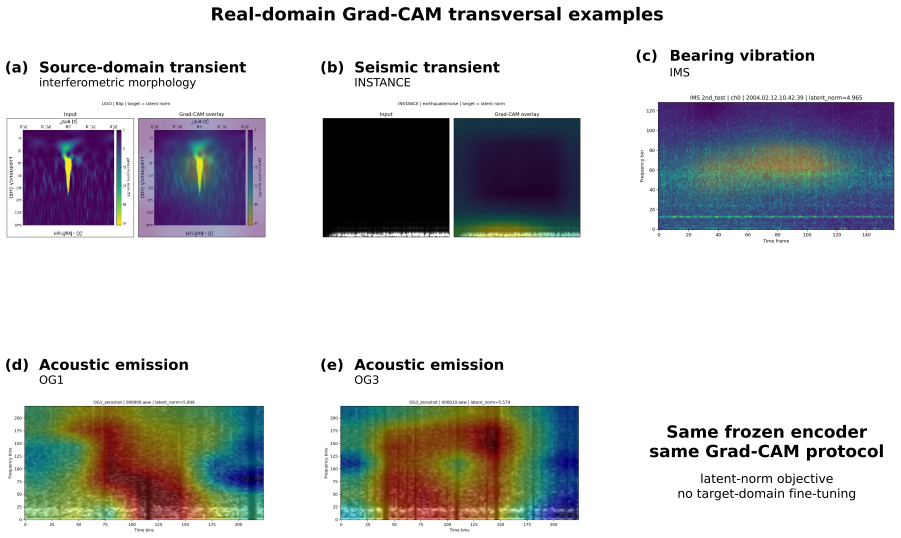
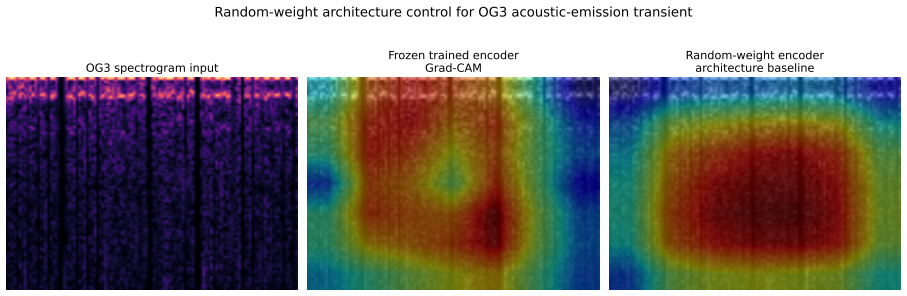
- Random-weight controls indicate that learned features combined with quantitative perturbation tests are required for the observed separation.
Where Pith is reading between the lines
- The same frozen probe could be applied directly to field seismic records to test whether laboratory and natural fracture morphologies occupy the same latent regions.
- If the hypersphere trajectories prove consistent across additional elastic systems, the angular-path measure might serve as a domain-independent coordinate for comparing non-Gaussian transients.
- Perturbation-response tests could be extended to quantify how much of any given signal's structure is carried by phase relations versus amplitude distribution.
Load-bearing premise
The convolutional encoder trained on interferometric noise captures morphology features that remain meaningful and comparable when applied without any retraining or recalibration to acoustic emissions in granite.
What would settle it
If new granite acoustic-emission experiments show that the cumulative angular path no longer separates distributed damage from localized rupture or that both regimes respond equally to phase randomization, the claimed distinction would be falsified.
Figures
read the original abstract
Elastic systems driven by intermittent energy release generate non-Gaussian transients across domains such as brittle fracture, seismicity, rotating machinery and interferometric instrumentation. These signals often contain bursts, ringdowns, ridges and clustered energy packets, but it remains unclear whether such motifs define a measurable morphology comparable across physical systems. Here we use a frozen convolutional encoder trained on transient-rich interferometric noise as a fixed probe of non-Gaussian elastic morphology. The encoder is not fine-tuned, retrained or recalibrated on any target domain. Signals are mapped to a common time-frequency representation and compared through latent geometry and perturbation response rather than task-specific classification. In granite acoustic-emission experiments, L2-normalized embeddings define trajectories on a latent hypersphere. The cumulative angular path provides a derivative-free observable of morphological reorganization. This geometry distinguishes two fracture organizations: a more distributed damage evolution and a more localized rupture regime. The localized regime accumulates a larger angular path and degrades more strongly under phase randomization and temporal-order perturbation, consistent with a more phase-sensitive and sequence-dependent rupture morphology. Synthetic controls and seismic morphology-destruction experiments indicate that the response is not explained by marginal spectral energy alone, while random-weight attribution controls show that visual localization is insufficient without quantitative perturbation tests. These results support frozen transient-rich representations as fixed measurement probes for comparing non-Gaussian elastic morphology across heterogeneous physical systems.
Editorial analysis
A structured set of objections, weighed in public.
Referee Report
Summary. The paper introduces a frozen convolutional encoder pre-trained on transient-rich interferometric noise as a fixed, non-retrained probe for non-Gaussian elastic morphology. Signals from granite acoustic-emission experiments are mapped to a common time-frequency domain; L2-normalized embeddings trace trajectories on a latent hypersphere whose cumulative angular path is proposed as a derivative-free observable. This geometry is claimed to distinguish distributed damage evolution from localized rupture, with the localized regime exhibiting larger angular paths and stronger degradation under phase randomization and temporal-order perturbation. Synthetic controls and random-weight tests are reported to rule out marginal spectral energy and visual localization as explanations.
Significance. If the encoder's features prove semantically aligned with fracture morphology rather than incidental statistics, the approach supplies a domain-agnostic, parameter-free measurement tool for comparing intermittent elastic transients across brittle fracture, seismicity, and instrumentation. The emphasis on perturbation response rather than classification accuracy and the use of an external pre-trained model are methodological strengths that could enable reproducible cross-system comparisons.
major comments (2)
- [Abstract] Abstract: the central experimental claim—that cumulative angular path distinguishes distributed versus localized rupture regimes—is stated without any quantitative metrics, sample sizes, error bars, or data-exclusion criteria, rendering the reported distinction unverifiable from the supplied evidence.
- [Abstract] Abstract (perturbation and control results): the claim that the frozen interferometric encoder captures morphology features transferable to granite AE rests on differential sensitivity to phase and temporal perturbations; these tests establish that the localized regime is more fragile but do not demonstrate that the latent directions align with physical fracture morphology rather than shared non-Gaussian statistics between domains.
minor comments (1)
- [Abstract] The abstract refers to 'synthetic controls and seismic morphology-destruction experiments' without indicating where in the manuscript the corresponding figures or tables appear.
Simulated Author's Rebuttal
We thank the referee for the constructive feedback and the recommendation for major revision. We address each comment below. Where the points identify gaps in the abstract's presentation of evidence, we have revised the manuscript to improve verifiability and interpretive clarity.
read point-by-point responses
-
Referee: [Abstract] Abstract: the central experimental claim—that cumulative angular path distinguishes distributed versus localized rupture regimes—is stated without any quantitative metrics, sample sizes, error bars, or data-exclusion criteria, rendering the reported distinction unverifiable from the supplied evidence.
Authors: We agree that the abstract as originally submitted does not supply the quantitative details needed for immediate verification. In the revised version we have added the mean cumulative angular path lengths (with standard deviations) for the distributed and localized regimes, the number of granite AE recordings analyzed in each category, and the explicit data-exclusion criteria applied prior to embedding. These values are now stated in the abstract and are supported by the corresponding tables and statistical tests in the results section. revision: yes
-
Referee: [Abstract] Abstract (perturbation and control results): the claim that the frozen interferometric encoder captures morphology features transferable to granite AE rests on differential sensitivity to phase and temporal perturbations; these tests establish that the localized regime is more fragile but do not demonstrate that the latent directions align with physical fracture morphology rather than shared non-Gaussian statistics between domains.
Authors: We acknowledge the distinction drawn by the referee. The perturbation results demonstrate greater fragility of the localized regime, while the synthetic controls and random-weight experiments were intended to exclude explanations based on marginal spectral content or purely visual localization. Nevertheless, these controls do not exhaustively rule out all forms of shared non-Gaussian structure. In the revision we have expanded the discussion section to state the interpretive limits more explicitly, clarifying that the current evidence supports a morphology-sensitive interpretation over a purely statistical one but does not constitute direct proof of semantic alignment with specific fracture mechanisms. revision: partial
Circularity Check
No circularity; derivation uses external frozen encoder and independent perturbation tests
full rationale
The paper trains a convolutional encoder exclusively on interferometric noise, then applies it without retraining, recalibration or fine-tuning to granite acoustic-emission signals. All reported observables (L2-normalized hyperspherical trajectories, cumulative angular path, differential degradation under phase randomization and temporal-order perturbation) are computed directly from the frozen embeddings and explicit perturbation experiments; none are obtained by fitting parameters inside the target domain and then relabeling the fit as a prediction. No self-citation chain is invoked to justify uniqueness or to forbid alternatives, and the abstract explicitly states that the encoder is not adapted to any target domain. The derivation therefore remains self-contained against external benchmarks.
Axiom & Free-Parameter Ledger
axioms (1)
- domain assumption The convolutional encoder trained on interferometric noise captures morphology features that remain meaningful and comparable when applied without any retraining or recalibration to acoustic emissions in granite and to seismic signals.
Reference graph
Works this paper leans on
-
[1]
Richards.Quantitative Seismology
Keiiti Aki and Paul G. Richards.Quantitative Seismology. University Science Books, Sausalito, CA, 2 edition, 2002
2002
-
[2]
American Mathematical Society, 2000
Shun-ichi Amari and Hiroshi Nagaoka.Methods of Information Geometry, volume 191. American Mathematical Society, 2000
2000
-
[3]
Representation learning: A review and new perspectives.IEEE Transactions on Pattern Analysis and Machine Intelligence, 35(8):1798–1828, 2013
Yoshua Bengio, Aaron Courville, and Pascal Vincent. Representation learning: A review and new perspectives.IEEE Transactions on Pattern Analysis and Machine Intelligence, 35(8):1798–1828, 2013
2013
-
[4]
Bracewell.The Fourier Transform and Its Applications
Ronald N. Bracewell.The Fourier Transform and Its Applications. McGraw-Hill, New York, 3 edition, 2000
2000
-
[5]
Case western reserve university bearing data center
Case Western Reserve University. Case western reserve university bearing data center. Bear- ing fault vibration dataset, 1998. Available through the Case Western Reserve University Bearing Data Center. 19
1998
-
[6]
Prentice Hall, Upper Saddle River, NJ, 1995
Leon Cohen.Time-Frequency Analysis. Prentice Hall, Upper Saddle River, NJ, 1995
1995
-
[7]
Convolutional neural network based fault detection for rotating machinery.Journal of Sound and Vibration, 377:331–345, 2016
Olivier Janssens, Viktor Slavkovikj, Bram Vervisch, Kurt Stockman, Mia Loccufier, Steven Verstockt, Rik Van de Walle, and Sofie Van Hoecke. Convolutional neural network based fault detection for rotating machinery.Journal of Sound and Vibration, 377:331–345, 2016
2016
-
[8]
Deep learning.Nature, 521(7553):436– 444, 2015
Yann LeCun, Yoshua Bengio, and Geoffrey Hinton. Deep learning.Nature, 521(7553):436– 444, 2015
2015
-
[9]
Bearing data set
Jay Lee, Hai Qiu, Gang Yu, and Jing Lin. Bearing data set. NASA Ames Prognostics Data Repository, IMS, University of Cincinnati, 2007. Run-to-failure bearing vibration dataset
2007
-
[10]
How do asperities fracture? an experimental study of unbroken asperities
Xinglin Lei. How do asperities fracture? an experimental study of unbroken asperities. Earth and Planetary Science Letters, 213(3–4):347–359, 2003
2003
-
[11]
David A. Lockner. The role of acoustic emission in the study of rock fracture.International Journal of Rock Mechanics and Mining Sciences & Geomechanics Abstracts, 30(7):883–899, 1993
1993
-
[12]
Group invariant scattering.Communications on Pure and Applied Math- ematics, 65(10):1331–1398, 2012
St´ ephane Mallat. Group invariant scattering.Communications on Pure and Applied Math- ematics, 65(10):1331–1398, 2012
2012
-
[13]
Instance: The italian seismic dataset for machine learning.Earth System Science Data, 13(12):5509–5544, 2021
Alberto Michelini, Sara Cianetti, Simone Gaviano, Carlo Giunchi, Dario Jozinovi´ c, and Valerio Lauciani. Instance: The italian seismic dataset for machine learning.Earth System Science Data, 13(12):5509–5544, 2021
2021
-
[14]
Study of elastic shocks caused by the fracture of heterogeneous materials and its relations to earthquake phenomena.Bulletin of the Earthquake Research Institute, 40:125–173, 1962
Kiyoo Mogi. Study of elastic shocks caused by the fracture of heterogeneous materials and its relations to earthquake phenomena.Bulletin of the Earthquake Research Institute, 40:125–173, 1962
1962
-
[15]
Pronostia: An experimental plat- form for bearings accelerated degradation tests
Patrick Nectoux, Rafael Gouriveau, Kamal Medjaher, Emmanuel Ramasso, Brigitte Chebel- Morello, Noureddine Zerhouni, and Christophe Varnier. Pronostia: An experimental plat- form for bearings accelerated degradation tests. InIEEE International Conference on Prognostics and Health Management, 2012
2012
-
[16]
A survey on transfer learning.IEEE Transactions on Knowledge and Data Engineering, 22(10):1345–1359, 2010
Sinno Jialin Pan and Qiang Yang. A survey on transfer learning.IEEE Transactions on Knowledge and Data Engineering, 22(10):1345–1359, 2010
2010
-
[17]
Convolutional neural network for earthquake detection and location.Science Advances, 4(2):e1700578, 2018
Thibaut Perol, Micha¨ el Gharbi, and Marine Denolle. Convolutional neural network for earthquake detection and location.Science Advances, 4(2):e1700578, 2018
2018
-
[18]
Mimii dataset: Sound dataset for malfunctioning industrial machine investigation and inspection
Harsh Purohit, Ryo Tanabe, Kohei Ichige, Takashi Endo, Yuki Nikaido, Kaori Suefusa, and Yohei Kawaguchi. Mimii dataset: Sound dataset for malfunctioning industrial machine investigation and inspection. InProceedings of the Detection and Classification of Acoustic Scenes and Events Workshop, pages 209–213, 2019
2019
-
[19]
Mimii dataset: Sound dataset for malfunctioning industrial machine investigation and inspection
Harsh Purohit, Ryo Tanabe, Kohei Ichige, Takashi Endo, Yuki Nikaido, Kaori Suefusa, and Yohei Kawaguchi. Mimii dataset: Sound dataset for malfunctioning industrial machine investigation and inspection. Zenodo, 2019
2019
-
[20]
John Wiley & Sons, Chichester, UK, 2011
Robert Bond Randall.Vibration-based Condition Monitoring: Industrial, Aerospace and Automotive Applications. John Wiley & Sons, Chichester, UK, 2011
2011
-
[21]
Stephen Berry
Peter Salamon and R. Stephen Berry. Thermodynamic length and dissipated availability. Physical Review Letters, 51(13):1127–1130, 1983
1983
-
[22]
Zero-shot detection of elastic transient morphology across physical systems, 2026
Jose S´ anchez Andreu. Zero-shot detection of elastic transient morphology across physical systems, 2026. 20
2026
-
[23]
Christopher H. Scholz. Microfracturing and the inelastic deformation of rock in compression. Journal of Geophysical Research, 73(4):1417–1432, 1968
1968
-
[24]
Selvaraju, Michael Cogswell, Abhishek Das, Ramakrishna Vedantam, Devi Parikh, and Dhruv Batra
Ramprasaath R. Selvaraju, Michael Cogswell, Abhishek Das, Ramakrishna Vedantam, Devi Parikh, and Dhruv Batra. Grad-cam: Visual explanations from deep networks via gradient- based localization. InProceedings of the IEEE International Conference on Computer Vision, pages 618–626, 2017
2017
-
[25]
Smith and Robert B
Wade A. Smith and Robert B. Randall. Rolling element bearing diagnostics using the case western reserve university data: A benchmark study.Mechanical Systems and Signal Processing, 64–65:100–131, 2015
2015
-
[26]
Vsb power line fault detection
VSB Technical University of Ostrava. Vsb power line fault detection. Kaggle competition dataset, 2019. Partial discharge and power-line fault detection dataset
2019
-
[27]
Metric geometry of equilibrium thermodynamics.The Journal of Chemical Physics, 63(6):2479–2483, 1975
Frank Weinhold. Metric geometry of equilibrium thermodynamics.The Journal of Chemical Physics, 63(6):2479–2483, 1975
1975
-
[28]
How transferable are features in deep neural networks? InAdvances in Neural Information Processing Systems, volume 27, 2014
Jason Yosinski, Jeff Clune, Yoshua Bengio, and Hod Lipson. How transferable are features in deep neural networks? InAdvances in Neural Information Processing Systems, volume 27, 2014
2014
-
[29]
Katsaggelos, Shane L
Michael Zevin, Scott Coughlin, Sara Bahaadini, Emre Besler, Neda Rohani, Sarah Allen, Miriam Cabero, Kevin Crowston, Aggelos K. Katsaggelos, Shane L. Larson, Tae K. Lee, Chris Lintott, Tyson B. Littenberg, Andrew Lundgren, Carsten Osterlund, Joshua R. Smith, Laura Trouille, and Vicky Kalogera. Gravity spy: Integrating advanced ligo detec- tor characteriza...
2017
discussion (0)
Sign in with ORCID, Apple, or X to comment. Anyone can read and Pith papers without signing in.