REVIEW 3 major objections 2 minor 74 references
Regularized Machine Learning for System Identification of Ship Free-Running Manoeuvres from CFD-Based Synthetic Data: A Comparative Study
T0 review · 3 major / 2 minor · reviewed 2026-06-27 · grok-4.3
Pith's one-line read Regularized regression techniques, especially Ridge, enhance the accuracy of identifying ship hydrodynamic coefficients from CFD data by addressing multicollinearity.
desk verdict A straightforward comparative study applying standard regularized regression to Abkowitz models on CFD ship data; useful checks on manoeuvres and coefficient sets but no big surprises or quantitative detail. read the letter →
The pith
A machine-rendered reading of the paper's core claim, the machinery that carries it, and where it could break.
The reading
What carries the argument
Regularized linear regression (Ridge, Lasso, Elastic Net) on Abkowitz-type coefficient models trained on CFD-derived time series from zig-zag and turning tests.
What would settle it
A direct comparison showing that models trained on this CFD data fail to predict manoeuvres accurately when tested against independent experimental sea trials would falsify the suitability of the data.
Extended reading notes
Core claim
Regularized regression methods applied to Abkowitz-type manoeuvring models from URANS simulations of free-running manoeuvres mitigate multicollinearity and improve prediction accuracy over ordinary least squares, with Ridge regression offering the best efficiency-accuracy compromise.
Load-bearing premise
The URANS CFD simulations of the manoeuvres provide data that sufficiently represents the ship's true hydrodynamic behaviour for coefficient identification.
Editorial extensions
If this is right
- Larger sets of coefficients allow greater model flexibility but increase multicollinearity risk unless regularized.
- Large-angle zig-zag manoeuvres suffice for identification when multicollinearity is controlled via regression choice or data variety.
- Including more varied manoeuvring data boosts overall model performance.
- Ridge regression balances computational efficiency and accuracy better than other tested regularizers.
Reading between the lines
- The approach could be extended to real experimental data to bridge simulation and physical tests.
- Similar techniques might apply to identifying models for other dynamic systems like aircraft or underwater vehicles.
- Minimum training lengths identified could guide efficient data collection in future studies.
Signed reviews
Editorial analysis
A structured set of objections, weighed in public.
Referee Report
Summary. The paper investigates supervised machine learning for identifying ship hydrodynamic coefficients from CFD-generated data of free-running manoeuvres. It applies ordinary least squares and regularized regression (Ridge, etc.) to Abkowitz-type models using URANS simulations of zig-zag and turning-circle manoeuvres that are validated against experimental benchmarks. The study examines effects of coefficient-set size, minimum training length, and manoeuvre combinations, concluding that regularization mitigates multicollinearity, enhances prediction accuracy, and that Ridge regression offers the best efficiency-accuracy trade-off while larger, more diverse datasets improve results.
Significance. If the quantitative results hold under scrutiny, the work offers a practical empirical demonstration of regularization benefits for handling multicollinear regressors in marine system identification from synthetic CFD data. It provides guidance on manoeuvre selection (e.g., large-angle zig-zag) and data diversity for coefficient estimation, which could aid practitioners using simulation-based identification. The comparative evaluation across regression methods and data configurations is a useful contribution to the applied statistics and naval hydrodynamics literature, though its impact depends on the fidelity of the underlying CFD force data.
major comments (3)
- [Abstract / Validation] Abstract and validation section: the claim that URANS simulations are validated against experimental benchmarks is load-bearing for all downstream regression results, yet the abstract provides no quantitative metrics (e.g., trajectory RMSE, force time-history correlation, or regressor-matrix condition numbers) to confirm that point-wise hydrodynamic forces are faithfully reproduced rather than only global manoeuvring paths.
- [Results] Results section on regularization: the assertion that 'regularized regression techniques effectively mitigate multicollinearity and notably enhance prediction accuracy' requires explicit reporting of effect sizes (e.g., changes in condition number, cross-validation RMSE, or R² with and without regularization) together with error bars or statistical significance tests; without these, the magnitude and robustness of the claimed improvement cannot be assessed.
- [Discussion / Methods] Discussion of CFD data: because all comparisons (OLS vs. Ridge, coefficient-set sizes, manoeuvre diversity) are performed within the same URANS framework, any systematic bias in the synthetic force time series (numerical dissipation, turbulence modeling, or free-surface effects correlated with regressors) would propagate identically to all methods and could artifactually favor regularization; a sensitivity test against experimental force data or perturbed CFD runs is needed to establish that the reported superiority is not data-specific.
minor comments (2)
- [Methods] Clarify the exact Abkowitz model structure and which coefficients are included in each 'set size' tested.
- [Results] Provide the precise definition of 'prediction accuracy' (e.g., one-step-ahead vs. multi-step trajectory error) and the validation split used.
Simulated Author's Rebuttal
We thank the referee for the constructive and detailed comments, which help strengthen the manuscript. We address each major comment below, indicating where revisions will be made.
read point-by-point responses
-
Referee: [Abstract / Validation] Abstract and validation section: the claim that URANS simulations are validated against experimental benchmarks is load-bearing for all downstream regression results, yet the abstract provides no quantitative metrics (e.g., trajectory RMSE, force time-history correlation, or regressor-matrix condition numbers) to confirm that point-wise hydrodynamic forces are faithfully reproduced rather than only global manoeuvring paths.
Authors: We agree that the abstract should better substantiate the validation claim. The manuscript's validation section reports quantitative trajectory metrics (e.g., RMSE for heading and position time histories) against experimental benchmarks, but direct point-wise force correlations are not available as the CFD validation emphasized global paths. We will revise the abstract to include key trajectory RMSE values and condition number references from the results, while clarifying the scope of validation. revision: yes
-
Referee: [Results] Results section on regularization: the assertion that 'regularized regression techniques effectively mitigate multicollinearity and notably enhance prediction accuracy' requires explicit reporting of effect sizes (e.g., changes in condition number, cross-validation RMSE, or R² with and without regularization) together with error bars or statistical significance tests; without these, the magnitude and robustness of the claimed improvement cannot be assessed.
Authors: We concur that explicit effect sizes and robustness measures are needed. The current results compare prediction RMSE and condition numbers across methods, but we will expand the section to report delta values (e.g., condition number reduction, CV-RMSE differences with standard deviations), R² changes, and error bars from repeated cross-validation folds to quantify the improvements. revision: yes
-
Referee: [Discussion / Methods] Discussion of CFD data: because all comparisons (OLS vs. Ridge, coefficient-set sizes, manoeuvre diversity) are performed within the same URANS framework, any systematic bias in the synthetic force time series (numerical dissipation, turbulence modeling, or free-surface effects correlated with regressors) would propagate identically to all methods and could artifactually favor regularization; a sensitivity test against experimental force data or perturbed CFD runs is needed to establish that the reported superiority is not data-specific.
Authors: This concern about potential data-specific bias is well-taken. All methods are evaluated on identical synthetic data, so relative rankings remain valid for the comparative purpose, but absolute claims could be affected by CFD artifacts. Direct experimental force time series are unavailable in the dataset (validation was trajectory-based), precluding a full sensitivity test here. We will add an explicit limitations paragraph discussing this scope and the value of future perturbed-CFD or hybrid experimental-CFD studies. revision: partial
- Full sensitivity testing against experimental force time-series data, as such direct force measurements are not available in the current CFD-validated trajectory dataset.
Circularity Check
No circularity: empirical regression comparison on external CFD data
full rationale
The paper conducts an empirical comparison of OLS and regularized regression (Ridge, etc.) applied to standard Abkowitz-type models using time-series from URANS free-running simulations of zig-zag and turning-circle manoeuvres. Training/validation splits, coefficient-set sizes, and manoeuvre diversity are varied, with performance measured on held-out segments; no equations, uniqueness theorems, or self-citations are invoked to derive results by construction from the fitted parameters themselves. The reported superiority of regularization follows directly from standard statistical properties evaluated on the provided synthetic data, making the derivation self-contained against external benchmarks.
Assumptions & free parameters
Cite this review
Pith. "Pith review of Regularized Machine Learning for System Identification of Ship Free-Running Manoeuvres from CFD-Based Synthetic Data: A Comparative Study." pith.science (2026). https://pith.science/paper/2FO4OJJP
@misc{pith2026260617121,
  author       = {Pith},
  title        = {Pith review of: Regularized Machine Learning for System Identification of Ship Free-Running Manoeuvres from CFD-Based Synthetic Data: A Comparative Study},
  year         = {2026},
  howpublished = {\url{https://pith.science/paper/2FO4OJJP}},
  note         = {Machine review of arXiv:2606.17121}
}
read the original abstract
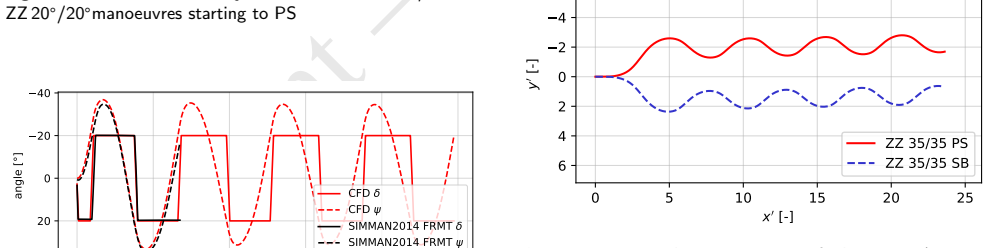
This study investigates supervised machine learning techniques for identifying ship hydrodynamic coefficients from CFD-generated data from free-running simulations. Specifically, ordinary least squares and regularized regression methods are applied to Abkowitz-type manoeuvring models. Training and validation datasets are derived from URANS simulations of zig-zag and turning circle manoeuvres, which are validated against experimental benchmark data. The analysis evaluates the effects of coefficient set size, minimum training length required for predictive model training, and manoeuvre combinations on model performance. Results demonstrate the suitability of large-angle zig-zag manoeuvres for hydrodynamic system identification, provided that multicollinearity is addressed through appropriate coefficient selection, regression models, or input data variability. Larger coefficient sets offer greater model flexibility for variable conditions but are more prone to multicollinearity. Regularized regression techniques effectively mitigate multicollinearity and notably enhance prediction accuracy, as does incorporating more diverse manoeuvring data. Among tested models, Ridge regression provided the best compromise between computational efficiency and prediction accuracy.
Figures


Figures from the paper (17 more)




Reference graph
Works this paper leans on
-
[1]
, title =
Fortunato, S. , title =. Phys. Rep.-Rev. Sec. Phys. Lett. , volume =. 2010 , pages =
2010
-
[2]
Newman, M. E. J. and Girvan, M. , title =. Phys. Rev. E. , volume =. 2004 , pages =
2004
-
[3]
and Reinhardt, T
Vehlow, C. and Reinhardt, T. and Weiskopf, D. , title =. IEEE Trans. Vis. Comput. Graph. , volume =. 2013 , pages =
2013
-
[4]
and Albert, R
Raghavan, U. and Albert, R. and Kumara, S. , title =. Phys. Rev E. , volume =. 2007 , pages =
2007
-
[5]
2011 , pages =
Robust network community detection using balanced propagation , journal =. 2011 , pages =
2011
-
[6]
and Li, S
Lou, H. and Li, S. and Zhao, Y. , title =. Physica A. , volume =. 2013 , pages =
2013
-
[7]
and Newman, M
Clauset, A. and Newman, M. E. J. and Moore, C. , title =. Phys. Rev. E. , volume =. 2004 , pages =
2004
-
[8]
Blondel, V. D. and Guillaume, J. L. and Lambiotte, R. and Lefebvre, E. , title =. J. Stat. Mech.-Theory Exp. , volume =. 2008 , pages =
2008
Show all 74 references
-
[9]
and Campari, R
Sobolevsky, S. and Campari, R. , title =. Phys. Rev. E. , volume =. 2014 , pages =
2014
-
[10]
and Barthelemy, M
Fortunato, S. and Barthelemy, M. , title =. Proc. Natl. Acad. Sci. U. S. A. , volume =. 2007 , pages =
2007
-
[11]
2011 , pages =
Unfolding communities in large complex networks: Combining defensive and offensive label propagation for core extraction , journal =. 2011 , pages =
2011
-
[12]
and Li, J
Wang, X. and Li, J. , title =. Physica A. , volume =. 2013 , pages =
2013
-
[13]
and Wang, X
Li, J. and Wang, X. and Eustace, J. , title =. Physica A. , volume =. 2013 , pages =
2013
-
[14]
Fabio, D. R. and Fabio, D. and Carlo, P. , title =. Sci. Rep. , volume =. 2013 , pages =
2013
-
[15]
and Wu, T
Chen, Q. and Wu, T. T. and Fang, M. , title =. Physica A. , volume =. 2013 , pages =
2013
-
[16]
and Wang, R
Zhang, S. and Wang, R. and Zhang, X. , title =. Physica A. , volume =. 2007 , pages =
2007
-
[17]
and Petr\'oczi, A
Nepusz, T. and Petr\'oczi, A. and N\'egyessy, L. and Bazs\'o, F. , title =. Phys. Rev. E. , volume =. 2008 , pages =
2008
-
[18]
and Liang, Z
Fabricio, B. and Liang, Z. , title =. Soft Comput. , volume =. 2013 , pages =
2013
-
[19]
and Gao, L
Sun, P. and Gao, L. and Han, S. , title =. Inf. Sci. , volume =. 2011 , pages =
2011
-
[20]
and Liu, D
Wang, W. and Liu, D. and Liu, X. and Pan, L. , title =. Physica A. , volume =. 2013 , pages =
2013
-
[21]
and Roberts, S
Psorakis, I. and Roberts, S. and Ebden, M. and Sheldon, B. , title =. Phys. Rev. E. , volume =. 2011 , pages =
2011
-
[22]
and Yeung, D
Zhang, Y. and Yeung, D. , title =. In Proc. ACM SIGKDD Conf. , year =
-
[23]
, title =
Liu, J. , title =. Eur. Phys. J. B. , volume =. 2010 , pages =
2010
-
[24]
Havens, T. C. and Bezdek, J. C. and Leckie, C. and Ramamohanarao, K. and Palaniswami, M. , title =. IEEE Trans. Fuzzy Syst. , volume =. 2013 , pages =
2013
-
[25]
Newman, M. E. J. , title =
-
[26]
2012 , pages =
Ubiquitousness of link-density and link-pattern communities in real-world networks , journal =. 2012 , pages =
2012
-
[27]
and Fortunato, S
Lancichinetti, A. and Fortunato, S. and Radicchi, F. , title =. Phys. Rev. E. , volume =. 2008 , pages =
2008
-
[28]
and Pellegrini, M
Liu, W. and Pellegrini, M. and Wang, X. , title =. Sci. Rep. , volume =. 2014 , pages =
2014
-
[29]
and Diaz-Guilera, A
Danon, L. and Diaz-Guilera, A. and Duch, J. and Arenas, A. , title =. J. Stat. Mech.-Theory Exp. , volume =. 2005 , pages =
2005
-
[30]
, title =
Gregory, S. , title =. J. Stat. Mech.-Theory Exp. , volume =. 2011 , pages =
2011
-
[31]
and Fortunato, S
Lancichinetti, A. and Fortunato, S. , title =. Phys. Rev. E. , volume =. 2009 , pages =
2009
-
[32]
and Rifqi, M
Hullermeier, E. and Rifqi, M. , title =. in Proc. IFSA/EUSFLAT Conf. , year =
-
[33]
Heat and Mass Transfer , author =
Ten. Heat and Mass Transfer , author =. 2003 , pages =
2003
-
[34]
Journal of Computational Physics , author =
Volume of fluid (. Journal of Computational Physics , author =. 1981 , pages =. doi:10.1016/0021-9991(81)90145-5 , language =
1981 doi
-
[35]
Muzaferija, S and Peric, M , month = aug, year =. A. Twenty-
-
[36]
1964 , pages =
Lectures on Ship Hydrodynamics: Steering and Maneuverability , author =. 1964 , pages =
1964
-
[37]
Physics of Fluids , author =
Data-driven system identification of hydrodynamic maneuvering coefficients from free-running tests , volume =. Physics of Fluids , author =. 2023 , pages =. doi:10.1063/5.0148219 , language =
2023 doi
-
[38]
Ocean Engineering , author =
Analytical prediction of reflection coefficients for wave absorbing layers in flow simulations of regular free-surface waves , volume =. Ocean Engineering , author =. 2018 , pages =. doi:10.1016/j.oceaneng.2017.10.009 , language =
2018 doi
-
[39]
Goldstein, Sydney , title =
-
[40]
2014 , note =
NRMI , title =. 2014 , note =
2014
-
[41]
Workshop Proceedings , editor =
SIMMAN 2014, Workshop on Verification and Validation of Ship Manoeuvering Simulation Methods , year =. Workshop Proceedings , editor =
2014
-
[42]
Standards for Ship Manoeuvrability (Resolution MSC.137(76)) , journal =
-
[43]
The Manoeuvring Committee Final Report and Recommendations to the 24th ITTC , year =
-
[44]
Åström, K. J. and Källström, C. G. , title =. Automatica , year =
-
[45]
Källström, C. G. and Åström, K. J. , title =. IFAC Proceedings Volumes , year =
-
[46]
SNAME Annual Meeting , organization =
Hwang, Wei Yuan , title =. SNAME Annual Meeting , organization =
-
[47]
Luo, W. L. and Zou, Z. J. , title =. Journal of Ship Research , year =
-
[48]
Journal of Hydrodynamics , year =
Zhang, Xin-Guang and Zou, Zao-Jian , title =. Journal of Hydrodynamics , year =
-
[49]
Mathematical Problems in Engineering , year =
Luo, Weilin , title =. Mathematical Problems in Engineering , year =
-
[50]
Applied Ocean Research , year =
Luo, Weilin and Li, Xinyu , title =. Applied Ocean Research , year =
-
[51]
IEEE Access , year =
Ban, Bo and Yang, Junjie and Chen, Pengguang and Xiong, Jianbin and Wang, Qinruo , title =. IEEE Access , year =
-
[52]
Xu, Haitong and Hassani, Vahid and Hinostroza, M. A. and Guedes Soares, C. , title =. OMAE 2018, Volume 11B: Honoring Symposium for Professor Carlos Guedes Soares , year =
2018
-
[53]
, title =
Wang, Zihao and Zou, Zaojian and Guedes Soares, C. , title =. Ocean Engineering , year =
-
[54]
Ocean Engineering , year =
Xue, Yifan and Liu, Yanjun and Ji, Chen and Xue, Gang , title =. Ocean Engineering , year =
-
[55]
, title =
Alexandersson, Martin and Mao, Wengang and Ringsberg, Jonas W. , title =. Ocean Engineering , year =
-
[56]
and Eda, H
Crane, C.L. and Eda, H. and Landsburg, A. , editor =. Principles of naval architecture , isbn =. 1988 , keywords =
1988
-
[57]
1989 , publisher =
Principles of Naval Architecture, Volume III: Motions in Waves and Controllability , editor =. 1989 , publisher =
1989
-
[58]
, title =
Mucha, P. , title =. 2017 , type =
2017
-
[59]
and Kim, S.Y
Stern, Frederick and Agdrup, K. and Kim, S.Y. and Cura-Hochbaum, Andrés and Rhee, Key and Quadvlieg, Frans and Perdon, P. and Hino, Takanori and Broglia, Riccardo and Gorski, J. , year =. Experience from SIMMAN 2008—The First Workshop on Verification and Validation of Ship Man...
2008
-
[60]
2008 , howpublished =
MARIN , title =. 2008 , howpublished =
2008
-
[61]
Applied Ocean Research , author =
Method for estimating parameters of practical ship manoeuvring models based on the combination of. Applied Ocean Research , author =. 2015 , note =. doi:10.1016/j.apor.2015.06.005 , abstract =
2015 doi
-
[62]
and Zou, Zaojian , title =
Luo, Weilin and Guedes Soares, C. and Zou, Zaojian , title =. Journal of Offshore Mechanics and Arctic Engineering , year =
-
[63]
Quantifying Multicollinearity in Ship Manoeuvring Modeling by Variance Inflation Factor , isbn =
Wang, Zi-Hao and Zou, Zao-Jian , month = jun, year =. Quantifying Multicollinearity in Ship Manoeuvring Modeling by Variance Inflation Factor , isbn =. Volume 7A: Ocean Engineering , publisher =. doi:10.1115/OMAE2018-77121 , abstract =
-
[64]
Applied Ocean Research , author =
An efficient and accurate approach for zero-frequency added mass for maneuvering simulations in deep and shallow water , volume =. Applied Ocean Research , author =. 2022 , pages =. doi:10.1016/j.apor.2022.103259 , language =
2022 doi
-
[65]
Mathematical Models for Manoeuvring under Realistic Environmental Conditions , school =
Guillermo Ar. Mathematical Models for Manoeuvring under Realistic Environmental Conditions , school =. 2023 , month =
2023
-
[66]
Mathematical models for simulation of manoeuvring performance of ships , abstract =
Sutulo, Serge and Soares, C Guedes , year =. Mathematical models for simulation of manoeuvring performance of ships , abstract =. Marine
-
[67]
, title =
Xu, Haitong and Guedes Soares, C. , title =. Journal of Marine Science and Application , year =
-
[68]
and Otzen, Janne F
Simonsen, Claus D. and Otzen, Janne F. and Klimt, Christian and Larsen, Nikolaj L. and Stern, Frederick , title =. Proceedings of the 29th Symposium on Naval Hydrodynamics , year =
-
[69]
, title =
Costa, Ana Catarina and Xu, Haitong and Guedes Soares, C. , title =. Journal of Marine Science and Engineering , year =
-
[70]
and Jin, Y
Liu, B. and Jin, Y. and Magee, A. R. and Yiew, L. J. and Zhang, S. , title =. Proceedings of the ASME 2019 38th International Conference on Ocean, Offshore and Arctic Engineering , year =
2019
-
[71]
Proceedings of the ASME 2023 42nd International Conference on Ocean, Offshore and Arctic Engineering , year =
Deogaonkar, Vallabh and Jadhav, Aditya and Ramachandran, Krishnavelu and Somayajula, Abhilash , title =. Proceedings of the ASME 2023 42nd International Conference on Ocean, Offshore and Arctic Engineering , year =
2023
-
[72]
Proceedings of the ASME 2023 42nd International Conference on Ocean, Offshore and Arctic Engineering , year =
Zhong, Yu-Xuan and Wang, Zi-Hao and Zou, Zao-Jian , title =. Proceedings of the ASME 2023 42nd International Conference on Ocean, Offshore and Arctic Engineering , year =
2023
-
[73]
Cura-Hochbaum, Andrés , month = sep, year =. Virtual. Proceedings of the 26th
-
[74]
Prediction of the manoeuvring behaviour of the
Cura-Hochbaum, Andrés and Uharek, Sebastian , year =. Prediction of the manoeuvring behaviour of the
Reviewed June 27, 2026 · model on record in the stance chip above.
Discussion (0). Continue with ORCID to comment.