Chiral Phonons Enable Ultrafast Magnetization Switching via Magnetoelastic Coupling
Pith reviewed 2026-06-27 03:20 UTC · model grok-4.3
The pith
Terahertz-driven chiral phonons switch magnetization faster than linear phonons by transferring both energy and angular momentum through magnetoelastic coupling.
A machine-rendered reading of the paper's core claim, the machinery that carries it, and where it could break.
Core claim
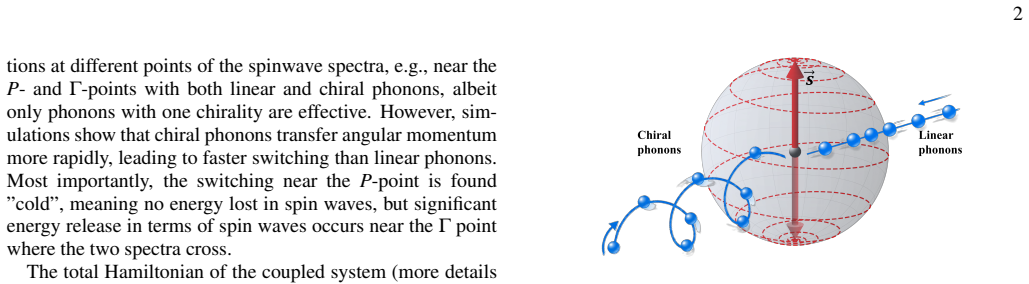
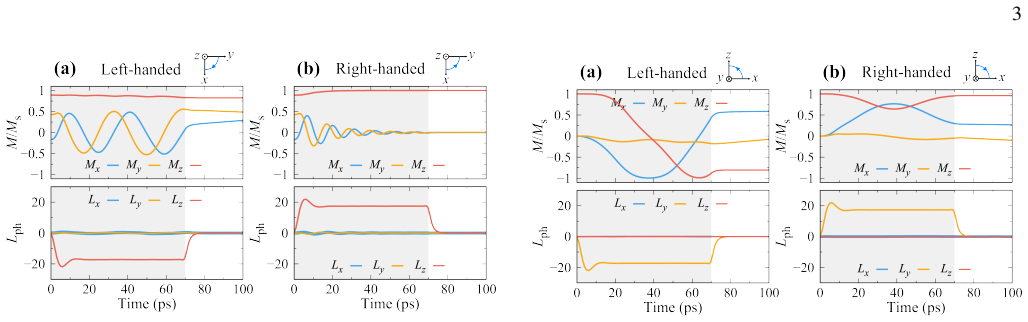
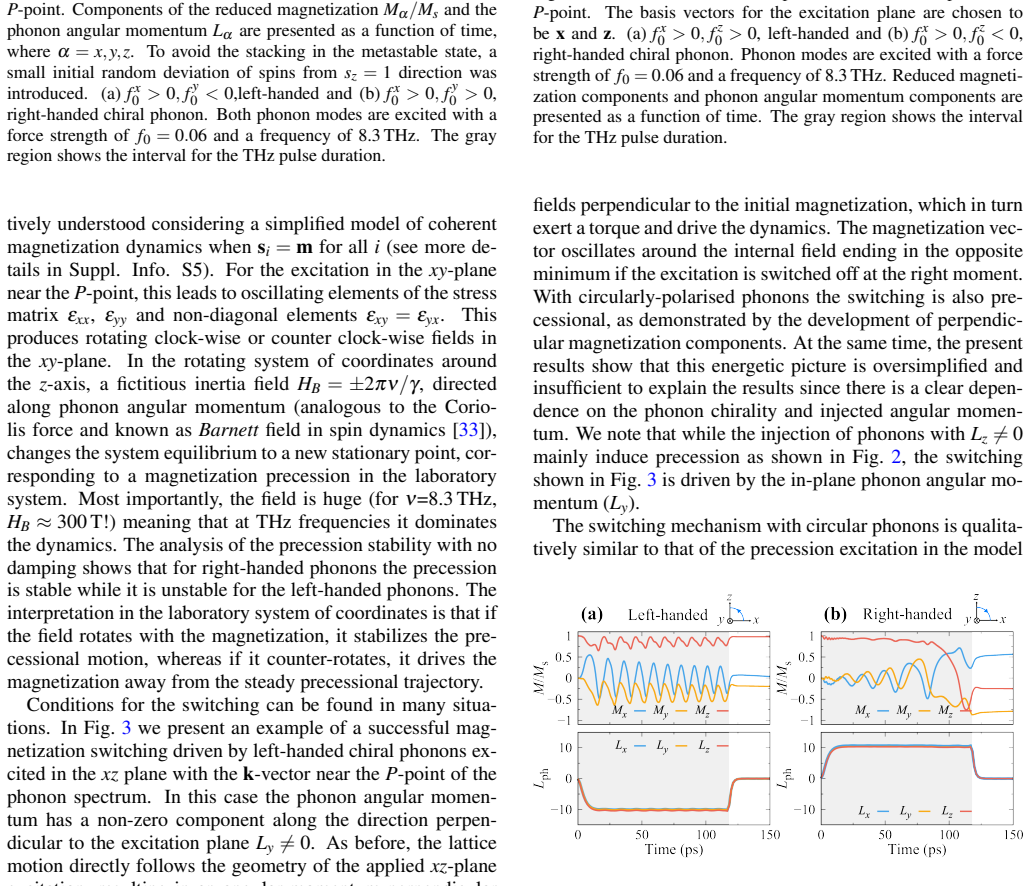
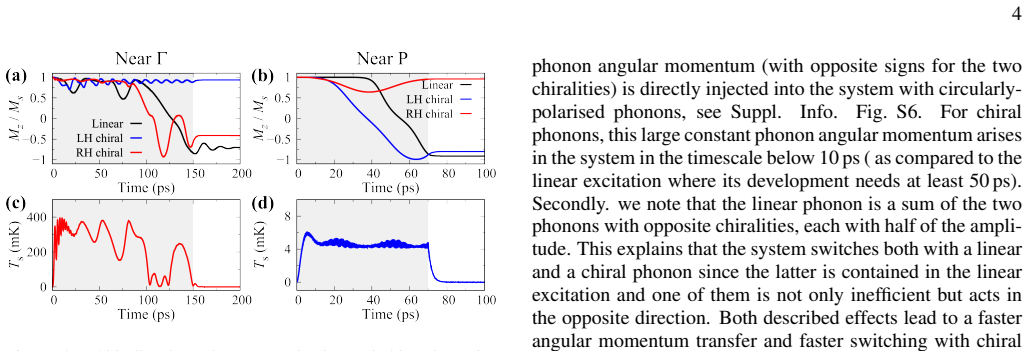
Chiral phonons enable faster magnetization switching than linear phonons through purely magnetoelastic coupling that transfers both energy and angular momentum. Only one phonon handedness efficiently transfers angular momentum to the spin system, explained by a large fictitious kinematic Barnett-like field at THz frequencies that destabilizes spin precession for the opposite chirality. Switching conditions can be realized near the Γ-point where strong energy transfer and spinwave excitation dominate, and near the P-point which offers minimal energy loss.
What carries the argument
Magnetoelastic coupling between terahertz-driven chiral phonons and the spin system, with handedness selection produced by a fictitious kinematic Barnett-like field.
If this is right
- Magnetization switching occurs near the Γ-point through strong energy transfer and spinwave excitation.
- Switching also occurs near the P-point with reduced energy loss.
- Phonon chirality acts as a decisive control parameter in spin-lattice dynamics.
- The mechanism supports design of ultrafast low-energy spintronic devices.
Where Pith is reading between the lines
- Device architectures could exploit circularly polarized THz pulses to select the efficient handedness and lower the energy cost of writing magnetic bits.
- The same handedness selectivity may appear in other materials where spin-phonon coupling dominates at high frequencies.
- Time-resolved measurements of spin precession under left- versus right-circular THz excitation would directly test the fictitious-field explanation.
Load-bearing premise
Magnetoelastic coupling can be treated as the dominant interaction without meaningful interference from other damping channels or couplings at THz frequencies.
What would settle it
An experiment in which both phonon handednesses produce identical switching times and efficiencies at the same THz drive strength would falsify the claim of selective angular-momentum transfer.
Figures
read the original abstract
Phonons are desirable for current-free energy-efficient spin manipulation and harnessing their chirality to achieve ultrafast magnetization switching remains actively pursued. Here we demonstrate that terahertz-driven chiral phonons enable faster magnetization switching than linear phonons through the purely magnetoelastic coupling that transfers both energy and angular momentum. Only one phonon handedness efficiently transfers angular momentum to the spin system, which we explain by a large fictitious kinematic Barnett-like field at THz frequencies that destabilizes spin precession for the opposite chirality. Considering different regions of the spinwave spectrum, we find that switching conditions can be realized near the {\Gamma}-point where strong energy transfer and spinwave excitation dominate, and near the P-point which offers minimal energy loss. Our results establish phonon chirality as a decisive and previously overlooked parameter in spin-lattice dynamics within the magnetoelastic coupling mechanism, offering a promising avenue for ultrafast low-energy spintronic devices.
Editorial analysis
A structured set of objections, weighed in public.
Referee Report
Summary. The manuscript claims that terahertz-driven chiral phonons enable faster magnetization switching than linear phonons via purely magnetoelastic coupling, which transfers both energy and angular momentum to the spin system. Only one phonon handedness is efficient; this selectivity is explained by a large fictitious kinematic Barnett-like field at THz frequencies that destabilizes spin precession for the opposite chirality. Favorable switching conditions are identified near the Γ-point (strong energy transfer and spinwave excitation) and the P-point (minimal energy loss). Phonon chirality is positioned as a previously overlooked but decisive parameter in spin-lattice dynamics.
Significance. If the underlying model and quantitative results hold, the work would establish phonon chirality as an important control knob in magnetoelastic spin dynamics and open a route toward current-free, low-energy ultrafast spintronic devices. The isolation of the purely magnetoelastic channel and the examination of distinct regions of the spinwave spectrum are constructive elements of the analysis.
major comments (2)
- [Abstract] Abstract: the central claim that a 'large fictitious kinematic Barnett-like field' at THz frequencies accounts for handedness selectivity is load-bearing, yet the abstract supplies neither the derivation of this field from the magnetoelastic Hamiltonian nor its magnitude relative to real fields or damping rates. Without these elements it is impossible to determine whether the field emerges naturally or functions as an ad-hoc explanatory construct.
- [Abstract] Abstract: the assertion of 'faster magnetization switching' than linear phonons is stated without any reported switching times, threshold fluences, or direct comparison metrics. The full model equations, simulation protocol, and numerical results are required to substantiate this quantitative advantage.
Simulated Author's Rebuttal
We thank the referee for their careful reading and constructive comments. We address each point below, clarifying where the requested details appear in the manuscript and proposing targeted revisions to the abstract.
read point-by-point responses
-
Referee: [Abstract] Abstract: the central claim that a 'large fictitious kinematic Barnett-like field' at THz frequencies accounts for handedness selectivity is load-bearing, yet the abstract supplies neither the derivation of this field from the magnetoelastic Hamiltonian nor its magnitude relative to real fields or damping rates. Without these elements it is impossible to determine whether the field emerges naturally or functions as an ad-hoc explanatory construct.
Authors: The derivation begins from the magnetoelastic Hamiltonian in Section II and proceeds through the equations of motion in Section III, where the THz-frequency phonon velocity directly generates the effective kinematic field via the coupling term; the resulting magnitude reaches several tesla, exceeding Gilbert-damping effective fields by more than an order of magnitude. This establishes that the field arises naturally from the Hamiltonian rather than being introduced ad hoc. We will revise the abstract to include a concise clause noting both the natural origin and the scale relative to damping. revision: yes
-
Referee: [Abstract] Abstract: the assertion of 'faster magnetization switching' than linear phonons is stated without any reported switching times, threshold fluences, or direct comparison metrics. The full model equations, simulation protocol, and numerical results are required to substantiate this quantitative advantage.
Authors: The model equations appear as Eqs. (1)–(7), the simulation protocol is described in the Methods section, and the quantitative comparisons (switching times, fluences, and handedness selectivity) are shown in Figures 3–5 together with the accompanying text in Section IV. Because an abstract cannot accommodate all numerical detail, these elements are placed in the body; we will add a brief quantitative phrase to the abstract to better anchor the claim. revision: partial
Circularity Check
No significant circularity detected in derivation chain
full rationale
The abstract presents the central claim as arising from magnetoelastic coupling transferring energy and angular momentum, with handedness selectivity explained by a fictitious kinematic Barnett-like field. No equations, model derivations, or simulation details are provided that reduce any prediction or result to a fitted parameter or self-citation by construction. The reader's assessment confirms no reduction to self-referential definitions or fitted inputs. The paper's content is treated as self-contained with independent explanatory constructs, consistent with the default expectation that most papers exhibit no circularity.
Axiom & Free-Parameter Ledger
axioms (1)
- domain assumption Magnetoelastic coupling is the purely dominant mechanism transferring energy and angular momentum between phonons and spins at THz frequencies.
invented entities (1)
-
fictitious kinematic Barnett-like field
no independent evidence
Reference graph
Works this paper leans on
-
[1]
Kirilyuk, A
A. Kirilyuk, A. Kimel, and T. Rasing, Ultrafast optical manipu- lation of magnetic order, Reviews of Modern Physics82, 2731 (2010)
2010
-
[2]
Scheid, Q
P. Scheid, Q. Remy, S. Leb ´egue, G. Malinowski, and S. Man- gin, Light induced ultrafast magnetization dynamics in metal- lic compounds, Journal of Magnetism and Magnetic Materiales 560, 169596 (2022)
2022
-
[3]
Ostler, J
T. Ostler, J. Barker, R. Evans, R. Chantrell, U. Atxitia, O. Chubykalo-Fesenko, S. El Moussaoui, L. Le Guyader, E. Mengotti, L. Heyderman,et al., Ultrafast heating as a suffi- cient stimulus for magnetization reversal in a ferrimagnet, Na- ture communications3, 666 (2012)
2012
-
[4]
I. Radu, K. Vahaplar, C. Stamm, T. Kachel, N. Pontius, H. A. D¨urr, T. A. Ostler, J. Barker, R. F. L. Evans, R. W. Chantrell, A. Tsukamoto, A. Itoh, A. Kirilyuk, T. Rasing, and A. V . Kimel, Transient ferromagnetic-like state mediating ultrafast reversal of antiferromagnetically coupled spins, Nature472, 205 (2011)
2011
-
[5]
J. H. Mentink, J. Hellsvik, D. V . Afanasiev, B. A. Ivanov, A. Kirilyuk, A. V . Kimel, O. Eriksson, M. I. Katsnelson, and T. Rasing, Ultrafast spin dynamics in multisublattice magnets, Physical Review Letters108, 057202 (2012)
2012
-
[6]
Stupakiewicz, C
A. Stupakiewicz, C. Davies, K. Szerenos, D. Afanasiev, K. Ra- binovich, A. Boris, A. Caviglia, A. Kimel, and A. Kirilyuk, Ul- trafast phononic switching of magnetization, Nature Physics17, 489 (2021)
2021
-
[7]
J. Luo, T. Lin, J. Zhang, X. Chen, E. R. Blackert, R. Xu, B. I. Yakobson, and H. Zhu, Large effective magnetic fields from chiral phonons in rare-earth halides, Science382, 698 (2023)
2023
-
[8]
Davies, F
C. Davies, F. Fennema, A. Tsukamoto, I. Razdolski, A. A. V . Kimel, and A. Kirilyuk, Phononic switching of magne- tization by the ultrafast Barnett effect, Nature628, 540 (2024)
2024
-
[9]
G. Luo, H. Ning, B. Ilyas, A. von Hoegen, E. Vi ˜nas Bostr ¨om, J. Park, J. Kim, J.-G. Park, D. Juraschek, R. A, and N. Gedik, Terahertz control of linear and nonlinear Magno-phononics, Nature Communications16, 6863 (2025)
2025
-
[10]
D. M. Juraschek and P. Narang, Magnetic control in the tera- hertz, Science374, 1555 (2021)
2021
-
[11]
Dornes, Y
C. Dornes, Y . Acremann, M. Savoini, M. Kubli, M. J. Neuge- bauer, E. Abreu, L. Huber, G. Lantz, C. A. Vaz, H. Lemke, E. M. Bothschafter, M. Porer, V . Esposito, L. Rettig, M. Buzzi, A. Alberca, Y . W. Windsor, P. Beaud, U. Staub, D. Zhu, S. Song, J. M. Glownia, and S. L. Johnson, The ultrafast Einstein–de Haas effect, Nature565, 209 (2019)
2019
-
[12]
Mankovsky, S
S. Mankovsky, S. Polesya, H. Lange, M. Weißenhofer, U. Nowak, and H. Ebert, Angular momentum transfer via rela- tivistic spin-lattice coupling from first principles, Physical Re- view Letters129, 067202 (2022)
2022
-
[13]
Gidding, T
M. Gidding, T. Janssen, C. S. Davies, and A. Kirilyuk, Dynamic self-organisation and pattern formation by magnon-polarons, Nature Communications14, 2208 (2023)
2023
-
[14]
Juraschek, R
D. Juraschek, R. Geilhufe, H. Zhu, M. Basini, P. Baum, A. Bay- din, S. Chaudhary, M. Fechner, B. Flebus, G. Grissonnanche, A. Kirilyuk, M. Lemeshko, S. Maehrlein, M. Mignolet, Q. Mu- rakami, S abd Niu, U. Nowak, C. Romao, H. Rostami, T. Satoh, N. Spaldin, H. Ueda, and L. Zhang, Chiral phonons, Nature Physics21, 1532 (2025)
2025
-
[15]
W. J. Einstein, A.and de Haas, Experimental proof of the exis- tence of amp `ere’s molecular currents, Koninklijke Akademie van Wetenschappen te Amsterdam, Proceedings.18, 696 (1915)
1915
-
[16]
S. J. Barnett, Magnetization by Rotation, Physical Review6, 239 (1915)
1915
-
[17]
Minakova, C
O. Minakova, C. Paiva, M. Frenzel, J. Spencer, MS Ur- ban, C. Ringkamp, M. Wolf, G. Mussler, D. Juraschek, and S. Maehrlein, Observation of angular momentum transfer among crystal lattice modes, Nature Physics (2026)
2026
-
[18]
D. M. Juraschek, T. c. v. Neuman, and P. Narang, Giant effec- tive magnetic fields from optically driven chiral phonons in 4f paramagnets, Physical Review Research4, 013129 (2022)
2022
-
[19]
Schl ¨omann, Generation of phonons in high-power ferromag- netic resonance experiments, Journal of Applied Physics31, 1647 (1960)
E. Schl ¨omann, Generation of phonons in high-power ferromag- netic resonance experiments, Journal of Applied Physics31, 1647 (1960)
1960
-
[20]
A. G. Gurevich and G. A. Melkov,Magnetization oscillations and waves(CRC Press, Boca Raton, 1996)
1996
-
[21]
Y . Li, C. Zhao, W. Zhang, A. Hoffmann, and V . Novosad, Ad- vances in coherent coupling between magnons and acoustic phonons, APL Materials9, 060902 (2021)
2021
-
[22]
V . S. Vlasov, A. M. Lomonosov, A. V . Golov, L. N. Kotov, V . Besse, A. Alekhin, D. A. Kuzmin, I. V . Bychkov, and V . V . Temnov, Magnetization switching in bistable nanomagnets by picosecond pulses of surface acoustic waves, Physical Review B101, 024425 (2020)
2020
-
[23]
M. Rovirola, J. `Odena, A. Castellv ´ı, Q. Badosa, B. Casals, A. Gud ´ın, H. Madathil, F. Ajejas, P. Perna, A. Hern ´andez- M´ınguez, J. M. Hern ´andez, S. V ´elez, and F. Maci `a, Chiral- phonon generation of orbital currents in light transition metals, arXiv:2512.08385 (2025)
arXiv 2025
-
[24]
M. Yi, B. X. Xu, and D. Gross, Mechanically induced determin- istic 180 ◦ switching in nanomagnets, Mechanics of Materials 87, 40 (2015)
2015
-
[25]
Kovalenko, T
O. Kovalenko, T. Pezeril, and V . V . Temnov, New concept for magnetization switching by ultrafast acoustic pulses, Physical Review Letters110, 266602 (2013)
2013
-
[26]
M. Yi, B. X. Xu, R. M ¨uller, and D. Gross, Strain-mediated magnetoelectric effect for the electric-field control of magnetic states in nanomagnets, Acta Mechanica230, 1247 (2019)
2019
-
[27]
Strungaru, M
M. Strungaru, M. O. Ellis, S. Ruta, O. Chubykalo-Fesenko, R. F. Evans, and R. W. Chantrell, Spin-lattice dynamics model with angular momentum transfer for canonical and microcanon- ical ensembles, Physical Review B103, 024429 (2021)
2021
-
[28]
Strungaru, M
M. Strungaru, M. O. Ellis, S. Ruta, R. F. Evans, R. W. Chantrell, and O. Chubykalo-Fesenko, Route to minimally dissipative switching in magnets via terahertz phonon pumping, Physical Review B109, 224412 (2024)
2024
-
[29]
A. I. Akhiezer, V . G. Bar’yakhtar, and S. V . Peletminski˘ı,Spin Waves(North-Holland Publishing Company, 1968)
1968
-
[30]
Beaujouan, P
D. Beaujouan, P. Thibaudeau, and C. Barreteau, Anisotropic magnetic molecular dynamics of cobalt nanowires, Physical Review B - Condensed Matter and Materials Physics86, 174409 (2012)
2012
-
[31]
Perera, M
D. Perera, M. Eisenbach, D. M. Nicholson, G. M. Stocks, and D. P. Landau, Reinventing atomistic magnetic simulations with spin-orbit coupling, Physical Review B93, 060402(R) (2016)
2016
-
[32]
P.-W. Ma, S. Dudarev, A. Semenov, and C. Woo, Temperature for a dynamic spin ensemble, Physical Review E82, 031111 (2010)
2010
-
[33]
M. Ono, H. Chudo, K. Harii, S. Okayasu, M. Matsuo, J. Ieda, R. Takahashi, S. Maekawa, and E. Saitoh, Physical Review B 92, 174424 (2015)
2015
-
[34]
Matsuo, J
M. Matsuo, J. Ieda, K. Harii, Saitoh, and S. Maekawa, Mechan- ical generation of spin current by spin-rotation coupling, Phys- ical Review B87, 180402(R) (2013)
2013
discussion (0)
Sign in with ORCID, Apple, or X to comment. Anyone can read and Pith papers without signing in.