QPO-like Signatures and Hydrodynamical Variability in Accretion around a JNW-type Compact Spacetime in Freund-Nambu Scalar-Tensor Gravity
Pith reviewed 2026-06-27 02:36 UTC · model grok-4.3
The pith
Numerical simulations show that shock-cone oscillations around a Freund-Nambu scalar-tensor naked singularity generate QPO-like frequencies matching those in stellar-mass black hole candidates.
A machine-rendered reading of the paper's core claim, the machinery that carries it, and where it could break.
Core claim
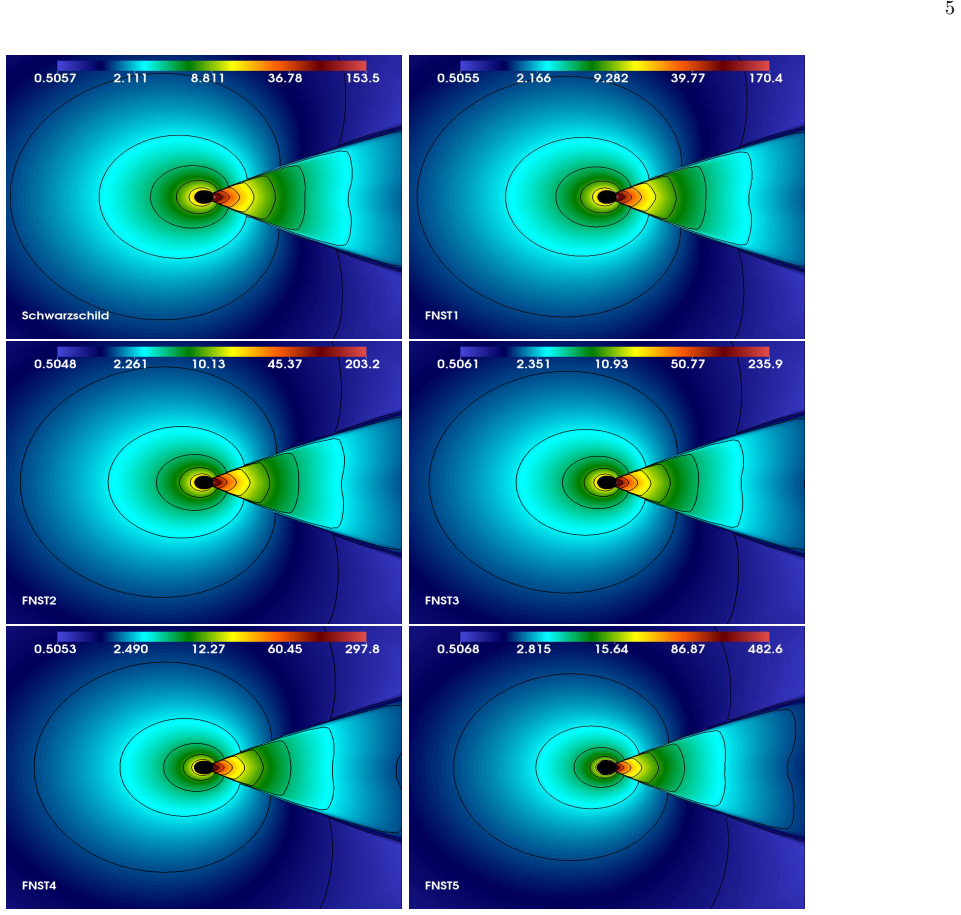
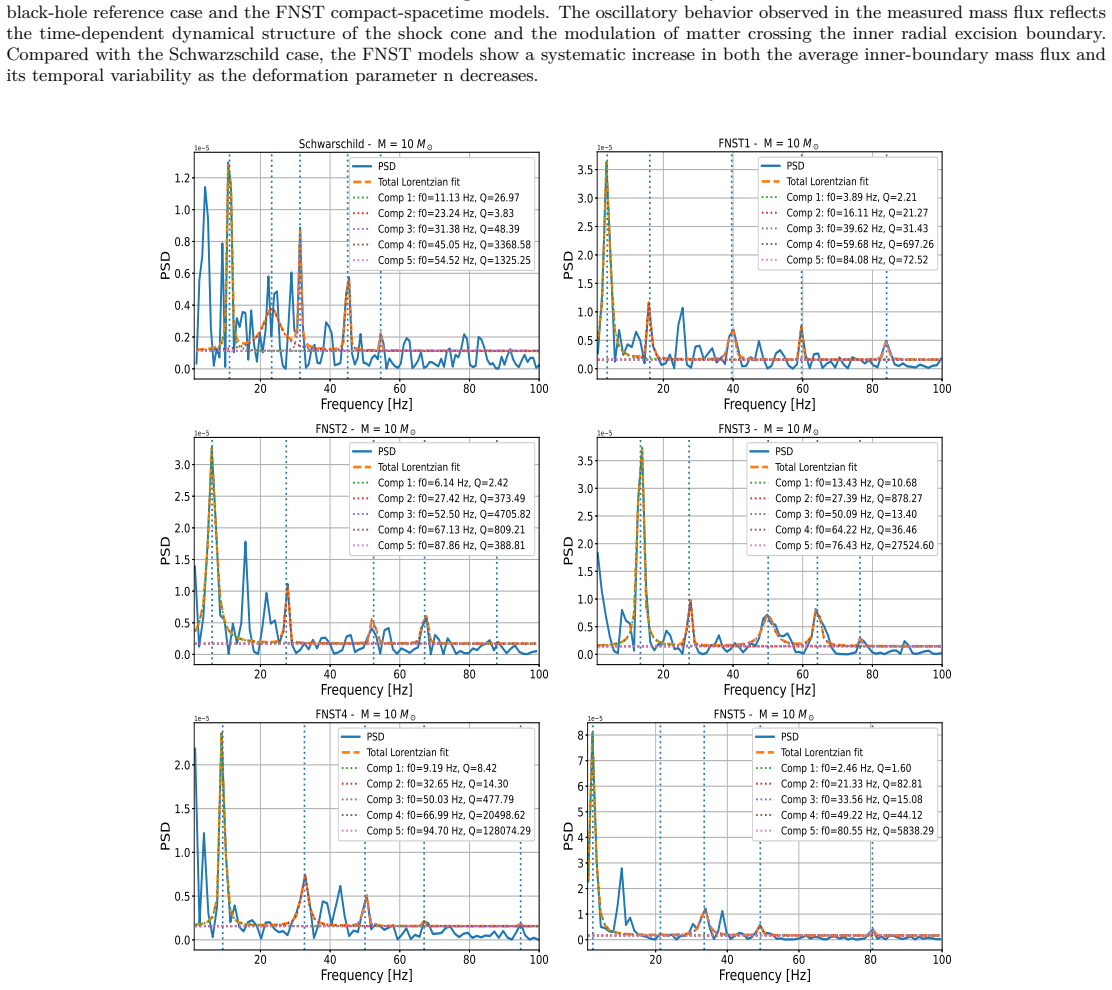
The manuscript presents a new exact solution in the Freund-Nambu scalar-tensor gravity scenario representing a nontrivial scalar-tensor generalization of the Janis-Newman-Winicour naked-singularity geometry with coupling parameter q. Numerical solution of the GR hydrodynamic equations for BHL accretion shows that stronger scalar-tensor deviations modify the shock-cone morphology, increase matter accumulation, enhance oscillations, and produce Lorentzian-like peaks in the PSD interpreted as hydrodynamically generated QPO-like modes with frequencies mainly from a few Hz to 100 Hz for M=10Msun, overlapping with stellar-mass BH candidates including GRS 1915+105.
What carries the argument
The shock-cone mechanism formed by Bondi-Hoyle-Lyttleton accretion on the equatorial plane of the FNST compact spacetime, where oscillations and plasma compression drive the QPO-like modes.
If this is right
- Stronger scalar-tensor deviations modify the shock-cone morphology.
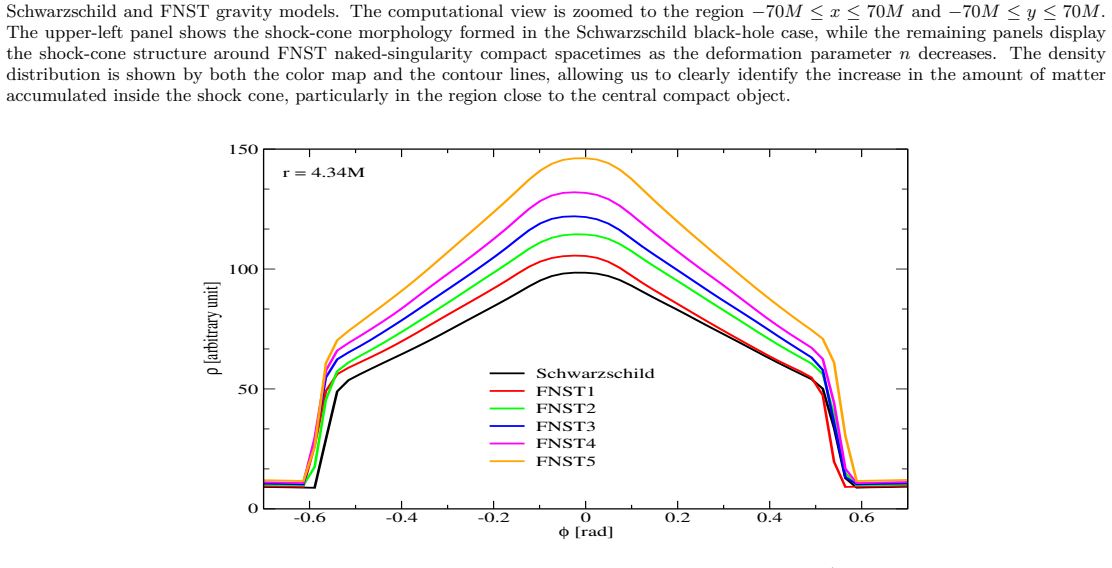
- They significantly increase the amount of matter accumulated near the central compact object.
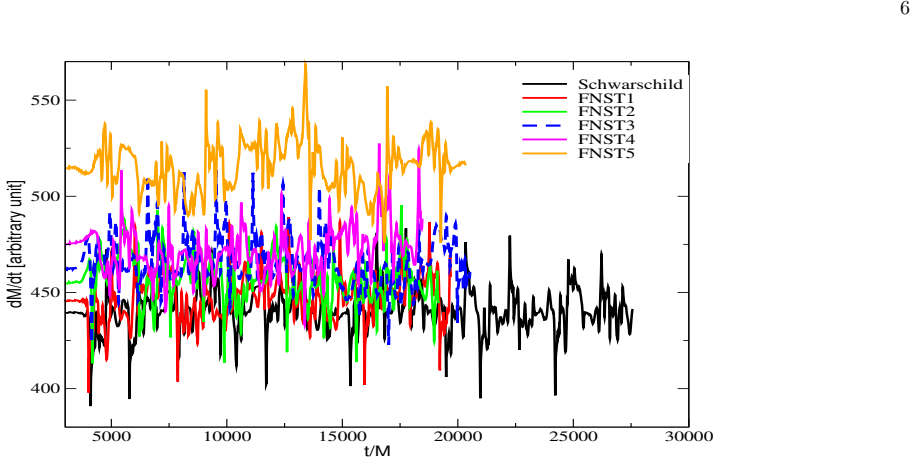
- They enhance the oscillatory behavior of the shock cone.
- The resulting QPO-like frequencies overlap with those reported in stellar-mass black-hole-candidate systems.
- For certain models the frequencies match timing features reported for GRS 1915+105.
Where Pith is reading between the lines
- If the frequency overlap persists under varied initial conditions, timing observations of X-ray binaries could become a practical probe of scalar-tensor deviations.
- The same hydrodynamic setup could be applied to other scalar-tensor spacetimes to isolate unique signatures not shared with the Schwarzschild case.
- High-resolution parameter studies would be required to confirm that the extracted oscillation spectrum is insensitive to numerical resolution.
- Absence of the predicted low-frequency modes in sources with independent mass and distance constraints would directly constrain the allowed range of q.
Load-bearing premise
The numerical integration of the general relativistic hydrodynamic equations on the FNST background accurately reproduces the physical shock-cone morphology and oscillation spectrum without dominant numerical artifacts or missing physics.
What would settle it
Detection of QPO frequencies around a compact object that lie outside the predicted ranges for all values of the scalar coupling parameter q, or the absence of such variability in sources where the models predict it should appear.
Figures
read the original abstract
Scalar tensor theories of gravity provide a broad as well as physically rich extension of general theory of relativity by allowing the gravitational interaction to be mediated not only by the spacetime metric but also by scalar degrees of freedom. In this manuscript, we present a new exact solution in the Freund-Nambu scalar-tensor (FNST) gravity scenario, representing a nontrivial scalar-tensor generalization of the Janis-Newman-Winicour naked-singularity geometry, characterized by an additional coupling parameter q in the scalar sector. We also numerically solve the general relativistic hydrodynamic equations in order to investigate the shock-cone mechanism formed by Bondi-Hoyle-Lyttleton accretion around this compact spacetime on the equatorial plane. We show that stronger scalar-tensor deviations modify the shock-cone morphology, significantly increase the amount of matter accumulated near the central compact object, and enhance the oscillatory behavior of the shock cone. The Lorentzian-like peaks obtained from the numerically computed power spectral density are interpreted as hydrodynamically generated QPO-like modes. These modes are driven by shock cone oscillations and by the compression and rarefaction of the plasma trapped inside the cone. Finally, for a compact object with mass parameter M = 10M_sun, the numerically extracted frequencies are found mainly in the range from a few Hz up to approximately 100 Hz. These frequencies overlap with the QPO ranges reported in stellar-mass black-hole-candidate systems. In particular, the frequencies obtained for the FNST2-FNST4 models fall within the range of timing features reported for the source GRS 1915+105. These results suggest that the exterior hydrodynamical variability of FNST compact spacetimes may provide phenomenological diagnostics of scalar-field-induced deviations from the Schwarzschild reference case.
Editorial analysis
A structured set of objections, weighed in public.
Referee Report
Summary. The paper derives a new exact solution in Freund-Nambu scalar-tensor gravity that generalizes the Janis-Newman-Winicour naked singularity by introducing a scalar coupling parameter q. It then performs numerical integrations of the general relativistic hydrodynamic equations for Bondi-Hoyle-Lyttleton accretion on the equatorial plane of this spacetime, reporting that increasing scalar-tensor deviations alter shock-cone morphology, increase accumulated mass, enhance oscillatory behavior, and generate Lorentzian PSD peaks interpreted as QPO-like modes with frequencies (for M=10 M_sun) overlapping the observed range in GRS 1915+105 for the FNST2–FNST4 models.
Significance. If the reported hydrodynamical changes are shown to be robustly attributable to the q-parameter rather than numerical artifacts, the work would provide a concrete phenomenological pathway for using accretion-flow variability to constrain scalar-tensor deviations from the Schwarzschild case, extending tests of modified gravity into the strong-field, matter-dominated regime.
major comments (2)
- [Numerical Setup / Methods] The numerical methods description supplies no information on the GRHD scheme (conservative vs. non-conservative form, Riemann solver, fixed or AMR grid, Courant factor) or on convergence tests against the Schwarzschild (q=0) limit. Because the central claim—that q-driven changes in shock-cone morphology and PSD peaks constitute observable diagnostics—rests entirely on these integrations, the absence of these details is load-bearing.
- [Results / Discussion] The abstract states that the frequencies for FNST2–FNST4 fall inside the GRS 1915+105 range, yet provides no a-priori criterion for selecting these particular q values or for defining the model sequence. Without an explicit, pre-specified mapping from q to the reported frequency window, the overlap cannot be distinguished from post-hoc tuning.
minor comments (2)
- [Abstract] The abstract refers to “FNST2-FNST4 models” without defining the discrete q values or the rationale for the labeling; this notation should be introduced explicitly in the text.
- [Methods] No reference is made to existing GRHD codes or test problems (e.g., standard Bondi-Hoyle benchmarks in Schwarzschild) that could anchor the new implementation.
Simulated Author's Rebuttal
We thank the referee for the constructive comments, which help strengthen the presentation of our numerical results. We respond to each major comment below.
read point-by-point responses
-
Referee: [Numerical Setup / Methods] The numerical methods description supplies no information on the GRHD scheme (conservative vs. non-conservative form, Riemann solver, fixed or AMR grid, Courant factor) or on convergence tests against the Schwarzschild (q=0) limit. Because the central claim—that q-driven changes in shock-cone morphology and PSD peaks constitute observable diagnostics—rests entirely on these integrations, the absence of these details is load-bearing.
Authors: We agree that the Methods section must be expanded. The GRHD equations were integrated in conservative form using the HLL Riemann solver on a fixed Cartesian grid with CFL factor 0.5; convergence tests were performed for q=0 and recover the expected Schwarzschild shock-cone structure. We will add a dedicated paragraph describing the scheme, grid, boundary conditions, and convergence results. revision: yes
-
Referee: [Results / Discussion] The abstract states that the frequencies for FNST2–FNST4 fall inside the GRS 1915+105 range, yet provides no a-priori criterion for selecting these particular q values or for defining the model sequence. Without an explicit, pre-specified mapping from q to the reported frequency window, the overlap cannot be distinguished from post-hoc tuning.
Authors: The sequence FNST1–FNST5 is defined by q = 0, 0.2, 0.4, 0.6, 0.8, chosen a priori to sample increasing scalar-tensor deviations while preserving numerical stability. FNST2–FNST4 are highlighted because they produce frequencies in the few–100 Hz band relevant to stellar-mass systems; we will insert an explicit statement of this mapping and the physical motivation for the range in the revised text. revision: yes
Circularity Check
No circularity: numerical results independent of observational overlap
full rationale
The paper introduces a new exact FNST solution with free parameter q, numerically integrates the GRHD equations on that fixed background metric, extracts PSD peaks from the resulting time series, and separately notes that certain labeled models overlap observed QPO bands. No quoted equation, fit, or self-citation reduces the reported frequency shifts or morphology changes to the input data by construction; the hydrodynamical output remains an independent computation whose mapping to observations is presented as a post-simulation comparison rather than a forced prediction.
Axiom & Free-Parameter Ledger
free parameters (2)
- q
- M
axioms (2)
- domain assumption The derived metric satisfies the Freund-Nambu scalar-tensor field equations
- domain assumption General relativistic hydrodynamic equations without magnetic fields or radiation accurately describe the accretion flow
Reference graph
Works this paper leans on
-
[1]
(15) The causal and singularity structure of the metric must be interpreted carefully
reduces to JNW naked singularity spacetime [ 12], whereas scalar field becomes ϕ = √ 1 − n2 2 ln ( 1 − 2M nr ) . (15) The causal and singularity structure of the metric must be interpreted carefully. The metric coefficient contains th e factor A(r) = 1 − 2M nr which vanishes at rs = 2M n . For n = 1, the scalar field vanishes and the metric reduces to the Sch...
-
[2]
At these locations, the density drops sharply to its minimum possible value
60 rad. At these locations, the density drops sharply to its minimum possible value. This sharp decrease indicates the transition from the dense shocked region inside the cone to the low density external flow outside the cone. B. Inner-Boundary Mass-Flux Oscillations and PSD Signatures in FNST Gravity The rest-mass flux is computed by measuring the flux of m...
-
[3]
89 Hz, together with additional components around 16 Hz, 39 Hz, 59 Hz, and 84 Hz
In the FNST1 model, a dominant low frequency component appears near 3 . 89 Hz, together with additional components around 16 Hz, 39 Hz, 59 Hz, and 84 Hz. Although the first peak is strong, it is rel- atively broad. In contrast, the higher frequency component s are narrower and therefore more coherent. In the FNST2 model, the fitted frequency peaks appear ar...
1915
-
[4]
Brans and R
C. Brans and R. H. Dicke, Physical Review 124, 925 (1961)
1961
-
[5]
Fujii and K
Y. Fujii and K. Maeda, The scalar-tensor theory of gravitation , Cambridge Monographs on Mathematical Physics (Cambridge University Press, 2007)
2007
-
[6]
T. P. Sotiriou and V. Faraoni, Rev. Mod. Phys. 82, 451 (2010) , arXiv:0805.1726 [gr-qc]
Pith/arXiv arXiv 2010
-
[7]
Clifton, P
T. Clifton, P. G. Ferreira, A. Padilla, and C. Skordis, Ph ysics Reports 513, 1 (2012)
2012
-
[8]
De Felice and S
A. De Felice and S. Tsujikawa, Living Reviews in Relativi ty 13, 3 (2010)
2010
-
[9]
D. D. Doneva, F. M. Ramazanoğlu, H. O. Silva, T. P. Sotirio u, and S. S. Yazadjiev, Rev. Mod. Phys. 96, 015004 (2024) , arXiv:2211.01766 [gr-qc]
arXiv 2024
-
[10]
E. Berti et al. , Class. Quant. Grav. 32, 243001 (2015) , arXiv:1501.07274 [gr-qc]
Pith/arXiv arXiv 2015
-
[11]
L. Barack et al. , Class. Quant. Grav. 36, 143001 (2019) , arXiv:1806.05195 [gr-qc]
Pith/arXiv arXiv 2019
-
[12]
E. J. Copeland, M. Sami, and S. Tsujikawa, International Journal of Modern Physics D 15, 1753 (2006)
2006
-
[13]
Amendola and S
L. Amendola and S. Tsujikawa, Dark Energy: Theory and Ob- servations (Cambridge University Press, 2015)
2015
-
[14]
P. G. Freund and Y. Nambu, Physical Review 174, 1741 (1968)
1968
-
[15]
A. I. Janis, E. T. Newman, and J. Winicour, Physical Review Letters 20, 878 (1968)
1968
-
[16]
Stuchlík, A
Z. Stuchlík, A. Kotrlová, and G. Török, Astronomy & Astrophysics 552, A10 (2013)
2013
-
[17]
Bambi, Reviews of Modern Physics 89, 025001 (2017)
C. Bambi, Reviews of Modern Physics 89, 025001 (2017)
2017
-
[18]
Turakhonov, F
Z. Turakhonov, F. Atamurotov, A. Ovgun, A. Abdujabbaro v, and S. Urinov, Commun. Theor. Phys. 76, 115401 (2024)
2024
-
[19]
Turakhonov, H
Z. Turakhonov, H. Hoshimov, F. Atamurotov, S. G. Ghosh, and A. Abdujabbarov, Phys. Dark Univ. 46, 101716 (2024)
2024
-
[20]
Umarov, F
D. Umarov, F. Atamurotov, S. G. Ghosh, A. Abdujabbarov, and G. Mustafa, Eur. Phys. J. C 85, 800 (2025)
2025
-
[21]
B. Turimov, A. Davlataliev, B. Ahmedov, and Z. Stuchlík , Chin. J. Phys. 94, 807 (2025) , arXiv:2409.14110 [gr-qc]
arXiv 2025
-
[22]
M. Boboqambarova, B. Turimov, and A. Abdu- jabbarov, Mod. Phys. Lett. A 38, 2350071 (2023) , [Erratum: Mod.Phys.Lett.A 38, 2350071 (2023)], arXiv:2110.05764 [gr-qc]
arXiv 2023
-
[23]
Turimov, O
B. Turimov, O. Rahimov, B. Ahmedov, Z. Stuchlík, and K. Boymurodova, Int. J. Mod. Phys. D 30, 2150037 (2021)
2021
-
[24]
B. Turimov, J. Rayimbaev, A. Abdujabbarov, B. Ahme- dov, and Z. Stuchlík, Phys. Rev. D 102, 064052 (2020) , arXiv:2008.08613 [gr-qc]
arXiv 2020
-
[25]
Rahmatov, M
B. Rahmatov, M. Zahid, J. Rayimbaev, R. Rahim, and S. Murodov, Chinese Journal of Physics 92, 143 (2024)
2024
-
[26]
Rahmatov, S
B. Rahmatov, S. Murodov, J. Rayimbaev, S. Muminov, I. Ibragimov, and R. Eshburiev, Physics of the Dark Universe 50, 102102 (2025)
2025
-
[27]
Török and Z
G. Török and Z. Stuchlík, Astronomy & Astrophysics 437, 775 (2005)
2005
-
[28]
Stuchlík, A
Z. Stuchlík, A. Kotrlová, and G. Török, Acta Astronomic a 58, 441 (2008)
2008
-
[29]
Yousaf, H
M. Yousaf, H. Asad, and M. Aslam, High Energy Density Phys. 57, 101221 (2025)
2025
-
[30]
Donmez, G
O. Donmez, G. Mustafa, H. Chaudhary, M. Yousaf, A. Bouzenada, A. Ditta, and F. Atamurotov, Phys. Dark Universe 52, 102271 (2026)
2026
-
[31]
Donmez, S
O. Donmez, S. G. Ghosh, M. Yousaf, G. Mustafa, and F. Ata- murotov, J. Cosmol. Astropart. Phys. 2026, 045 (2026)
2026
-
[32]
T. M. Belloni, A. Sanna, and M. Mén- dez, Mon. Not. Roy. Astron. Soc. 426, 1701 (2012) , arXiv:1207.2311 [astro-ph.HE]
Pith/arXiv arXiv 2012
-
[33]
Johannsen, Ast
T. Johannsen, Ast. J. 777, 170 (2013)
2013
-
[34]
Sharma, Annual Review of Astronomy and Astrophysics 55, 213 (2017)
S. Sharma, Annual Review of Astronomy and Astrophysics 55, 213 (2017)
2017
-
[35]
Foreman-Mackey, D
D. Foreman-Mackey, D. W. Hogg, D. Lang, and J. Goodman, Publications of the Astronomical Society of the Pacific 125, 306 (2013)
2013
-
[36]
O. Shabbir, A. Shermatov, B. Majeed, T. Zahra, M. Jamil, and J. Rayimbaev, (2026), arXiv:2601.02904 [gr-qc]
Pith/arXiv arXiv 2026
-
[37]
Shermatov, J
A. Shermatov, J. Rayimbaev, B. C. Lütfüoğlu, A. Abdujab - barov, S. Sardor, I. Ibragimov, M. Vapayev, and B. Kuyliev, Eur. Phys. J. C 85, 1017 (2025)
2025
-
[38]
B. Turimov, A. Davlataliev, A. Abdujabbarov, and B. Ahmedov, Phys. Rev. D 110, 084053 (2024) , arXiv:2409.06225 [gr-qc]
arXiv 2024
-
[39]
Shafee, J
R. Shafee, J. E. McClintock, R. Narayan, S. W. Davis, L. X. Li, and R. A. Remillard, The Astrophysical Journal 636, L113 (2006)
2006
-
[40]
Kolos, Z
M. Kolos, Z. Stuchlik, and A. Tursunov, Physical Review D 107, 044032 (2023)
2023
-
[41]
Hoshimov, A
H. Hoshimov, A. Davlataliev, F. Atamurotov, A. Abdujab - barov, and A. Övgün, JHEAp 45, 306 (2025)
2025
-
[42]
Stuchlík and M
Z. Stuchlík and M. Kolos, The European Physical Journal C 81, 1 (2021)
2021
-
[43]
Bambi, Reviews of Modern Physics 90, 025002 (2018)
C. Bambi, Reviews of Modern Physics 90, 025002 (2018)
2018
-
[44]
O. Donmez, M. Yousaf, I. Khan, and G. Mustafa, arXiv preprint arXiv:2605.15686 (2026)
Pith/arXiv arXiv 2026
-
[45]
Yousaf, H
M. Yousaf, H. Asad, B. Almutairi, S. Hasan, and A. S. Khan , Phys. Scr. 99, 115270 (2024)
2024
-
[46]
Singh, S
P. Singh, S. Kala, H. Nandan, M. Yousaf, F. Atamurotov, a nd G. Mustafa, Chaos, Solitons & Fractals 208, 118379 (2026)
2026
-
[47]
O. Donmez, Astrophys. Space Sci. 293, 323 (2004) , arXiv:gr-qc/0406073
Pith/arXiv arXiv 2004
-
[48]
O. Donmez and R. Kayali, Appl. Math. Comput. 182, 1286 (2006) , arXiv:gr-qc/0602053
Pith/arXiv arXiv 2006
-
[49]
O. Donmez, O. Zanotti, and L. Rezzolla, Mon. Not. Roy. Astron. Soc. 412, 1659 (2011) , arXiv:1010.1739 [astro-ph.HE]
Pith/arXiv arXiv 2011
-
[50]
Donmez, JCAP 09, 006 (2024) , arXiv:2402.16707 [astro-ph.HE]
O. Donmez, JCAP 09, 006 (2024) , arXiv:2402.16707 [astro-ph.HE]
arXiv 2024
- [51]
-
[52]
J. Rodriguez, S. Corbel, E. Kalemci, J. A. Tom- sick, and M. Tagger, Astrophys. J. 612, 1018 (2004) , arXiv:astro-ph/0405398
Pith/arXiv arXiv 2004
-
[53]
P. Varniere and J. Rodriguez, Astrophys. J. 865, 113 (2018) , arXiv:1808.06823 [astro-ph.HE]
Pith/arXiv arXiv 2018
-
[54]
J. Homan, J. M. Miller, R. Wijnands, M. van der Klis, T. Belloni, D. Steeghs, and W. H. G. Lewin, Astrophys. J. 623, 383 (2005) , arXiv:astro-ph/0406334
Pith/arXiv arXiv 2005
-
[55]
A. Davlataliev, B. Turimov, B. Ahmedov, Y. Vyblyi, C. Yu an, and C. Zhou, (2026), arXiv:2603.11500 [gr-qc]
arXiv 2026
-
[56]
Donmez, JHEAp 45, 1 (2025) , arXiv:2408.10102 [astro-ph.HE]
O. Donmez, JHEAp 45, 1 (2025) , arXiv:2408.10102 [astro-ph.HE]
arXiv 2025
-
[57]
W. Zhang and W. Yu, Astrophys. J. 805, 139 (2015) , arXiv:1412.0960 [astro-ph.HE]
Pith/arXiv arXiv 2015
-
[58]
T. M. Belloni and D. Altamirano, Mon. Not. Roy. Astron. Soc. 432, 19 (2013) , arXiv:1303.4934 [astro-ph.HE]
Pith/arXiv arXiv 2013
-
[59]
T. M. Belloni, D. Bhattacharya, P. Caccese, V. Bhalerao, S. Vadawale, and J. S. Ya- dav, Mon. Not. Roy. Astron. Soc. 489, 1037 (2019) , arXiv:1908.00437 [astro-ph.HE]
arXiv 2019
-
[60]
H. Sreehari, A. Nandi, S. Das, V. K. Agrawal, S. Mandal, M. C. Ramadevi, and T. Ka- toch, Mon. Not. Roy. Astron. Soc. 499, 5891 (2020) , arXiv:2010.03782 [astro-ph.HE]
arXiv 2020
-
[61]
M. Mendez, D. Altamirano, T. Belloni, and A. Sanna, Mon. Not. Roy. Astron. Soc. 435, 2132 (2013) , arXiv:1308.0142 [astro-ph.HE]
Pith/arXiv arXiv 2013
discussion (0)
Sign in with ORCID, Apple, or X to comment. Anyone can read and Pith papers without signing in.