Uncertainty Quantification of Engineering Structures by Polynomial Chaos Expansion and Multivariate Active Learning
Pith reviewed 2026-06-27 03:23 UTC · model grok-4.3
The pith
A single adaptive sampling strategy for polynomial chaos expansions can approximate multiple engineering outputs simultaneously by aggregating their local variance contributions.
A machine-rendered reading of the paper's core claim, the machinery that carries it, and where it could break.
Core claim
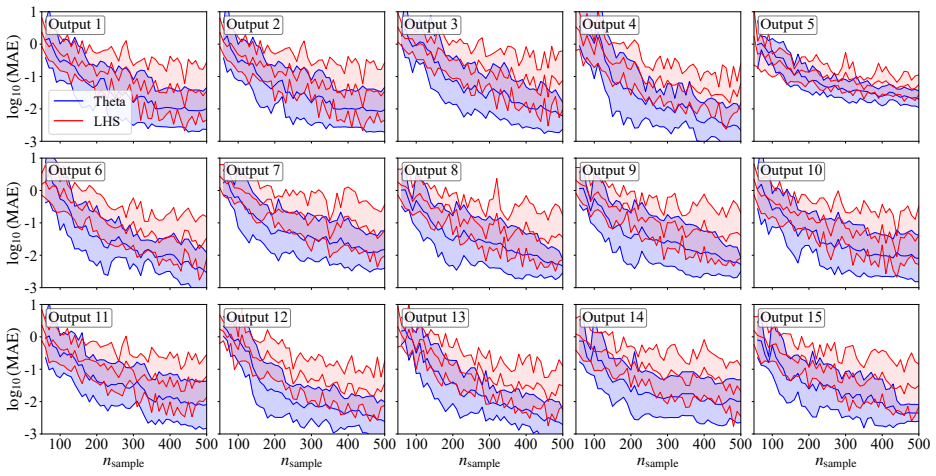
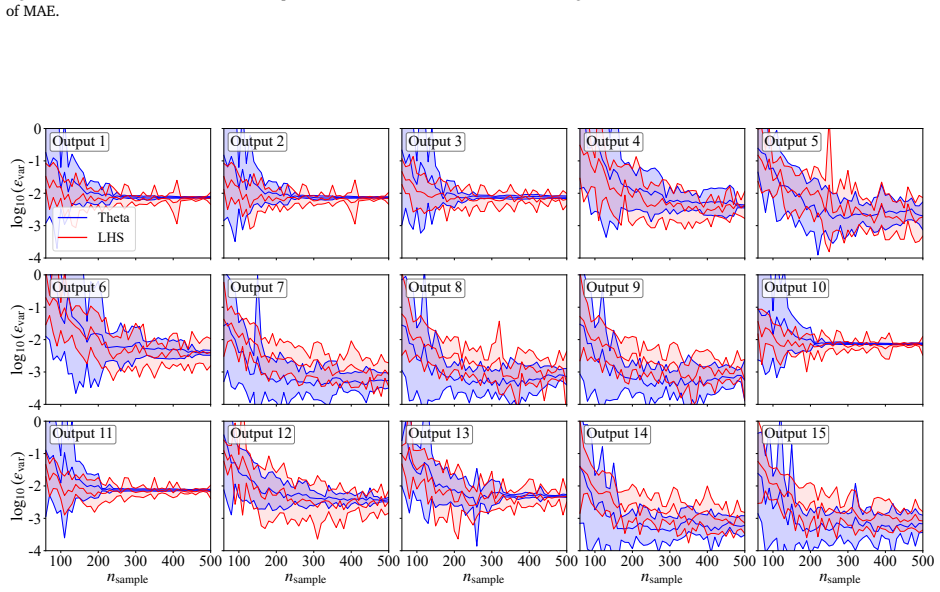
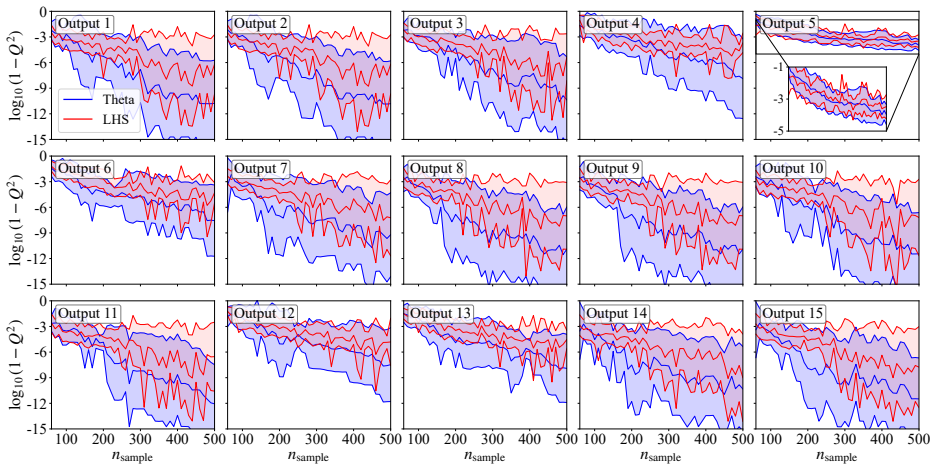
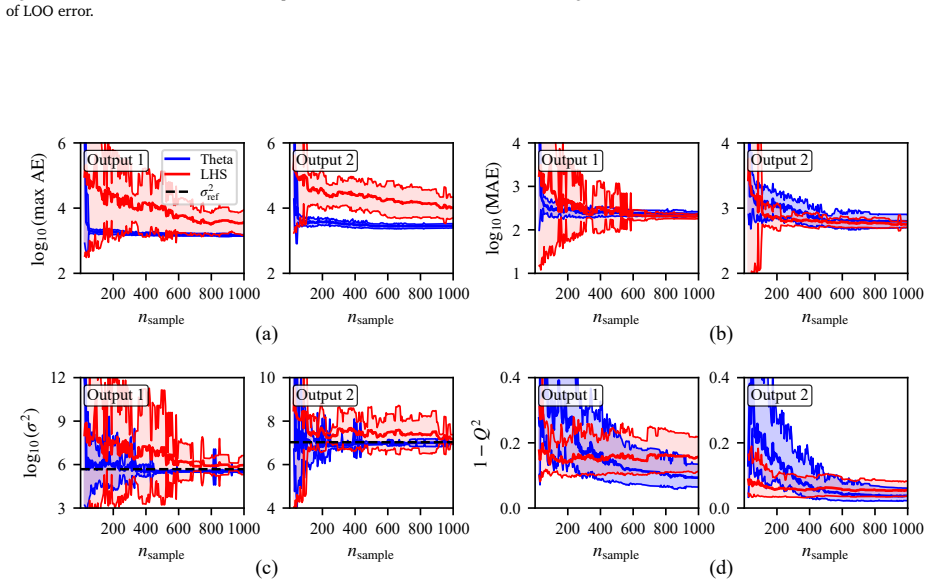
The adaptive sequential sampling procedure is generalized to vector-valued quantities of interest by replacing per-output variance indicators with a single scalar that sums the local variance contributions of every output; new samples are then drawn from a candidate pool to maximize this aggregate while enforcing a minimum-distance exploration term, yielding experimental designs that simultaneously improve surrogate accuracy, stability, and second-moment reliability for all outputs.
What carries the argument
The aggregated local-variance selection criterion, which sums each candidate point's estimated contribution to output variance across every quantity of interest and balances it against a distance-to-existing-points term.
If this is right
- Fewer total model evaluations are needed to reach a target accuracy level when multiple quantities must be approximated from the same high-fidelity code.
- Estimated means and variances of all outputs become more stable across repeated surrogate constructions.
- Correlations among outputs are automatically respected because all outputs share the same set of training points.
- The method scales to any number of outputs without a combinatorial increase in sampling effort.
Where Pith is reading between the lines
- The same aggregation idea could be tested on other surrogate families such as Gaussian processes or neural networks to check whether the benefit is specific to polynomial chaos expansions.
- If the outputs are known to be strongly correlated, the variance aggregation could be weighted by a correlation matrix estimated from an initial pilot sample.
- The approach might be combined with dimension-reduction techniques when the input space itself is high-dimensional.
Load-bearing premise
That a single experimental design chosen from the summed variance contributions of all outputs will remain adequate for every individual output even when the outputs respond to the inputs with markedly different sensitivities.
What would settle it
A numerical experiment on a model whose outputs have strongly opposing sensitivities (one output most sensitive to input A, another to input B) in which the aggregated design produces visibly larger error on one output than an output-specific design of the same total size.
Figures
read the original abstract
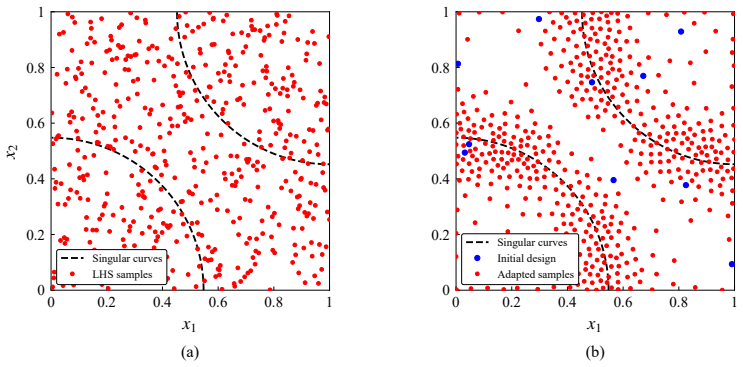
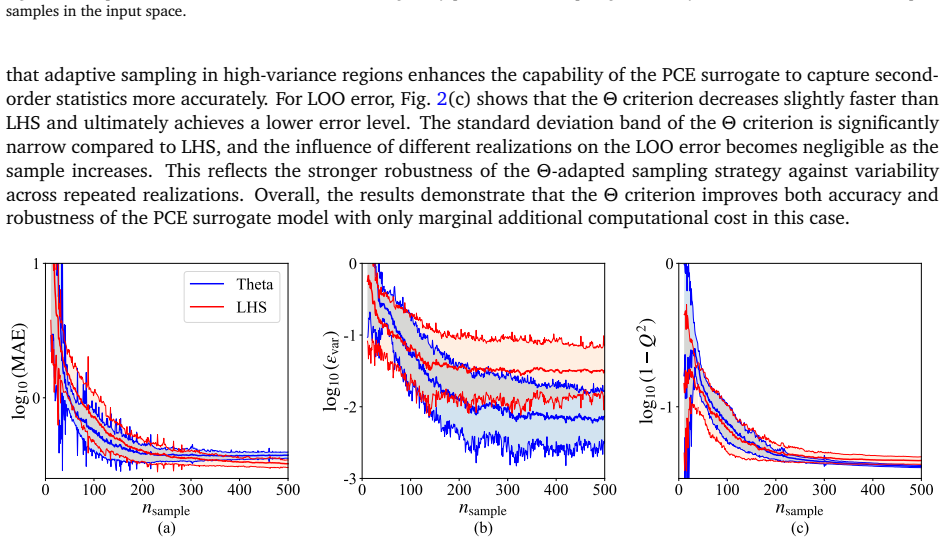
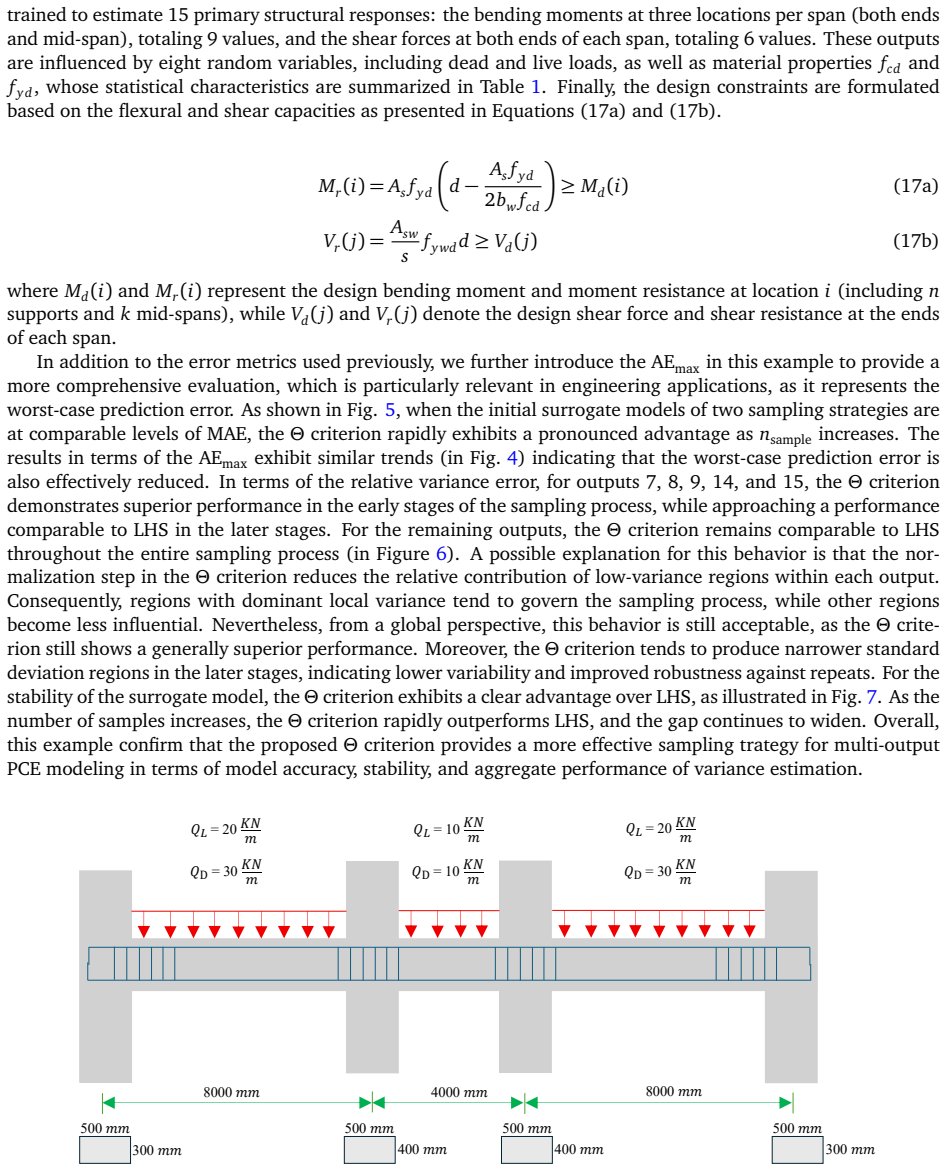
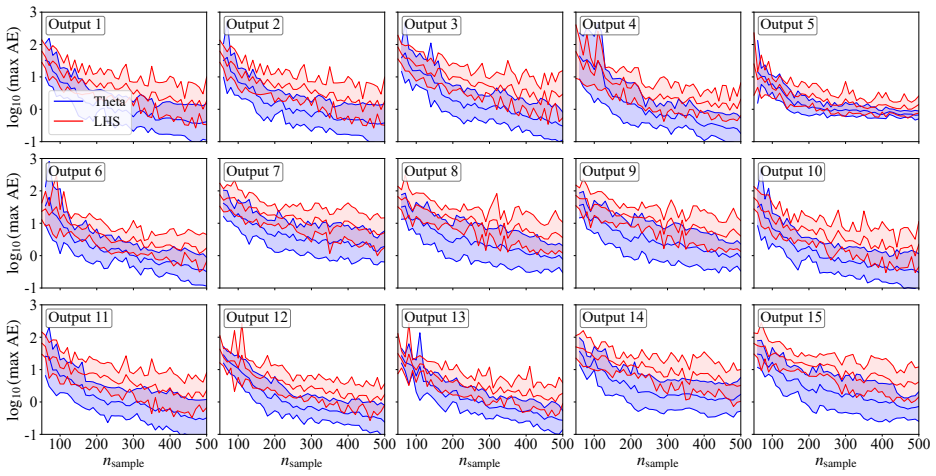
In many engineering applications, a single high-fidelity model produces multiple quantities of interest (QoIs) under the same input parameters, e.g. finite element models of complex physical systems. To alleviate the high computational cost of direct model evaluations, surrogate models are widely used to construct efficient approximations of model responses. Naturally, the accuracy of surrogates strongly depends on the quality of the experimental design (ED). However, a single ED may not provide an adequate representation for all outputs simultaneously, especially when different outputs exhibit varying sensitivities to the input variables. A straightforward solution is to perform separate sampling for each output, but this results in increased sampling complexity and computational cost. From a statistical perspective, such an approach also ignores potential correlations among all outputs and may compromise data consistency. To address this issue, an adaptive sequential sampling method for constructing polynomial chaos expansion surrogate models is generalized for vector valued QoIs. The method sequentially selects new samples from a candidate pool based on their local contribution to the output variance, while balancing distance-based exploration of the input space and exploitation of aggregated variance information across all outputs. Its performance is compared with non-sequential Latin Hypercube Sampling through several numerical examples from engineering problems. Numerical results demonstrate that the proposed strategy improves both surrogate accuracy and stability, and provides a more reliable estimation of second-order statistics.
Editorial analysis
A structured set of objections, weighed in public.
Referee Report
Summary. The manuscript generalizes an adaptive sequential sampling method for polynomial chaos expansion (PCE) surrogates to vector-valued quantities of interest (QoIs). New samples are chosen from a candidate pool by maximizing an acquisition function that aggregates local variance contributions across outputs while balancing distance-based exploration; performance is compared to non-sequential Latin Hypercube Sampling on several engineering numerical examples, with the claim that the strategy improves surrogate accuracy, stability, and second-order statistics estimation.
Significance. If the empirical claims are substantiated with per-output quantitative validation, the method could reduce sampling cost for multi-output engineering UQ problems while preserving output correlations, offering a practical alternative to separate per-QoI designs.
major comments (2)
- [Abstract and numerical examples] Abstract and numerical examples section: the central claim that the aggregated-variance design improves accuracy for every QoI rests on the assumption that high-variance regions overlap sufficiently across outputs. No per-output error tables, comparisons against output-specific adaptive designs, or worst-case analysis are supplied to verify that the single experimental design does not systematically under-sample regions critical to the most sensitive output.
- [Method description] Method description: the acquisition function aggregates local variance contributions, yet no convergence-rate bound or sensitivity-misalignment test is provided to guarantee that the resulting PCE still converges at the expected rate for each marginal output when sensitivities differ.
Simulated Author's Rebuttal
We thank the referee for the constructive comments. We address the major comments point by point below, indicating planned revisions to the manuscript.
read point-by-point responses
-
Referee: [Abstract and numerical examples] Abstract and numerical examples section: the central claim that the aggregated-variance design improves accuracy for every QoI rests on the assumption that high-variance regions overlap sufficiently across outputs. No per-output error tables, comparisons against output-specific adaptive designs, or worst-case analysis are supplied to verify that the single experimental design does not systematically under-sample regions critical to the most sensitive output.
Authors: The manuscript reports aggregate accuracy and stability metrics over the vector QoI, consistent with the goal of a single design that respects output correlations. We acknowledge the absence of per-output error tables and direct comparisons to output-specific designs. To address this, the revised manuscript will include per-output error metrics for the numerical examples and a brief discussion of cases where output sensitivities may differ substantially. revision: yes
-
Referee: [Method description] Method description: the acquisition function aggregates local variance contributions, yet no convergence-rate bound or sensitivity-misalignment test is provided to guarantee that the resulting PCE still converges at the expected rate for each marginal output when sensitivities differ.
Authors: The method is presented as a practical heuristic that aggregates variance information while incorporating distance-based exploration; no theoretical convergence-rate analysis is derived. The numerical examples demonstrate reliable performance on the chosen engineering test cases. A general guarantee for arbitrary sensitivity misalignment would require substantial additional theoretical development beyond the scope of this applied contribution. We will add a short limitations paragraph noting this point. revision: partial
Circularity Check
No significant circularity; derivation remains self-contained
full rationale
The paper describes an adaptive sequential sampling strategy for multivariate PCE that aggregates local variance contributions across outputs to select new design points while balancing exploration. No equations, derivations, or performance claims reduce the reported accuracy/stability improvements to a quantity defined by construction from the method's own fitted inputs or self-citations. Numerical examples are presented as external empirical checks rather than tautological predictions. The central premise relies on standard PCE theory and active-learning heuristics without load-bearing self-referential loops.
Axiom & Free-Parameter Ledger
Reference graph
Works this paper leans on
-
[1]
On distribution-based global sensitivity analysis by polynomial chaos expansion , journal =. 2022 , issn =. doi:https://doi.org/10.1016/j.compstruc.2022.106808 , author =
-
[2]
Papadopoulos and Dimitris Syvridis and Elias N
Aristeides D. Papadopoulos and Dimitris Syvridis and Elias N. Glytsis , journal =. Sparse polynomial chaos algorithm with a variance-adaptive design domain for the uncertainty quantification and optimization of grating structures , volume =. 2025 , doi =
2025
-
[3]
Multivariate sensitivity-adaptive polynomial chaos expansion for high-dimensional surrogate modeling and uncertainty quantification , journal =. 2025 , issn =. doi:https://doi.org/10.1016/j.apm.2024.115746 , author =
-
[4]
Polynomial chaos expansion for operator learning , journal =. 2026 , issn =. doi:https://doi.org/10.1016/j.cma.2026.118796 , author =
-
[5]
Physics-constrained polynomial chaos expansion for scientific machine learning and uncertainty quantification , journal =. 2024 , issn =. doi:https://doi.org/10.1016/j.cma.2024.117314 , author =
-
[6]
Physics-informed polynomial chaos expansions , journal =. 2024 , issn =. doi:https://doi.org/10.1016/j.jcp.2024.112926 , author =
-
[7]
AIP Advances , volume =
Ayoob, Keenjhar and Zafar, Tayyab and Hamza, Amir and Wang, Zhonglai , title =. AIP Advances , volume =. 2025 , month =
2025
-
[8]
Structural Concrete , volume =
Slowik, Ondřej and Lehký, David and Novák, Drahomír , title =. Structural Concrete , volume =. doi:https://doi.org/10.1002/suco.202000455 , year =
-
[9]
Active learning-based domain adaptive localized polynomial chaos expansion , journal =. 2023 , issn =. doi:https://doi.org/10.1016/j.ymssp.2023.110728 , author =
-
[10]
SIAM Journal on Scientific Computing , volume =
Wan, Xiaoliang and Karniadakis, George Em , title =. SIAM Journal on Scientific Computing , volume =. 2006 , doi =
2006
-
[11]
J. Kiefer and J. Wolfowitz , title =. doi:10.4153/cjm-1960-030-4 , year =
-
[12]
Journal of Engineering Mechanics , volume =
Armen Der Kiureghian and Pei‐Ling Liu , title =. Journal of Engineering Mechanics , volume =
-
[13]
Distance-based optimal sampling in a hypercube:
Miroslav Vo. Distance-based optimal sampling in a hypercube:. Advances in Engineering Software , volume =. 2019 , issn =
2019
-
[14]
Distance-based optimal sampling in a hypercube:
Miroslav Vo. Distance-based optimal sampling in a hypercube:. Advances in Engineering Software , volume =. 2020 , issn =
2020
-
[15]
A literature survey of benchmark functions for global optimisation problems , author=. Int. J. Math. Model. Numer. Optimisation , year=
-
[16]
Polynomial chaos expansions for dependent random variables , journal =. 2019 , issn =. doi:https://doi.org/10.1016/j.cma.2019.03.049 , author =
-
[17]
Efficient computation of global sensitivity indices using sparse polynomial chaos expansions , journal =. 2010 , issn =. doi:10.1016/j.ress.2010.06.015 , author =
-
[18]
SIAM/ASA Journal on Uncertainty Quantification , volume =
Lüthen, Nora and Marelli, Stefano and Sudret, Bruno , title =. SIAM/ASA Journal on Uncertainty Quantification , volume =. 2021 , doi =
2021
-
[19]
Global sensitivity analysis using sparse grid interpolation and polynomial chaos , journal =. 2012 , note =. doi:10.1016/j.ress.2011.07.011 , author =
-
[20]
Narayan and J
Akil C. Narayan and J. Jakeman and Tao Zhou , journal=. A. 2017 , volume=
2017
-
[21]
Grid and basis adaptive polynomial chaos techniques for sensitivity and uncertainty analysis , journal =. 2014 , issn =. doi:10.1016/j.jcp.2013.12.025 , author =
-
[22]
The SMAI journal of computational mathematics , pages =
Albert Cohen and Giovanni Migliorati , title =. The SMAI journal of computational mathematics , pages =. 2017 , doi =
2017
-
[23]
An efficient and robust adaptive sampling method for polynomial chaos expansion in sparse Bayesian learning framework , journal =. 2019 , issn =. doi:10.1016/j.cma.2019.04.046 , author =
-
[24]
SIAM Journal on Numerical Analysis , volume =
Migliorati, Giovanni , title =. SIAM Journal on Numerical Analysis , volume =. 2019 , doi =
2019
-
[25]
Journal of Computational Physics , volume =
Basis adaptive sample efficient polynomial chaos. Journal of Computational Physics , volume =. 2018 , issn =. doi:10.1016/j.jcp.2018.03.035 , author =
-
[26]
doi:10.1016/j.cma.2017.12.019 , year =
Mohammad Hadigol and Alireza Doostan , title =. doi:10.1016/j.cma.2017.12.019 , year =
-
[27]
and Canfield, Robert A
Choi, Seung-Kyum and Grandhi, Ramana V. and Canfield, Robert A. and Pettit, Chris L. , title =. AIAA Journal , volume =. 2004 , doi =
2004
-
[28]
Jerrad Hampton and Alireza Doostan , title =. 2015. doi:10.1016/j.cma.2015.02.006
-
[29]
, TITLE =
Conover, W.J. , TITLE =. 1975 , url =
1975
-
[30]
Jerrad Hampton and Alireza Doostan , title =. 2015. doi:10.1016/j.jcp.2014.09.019
-
[31]
doi:10.1137/16m1103488 , year =
Noura Fajraoui and Stefano Marelli and Bruno Sudret , title =. doi:10.1137/16m1103488 , year =
-
[32]
Technometrics , volume =
Otto Dykstra , title =. Technometrics , volume =. 1971 , publisher =
1971
-
[33]
Sparse polynomial chaos expansions via compressed sensing and D -optimal design
Paul Diaz and Alireza Doostan and Jerrad Hampton. Sparse polynomial chaos expansions via compressed sensing and D -optimal design. 2018. doi:10.1016/j.cma.2018.03.020
-
[34]
Journal of the Royal Statistical Society
Algorithm. Journal of the Royal Statistical Society. Series C (Applied Statistics) , number =. doi:10.2307/2986264 , author =
-
[35]
Michael D. Shields , title =. Reliability Engineering. doi:10.1016/j.ress.2018.03.018 , year =
-
[36]
John J Borkowski and Elsie S Valeroso , publisher =. Comparison of Design Optimality Criteria of Reduced Models for Response Surface Designs in the Hypercube , journal =. doi:10.1198/00401700152672564 , year =
-
[37]
Shields , journal=
M. Shields , journal=. Refined Latinized Stratified Sampling: a Robust Sequential Sample Size Extension Methodology for High-Dimensional. 2016 , volume=
2016
-
[38]
Refinement strategies for stratified sampling methods , journal =. 2006 , issn =. doi:10.1016/j.ress.2005.11.027 , author =
-
[39]
Efficient space-filling and near-orthogonality sequential. 2017 , issn =. doi:10.1016/j.cma.2017.05.020 , author =
-
[40]
Joel A. Tropp and Anna C. Gilbert , title =. doi:10.1109/tit.2007.909108 , year =
-
[41]
Spectral stochastic finite element analysis for laminated composite plates , journal = CMAME, volume =. 2008 , issn =. doi:10.1016/j.cma.2008.07.003 , author =
-
[42]
A painless intrusive polynomial chaos method with RANS-based applications , journal = CMAME, volume =. 2019 , issn =. doi:10.1016/j.cma.2019.01.018 , author =
-
[43]
An innovating analysis of the
R. An innovating analysis of the. Probabilistic Engineering Mechanics , volume =. 2009 , doi =
2009
-
[44]
R. A generalization of the. doi:10.1016/j.probengmech.2008.05.001 , year =
-
[45]
Fan Wang and Heng Li , title =. Reliability Engineering. doi:10.1016/j.ress.2017.12.018 , year =
-
[46]
Computation of higher-order moments of generalized polynomial chaos expansions , journal =. doi:10.1002/nme.5505 , year =
-
[47]
Journal of Computational and Applied Mathematics , doi =
On linearization and connection coefficients for generalized. Journal of Computational and Applied Mathematics , doi =. 2011 , volume =
2011
-
[48]
Expressing a Probability Density Function in Terms of another
M. Expressing a Probability Density Function in Terms of another. Journal of Mathematical Chemistry , doi =. 2006 , volume =
2006
-
[49]
Canadian Journal of Mathematics , doi =
George Gasper , title =. Canadian Journal of Mathematics , doi =. 1970 , publisher =
1970
-
[50]
R. Do. Probabilistic Engineering Mechanics , year =. doi:10.1016/j.probengmech.2009.04.006 , pages =
-
[51]
Journal of Engineering Mechanics , year =
Armen Der Kiureghian and Pei‐Ling Liu , title =. Journal of Engineering Mechanics , year =. doi:10.1061/(asce)0733-9399(1986)112:1(85) , pages =
-
[52]
L.S. Katafygiotis and K.M. Zuev , title =. doi:10.1016/j.probengmech.2007.12.026 , year =
-
[53]
High-Dimensional p -Norms , booktitle =
G. High-Dimensional p -Norms , booktitle =. doi:10.1007/978-3-319-12442-1_3 , year =
-
[54]
Borgonovo , title=
E. Borgonovo , title=. Reliability Engineering. 2007 , doi =
2007
-
[55]
Beton- und Stahlbetonbau , doi =
Novak, Lukas and Novak, Drahomir , title =. Beton- und Stahlbetonbau , doi =. 2018 , volume =
2018
-
[56]
Bayesian Compressive Sensing , year=
Shihao Ji and Ya Xue and Lawrence Carin , journal=. Bayesian Compressive Sensing , year=
-
[57]
Chaospy: An open source tool for designing methods of uncertainty quantification
Jonathan Feinberg and Hans Petter Langtangen. Chaospy: An open source tool for designing methods of uncertainty quantification. Journal of Computational Science , volume = "11", pages =. 2015. doi:10.1016/j.jocs.2015.08.008
-
[58]
Sensitivity Analysis Based on
Fabrice Gamboa and Thierry Klein and Agn. Sensitivity Analysis Based on. 2018 , volume =
2018
-
[59]
David Lehk. Reliability calculation of time-consuming problems using a small-sample artificial neural network-based response surface method , journal=. doi:10.1007/s00521-016-2485-3 , year =
-
[60]
Lingjian Shi and Beibei Sun and Dauda Sh. Ibrahim , title =. doi:10.1007/s00158-019-02210-0 , year =
-
[61]
doi:10.1016/j.strusafe.2018.06.003 , year =
Stefano Marelli and Bruno Sudret , title =. doi:10.1016/j.strusafe.2018.06.003 , year =
-
[62]
Yicheng Zhou and Zhenzhou Lu and Wanying Yun , title =. Reliability Engineering. doi:10.1016/j.ress.2020.107025 , year =
-
[63]
Kai Cheng and Zhenzhou Lu , title =. doi:10.1002/nme.6351 , year =
-
[64]
Xufeng Yang and Xin Cheng , title =. doi:10.1002/nme.6495 , year =
-
[65]
B. Echard and N. Gayton and M. Lemaire , title =. doi:10.1016/j.strusafe.2011.01.002 , year =
-
[66]
Corinna Cortes and Vladimir Vapnik , title =. doi:10.1007/bf00994018 , year =
-
[67]
and Novak, D
Novak, L. and Novak, D. , title=. Proceedings of 2019 International Conference on Quality, Reliability, Risk, Maintenance, and Safety Engineering, QR2MSE 2019 , year=
2019
-
[68]
An adaptive algorithm to build up sparse polynomial chaos expansions for stochastic finite element analysis , journal =
G. An adaptive algorithm to build up sparse polynomial chaos expansions for stochastic finite element analysis , journal =. 2010 , doi =
2010
-
[69]
Nataf , title =
A. Nataf , title =. Comptes Rendus de l'Académie des Sciences , year =
-
[70]
Journal of Applied Mechanics , volume =
Polynomial Chaos in Stochastic Finite Elements. Journal of Applied Mechanics , volume =. 1990 , doi =
1990
-
[71]
Berveiller and Bruno Sudret and M
M. Berveiller and Bruno Sudret and M. Lemaire , title =. Proc. 9th ASCE Specialty Conference on Probabilistic Mechanics and Structural Reliability , year =
-
[72]
Lukas Novak and Drahomir Novak , title =. Proc. of the Fib Symposium 2019: Concrete - Innovations in Materials, Design and Structures , year =
2019
-
[73]
Rosenblatt, Murray , title =. The Annals of Mathematical Statistics , year =. doi:10.1214/aoms/1177729394 , volume =
-
[74]
Mishal Thapa and Sameer B. Mulani and Robert W. Walters. Adaptive weighted least-squares polynomial chaos expansion with basis adaptivity and sequential adaptive sampling. 2020. doi:10.1016/j.cma.2019.112759
-
[75]
Candes and Yaniv Plan , title =
Emmanuel J. Candes and Yaniv Plan , title =. 2011 , doi =
2011
-
[76]
Jakeman and Akil Narayan and Tao Zhou , title =
John D. Jakeman and Akil Narayan and Tao Zhou , title =. 2017 , doi =
2017
-
[77]
Vulnerability, Uncertainty, and Risk , pages =
Stefano Marelli and Bruno Sudret , title =. Vulnerability, Uncertainty, and Risk , pages =. doi:10.1061/9780784413609.257 , year =
-
[78]
OpenCossan 2.0: an efficient computational toolbox for risk, reliability and resilience analysis
Edoardo Patelli and Silvia Tolo and Hindolo George-Williams and Jonathan Sadeghi and Roberto Rocchetta and de Angelis , Marco and Matteo Broggi. OpenCossan 2.0: an efficient computational toolbox for risk, reliability and resilience analysis. Proceedings of the joint ICVRAM ISUMA UNCERTAINTIES conference. 2018
2018
-
[79]
Dongbin Xiu and George Em Karniadakis , journal =. The. 2002 , doi =
2002
-
[80]
Bruno Sudret and Armen Der Kiureghian , title =
discussion (0)
Sign in with ORCID, Apple, or X to comment. Anyone can read and Pith papers without signing in.