Amortized Probabilistic Retrieval of Atmospheric CO2 from OCO-2 Spectra Using Deep Learning with Laplace Approximations and Normalizing Flows
Pith reviewed 2026-06-27 01:58 UTC · model grok-4.3
The pith
Deep learning with Laplace approximations and normalizing flows amortizes OCO-2 CO2 retrieval while capturing non-Gaussian posteriors.
A machine-rendered reading of the paper's core claim, the machinery that carries it, and where it could break.
Core claim
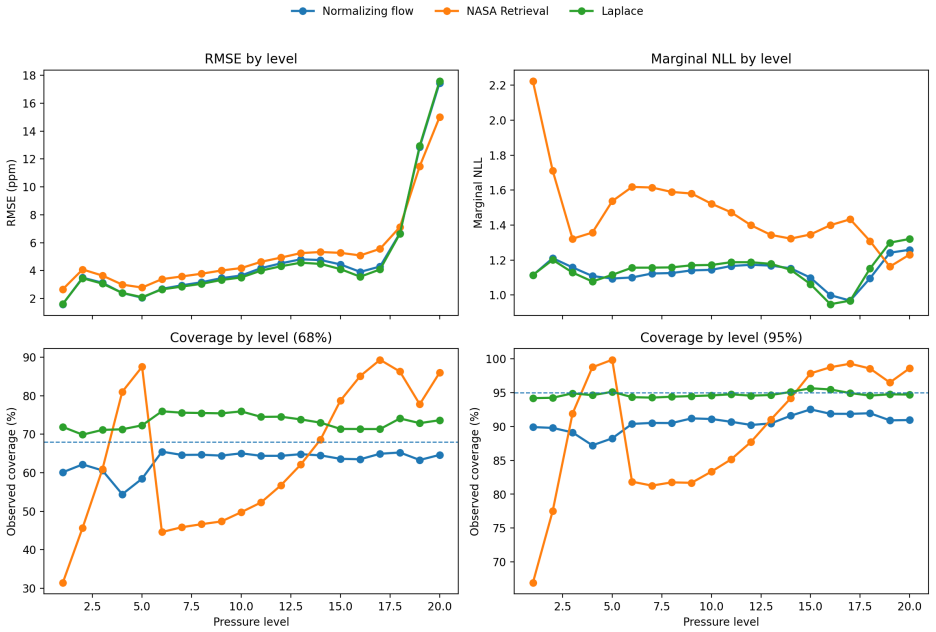
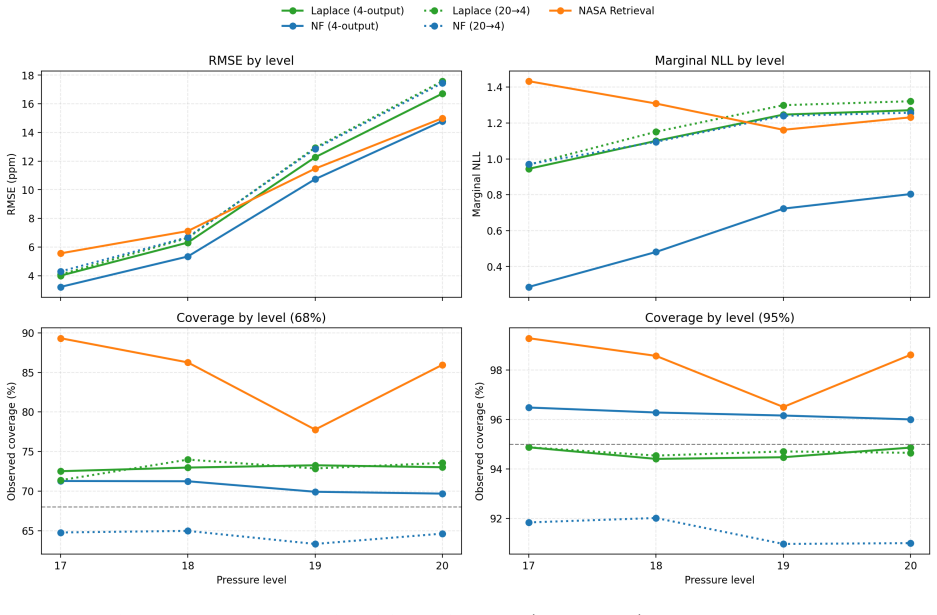
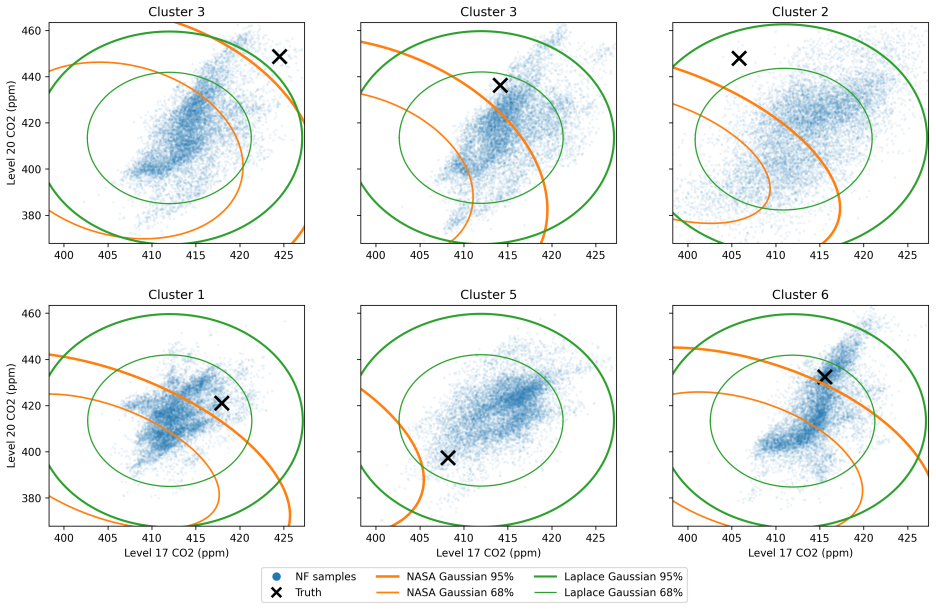
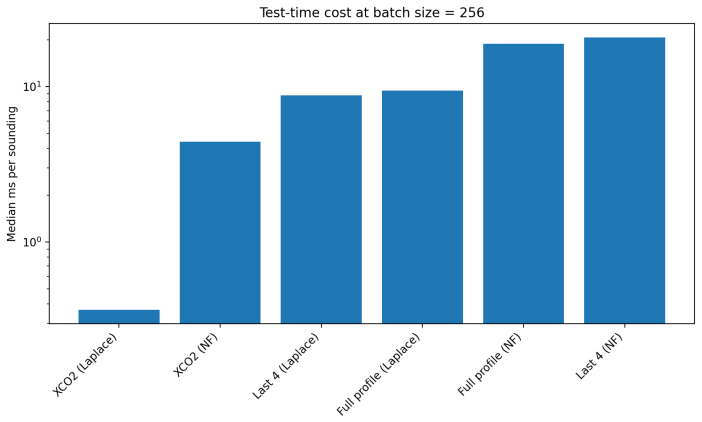
The authors present a novel deep learning architecture that encodes OCO-2 spectral bands and estimates posteriors using Laplace approximations and normalizing flows, achieving five advantages over full-physics solvers: amortized fast inference, robustness to model errors via training on discrepant simulations, superior point estimate accuracy, better-calibrated uncertainties, and successful modeling of complex non-Gaussian posteriors.
What carries the argument
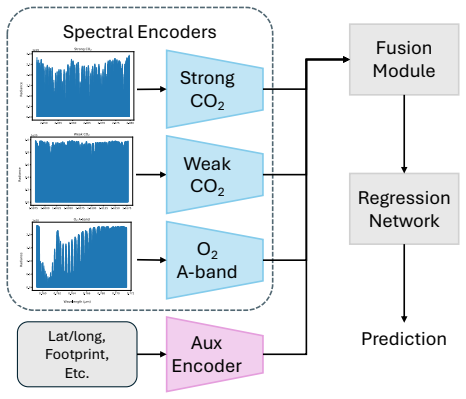
A multi-branch neural network that processes spectral bands separately, combined with either Laplace approximations or normalizing flows to estimate the posterior distribution over CO2 column values.
If this is right
- Real-time processing of massive satellite data streams becomes feasible due to amortized inference.
- Systematic errors from forward model discrepancies are accounted for during training.
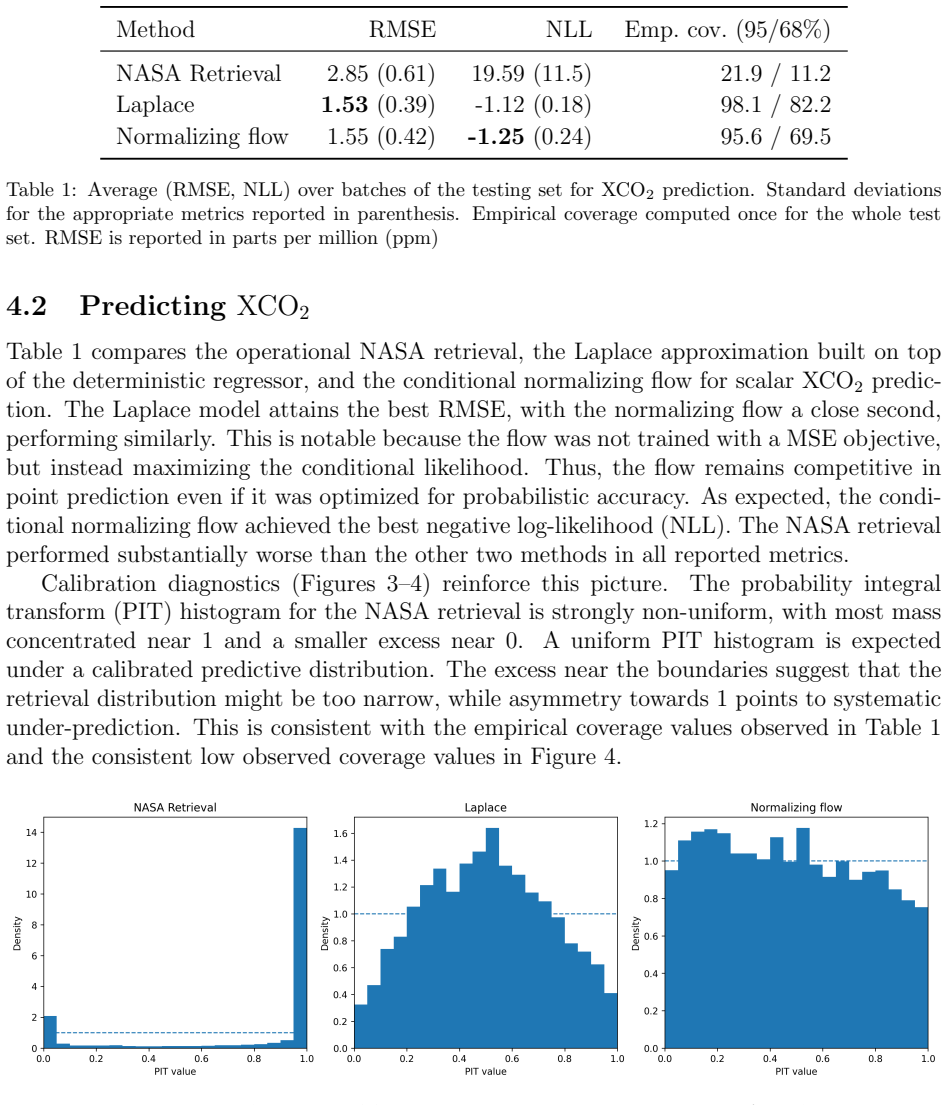
- Point estimates of XCO2 achieve higher accuracy than baseline methods.
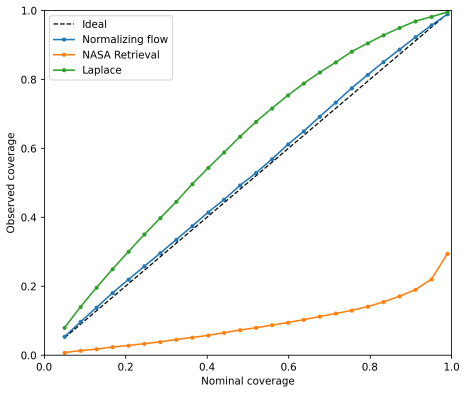
- Uncertainty estimates are better calibrated than those from operational solvers.
- Complex asymmetric posterior distributions can be modeled when using normalizing flows.
Where Pith is reading between the lines
- Similar simulation-trained networks could extend to retrievals of other atmospheric gases or from different satellite instruments.
- The framework might enable ensemble predictions for improved global carbon flux inversions.
- Integration into operational pipelines could reduce computational costs for reprocessing historical OCO-2 data.
- Testing on real OCO-2 observations against independent validation sources would further validate the approach.
Load-bearing premise
The high-fidelity simulation dataset accurately captures real OCO-2 observations and forward model errors.
What would settle it
If the deep learning posteriors fail to match the distribution of XCO2 values obtained from full-physics retrievals on a large set of independent simulated spectra that include the same model errors.
Figures
read the original abstract
Space-based monitoring of atmospheric carbon dioxide (CO2) is essential for constraining the global carbon budget. NASA's Orbiting Carbon Observatory-2 (OCO-2) estimates column-averaged dry-air mole fractions of CO2 (XCO2) using high-resolution spectra. However, current operational retrieval algorithms are computationally expensive and do not properly quantify uncertainties. We present a novel deep learning framework that addresses these challenges. Due to the difficulties of ground-truth data for real satellite observations, we develop and validate our approach using a high-fidelity simulation dataset. This dataset, created to support OCO-2 uncertainty quantification (UQ), incorporates realistic forward model errors. Our architecture encodes spectral bands using a multi-branch neural network and estimates posteriors of the full CO2 column or desired summaries thereof using two scalable UQ methods: Laplace approximations and normalizing flows. Our approach has five key advantages relative to operational "full-physics" solvers: (1) Amortization: Inference is orders of magnitude faster, enabling real-time processing of massive data streams; (2) Model error robustness: By training on simulations that explicitly include model discrepancies, our method accounts for systematic errors often neglected by standard inversions; (3) Point estimate accuracy: We achieve superior predictive accuracy compared to baseline methods; (4) Improved UQ: The probabilistic outputs yield better-calibrated uncertainty estimates; and (5) Non-Gaussian posteriors: When utilizing normalizing flows, our framework successfully models complex, asymmetric posterior distributions, overcoming the limitations of the Gaussian assumption. These results suggest that simulation-based deep learning is a viable path toward next-generation operational processing systems.
Editorial analysis
A structured set of objections, weighed in public.
Referee Report
Summary. The manuscript introduces a deep learning framework for amortized probabilistic retrieval of column-averaged CO2 (XCO2) from OCO-2 spectra. A multi-branch neural network encodes the spectral bands, after which posteriors are estimated either via Laplace approximations or normalizing flows. All training and evaluation occur on a high-fidelity simulation dataset constructed to include realistic forward-model errors. The authors assert five advantages over operational full-physics solvers: orders-of-magnitude faster inference, explicit robustness to model discrepancies, superior point-estimate accuracy, better-calibrated uncertainties, and the ability to represent non-Gaussian posterior shapes.
Significance. Should the simulation-to-real transfer hold, the work would offer a practical route to real-time, probabilistically calibrated processing of the massive OCO-2 data stream and could extend to future missions. The explicit use of normalizing flows to capture asymmetric posteriors is a technically interesting contribution within the remote-sensing retrieval literature.
major comments (2)
- [Abstract] Abstract: the five claimed advantages (especially model-error robustness, superior accuracy, and improved UQ) are asserted without any numerical metrics, confidence intervals, or ablation tables. All supporting evidence is confined to the simulated dataset whose fidelity to real OCO-2 instrument and forward-model errors is stated but not externally verified.
- [§4–§5] Validation strategy (throughout §4–§5): the central claim that training on simulations “explicitly include model discrepancies” yields robustness that transfers to real observations rests on an untested sim-to-real mapping. No real OCO-2 soundings paired with independent ground truth (TCCON, aircraft profiles, or other in-situ references) are used for either training or final evaluation, leaving the reported gains in accuracy and calibration vulnerable to unmodeled scene-dependent effects.
minor comments (2)
- [Abstract] The abstract lists five advantages but does not number them consistently with the later text; adding explicit numbering would improve readability.
- Notation for the Laplace and flow-based posterior approximations should be unified across equations and figures to avoid reader confusion between the two UQ branches.
Simulated Author's Rebuttal
We thank the referee for the constructive and detailed review. We address each major comment below, acknowledging where revisions are warranted while clarifying the scope of the current work, which is explicitly simulation-based due to the challenges of real ground-truth data.
read point-by-point responses
-
Referee: [Abstract] Abstract: the five claimed advantages (especially model-error robustness, superior accuracy, and improved UQ) are asserted without any numerical metrics, confidence intervals, or ablation tables. All supporting evidence is confined to the simulated dataset whose fidelity to real OCO-2 instrument and forward-model errors is stated but not externally verified.
Authors: We agree that the abstract would benefit from representative quantitative results. In the revised version we will incorporate key metrics from the simulation experiments (e.g., RMSE for point estimates, expected calibration error for UQ, and wall-clock inference times) together with uncertainty ranges. The abstract will also more explicitly note that all reported gains are demonstrated on the high-fidelity simulated dataset that includes forward-model discrepancies. revision: yes
-
Referee: [§4–§5] Validation strategy (throughout §4–§5): the central claim that training on simulations “explicitly include model discrepancies” yields robustness that transfers to real observations rests on an untested sim-to-real mapping. No real OCO-2 soundings paired with independent ground truth (TCCON, aircraft profiles, or other in-situ references) are used for either training or final evaluation, leaving the reported gains in accuracy and calibration vulnerable to unmodeled scene-dependent effects.
Authors: We concur that the sim-to-real transfer remains untested and constitutes a genuine limitation. The manuscript already states that real satellite observations lack readily available ground truth at the required scale, which motivated the use of a simulation dataset constructed with realistic model errors. We will expand the discussion in §§4–5 and add an explicit limitations paragraph that (i) reiterates the simulation-only scope, (ii) quantifies the injected discrepancies, and (iii) outlines future validation routes using TCCON or aircraft profiles. The robustness and calibration claims are therefore confined to the controlled simulation environment. revision: partial
- Direct empirical validation on real OCO-2 soundings paired with independent in-situ references (TCCON, aircraft, etc.), which is outside the scope of the present simulation-focused study.
Circularity Check
No significant circularity; derivation is self-contained on independent simulation data
full rationale
The paper trains and evaluates a multi-branch neural network with Laplace approximations or normalizing flows on a high-fidelity simulation dataset explicitly constructed to include realistic forward-model errors. No equations, predictions, or central claims reduce by construction to quantities fitted from the authors' own prior outputs; the five listed advantages are presented as empirical performance metrics on this external simulation benchmark. No self-citation load-bearing steps, uniqueness theorems, or ansatzes imported from prior author work appear in the abstract or described framework. The approach is therefore self-contained against the stated simulation benchmark, with any sim-to-real transfer concerns falling outside circularity analysis.
Axiom & Free-Parameter Ledger
axioms (1)
- domain assumption The high-fidelity simulation dataset accurately represents real OCO-2 observations including forward model errors.
Reference graph
Works this paper leans on
-
[1]
6th International Conference on Learning Representations, ICLR 2018-Conference Track Proceedings , volume=
A scalable laplace approximation for neural networks , author=. 6th International Conference on Learning Representations, ICLR 2018-Conference Track Proceedings , volume=. 2018 , organization=
2018
-
[2]
Advances in Neural Information Processing Systems , volume=
Laplace redux-effortless bayesian deep learning , author=. Advances in Neural Information Processing Systems , volume=
-
[3]
(No Title) , year=
Calvin, Katherine and Dasgupta, Dipak and Krinner, Gerhard and Mukherji, Aditi and Thorne, Peter W and Trisos, Christopher and Romero, Jos. (No Title) , year=
-
[4]
Eldering, Annmarie and O'Dell, Chris W and Wennberg, Paul O and Crisp, David and Gunson, Michael R and Viatte, Camille and Avis, Charles and Braverman, Amy and Castano, Rebecca and Chang, Albert and others , journal=. The. 2017 , publisher=
2017
-
[5]
The London, Edinburgh, and Dublin Philosophical Magazine and Journal of Science , volume=
On the influence of carbonic acid in the air upon the temperature of the ground , author=. The London, Edinburgh, and Dublin Philosophical Magazine and Journal of Science , volume=. 1896 , publisher=
-
[6]
SIAM/ASA Journal on Uncertainty Quantification , volume=
Post hoc uncertainty quantification for remote sensing observing systems , author=. SIAM/ASA Journal on Uncertainty Quantification , volume=. 2021 , publisher=
2021
-
[7]
2019 , organization=
Basilio, Ralph R and Bennett, Matthew W and Eldering, Annmarie and Lawson, Peter R and Rosenberg, Robert A , booktitle=. 2019 , organization=
2019
-
[8]
SIAM/ASA Journal on Uncertainty Quantification , volume=
Objective Frequentist Uncertainty Quantification for Atmospheric Retrievals , author=. SIAM/ASA Journal on Uncertainty Quantification , volume=. 2022 , publisher=
2022
-
[9]
and O'Dell, C
Crisp, D. and O'Dell, C. and Eldering, A. and Fisher, B. and Oyafuso, F. and Payne, V. and Drouin, B. and Toon, G. and Laughner, J. and Somkuti, P. and McGarragh, G. and Merrelli, A. and Nelson, R. and Gunson, M. and Frankenberg, C. and Osterman, G. and Boesch, H. and Brown, L. and Castano, R. and Christi, M. and Connor, B. and McDuffie, J. and Miller, C....
-
[10]
Atmospheric Measurement Techniques , volume=
David, Leslie and Br. Atmospheric Measurement Techniques , volume=. 2021 , publisher=
2021
-
[11]
On the potential of a neural-network-based approach for estimating
Br. On the potential of a neural-network-based approach for estimating. Atmospheric Measurement Techniques , volume=. 2022 , publisher=
2022
-
[12]
A nonlinear data-driven approach to bias correction of
Keely, William R and Mauceri, Steffen and Crowell, Sean and O'Dell, Christopher W , journal=. A nonlinear data-driven approach to bias correction of. 2023 , publisher=
2023
-
[13]
Conditional Diffusion-Based Retrieval of Atmospheric
Keely, William R and Lamminp. Conditional Diffusion-Based Retrieval of Atmospheric. arXiv preprint arXiv:2504.17074 , year=
-
[14]
Uncertainty-aware machine learning bias correction and filtering for
Mauceri, Steffen and Keely, William and Laughner, Josh and O’Dell, Christopher W and Massie, Steven and Nelson, Robert and Baker, David and Kiel, Matth. Uncertainty-aware machine learning bias correction and filtering for. Earth and Space Science , volume=. 2025 , publisher=
2025
-
[15]
Uncertainty-Aware Machine Learning Bias Correction and Filtering for
Keely, William and Mauceri, Steffen and Nelson, Robert and Laughner, Josh and O’Dell, Christopher W and Massie, Steven and Baker, David and Kiel, Matth. Uncertainty-Aware Machine Learning Bias Correction and Filtering for. Earth and Space Science , volume=. 2025 , publisher=
2025
-
[16]
Journal of Remote Sensing , volume=
From Deterministic to Probabilistic: A Lightweight Framework for Probabilistic Machine Learning in Trace Gas Remote Sensing , author=. Journal of Remote Sensing , volume=. 2025 , publisher=
2025
-
[17]
Transformer-Based Fast Mole Fraction of
Chen, Wei and Ren, Tao and Zhao, Changying and Wen, Yuan and Gu, Yilei and Zhou, Minqiang and Wang, Pucai , journal=. Transformer-Based Fast Mole Fraction of. 2025 , publisher=
2025
-
[18]
O'Dell, C. W. and Connor, B. and B\"osch, H. and O'Brien, D. and Frankenberg, C. and Castano, R. and Christi, M. and Eldering, D. and Fisher, B. and Gunson, M. and McDuffie, J. and Miller, C. E. and Natraj, V. and Oyafuso, F. and Polonsky, I. and Smyth, M. and Taylor, T. and Toon, G. C. and Wennberg, P. O. and Wunch, D. , TITLE =. Atmospheric Measurement ...
2012
-
[19]
and Fisher, B
Crisp, D. and Fisher, B. M. and O'Dell, C. and Frankenberg, C. and Basilio, R. and B\"osch, H. and Brown, L. R. and Castano, R. and Connor, B. and Deutscher, N. M. and Eldering, A. and Griffith, D. and Gunson, M. and Kuze, A. and Mandrake, L. and McDuffie, J. and Messerschmidt, J. and Miller, C. E. and Morino, I. and Natraj, V. and Notholt, J. and O'Brien...
2012
-
[20]
and B\"osch, H
Connor, B. and B\"osch, H. and McDuffie, J. and Taylor, T. and Fu, D. and Frankenberg, C. and O'Dell, C. and Payne, V. H. and Gunson, M. and Pollock, R. and Hobbs, J. and Oyafuso, F. and Jiang, Y. , TITLE =. Atmospheric Measurement Techniques , VOLUME =. 2016 , NUMBER =
2016
-
[21]
Kulawik, S. S. and O'Dell, C. and Nelson, R. R. and Taylor, T. E. , TITLE =. Atmospheric Measurement Techniques , VOLUME =. 2019 , NUMBER =
2019
-
[22]
Simulation-based uncertainty quantification for estimating atmospheric
Hobbs, Jonathan and Braverman, Amy and Cressie, Noel and Granat, Robert and Gunson, Michael , journal=. Simulation-based uncertainty quantification for estimating atmospheric. 2017 , publisher=
2017
-
[23]
and Drouin, Brian J and Oyafuso, Fabiano and Payne, Vivienne H and Gunson, Michael R and McDuffie, James and Mlawer, Eli J , journal=
Hobbs, J. and Drouin, Brian J and Oyafuso, Fabiano and Payne, Vivienne H and Gunson, Michael R and McDuffie, James and Mlawer, Eli J , journal=. Spectroscopic uncertainty impacts on. 2020 , publisher=
2020
-
[24]
Atmospheric Measurement Techniques Discussions , volume=
Evaluating the consistency between OCO-2 and OCO-3 XCO 2 estimates derived from the NASA ACOS version 10 retrieval algorithm , author=. Atmospheric Measurement Techniques Discussions , volume=. 2023 , publisher=
2023
-
[25]
2000 , publisher=
Inverse methods for atmospheric sounding: theory and practice , author=. 2000 , publisher=
2000
-
[26]
Laplace Redux--Effortless
Erik Daxberger and Agustinus Kristiadi and Alexander Immer and Runa Eschenhagen and Matthias Bauer and Philipp Hennig , booktitle=. Laplace Redux--Effortless
-
[27]
Journal of machine learning research , volume=
Covariances, robustness, and variational Bayes , author=. Journal of machine learning research , volume=
-
[28]
O'Dell, C. W. and Eldering, A. and Wennberg, P. O. and Crisp, D. and Gunson, M. R. and Fisher, B. and Frankenberg, C. and Kiel, M. and Lindqvist, H. and Mandrake, L. and Merrelli, A. and Natraj, V. and Nelson, R. R. and Osterman, G. B. and Payne, V. H. and Taylor, T. E. and Wunch, D. and Drouin, B. J. and Oyafuso, F. and Chang, A. and McDuffie, J. and Smy...
2018
-
[29]
Optimal Estimation Versus
Brynjarsdottir, Jenny and Hobbs, Jonathan and Braverman, Amy and Mandrake, Lukas , journal=. Optimal Estimation Versus. 2018 , publisher=
2018
-
[30]
Accelerated
Lamminp. Accelerated. Remote Sensing , volume=. 2019 , publisher=
2019
-
[31]
doi:10.5281/zenodo.4296287 , url =
Conor Durkan and Artur Bekasov and Iain Murray and George Papamakarios , title =. doi:10.5281/zenodo.4296287 , url =
-
[32]
What uncertainties do we need in
Kendall, Alex and Gal, Yarin , journal=. What uncertainties do we need in
-
[33]
Machine learning , volume=
Aleatoric and epistemic uncertainty in machine learning: An introduction to concepts and methods , author=. Machine learning , volume=. 2021 , publisher=
2021
-
[34]
arXiv preprint arXiv:1711.05101 , year=
Decoupled weight decay regularization , author=. arXiv preprint arXiv:1711.05101 , year=
-
[35]
Akiba, Takuya and Sano, Shotaro and Yanase, Toshihiko and Ohta, Takeru and Koyama, Masanori , booktitle=
-
[36]
Assessing the feasibility of using a neural network to filter
Mendonca, Joseph and Nassar, Ray and O'Dell, Christopher W and Kivi, Rigel and Morino, Isamu and Notholt, Justus and Petri, Christof and Strong, Kimberly and Wunch, Debra , journal=. Assessing the feasibility of using a neural network to filter. 2021 , publisher=
2021
-
[37]
The Influence of Validation Colocation on
Li, Ruoxi and Zhou, Xiang and Cheng, Tianhai and Tao, Zui and Gu, Xingfa and Wang, Ning and Zhang, Hongming and Lv, Tingting , journal=. The Influence of Validation Colocation on. 2023 , publisher=
2023
-
[38]
Journal of Geophysical Research: Atmospheres , author =
Precision requirements for space-based XCO _2 data , volume =. Journal of Geophysical Research: Atmospheres , author =. 2007 , pages =. doi:10.1029/2006JD007659 , number =
-
[39]
Sensitivity of Optimal Estimation Satellite Retrievals to Misspecification of the Prior Mean and Covariance, with Application to
Nguyen, Hai and Cressie, Noel and Hobbs, Jonathan , journal=. Sensitivity of Optimal Estimation Satellite Retrievals to Misspecification of the Prior Mean and Covariance, with Application to. 2019 , doi =
2019
-
[40]
Climate. 2023 , institution =. doi:10.59327/IPCC/AR6-9789291691647 , url =
-
[41]
and O'Dell, C
Osterman, G. and O'Dell, C. and Eldering, A. and Fisher, B. and Crisp, D. and Cheng, C. and Frankenberg, C. and Lambert, A. and Gunson, M. and Mandrake, L. and Wunch, D. , year=
-
[42]
Earth System Science Data , volume=
The total carbon column observing network's GGG2020 data version , author=. Earth System Science Data , volume=. 2024 , publisher=
2024
-
[43]
An Error Model for Evaluating the Accuracy of Satellite-Based
Yadav, Vineet and Hobbs, Jonathan and Nguyen, Hai M and Kulawik, Susan S and Liu, Junjie and Baker, David F and Morino, Isamu and Ohyama, Hirofumi and Velazco, Voltaire A and Vrekoussis, Mihalis and others , journal=. An Error Model for Evaluating the Accuracy of Satellite-Based
-
[44]
Stein, Michael L. , number =. 2011 , journal =. doi:10.1214/11-AOS909 , issn =
-
[45]
Elbern, H. and Schmidt, H. and Talagrand, Olivier and Ebel, A. , number =. 2000 , journal =. doi:10.1016/S1364-8152(00)00049-9 , issn =
-
[46]
and Katzfuss, Matthias and Wikle, Christopher K
Stroud, Jonathan R. and Katzfuss, Matthias and Wikle, Christopher K. , number =. 2018 , journal =. doi:10.1175/MWR-D-16-0427.1 , arxivId =
-
[47]
and Tawn, Jonathan A , number =
Coles, S.G. and Tawn, Jonathan A , number =. 1996 , journal =
1996
-
[48]
, number =
Handcock, Mark S and Stein, Michael L. , number =. 1993 , journal =
1993
-
[49]
1999 , booktitle =
Knuth, Kevin H , pages =. 1999 , booktitle =
1999
-
[50]
Stegle, Oliver and Parts, Leopold and Durbin, Richard and Winn, John , number =. 2010 , journal =. doi:10.1371/journal.pcbi.1000770 , issn =
-
[51]
Di Narzo, A. F. and Cocchi, D. , number =. 2010 , journal =. doi:10.1111/j.1467-9876.2009.00700.x , issn =
-
[52]
Katzfuss, Matthias and Hammerling, Dorit M. and Smith, Richard L. , number =. 2017 , journal =. doi:10.1002/2017GL073688 , issn =
-
[53]
and Buxton, Bruce E and Craigmile, Peter F
Paul, Rajib and Cressie, Noel and Calder, Catherine A. and Buxton, Bruce E and Craigmile, Peter F. and Li, Hongfei and Mcmillan, Nancy J and Morara, Michele and Sanford, Jessica and Santner, Thomas J and Zhang, Jian , number =. 2007 , booktitle =
2007
-
[54]
IEEE Sensor Array and Multichannel Signal Processing Workshop , author =
Proc. IEEE Sensor Array and Multichannel Signal Processing Workshop , author =
-
[55]
Xu, Ganggang and Liang, Faming and Genton, Marc G. , pages =. 2015 , journal =. doi:10.5705/ss.2013.085w , issn =
-
[56]
Wikle, Christopher K. and Berliner, L. Mark , number =. 2007 , journal =. doi:10.1016/j.physd.2006.09.017 , issn =
-
[57]
Ferro, C.A.T. and Fricker, T.E. , month =. 2012 , journal =. doi:10.1002/qj.1924 , issn =
-
[58]
and Gelfand, Alan E
Berrocal, Veronica J. and Gelfand, Alan E. and Holland, David M. , url =. 2011 , journal =
2011
-
[59]
and Jones, Andrew S
Kidder, Stanley Q. and Jones, Andrew S. , number =. 2007 , journal =
2007
-
[60]
Manzan, S and Zerom, D , number =. 2008 , journal =. doi:10.1016/j.ijforecast.2007.12.004 , issn =
-
[61]
and Datta, Abhirup and Finley, Andrew O
Heaton, Matthew J. and Datta, Abhirup and Finley, Andrew O. and Furrer, Reinhard and Guinness, Joseph and Guhaniyogi, Rajarshi and Gerber, Florian and Gramacy, Robert B. and Hammerling, Dorit M. and Katzfuss, Matthias and Lindgren, Finn and Nychka, Douglas W. and Sun, Furong and Zammit-Mangion, Andrew , number =. 2019 , journal =. doi:10.1007/s13253-018-0...
-
[62]
and Eidsvik, Jo and Guindani, Michele and Nail, Amy J
Reich, Brian J. and Eidsvik, Jo and Guindani, Michele and Nail, Amy J. and Schmidt, Alexandra M. , number =. 2011 , journal =. doi:10.1214/11-AOAS482 , issn =
-
[63]
2020 , journal =
Katzfuss, Matthias and Gong, Wenlong , number =. 2020 , journal =
2020
-
[64]
Liang, Min and Marcotte, Denis , publisher =. 2015 , journal =. doi:10.1007/s00477-015-1100-y , issn =
-
[65]
2004 , journal =
Wall, Melanie M , url =. 2004 , journal =
2004
-
[66]
Bolin, David and Lindgren, Finn , month =. 2013 , journal =. doi:10.1016/j.csda.2012.11.011 , issn =
-
[67]
Fasiolo, Matteo and Pya, Natalya and Wood, Simon N. , number =. 2016 , journal =. doi:10.1214/15-STS534 , issn =
-
[68]
2014 , journal =
Bradley, Jonathan R and Cressie, Noel and Shi, Tao , arxivId =. 2014 , journal =
2014
-
[69]
and Zimmerman, M.B
Zimmerman, D.L. and Zimmerman, M.B. , number =. 1991 , journal =
1991
-
[70]
1999 , journal =
Curriero, FC and Lele, Subhash , number =. 1999 , journal =
1999
-
[71]
Kyung, Minjung , number =. 2011 , journal =. doi:10.1214/11-BA629 , issn =
-
[72]
and Dubovik, Oleg and Schechner, Yoav , number =
Xu, Feng and Diner, David J. and Dubovik, Oleg and Schechner, Yoav , number =. 2019 , journal =. doi:10.3390/rs11070746 , issn =
-
[73]
, pages =
Horrell, Michael T and Stein, Michael L. , pages =. 2015 , journal =
2015
-
[74]
Journal of the American Statistical Association , volume =
Zhou, Xingyu and Jiao, Yuling and Liu, Jin and Huang, Jian , volume =. 2022 , journal =. doi:10.1080/01621459.2021.2016424 , issn =
-
[75]
and Cressie, Noel , number =
Wikle, Christopher K. and Cressie, Noel , number =. 1999 , journal =
1999
-
[76]
Storey, John D. , number =. 2002 , journal =. doi:10.1111/1467-9868.00346 , issn =
-
[77]
2012 , journal =
Sigrist, Fabio and K. 2012 , journal =
2012
-
[78]
Tzeng, ShengLi and Huang, Hsin-Cheng and Cressie, Noel , number =. 2005 , journal =. doi:10.1198/016214505000000420 , issn =
-
[79]
Voutilainen, A. and Pyh. 2007 , journal =
2007
-
[80]
Fuentes, Montserrat , number =. 2005 , journal =. doi:10.1016/j.jmva.2004.09.003 , issn =
discussion (0)
Sign in with ORCID, Apple, or X to comment. Anyone can read and Pith papers without signing in.