REVIEW 1 major objections 2 minor 1 cited by
Broadband High-Level Squeezed Light using Waveguide Optical Parametric Amplifiers with External Dispersion Compensation
T0 review · 1 major / 2 minor · reviewed 2026-06-27 · grok-4.3
Pith's one-line read External dispersion compensation between two waveguide OPAs suppresses quadrature rotation and enables measurement of 5.9 dB squeezing over a 4.5 THz bandwidth.
desk verdict The paper shows a workable external dispersion compensator between two waveguide OPAs that extends observable squeezing to 6 THz, but the compensator's loss and phase performance are not independently checked. read the letter →
The pith
A machine-rendered reading of the paper's core claim, the machinery that carries it, and where it could break.
The reading
What carries the argument
External dispersion compensation placed between two OPAs, which counters group-velocity-dispersion-induced quadrature rotation over a multi-THz range without adding prohibitive loss or noise.
What would settle it
An experiment in which squeezing still falls below 5 dB at an offset well below 4.5 THz when the external compensator is in place, or in which the observable bandwidth fails to reach the phase-matching limit of the waveguide OPA.
Extended reading notes
Core claim
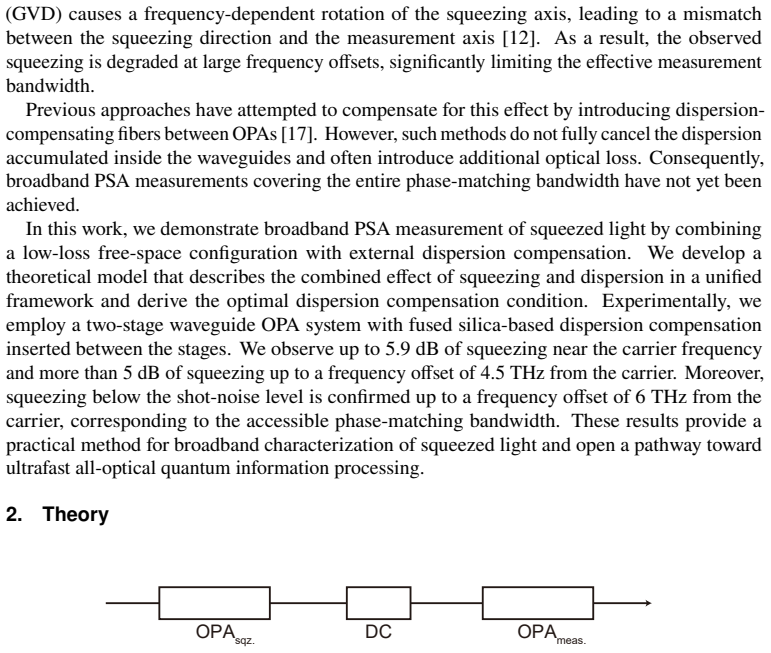
By introducing external dispersion compensation between two waveguide optical parametric amplifiers, the frequency-dependent rotation of the squeezing quadrature induced by group velocity dispersion is suppressed. This enables phase-sensitive amplification measurements that record a maximum of 5.9 dB squeezing near the carrier frequency, more than 5 dB squeezing up to a 4.5 THz offset, and squeezing below the shot-noise level up to a 6 THz offset that matches the accessible phase-matching bandwidth of the waveguide OPA.
Load-bearing premise
The external dispersion compensation fully cancels frequency-dependent quadrature rotation without introducing enough additional optical loss, phase noise, or other degradations to reduce the measured squeezing levels.
Editorial extensions
If this is right
- More than 5 dB of squeezing becomes measurable across multi-THz bandwidths in phase-sensitive setups.
- Squeezed light can be characterized up to the full phase-matching bandwidth of the waveguide OPA.
- The technique supplies a practical route toward ultrafast continuous-variable quantum information processing.
Reading between the lines
- The same compensation method could be applied to other nonlinear optical sources to extend their usable squeezing bandwidth.
- Integration with faster homodyne detectors might then support higher-rate quantum protocols that rely on the THz-scale bandwidth.
- Testing alternative dispersion-compensating materials or geometries could reveal whether further bandwidth or squeezing depth is reachable without new loss mechanisms.
Signed reviews
Editorial analysis
A structured set of objections, weighed in public.
Referee Report
Summary. The manuscript reports an experimental demonstration of broadband phase-sensitive amplification (PSA) measurements on squeezed light from a waveguide optical parametric amplifier (OPA), using external dispersion compensation between two OPAs to counteract group-velocity-dispersion-induced quadrature rotation. The central result is a maximum squeezing level of 5.9 dB near the carrier frequency, with >5 dB squeezing maintained up to a 4.5 THz offset and squeezing below the shot-noise level confirmed out to 6 THz, matching the phase-matching bandwidth of the waveguide OPA. The work positions the external-compensation approach as a practical route to broadband squeezed-light characterization for ultrafast continuous-variable quantum information processing.
Significance. If the central experimental claim is substantiated, the result supplies a concrete, implementable technique for extending the observable bandwidth of squeezed light in waveguide systems without requiring monolithic integration of dispersion compensation. The direct measurement of squeezing levels across multi-THz offsets, together with the explicit mapping to the OPA phase-matching bandwidth, constitutes a falsifiable benchmark that can be tested in other waveguide platforms. This strengthens the experimental foundation for broadband CV quantum optics and is a positive contribution to the literature on practical squeezed-light sources.
major comments (1)
- [§II and §III] §II (Experimental Setup) and §III (Results): The claim that external dispersion compensation fully suppresses frequency-dependent quadrature rotation up to 6 THz while adding negligible loss and phase noise is load-bearing for the reported bandwidth. No independent transmission spectrum, insertion-loss measurement, or noise characterization of the compensator alone is presented; any unaccounted frequency-dependent loss or residual rotation would directly attenuate the observed squeezing at high offsets and undermine the 4.5 THz / 6 THz assertions.
minor comments (2)
- [Figure 3] Figure 3 caption and associated text: the precise definition of the frequency offset (one-sided vs. two-sided) and the exact normalization used for the shot-noise level should be stated explicitly to allow direct comparison with other broadband squeezing reports.
- [§III] The manuscript would benefit from a short table summarizing the measured squeezing values at representative offsets together with the corresponding error bars or statistical uncertainties.
Simulated Author's Rebuttal
We thank the referee for their positive assessment of the work's significance and for the constructive major comment. We address the point regarding characterization of the external dispersion compensator below.
read point-by-point responses
-
Referee: [§II and §III] §II (Experimental Setup) and §III (Results): The claim that external dispersion compensation fully suppresses frequency-dependent quadrature rotation up to 6 THz while adding negligible loss and phase noise is load-bearing for the reported bandwidth. No independent transmission spectrum, insertion-loss measurement, or noise characterization of the compensator alone is presented; any unaccounted frequency-dependent loss or residual rotation would directly attenuate the observed squeezing at high offsets and undermine the 4.5 THz / 6 THz assertions.
Authors: We agree that independent characterization of the compensator would strengthen the manuscript. The observed squeezing bandwidth precisely matching the OPA phase-matching bandwidth, together with 5.9 dB squeezing near DC, provides indirect evidence that the compensator suppresses rotation without substantial added loss or noise; significant uncompensated effects would have prevented squeezing detection at multi-THz offsets. Nevertheless, we will add transmission spectrum and insertion-loss data for the compensator (and a brief noise discussion) to the revised manuscript to directly address this concern. revision: yes
Circularity Check
No circularity: direct experimental measurement report
full rationale
This paper reports empirical measurements of squeezing levels achieved in a PSA setup using waveguide OPAs with external dispersion compensation. The central claims (maximum 5.9 dB squeezing near carrier, >5 dB to 4.5 THz, below SNL to 6 THz) are presented as observed data without any derivation chain, fitted parameters renamed as predictions, or load-bearing self-citations that reduce results to inputs by construction. No equations or steps equate outputs to inputs via definition or fitting; the work is self-contained as an experimental characterization.
Assumptions & free parameters
assumptions (2)
- domain assumption Group velocity dispersion induces frequency-dependent rotation of the squeezing axis in broadband systems
- standard math Standard principles of phase-sensitive amplification and optical parametric amplification apply to the waveguide devices
Cite this review
Pith. "Pith review of Broadband High-Level Squeezed Light using Waveguide Optical Parametric Amplifiers with External Dispersion Compensation." pith.science (2026). https://pith.science/paper/XF3JDIEY
@misc{pith2026260617422,
  author       = {Pith},
  title        = {Pith review of: Broadband High-Level Squeezed Light using Waveguide Optical Parametric Amplifiers with External Dispersion Compensation},
  year         = {2026},
  howpublished = {\url{https://pith.science/paper/XF3JDIEY}},
  note         = {Machine review of arXiv:2606.17422}
}
read the original abstract
We demonstrate broadband phase-sensitive amplification (PSA) measurement of squeezed light generated by a waveguide optical parametric amplifier (OPA) with external dispersion compensation. In broadband systems, group velocity dispersion (GVD) induces a frequency-dependent rotation of the squeezing axis, which limits the observable bandwidth in PSA measurements. To overcome this limitation, we introduce external dispersion compensation between two OPAs and suppress the quadrature rotation over a wide frequency range. As a result, we observe a maximum squeezing of 5.9 dB near the carrier frequency and more than 5 dB of squeezing up to a frequency offset of 4.5 THz from the carrier. Furthermore, squeezing below the shot-noise level is confirmed up to a frequency offset of 6 THz from the carrier, corresponding to the accessible phase-matching bandwidth of the waveguide OPA. Our results establish a practical method for broadband characterization of squeezed light and provide a key step toward ultrafast continuous-variable quantum information processing.
Figures


Figures from the paper (4 more)


Forward citations
Cited by 1 Pith paper
-
All-optical Implementation of Generalized Quantum Teleportation
Proposes an all-optical feedforward scheme for arbitrary linear operations via generalized quantum teleportation that suppresses hardware noise and supports high-speed optical quantum computing.
Reference graph
Works this paper leans on
-
[1]
Quantum information with continuous variables,
S. L. Braunstein and P. v. Loock, “Quantum information with continuous variables,” Rev. Mod. Phys.77, 513 (2005)
2005
-
[2]
Quantum-enhanced measurements: beating the standard quantum limit,
V. Giovannetti, S. Lloyd, and L. Maccone, “Quantum-enhanced measurements: beating the standard quantum limit,” Science306, 1330–6 (2004)
2004
-
[3]
30 years of squeezed light generation,
U. L. Andersen, T. Gehring, C. Marquardt, and G. Leuchs, “30 years of squeezed light generation,” Phys. Scripta91, 053001 (2016)
2016
-
[4]
Unconditional quantum teleportation,
A. Furusawa, J. L. Sorensen, S. L. Braunstein,et al., “Unconditional quantum teleportation,” Science282, 706–9 (1998)
1998
-
[5]
Teleportation of continuous quantum variables,
S. L. Braunstein and H. J. Kimble, “Teleportation of continuous quantum variables,” Phys. Rev. Lett.80, 869–872 (1998)
1998
-
[6]
Generation of time-domain-multiplexed two-dimensional cluster state,
W. Asavanant, Y. Shiozawa, S. Yokoyama,et al., “Generation of time-domain-multiplexed two-dimensional cluster state,” Science366, 373–376 (2019)
2019
-
[7]
Deterministic generation of a two-dimensional cluster state,
M. V. Larsen, X. Guo, C. R. Breum,et al., “Deterministic generation of a two-dimensional cluster state,” Science 366, 369–372 (2019)
2019
-
[8]
Universal quantum computation with continuous-variable cluster states,
N. C. Menicucci, P. van Loock, M. Gu,et al., “Universal quantum computation with continuous-variable cluster states,” Phys Rev Lett97, 110501 (2006)
2006
Show all 24 references
-
[9]
A one-way quantum computer,
R. Raussendorf and H. J. Briegel, “A one-way quantum computer,” Phys Rev Lett86, 5188–91 (2001)
2001
-
[10]
Measurement-based quantum computation on cluster states,
R. Raussendorf, D. E. Browne, and H. J. Briegel, “Measurement-based quantum computation on cluster states,” Phys. Rev. A68, 022312 (2003)
2003
-
[11]
Detection of 15 db squeezed states of light and their application for the absolute calibration of photoelectric quantum efficiency,
H. Vahlbruch, M. Mehmet, K. Danzmann, and R. Schnabel, “Detection of 15 db squeezed states of light and their application for the absolute calibration of photoelectric quantum efficiency,” Phys Rev Lett117, 110801 (2016). (a) (b) T = 0.99 T = 0.9 T = 0.8 T = 0.5 1.0 0.8 0.6 0....
2016
-
[12]
Fabrication of low-loss quasi-single-mode ppln waveguide and its application to a modularized broadband high-level squeezer,
T. Kashiwazaki, T. Yamashima, N. Takanashi,et al., “Fabrication of low-loss quasi-single-mode ppln waveguide and its application to a modularized broadband high-level squeezer,” Appl. Phys. Lett.119, 251104 (2021)
2021
-
[13]
Few-cycle vacuum squeezing in nanophotonics,
R. Nehra, R. Sekine, L. Ledezma,et al., “Few-cycle vacuum squeezing in nanophotonics,” Science377, 1333–1337 (2022)
2022
-
[14]
Continuous-wave 6-db-squeezed light with 2.5-thz-bandwidth from single-mode ppln waveguide,
T. Kashiwazaki, N. Takanashi, T. Yamashima,et al., “Continuous-wave 6-db-squeezed light with 2.5-thz-bandwidth from single-mode ppln waveguide,” APL Photonics5, 036104 (2020)
2020
-
[15]
Lifting the bandwidth limit of optical homodyne measurement with broadband parametric amplification,
Y. Shaked, Y. Michael, R. Z. Vered,et al., “Lifting the bandwidth limit of optical homodyne measurement with broadband parametric amplification,” Nat Commun9, 609 (2018)
2018
-
[16]
Wigner function tomography via optical parametric amplification,
M. Kalash and M. V. Chekhova, “Wigner function tomography via optical parametric amplification,” Optica10, 1142–1146 (2023)
2023
-
[17]
All-optical phase-sensitive detection for ultra-fast quantum computation,
N. Takanashi, A. Inoue, T. Kashiwazaki,et al., “All-optical phase-sensitive detection for ultra-fast quantum computation,” Opt Express28, 34916–34926 (2020)
2020
-
[18]
Quantum limits on noise in linear amplifiers,
C. M. Caves, “Quantum limits on noise in linear amplifiers,” Phys. Rev. D26, 1817–1839 (1982)
1982
-
[19]
Inoue, T
A. Inoue, T. Kashiwazaki, T. Yamashima,et al., “Toward a multi-core ultra-fast optical quantum processor: 43-ghz bandwidth real-time amplitude measurement of 5-db squeezed light using modularized optical parametric amplifier with 5g technology,” Appl. Phys. Lett.122, 104001 (2023)
2023
-
[20]
Broadband generation and tomography of non-gaussian states for ultra-fast optical quantum processors,
A. Kawasaki, R. Ide, H. Brunel,et al., “Broadband generation and tomography of non-gaussian states for ultra-fast optical quantum processors,” Nat Commun15, 9075 (2024)
2024
-
[21]
Real-timeobservationofpicosecond-timescaleopticalquantumentanglement towards ultrafast quantum information processing,
A.Kawasaki,H.Brunel,R.Ide,et al.,“Real-timeobservationofpicosecond-timescaleopticalquantumentanglement towards ultrafast quantum information processing,” Nat. Photonics p. 271–276 (2025)
2025
-
[22]
Squeezing as an irreducible resource,
S. L. Braunstein, “Squeezing as an irreducible resource,” Phys. Rev. A71, 055801 (2005)
2005
-
[23]
Infrared corrected sellmeier coefficients for congruently grown lithium niobate and 5 mol% magnesium oxide –doped lithium niobate,
D. E. Zelmon, D. L. Small, and D. Jundt, “Infrared corrected sellmeier coefficients for congruently grown lithium niobate and 5 mol% magnesium oxide –doped lithium niobate,” J. Opt. Soc. Am. B14, 3319–3322 (1997)
1997
-
[24]
Interspecimen comparison of the refractive index of fused silica,
I. H. Malitson, “Interspecimen comparison of the refractive index of fused silica,” J. Opt. Soc. Am.55, 1205–1209 (1965)
1965
Reviewed June 27, 2026 · model on record in the stance chip above.
Discussion (0). Continue with ORCID to comment.