REVIEW 2 minor 33 references
Perron--Frobenius Operator Matching for Generative Modeling
T0 review · 0 major / 2 minor · reviewed 2026-06-27 · grok-4.3
Pith's one-line read Matching the integral Perron-Frobenius operator with Kullback-Leibler divergence unifies flow, diffusion, and jump generative models under one practical loss.
desk verdict The paper offers a PF operator unification of generative models plus a KL uniqueness claim among Bregman divergences, but the abstract supplies no derivations or numbers so the claims stay untested. read the letter →
The pith
A machine-rendered reading of the paper's core claim, the machinery that carries it, and where it could break.
The reading
What carries the argument
The integral Perron-Frobenius operator, which advances densities forward in time and is matched between model and data to define the training objective.
What would settle it
A calculation or simulation in which the sample-conditioned loss obtained with Kullback-Leibler divergence fails to equal the density-level objective, or in which the PFOM objective cannot recover the standard continuous normalizing flow or score-based diffusion training as special cases.
Extended reading notes
Core claim
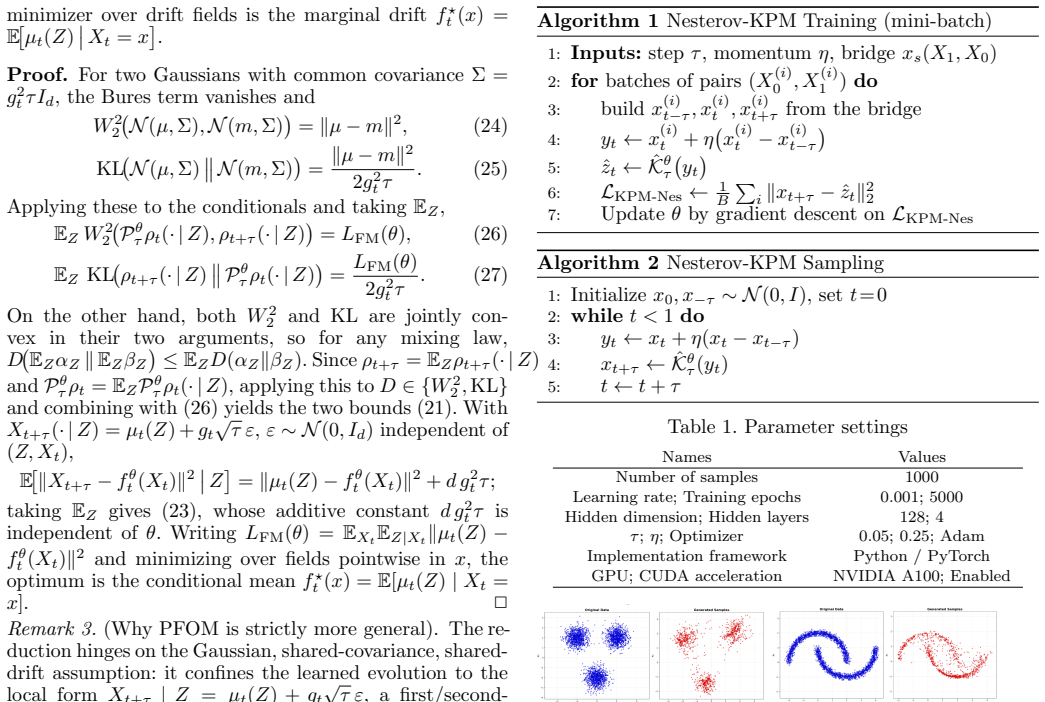
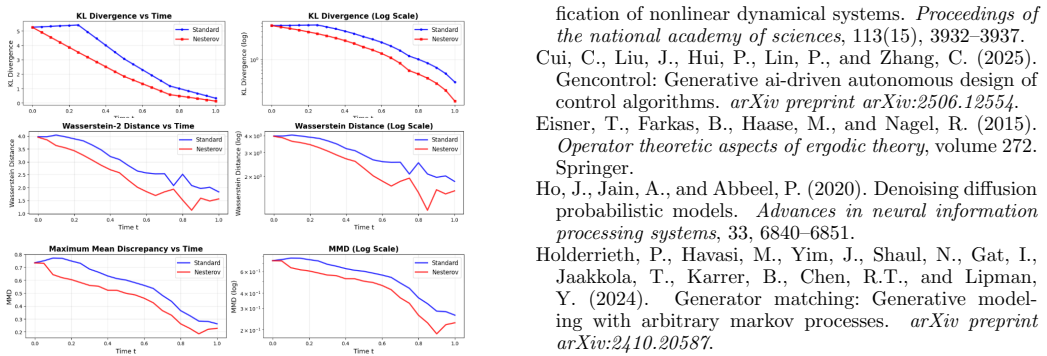
We introduce Perron--Frobenius Operator Matching (PFOM), a generative framework that matches density evolution via the integral PF operator, subsuming flow, diffusion, and jump models. We prove that among Bregman divergences, only Kullback--Leibler divergence preserves equality between density-level and sample-conditioned objectives, yielding a practical loss equivalent to Koopman path matching. We further develop Nesterov-accelerated training and sampling that stabilize discretization and accelerate convergence.
Load-bearing premise
The integral Perron-Frobenius operator can be matched practically between model and data densities in a way that subsumes flow, diffusion, and jump models without additional unstated restrictions on the dynamics.
Editorial extensions
If this is right
- Flow, diffusion, and jump generative models are subsumed under the same density-evolution matching objective.
- Only the Kullback-Leibler divergence produces an objective whose density-level and sample-conditioned forms remain equivalent.
- The resulting loss reduces exactly to Koopman path matching and is therefore directly implementable.
- Nesterov acceleration improves stability of the discretized training and sampling steps.
Reading between the lines
- The operator view may allow reuse of dictionary-learning methods from dynamical systems to adapt the basis functions used inside the generative model.
- High-dimensional scaling could follow if efficient approximations to the integral operator become available.
- The same matching principle might extend to other classes of stochastic processes not covered in the current unification.
Editorial analysis
A structured set of objections, weighed in public.
Referee Report
Summary. The manuscript introduces Perron--Frobenius Operator Matching (PFOM), a generative modeling framework that matches the integral Perron--Frobenius operator between model and data densities. It claims to prove that, among Bregman divergences, only the Kullback--Leibler divergence preserves equality between the density-level and sample-conditioned objectives, yielding a loss equivalent to Koopman path matching. The work further develops Nesterov-accelerated training and sampling procedures that stabilize discretization and accelerate convergence, and positions PFOM as a unification of flow, diffusion, and jump models.
Significance. If the central uniqueness result for KL holds and the operator matching is shown to be practical without additional restrictions, the paper would supply a theoretically grounded unification of several generative paradigms under a single operator-theoretic objective. The claimed equivalence to Koopman path matching and the acceleration techniques would constitute concrete contributions to both the analysis and implementation of score- and flow-based models.
minor comments (2)
- The abstract contains a LaTeX-commented sentence beginning with "%On Gaussian mixtures..." that references empirical results on KL/W2/MMD decrease and wall-clock efficiency; this material should either be restored with the corresponding experiments or removed to avoid implying results that are not presented.
- Notation for the integral Perron--Frobenius operator and the sample-conditioned objective should be introduced with explicit definitions (e.g., in the section containing the main theorem) to ensure the equality statement is self-contained.
Simulated Author's Rebuttal
We thank the referee for the positive summary of our work on Perron--Frobenius Operator Matching (PFOM) and for the recommendation of minor revision. We are pleased that the central uniqueness result for the KL divergence and the unification of generative paradigms are viewed as potentially significant contributions.
Circularity Check
No significant circularity; central proof is independent
full rationale
The paper's key claim is a mathematical proof that, among Bregman divergences, only KL preserves equality between density-level and sample-conditioned objectives. This is stated as a derivation from first principles on the operator and divergence properties, not reduced to a fit, self-citation chain, or definitional renaming. The PFOM framework and model subsumption follow directly from the integral operator definition once the KL property is established. No load-bearing self-citation, ansatz smuggling, or prediction-by-construction is present in the abstract or described derivation chain. The result is self-contained against external mathematical benchmarks.
Assumptions & free parameters
Cite this review
Pith. "Pith review of Perron--Frobenius Operator Matching for Generative Modeling." pith.science (2026). https://pith.science/paper/66QZAQ4T
@misc{pith2026260617465,
  author       = {Pith},
  title        = {Pith review of: Perron--Frobenius Operator Matching for Generative Modeling},
  year         = {2026},
  howpublished = {\url{https://pith.science/paper/66QZAQ4T}},
  note         = {Machine review of arXiv:2606.17465}
}
abstract
We introduce Perron--Frobenius Operator Matching (PFOM), a generative framework that matches density evolution via the integral PF operator, subsuming flow, diffusion, and jump models. We prove that among Bregman divergences, only Kullback--Leibler divergence preserves equality between density-level and sample-conditioned objectives, yielding a practical loss equivalent to Koopman path matching. We further develop Nesterov-accelerated training and sampling that stabilize discretization and accelerate convergence. %On Gaussian mixtures and two-moons, PFOM achieves faster KL/$W_2$/MMD decrease and improved wall-clock efficiency with empirical validation. PFOM unifies operator-theoretic identification with modern generative modeling and opens paths to adaptive dictionaries and high-dimensional applications.
Figures

Figures from the paper (1 more)

Reference graph
Works this paper leans on
-
[1]
Flow Matching for Generative Modeling
Flow matching for generative modeling , author=. arXiv preprint arXiv:2210.02747 , year=
-
[2]
SIAM Journal on Applied Dynamical Systems , volume=
Dynamic mode decomposition with control , author=. SIAM Journal on Applied Dynamical Systems , volume=. 2016 , publisher=
2016
-
[3]
1995 , publisher=
Stochastic processes , author=. 1995 , publisher=
1995
-
[4]
2012 , publisher=
Nonlinear Perron-Frobenius Theory , author=. 2012 , publisher=
2012
-
[5]
Proceedings of the national academy of sciences , volume=
Discovering governing equations from data by sparse identification of nonlinear dynamical systems , author=. Proceedings of the national academy of sciences , volume=. 2016 , publisher=
2016
-
[6]
2018 , publisher=
Lectures on convex optimization , author=. 2018 , publisher=
2018
-
[7]
2015 , publisher=
Operator theoretic aspects of ergodic theory , author=. 2015 , publisher=
2015
-
[8]
ACM computing surveys , volume=
Diffusion models: A comprehensive survey of methods and applications , author=. ACM computing surveys , volume=. 2023 , publisher=
2023
Show all 33 references
-
[9]
1994 , publisher=
Linear matrix inequalities in system and control theory , author=. 1994 , publisher=
1994
-
[10]
Journal of Aerospace Information Systems , volume=
Verification of image-based neural network controllers using generative models , author=. Journal of Aerospace Information Systems , volume=. 2022 , publisher=
2022
-
[11]
arXiv preprint arXiv:2506.12554 , year=
GenControl: Generative AI-Driven Autonomous Design of Control Algorithms , author=. arXiv preprint arXiv:2506.12554 , year=
-
[12]
Advances in neural information processing systems , volume=
Denoising diffusion probabilistic models , author=. Advances in neural information processing systems , volume=
-
[13]
1997 , publisher=
Signals & systems , author=. 1997 , publisher=
1997
-
[14]
1992 , publisher=
Stochastic processes in physics and chemistry , author=. 1992 , publisher=
1992
-
[15]
2009 , publisher=
Stochastic processes for insurance and finance , author=. 2009 , publisher=
2009
-
[16]
2013 , publisher=
Chaos, fractals, and noise: stochastic aspects of dynamics , author=. 2013 , publisher=
2013
-
[17]
The Fokker-Planck equation: methods of solution and applications , pages=
Fokker-planck equation , author=. The Fokker-Planck equation: methods of solution and applications , pages=. 1989 , publisher=
1989
-
[18]
arXiv preprint arXiv:2410.20587 , year=
Generator matching: Generative modeling with arbitrary markov processes , author=. arXiv preprint arXiv:2410.20587 , year=
-
[19]
Advances in neural information processing systems , volume=
Learning Koopman invariant subspaces for dynamic mode decomposition , author=. Advances in neural information processing systems , volume=
-
[20]
Chaos: An Interdisciplinary Journal of Nonlinear Science , volume=
Extended dynamic mode decomposition with dictionary learning: A data-driven adaptive spectral decomposition of the Koopman operator , author=. Chaos: An Interdisciplinary Journal of Nonlinear Science , volume=. 2017 , publisher=
2017
-
[21]
First conference on language modeling , year=
Mamba: Linear-time sequence modeling with selective state spaces , author=. First conference on language modeling , year=
-
[22]
arXiv preprint arXiv:2412.06264 , year=
Flow matching guide and code , author=. arXiv preprint arXiv:2412.06264 , year=
-
[23]
IFAC-PapersOnLine , volume=
Data-driven approximation of the Perron-Frobenius operator using the Wasserstein metric , author=. IFAC-PapersOnLine , volume=. 2022 , publisher=
2022
-
[24]
Able , title=
B.C. Able , title=. Birches. J. , year=
-
[25]
Able , title=
B.C. Able , title=. Nature , year=
-
[26]
Able and R.A
B.C. Able and R.A. Tagg and M. Rush , title=. Advances in Enzymology , address=. 1954 , volume=
1954
-
[27]
Baker , title=
R.C. Baker , title=. 1963 , address=
1963
-
[28]
Baker , title=
R.C. Baker , title=. J. Brit. Med. Assoc. , year=
-
[29]
Dictionary of the American Language
The American Heritage. Dictionary of the American Language
-
[30]
Charlie and M.B
F.H. Charlie and M.B. Routh , title=. J. Am. Chem. Soc. , year=
-
[31]
Dog , title=
P.R. Dog , title=. Chemical Carcinogenesis , publisher=. 1958 , editor=
1958
-
[32]
Keohane , title=
R. Keohane , title=. 1958 , address=
1958
-
[33]
Powers , title=
T. Powers , title=. Harpers , year=
Reviewed June 27, 2026 · model on record in the stance chip above.
Discussion (0). Continue with ORCID to comment.