REVIEW 2 major objections 1 minor 42 references
OmniDroneX: An LLM-Assisted Holistic Drone-as-a-Service Ecosystem
T0 review · 2 major / 1 minor · reviewed 2026-06-27 · grok-4.3
Pith's one-line read OmniDroneX uses LLMs across layers to turn fixed drones into composable services via a vendor-neutral interface and formal abstraction model.
desk verdict This is a high-level architecture proposal for LLM-assisted drone services with no implementation, experiments, or validation of the core claims. read the letter →
The pith
A machine-rendered reading of the paper's core claim, the machinery that carries it, and where it could break.
The reading
What carries the argument
PT-SOA formal physical-service abstraction model paired with libUAV vendor-agnostic interface, which together convert raw device capabilities into composable services while LLMs operate at multiple architecture layers for formalization, composition, and mission interaction.
What would settle it
An experiment in which LLMs produce incorrect formalizations of drone primitives or invalid service compositions for a multi-drone mission with physical and QoS constraints, leading to unsafe or failed execution.
Extended reading notes
Core claim
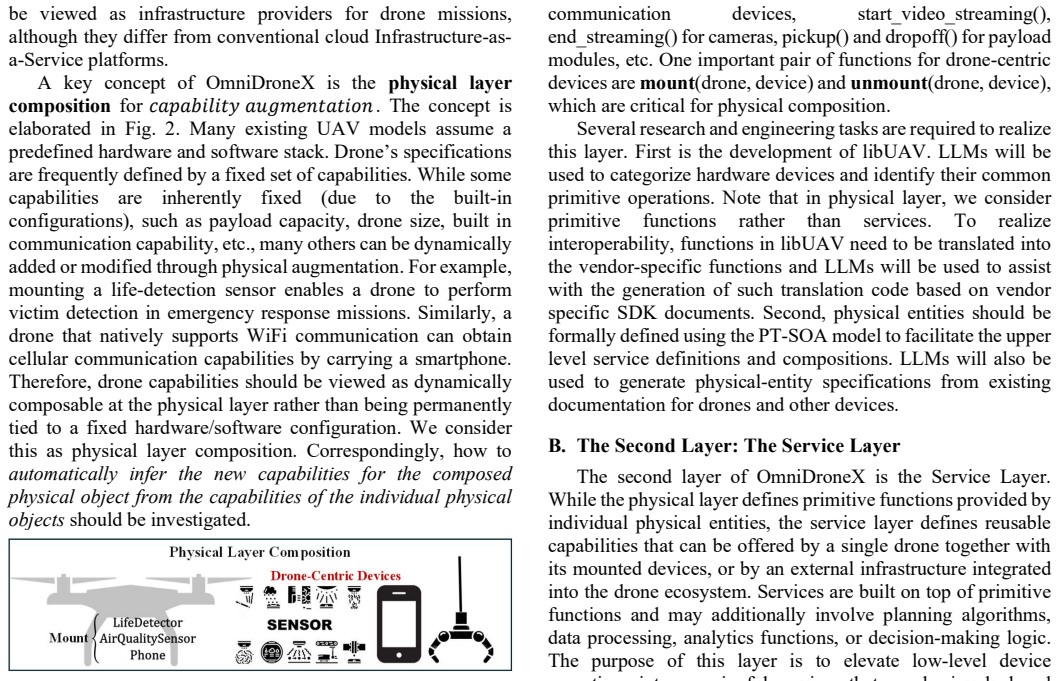
OmniDroneX transitions drones from fixed-function platforms into dynamically composable entities by bridging physical primitives to mission intent through the vendor-agnostic libUAV interface and the PT-SOA physical-service abstraction model, while applying LLMs to identify and formalize primitive functions, automate service composition and workflow generation, and support interactive natural-language mission specification and refinement, all while incorporating physical-layer, spatiotemporal, functional, collaborative, exception-aware, and QoS-based composition techniques.
Load-bearing premise
Large language models can reliably identify primitive device functions, formalize abstract services, generate correct compositions and workflows, and support natural-language mission specification in dynamic UAV settings.
Editorial extensions
If this is right
- Physical-layer composition allows drones to augment capabilities by integrating with external infrastructures.
- Spatiotemporal, functional, collaborative, exception-aware, and QoS-based compositions become automatable through LLM support.
- Natural-language mission specification and refinement reduce the need for low-level programming.
- The ecosystem supports scalable, resilient UAV operation in complex and dynamic environments.
- Drones can evolve as self-adapting service entities rather than remaining fixed platforms.
Reading between the lines
- The same abstraction and LLM layering could apply to other robotic or IoT device fleets beyond UAVs.
- Reliable LLM use for exception handling might reduce human oversight requirements in field operations.
- Integration with broader infrastructure services could enable hybrid drone-ground systems not addressed in the core model.
- Real-world validation would require testing LLM accuracy on actual hardware variability across vendors.
Editorial analysis
A structured set of objections, weighed in public.
Referee Report
Summary. The manuscript proposes OmniDroneX, a unified Drone-as-a-Service ecosystem that transitions drones from fixed-function platforms to dynamically composable entities. It bridges low-level physical primitives with high-level mission intent via a vendor-agnostic interface (libUAV) and a formal physical-service abstraction model (PT-SOA), with large language models applied across layers for function identification, automated service composition and workflow generation, and natural-language mission specification. The architecture incorporates physical-layer, spatiotemporal, functional, collaborative, exception-aware, and QoS-based composition techniques to support scalable, resilient, and self-evolving UAV ecosystems in complex environments.
Significance. If realized with supporting validation, the proposal could advance UAV systems research by offering a vendor-agnostic, LLM-augmented service-oriented framework that integrates physical capabilities with intent-driven composition. The explicit inclusion of multiple composition categories and LLM roles across abstraction layers provides a structured vision for addressing current deployment gaps, potentially enabling more adaptive ecosystems.
major comments (2)
- [Abstract] Abstract: The claim that the described features 'allow OmniDroneX to serve as a foundation for scalable, resilient, and self-evolving UAV ecosystems' is load-bearing for the central contribution yet is advanced without any algorithms, prompting strategies, error-handling mechanisms, simulations, or evaluations demonstrating LLM reliability for identifying primitive functions, automated composition, or interactive mission specification under dynamic or safety-critical conditions.
- [Abstract] Abstract: The core innovation of diverse LLM application across layers to formalize device functions and support service composition is presented as a key advance, but the manuscript supplies no concrete methods, training considerations, or robustness analysis for these uses in the context of PT-SOA and libUAV, leaving the bridging of low-level primitives to high-level intent as an assertion rather than a demonstrated capability.
minor comments (1)
- The manuscript would benefit from explicit section headings or a figure defining the relationships among libUAV, PT-SOA, and the LLM layers to improve readability of the architectural description.
Simulated Author's Rebuttal
We thank the referee for the constructive feedback. The manuscript presents OmniDroneX as a conceptual architectural proposal for a Drone-as-a-Service ecosystem. We address the major comments point-by-point below.
read point-by-point responses
-
Referee: [Abstract] Abstract: The claim that the described features 'allow OmniDroneX to serve as a foundation for scalable, resilient, and self-evolving UAV ecosystems' is load-bearing for the central contribution yet is advanced without any algorithms, prompting strategies, error-handling mechanisms, simulations, or evaluations demonstrating LLM reliability for identifying primitive functions, automated composition, or interactive mission specification under dynamic or safety-critical conditions.
Authors: We agree the abstract phrasing presents prospective outcomes as established. The paper is a framework proposal and does not include implementations or empirical evaluations. We will revise the abstract to replace 'allow' with language such as 'are designed to enable' and add a dedicated subsection on validation requirements, including the need for robustness testing of LLMs in dynamic UAV settings. revision: yes
-
Referee: [Abstract] Abstract: The core innovation of diverse LLM application across layers to formalize device functions and support service composition is presented as a key advance, but the manuscript supplies no concrete methods, training considerations, or robustness analysis for these uses in the context of PT-SOA and libUAV, leaving the bridging of low-level primitives to high-level intent as an assertion rather than a demonstrated capability.
Authors: The contribution centers on the multi-layer LLM integration concept within the proposed PT-SOA and libUAV abstractions rather than on specific implementations. To address the concern, we will expand the manuscript with high-level example prompting patterns and references to relevant LLM techniques for service formalization and composition, while explicitly noting that detailed training and robustness analyses remain future work. revision: partial
Circularity Check
No circularity in high-level architectural proposal
full rationale
The paper is a descriptive systems-architecture proposal with no equations, derivations, fitted parameters, or mathematical claims. It introduces libUAV, PT-SOA, and LLM uses across layers as design elements, but supplies no derivation chain that reduces any result to its own inputs by construction. No self-citation load-bearing steps, uniqueness theorems, or ansatzes appear. The central claims remain unverified assertions rather than tautological reductions, consistent with an honest non-finding of circularity.
Assumptions & free parameters
assumptions (1)
- domain assumption Drones can be transitioned from fixed function platforms into dynamically composable entities that can be integrated with external infrastructures to offer omni-capabilities.
invented entities (3)
-
OmniDroneX
-
libUAV
-
PT-SOA
Cite this review
Pith. "Pith review of OmniDroneX: An LLM-Assisted Holistic Drone-as-a-Service Ecosystem." pith.science (2026). https://pith.science/paper/VFSPCGGH
@misc{pith2026260617510,
  author       = {Pith},
  title        = {Pith review of: OmniDroneX: An LLM-Assisted Holistic Drone-as-a-Service Ecosystem},
  year         = {2026},
  howpublished = {\url{https://pith.science/paper/VFSPCGGH}},
  note         = {Machine review of arXiv:2606.17510}
}
read the original abstract
Despite rapid advances in UAV technologies, current deployments remain limited due to several gaps in UAV systems research. To address these challenges, we propose OmniDroneX, a unified Drone-as-a-Service ecosystem, in which drones are transitioned from fixed function platforms into dynamically composable entities that can be integrated with external infrastructures to offer omni-capabilities. OmniDroneX bridges low-level physical primitives with high-level mission intent through a unified vendor-agnostic interface (libUAV) and a formal physical-service abstraction model (PT-SOA). A core innovation is the diverse application of large language models (LLMs) across multiple layers of the OmniDroneX architecture. LLMs are used to assist in identifying and formalizing primitive device functions and abstract service definitions, supporting automated service composition and workflow generation, and enabling interactive, natural-language mission specification and refinement. OmniDroneX also incorporates important categories of composition techniques that are essential in dynamic UAV systems, including physical layer composition for drone capability augmentation, as well as spatiotemporal, functional, collaborative, exception-aware, and QoS-based service compositions. Collectively, these features allow OmniDroneX to serve as a foundation for scalable, resilient, and self-evolving UAV ecosystems operating in complex and dynamic environments.
Figures


Reference graph
Works this paper leans on
-
[1]
Drone-as-a-Service composition under uncertainty,
A. Hamdi, F. D. Salim, D. Y. Kim, A. Ghari Neiat and A. Bouguettaya, "Drone-as-a-Service composition under uncertainty," IEEE Transactions on Services Computing, vol. 15, no. 5, pp. 2685-2698, 2022
2022
-
[2]
Drone- as-a-Service: proximity-aware composition of UAV-based delivery services,
M. Sellami, H. Mezni, H. Elmannai and R. Alkanhel, "Drone- as-a-Service: proximity-aware composition of UAV-based delivery services," Cluster Computing, vol. 28, p. 330, 2025
2025
-
[3]
Drone-as-a-Service (DaaS) for COVID-19 self-testing kits delivery in smart healthcare setups: a technological perspective,
H. S. Munawar, J. Akram, S. I. Khan, F. Ullah and B. J. Choi, "Drone-as-a-Service (DaaS) for COVID-19 self-testing kits delivery in smart healthcare setups: a technological perspective," ICT Express, vol. 9, no. 4, pp. 748-753, 2023
2023
-
[4]
Drones as a service (DaaS) for 5G networks and blockchain-assisted IoT- based smart city infrastructure,
T. Garg, S. Gupta, M. S. Obaidat and M. Raj, "Drones as a service (DaaS) for 5G networks and blockchain-assisted IoT- based smart city infrastructure," Cluster Computing, vol. 27, pp. 8725-8788, 2024
2024
-
[5]
Drone-as-a-Service: research challenges and directions,
A. Hamdi, B. Alkouz, B. Shahzaad, A. Ghari Neiat, F. Salim, D. Yong Kim and A. Bouguettaya, "Drone-as-a-Service: research challenges and directions," Proceedings of the IEEE, vol. 113, no. 5, pp. 416-442, 2025
2025
-
[6]
AeroDaaS: towards an application programming framework for Drones-as-a- Service,
S. Raj, R. Singh, K. Astu and Y. Simmhan, "AeroDaaS: towards an application programming framework for Drones-as-a- Service," in 2025 IEEE International Conference on Web Services (ICWS), Helsinki, 2025
2025
-
[7]
UAVs-as-a-Service: cloud-based remote application management for drones,
J. Moeyersons, M. Gevaert, K.-E. Réculé, B. Volckaert and F. De Turck, "UAVs-as-a-Service: cloud-based remote application management for drones," in 2021 IFIP/IEEE International Symposium on Integrated Network Management (IM), Bordeaux, 2021
2021
-
[8]
IoT enabled UAV: network architecture and routing algorithm,
Q. Zhang, M. Jiang, Z. Feng, W. Li, W. Zhang and M. Pan, "IoT enabled UAV: network architecture and routing algorithm," IEEE Internet of Things Journal, vol. 6, no. 2, pp. 3727-3742, 2019
2019
Show all 42 references
-
[9]
IoTaaS: drone-based Internet of Things as a service framework for smart cities,
M. A. Hoque, M. Hossain, S. Noor, S. M. R. Islam and R. Hasan, "IoTaaS: drone-based Internet of Things as a service framework for smart cities," IEEE Internet of Things Journal, vol. 9, no. 14, pp. 12425-12439, 2022
2022
-
[10]
Surveillance drone cloud and intelligence service,
S. Richhariya, K. Wanaskar, S. Shrivastava and J. Gao, "Surveillance drone cloud and intelligence service," in 2023 11th IEEE International Conference on Mobile Cloud Computing, Services, and Engineering (MobileCloud), Athens, 2023
2023
-
[11]
In- flight energy-driven composition of drone swarm services,
B. Alkouz, A. Abusafia, N. Lakhdari and A. Bouguettaya, "In- flight energy-driven composition of drone swarm services," IEEE Transactions on Services Computing, vol. 16, no. 3, pp. 1919-1933, 2023
1919
-
[12]
Determining the composition of the group of drones and the basing method for oil pipeline monitoring,
A. A. Fedorova, V. A. Beliautsou and A. N. Barysevich, "Determining the composition of the group of drones and the basing method for oil pipeline monitoring," in 2020 International Russian Automation Conference (RusAutoCon), Sochi, 2020
2020
-
[13]
A spatiotemporal- aware decentralized service discovery framework for drone swarms,
H. Yu, N. Chen, B. Shen, T. Li and H. Cai, "A spatiotemporal- aware decentralized service discovery framework for drone swarms," IEEE Internet of Things Journal, vol. 13, no. 5, pp. 9163-9176, 2026
2026
-
[14]
A PT-SOA model for CPS/IoT services,
W. Zhu, G. Zhou, I.-L. Yen and F. Bastani, "A PT-SOA model for CPS/IoT services," in 2015 IEEE International Conference on Web Services (ICWS), New York, 2015
2015
-
[15]
Service-oriented IoT modeling and its deviation from software services,
I.-L. Yen, F. Bastani, W. Zhu, H. Moeini, S.-Y. Hwang and Y. Zhang, "Service-oriented IoT modeling and its deviation from software services," in 2018 IEEE Symposium on Service- Oriented System Engineering (SOSE), Bamberg, 2018
2018
-
[16]
From software services to IoT services: the modeling perspective,
I.-L. Yen, F. Bastani, S.-Y. Hwang, W. Zhu and G. Zhou, "From software services to IoT services: the modeling perspective," in Serviceology for Services, Cham, Springer International Publishing, 2017, pp. 215-223
2017
-
[17]
A comparative review of air drones (UAVs) and delivery bots (SUGVs) for automated last-mile home delivery,
F. Li and O. Kunze, "A comparative review of air drones (UAVs) and delivery bots (SUGVs) for automated last-mile home delivery," Logistics, vol. 7, no. 2, p. 21, 2023
2023
-
[18]
Routing and scheduling for hybrid truck-drone collaborative parcel delivery with independent and truck-carried drones,
D. Wang, P. Hu, J. Du, P. Zhou, T. Deng and M. Hu, "Routing and scheduling for hybrid truck-drone collaborative parcel delivery with independent and truck-carried drones," IEEE Internet of Things Journal, vol. 6, no. 6, pp. 10483-10495, 2019
2019
-
[19]
Hybrid truck-drone delivery systems: a systematic literature review,
B. Madani and M. Ndiaye, "Hybrid truck-drone delivery systems: a systematic literature review," IEEE Access, vol. 10, pp. 92854-92878, 2022
2022
-
[20]
Self-stabilizing structure forming algorithms for distributed multi-robot systems,
Y. Zhang, F. Bastani and I.-L. Yen, "Self-stabilizing structure forming algorithms for distributed multi-robot systems," in Cooperative Information Systems, OTM 2007 Workshops, Springer, 2007, pp. 754-766
2007
-
[21]
A self-stabilizing algorithm for the foraging problem in swarm robotic systems,
G. Zhou, F. Bastani, W. Zhu and I.-L. Yen, "A self-stabilizing algorithm for the foraging problem in swarm robotic systems," in 2016 IEEE/RSJ International Conference on Intelligent Robots and Systems (IROS), Daejeon, 2016
2016
-
[22]
Rapid service composition reasoning for agile cyber physical systems,
I.-L. Yen, W. Zhu, F. Bastani, Y. Huang and G. Zhou, "Rapid service composition reasoning for agile cyber physical systems," in 2016 IEEE Symposium on Service-Oriented System Engineering (SOSE), Oxford, 2016
2016
-
[23]
Towards a framework of key technologies for drones,
R. Nouacer, M. Hussein, H. Espinoza, Y. Ouhammou, M. Ladeira and R. Castiñeira, "Towards a framework of key technologies for drones," Microprocessors and Microsystems, vol. 77, p. 103142, 2020
2020
-
[24]
Toward integrated large-scale environmental monitoring using WSN/UAV/crowdsensing: a review of applications, signal processing, and future perspectives,
A. Fascista, "Toward integrated large-scale environmental monitoring using WSN/UAV/crowdsensing: a review of applications, signal processing, and future perspectives," Sensors, vol. 22, no. 5, p. 1824, 2022
2022
-
[25]
Robust real-time UAV-based power line detection and tracking,
G. Zhou, J. Yuan, I.-L. Yen and F. Bastani, "Robust real-time UAV-based power line detection and tracking," in 2016 IEEE International Conference on Image Processing (ICIP), Phoenix, 2016
2016
-
[26]
A review of UAV power line inspection,
Z. Wang, Q. Gao, J. Xu and D. Li, "A review of UAV power line inspection," in Advances in Guidance, Navigation and Control, Singapore, Springer, 2022
2022
-
[27]
Automatic damage detection and diagnosis for hydraulic structures using drones and artificial intelligence techniques,
Y. Zhu and H. Tang, "Automatic damage detection and diagnosis for hydraulic structures using drones and artificial intelligence techniques," Remote Sensing, vol. 15, no. 3, p. 615, 2023
2023
-
[28]
Drone-based photogrammetry for riverbed characteristics extraction and flood discharge modeling in Taiwan's mountainous rivers,
L. Liu, "Drone-based photogrammetry for riverbed characteristics extraction and flood discharge modeling in Taiwan's mountainous rivers," Measurement, vol. 220, p. 113386, 2023
2023
-
[29]
Towards UAV- based bridge inspection systems: a review and an application perspective,
B. Chan, H. Guan, J. Jo and M. Blumenstein, "Towards UAV- based bridge inspection systems: a review and an application perspective," Structural Monitoring and Maintenance, vol. 2, no. 3, pp. 283-300, 2015
2015
-
[30]
UAV bridge inspection through evaluated 3D reconstructions,
S. Chen, D. F. Laefer, E. Mangina, S. M. I. Zolanvari and J. Byrne, "UAV bridge inspection through evaluated 3D reconstructions," Journal of Bridge Engineering, vol. 24, no. 4, p. 05019001, 2019
2019
-
[31]
A UAV-based visual inspection method for rail surface defects,
Y. Wu, Y. Qin, Z. Wang and L. Jia, "A UAV-based visual inspection method for rail surface defects," Applied Sciences, vol. 8, no. 7, p. 1028, 2018
2018
-
[32]
Quality assessment of unmanned aerial vehicle (UAV) based visual inspection of structures,
G. Morgenthal and N. Hallermann, "Quality assessment of unmanned aerial vehicle (UAV) based visual inspection of structures," Advances in Structural Engineering, vol. 17, no. 3, pp. 289-302, 2014
2014
-
[33]
Automatic inspection data collection of building surface based on BIM and UAV,
Y. Tan, S. Li, H. Liu, P. Chen and Z. Zhou, "Automatic inspection data collection of building surface based on BIM and UAV," Automation in Construction, vol. 131, p. 103881, 2021
2021
-
[34]
A UAV system for inspection of industrial facilities,
J. Nikolic, M. Burri, J. Rehder, S. Leutenegger, C. Huerzeler and R. Siegwart, "A UAV system for inspection of industrial facilities," in 2013 IEEE Aerospace Conference, Big Sky, 2013
2013
-
[35]
Unmanned aerial vehicles (UAV) in precision agriculture: applications and challenges,
P. Velusamy, S. Rajendran, R. K. Mahendran, S. Naseer, M. Shafiq and J.-G. Choi, "Unmanned aerial vehicles (UAV) in precision agriculture: applications and challenges," Energies, vol. 15, no. 1, p. 217, 2022
2022
-
[36]
Estimating crop seed composition using machine learning from multisensory UAV data,
K. Dilmurat, V. Sagan, M. Maimaitijiang, S. Moose and F. B. Fritschi, "Estimating crop seed composition using machine learning from multisensory UAV data," Remote Sensing, vol. 14, no. 19, p. 4786, 2022
2022
-
[37]
A comparative review of air drones (UAVs) and delivery bots (SUGVs) for automated last mile home delivery,
F. Li and O. Kunze, "A comparative review of air drones (UAVs) and delivery bots (SUGVs) for automated last mile home delivery," Logistics, vol. 7, no. 2, p. 21, 2023
2023
-
[38]
Unmanned aerial vehicles (UAVs) for disaster management,
O. Bushnaq, D. Mishra, E. Natalizio and I. F. Akyildiz, "Unmanned aerial vehicles (UAVs) for disaster management," in Internet of Drones Applications, Opportunities, and Challenges, Elsevier, 2022, pp. 159-188
2022
-
[39]
Drones-as-a-service: a management architecture to provide mission planning, resource brokerage and operation support for fleets of drones,
J. A. Besada, A. M. Bernardos, L. Bergesio, D. Vaquero, I. Campaña and J. R. Casar, "Drones-as-a-service: a management architecture to provide mission planning, resource brokerage and operation support for fleets of drones," in 2019 IEEE International Conference on Pervasive C...
2019
-
[40]
Toward a marketplace for aerial computing,
A. Balasingam, K. Gopalakrishnan, R. Mittal, M. Alizadeh, H. Balakrishnan and H. Balakrishnan, "Toward a marketplace for aerial computing," in Proceedings of the 7th Workshop on Micro Aerial Vehicle Networks, Systems, and Applications, Virtual, 2021
2021
-
[41]
Community drones: a concept study on shared drone services,
P. Widhalm, U. Ritzinger, N. Prüggler, W. Prüggler, D. Strelnikova, G. Paulus, F. d'Apolito and F. Eicken, "Community drones: a concept study on shared drone services," Drones, vol. 9, no. 2, p. 107, 2025
2025
-
[42]
STANAG 4586 – standard interfaces of UAV control system (UCS) for NATO UAV interoperability,
M. Monteiro Marques, "STANAG 4586 – standard interfaces of UAV control system (UCS) for NATO UAV interoperability," NATO, 2015
2015
Reviewed June 27, 2026 · model on record in the stance chip above.
Discussion (0). Continue with ORCID to comment.