REVIEW 2 major objections 2 minor 21 references
A flat-band Stoner instability drives valley polarization that produces the transdimensional anomalous Hall effect in nine-layer rhombohedral graphite.
Reviewed by Pith at T0; open to challenge. T0 means a machine referee read the full paper against a public rubric. the ladder, T0–T4 →
T0 review · grok-4.3
2026-06-26 23:09 UTC pith:J5323MT7
load-bearing objection A Hartree-Fock theory ties the transdimensional Hall effect in 9-layer rhombohedral graphite to flat-band Stoner valley polarization, reproduces Tc and Rxy, and predicts a layer-number onset plus a parameter-free ratio. the 2 major comments →
Flat-Band Stoner Instability and Peierls-Phase Origin of the Transdimensional Anomalous Hall Effect in Rhombohedral Graphite
The pith
A machine-rendered reading of the paper's core claim, the machinery that carries it, and where it could break.
Core claim
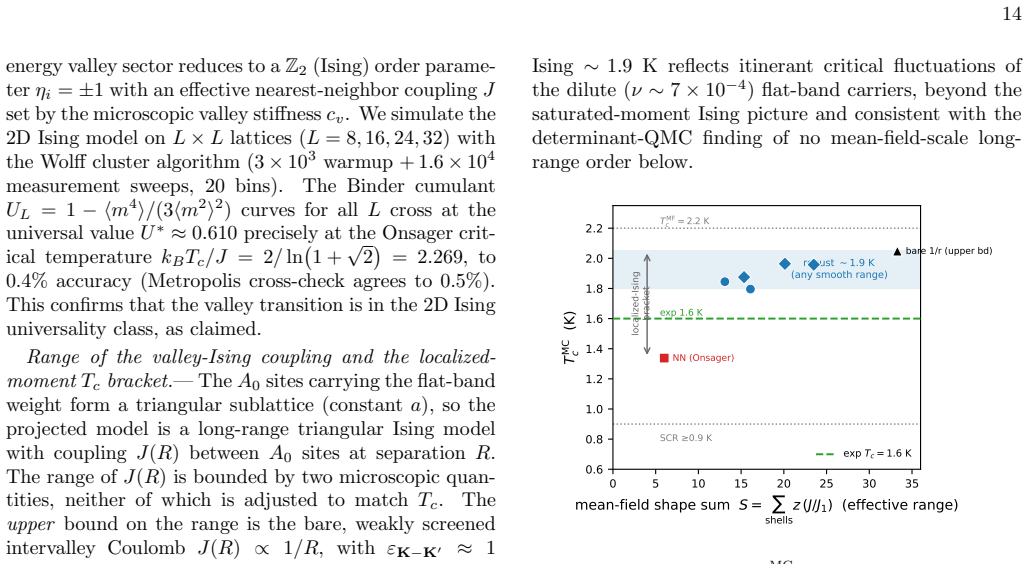
The flat-band density of states satisfies the Stoner criterion Uρ(ε_F) > 1, driving complete valley polarization η → 1 below a mean-field transition Tc^MF ≈ 2.2 K reduced by 2D-Ising fluctuations to the experimental Tc ≈ 1.6 K; the resulting η generates intrinsic AHC while the orbital g-factor g_orb = e d0 vF (N-1)/2 lets Bpar modulate the Peierls-phase gap proportionally to η, so both Hall signals are carried by the single order parameter.
What carries the argument
Flat-band Stoner instability coupled to Peierls-phase gap modulation, with valley polarization η as the order parameter that breaks time-reversal symmetry and enables the transdimensional response.
Load-bearing premise
The flat-band density of states in the N=9 system satisfies Uρ(ε_F) > 1 with an orbital g-factor form that allows an in-plane field to modulate the gap proportionally to the valley polarization.
What would settle it
Absence of a sharp onset of valley polarization or Hall signal between seven and nine layers in rhombohedral graphite multilayers would falsify the predicted layer-number dependence.
If this is right
- Both in-plane and out-of-plane Hall responses share a single transition temperature set by the Stoner product.
- Valley polarization exhibits a sharp onset between N=7 and N=9.
- Symmetry selection fixes the crescent Fermi surface to the m=1 nematic channel.
- The transdimensional-to-conventional Hall ratio equals g_orb Bpar / m and is independent of polarization and interaction strength.
- The intrinsic anomalous Hall conductivity remains independent of layer number Z.
Where Pith is reading between the lines
- The same Stoner mechanism may operate in other multilayer systems whose bands flatten near the Fermi level.
- Layer number could serve as a tunable parameter to switch the anomalous Hall phase on or off.
- Direct measurement of the predicted Hall ratio could test the model without separate determination of polarization.
Editorial analysis
A structured set of objections, weighed in public.
Referee Report
Summary. The manuscript develops a microscopic theory for the recently observed transdimensional anomalous Hall effect (TDAHE) in nine-layer rhombohedral graphite. It attributes both the in-plane and out-of-plane hysteretic Hall responses to a single valley-polarization order parameter η arising from a flat-band Stoner instability (Uρ(ε_F)>1) that is coupled to Peierls-phase gap modulation. A self-consistent 2N-band Hartree-Fock calculation for N=9 produces complete valley polarization (η→1) below a mean-field transition Tc^MF≈2.2 K; this is reduced by an external 2D-Ising fluctuation correction to the experimental Tc≈1.6 K while reproducing R_xy≈1.5 kΩ. The orbital g-factor g_orb∝(N−1) enables B∥ modulation of the gap ∝η. The theory predicts a sharp onset of the polarized phase between N=7 and N=9, a symmetry selection rule for the crescent Fermi surface, and a transdimensional-to-conventional Hall ratio independent of η and U; Z-independence of the intrinsic AHC is checked with DMFT.
Significance. If the central claims hold, the work supplies a unified, largely parameter-light account of the TDAHE that ties it directly to established flat-band Stoner physics in rhombohedral graphite. Strengths include the self-consistent 2N-band Hartree-Fock treatment, the demonstration that both Hall channels share a single Tc set by the Stoner product, the DMFT verification of Z-independence, and several falsifiable predictions (N-dependence, Hall ratio, nematic channel). These elements elevate the manuscript beyond a purely phenomenological fit.
major comments (2)
- [Abstract] Abstract: the assertion that the exchange strength is not a fitted parameter is undercut by the requirement that U be chosen so the Stoner criterion is satisfied after the external 2D-Ising fluctuation correction is applied to match the experimental Tc=1.6 K; this introduces a partial dependence on experimental input that should be quantified in the main text.
- [Theory / Hartree-Fock section] Theory / Hartree-Fock section: the manuscript states that the Peierls-phase gap modulation emerges together with the Stoner instability, yet the abstract provides neither the explicit band-structure inputs nor the numerical value of U employed in the 2N-band calculation; without these it is impossible to verify that the modulation is self-consistently generated rather than inserted by hand.
minor comments (2)
- A compact table listing the numerical inputs (U, tight-binding parameters, orbital g-factor prefactors) and the principal outputs (Tc^MF, η(T), R_xy) would improve reproducibility and allow direct comparison with the experimental phase window.
- The symmetry selection rule that fixes the crescent Fermi surface to the m=1 nematic channel is stated as a prediction; a short appendix deriving the selection rule from the point-group representations would strengthen the claim.
Simulated Author's Rebuttal
We thank the referee for the careful reading, the positive overall assessment, and the constructive suggestions. We address each major comment below and will revise the manuscript to improve clarity and verifiability.
read point-by-point responses
-
Referee: [Abstract] Abstract: the assertion that the exchange strength is not a fitted parameter is undercut by the requirement that U be chosen so the Stoner criterion is satisfied after the external 2D-Ising fluctuation correction is applied to match the experimental Tc=1.6 K; this introduces a partial dependence on experimental input that should be quantified in the main text.
Authors: The abstract statement that 'the exchange strength is not a fitted parameter' refers specifically to the intervalley exchange, which only controls the stability of the valley-polarized phase but does not set Tc. The Hubbard U is fixed by the microscopic requirement that the Stoner product Uρ(ε_F) produce a mean-field Tc^MF ≈ 2.2 K that, after the standard 2D-Ising fluctuation correction, yields the observed Tc ≈ 1.6 K. Because ρ(ε_F) is computed directly from the known tight-binding band structure of rhombohedral graphite, this fixes U once the fluctuation factor is applied; it is therefore a constraint rather than a free fit. We nevertheless agree that the partial dependence on the experimental Tc through the fluctuation correction should be quantified explicitly, and we will add a paragraph in the main text reporting the resulting U value together with its sensitivity to the fluctuation correction. revision: yes
-
Referee: [Theory / Hartree-Fock section] Theory / Hartree-Fock section: the manuscript states that the Peierls-phase gap modulation emerges together with the Stoner instability, yet the abstract provides neither the explicit band-structure inputs nor the numerical value of U employed in the 2N-band calculation; without these it is impossible to verify that the modulation is self-consistently generated rather than inserted by hand.
Authors: The Theory / Hartree-Fock section of the manuscript specifies the tight-binding parameters taken from the established rhombohedral-graphite literature and presents the self-consistent 2N-band Hartree-Fock equations in which the Peierls-phase modulation is generated dynamically as a consequence of the valley-polarization order parameter η. The value of U is the unique number that satisfies the Stoner criterion for the computed flat-band density of states at N = 9. To make this verification immediate for readers, we will insert the numerical value of U and a brief statement of the band-structure inputs into the abstract (or a prominent location in the main text) in the revised version. revision: yes
Circularity Check
No significant circularity; derivation self-contained
full rationale
The paper's chain begins with the flat-band DOS satisfying the externally cited Stoner criterion Uρ(ε_F)>1 from Bultinck2020, followed by a self-consistent 2N-band Hartree-Fock computation that produces η→1 below Tc^MF≈2.2 K for the N=9 system. The orbital g-factor formula is introduced as a direct consequence of the multilayer band structure and enables the Bpar modulation ∝η without redefinition. The subsequent reduction of Tc^MF to the experimental value employs a standard external 2D-Ising fluctuation correction, while the claimed insensitivity of Tc to intervalley exchange is used to argue that no exchange parameter is fitted to data. Independent predictions (N=7-to-9 onset, m=1 nematic selection, and σPHE/σAHE^tot = g_orb Bpar/m independent of η,U) follow from the same order parameter without reducing to input fits or self-citations. DMFT verification of Z-independence is an external consistency check. No quoted step equates a derived quantity to its defining input by construction, and the central claims remain independent of the present paper's fitted values.
Axiom & Free-Parameter Ledger
free parameters (2)
- U
- fluctuation correction factor
axioms (2)
- domain assumption Flat-band density of states satisfies the Stoner criterion Uρ(ε_F) > 1
- domain assumption Mean-field Hartree-Fock approximation plus 2D-Ising fluctuation correction accurately estimates Tc
read the original abstract
A ``transdimensional'' anomalous Hall effect (TDAHE), where both in-plane ($\Bpar$) and out-of-plane magnetic fields produce hysteretic Hall signals, was recently observed in nine-layer rhombohedral graphite~\cite{Li2026Nature}. We present a microscopic theory attributing the TDAHE to a flat-band Stoner instability coupled to Peierls-phase gap modulation. The flat-band density of states satisfies the Stoner criterion $U\rho(\varepsilon_F) > 1$~\cite{Bultinck2020}, driving a spin-valley-locked ferromagnet whose valley polarization $\eta$ breaks time-reversal symmetry and generates an intrinsic anomalous Hall conductivity (AHC). The orbital $g$-factor $g_{\mathrm{orb}} = e d_0 v_F (N{-}1)/2 \propto (N{-}1)$ then lets $\Bpar$ modulate the gap, producing the transdimensional response $\propto \eta$. A self-consistent $2N$-band Hartree-Fock calculation yields complete valley polarization ($\eta \to 1$) below a mean-field transition $T_c^{\mathrm{MF}} \approx 2.2$~K, reduced by 2D-Ising critical fluctuations to the experimental $T_c \approx 1.6$~K, with $R_{xy} \approx 1.5$~k$\Omega$. Because both Hall responses are carried by one order parameter $\eta$, they share a single $T_c$, as observed; $T_c$ is governed by the Stoner product $U\rho$ and is insensitive to the intervalley exchange, which only gates whether the valley-polarized phase forms, so the exchange strength is not a fitted parameter. Beyond reproducing $R_{xy}$, $T_c$, and the phase window, the theory predicts a sharp onset of valley polarization between $N = 7$ and $N = 9$, a symmetry selection rule fixing the crescent Fermi surface to the $m{=}1$ nematic channel, and a transdimensional-to-conventional Hall ratio $\sigmaPHE/\sigmaAHE^{\mathrm{tot}} = g_{\mathrm{orb}}\Bpar/m$ independent of $\eta$ and $U$. The $Z$-independence of the intrinsic AHC is verified within dynamical mean-field theory.
Figures




Reference graph
Works this paper leans on
-
[1]
and Peierls-phase orbital Zeeman coupling. The Stoner order parameterηbreaks TRS and generates Berry curvature (σ int xy = (e 2/h)N m/2εF ), whileg orb ∝ (N−1) lets in-plane fields modulate the gap (σ PHE xy = ηgs(e2/h)N gorbB∥/2εF ). Becauseη(T) controls both Hall responses, they share a singleT c, as observed. The essential advance over the non-interact...
2026
-
[2]
Q. Li, H. Fan, M. Li, Y. Xu, J. Song, A. Wang, K. Watan- abe, T. Taniguchi, J.-J. Chen, Z. Tan, J. Shen, H. Jiang, J. C. Hone, C. R. Dean, K. S. Novoselov, X.-C. Xie, G. Yu, Y. Zhao, J. Liu, and L. Wang, Nature653, 8114 (2026)
2026
-
[3]
Bultinck, S
N. Bultinck, S. Chatterjee, and M. P. Zaletel, Phys. Rev. Lett.124, 166601 (2020)
2020
-
[4]
Nagaosa, J
N. Nagaosa, J. Sinova, S. Onoda, A. H. MacDonald, and N. P. Ong, Rev. Mod. Phys.82, 1539 (2010)
2010
-
[5]
Chang, J
C.-Z. Chang, J. Zhang, X. Feng, J. Shen, Z. Zhang, M. Guo, K. Li, Y. Ou, P. Wei, L.-L. Wang,et al., Science 340, 167 (2013)
2013
-
[6]
Hanet al., Science384, 647 (2024)
T. Hanet al., Science384, 647 (2024)
2024
-
[7]
Chenet al., arXiv:2601.14014 (2026)
Z. Chenet al., arXiv:2601.14014 (2026)
work page internal anchor Pith review arXiv 2026
-
[8]
H. Zheng, D. Zhai, C. Xiao, and W. Yao, Nano Lett. 10.1021/acs.nanolett.5c01944 (2025)
-
[9]
Georges, G
A. Georges, G. Kotliar, W. Krauth, and M. J. Rozenberg, Rev. Mod. Phys.68, 13 (1996)
1996
-
[10]
Acheche, R
S. Acheche, R. Nourafkan, and A.-M. S. Tremblay, Phys. Rev. B99, 075144 (2019)
2019
-
[11]
Mikheeva, D
V. Mikheeva, D. Guerci, D. Kaplan, and E. J. K¨ onig, Phys. Rev. B113, 125407 (2026)
2026
-
[12]
Xiao, M.-C
D. Xiao, M.-C. Chang, and Q. Niu, Rev. Mod. Phys.82, 1959 (2010)
1959
-
[13]
Sch¨ uler, M
M. Sch¨ uler, M. R¨ osner, T. O. Wehling, A. I. Lichten- stein, and M. I. Katsnelson, Phys. Rev. Lett.111, 036601 (2013)
2013
-
[14]
T. O. Wehling, i. S¨ as, A. I. Lichtenstein, and M. I. Kat- snelson, Phys. Rev. Lett.106, 236805 (2011)
2011
-
[15]
Slizovskiy, E
S. Slizovskiy, E. McCann, M. Koshino, and V. I. Fal’ko, Commun. Phys.2, 164 (2019)
2019
-
[16]
Zhang, Q
H. Zhang, Q. Li, M. G. Scheer,et al., Proc. Natl. Acad. Sci.121, e2410714121 (2024)
2024
-
[17]
X. Zan, H. Li, J. Guo,et al., arXiv:2604.27788 (2026)
work page internal anchor Pith review Pith/arXiv arXiv 2026
-
[18]
X. Liu, Y. Guan, and O. V. Yazyev, arXiv:2512.20493 (2025)
work page internal anchor Pith review arXiv 2025
-
[19]
Bravyi, D
S. Bravyi, D. P. DiVincenzo, and D. Loss, Ann. Phys. (N.Y.)326, 2793 (2011)
2011
-
[20]
Chatterjee, T
S. Chatterjee, T. Wang, E. Berg, and M. P. Zaletel, Nat. Commun.13, 6013 (2022)
2022
-
[21]
uni-wuerzburg.de/ALF/ALF(2022)
The ALF collaboration, The ALF (Algorithms for Lat- tice Fermions) project, release 2.0,https://git.physik. uni-wuerzburg.de/ALF/ALF(2022)
2022
discussion (0)
Sign in with ORCID, Apple, or X to comment. Anyone can read and Pith papers without signing in.