Characterizing Orbital Parameters of Hot Subdwarf Binaries with Multiple Spectroscopic Surveys
Pith reviewed 2026-06-26 23:21 UTC · model grok-4.3
The pith
Hot subdwarf binaries mostly follow the mass-period distribution of post-common-envelope systems.
A machine-rendered reading of the paper's core claim, the machinery that carries it, and where it could break.
Core claim
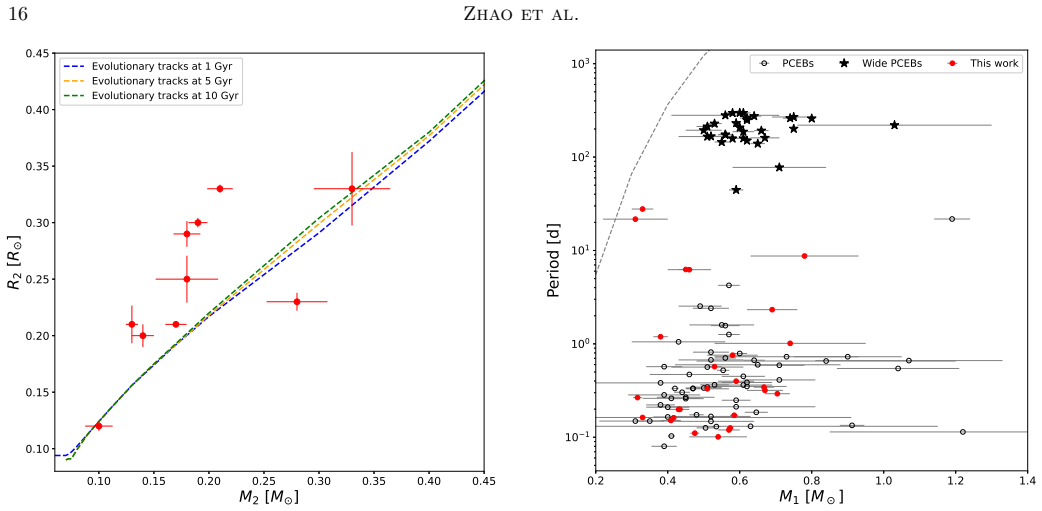
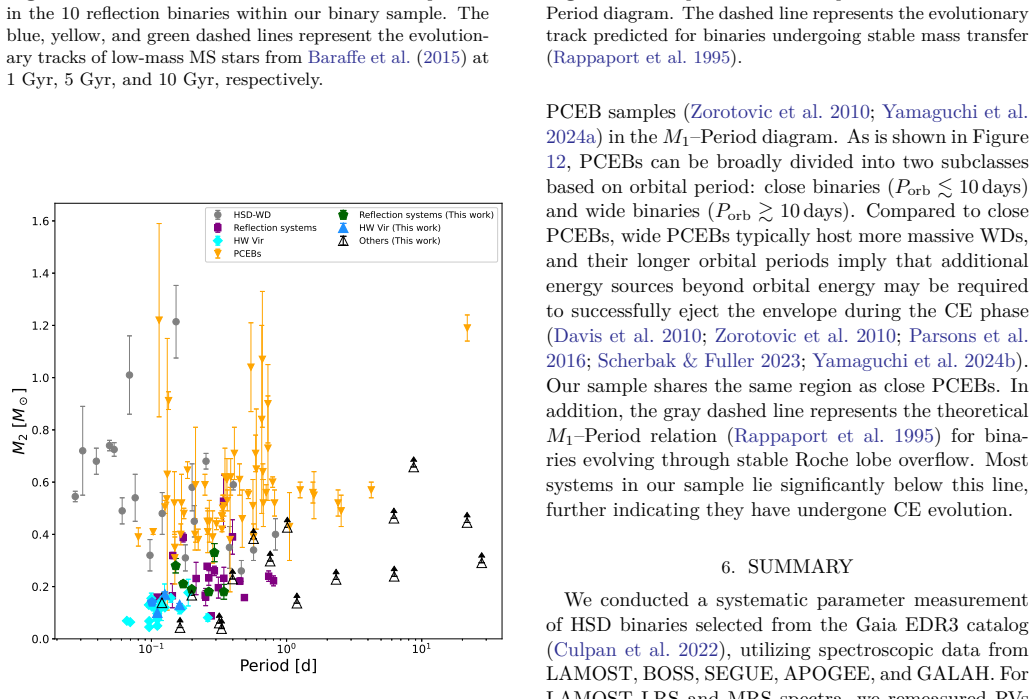
Most of these systems share a similar mass--period distribution with that of post-common-envelope binaries, supporting a common-envelope origin.
What carries the argument
Mass-period distribution constructed from orbital solutions derived by simultaneous radial-velocity and light-curve fitting.
Load-bearing premise
The observed similarity between the derived mass-period distribution and that of known post-common-envelope binaries is not dominated by selection effects or by alternative formation channels that happen to occupy the same region of parameter space.
What would settle it
A statistically significant excess of hot-subdwarf binaries lying outside the post-common-envelope mass-period locus once detection probabilities and survey selection functions are explicitly modeled.
Figures
read the original abstract
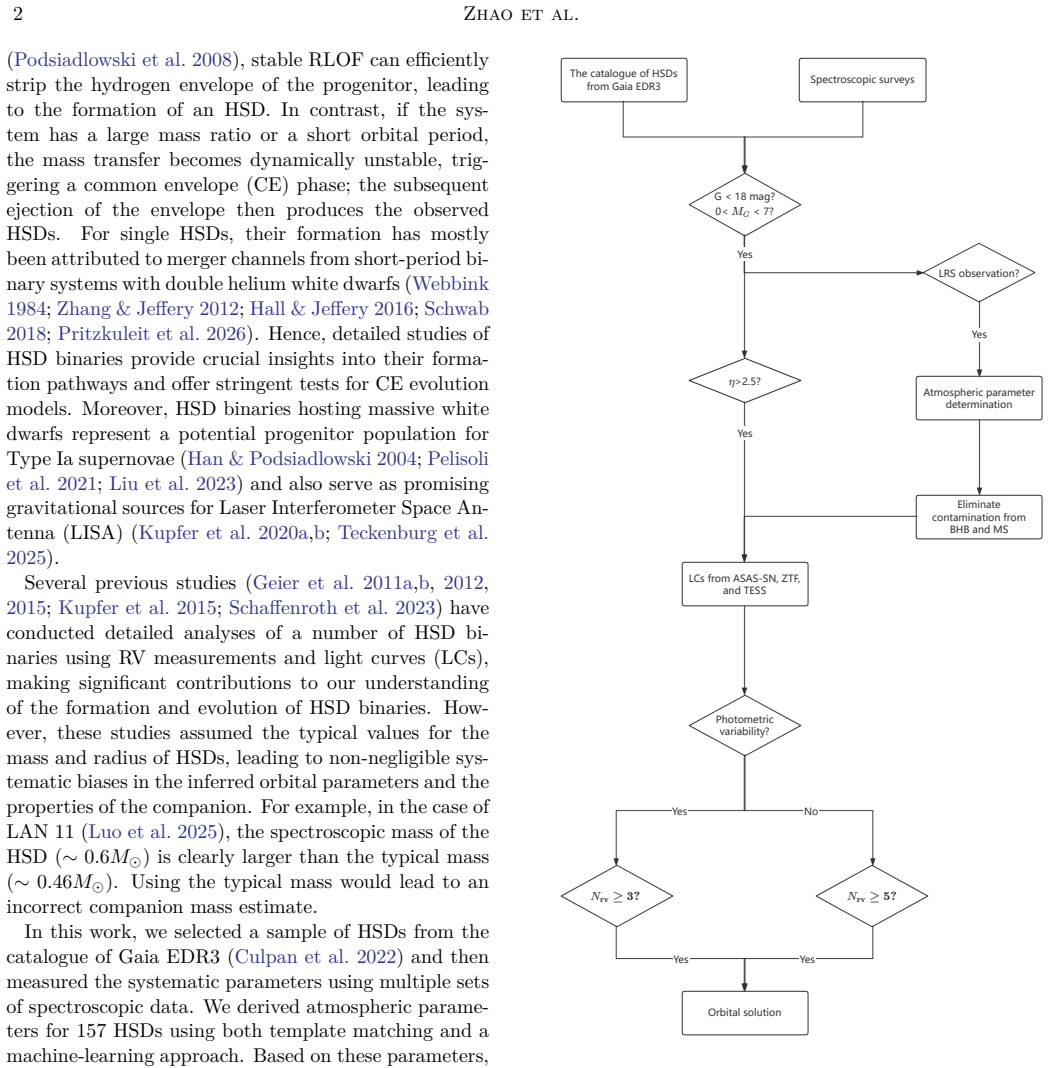
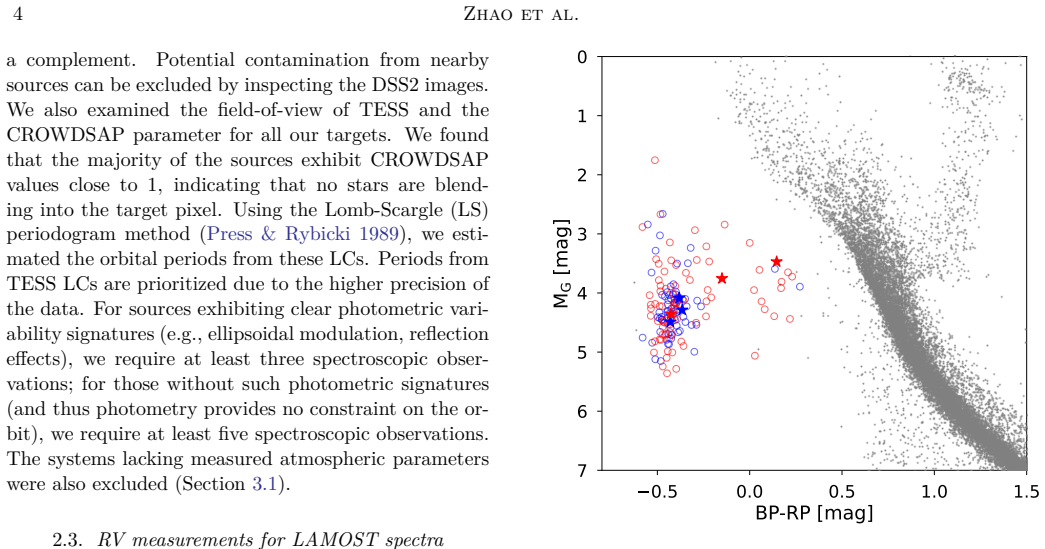
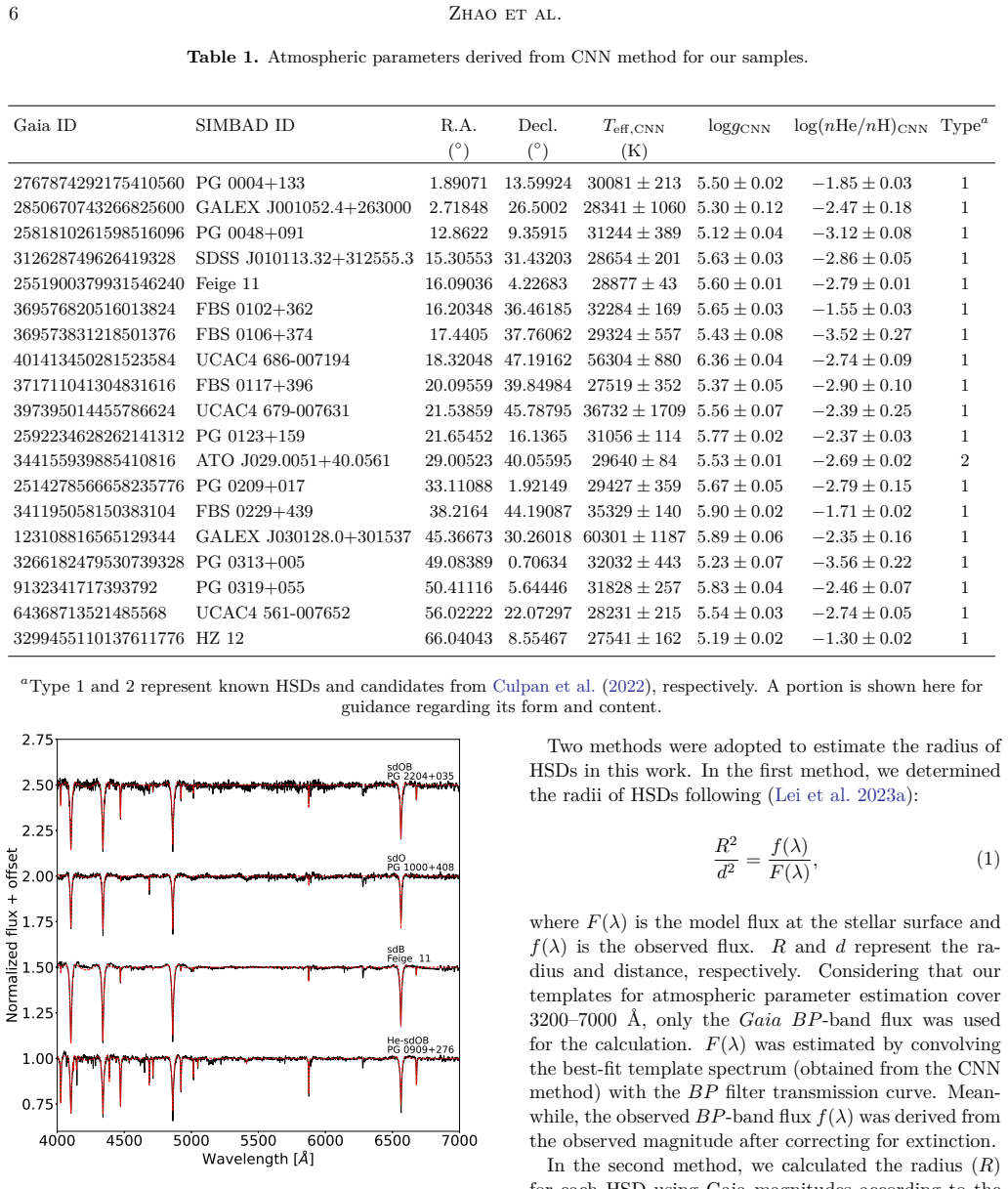
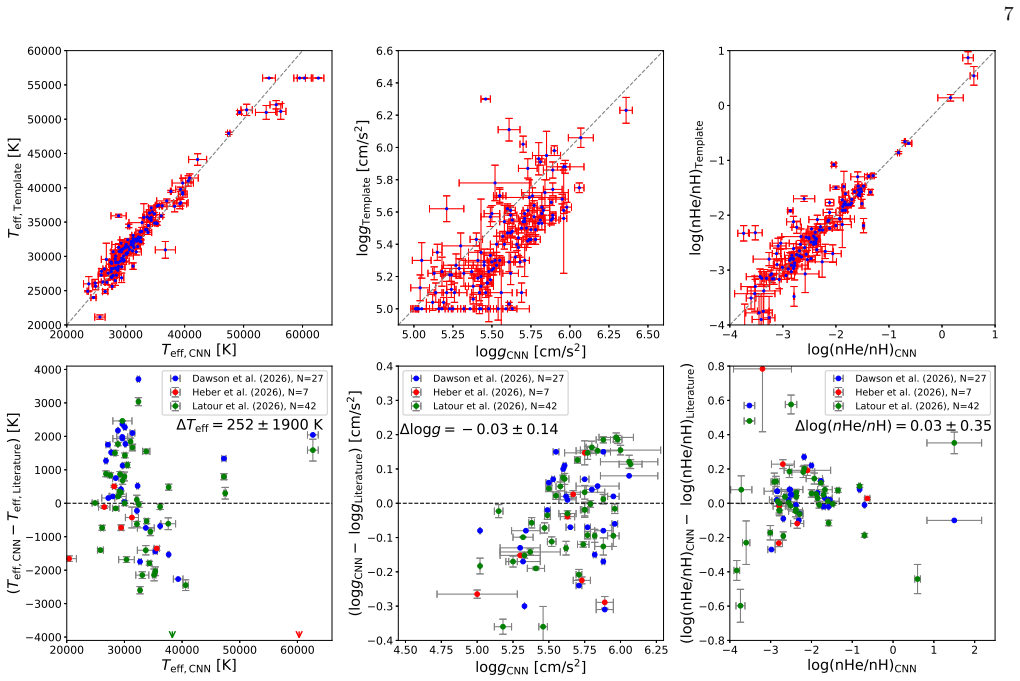
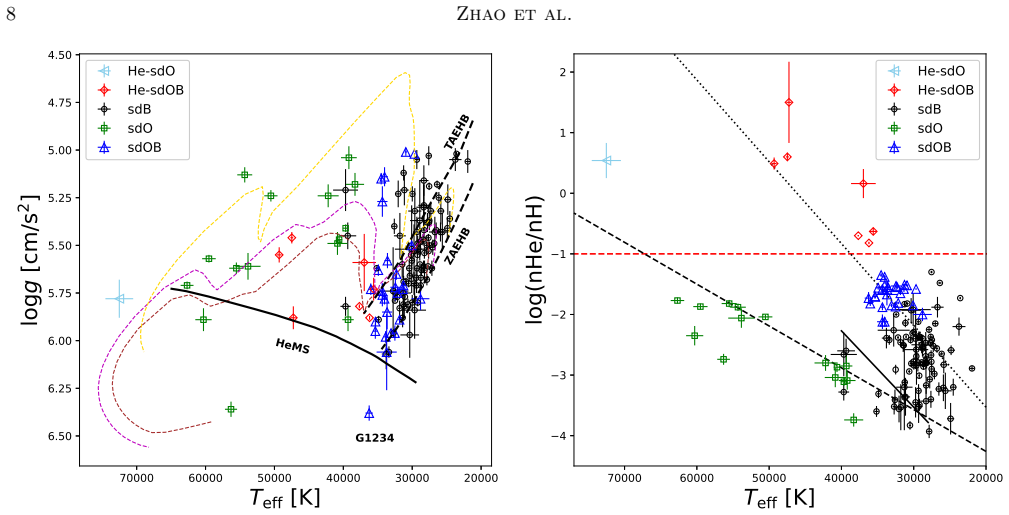
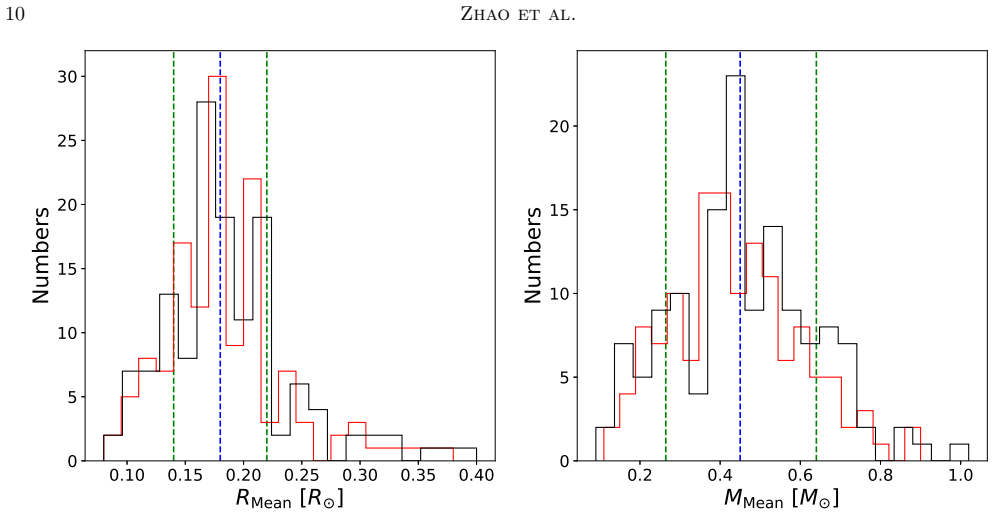
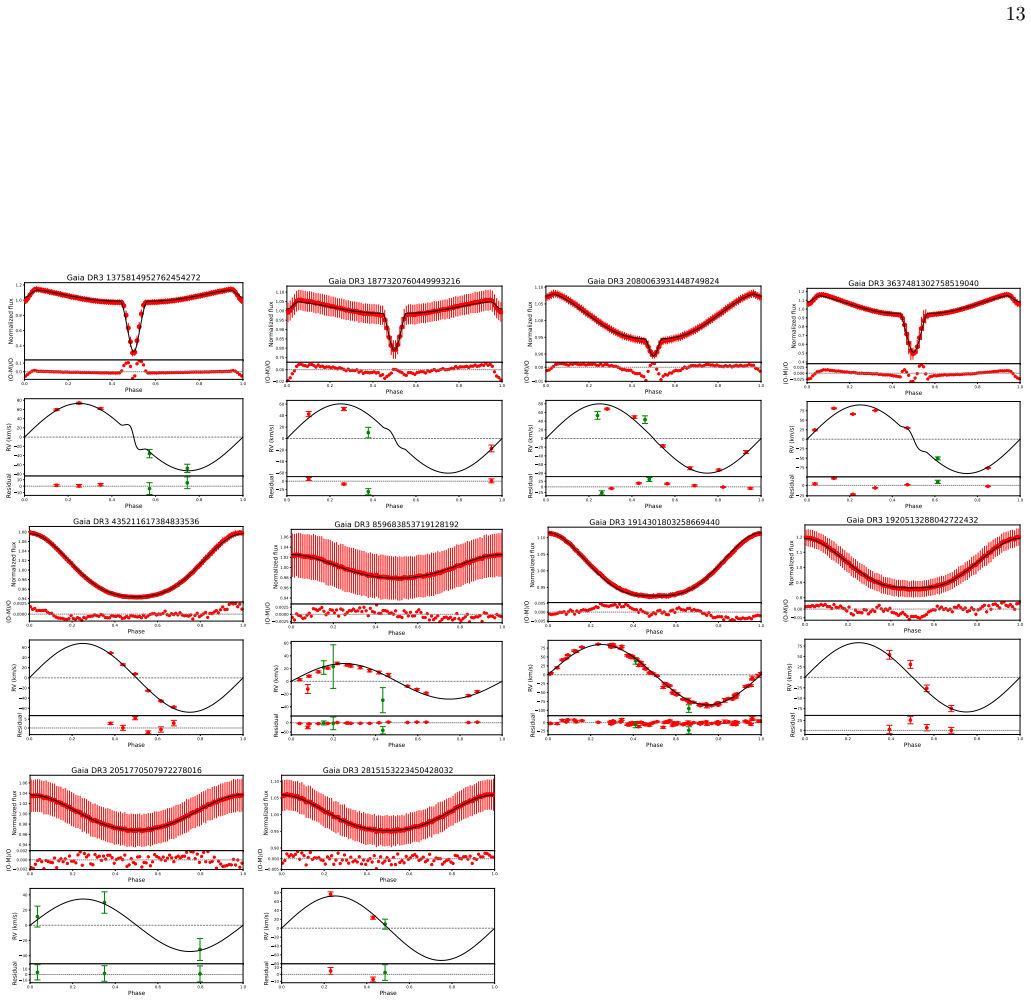
Hot subdwarfs (HSDs) provide critical insights into the physical mechanisms governing binary evolution. In this work, we conduct a systematic analysis of 157 HSDs, selected from Gaia EDR3 and characterized using multi-survey spectroscopic data. Atmospheric parameters of these HSDs are derived via a convolutional neural network (CNN) method and template-matching method. Based on the atmospheric parameters from CNN method, these HSDs exhibit a median mass of $0.45^{+0.19}_{-0.17} M_{\odot}$ and radius of $0.18^{+0.04}_{-0.05} R_{\odot}$, consistent with earlier work. Orbital parameters of 23 systems are determined through the fitting of radial velocity data and light curves, with 11 of them being new solutions. We find that reflection-dominated binaries typically have periods longer than 0.1 d and host low-mass main-sequence companions ($\sim$ 0.2 $M_{\odot}$) with rotation-inflated radii. In contrast, binaries including an HSD and a white dwarf show very short periods ($P < 0.2$ d), with the closest systems hosting more massive white dwarfs. Most of these systems share a similar mass--period distribution with that of post-common-envelope binaries, supporting a common-envelope origin.
Editorial analysis
A structured set of objections, weighed in public.
Referee Report
Summary. The paper analyzes 157 hot subdwarfs from Gaia EDR3, deriving atmospheric parameters via CNN and template-matching methods and reporting median mass 0.45 M_⊙ and radius 0.18 R_⊙. It determines orbital parameters for 23 binaries (11 new) via multi-survey RV and light-curve fitting, distinguishes reflection-dominated systems (P > 0.1 d, low-mass MS companions) from WD companions (P < 0.2 d), and claims that most systems share a mass-period distribution with known post-common-envelope binaries, supporting a common-envelope origin.
Significance. If the mass-period similarity holds after accounting for selection, the addition of 11 new orbital solutions and the period-companion distinctions would strengthen observational constraints on hot subdwarf binary formation channels by extending the sample of systems with measured parameters.
major comments (3)
- [Abstract] Abstract: the central claim that 'Most of these systems share a similar mass--period distribution with that of post-common-envelope binaries, supporting a common-envelope origin' is load-bearing for the paper's interpretation but rests on a direct comparison to an external literature benchmark without applying a quantitative selection function to the Gaia EDR3 parent catalog of 157 HSDs or forward-modeling the RV detection threshold through the multi-survey pipeline.
- [Atmospheric parameters] Atmospheric parameters section: no quantitative error budgets, goodness-of-fit statistics, or assessment of systematic offsets between CNN and template-matching results are reported for the median mass (0.45^{+0.19}_{-0.17} M_⊙) and radius (0.18^{+0.04}_{-0.05} R_⊙), which underpin the mass-period distribution used for the formation-channel conclusion.
- [Orbital parameters] Orbital parameters for the 23 systems: the manuscript provides no goodness-of-fit statistics or full covariance/error budgets for the fitted periods and companion masses, limiting evaluation of the claimed period-companion distinctions (reflection vs. WD) and the robustness of the mass-period overlap.
minor comments (2)
- [Abstract] The abstract does not specify whether the quoted median mass and radius are taken from the CNN or template-matching results.
- A summary table of the 23 orbital solutions (periods, companion types, fit metrics) would improve clarity of the period-regime distinctions.
Simulated Author's Rebuttal
We thank the referee for the constructive report and the recommendation for major revision. We address each major comment below and will revise the manuscript to incorporate quantitative assessments, error budgets, and goodness-of-fit statistics where these were previously omitted.
read point-by-point responses
-
Referee: [Abstract] Abstract: the central claim that 'Most of these systems share a similar mass--period distribution with that of post-common-envelope binaries, supporting a common-envelope origin' is load-bearing for the paper's interpretation but rests on a direct comparison to an external literature benchmark without applying a quantitative selection function to the Gaia EDR3 parent catalog of 157 HSDs or forward-modeling the RV detection threshold through the multi-survey pipeline.
Authors: We acknowledge that the mass-period comparison is currently qualitative and that a quantitative selection function or forward-modeling of detection thresholds would strengthen the claim. The manuscript's primary contribution is the addition of 11 new orbital solutions and the period-companion distinctions; the formation-channel interpretation is presented as supportive rather than definitive. In revision we will add an explicit discussion of Gaia EDR3 selection effects and the multi-survey RV sensitivity limits, including a simple forward-model estimate of detection completeness. revision: yes
-
Referee: [Atmospheric parameters] Atmospheric parameters section: no quantitative error budgets, goodness-of-fit statistics, or assessment of systematic offsets between CNN and template-matching results are reported for the median mass (0.45^{+0.19}_{-0.17} M_⊙) and radius (0.18^{+0.04}_{-0.05} R_⊙), which underpin the mass-period distribution used for the formation-channel conclusion.
Authors: The reported medians and uncertainties come from the CNN-derived parameters for the full sample of 157 objects; the template-matching results were used only for cross-checks. We agree that quantitative error budgets, goodness-of-fit metrics, and a direct comparison of systematic offsets between the two methods are needed. These will be added to the revised Atmospheric parameters section, including tables of fit statistics and a quantitative offset analysis. revision: yes
-
Referee: [Orbital parameters] Orbital parameters for the 23 systems: the manuscript provides no goodness-of-fit statistics or full covariance/error budgets for the fitted periods and companion masses, limiting evaluation of the claimed period-companion distinctions (reflection vs. WD) and the robustness of the mass-period overlap.
Authors: The orbital solutions were obtained via joint RV and light-curve fitting, but the manuscript indeed omitted the full covariance matrices and goodness-of-fit diagnostics. We will include these (reduced chi-squared values, residual plots, and parameter covariance tables) for all 23 systems in the revised Orbital parameters section to allow readers to assess the robustness of the period-companion distinctions and the mass-period distribution. revision: yes
Circularity Check
No circularity: orbital parameters from direct RV/light-curve fits; mass-period comparison uses external literature benchmarks
full rationale
The paper determines orbital parameters for 23 systems (11 new) by fitting observed radial velocity data and light curves. Atmospheric parameters come from CNN and template-matching applied to spectroscopic data. The central claim compares the resulting mass-period distribution to post-common-envelope binaries drawn from independent external literature. No step reduces a derived quantity to a fitted input by construction, invokes a self-citation as the sole justification for a uniqueness theorem, or renames a known result as a new derivation. The comparison is presented as an empirical match to an external reference distribution rather than a self-defined or internally fitted prediction. The derivation chain is therefore self-contained against external benchmarks.
Axiom & Free-Parameter Ledger
axioms (2)
- domain assumption The CNN and template-matching procedures return unbiased atmospheric parameters (Teff, log g) from the available spectra.
- domain assumption Fits to radial-velocity and light-curve data yield reliable orbital periods and companion masses without significant aliasing or systematic bias.
Reference graph
Works this paper leans on
-
[1]
Almeida, L. A., Jablonski, F., Tello, J., & Rodrigues, C. V. 2012, MNRAS, 423, 478, doi: 10.1111/j.1365-2966.2012.20891.x
-
[2]
2021, The Astronomical Journal, 161, 147, doi: 10.3847/1538-3881/abd806
Demleitner, M., & Andrae, R. 2021, AJ, 161, 147, doi: 10.3847/1538-3881/abd806
work page internal anchor Pith review doi:10.3847/1538-3881/abd806 2021
-
[3]
2015, A&A, 577, A42, doi: 10.1051/0004-6361/201425481
Baraffe, I., Homeier, D., Allard, F., & Chabrier, G. 2015, A&A, 577, A42, doi: 10.1051/0004-6361/201425481
work page internal anchor Pith review doi:10.1051/0004-6361/201425481 2015
-
[4]
N., Kilkenny, D., Drechsel, H., et al
Barlow, B. N., Kilkenny, D., Drechsel, H., et al. 2013, MNRAS, 430, 22, doi: 10.1093/mnras/sts271
-
[5]
Beuermann, K., Dreizler, S., Hessman, F. V., & Deller, J. 2012, A&A, 543, A138, doi: 10.1051/0004-6361/201219391
-
[6]
Robust constraints on neutrino properties
Bloemen, S., Marsh, T. R., Østensen, R. H., et al. 2011, MNRAS, 410, 1787, doi: 10.1111/j.1365-2966.2010.17559.x 18 Zhao et al
-
[7]
Breedt, E., Steeghs, D., Marsh, T. R., et al. 2017, MNRAS, 468, 2910, doi: 10.1093/mnras/stx430
-
[8]
Buder, S., Kos, J., Wang, X. E., et al. 2025, PASA, 42, e051, doi: 10.1017/pasa.2025.26
-
[9]
2008, A&A, 489, 377, doi: 10.1051/0004-6361:200809907
Charpinet, S., Van Grootel, V., Reese, D., et al. 2008, A&A, 489, 377, doi: 10.1051/0004-6361:200809907
-
[10]
E., Kochoska, A., Hey, D., et al
Conroy, K. E., Kochoska, A., Hey, D., et al. 2020, ApJS, 250, 34, doi: 10.3847/1538-4365/abb4e2
-
[11]
Maxted, P. F. L., & Heber, U. 2011, MNRAS, 415, 1381, doi: 10.1111/j.1365-2966.2011.18786.x
-
[12]
2022, A&A, 662, A40, doi: 10.1051/0004-6361/202243337
Culpan, R., Geier, S., Reindl, N., et al. 2022, A&A, 662, A40, doi: 10.1051/0004-6361/202243337
-
[13]
Davis, P. J., Kolb, U., & Willems, B. 2010, MNRAS, 403, 179, doi: 10.1111/j.1365-2966.2009.16138.x
-
[14]
2024, A&A, 686, A25, doi: 10.1051/0004-6361/202348319
Dawson, H., Geier, S., Heber, U., et al. 2024, A&A, 686, A25, doi: 10.1051/0004-6361/202348319
-
[15]
2026, A&A, 707, A6, doi: 10.1051/0004-6361/202558123
Dawson, H., Dorsch, M., Geier, S., et al. 2026, A&A, 707, A6, doi: 10.1051/0004-6361/202558123
-
[16]
2015, ApJ, 808, 179, doi: 10.1088/0004-637X/808/2/179
Derekas, A., Németh, P., Southworth, J., et al. 2015, ApJ, 808, 179, doi: 10.1088/0004-637X/808/2/179
-
[17]
Dorman, B., Rood, R. T., & O’Connell, R. W. 1993, ApJ, 419, 596, doi: 10.1086/173511
-
[18]
2001, A&A, 379, 893, doi: 10.1051/0004-6361:20011376
Drechsel, H., Heber, U., Napiwotzki, R., et al. 2001, A&A, 379, 893, doi: 10.1051/0004-6361:20011376
-
[19]
2005, A&A, 442, 1023, doi: 10.1051/0004-6361:20053267
Edelmann, H., Heber, U., Altmann, M., Karl, C., & Lisker, T. 2005, A&A, 442, 1023, doi: 10.1051/0004-6361:20053267
-
[20]
2003, A&A, 400, 939, doi: 10.1051/0004-6361:20030135
Edelmann, H., Heber, U., Hagen, H.-J., et al. 2003, A&A, 400, 939, doi: 10.1051/0004-6361:20030135
-
[21]
For, B. Q., Green, E. M., Fontaine, G., et al. 2010, ApJ, 708, 253, doi: 10.1088/0004-637X/708/1/253 Gaia Collaboration. 2020, VizieR Online Data Catalog: Gaia EDR3 (Gaia Collaboration, 2020), VizieR On-line Data Catalog: I/350. Originally published in: 2021A&A...649A...1G, doi: 10.26093/cds/vizier.1350 Gaia Collaboration, Brown, A. G. A., Vallenari, A., ...
-
[22]
2008, A&A, 477, L13, doi: 10.1051/0004-6361:20078797
Geier, S., Nesslinger, S., Heber, U., et al. 2008, A&A, 477, L13, doi: 10.1051/0004-6361:20078797
-
[23]
Geier, S., Maxted, P. F. L., Napiwotzki, R., et al. 2011a, A&A, 526, A39, doi: 10.1051/0004-6361/201015794
-
[24]
2011b, A&A, 530, A28, doi: 10.1051/0004-6361/201015316
Geier, S., Hirsch, H., Tillich, A., et al. 2011b, A&A, 530, A28, doi: 10.1051/0004-6361/201015316
-
[25]
2011c, ApJL, 731, L22, doi: 10.1088/2041-8205/731/2/L22
Geier, S., Schaffenroth, V., Drechsel, H., et al. 2011c, ApJL, 731, L22, doi: 10.1088/2041-8205/731/2/L22
-
[26]
Geier, S., Schaffenroth, V., Hirsch, H., et al. 2012, in Astronomical Society of the Pacific Conference Series, Vol. 452, Fifth Meeting on Hot Subdwarf Stars and Related Objects, ed. D. Kilkenny, C. S. Jeffery, & C. Koen, 129, doi: 10.48550/arXiv.1112.2922
work page internal anchor Pith review Pith/arXiv arXiv doi:10.48550/arxiv.1112.2922 2012
-
[27]
Geier, S., Marsh, T. R., Wang, B., et al. 2013, A&A, 554, A54, doi: 10.1051/0004-6361/201321395
-
[28]
2015, A&A, 577, A26, doi: 10.1051/0004-6361/201525666
Geier, S., Kupfer, T., Heber, U., et al. 2015, A&A, 577, A26, doi: 10.1051/0004-6361/201525666
-
[29]
2024, A&A, 690, A368, doi: 10.1051/0004-6361/202450778
Geier, S., Heber, U., Irrgang, A., et al. 2024, A&A, 690, A368, doi: 10.1051/0004-6361/202450778
-
[30]
Green, G. M., Schlafly, E. F., Finkbeiner, D. P., et al. 2015, ApJ, 810, 25, doi: 10.1088/0004-637X/810/1/25
-
[31]
Hall, P. D., & Jeffery, C. S. 2016, MNRAS, 463, 2756, doi: 10.1093/mnras/stw2188
-
[32]
Han, Z., & Podsiadlowski, P. 2004, MNRAS, 350, 1301, doi: 10.1111/j.1365-2966.2004.07713.x
-
[33]
Han, Z., Podsiadlowski, P., Maxted, P. F. L., & Marsh, T. R. 2003, MNRAS, 341, 669, doi: 10.1046/j.1365-8711.2003.06451.x
-
[34]
Han, Z., Podsiadlowski, P., Maxted, P. F. L., Marsh, T. R., & Ivanova, N. 2002, MNRAS, 336, 449, doi: 10.1046/j.1365-8711.2002.05752.x
-
[35]
2020, Research in Astronomy and Astrophysics, 20, 161, doi: 10.1088/1674-4527/20/10/161
Han, Z.-W., Ge, H.-W., Chen, X.-F., & Chen, H.-L. 2020, Research in Astronomy and Astrophysics, 20, 161, doi: 10.1088/1674-4527/20/10/161
-
[36]
2025, A&A, 693, A121, doi: 10.1051/0004-6361/202451411
He, R., Meng, X., Lei, Z., Yan, H., & Lan, S. 2025, A&A, 693, A121, doi: 10.1051/0004-6361/202451411
-
[37]
2026, in Encyclopedia of Astrophysics, Volume 2, Vol
Heber, U. 2026, in Encyclopedia of Astrophysics, Volume 2, Vol. 2, 488–507, doi: 10.1016/B978-0-443-21439-4.00043-2
-
[38]
2026, A&A, 708, A115, doi: 10.1051/0004-6361/202558636
Heber, U., Kufleitner, L., Dorsch, M., et al. 2026, A&A, 708, A115, doi: 10.1051/0004-6361/202558636
-
[39]
Horvat, M., Conroy, K. E., Pablo, H., et al. 2018, ApJS, 237, 26, doi: 10.3847/1538-4365/aacd0f
-
[40]
Kruk, J. W. 2015, A&A, 578, A125, doi: 10.1051/0004-6361/201526229
-
[41]
2019, Squeeze-and-Excitation Networks
Hu, J., Shen, L., Albanie, S., Sun, G., & Wu, E. 2019, Squeeze-and-Excitation Networks. https://arxiv.org/abs/1709.01507
Pith/arXiv arXiv 2019
-
[42]
A brief introductory guide to TLUSTY and SYNSPEC
Hubeny, I., & Lanz, T. 2017, arXiv e-prints, arXiv:1706.01859, doi: 10.48550/arXiv.1706.01859
work page internal anchor Pith review Pith/arXiv arXiv doi:10.48550/arxiv.1706.01859 2017
-
[43]
Spectrophotometry and period analysis of the sdB eclipsing binary HW Virginis
Kiss, L. L., Csák, B., Szatmáry, K., Furész, G., & Sziládi, K. 2000, A&A, 364, 199, doi: 10.48550/arXiv.astro-ph/0010446
work page internal anchor Pith review Pith/arXiv arXiv doi:10.48550/arxiv.astro-ph/0010446 2000
-
[44]
Kraus, A. L., Tucker, R. A., Thompson, M. I., Craine, E. R., & Hillenbrand, L. A. 2011, ApJ, 728, 48, doi: 10.1088/0004-637X/728/1/48 19
-
[45]
2015, A&A, 576, A44, doi: 10.1051/0004-6361/201425213
Kupfer, T., Geier, S., Heber, U., et al. 2015, A&A, 576, A44, doi: 10.1051/0004-6361/201425213
-
[46]
2017a, ApJ, 851, 28, doi: 10.3847/1538-4357/aa9522
Kupfer, T., Ramsay, G., van Roestel, J., et al. 2017a, ApJ, 851, 28, doi: 10.3847/1538-4357/aa9522
-
[47]
2017b, ApJ, 835, 131, doi: 10.3847/1538-4357/835/2/131
Kupfer, T., van Roestel, J., Brooks, J., et al. 2017b, ApJ, 835, 131, doi: 10.3847/1538-4357/835/2/131
-
[48]
Kupfer, T., Bauer, E. B., Marsh, T. R., et al. 2020a, ApJ, 891, 45, doi: 10.3847/1538-4357/ab72ff
-
[49]
Kupfer, T., Bauer, E. B., Burdge, K. B., et al. 2020b, ApJL, 898, L25, doi: 10.3847/2041-8213/aba3c2
-
[50]
Kupfer, T., Bauer, E. B., van Roestel, J., et al. 2022, ApJL, 925, L12, doi: 10.3847/2041-8213/ac48f1
-
[51]
2007, ApJS, 169, 83, doi: 10.1086/511270
Lanz, T., & Hubeny, I. 2007, ApJS, 169, 83, doi: 10.1086/511270
-
[52]
2011, ApJ, 733, 100, doi: 10.1088/0004-637X/733/2/100
Latour, M., Fontaine, G., Brassard, P., et al. 2011, ApJ, 733, 100, doi: 10.1088/0004-637X/733/2/100
-
[53]
Latour, M., Green, E. M., Dorsch, M., et al. 2026, A&A, 705, A248, doi: 10.1051/0004-6361/202557314
-
[54]
Lei, Z., Dong, Y., Kou, B., et al. 2025, Deep learning-driven atmospheric parameter prediction for hot subdwarf stars with synthetic and observed spectra. https://arxiv.org/abs/2512.20185
arXiv 2025
-
[55]
2023a, ApJ, 953, 122, doi: 10.3847/1538-4357/ace25e
Lei, Z., He, R., Németh, P., et al. 2023a, ApJ, 953, 122, doi: 10.3847/1538-4357/ace25e
-
[56]
2018, ApJ, 868, 70, doi: 10.3847/1538-4357/aae82b —
Lei, Z., Zhao, J., Németh, P., & Zhao, G. 2018, ApJ, 868, 70, doi: 10.3847/1538-4357/aae82b —. 2019, ApJ, 881, 135, doi: 10.3847/1538-4357/ab2edc —. 2020, ApJ, 889, 117, doi: 10.3847/1538-4357/ab660a
-
[57]
2023b, ApJ, 942, 109, doi: 10.3847/1538-4357/aca542 Lightkurve Collaboration, Cardoso, J
Lei, Z., He, R., Németh, P., et al. 2023b, ApJ, 942, 109, doi: 10.3847/1538-4357/aca542 Lightkurve Collaboration, Cardoso, J. V. d. M., Hedges, C., et al. 2018, Lightkurve: Kepler and TESS time series analysis in Python, Astrophysics Source Code Library. http://ascl.net/1812.013
-
[58]
2020, arXiv e-prints, arXiv:2005.07210
Liu, C., Fu, J., Shi, J., et al. 2020, arXiv e-prints, arXiv:2005.07210. https://arxiv.org/abs/2005.07210
arXiv 2020
-
[59]
Liu, Z.-W., Röpke, F. K., & Han, Z. 2023, Research in Astronomy and Astrophysics, 23, 082001, doi: 10.1088/1674-4527/acd89e
-
[60]
L., Zhao, Y.-H., Zhao, G., et al
Luo, A. L., Zhao, Y.-H., Zhao, G., et al. 2015, Research in Astronomy and Astrophysics, 15, 1095, doi: 10.1088/1674-4527/15/8/002
-
[61]
2025, Science China
Luo, C., Li, J., Zheng, C., et al. 2025, Science China
2025
-
[62]
Physics, Mechanics, and Astronomy, 68, 269511, doi: 10.1007/s11433-024-2630-x
-
[63]
2021, ApJS, 256, 28, doi: 10.3847/1538-4365/ac11f6
Luo, Y., Németh, P., Wang, K., Wang, X., & Han, Z. 2021, ApJS, 256, 28, doi: 10.3847/1538-4365/ac11f6
-
[64]
Maxted, P. F. L., Heber, U., Marsh, T. R., & North, R. C. 2001, MNRAS, 326, 1391, doi: 10.1111/j.1365-2966.2001.04714.x
-
[65]
Maxted, P. F. L., Marsh, T. R., Heber, U., et al. 2002, MNRAS, 333, 231, doi: 10.1046/j.1365-8711.2002.05406.x
-
[66]
Maxted, P. F. L., Marsh, T. R., & Moran, C. K. J. 2000, MNRAS, 319, 305, doi: 10.1046/j.1365-8711.2000.03840.x
-
[67]
Wide sdB binaries. I. Orbital and atmospheric parameters
Molina, F., Vos, J., Bobrick, A., & Vučković, M. 2026, arXiv e-prints, arXiv:2602.05008, doi: 10.48550/arXiv.2602.05008
work page internal anchor Pith review Pith/arXiv arXiv doi:10.48550/arxiv.2602.05008 2026
-
[68]
Morales-Rueda, L., Maxted, P. F. L., Marsh, T. R., North, R. C., & Heber, U. 2003, MNRAS, 338, 752, doi: 10.1046/j.1365-8711.2003.06088.x
-
[69]
Morton, T. D. 2015, isochrones: Stellar model grid package. http://ascl.net/1503.010 Németh, P., Kawka, A., & Vennes, S. 2012, MNRAS, 427, 2180, doi: 10.1111/j.1365-2966.2012.22009.x
-
[70]
Synthetic spectra for O and B type subdwarf stars
Nemeth, P., Östensen, R., Tremblay, P., & Hubeny, I. 2014, in Astronomical Society of the Pacific Conference Series, Vol. 481, 6th Meeting on Hot Subdwarf Stars and Related Objects, ed. V. van Grootel, E. Green, G. Fontaine, & S. Charpinet, 95, doi: 10.48550/arXiv.1308.0252 Østensen, R., Oreiro, R., Drechsel, H., et al. 2007, in Astronomical Society of th...
work page internal anchor Pith review Pith/arXiv arXiv doi:10.48550/arxiv.1308.0252 2014
-
[71]
G., Rebassa-Mansergas, A., Schreiber, M
Parsons, S. G., Rebassa-Mansergas, A., Schreiber, M. R., et al. 2016, MNRAS, 463, 2125, doi: 10.1093/mnras/stw2143
-
[72]
Parsons, S. G., Gänsicke, B. T., Marsh, T. R., et al. 2018, MNRAS, 481, 1083, doi: 10.1093/mnras/sty2345
-
[73]
2021, Nature Astronomy, 5, 1052, doi: 10.1038/s41550-021-01413-0
Pelisoli, I., Neunteufel, P., Geier, S., et al. 2021, Nature Astronomy, 5, 1052, doi: 10.1038/s41550-021-01413-0
-
[74]
Hot Subdwarfs in Binaries as the Source of the Far-UV Excess in Elliptical Galaxies
Podsiadlowski, P., Han, Z., Lynas-Gray, A. E., & Brown, D. 2008, in Astronomical Society of the Pacific Conference Series, Vol. 392, Hot Subdwarf Stars and Related Objects, ed. U. Heber, C. S. Jeffery, & R. Napiwotzki, 15, doi: 10.48550/arXiv.0808.0574 20 Zhao et al
work page internal anchor Pith review Pith/arXiv arXiv doi:10.48550/arxiv.0808.0574 2008
-
[75]
2007, in Astronomical Society of the Pacific Conference Series, Vol
Polubek, G., Pigulski, A., Baran, A., & Udalski, A. 2007, in Astronomical Society of the Pacific Conference Series, Vol. 372, 15th European Workshop on White Dwarfs, ed. R. Napiwotzki & M. R. Burleigh, 487
2007
-
[76]
Press, W. H., & Rybicki, G. B. 1989, ApJ, 338, 277, doi: 10.1086/167197
-
[77]
Pritzkuleit, M., Dorsch, M., Miller Bertolami, M. M., et al. 2026, A&A, 710, A99, doi: 10.1051/0004-6361/202659703 Prša, A., Conroy, K. E., Horvat, M., et al. 2016, ApJS, 227, 29, doi: 10.3847/1538-4365/227/2/29
-
[78]
Ramsay, G., Woudt, P. A., Kupfer, T., et al. 2022, MNRAS, 513, 2215, doi: 10.1093/mnras/stac1000
-
[79]
Rappaport, S., Podsiadlowski, P., Joss, P. C., Di Stefano, R., & Han, Z. 1995, MNRAS, 273, 731, doi: 10.1093/mnras/273.3.731
-
[80]
Ratzloff, J. K., Barlow, B. N., Kupfer, T., et al. 2019, ApJ, 883, 51, doi: 10.3847/1538-4357/ab3727
discussion (0)
Sign in with ORCID, Apple, or X to comment. Anyone can read and Pith papers without signing in.