REVIEW 1 major objections 2 minor 52 references
Reducing Learner Redundancy in Boosting via Residual Orthogonalization
T0 review · 1 major / 2 minor · reviewed 2026-06-27 · grok-4.3
Pith's one-line read SCBoost projects each residual onto the orthogonal complement of prior predictions to eliminate learner redundancy in boosting.
desk verdict SCBoost adds orthogonal projection of residuals to cut boosting redundancy, with experiments showing gains, but the SNR result needs an isotropic noise assumption. read the letter →
The pith
A machine-rendered reading of the paper's core claim, the machinery that carries it, and where it could break.
The reading
What carries the argument
Spectral Residual Projection (SRP): the linear projection of the current residual vector onto the orthogonal complement of the subspace spanned by all earlier base-learner predictions.
What would settle it
A controlled simulation in which residuals are corrupted by anisotropic noise and the measured SNR after projection fails to rise would refute the SNR claim.
Extended reading notes
Core claim
Spectral Residual Projection projects each successive residual target onto the orthogonal complement of the span of previous predictions, forcing every new learner to capture only empirical innovations not already represented; the resulting finite-sample geometry yields an exact additive decomposition of residual energy, and under isotropic noise the projection improves the effective signal-to-noise ratio of the fitted learner.
Load-bearing premise
Noise must be isotropic for the projection step to guarantee an increase in effective signal-to-noise ratio.
Editorial extensions
If this is right
- Each new base learner is guaranteed to capture only directions orthogonal to those already used.
- Residual energy decomposes exactly into a sum of orthogonal components across the ensemble.
- Under isotropic noise the projection step improves the effective SNR seen by the next learner.
- Covariance-regularized weighting on a validation set further suppresses remaining correlations among learners.
- The method delivers measurable gains in accuracy and F1 on standard classification benchmarks.
Reading between the lines
- The same orthogonalization step could be inserted into gradient-boosted trees or neural boosting without changing the loss function.
- Because each learner is forced into a new direction, the total number of learners needed for a given error level may decrease.
- The geometric view suggests that boosting performance is limited by the dimension of the span of the base learners rather than by their individual strengths.
Editorial analysis
A structured set of objections, weighed in public.
Referee Report
Summary. The manuscript proposes SCBoost, a boosting method that replaces standard residual fitting with residual orthogonalization. It introduces Spectral Residual Projection (SRP) to project each residual onto the orthogonal complement of the span of prior predictions, and Covariance-Regularized Weighting (CRW) to optimize ensemble weights on a validation set with an explicit covariance penalty. The central theoretical claims are a finite-sample geometric characterization showing that SRP produces an exact additive residual-energy decomposition, and, under an isotropic-noise assumption, rigorous conditions under which the projection improves effective Signal-to-Noise Ratio. Experiments on ten benchmark datasets are reported to demonstrate strong out-of-the-box performance, especially in accuracy and F1.
Significance. If the geometric decomposition and conditional SNR results hold, the work supplies a principled geometric lens on boosting that directly targets learner redundancy, which could improve efficiency of sequential ensembles. The explicit use of orthogonal projections for residuals and the covariance penalty in weighting are concrete mechanisms that address a known issue in boosting. The empirical results, if they include appropriate baselines and controls, would support practical relevance.
major comments (1)
- [Theoretical analysis (SRP and SNR sections)] Theoretical analysis (SRP and SNR sections): the exact additive residual-energy decomposition follows immediately from the Pythagorean identity once each target is replaced by its projection onto the orthogonal complement of the prior span; this holds by construction in the empirical inner product. The SNR improvement, however, is derived only after imposing isotropy on the noise; without it the cross terms between signal and noise do not necessarily vanish and the claimed inequality can fail. Because the manuscript presents the SNR result as a rigorous justification for the method, the isotropic-noise assumption is load-bearing and requires explicit discussion of its necessity, robustness, or practical validity.
minor comments (2)
- [Abstract and experimental section] Abstract and experimental section: the claim of 'extensive experiments across ten benchmark datasets' should list the specific datasets, the competing methods (e.g., AdaBoost, XGBoost, LightGBM), and the precise metrics reported so that the performance claims can be assessed.
- [Notation] Notation: define the empirical inner product and the projection operator explicitly at first use and maintain consistent symbols for the residual sequence and the historical prediction subspace throughout.
Simulated Author's Rebuttal
We thank the referee for the detailed and constructive feedback. The observation regarding the theoretical sections is well-taken, and we will revise the manuscript to address it explicitly.
read point-by-point responses
-
Referee: Theoretical analysis (SRP and SNR sections): the exact additive residual-energy decomposition follows immediately from the Pythagorean identity once each target is replaced by its projection onto the orthogonal complement of the prior span; this holds by construction in the empirical inner product. The SNR improvement, however, is derived only after imposing isotropy on the noise; without it the cross terms between signal and noise do not necessarily vanish and the claimed inequality can fail. Because the manuscript presents the SNR result as a rigorous justification for the method, the isotropic-noise assumption is load-bearing and requires explicit discussion of its necessity, robustness, or practical validity.
Authors: We agree that the exact additive residual-energy decomposition is a direct consequence of the Pythagorean identity applied in the empirical inner product after orthogonal projection; this is indeed immediate by construction. In the revision we will make this connection explicit in the SRP section to clarify the geometric characterization. For the SNR result, we acknowledge that the improvement is established under the isotropic-noise assumption and that the cross terms do not vanish in general without it. We will add a dedicated paragraph discussing the necessity of this assumption, its role as a sufficient condition, robustness considerations under approximate isotropy, and its practical relevance to the benchmark settings where the method still yields empirical gains. revision: yes
Circularity Check
Residual-energy decomposition holds by construction from orthogonal projection definition
-
self definitional
[Abstract]
"Theoretically, we provide a finite-sample geometric characterization proving that SRP yields an exact additive residual-energy decomposition."
SRP is defined as projecting each residual onto the orthogonal complement of the historical prediction subspace. The claimed exact additive decomposition then follows immediately from the Pythagorean theorem in the empirical inner product; the 'proof' and 'characterization' are therefore equivalent to the definition of the projection step itself.
full rationale
The paper's finite-sample geometric characterization reduces directly to the Pythagorean identity once SRP is defined as projection onto the orthogonal complement of prior predictions; the additive decomposition is therefore true identically by the definition of the operation rather than derived from independent premises. The SNR improvement claim is explicitly conditioned on an external isotropic-noise assumption and does not create additional circularity. No load-bearing self-citations or fitted inputs presented as predictions appear in the provided text. This produces partial circularity confined to the central theoretical claim.
Assumptions & free parameters
assumptions (1)
- domain assumption isotropic-noise assumption
Cite this review
Pith. "Pith review of Reducing Learner Redundancy in Boosting via Residual Orthogonalization." pith.science (2026). https://pith.science/paper/P526L3GA
@misc{pith2026260617567,
  author       = {Pith},
  title        = {Pith review of: Reducing Learner Redundancy in Boosting via Residual Orthogonalization},
  year         = {2026},
  howpublished = {\url{https://pith.science/paper/P526L3GA}},
  note         = {Machine review of arXiv:2606.17567}
}
read the original abstract
While sequential residual fitting is the bedrock of standard boosting frameworks, it inherently breeds learner redundancy by repeatedly revisiting correlated error components. To address this bottleneck, we propose a shift from residual fitting to \textit{residual orthogonalization} and introduce SCBoost. Our framework tackles redundancy through two complementary mechanisms: Spectral Residual Projection (SRP) and Covariance-Regularized Weighting (CRW). During training, SRP projects each residual target onto the orthogonal complement of the historical prediction subspace, forcing successive learners to capture only novel empirical innovations. During aggregation, CRW optimizes ensemble weights on a validation set with an explicit covariance penalty to mitigate remaining correlations. Theoretically, we provide a finite-sample geometric characterization proving that SRP yields an exact additive residual-energy decomposition. Furthermore, under an isotropic-noise assumption, we rigorously establish the conditions under which this projection improves the effective Signal-to-Noise Ratio. Extensive experiments across ten benchmark datasets demonstrate that SCBoost delivers strong out-of-the-box performance, particularly in accuracy and F1 score. This work reinterprets boosting through a geometric lens, suggesting that explicit redundancy control is a principled and necessary step toward more efficient ensemble architectures.
Figures


Figures from the paper (3 more)
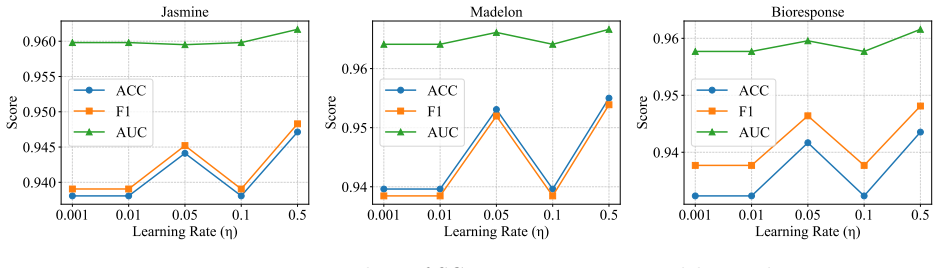


Reference graph
Works this paper leans on
-
[1]
Proceedings of the 22nd ACM SIGKDD International Conference on Knowledge Discovery and Data Mining , year =
Chen, Tianqi and Guestrin, Carlos , title =. Proceedings of the 22nd ACM SIGKDD International Conference on Knowledge Discovery and Data Mining , year =
-
[2]
Advances in Neural Information Processing Systems 30 , year =
Ke, Guolin and Meng, Qi and Finley, Thomas and Wang, Taifeng and Chen, Wei and Ma, Weidong and Liu, Tie-Yan , title =. Advances in Neural Information Processing Systems 30 , year =
-
[3]
, title =
Schapire, Robert E. , title =. Proceedings of the 16th International Joint Conference on Artificial Intelligence (IJCAI) , year =
-
[4]
2007 , pages =
Bühlmann, Peter and Hothorn, Torsten , title =. 2007 , pages =
2007
-
[5]
Methods of Information in Medicine , year =
Mayr, Andreas and Binder, Harald and Gefeller, Olaf and Schmid, Matthias , title =. Methods of Information in Medicine , year =
-
[6]
Neural Networks , year =
Liu, Yong and Yao, Xin , title =. Neural Networks , year =
-
[7]
IEEE Transactions on Evolutionary Computation , year =
Liu, Yong and Yao, Xin and Higuchi, Tetsuya , title =. IEEE Transactions on Evolutionary Computation , year =
-
[8]
The 2010 International Joint Conference on Neural Networks (IJCNN) , year =
Wang, Shi and Chen, He and Yao, Xin , title =. The 2010 International Joint Conference on Neural Networks (IJCNN) , year =
2010
Show all 52 references
-
[9]
, title =
Dietterich, Thomas G. , title =. Machine Learning , year =
-
[10]
Artificial Intelligence Review , year =
Kotsiantis, Sotiris , title =. Artificial Intelligence Review , year =
-
[11]
2020 , howpublished =
Wen, Yeming and Tran, Dixian and Ba, Jimmy , title =. 2020 , howpublished =
2020
-
[12]
, title =
Bartlett, Peter and Freund, Yoav and Lee, Wee Sun and Schapire, Robert E. , title =. The Annals of Statistics , year =
-
[13]
, title =
Freund, Yoav and Schapire, Robert E. , title =. Journal of Computer and System Sciences , year =
-
[14]
, title =
Friedman, Jerome H. , title =. The Annals of Statistics , year =
-
[15]
Advances in Neural Information Processing Systems 31 , year =
Prokhorenkova, Liudmila and Gusev, Gleb and Vorobev, Aleksandr and Dvornik, Nikita , title =. Advances in Neural Information Processing Systems 31 , year =
-
[16]
Machine Learning , year =
Geurts, Pierre and Ernst, Damien and Wehenkel, Louis , title =. Machine Learning , year =
-
[17]
Machine Learning , year =
Breiman, Leo , title =. Machine Learning , year =
-
[18]
The Annals of Statistics , year =
Bühlmann, Peter and Yu, Bin , title =. The Annals of Statistics , year =
-
[19]
IEEE Transactions on Neural Networks , year =
Chen, He and Yao, Xin , title =. IEEE Transactions on Neural Networks , year =
-
[20]
and Yao, Xin , title =
Chen, He and Cohn, Anthony G. and Yao, Xin , title =. Ensemble Machine Learning , year =
-
[21]
Computers in Industry , year =
Yu, Jianbo , title =. Computers in Industry , year =
-
[22]
Artificial Intelligence and Statistics , year =
Xie, Binxin and Liang, Yixuan and Song, Le , title =. Artificial Intelligence and Statistics , year =
-
[23]
Proceedings of the International Joint Conference on Artificial Intelligence (IJCAI) , year =
Gu, Siyu and Hou, Yijiang and Zhang, Li and Zhang, Yue , title =. Proceedings of the International Joint Conference on Artificial Intelligence (IJCAI) , year =
-
[24]
IEEE Transactions on Systems, Man, and Cybernetics: Systems , year =
Zhang, Chao and Guo, Changsheng and Wang, Xin and Ding, Shifei and Wu, Feng and Zhang, Dongyue , title =. IEEE Transactions on Systems, Man, and Cybernetics: Systems , year =
-
[25]
The College Mathematics Journal , year =
Kalman, Dan , title =. The College Mathematics Journal , year =
-
[26]
and Malaschonok, Gennadi I
Akritas, Alkiviadis G. and Malaschonok, Gennadi I. , title =. Mathematics and Computers in Simulation , year =
-
[27]
2007 , note =
Abdi, Hervé , title =. 2007 , note =
2007
-
[28]
2013 , pages =
Rudelson, Mark and Vershynin, Roman , title =. 2013 , pages =
2013
-
[29]
Klochkov, Yegor and Zhivotovskiy, Nikita , title =
-
[30]
Journal of Artificial Intelligence Research , year =
El-Yaniv, Ran and Pechyony, Dmitry , title =. Journal of Artificial Intelligence Research , year =
-
[31]
Advances in Neural Information Processing Systems 21 , year =
Mohri, Mehryar and Rostamizadeh, Afshin , title =. Advances in Neural Information Processing Systems 21 , year =
-
[32]
IEEE Transactions on Cybernetics , year =
Chen, Qi and Xue, Bing and Zhang, Mengjie , title =. IEEE Transactions on Cybernetics , year =
-
[33]
BioMed Research International , year =
Stiglic, Gregor and Kokol, Peter , title =. BioMed Research International , year =
-
[34]
and Mader, T
Guyon, Isabelle and Li, J. and Mader, T. and Pletscher, P. A. and Schneider, G. and Uhr, M. , title =. Pattern Recognition Letters , year =
-
[35]
and Bontempi, Gianluca , title =
Dal Pozzolo, Andrea and Caelen, Olivier and Johnson, Reid A. and Bontempi, Gianluca , title =. 2015 IEEE Symposium Series on Computational Intelligence , year =
2015
-
[36]
Knowledge-Based Systems , year =
Liu, Boyu and Tsoumakas, Grigorios , title =. Knowledge-Based Systems , year =
-
[37]
2018 IEEE International Conference on Information Reuse and Integration (IRI) , year =
Hasanin, Taha and Khoshgoftaar, Taghi , title =. 2018 IEEE International Conference on Information Reuse and Integration (IRI) , year =
2018
-
[38]
and Basu, Sudipto and Ng, Andrew and Schuler, Alejandro , title =
Duan, Tony and Anand, Avati and Ding, Daisy Yi and Thai, Kevin K. and Basu, Sudipto and Ng, Andrew and Schuler, Alejandro , title =. International Conference on Machine Learning , year =
-
[39]
Scholarpedia , volume=
Fano inequality , author=. Scholarpedia , volume=
-
[40]
IEEE Transactions on Information Theory , volume=
Generalizing the Fano inequality , author=. IEEE Transactions on Information Theory , volume=. 1994 , publisher=
1994
-
[41]
arXiv preprint arXiv:1901.00555 , year=
An introductory guide to Fano's inequality with applications in statistical estimation , author=. arXiv preprint arXiv:1901.00555 , year=
1901
-
[42]
IEEE Transactions on signal processing , volume=
Generalized orthogonal matching pursuit , author=. IEEE Transactions on signal processing , volume=. 2012 , publisher=
2012
-
[43]
IEEE Transactions on information theory , volume=
Signal recovery from random measurements via orthogonal matching pursuit , author=. IEEE Transactions on information theory , volume=. 2007 , publisher=
2007
-
[44]
Proceedings of 27th Asilomar conference on signals, systems and computers , pages=
Orthogonal matching pursuit: Recursive function approximation with applications to wavelet decomposition , author=. Proceedings of 27th Asilomar conference on signals, systems and computers , pages=. 1993 , organization=
1993
-
[45]
Proceedings of the 20th International Conference on Machine Learning (ICML-03) , pages=
The use of the ambiguity decomposition in neural network ensemble learning methods , author=. Proceedings of the 20th International Conference on Machine Learning (ICML-03) , pages=
-
[46]
Journal of Machine Learning Research , volume=
Generalized ambiguity decomposition for ranking ensemble learning , author=. Journal of Machine Learning Research , volume=
-
[47]
Proceedings of the AAAI Conference on Artificial Intelligence , volume=
Generalized ambiguity decompositions for classification with applications in active learning and unsupervised ensemble pruning , author=. Proceedings of the AAAI Conference on Artificial Intelligence , volume=
-
[48]
Jensen's inequality , author=
-
[49]
Proceedings of the 25th ACM SIGKDD international conference on knowledge discovery & data mining , pages=
Optuna: A next-generation hyperparameter optimization framework , author=. Proceedings of the 25th ACM SIGKDD international conference on knowledge discovery & data mining , pages=
-
[50]
Machine learning , volume=
Random forests , author=. Machine learning , volume=. 2001 , publisher=
2001
-
[51]
arXiv preprint arXiv:2605.04671 , year=
ITBoost: Information-Theoretic Trust for Robust Boosting , author=. arXiv preprint arXiv:2605.04671 , year=
-
[52]
arXiv preprint arXiv:2605.06314 , year=
When Does _2 -Boosting Overfit Benignly? High-Dimensional Risk Asymptotics and the _1 Implicit Bias , author=. arXiv preprint arXiv:2605.06314 , year=
Reviewed June 27, 2026 · model on record in the stance chip above.
Discussion (0). Continue with ORCID to comment.