Search for a Time-Dependent Z' Resonance in the Dimuon Channel
Pith reviewed 2026-06-27 00:28 UTC · model grok-4.3
The pith
A two-dimensional likelihood in mass and time detects resonances whose masses vary periodically over the data-taking period.
A machine-rendered reading of the paper's core claim, the machinery that carries it, and where it could break.
Core claim
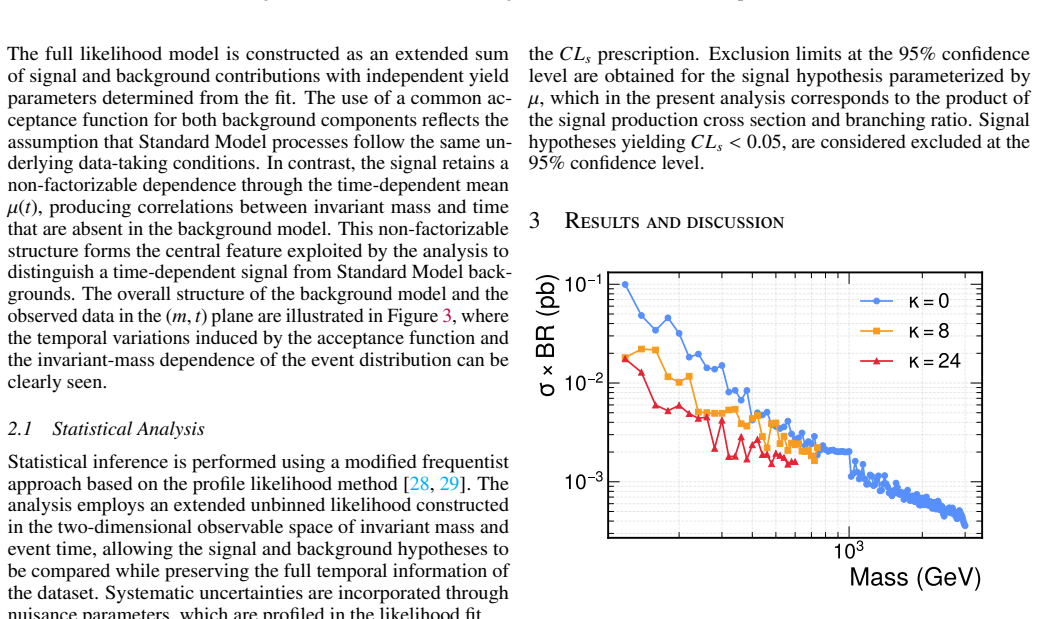
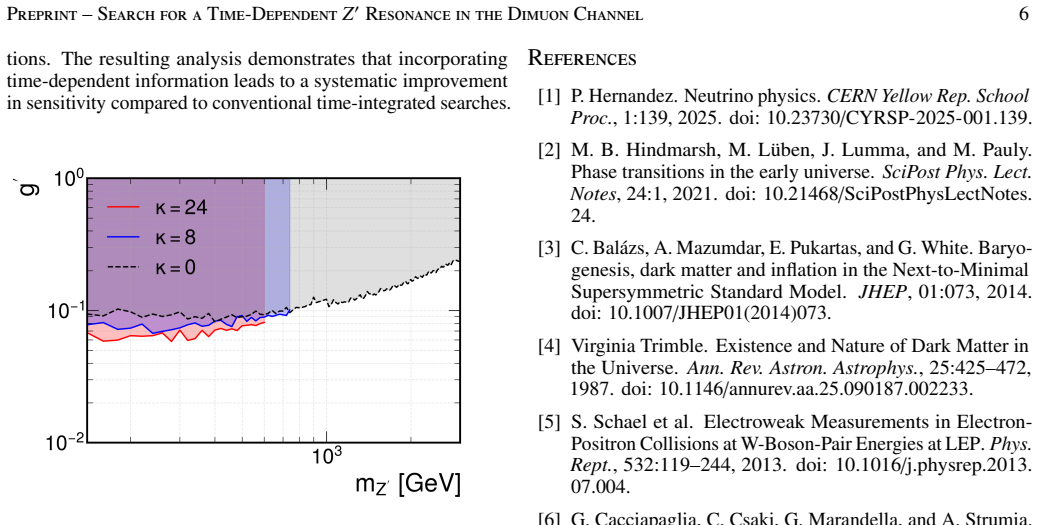
We develop a two-dimensional unbinned likelihood framework in invariant mass and time that reconstructs signals tracing nontrivial trajectories in the (m,t) plane. As a benchmark we introduce a phenomenological model in which a Z' boson from a gauged U(1)B-L extension has a periodically modulating mass, producing time-dependent resonance patterns inaccessible to standard invariant-mass analyses. Using dimuon events from CMS Open Data at 13 TeV with 7.54 fb^{-1}, we derive upper limits on g' for several choices of modulation amplitude and demonstrate sensitivity gains relative to time-integrated searches in regions with sufficient signal statistics.
What carries the argument
The two-dimensional unbinned likelihood framework in invariant mass and time, which captures signals that move along trajectories in the (m,t) plane rather than remaining stationary.
If this is right
- Upper limits on the gauge coupling g' can be set as a function of Z' mass for different values of the modulation amplitude.
- Signals whose resonance position changes with time become accessible, whereas they remain invisible to time-integrated searches.
- Sensitivity gains appear specifically in kinematic regions that contain enough signal events for the time evolution to be resolved.
- The same framework can be applied to any resonance whose properties are expected to evolve during data taking.
Where Pith is reading between the lines
- The method could be extended to other final states or to searches for resonances with non-periodic time dependence.
- If time-dependent effects are present in nature, models with constant-mass assumptions may systematically underestimate the reach of collider data.
- Future high-luminosity datasets would increase the regions where the time-dependent approach yields measurable improvements.
Load-bearing premise
The phenomenological model in which the Z' mediator mass undergoes periodic temporal modulation is a valid description of possible new physics.
What would settle it
Applying the 2D likelihood to the same CMS dimuon dataset and finding that the resulting upper limits on g' are not tighter than those from a standard 1D mass-only analysis for the benchmark modulating signal.
Figures
read the original abstract
We present a time-domain search strategy for resonances with periodically varying masses in high-energy collider data. Conventional resonance searches rely on time-integrated event samples and are therefore insensitive to signals whose properties evolve during data taking. To address this limitation, we develop a two-dimensional unbinned likelihood framework in invariant mass and time, allowing the reconstruction of signals that trace nontrivial trajectories in the $(m,t)$ plane rather than appearing as stationary resonances. As a benchmark scenario, we consider a $Z'$ boson arising from a gauged $U(1)_{B-L}$ extension of the Standard Model and introduce a phenomenological model in which the mediator mass undergoes periodic temporal modulation. The resulting signal manifests as a resonance whose position changes with time, producing distinctive patterns that are inaccessible to conventional analyses based solely on invariant-mass information. The method is implemented using dimuon events from the CMS Open Data corresponding to the Run~G data-taking period at $\sqrt{s}=13~\mathrm{TeV}$, with an integrated luminosity of $7.54~\mathrm{fb}^{-1}$. We derive upper limits on the gauge coupling $g'$ as a function of the $Z'$ mass for several choices of the modulation amplitude. The results demonstrate that incorporating temporal information can enhance sensitivity relative to standard time-integrated searches, particularly in regions with sufficient signal statistics.
Editorial analysis
A structured set of objections, weighed in public.
Referee Report
Summary. The manuscript develops a two-dimensional unbinned likelihood analysis in invariant mass and time to search for resonances whose masses vary periodically during data taking. As a benchmark it adopts a Z' from a gauged U(1)_{B-L} extension whose mass is modulated periodically, applies the method to CMS Open Data dimuon events from Run G (7.54 fb^{-1} at 13 TeV), and derives upper limits on the gauge coupling g' for several modulation amplitudes. The central claim is that the time-dependent approach yields improved sensitivity relative to conventional time-integrated searches, especially where signal statistics are adequate.
Significance. If the quantitative results support the claimed sensitivity gain, the work would provide a concrete, reproducible demonstration that temporal information can be exploited in resonance searches on public collider data. The explicit construction of the 2D likelihood and the use of open data constitute clear strengths. The significance is tempered by the fact that the benchmark relies on an ad-hoc modulation whose physical motivation is not derived from the underlying theory, limiting the generality of the result.
major comments (2)
- [Abstract] Abstract: the assertion that 'incorporating temporal information can enhance sensitivity' is presented without any quantitative comparison to the time-integrated case, without reported fit results, systematic uncertainties, or validation plots. This absence prevents evaluation of whether the data actually support the central claim.
- [Benchmark scenario] Benchmark scenario paragraph: the periodic mass modulation is introduced as a phenomenological model without derivation from the U(1)_{B-L} Lagrangian or any dynamical mechanism; the reported sensitivity gain is therefore specific to this parametrization and does not automatically extend to other time-dependent signals.
minor comments (1)
- Notation for the modulation amplitude and the time coordinate should be defined explicitly at first use and used consistently throughout.
Simulated Author's Rebuttal
We thank the referee for the detailed review and constructive comments. We address each major point below and indicate where revisions will be made to strengthen the manuscript.
read point-by-point responses
-
Referee: [Abstract] Abstract: the assertion that 'incorporating temporal information can enhance sensitivity' is presented without any quantitative comparison to the time-integrated case, without reported fit results, systematic uncertainties, or validation plots. This absence prevents evaluation of whether the data actually support the central claim.
Authors: We agree that the abstract would benefit from greater specificity. The full manuscript presents the quantitative comparison between the 2D time-dependent likelihood and the conventional time-integrated analysis in Section 4 (including limit curves for several modulation amplitudes), together with fit validation and systematic uncertainty treatment in the appendices. In the revised version we will update the abstract to include a brief quantitative statement of the observed sensitivity improvement (e.g., the factor by which upper limits on g' are strengthened in regions of adequate signal statistics) while retaining the overall length constraint. revision: yes
-
Referee: [Benchmark scenario] Benchmark scenario paragraph: the periodic mass modulation is introduced as a phenomenological model without derivation from the U(1)_{B-L} Lagrangian or any dynamical mechanism; the reported sensitivity gain is therefore specific to this parametrization and does not automatically extend to other time-dependent signals.
Authors: The manuscript already characterizes the modulation explicitly as a 'phenomenological model' introduced solely for benchmarking. We accept that the quantitative sensitivity gain is therefore tied to this specific parametrization and does not automatically generalize. The 2D unbinned likelihood framework itself, however, is constructed to be model-agnostic and applicable to any resonance whose mass or width varies with time. In the revision we will add a clarifying sentence in the benchmark section underscoring both the illustrative purpose of the chosen modulation and the broader applicability of the method. revision: partial
Circularity Check
No significant circularity; analysis is self-contained
full rationale
The paper defines a 2D unbinned likelihood in (m,t) and applies it to public CMS Open Data to set limits on a benchmark phenomenological Z' model with periodic mass modulation. The claimed sensitivity gain is obtained by direct numerical comparison of the 2D method versus the time-integrated 1D method on the same dataset and signal hypothesis; no equation reduces the output limits or the gain to a fitted parameter by construction, and no load-bearing self-citation or uniqueness theorem is invoked. The derivation chain consists of standard likelihood construction followed by data-driven limit setting and is therefore independent of its inputs.
Axiom & Free-Parameter Ledger
free parameters (1)
- modulation amplitude
axioms (1)
- domain assumption A Z' boson arises from a gauged U(1)_{B-L} extension of the Standard Model.
invented entities (1)
-
periodic temporal modulation of Z' mass
no independent evidence
Reference graph
Works this paper leans on
-
[1]
P. Hernandez. Neutrino physics.CERN Yellow Rep. School Proc., 1:139, 2025. doi: 10.23730/CYRSP-2025-001.139
-
[2]
M. B. Hindmarsh, M. Lüben, J. Lumma, and M. Pauly. Phase transitions in the early universe.SciPost Phys. Lect. Notes, 24:1, 2021. doi: 10.21468/SciPostPhysLectNotes. 24
-
[3]
C. Balázs, A. Mazumdar, E. Pukartas, and G. White. Baryo- genesis, dark matter and inflation in the Next-to-Minimal Supersymmetric Standard Model.JHEP, 01:073, 2014. doi: 10.1007/JHEP01(2014)073
-
[4]
Existence and Nature of Dark Matter in the Universe.Ann
Virginia Trimble. Existence and Nature of Dark Matter in the Universe.Ann. Rev. Astron. Astrophys., 25:425–472,
-
[5]
doi: 10.1146/annurev.aa.25.090187.002233
-
[6]
S. Schael et al. Electroweak Measurements in Electron- Positron Collisions at W-Boson-Pair Energies at LEP.Phys. Rept., 532:119–244, 2013. doi: 10.1016/j.physrep.2013. 07.004
-
[7]
G. Cacciapaglia, C. Csaki, G. Marandella, and A. Strumia. The minimal set of electroweak precision parameters.Phys. Rev. D, 74:033011, 2006. doi: 10.1103/PhysRevD.74. 033011
-
[8]
A. Das, P. S. B. Dev, Y . Hosotani, and S. Mandal. Probing the minimal U(1)X model at future electron-positron col- liders via fermion pair-production channels.Phys. Rev. D, 105:115030, 2022. doi: 10.1103/PhysRevD.105.115030
-
[9]
H. Merkel et al. Search for Light Gauge Bosons of the Dark Sector at the Mainz Microtron.Phys. Rev. Lett., 106: 251802, 2011. doi: 10.1103/PhysRevLett.106.251802
-
[10]
D. Banerjee et al. Improved limits on a hypothetical X(16.7) boson and a dark photon decaying into e+e− pairs. Phys. Rev. D, 101:071101, 2020. doi: 10.1103/PhysRevD. 101.071101
-
[11]
D. Banerjee et al. Search for vector mediator of Dark Matter production in invisible decay mode.Phys. Rev. D, 97:072002, 2018. doi: 10.1103/PhysRevD.97.072002
-
[12]
A. Anastasi et al. Limit on the production of a new vec- tor boson in e+e− →Uγ , U→π +π− with the KLOE experiment.Phys. Lett. B, 757:356–361, 2016. doi: 10.1016/j.physletb.2016.04.019
-
[13]
S. Abrahamyan et al. Search for a New Gauge Boson in Electron-Nucleus Fixed-Target Scattering by the APEX Experiment.Phys. Rev. Lett., 107:191804, 2011. doi: 10.1103/PhysRevLett.107.191804
-
[14]
R. Essig, P. Schuster, N. Toro, and B. Wojtsekhowski. An Electron Fixed Target Experiment to Search for a New Vector Boson A′ Decaying to e+e−.JHEP, 02:009, 2011. doi: 10.1007/JHEP02(2011)009
-
[15]
Freytsis, G
M. Freytsis, G. Ovanesyan, and J. Thaler. Dark Force Detection in Low Energy e− p Collisions.JHEP, 01:111,
-
[16]
doi: 10.1007/JHEP01(2010)111
-
[17]
J. P. Lees et al. Search for a Dark Photon ine+e− Collisions at BaBar.Phys. Rev. Lett., 113:201801, 2014. doi: 10. 1103/PhysRevLett.113.201801. *correspondence: marlon.brade@g.msuiit.edu.ph Preprint– Search for aTime-DependentZ ′ Resonance in theDimuonChannel7
2014
-
[18]
Ablikim et al
M. Ablikim et al. Dark Photon Search in the Mass Range Between 1.5 and 3.4 GeV/c2.Phys. Lett. B, 774:252–257,
-
[19]
doi: 10.1016/j.physletb.2017.09.067
-
[20]
R. Aaij et al. Search for Dark Photons Produced in 13 TeV pp Collisions.Phys. Rev. Lett., 120:061801, 2018. doi: 10.1103/PhysRevLett.120.061801
-
[21]
Problem of Strong P and T Invariance in the Presence of Instantons.Phys
Frank Wilczek. Problem of Strong P and T Invariance in the Presence of Instantons.Phys. Rev. Lett., 40:279–282,
-
[22]
doi: 10.1103/PhysRevLett.40.279
-
[23]
Wise, and Frank Wilczek
John Preskill, Mark B. Wise, and Frank Wilczek. Cosmol- ogy of the Invisible Axion.Phys. Lett. B, 120:127–132,
-
[24]
doi: 10.1016/0370-2693(83)90637-8
-
[25]
L. F. Abbott and P. Sikivie. A Cosmological Bound on the Invisible Axion.Phys. Lett. B, 120:133–136, 1983. doi: 10.1016/0370-2693(83)90638-X
-
[26]
Scott Dodelson and Lawrence M. Widrow. Sterile- neutrinos as dark matter.Phys. Rev. Lett., 72:17–20, 1994. doi: 10.1103/PhysRevLett.72.17
-
[27]
Nima Arkani-Hamed, Douglas P. Finkbeiner, Tracy R. Slatyer, and Neal Weiner. A Theory of Dark Matter.Phys. Rev. D, 79:015014, 2009. doi: 10.1103/PhysRevD.79. 015014
-
[28]
Jackson Kimball and Karl van Bibber, editors
Derek F. Jackson Kimball and Karl van Bibber, editors. The Search for Ultralight Bosonic Dark Matter. Springer,
-
[29]
doi: 10.1007/978-3-030-95852-7
ISBN 978-3-030-95851-0, 978-3-030-95854-1, 978- 3-030-95852-7. doi: 10.1007/978-3-030-95852-7
-
[30]
J. Guo, Y . He, J. Liu, X.-P. Wang, and K.-P. Xie. Unveiling time-varying signals of ultralight bosonic dark matter at collider and beam dump experiments.Commun. Phys., 6 (1):225, 2023. doi: 10.1038/s42005-023-01350-6
-
[31]
Lorenzo Basso, Alexander Belyaev, Stefano Moretti, Giovanni Marco Pruna, and Claire H. Shepherd- Themistocleous. Z′ discovery potential at the LHC in the minimal B−L extension of the Standard Model. Eur . Phys. J. C, 71:1613, 2011. doi: 10.1140/epjc/ s10052-011-1613-6
-
[32]
Shepherd-Themistocleous
Lorenzo Basso, Alexander Belyaev, Stefano Moretti, and Claire H. Shepherd-Themistocleous. Phenomenology of the minimal B-L extension of the Standard model: Z’ and neutrinos.Phys. Rev. D, 80:055030, 2009. doi: 10.1103/ PhysRevD.80.055030
2009
-
[33]
Lorenzo Basso, Stefano Moretti, and Giovanni Marco Pruna. A Renormalisation Group Equation Study of the Scalar Sector of the Minimal B-L Extension of the Standard Model.Phys. Rev. D, 82:055018, 2010. doi: 10.1103/PhysRevD.82.055018
-
[34]
Asymptotic formulae for likelihood-based tests of new physics.Eur
Glen Cowan, Kyle Cranmer, Eilam Gross, and Ofer Vitells. Asymptotic formulae for likelihood-based tests of new physics.Eur . Phys. J. C, 71:1554, 2011. doi: 10.1140/ epjc/s10052-011-1554-0. [Erratum: Eur.Phys.J.C 73, 2501 (2013)]
2011
-
[35]
Lorenzo Moneta, Kevin Belasco, Kyle S. Cranmer, S. Kreiss, Alfio Lazzaro, Danilo Piparo, Gregory Schott, Wouter Verkerke, and Matthias Wolf. The RooStats Project. PoS, ACAT2010:057, 2010. doi: 10.22323/1.093.0057
discussion (0)
Sign in with ORCID, Apple, or X to comment. Anyone can read and Pith papers without signing in.