Engineering entanglement and transport in interacting quantum walks with tailored potentials
Pith reviewed 2026-06-27 00:52 UTC · model grok-4.3
The pith
Two distinguishable quantum walkers on parallel lattices show an intermediate interaction regime that simultaneously maximizes transport efficiency and entanglement.
A machine-rendered reading of the paper's core claim, the machinery that carries it, and where it could break.
Core claim
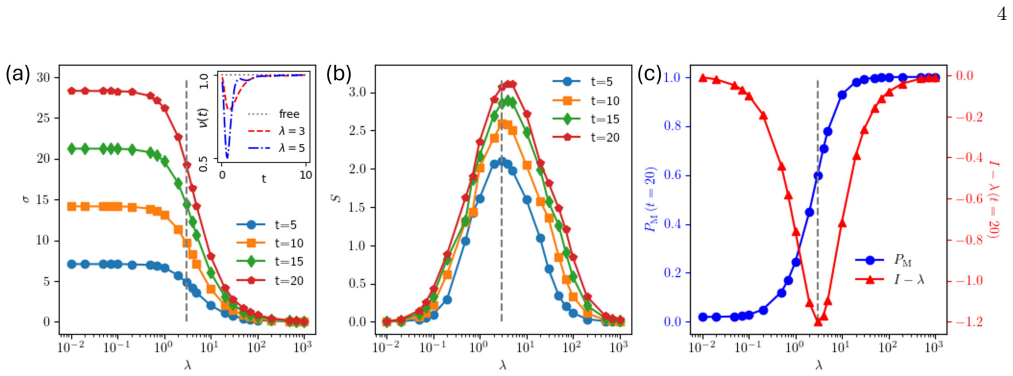
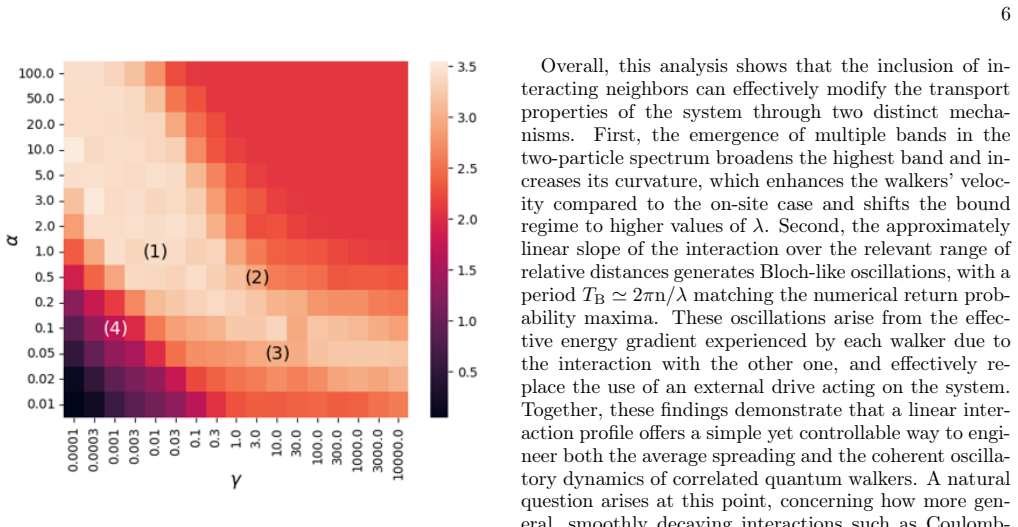
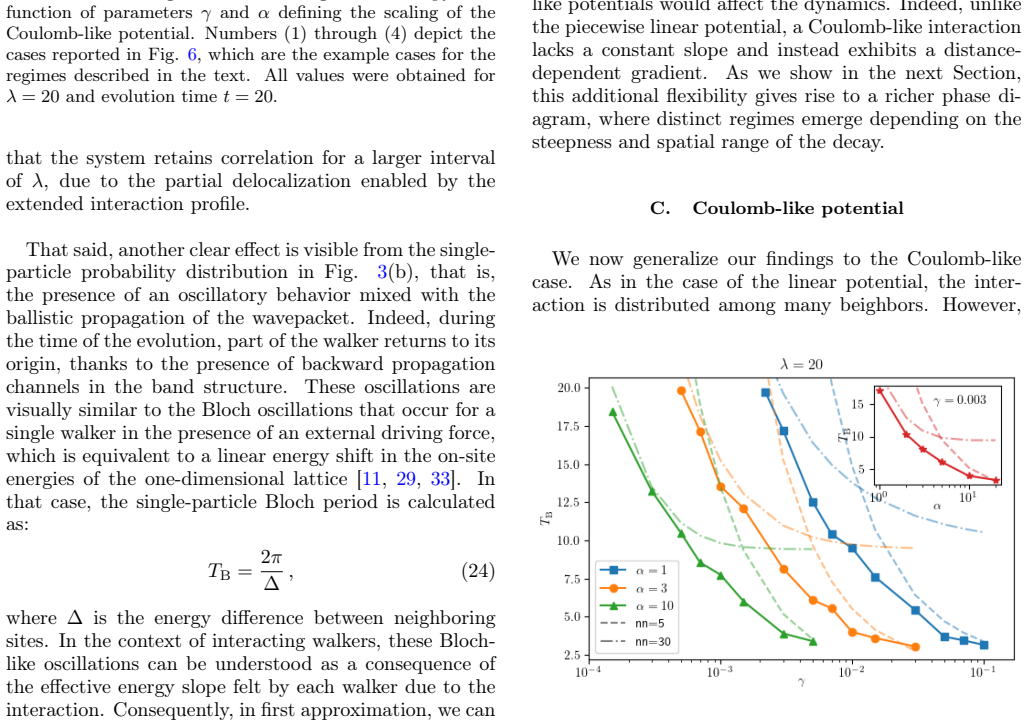
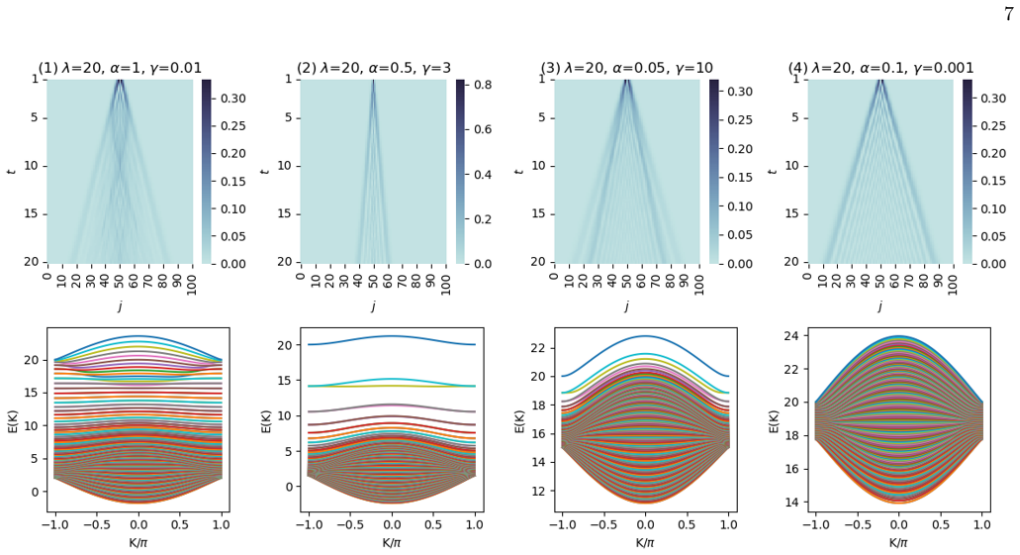
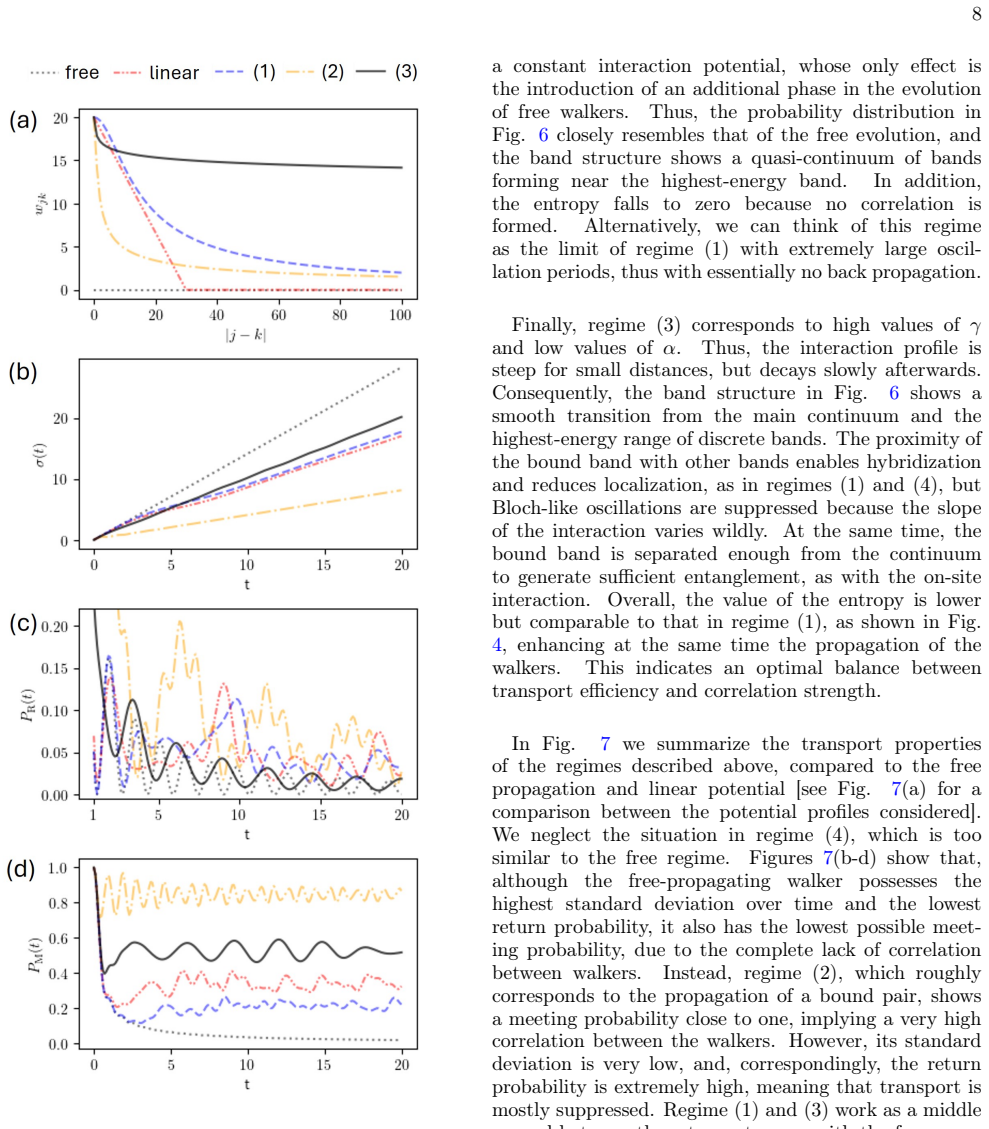
The central discovery is that a Coulomb-like interaction with tuned strength, spatial scaling, and decay rate produces four dynamical regimes: a high-entropy oscillatory regime similar to linear potentials, a strongly localized bound-pair regime, a novel intermediate regime with near-ballistic spreading and strong correlations, and a weakly interacting free-propagation regime. Regime (iii) is shown to optimize transport efficiency and entanglement concurrently.
What carries the argument
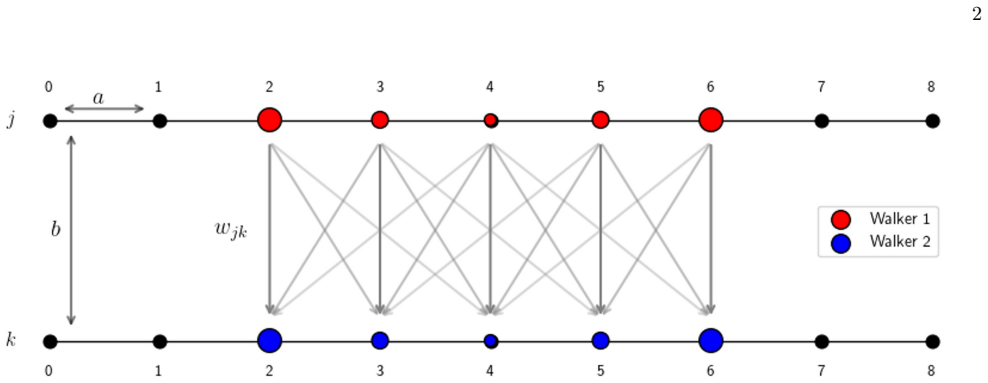
Distance-dependent potentials (on-site, linear, and Coulomb-like parameterized by strength, spatial scaling, and decay rate) acting between distinguishable walkers on parallel lattices, used to classify dynamics into four regimes via numerical simulation.
If this is right
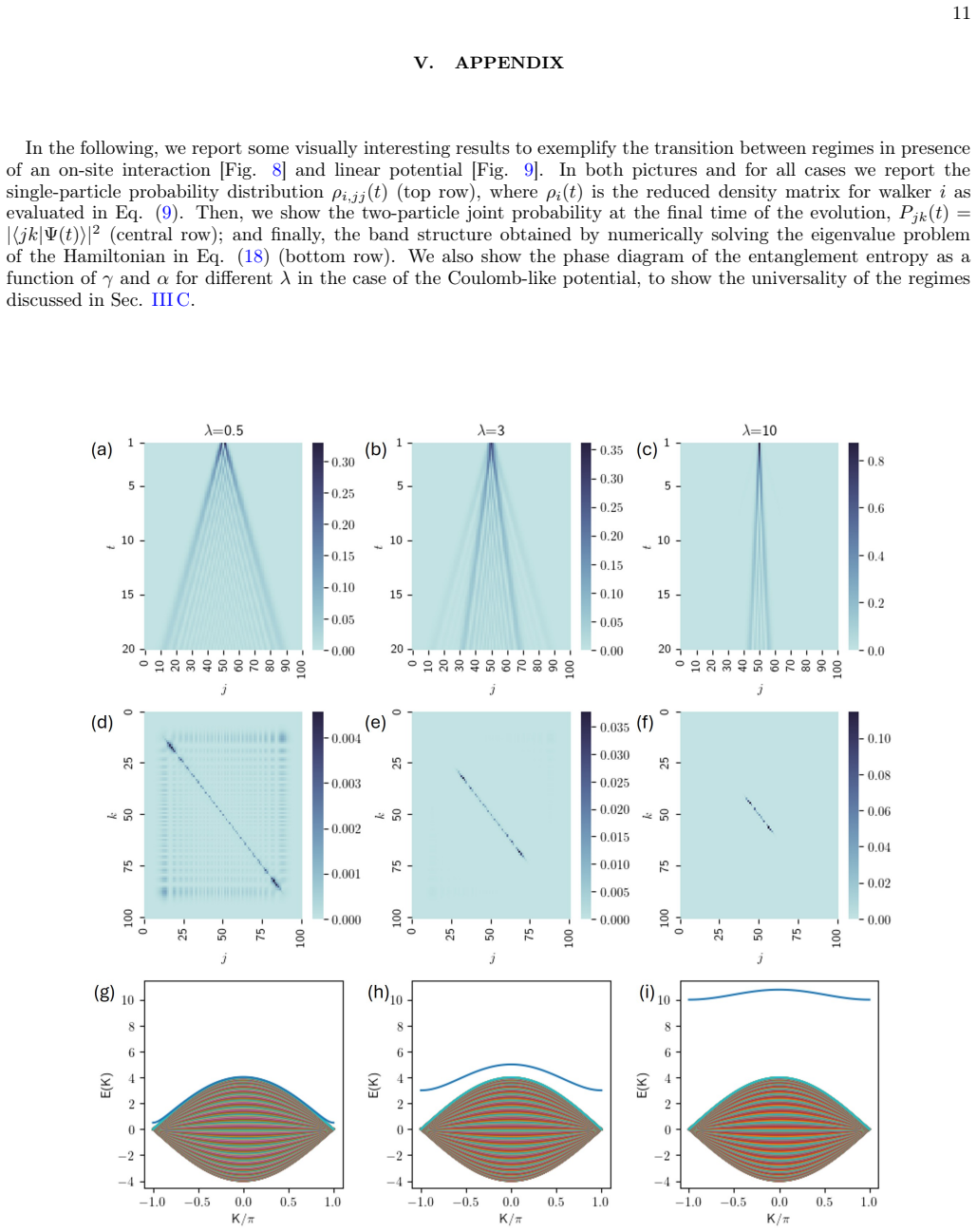
- On-site interactions recover standard bosonic behavior in the two-walker system.
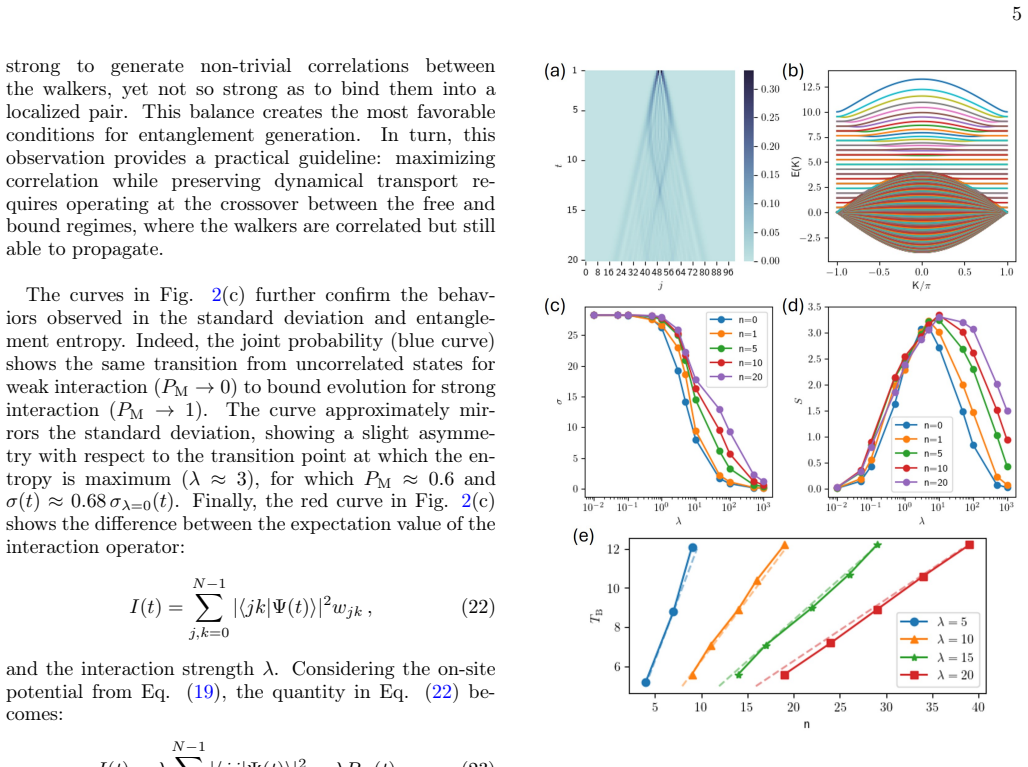
- Extending the interaction to a linear potential over multiple neighbors produces controlled Bloch-like oscillations and moves the bound-pair regime to stronger couplings.
- The intermediate regime provides concurrent high transport efficiency and strong entanglement without requiring separate control mechanisms.
- The overall phase diagram supplies a tunable tool for designing interaction-engineered quantum walks.
Where Pith is reading between the lines
- The identified sweet-spot regime could be tested for robustness when the walkers are made indistinguishable or when lattices are coupled in higher dimensions.
- Platforms such as trapped ions or superconducting circuits might realize the Coulomb-like potentials to check whether the four-regime structure persists beyond numerics.
- The concurrent optimization might translate to improved performance in quantum information tasks that require both particle delocalization and built-in correlations.
Load-bearing premise
The model assumes distinguishable continuous-time particles on parallel one-dimensional lattices whose dynamics under distance-dependent potentials can be classified into exactly four distinct regimes by numerical exploration.
What would settle it
A simulation or experiment in the parameter window identified for regime (iii) that finds either transport efficiency below the reported optimum or entanglement strength below the reported level, or that reveals more or fewer than four regimes.
Figures
read the original abstract
Controlling the interplay between particle propagation and quantum correlation generation is a central challenge in quantum transport. Here, we investigate two distinguishable continuous-time quantum walkers evolving on parallel one-dimensional lattices, interacting via distance-dependent potentials. While on-site interactions reproduce the typical bosonic behaviour, extending the interaction to a linear potential over multiple neighbors introduces controlled Bloch-like oscillations and shifts the bound-pair regime to stronger couplings. More generally, we explore a Coulomb-like interaction parameterized by strength, spatial scaling, and decay rate. This reveals a rich phase diagram including four distinct dynamical regimes: (i) a high-entropy, oscillatory regime akin to a linear potential; (ii) a strongly localized, bound-pair regime; (iii) a novel intermediate regime combining near-ballistic spreading with strong correlations; and (iv) a weakly interacting, free-propagation regime. Notably, regime (iii) achieves concurrent optimization of transport efficiency and entanglement, offering a sweet spot for correlated quantum dynamics. Our results provide a tool for designing interaction-engineered quantum walks with potential applications in quantum information processing and simulations.
Editorial analysis
A structured set of objections, weighed in public.
Referee Report
Summary. The paper studies two distinguishable continuous-time quantum walkers on parallel 1D lattices interacting through distance-dependent potentials (on-site, linear, and Coulomb-like parameterized by strength, spatial scaling, and decay rate). Numerical parameter sweeps are used to classify the dynamics into four regimes: (i) high-entropy oscillatory, (ii) strongly localized bound-pair, (iii) intermediate near-ballistic with strong correlations, and (iv) weakly interacting free propagation. Regime (iii) is highlighted as concurrently optimizing transport efficiency and entanglement generation.
Significance. If the numerical classification is robust, the work provides a concrete parameter-space map for engineering interactions that simultaneously enhance transport and correlations in quantum walks. The direct sweeps over interaction parameters (without fitting or self-referential definitions) and the identification of an intermediate 'sweet spot' regime constitute a useful design tool for quantum information processing and simulation applications.
major comments (1)
- [Numerical methods / regime classification (abstract and §3–4)] Numerical methods / regime classification (abstract and §3–4): the delineation of the four regimes and the claim that regime (iii) optimizes both transport and entanglement rest on parameter sweeps, yet no discretization scheme, integrator, convergence checks, error bounds, or quantitative criteria (e.g., thresholds on spreading rate or entanglement entropy) are supplied. This absence directly undermines assessment of whether the reported phase boundaries are stable under reasonable numerical variations.
Simulated Author's Rebuttal
We thank the referee for the constructive report and for recognizing the potential utility of the parameter-space map. We address the single major comment below.
read point-by-point responses
-
Referee: Numerical methods / regime classification (abstract and §3–4): the delineation of the four regimes and the claim that regime (iii) optimizes both transport and entanglement rest on parameter sweeps, yet no discretization scheme, integrator, convergence checks, error bounds, or quantitative criteria (e.g., thresholds on spreading rate or entanglement entropy) are supplied. This absence directly undermines assessment of whether the reported phase boundaries are stable under reasonable numerical variations.
Authors: We agree that the manuscript lacks explicit documentation of the numerical procedures. In the revised version we will insert a dedicated subsection in §3 that specifies: the spatial discretization (finite lattice of L sites with open boundaries and nearest-neighbor hopping), the time-evolution algorithm (fourth-order Runge-Kutta integrator with fixed step Δt = 0.01 ħ/J), convergence tests (doubling L up to 200 and halving Δt, confirming that regime assignments vary by <8 % in the diagnostic quantities), and the quantitative thresholds used to delineate the four regimes (e.g., time-averaged participation ratio >0.75 for near-ballistic transport and von Neumann entropy S>0.65 ln 2 for strong correlations). Estimated error bounds from these checks will be stated. These additions will permit independent assessment of phase-boundary stability. The reported regimes and the identification of regime (iii) as the concurrent optimum remain unchanged. revision: yes
Circularity Check
No significant circularity
full rationale
The paper defines a model of two distinguishable continuous-time quantum walkers on parallel lattices with distance-dependent potentials (on-site, linear, Coulomb-like) and performs numerical parameter sweeps over strength, scaling, and decay rate to classify four dynamical regimes directly from the resulting dynamics. Regime (iii) is identified observationally as the concurrent optimum for transport and entanglement. No equations reduce a claimed prediction to a fitted input by construction, no uniqueness theorems are imported from self-citations, and no ansatz is smuggled via prior work; the classification is an output of the explicit Hamiltonian evolution rather than a tautology.
Axiom & Free-Parameter Ledger
free parameters (3)
- interaction strength
- spatial scaling
- decay rate
axioms (2)
- standard math The time evolution of the walkers obeys the continuous-time Schrödinger equation on a lattice
- domain assumption The two walkers are distinguishable
Reference graph
Works this paper leans on
-
[1]
Mülken and A
O. Mülken and A. Blumen, Continuous-time quantum walks: Models for coherent transport on complex net- works, Physics Reports502, 37 (2011)
2011
-
[2]
Ambainis, Quantum walks and their algorithmic applications, Int
A. Ambainis, Quantum walks and their al- gorithmic applications, International Jour- nal of Quantum Information01, 507 (2003), https://doi.org/10.1142/S0219749903000383
-
[3]
Annoni, M
E. Annoni, M. Frigerio, and M. G. A. Paris, Enhanced quantum transport in chiral quantum walks, Quantum Information Processing23, 117 (2024)
2024
-
[4]
Bottarelli, M
A. Bottarelli, M. Frigerio, and M. G. A. Paris, Quantum routing of information using chiral quantum walks, AVS Quantum Science5, 025001 (2023)
2023
-
[5]
Cavazzoni, L
S. Cavazzoni, L. Razzoli, P. Bordone, and M. G. A. Paris, Perturbed graphs achieve unit transport efficiency with- out environmental noise, Physical Review E106, 024118 (2022)
2022
-
[6]
G. Ragazzi, S. Cavazzoni, C. Benedetti, P. Bordone, and M. G. A. Paris, Scalable structure for chiral quantum routing, Entropy27, 10.3390/e27050498 (2025)
-
[7]
Candeloro, C
A. Candeloro, C. Benedetti, M. G. Genoni, and M. G. Paris, Feedback-assisted quantum search by continuous- time quantum walks, Advanced Quantum Technologies 6, 2200093 (2023)
2023
-
[8]
Apers, S
S. Apers, S. Chakraborty, L. Novo, and J. Roland, Quadratic speedup for spatial search by continuous-time 10 quantum walk, Phys. Rev. Lett.129, 160502 (2022)
2022
-
[9]
Siloi, C
I. Siloi, C. Benedetti, E. Piccinini, J. Piilo, S. Maniscalco, M. G. A. Paris, and P. Bordone, Noisy quantum walks of two indistinguishable interacting particles, Phys. Rev. A 95, 022106 (2017)
2017
-
[10]
L. Wang, L. Wang, and Y. Zhang, Quantum walks of two interacting anyons in one-dimensional optical lat- tices, Phys. Rev. A90, 063618 (2014)
2014
-
[11]
P. M. Preiss, R. Ma, M. E. Tai, A. Lukin, M. Rispoli, P. Zupancic, Y. Lahini, R. Islam, and M. Greiner, Strongly correlated quantum walks in optical lattices, Science347, 1229 (2015), https://www.science.org/doi/pdf/10.1126/science.1260364
-
[12]
Z. Yan, Y.-R. Zhang, M. Gong, Y. Wu, Y. Zheng, S. Li, C. Wang, F. Liang, J. Lin, Y. Xu, C. Guo, L. Sun, C.-Z. Peng, K. Xia, H. Deng, H. Rong, J. Q. You, F. Nori, H. Fan, X. Zhu, and J.-W. Pan, Strongly correlated quantum walks with a 12-qubit superconducting processor, Science364, 753 (2019), https://www.science.org/doi/pdf/10.1126/science.aaw1611
-
[13]
M. S. Underwood and D. L. Feder, Bose-hubbard model for universal quantum-walk-based computation, Phys. Rev. A85, 052314 (2012)
2012
-
[14]
A. M. Childs, D. Gosset, and Z. Webb, Universal computation by multiparticle quantum walk, Science339, 791 (2013), https://www.science.org/doi/pdf/10.1126/science.1229957
-
[15]
Asaka, K
R. Asaka, K. Sakai, and R. Yahagi, Two-level quantum walkers on directed graphs. i. universal quantum com- puting, Phys. Rev. A107, 022415 (2023)
2023
-
[16]
X. Qiang, S. Ma, and H. Song, Quantum walk computing: Theory, implementation, and ap- plication, Intelligent Computing3, 0097 (2024), https://spj.science.org/doi/pdf/10.34133/icomputing.0097
-
[17]
L. Razzoli, G. Cenedese, M. Bondani, and G. Benenti, Efficient implementation of discrete-time quantum walks on quantum computers, Entropy26, 10.3390/e26040313 (2024)
-
[18]
Lahini, M
Y. Lahini, M. Verbin, S. D. Huber, Y. Bromberg, R. Pu- gatch, and Y. Silberberg, Quantum walk of two interact- ing bosons, Phys. Rev. A86, 011603(R) (2012)
2012
-
[19]
A. A. Melnikov and L. E. Fedichkin, Quantum walks of interacting fermions on a cycle graph, Scientific Reports 6, 34226 (2016)
2016
-
[20]
A. Rai, G. S. Agarwal, and J. H. H. Perk, Transport and quantum walk of nonclassical light in coupled waveg- uides, Phys. Rev. A78, 042304 (2008)
2008
-
[21]
Zhou, X.-W
W.-H. Zhou, X.-W. Wang, R.-J. Ren, Y.-X. Fu, Y.-J. Chang, X.-Y. Xu, H. Tang, and X.-M. Jin, Multi-particle quantum walks on 3d integrated photonic chip, Light: Science & Applications13, 296 (2024)
2024
-
[22]
M. Gao, C. Sheng, Y. Zhao, R. He, L. Lu, W. Chen, K.Ding, S.Zhu,andH.Liu,Quantumwalksofcorrelated photons in non-hermitian photonic lattices, Phys. Rev. B 110, 094308 (2024)
2024
-
[23]
Raymond, P
A. Raymond, P. Cathala, M. Morassi, A. Lemaître, F. Raineri, S. Ducci, and F. Baboux, Tailoring quantum walks in integrated photonic lattices, Opt. Express33, 45869 (2025)
2025
-
[24]
Zähringer, G
F. Zähringer, G. Kirchmair, R. Gerritsma, E. Solano, R. Blatt, and C. F. Roos, Realization of a quantum walk with one and two trapped ions, Phys. Rev. Lett.104, 100503 (2010)
2010
-
[25]
Tamura, T
M. Tamura, T. Mukaiyama, and K. Toyoda, Quantum walks of a phonon in trapped ions, Phys. Rev. Lett.124, 200501 (2020)
2020
-
[26]
Huerta Alderete, S
C. Huerta Alderete, S. Singh, N. H. Nguyen, D. Zhu, R. Balu, C. Monroe, C. M. Chandrashekar, and N. M. Linke, Quantum walks and dirac cellular automata on a programmable trapped-ion quantum computer, Nature Communications11, 3720 (2020)
2020
-
[27]
R. Côté, A. Russell, E. E. Eyler, and P. L. Gould, Quan- tum random walk with rydberg atoms in an optical lat- tice, New Journal of Physics8, 156 (2006)
2006
-
[28]
Khazali, Discrete-time quantum-walk & floquet topological insulators via distance-selective rydberg- interaction, Quantum6, 664 (2022)
M. Khazali, Discrete-time quantum-walk & floquet topological insulators via distance-selective rydberg- interaction, Quantum6, 664 (2022)
2022
-
[29]
T. Chen, C. Huang, B. Gadway, and J. P. Covey, Quan- tum walks and correlated dynamics in an interacting synthetic rydberg lattice, Phys. Rev. Lett.133, 120604 (2024)
2024
-
[30]
N. E. Palaiodimopoulos, S. Ohler, M. Fleischhauer, and D. Petrosyan, Chiral quantum router with rydberg atoms, Phys. Rev. A109, 032622 (2024)
2024
-
[31]
Chattaraj and R
T. Chattaraj and R. V. Krems, Effects of long-range hop- ping and interactions on quantum walks in ordered and disordered lattices, Phys. Rev. A94, 023601 (2016)
2016
-
[32]
Štefanák, T
M. Štefanák, T. Kiss, I. Jex, and B. Mohring, The meet- ing problem in the quantum walk, Journal of Physics A: Mathematical and General39, 14965 (2006)
2006
-
[33]
Ahlbrecht, A
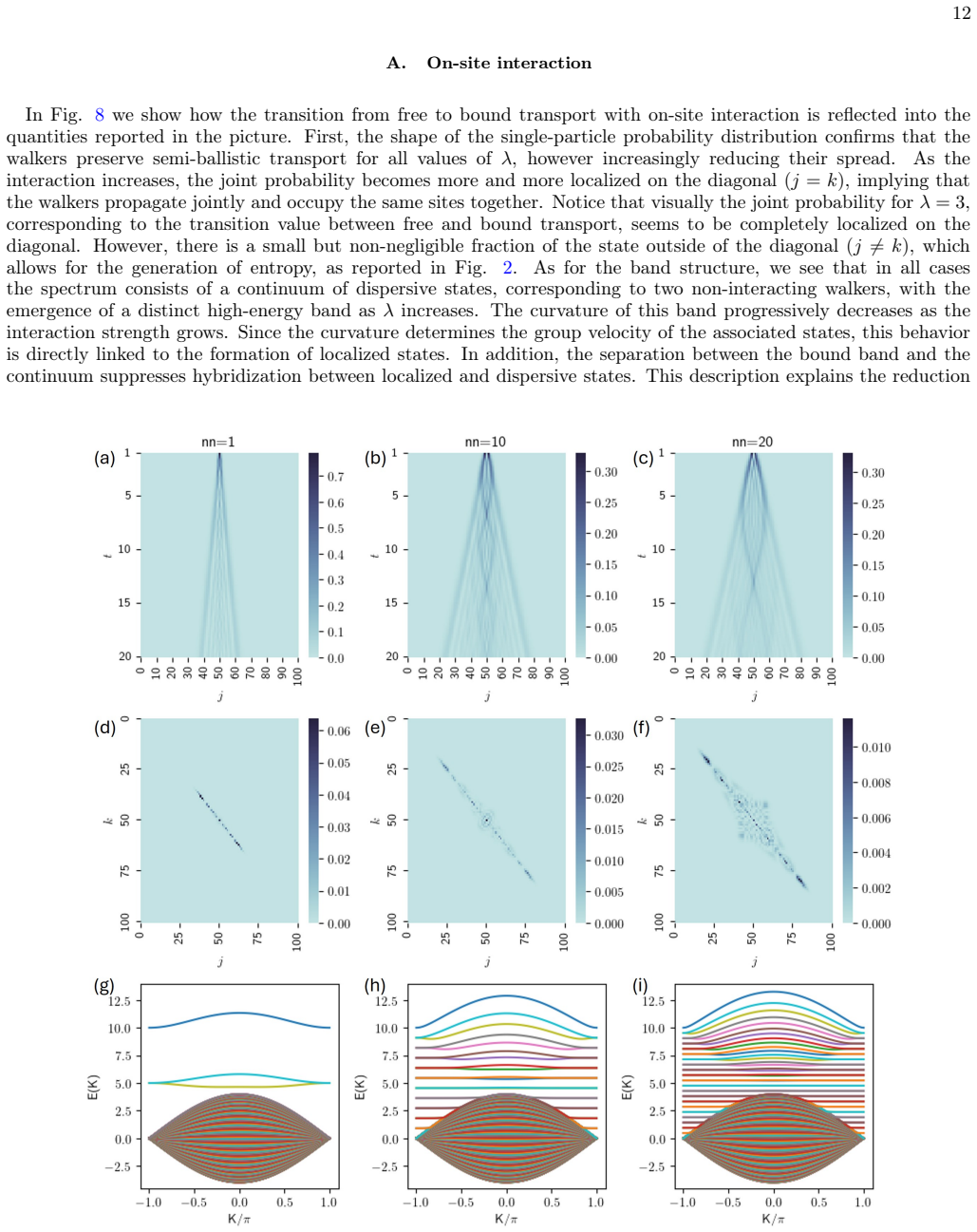
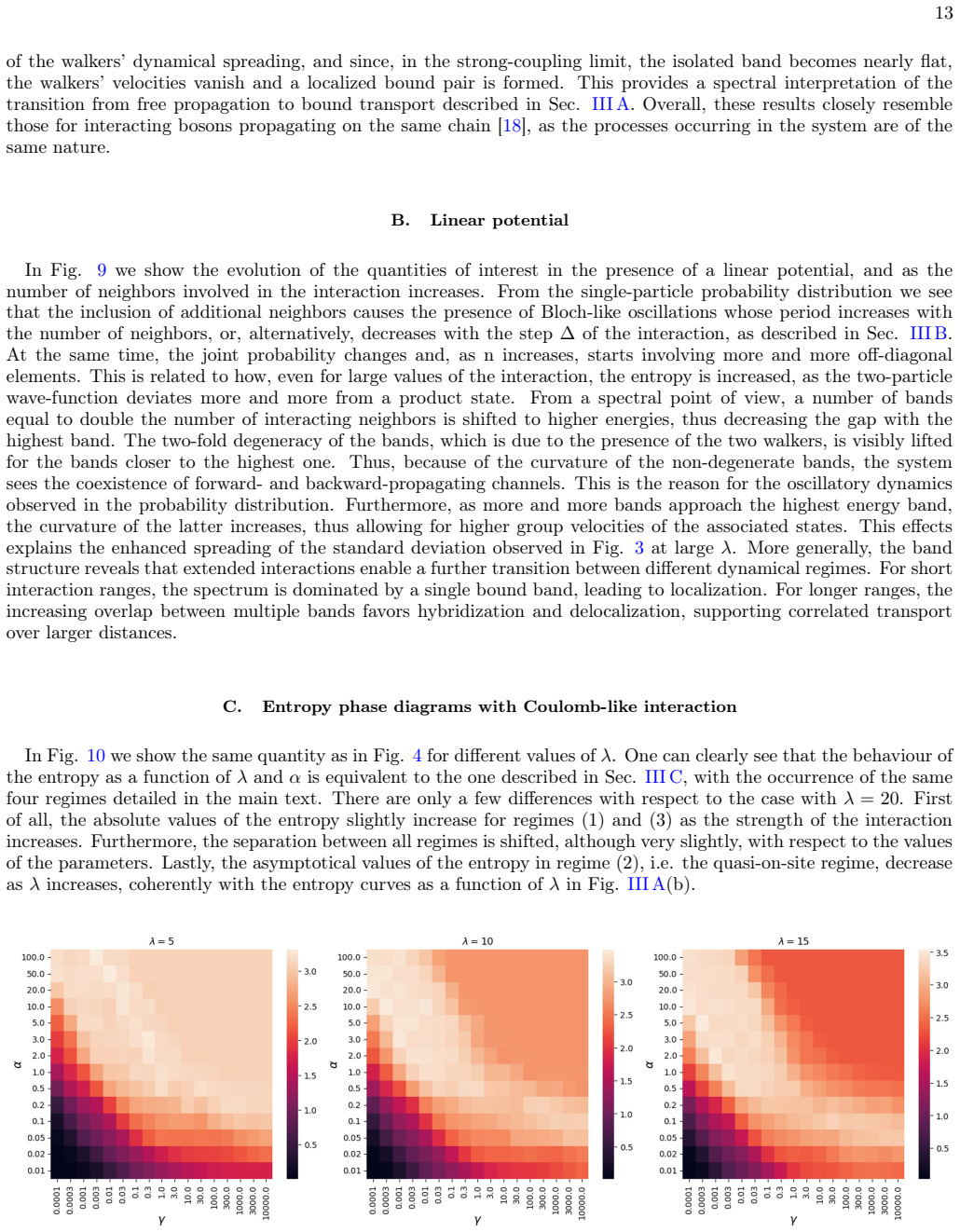
A. Ahlbrecht, A. Alberti, D. Meschede, V. B. Scholz, A. H. Werner, and R. F. Werner, Molecular binding in interacting quantum walks, New Journal of Physics14, 073050 (2012). 11 V. APPENDIX In the following, we report some visually interesting results to exemplify the transition between regimes in presence of an on-site interaction [Fig. 8] and linear pote...
2012
discussion (0)
Sign in with ORCID, Apple, or X to comment. Anyone can read and Pith papers without signing in.