Chirality-induced spin selectivity without intrinsic spin-orbit coupling: Role of current-induced molecular orbital moment
Pith reviewed 2026-06-26 22:57 UTC · model grok-4.3
The pith
Current circulation in molecular loops generates a molecular orbital moment whose direction tracks molecular handedness and produces CISS effects without intrinsic spin-orbit coupling.
A machine-rendered reading of the paper's core claim, the machinery that carries it, and where it could break.
Core claim
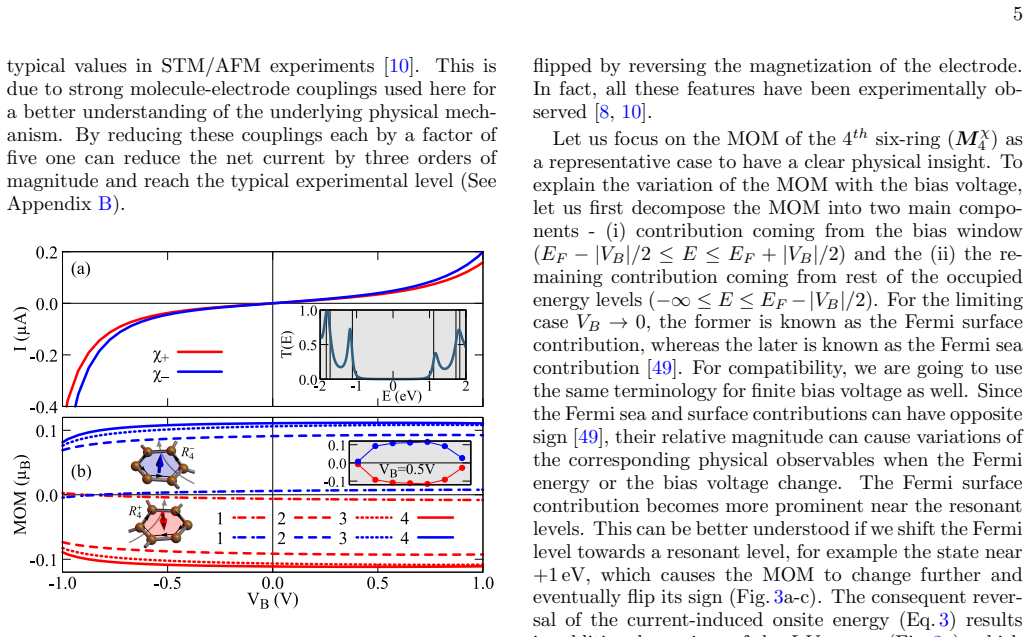
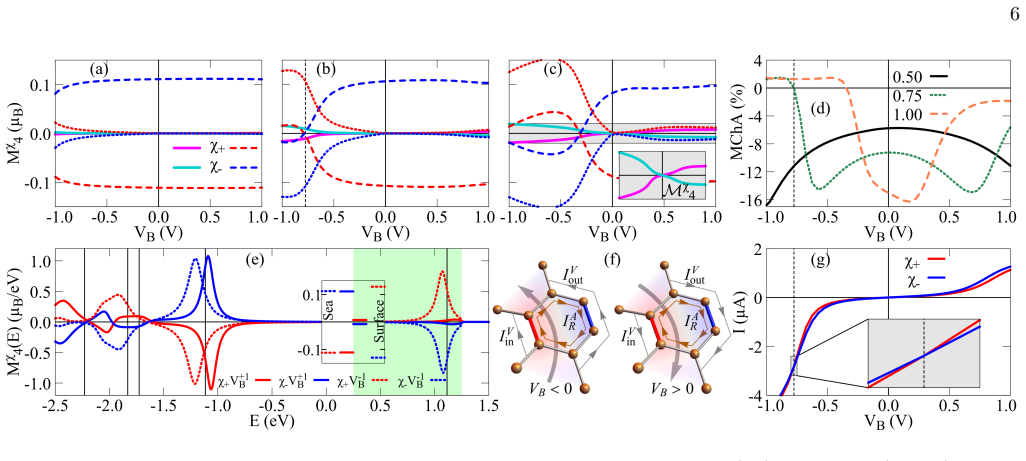
The circulation of charge current in molecular loops generates a molecular orbital moment whose direction is governed by the gauge field arising from the structural distortion of the molecule and is therefore associated with the molecule's handedness. This moment produces finite CISS magnetoresistance and magnetochiral conductance asymmetries that are even in bias voltage without violating Onsager-Casimir reciprocity relations. Depending on the Fermi level and bias voltage the moment can be tuned externally, resulting in additional crossings of the enantiomer I-V curves. The same construction accounts for electrical magnetochiral anisotropy.
What carries the argument
Molecular orbital moment (MOM) generated by charge-current circulation in molecular loops, with its direction fixed by the gauge field of the structural distortion and therefore locked to molecular handedness.
If this is right
- CISS magnetoresistance remains finite and even in bias voltage.
- Magnetochiral conductance asymmetries are likewise even in bias voltage.
- Onsager-Casimir reciprocity is preserved because the moment reverses with both current and handedness.
- External tuning of Fermi level or bias produces additional crossings between the I-V curves of opposite enantiomers.
- Electrical magnetochiral anisotropy emerges as a direct consequence of the same orbital-moment mechanism.
Where Pith is reading between the lines
- The mechanism suggests CISS can appear in any chiral conductor that supports closed current loops, even when atomic spin-orbit coupling is negligible.
- Gate control of the moment offers a route to electrically switch the sign of spin selectivity in a single device.
- Disrupting loop closure while preserving chirality should suppress the predicted CISS signatures, providing a direct experimental test.
- The same orbital-moment picture may unify molecular CISS with related effects in chiral crystals or metamaterials that carry circulating currents.
Load-bearing premise
Circulating charge current in the loops of a structurally distorted chiral molecule produces an orbital moment whose direction is set by a gauge field that follows the molecule's handedness.
What would settle it
Measurement of bias-even CISS magnetoresistance in a gated helical-molecule junction whose current path forms closed loops, contrasted with the absence of the effect when the loops are broken or the handedness is reversed.
Figures
read the original abstract
The microscopic origin of the chirality-induced spin selectivity (CISS) in helical molecules remains an open question. Recent experiments suggest that a significant contribution to CISS arises from the molecule itself, which is disregarded in existing interfacial or scattering based theories. Here we present an alternative theory of CISS to address this molecular contribution. The mechanism is based on the circulation of charge current in molecular loops that generates a molecular orbital moment (MOM). The direction of the MOM is governed by the gauge field arising from the structural distortion of the molecule and is associated with the handedness of the molecule. Such a MOM can produce finite CISS magnetoresistance and magnetochiral conductance asymmetries that are even in bias voltage, without violating the Onsager-Casimir reciprocity relations. Depending on the Fermi level and bias voltage, the MOM can be controlled externally, which can result in additional crossings of the enantiomer $I-V$ curves. Finally we explain the origin of the electrical magnetochiral anisotropy within the same framework, which establishes its generic applicability.
Editorial analysis
A structured set of objections, weighed in public.
Referee Report
Summary. The manuscript proposes an alternative theory for chirality-induced spin selectivity (CISS) in helical molecules, attributing the effect to current circulation in molecular loops that generates a molecular orbital moment (MOM). The MOM direction is governed by a gauge field arising from structural distortion and is associated with molecular handedness. This is claimed to produce finite CISS magnetoresistance and magnetochiral conductance asymmetries even in bias voltage, without intrinsic spin-orbit coupling or violating Onsager-Casimir reciprocity. The work further discusses external control of the MOM via Fermi level and bias (leading to enantiomer I-V curve crossings) and explains electrical magnetochiral anisotropy within the same framework.
Significance. If the central derivation holds, the result would provide a molecular-intrinsic mechanism for CISS that addresses experimental indications of molecule-specific contributions overlooked by interfacial/scattering theories. It offers a route to even-in-bias asymmetries while respecting reciprocity and avoiding intrinsic SOC, with potential for external control and broader applicability to magnetochiral effects. The framework is falsifiable via bias-dependent I-V crossings and could be tested against existing CISS data.
major comments (2)
- [Abstract / mechanism section] Abstract and § on mechanism: The association of the gauge field from structural distortion with molecular handedness (which fixes MOM direction and enables chiral transport asymmetries) is stated directly but lacks an explicit microscopic derivation or Hamiltonian term showing how the gauge field arises from the distortion and reverses with enantiomer without an implicit SOC-like contribution. This link is load-bearing for the central claim of CISS without intrinsic SOC.
- [Transport section] Section on transport asymmetries: The claim that the MOM produces finite even-in-bias CISS magnetoresistance and magnetochiral conductance without violating Onsager-Casimir relations requires showing that the MOM-induced spin coupling respects reciprocity by construction; the manuscript should provide the explicit current-MOM coupling term and demonstrate the even-bias property from the equations rather than asserting it.
minor comments (1)
- [Notation] Notation for the gauge field and MOM should be defined consistently with standard electromagnetic conventions to avoid ambiguity in how the handedness association enters.
Simulated Author's Rebuttal
We thank the referee for their careful reading of the manuscript and constructive comments. We address each major comment below and indicate the revisions planned.
read point-by-point responses
-
Referee: [Abstract / mechanism section] Abstract and § on mechanism: The association of the gauge field from structural distortion with molecular handedness (which fixes MOM direction and enables chiral transport asymmetries) is stated directly but lacks an explicit microscopic derivation or Hamiltonian term showing how the gauge field arises from the distortion and reverses with enantiomer without an implicit SOC-like contribution. This link is load-bearing for the central claim of CISS without intrinsic SOC.
Authors: We agree that an explicit microscopic derivation would strengthen the central claim. In the revised manuscript we will add a dedicated subsection deriving the gauge field from the helical structural distortion via an effective geometric-phase term in the Hamiltonian. This term is constructed from the molecular geometry alone and reverses sign under enantiomer exchange through the change in helix handedness, without reference to spin-orbit coupling. The derivation will be placed immediately after the mechanism overview. revision: yes
-
Referee: [Transport section] Section on transport asymmetries: The claim that the MOM produces finite even-in-bias CISS magnetoresistance and magnetochiral conductance without violating Onsager-Casimir relations requires showing that the MOM-induced spin coupling respects reciprocity by construction; the manuscript should provide the explicit current-MOM coupling term and demonstrate the even-bias property from the equations rather than asserting it.
Authors: We accept the point that an explicit derivation is preferable to assertion. The revised transport section will introduce the current-MOM coupling Hamiltonian explicitly and then derive the even-in-bias magnetoresistance and magnetochiral asymmetry directly from the resulting Landauer-Büttiker expressions, confirming that Onsager-Casimir reciprocity holds because the MOM is an orbital (time-reversal even) quantity. revision: yes
Circularity Check
No significant circularity; derivation is self-contained as a proposed mechanism
full rationale
The paper introduces a mechanism in which current circulation generates a MOM whose direction is tied to molecular handedness via a gauge field from structural distortion. This association is presented as the foundational premise enabling CISS effects without intrinsic SOC. No equations, fitted parameters, or self-citations are exhibited in the text that would reduce the central predictions (finite even-in-bias magnetoresistance and magnetochiral asymmetries) to the inputs by construction. The result follows from the stated assumptions rather than re-expressing them, satisfying the criteria for an independent theoretical proposal.
Axiom & Free-Parameter Ledger
Forward citations
Cited by 1 Pith paper
-
Large CISS Polarization from the Hierarchy Between Transport and Geometrical Spin Currents
Large CISS polarization is interpreted as transport selection from underlying geometrical spin-current states whose intrinsic scale exceeds measured currents in dsDNA.
Reference graph
Works this paper leans on
-
[1]
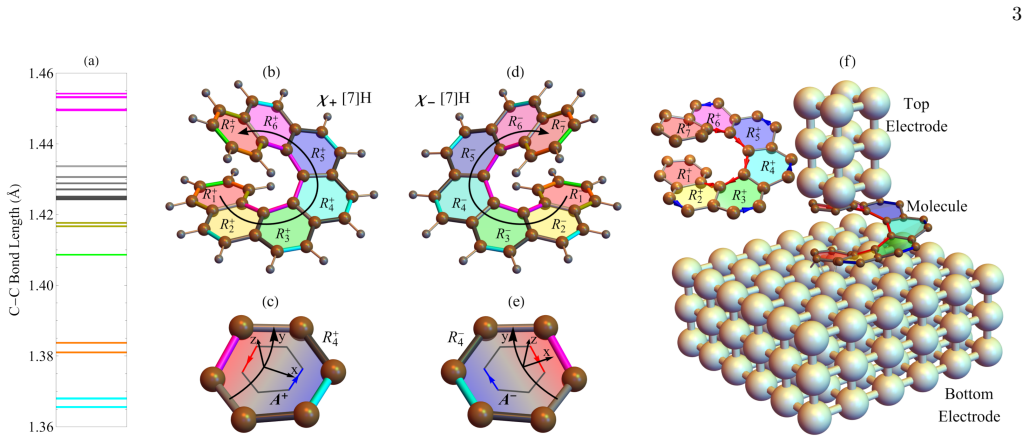
which can alter the theoretical outcome significantly. The main hurdle in the SOC-based theoretical expla- nation of CISS is posed by the reciprocity relations by Onsager-Casimir [21] and B¨ uttiker [22] which dictate that in absence of time reversal symmetry breaking interac- tion, the transport coefficients satisfyG ij(B)=Gji(−B). In presence of magneti...
Pith/arXiv arXiv 2026
-
[2]
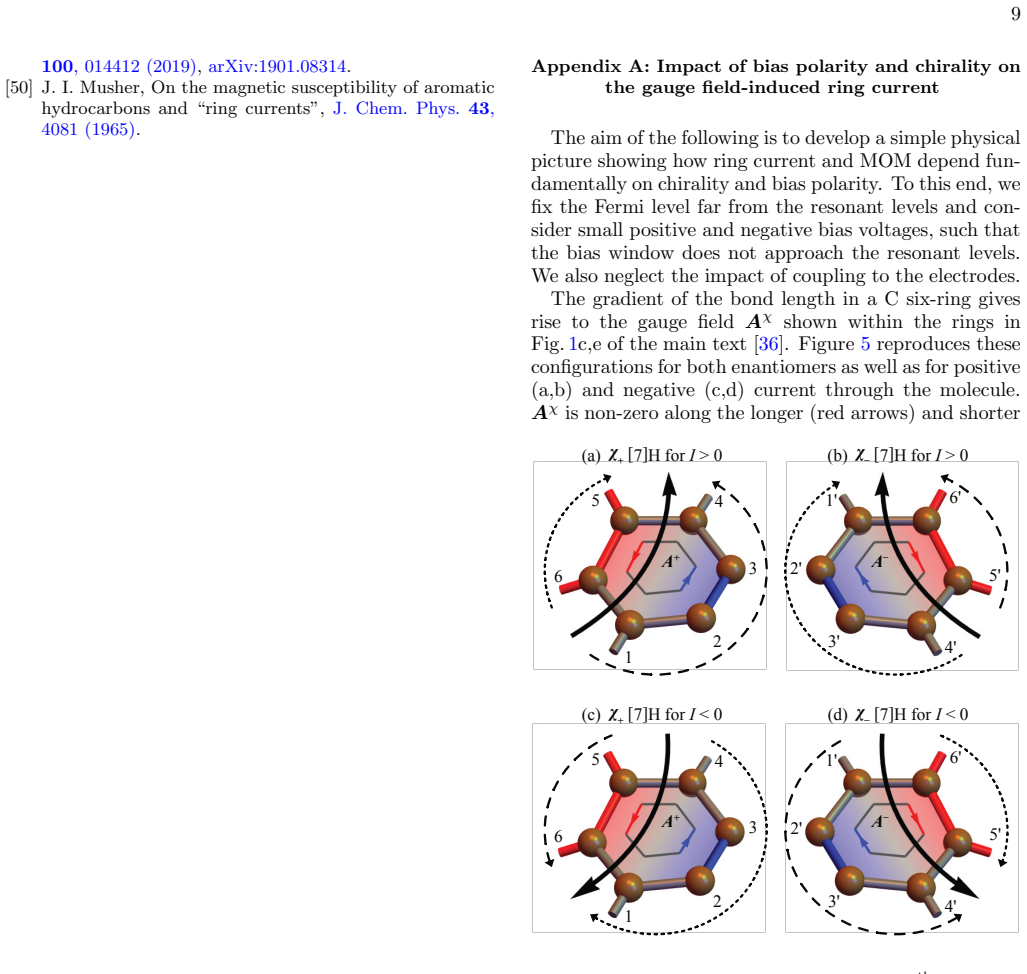
Note that while the flux due toA χ changes sign for molecules with opposite handedness ( H χAχ ·dl∝χ, see also Fig
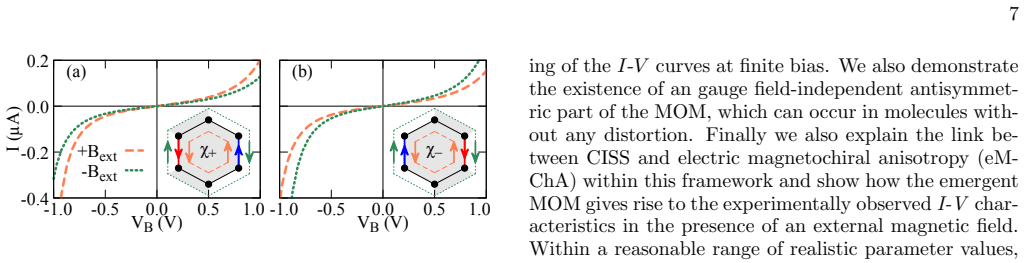
and consider a simple scenario where an external magnetic field creates a ring current in each C six-ring. Note that while the flux due toA χ changes sign for molecules with opposite handedness ( H χAχ ·dl∝χ, see also Fig. 1c,e), the flux due to the external field (Bext) re- mains constant and only changes sign with the direction of field ( H χAB ·dl∝B ex...
-
[3]
Naaman and D
R. Naaman and D. H. Waldeck, Chiral-induced spin se- lectivity effect, J. Phys. Chem. Lett.3, 2178 (2012)
2012
-
[4]
Naaman, Y
R. Naaman, Y. Paltiel, and D. H. Waldeck, Chiral molecules and the electron spin, Nat. Rev. Chem.3, 250 (2019)
2019
-
[5]
Evers, A
F. Evers, A. Aharony, N. Bar-Gill, O. Entin-Wohlman, P. Hedeg˚ ard, O. Hod, P. Jelinek, G. Kamieniarz, M. Lemeshko, K. Michaeli, V. Mujica, R. Naamana, Y. Paltiel, S. Refaely-Abramson, O. Tal, J. Thijssen, M. Thoss, J. M. van Ruitenbeek, L. Venkataraman, D. H. Waldeck, B. Yan, and L. Kronik, Theory of Chirality In- duced Spin Selectivity: Progress and Cha...
2022
-
[6]
A. C. Aragon` es, D. Aravena, J. M. Ugalde, E. Med- ina, R. Gutierrez, E. Ruiz, V. Mujica, and I. D´ ıez-P´ erez, Magnetoresistive Single-Molecule Junctions: the Role of the Spinterface and the CISS Effect, Israel J. Chem.62, 10.1002/ijch.202200090 (2022)
-
[7]
Z. Xie, T. Z. Markus, S. R. Cohen, Z. Vager, R. Gutier- rez, and R. Naaman, Spin specific electron conduction through DNA oligomers, Nano Lett.11, 4652 (2011)
2011
-
[8]
Kiran, S
V. Kiran, S. P. Mathew, S. R. Cohen, I. Hern´ andez Del- gado, J. Lacour, and R. Naaman, Helicenes – a new class of organic spin filter, Adv. Mater.28, 1957 (2016)
1957
-
[9]
B. P. Bloom, V. Kiran, V. Varade, R. Naaman, and D. H. Waldeck, Spin selective charge transport through cys- teine capped cdse quantum dots, Nano Lett.16, 4583 (2016)
2016
-
[10]
A. C. Aragon` es, E. Medina, M. Ferrer-Huerta, N. Gi- meno, M. Teixid´ o, J. L. Palma, N. Tao, J. M. Ugalde, E. Giralt, I. D´ ıez-P´ erez, and V. Mujica, Measuring the spin-polarization power of a single chiral molecule, Small 13, 10.1002/smll.201602519 (2016)
-
[11]
Mishra, A
S. Mishra, A. K. Mondal, S. Pal, T. K. Das, E. Z. B. Smolinsky, G. Siligardi, and R. Naaman, Length- dependent electron spin polarization in oligopeptides and DNA, J. Phys. Chem. C124, 10776 (2020)
2020
-
[12]
M. R. Safari, F. Matthes, C. M. Schneider, K.-H. Ernst, and D. E. B¨ urgler, Spin-selective electron trans- port through single chiral molecules, Small20, 2308233 (2024)
2024
-
[13]
T. N. H. Nguyen, G. Salvan, O. Hellwig, Y. Paltiel, L. T. Baczewski, and C. Tegenkamp, The mechanism of the molecular CISS effect in chiral nano-junctions, Chem. Sci.15, 14905 (2024)
2024
-
[14]
A. C. Aragon` es, M. Varese, K. Garg, W. Kuang, Q. Wang, E. Giralt, V. Mujica, R. Gutierrez, G. Cu- niberti, L. Puerta, and I. D´ ıez-P´ erez, Dipole-induced in- version of spin-dependent charge transport throughα- helical peptide-based single-molecule junctions, J. Am. Chem. Soc.147, 36453 (2025)
2025
-
[15]
H. Lu, C. Xiao, R. Song, T. Li, A. E. Maughan, A. Levin, R. Brunecky, J. J. Berry, D. B. Mitzi, V. Blum, and M. C. Beard, Highly distorted chiral two-dimensional tin iodide perovskites for spin polarized charge transport, J. Am. Chem. Soc.142, 13030 (2020)
2020
-
[16]
Z. Bian, Y. Nakano, K. Miyata, I. Oya, M. Nobuoka, Y. Tsutsui, S. Seki, and M. Suda, Chiral van der Waals superlattices for enhanced spin-selective transport and spin-dependent electrocatalytic performance, Adv. Mater.9, 2306061 (2023)
2023
-
[17]
Kulkarni, A
C. Kulkarni, A. K. Mondal, T. K. Das, G. Grinbom, F. Tassinari, M. F. J. Mabesoone, E. W. Meijer, and R. Naaman, Highly efficient and tunable filtering of elec- trons’ spin by supramolecular chirality of nanofiber-based materials, Adv. Mater.32, 1904965 (2020). 8
2020
-
[18]
Al-Bustami, S
H. Al-Bustami, S. Khaldi, O. Shoseyov, S. Yochelis, K. Killi, I. Berg, E. Gross, Y. Paltiel, and R. Yerushalmi, Atomic and molecular layer deposition of chiral thin films showing up to 99% spin selective transport, Nano Lett. 22, 5022 (2022)
2022
-
[19]
Dalum and P
S. Dalum and P. Hedeg˚ ard, Theory of chiral induced spin selectivity, Nano Lett.19, 5253 (2019)
2019
-
[20]
Kuemmeth, S
F. Kuemmeth, S. Ilani, D. C. Ralph, and P. L. McEuen, Coupling of spin and orbital motion of electrons in carbon nanotubes, Nature452, 448 (2008)
2008
-
[21]
Shitade and E
A. Shitade and E. Minamitani, Geometric spin–orbit cou- pling and chirality-induced spin selectivity, New J. Phys. 22, 113023 (2020)
2020
-
[22]
Ghosh, Relativistic fermion on a ring: Energy spec- trum and persistent current, Adv
S. Ghosh, Relativistic fermion on a ring: Energy spec- trum and persistent current, Adv. Cond. Matter Phys. 2013, 592402 (2013)
2013
-
[23]
Onsager, Reciprocal relations in irreversible processes I., Phys
L. Onsager, Reciprocal relations in irreversible processes I., Phys. Rev.37, 405 (1931); Reciprocal relations in irreversible processes II., Phys. Rev.38, 2265 (1931); H. B. G. Casimir, On onsager’s principle of microscopic reversibility, Rev. Mod. Phys.17, 343 (1945)
1931
-
[24]
B¨ uttiker, Symmetry of electrical conduction, IBM J
M. B¨ uttiker, Symmetry of electrical conduction, IBM J. Res. Dev.32, 317 (1988)
1988
-
[25]
Shtrikman and H
S. Shtrikman and H. Thomas, Remarks on lin- ear magneto-resistance and magneto-heat-conductivity, Solid State Commun.3, 147 (1965)
1965
-
[26]
X. Yang, C. H. van der Wal, and B. J. van Wees, De- tecting chirality in two-terminal electronic nanodevices, Nano Lett.20, 6148 (2020)
2020
-
[27]
K. H. Huisman and J. M. Thijssen, CISS effect: A magne- toresistance through inelastic scattering, J. Phys. Chem. C125, 23364 (2021)
2021
-
[28]
Alwan and Y
S. Alwan and Y. Dubi, Spinterface origin for the chirality- induced spin-selectivity effect, J. Am. Chem. Soc.143, 14235 (2021); O. L. A. Monti and Y. Dubi, Surface mag- netic stabilization and the photo-emission chiral-induced spin-selectivity effect, J. Am. Chem. Soc.146, 32795 (2024); S. Sarkar, A. Sharoni, O. L. A. Monti, and Y. Dubi, The Spinterface ...
2021
-
[29]
S. H. Tirion and B. J. van Wees, Mechanism for electro- statically generated magnetoresistance in chiral systems without spin-dependent transport, ACS Nano18, 6028 (2024)
2024
-
[30]
Y. Zhao, K. Zhang, J. Xiao, K. Sun, and B. Yan, Magne- tochiral charge pumping due to charge trapping and skin effect in chirality-induced spin selectivity, Nat. Commun. 16, 37 (2025)
2025
-
[31]
Fransson, Chirality-induced spin selectivity: The role of electron correlations, J
J. Fransson, Chirality-induced spin selectivity: The role of electron correlations, J. Phys. Chem. Lett.10, 7126 (2019); Vibrational origin of exchange splitting and chiral-induced spin selectivity, Phys. Rev. B102, 235416 (2020); Charge redistribution and spin polarization driven by correlation induced electron exchange in chi- ral molecules, Nano Lett.2...
2019
-
[32]
Geyer, R
M. Geyer, R. Gutierrez, V. Mujica, and G. Cunib- erti, Chirality-induced spin selectivity in a coarse-grained tight-binding model for helicene, J. Phys. Chem. C123, 27230 (2019)
2019
-
[33]
Varela, V
S. Varela, V. Mujica, and E. Medina, Effective spin-orbit couplings in an analytical tight-binding model of DNA: Spin filtering and chiral spin transport, Phys. Rev. B93, 155436 (2016)
2016
-
[34]
Y. Liu, J. Xiao, J. Koo, and B. Yan, Chirality-driven topological electronic structure of DNA-like materials, Nat. Mater.20, 638 (2021)
2021
-
[35]
H. J. Eckvahl, N. A. Tcyrulnikov, A. Chiesa, J. M. Bradley, R. M. Young, S. Carretta, M. D. Krzyaniak, and M. R. Wasielewski, Direct observation of chirality- induced spin selectivity in electron donor–acceptor molecules, Science382, 197 (2023)
2023
-
[36]
Nakanishi and M
S. Nakanishi and M. Tsukada, Quantum Loop Current in a C 60 Molecular Bridge, Phys. Rev. Lett.87, 126801 (2001)
2001
-
[37]
Sasaki, Y
K.-I. Sasaki, Y. Kawazoe, and R. Saito, Local energy gap in deformed carbon nanotubes, Prog. Theor. Phys.113, 463 (2005)
2005
-
[38]
Vozmediano, M
M. Vozmediano, M. Katsnelson, and F. Guinea, Gauge fields in graphene, Phys. Rep.496, 109 (2010)
2010
-
[39]
Singh, K
A.-K. Singh, K. Martin, M. M. Talamo, A. Houssin, N. Vanthuyne, N. Avarvari, and O. Tal, Single-molecule junctions map the interplay between electrons and chi- rality, Nat. Commun.16, 1759 (2025)
2025
-
[40]
Giannozzi, S
P. Giannozzi, S. Baroni, N. Bonini, M. Calandra, R. Car, C. Cavazzoni, D. Ceresoli, G. L. Chiarotti, M. Cococ- cioni, I. Dabo, A. Dal Corso, S. de Gironcoli, S. Fabris, G. Fratesi, R. Gebauer, U. Gerstmann, C. Gougoussis, A. Kokalj, M. Lazzeri, L. Martin-Samos, N. Marzari, F. Mauri, R. Mazzarello, S. Paolini, A. Pasquarello, L. Paulatto, C. Sbraccia, S. S...
2009
-
[41]
D. R. Hamann, Optimized norm-conserving Vanderbilt pseudopotentials, Phys. Rev. B88, 085117 (2013)
2013
-
[42]
Navaza, G
J. Navaza, G. Tsoucaris, G. Le Bas, A. Navaza, and C. de Rango, General models for helicenes, Bulletin des Soci´ et´ es Chimiques Belges88, 863 (1979)
1979
-
[43]
Murguly, R
E. Murguly, R. McDonald, and N. R. Branda, Chiral dis- crimination in hydrogen-bonded [7]helicenes, Org. Lett. 2, 3169 (2000)
2000
-
[44]
de Juan, J
F. de Juan, J. L. Ma˜ nes, and M. A. H. Vozmediano, Gauge fields from strain in graphene, Phys. Rev. B87, 165131 (2013)
2013
-
[45]
Shapourian, T
H. Shapourian, T. L. Hughes, and S. Ryu, Viscoelastic response of topological tight-binding models in two and three dimensions, Phys. Rev. B92, 165131 (2015)
2015
-
[46]
de Juan, A
F. de Juan, A. Cortijo, M. A. H. Vozmediano, and A. Cano, Aharonov–Bohm interferences from local de- formations in graphene, Nat. Phys.7, 810 (2011)
2011
-
[47]
C. H. Lewenkopf and E. R. Mucciolo, The recursive Green’s function method for graphene, J. Comput. Elec- tron.12, 203 (2013)
2013
-
[48]
X. Waintal, M. Wimmer, A. Akhmerov, C. Groth, B. K. Nikolic, M. Istas, T. ¨O. Rosdahl, and D. Varjas, Com- putational quantum transport (2024), arXiv:2407.16257 [cond-mat.mes-hall]
Pith/arXiv arXiv 2024
-
[49]
P. W. Anderson and H. Hasegawa, Considerations on double exchange, Phys. Rev.100, 675 (1955)
1955
-
[50]
G. L. J. A. Rikken, J. F¨ olling, and P. Wyder, Electrical magnetochiral anisotropy, Phys. Rev. Lett.87, 236602 (2001)
2001
-
[51]
S. Ghosh and A. Manchon, Nonequilibrium spin density and spin-orbit torque in a three-dimensional topological insulator/antiferromagnet heterostructure, Phys. Rev. B 9 100, 014412 (2019), arXiv:1901.08314
Pith/arXiv arXiv 2019
-
[52]
ring currents
J. I. Musher, On the magnetic susceptibility of aromatic hydrocarbons and “ring currents”, J. Chem. Phys.43, 4081 (1965). Appendix A: Impact of bias polarity and chirality on the gauge field-induced ring current The aim of the following is to develop a simple physical picture showing how ring current and MOM depend fun- damentally on chirality and bias po...
1965
discussion (0)
Sign in with ORCID, Apple, or X to comment. Anyone can read and Pith papers without signing in.