Long-Lived Ringing of Near-Extremal Kerr Black Holes Resonantly Driven by Extreme-Mass-Ratio Inspirals
Pith reviewed 2026-06-26 23:44 UTC · model grok-4.3
The pith
Bound extreme-mass-ratio inspirals can resonantly drive the zero-damped modes of near-extremal Kerr black holes.
A machine-rendered reading of the paper's core claim, the machinery that carries it, and where it could break.
Core claim
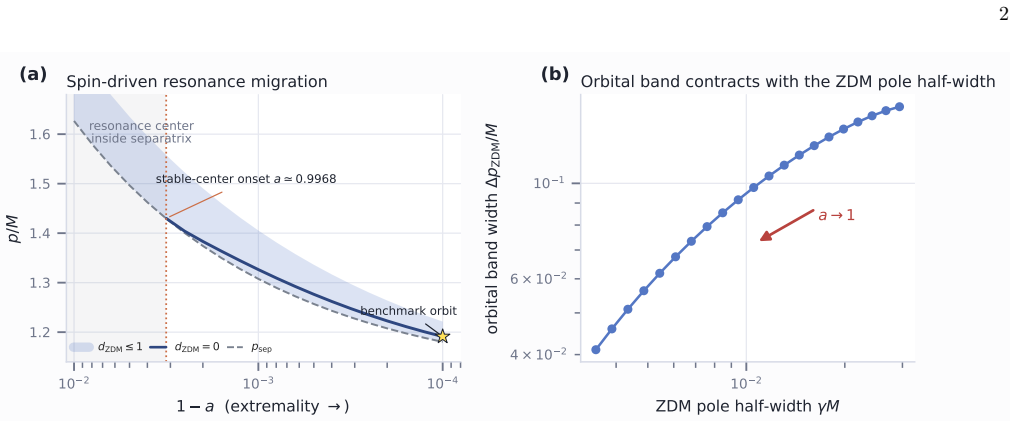
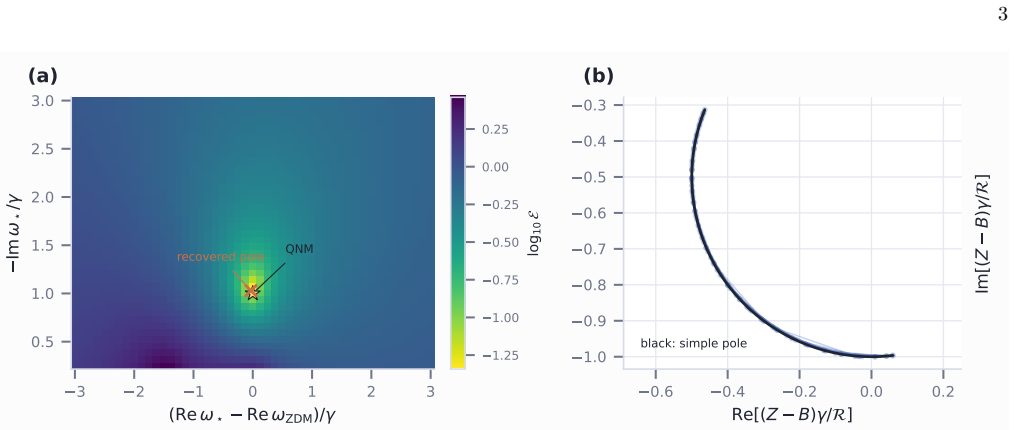
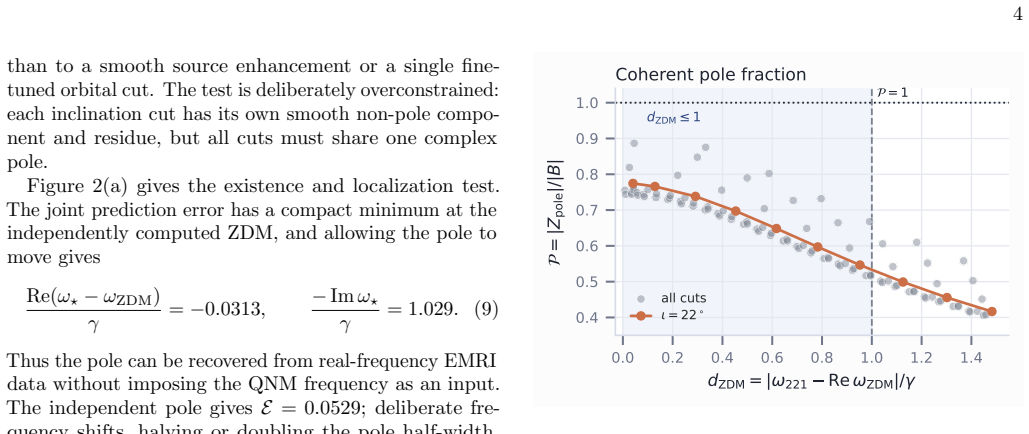
Bound extreme-mass-ratio inspirals can resonantly drive this response in vacuum general relativity. Using frequency-domain Teukolsky amplitudes for eccentric-inclined Kerr geodesics, we identify a source-supported orbital harmonic whose real frequency falls within one pole half-width of the fundamental gravitational ZDM. In the complex response, the pole contribution is enhanced by this small half-width, while complex-response tomography recovers the independently computed Kerr pole from real-frequency orbital data. After subtracting the smooth non-pole component, the residual exhibits the phase winding of a coherent simple pole, with a pole contribution comparable to the smooth non-pole par
What carries the argument
The resonant alignment between a source-supported orbital harmonic in the EMRI Teukolsky amplitude and the fundamental gravitational zero-damped mode, with enhancement of the pole contribution by the small half-width.
If this is right
- The pole contribution in the complex response becomes comparable to the smooth non-pole part of the EMRI-sourced amplitude.
- Complex-response tomography recovers the Kerr pole parameters directly from real-frequency orbital data.
- The residual after subtraction shows the phase winding characteristic of a coherent simple pole.
- The driven response lies in the superradiant regime and produces negative horizon flux.
- The recovered pole half-width provides a route to measuring the horizon surface gravity.
Where Pith is reading between the lines
- EMRI signals observed by future detectors could contain extractable information about near-horizon geometry through this resonant channel.
- The tomography technique might be applied to other perturbation problems where real-frequency data must isolate a nearby complex pole.
- Negative horizon flux during the resonance could back-react on the orbital evolution in ways not captured by the vacuum calculation.
Load-bearing premise
A source-supported orbital harmonic exists whose real frequency lies within one pole half-width of the fundamental gravitational zero-damped mode.
What would settle it
A frequency-domain calculation showing that no EMRI orbital harmonic for eccentric-inclined geodesics falls within one pole half-width of the ZDM, or that the residual Teukolsky amplitude after smooth-component subtraction lacks the phase winding of a simple pole.
Figures
read the original abstract
Near-extremal Kerr black holes support zero-damped modes (ZDMs), whose small time-domain damping rates make them long-lived probes of the near-horizon region. We show that bound extreme-mass-ratio inspirals (EMRIs) can resonantly drive this response in vacuum general relativity. Using frequency-domain Teukolsky amplitudes for eccentric-inclined Kerr geodesics, we identify a source-supported orbital harmonic whose real frequency falls within one pole half-width of the fundamental gravitational ZDM. In the complex response, the pole contribution is enhanced by this small half-width, while complex-response tomography recovers the independently computed Kerr pole from real-frequency orbital data. After subtracting the smooth non-pole component, the residual exhibits the phase winding of a coherent simple pole, with a pole contribution comparable to the smooth non-pole part of the EMRI-sourced Teukolsky amplitude. The driven branch also lies in the superradiant regime and carries negative horizon flux. These results establish a pole-resolved, resonantly driven ZDM response by EMRIs and make the recovered pole half-width a route to measuring the horizon surface gravity.
Editorial analysis
A structured set of objections, weighed in public.
Referee Report
Summary. The manuscript claims that bound extreme-mass-ratio inspirals (EMRIs) can resonantly drive the long-lived zero-damped modes (ZDMs) of near-extremal Kerr black holes in vacuum GR. Frequency-domain Teukolsky amplitudes for eccentric-inclined geodesics are used to identify a source-supported orbital harmonic whose real frequency lies within one pole half-width of the fundamental gravitational ZDM. The pole contribution is thereby enhanced, complex-response tomography recovers the independently computed Kerr pole from real-frequency orbital data, the residual after subtracting the smooth component exhibits the phase winding of a coherent simple pole, and the driven branch lies in the superradiant regime with negative horizon flux. The recovered pole half-width is proposed as a route to measuring the horizon surface gravity.
Significance. If the resonance condition is explicitly verified, the work would establish a concrete, pole-resolved mechanism by which EMRIs resonantly excite ZDMs, linking EMRI dynamics to near-horizon physics and offering a potential observable signature of the horizon surface gravity. The complex-response tomography technique for extracting the pole location from real-frequency data is a useful technical contribution. The approach uses geodesic sources without additional free parameters beyond the Kerr background.
major comments (1)
- [Abstract] Abstract: The central claim requires a source-supported orbital harmonic satisfying |Re(ω_orb) − ω_ZDM| ≲ |Im(ω_ZDM)|. The abstract asserts that such a harmonic is identified via Teukolsky amplitudes, yet provides no explicit numerical values for the frequencies, the ZDM half-width, or the resulting detuning ratio. Because the stated pole enhancement, the tomography recovery, and the negative horizon flux all scale directly with how small this detuning is, the manuscript must supply these quantities (with error estimates) to substantiate the resonance condition.
minor comments (1)
- [Abstract] The abstract would benefit from a single sentence stating the specific near-extremal spin value a/M and the numerical detuning achieved, to allow immediate assessment of the resonance claim.
Simulated Author's Rebuttal
We thank the referee for the positive assessment of our manuscript and for the constructive comment on the abstract. We address the point below.
read point-by-point responses
-
Referee: [Abstract] Abstract: The central claim requires a source-supported orbital harmonic satisfying |Re(ω_orb) − ω_ZDM| ≲ |Im(ω_ZDM)|. The abstract asserts that such a harmonic is identified via Teukolsky amplitudes, yet provides no explicit numerical values for the frequencies, the ZDM half-width, or the resulting detuning ratio. Because the stated pole enhancement, the tomography recovery, and the negative horizon flux all scale directly with how small this detuning is, the manuscript must supply these quantities (with error estimates) to substantiate the resonance condition.
Authors: We agree that the abstract would benefit from explicit numerical values to make the resonance condition transparent. The full manuscript contains the relevant Teukolsky amplitudes and pole locations, from which the detuning ratio can be computed directly. In the revised version we will augment the abstract with the specific real frequencies of the orbital harmonic and ZDM, the ZDM half-width, the resulting detuning ratio, and associated error estimates obtained from our frequency-domain calculations. revision: yes
Circularity Check
No significant circularity; numerical resonance identification and independent pole recovery are self-contained
full rationale
The paper numerically locates a source-supported orbital harmonic (via frequency-domain Teukolsky amplitudes on eccentric-inclined geodesics) whose real frequency satisfies the resonance condition |Re(ω_orb) − ω_ZDM| ≲ |Im(ω_ZDM)|. It then demonstrates pole enhancement in the complex response and recovers the Kerr pole location via tomography applied to real-frequency orbital data. The abstract explicitly states recovery of an 'independently computed Kerr pole,' and no equations reduce a claimed prediction or uniqueness result to a fitted parameter or self-citation by construction. The derivation chain consists of explicit numerical matching rather than definitional equivalence or load-bearing self-reference.
Axiom & Free-Parameter Ledger
axioms (2)
- standard math Teukolsky equation governs linear perturbations of Kerr spacetime
- domain assumption Vacuum general relativity
Reference graph
Works this paper leans on
-
[1]
W. Schmidt, Celestial mechanics in kerr spacetime, Clas- sical and Quantum Gravity19, 2743 (2002), arXiv:gr- qc/0202090
arXiv 2002
-
[2]
S. Drasco and S. A. Hughes, Rotating black hole orbit functionals in the frequency domain, Physical Review D 69, 044015 (2004), arXiv:astro-ph/0308479
Pith/arXiv arXiv 2004
-
[3]
R. Fujita and W. Hikida, Analytical solutions of bound timelike geodesic orbits in kerr spacetime, Classical and Quantum Gravity26, 135002 (2009), arXiv:0906.1420 [gr-qc]
Pith/arXiv arXiv 2009
-
[4]
F. D. Ryan, Gravitational waves from the inspiral of a compact object into a massive, axisymmetric body with arbitrary multipole moments, Physical Review D52, 5707 (1995)
1995
-
[5]
L. Barack and C. Cutler, LISA capture sources: Approx- imate waveforms, signal-to-noise ratios, and parameter estimation accuracy, Physical Review D69, 082005 (2004), arXiv:gr-qc/0310125
Pith/arXiv arXiv 2004
-
[6]
J. R. Gair, M. Vallisneri, S. L. Larson, and J. G. Baker, Testing general relativity with low-frequency, space-based gravitational-wave detectors, Living Reviews in Relativity 16, 7 (2013), arXiv:1212.5575 [gr-qc]
Pith/arXiv arXiv 2013
-
[7]
P. Amaro-Seoaneet al., Laser interferometer space an- tenna, arXiv e-prints (2017), arXiv:1702.00786 [astro- ph.IM]
Pith/arXiv arXiv 2017
-
[8]
S. Babak, J. Gair, A. Sesana, E. Barausse, C. F. Sopuerta, C. P. L. Berry, E. Berti, P. Amaro-Seoane, A. Petiteau, and A. Klein, Science with the space-based interferometer LISA. v. extreme mass-ratio inspirals, Physical Review D 95, 103012 (2017), arXiv:1703.09722 [gr-qc]
Pith/arXiv arXiv 2017
-
[9]
S. A. Teukolsky, Perturbations of a rotating black hole. i. fundamental equations for gravitational, electromag- netic, and neutrino-field perturbations, The Astrophysical Journal185, 635 (1973)
1973
-
[10]
Detweiler, Black holes and gravitational waves
S. Detweiler, Black holes and gravitational waves. iii. the resonant frequencies of rotating holes, The Astrophysical Journal239, 292 (1980)
1980
-
[11]
E. W. Leaver, An analytic representation for the quasi- normal modes of kerr black holes, Proceedings of the Royal Society of London. Series A402, 285 (1985)
1985
-
[12]
E. Berti, V. Cardoso, and A. O. Starinets, Quasinormal modes of black holes and black branes, Classical and Quantum Gravity26, 163001 (2009), arXiv:0905.2975 [gr-qc]
Pith/arXiv arXiv 2009
-
[13]
H. Yang, A. Zimmerman, A. Zengino˘ glu, F. Zhang, E. Berti, and Y. Chen, Quasinormal modes of nearly ex- tremal kerr spacetimes: spectrum bifurcation and power- law ringdown, Physical Review D87, 041502 (2013), arXiv:1212.3271 [gr-qc]
Pith/arXiv arXiv 2013
-
[14]
J. M. Bardeen, B. Carter, and S. W. Hawking, The four laws of black hole mechanics, Communications in Mathe- matical Physics31, 161 (1973)
1973
-
[15]
S. W. Hawking, Particle creation by black holes, Commu- nications in Mathematical Physics43, 199 (1975)
1975
-
[16]
J. Thornburg, B. Wardell, and M. van de Meent, Exci- tation of kerr quasinormal modes in extreme-mass-ratio inspirals, Physical Review Research2, 013365 (2020), arXiv:1906.06791 [gr-qc]
arXiv 2020
-
[17]
W. H. Press and S. A. Teukolsky, Floating orbits, super- radiant scattering and the black-hole bomb, Nature238, 211 (1972)
1972
-
[18]
S. A. Teukolsky and W. H. Press, Perturbations of a rotating black hole. iii. interaction of the hole with gravi- tational and electromagnetic radiation, The Astrophysical Journal193, 443 (1974)
1974
-
[19]
S. A. Hughes, Evolution of circular, nonequatorial orbits of kerr black holes due to gravitational-wave emission, Phys- ical Review D61, 084004 (2000), arXiv:gr-qc/9910091
Pith/arXiv arXiv 2000
-
[20]
G. B. Cook and M. Zalutskiy, qnm: Python routines for kerr quasinormal modes (2020)
2020
-
[21]
Black Hole Perturbation Toolkit contributors, pybhpt: Python tools for black-hole perturbation theory (2026)
2026
-
[22]
S. R. Green, S. Hollands, L. Sberna, V. Toomani, and P. Zimmerman, Conserved currents for kerr and orthog- onality of quasinormal modes, Physical Review D107, 064030 (2023), arXiv:2210.15935 [gr-qc]. 6 SUPPLEMENT AL MA TERIAL BRANCH SELECTION AND NEAR-HORIZON CONTINUA TION The low-order prescreen tests whether a sourced EMRI harmonic can enter one ZDM pol...
arXiv 2023
discussion (0)
Sign in with ORCID, Apple, or X to comment. Anyone can read and Pith papers without signing in.