Influence of Ultramicroporosity and Surface Chemistry on Dynamic CO2 Capture in Activated Carbons
Pith reviewed 2026-06-26 23:48 UTC · model grok-4.3
The pith
A biomass-derived activated carbon with more ultramicropores and oxygen groups achieves higher dynamic CO2 capture than a coal-derived carbon with greater total porosity.
A machine-rendered reading of the paper's core claim, the machinery that carries it, and where it could break.
Core claim
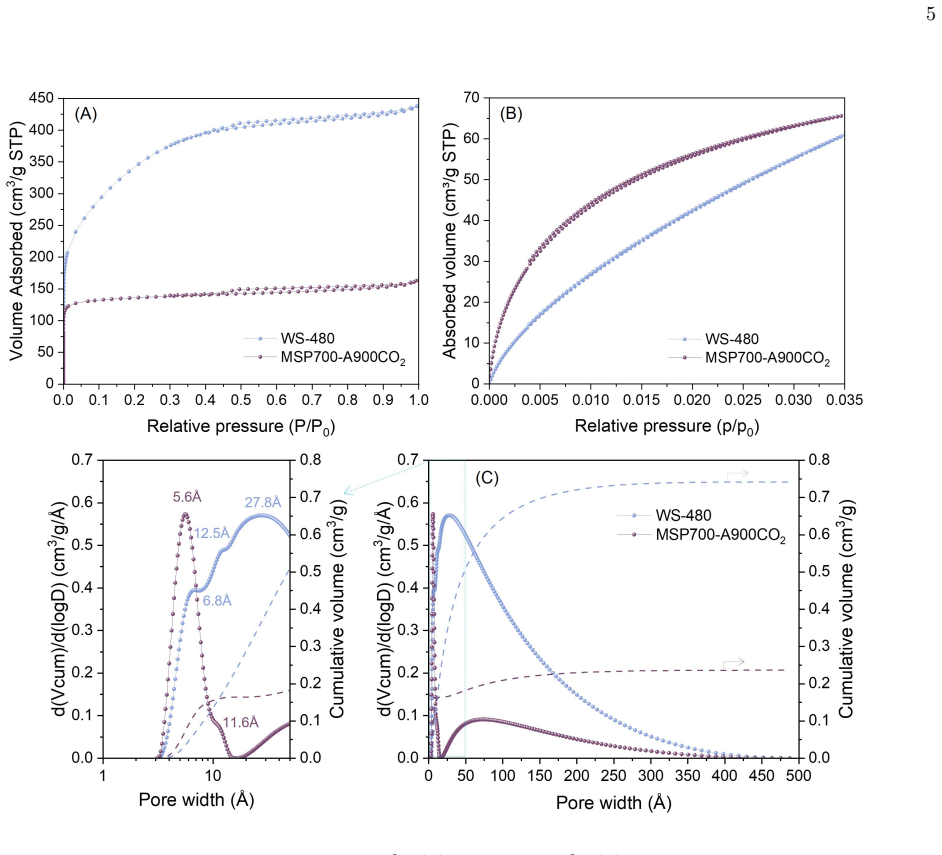
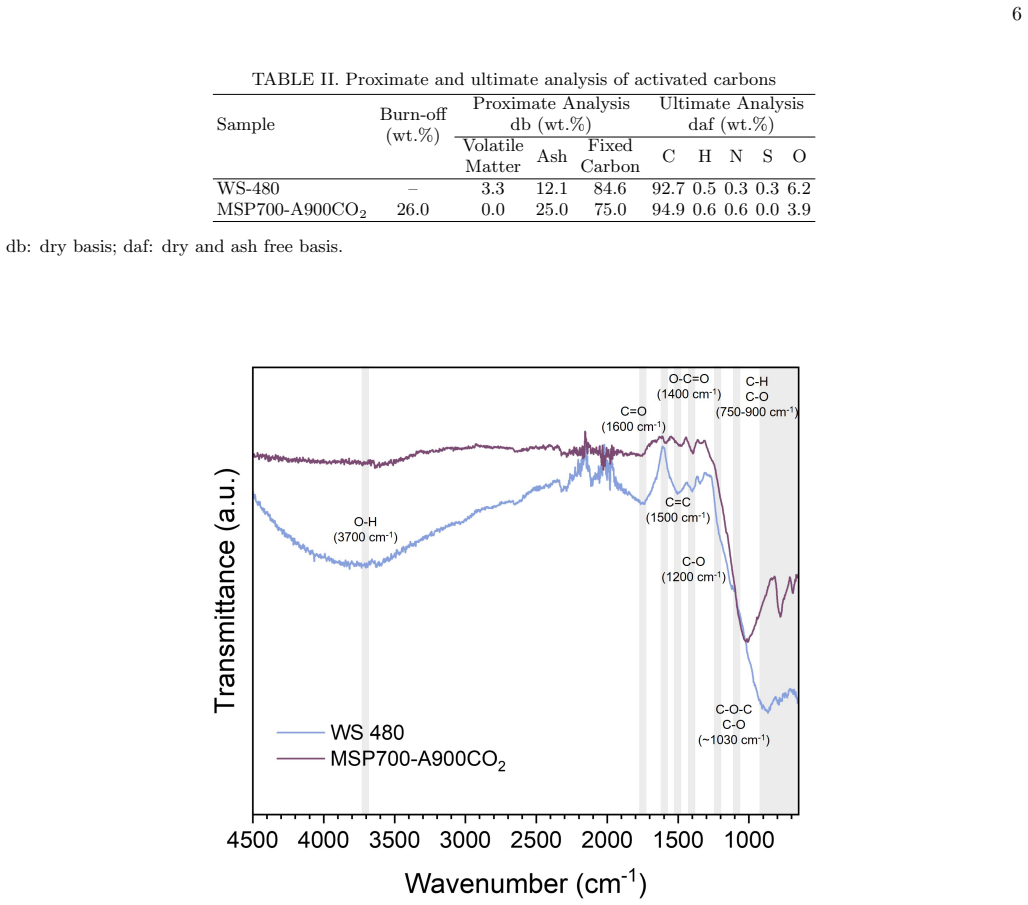
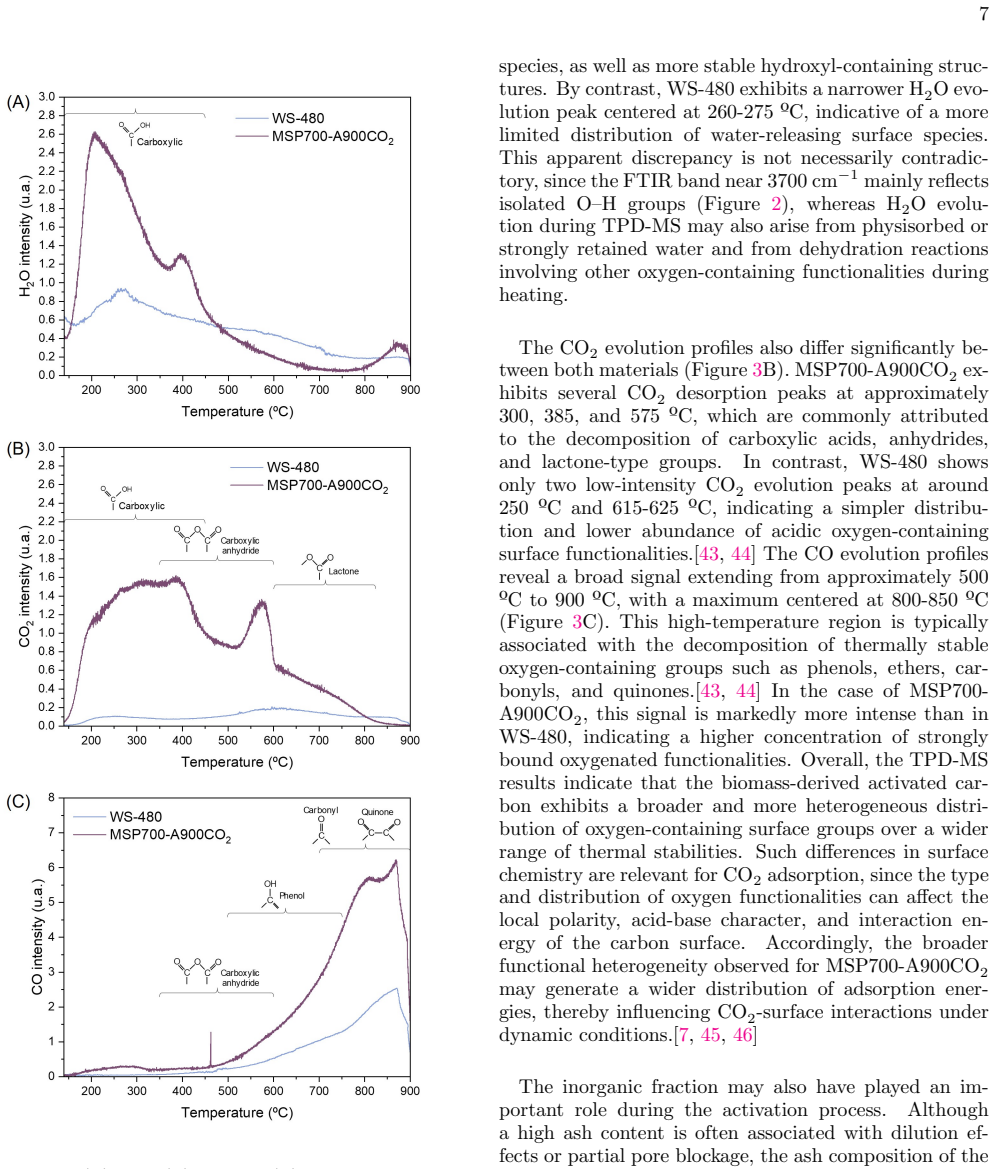
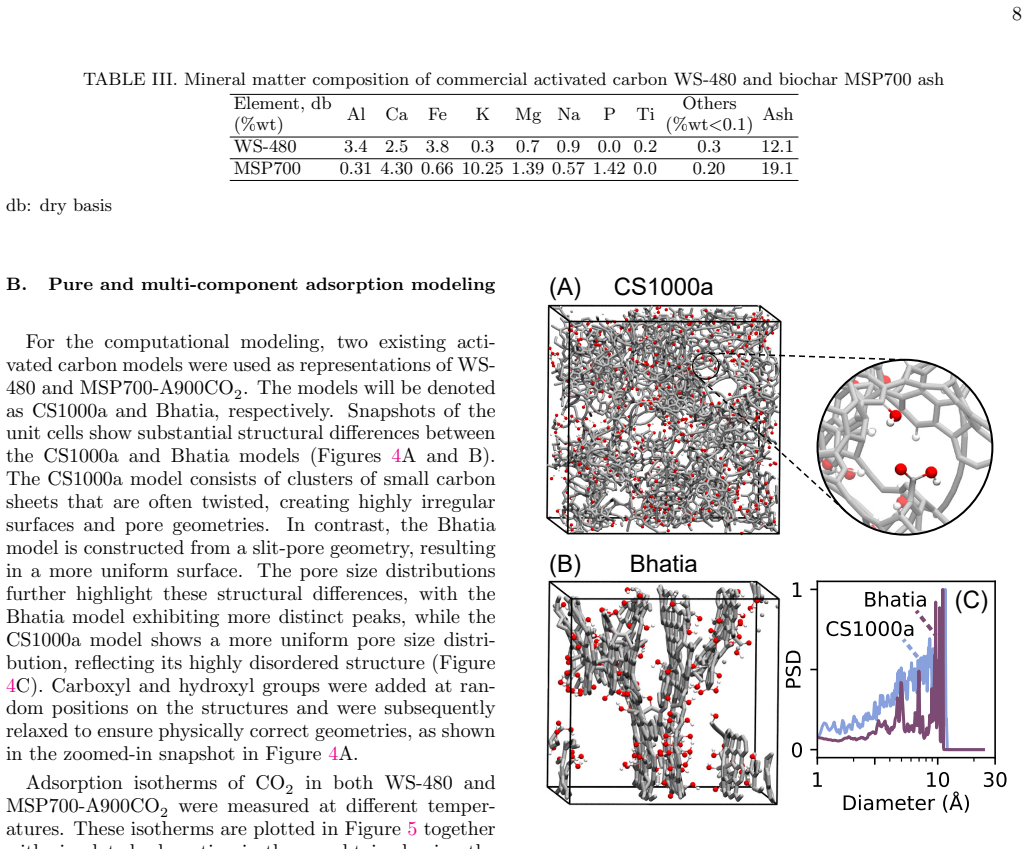
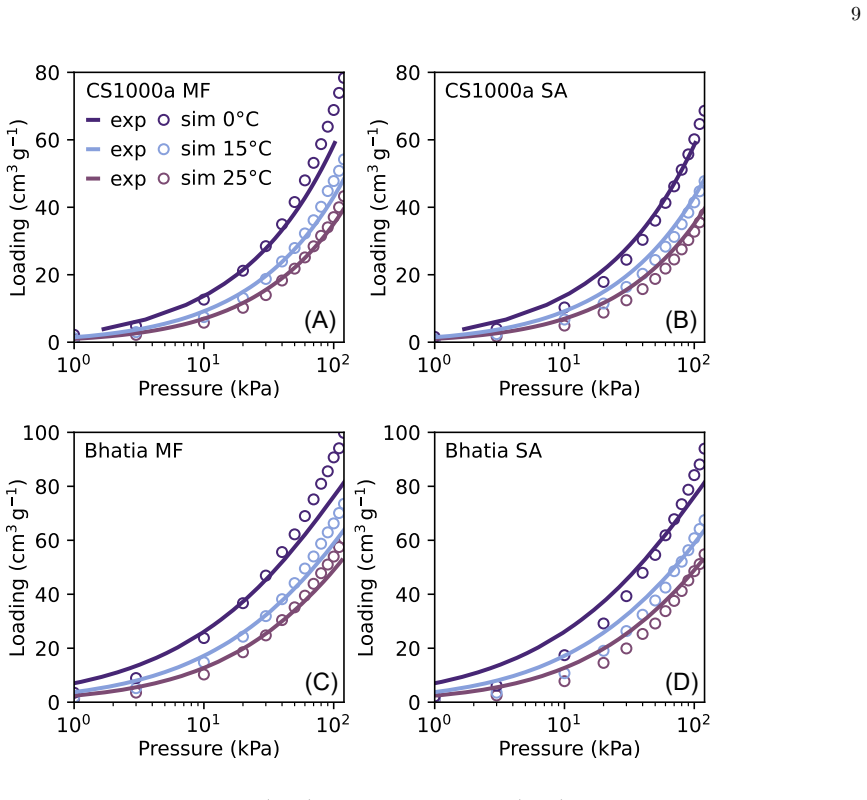
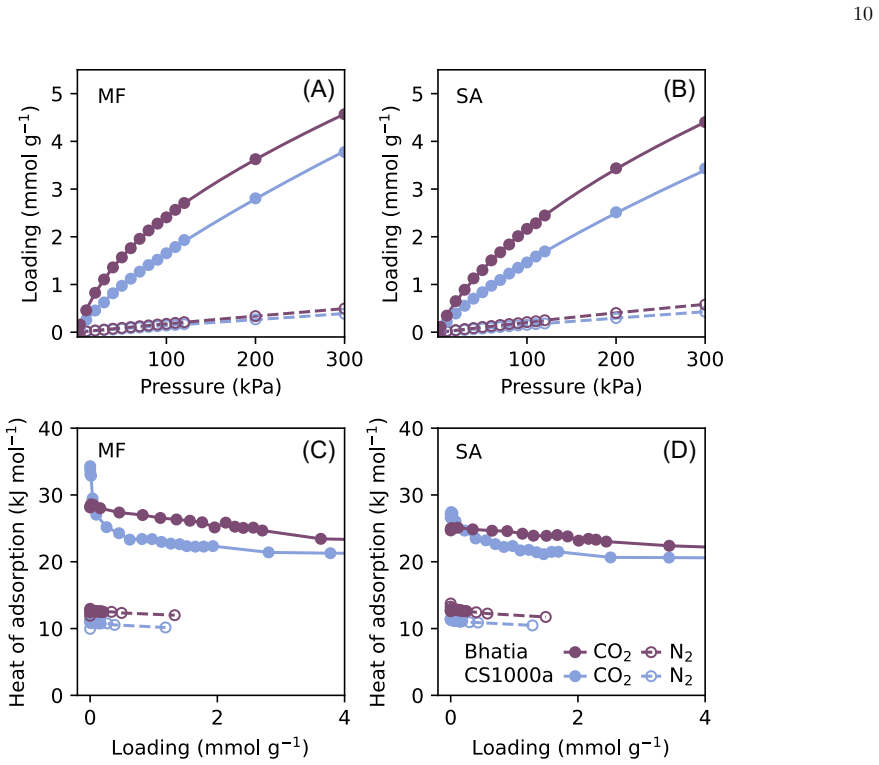
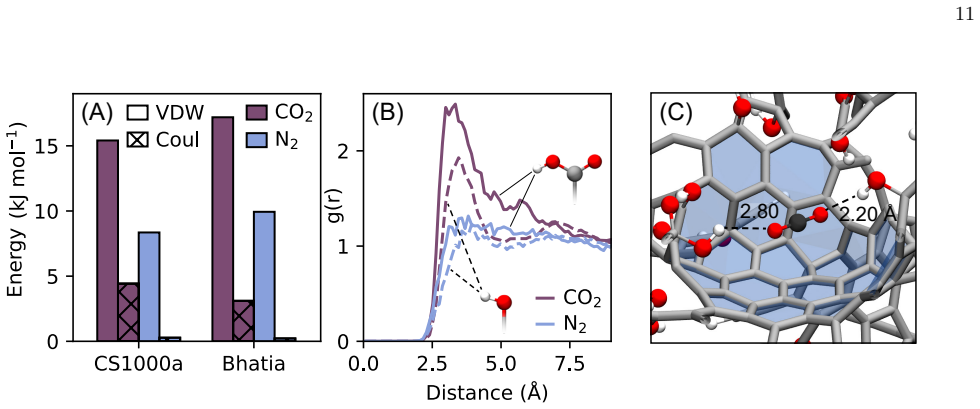
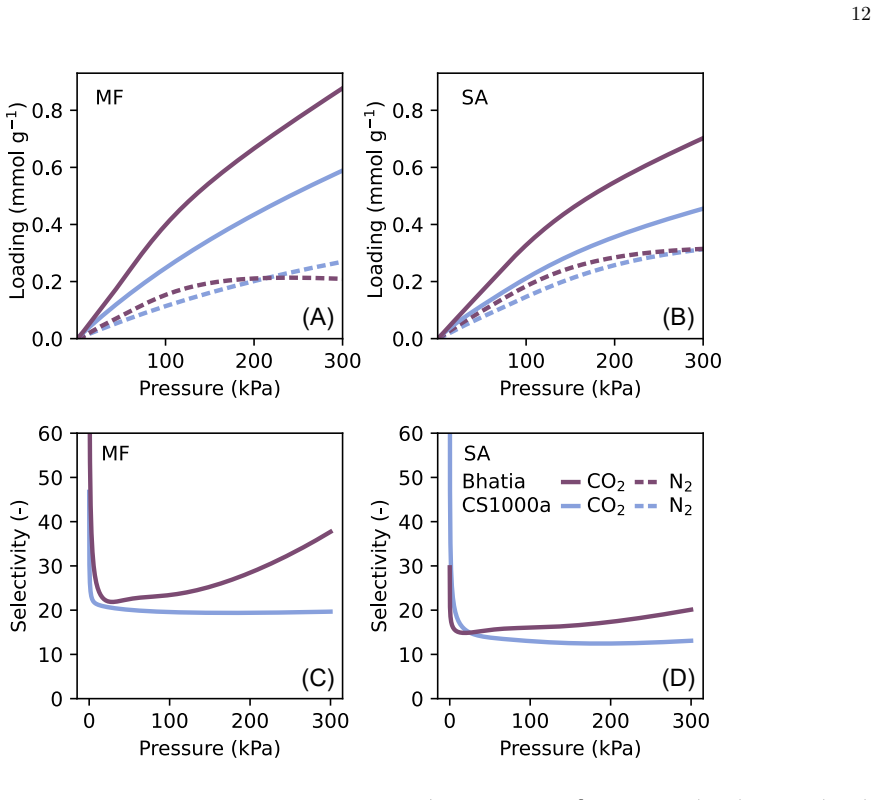
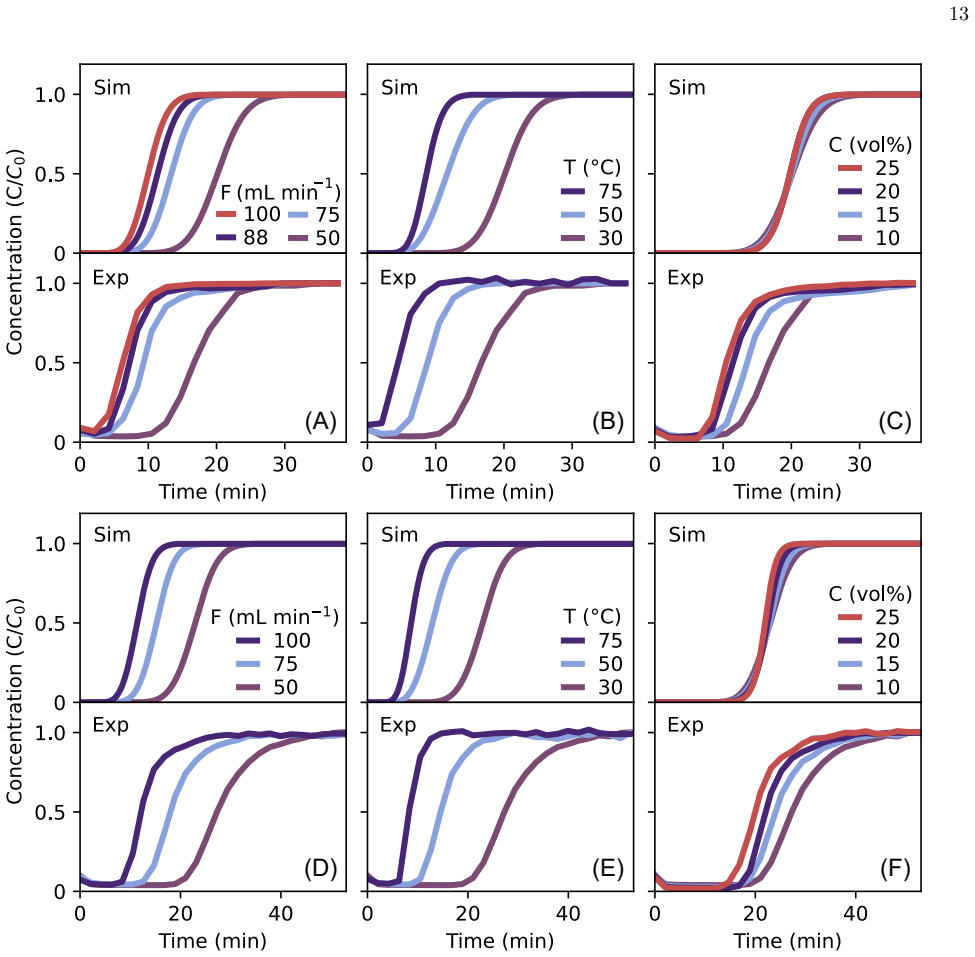
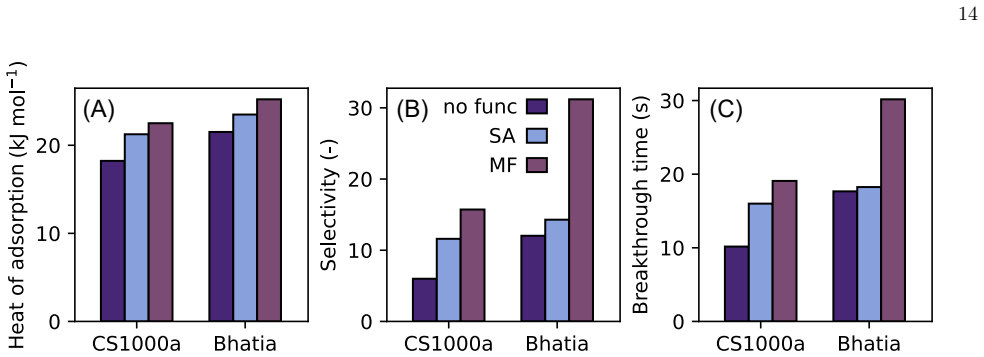
Although WS-480 has higher total porosity, MSP700-A900CO2 contains a larger fraction of ultramicropores below 0.7 nm and a broader distribution of oxygen-containing functional groups; these two features produce higher CO2 adsorption capacities in fixed-bed breakthrough experiments. Atomistic models augmented with surface functional groups match experimental equilibrium data for both carbons and, once validated, reproduce the experimental dynamic breakthrough curves while supplying molecular-level insight into the separate roles of pore structure and surface chemistry.
What carries the argument
The fraction of ultramicropores narrower than 0.7 nm together with the distribution of oxygen-containing functional groups, represented in atomistic carbon models that incorporate these groups.
If this is right
- The biomass carbon delivers higher CO2 capacities than the coal carbon in fixed-bed breakthrough tests at varied flow rates, temperatures, and inlet concentrations.
- Validated atomistic models successfully predict both equilibrium uptake and dynamic separation performance for the two carbons.
- Pore-size distribution below 0.7 nm and surface oxygen groups exert stronger control over dynamic CO2 uptake than total porosity alone.
Where Pith is reading between the lines
- Activation protocols that increase the share of ultramicropores while preserving oxygen groups could be prioritized when developing carbons for post-combustion capture.
- Biomass feedstocks may provide a route to carbons with favorable ultramicropore fractions if activation conditions are tuned accordingly.
- The models imply that screening candidate carbons by ultramicropore volume and oxygen-group density could reduce the need for full dynamic testing.
Load-bearing premise
The atomistic models with added functional groups accurately represent the real materials' ultramicroporosity and surface chemistry so that agreement with equilibrium data extends to dynamic breakthrough behavior.
What would settle it
Breakthrough experiments in which the coal-derived carbon with higher total porosity captured more CO2 than the biomass carbon under identical flow, temperature, and concentration conditions would falsify the claim.
Figures
read the original abstract
Activated carbons are promising adsorbents for post-combustion CO2 capture due to their high surface area, tunable microporosity, and resistance to moisture and flue-gas impurities. Despite extensive equilibrium adsorption studies, the dynamic behavior of activated carbons under fixed-bed operating conditions relevant to post-combustion CO2/N2 remains insufficiently understood, particularly for renewable materials. In this work, the adsorption and separation behavior of CO2/N2 mixtures on a commercial coal-derived activated carbon (WS-480) and a biomass-based activated carbon (MSP700-A900CO2) is comparatively evaluated by combining experimental measurements and simulations. We examine the physicochemical properties of both materials, revealing that although WS-480 exhibits a higher of porosity, MSP700-A900CO2 contains a larger fraction of ultramicropores (<0.7 nm) and a broader distribution of oxygen-containing functional groups. These characteristics result in higher CO2 adsorption capacities for MSP700-A900CO2 in fixed-bed breakthrough experiments conducted under varying flow rates, temperatures and CO2 concentrations. We employ atomistic activated carbon models, augmented with surface functional groups as representations of WS-480 and MSP700-A900CO2, achieving close agreement with experimental adsorption data. The validated models are subsequently used to predict CO2/N2 separation under equilibrium and dynamic conditions, reproducing the experimental breakthrough behavior while providing molecular-level insight into the influence of pore structure and surface chemistry on adsorption performance.
Editorial analysis
A structured set of objections, weighed in public.
Referee Report
Summary. The manuscript compares CO2/N2 adsorption and separation on coal-derived WS-480 and biomass-derived MSP700-A900CO2 activated carbons via fixed-bed breakthrough experiments and atomistic modeling. It reports that MSP700-A900CO2 exhibits higher dynamic CO2 capacities despite lower total porosity, attributing this to a larger ultramicropore fraction (<0.7 nm) and broader oxygen-containing functional groups. Atomistic models augmented with surface groups are stated to achieve close agreement with experimental equilibrium adsorption data and to reproduce the experimental breakthrough behavior, providing molecular insight into structure-performance relationships.
Significance. If the atomistic models link ultramicroporosity and surface chemistry directly to both equilibrium and dynamic performance without independent kinetic fitting, the work would strengthen understanding of renewable carbons for post-combustion capture and offer a template for structure-based material design.
major comments (1)
- [Abstract] Abstract: the statement that 'the validated models are subsequently used to predict CO2/N2 separation under equilibrium and dynamic conditions, reproducing the experimental breakthrough behavior' is load-bearing for the central claim. Without explicit description of whether the dynamic fixed-bed simulations employ only the GCMC isotherms or require separate mass-transfer coefficients, diffusivities, or axial dispersion terms, it is unclear whether the reported material characteristics (ultramicropore fraction and oxygen groups) suffice to explain the breakthrough results or whether additional fitted parameters are involved.
minor comments (1)
- [Abstract] Abstract: 'higher of porosity' is presumably a typographical error for 'higher total porosity'.
Simulated Author's Rebuttal
We thank the referee for the constructive feedback on our manuscript. The single major comment raises a valid point about clarity in the abstract regarding the dynamic modeling approach. We address it directly below and will revise the manuscript accordingly.
read point-by-point responses
-
Referee: [Abstract] Abstract: the statement that 'the validated models are subsequently used to predict CO2/N2 separation under equilibrium and dynamic conditions, reproducing the experimental breakthrough behavior' is load-bearing for the central claim. Without explicit description of whether the dynamic fixed-bed simulations employ only the GCMC isotherms or require separate mass-transfer coefficients, diffusivities, or axial dispersion terms, it is unclear whether the reported material characteristics (ultramicropore fraction and oxygen groups) suffice to explain the breakthrough results or whether additional fitted parameters are involved.
Authors: We agree that the abstract lacks sufficient detail on this point and appreciate the opportunity to clarify. The dynamic fixed-bed simulations employ a standard 1D plug-flow reactor model that uses only the equilibrium CO2/N2 isotherms from GCMC on the atomistic models (augmented with surface groups) as input. Axial dispersion and mass-transfer coefficients are estimated from established literature correlations (e.g., Wakao-Funazkri for dispersion, standard Sherwood correlations for film resistance) without any independent fitting of kinetic parameters to the experimental breakthrough curves. The reproduction of the measured breakthrough behavior therefore arises directly from the differences in ultramicropore fraction and oxygen functional groups captured in the GCMC isotherms. We will revise the abstract and add an explicit statement in the methods section to document this approach. revision: yes
Circularity Check
No significant circularity; experimental breakthrough data independently grounds central claim
full rationale
The paper's strongest claim attributes higher dynamic CO2 capacities in MSP700-A900CO2 to its measured ultramicropore fraction and oxygen functional groups, directly supported by fixed-bed breakthrough experiments under varying conditions. Atomistic models are validated on equilibrium isotherms and then applied to dynamic cases, but the reproduction of breakthrough curves functions as post-validation insight rather than the load-bearing evidence. No derivation step reduces a 'prediction' to a fitted parameter by construction, invokes self-citation for uniqueness, or renames a known result. The experimental measurements of porosity, pore-size distribution, surface chemistry, and breakthrough capacities remain independent of the simulation chain.
Axiom & Free-Parameter Ledger
Reference graph
Works this paper leans on
-
[1]
Raganati, F
F. Raganati, F. Miccio, and P. Ammendola, Adsorption of Carbon Dioxide for Post-combustion Capture: A Re- view, Energy & Fuels.35, 12845 (2021)
2021
-
[2]
B. Wen, Y. Li, C. Liang, Y. Chen, Y. Zhao, and Q. Wang, Recent Progress on Porous Carbons for Carbon Capture, Langmuir40, 8327 (2024). 16
2024
-
[3]
Gonz´ alez, M
A. Gonz´ alez, M. Plaza, F. Rubiera, and C. Pevida, Sustainable biomass-based carbon adsorbents for post- combustion CO2 capture, Chem. Eng. J.230, 456 (2013)
2013
-
[4]
Ibrahim, B
S. Ibrahim, B. H. Hameed, and F. A. Almomani, Review on recent progress in post-combustion carbon dioxide capture using carbonaceous and non-carbonaceous mate- rials in fixed-bed adsorption column, J. Environ. Chem. Eng.13, 114952 (2025)
2025
-
[5]
Sevilla and A
M. Sevilla and A. B. Fuertes, Sustainable porous carbons with a superior performance for CO 2 capture, Energy Environ. Sci.4, 1765 (2011)
2011
-
[6]
Presser, J
V. Presser, J. McDonough, S.-H. Yeon, and Y. Gogotsi, Effect of pore size on carbon dioxide sorption by carbide derived carbon, Energy Environ. Sci.4, 3059 (2011)
2011
-
[7]
Kundu, T
S. Kundu, T. Khandaker, M. A.-A. M. Anik, M. K. Hasan, P. K. Dhar, S. K. Dutta, M. A. Latif, and M. S. Hossain, A comprehensive review of enhanced CO 2 cap- ture using activated carbon derived from biomass feed- stock, RSC Adv.14, 29693 (2024)
2024
-
[8]
Jedli, M
H. Jedli, M. Almonnef, R. Rabhi, M. Mbarek, J. Ab- dessalem, and K. Slimi, Activated Carbon as an Adsor- bent for CO 2 Capture: Adsorption, Kinetics, and RSM Modeling, ACS Omega9, 2080 (2024)
2080
-
[9]
A. K. Senthilkumar, M. Kumar, M. A. Kader, M. Shkir, and J.-H. Chang, Unveiling the CO2 adsorption capabili- ties of carbon nanostructures from biomass waste: An ex- tensive review, Carbon Capture Sci. Technol.14, 100339 (2025)
2025
-
[10]
Plaza, C
M. Plaza, C. Pevida, B. Arias, J. Fermoso, M. Casal, C. Mart´ ın, F. Rubiera, and J. Pis, Development of low- cost biomass-based adsorbents for postcombustion CO 2 capture, Fuel88, 2442 (2009)
2009
-
[11]
X. Y. D. Soo, J. J. C. Lee, W.-Y. Wu, L. Tao, C. Wang, Q. Zhu, and J. Bu, Advancements in CO 2 capture by absorption and adsorption: A comprehensive review, J. CO2 Util.81, 102727 (2024)
2024
-
[12]
Jaria, V
G. Jaria, V. Calisto, V. I. Esteves, and M. Otero, Overview of relevant economic and environmental as- pects of waste-based activated carbons aimed at ad- sorptive water treatments, J. Clean. Prod.344, 130984 (2022)
2022
-
[13]
E. H. Al-Ghurabi, M. M. Boumaza, W. Al-Masry, and M. Asif, Optimizing the synthesis of nanoporous acti- vated carbon from date-palm waste for enhanced CO 2 capture, Sci. Rep.15, 17132 (2025)
2025
-
[14]
Karimi, M
M. Karimi, M. Shirzad, J. A. C. Silva, and A. E. Ro- drigues, Carbon dioxide separation and capture by ad- sorption: a review, Environ. Chem. Lett.21, 2041 (2023)
2041
-
[15]
Sircar, Basic Research Needs for Design of Adsorptive Gas Separation Processes, Ind
S. Sircar, Basic Research Needs for Design of Adsorptive Gas Separation Processes, Ind. Eng. Chem. Res.45, 5435 (2006)
2006
-
[16]
Ishii and T
T. Ishii and T. Kyotani, Temperature Programmed Des- orption, inMaterials Science and Engineering of Carbon (Elsevier, 2016) pp. 287–305
2016
-
[17]
Jagiello, J
J. Jagiello, J. Kenvin, A. Celzard, and V. Fierro, En- hanced resolution of ultra micropore size determination of biochars and activated carbons by dual gas analysis using N 2 and CO 2 with 2D-NLDFT adsorption models, Carbon144, 206 (2019)
2019
-
[18]
Palmer, A
J. Palmer, A. Llobet, S.-H. Yeon, J. Fischer, Y. Shi, Y. Gogotsi, and K. Gubbins, Modeling the structural evo- lution of carbide-derived carbons using quenched molec- ular dynamics, Carbon48, 1116 (2010)
2010
-
[19]
S. K. Bhatia, Characterizing Structural Complexity in Disordered Carbons: From the Slit Pore to Atomistic Models, Langmuir33, 831 (2017)
2017
-
[20]
Thyagarajan and D
R. Thyagarajan and D. S. Sholl, A Database of Porous Rigid Amorphous Materials, Chem. Mater.32, 8020 (2020)
2020
-
[21]
S. K. Jain, R. J.-M. Pellenq, J. P. Pikunic, and K. E. Gubbins, Molecular Modeling of Porous Carbons Using the Hybrid Reverse Monte Carlo Method, Langmuir22, 9942 (2006)
2006
-
[22]
X. Peng, S. K. Jain, and J. K. Singh, Adsorption and Sep- aration of N 2/CH4/CO2/SO2 Gases in Disordered Car- bons Obtained Using Hybrid Reverse Monte Carlo Sim- ulations, J. Phys. Chem. C121, 13457 (2017)
2017
-
[23]
J. W. Wu, S. H. Madani, M. J. Biggs, P. Phillip, C. Lei, and E. J. Hu, Characterizations of Activated Car- bon–Methanol Adsorption Pair Including the Heat of Ad- sorptions, J. Chem. Eng. Data60, 1727 (2015)
2015
-
[24]
R. M. Madero-Castro, J. M. Vicent-Luna, X. Peng, and S. Calero, Adsorption of Linear Alcohols in Amorphous Activated Carbons: Implications for Energy Storage Ap- plications, ACS Sustain. Chem. Eng.10, 6509 (2022)
2022
-
[25]
T. X. Nguyen, N. Cohaut, J.-S. Bae, and S. K. Bhatia, New Method for Atomistic Modeling of the Microstruc- ture of Activated Carbons Using Hybrid Reverse Monte Carlo Simulation, Langmuir24, 7912 (2008)
2008
-
[26]
Chen and S
C. Chen and S. P. Ong, A universal graph deep learning interatomic potential for the periodic table, Nat. Com- put. Sci.2, 718 (2022)
2022
-
[27]
E. J. Baerends, N. F. Aguirre, N. D. Austin, J. Autschbach, F. M. Bickelhaupt, R. Bulo, C. Cap- pelli, A. C. T. Van Duin, F. Egidi, C. Fonseca Guerra, A. F¨ orster, M. Franchini, T. P. M. Goumans, T. Heine, M. Hellstr¨ om, C. R. Jacob, L. Jensen, M. Krykunov, E. Van Lenthe, A. Michalak, M. M. Mitoraj, J. Neuge- bauer, V. P. Nicu, P. Philipsen, H. Ramanant...
2025
-
[28]
Y. A. Ran, S. Sharma, S. R. G. Balestra, Z. Li, S. Calero, T. J. H. Vlugt, R. Q. Snurr, and D. Dubbeldam, RASPA3: A Monte Carlo code for computing adsorption and diffusion in nanoporous materials and thermody- namics properties of fluids, J. Chem. Phys.161, 114106 (2024)
2024
-
[29]
Jorge, C
M. Jorge, C. Schumacher, and N. A. Seaton, Simulation Study of the Effect of the Chemical Heterogeneity of Ac- tivated Carbon on Water Adsorption, Langmuir18, 9296 (2002)
2002
-
[30]
Garc´ ıa-S´ anchez, C
A. Garc´ ıa-S´ anchez, C. O. Ania, J. B. Parra, D. Dubbel- dam, T. J. H. Vlugt, R. Krishna, and S. Calero, Trans- ferable Force Field for Carbon Dioxide Adsorption in Ze- olites, J. Phys. Chem. C113, 8814 (2009)
2009
-
[31]
Mart´ ın-Calvo, E
A. Mart´ ın-Calvo, E. Garc´ ıa-P´ erez, A. Garc´ ıa-S´ anchez, R. Bueno-P´ erez, S. Hamad, and S. Calero, Effect of air humidity on the removal of carbon tetrachloride from air using Cu–BTC metal–organic framework, Phys. Chem. Chem. Phys.13, 11165 (2011)
2011
-
[32]
H. A. Lorentz, Ueber die Anwendung des Satzes vom Virial in der kinetischen Theorie der Gase, Ann. Phys. 248, 127 (1881)
-
[33]
Berthelot, Sur le m´ elange dez gas, Comptes
D. Berthelot, Sur le m´ elange dez gas, Comptes. Rendus. Acad. Sci.126, 1703 (1898). 17
-
[34]
Darden, D
T. Darden, D. York, and L. Pedersen, Particle mesh Ewald: AnNlog(N) method for Ewald sums in large systems, J. Chem. Phys.98, 10089 (1993)
1993
-
[35]
T. J. H. Vlugt, E. Garc´ ıa-P´ erez, D. Dubbeldam, S. Ban, and S. Calero, Computing the Heat of Adsorption using Molecular Simulations: The Effect of Strong Coulombic Interactions, J. Chem. Theory Comput.4, 1107 (2008)
2008
-
[36]
Czepirski and J
L. Czepirski and J. Jagie L Lo, Virial-type thermal equa- tion of gas—solid adsorption, Chem. Eng. Sci.44, 797 (1989)
1989
-
[37]
Nuhnen and C
A. Nuhnen and C. Janiak, A practical guide to calculate the isosteric heat/enthalpy of adsorption via adsorption isotherms in metal–organic frameworks, MOFs, Dalton Trans.49, 10295 (2020)
2020
-
[38]
Lucassen, A
H. Lucassen, A. Luna-Triguero, and J. M. Vicent-Luna, Mixture adsorption thermodynamics (2026)
2026
-
[39]
Sharma, S
S. Sharma, S. R. G. Balestra, R. Baur, U. Agarwal, E. Zuidema, M. S. Rigutto, S. Calero, T. J. H. Vlugt, and D. Dubbeldam, RUPTURA: simulation code for breakthrough, ideal adsorption solution theory compu- tations, and fitting of isotherm models, Mol. Simul.49, 893 (2023)
2023
-
[40]
Sips, On the Structure of a Catalyst Surface, J
R. Sips, On the Structure of a Catalyst Surface, J. Chem. Phys.16, 490 (1948)
1948
-
[41]
Silvestre-Albero, A
J. Silvestre-Albero, A. Silvestre-Albero, F. Rodr´ ıguez- Reinoso, and M. Thommes, Physical characterization of activated carbons with narrow microporosity by nitro- gen (77.4 K), carbon dioxide (273 K) and argon (87.3 K) adsorption in combination with immersion calorimetry, Carbon50, 3128 (2012)
2012
-
[42]
Thommes, K
M. Thommes, K. Kaneko, A. V. Neimark, J. P. Olivier, F. Rodriguez-Reinoso, J. Rouquerol, and K. S. Sing, Ph- ysisorption of gases, with special reference to the evalu- ation of surface area and pore size distribution (IUPAC Technical Report), Pure Appl. Chem.87, 1051 (2015)
2015
-
[43]
Figueiredo, M
J. Figueiredo, M. Pereira, M. Freitas, and J. ´Orf˜ ao, Mod- ification of the surface chemistry of activated carbons, Carbon37, 1379 (1999)
1999
-
[44]
Boehm, Surface oxides on carbon and their analysis: a critical assessment, Carbon40, 145 (2002)
H. Boehm, Surface oxides on carbon and their analysis: a critical assessment, Carbon40, 145 (2002)
2002
-
[45]
Petrovic, M
B. Petrovic, M. Gorbounov, and S. Masoudi Soltani, Im- pact of Surface Functional Groups and Their Introduc- tion Methods on the Mechanisms of CO 2 Adsorption on Porous Carbonaceous Adsorbents, Carbon Capture Sci. Technol.3, 100045 (2022)
2022
-
[46]
J. Chen, J. Zhou, W. Zheng, S. Leng, Z. Ai, W. Zhang, Z. Yang, J. Yang, Z. Xu, J. Cao, M. Zhang, L. Leng, and H. Li, A complete review on the oxygen-containing functional groups of biochar: Formation mechanisms, de- tection methods, engineering, and applications, Sci. Total Environ.946, 174081 (2024)
2024
-
[47]
Perander, N
M. Perander, N. DeMartini, A. Brink, J. Kramb, O. Karl- str¨ om, J. Hemming, A. Moilanen, J. Konttinen, and M. Hupa, Catalytic effect of Ca and K on CO 2 gasifi- cation of spruce wood char, Fuel150, 464 (2015)
2015
-
[48]
L. M. Romero Mill´ an, F. E. Sierra Vargas, and A. Nz- ihou, Catalytic Effect of Inorganic Elements on Steam Gasification Biochar Properties from Agrowastes, Energ. Fuels33, 8666 (2019)
2019
-
[49]
Y. Zhao, X. Liu, and Y. Han, Microporous carbonaceous adsorbents for CO 2 separation via selective adsorption, RSC Adv.5, 30310 (2015)
2015
-
[50]
Gooijer, S
S. Gooijer, S. Capelo-Avil´ es, S. Sharma, S. Giancola, J. R. Gal´ an-Mascaros, T. J. H. Vlugt, D. Dubbeldam, J. M. Vicent-Luna, and S. Calero, TAMOF-1 for cap- ture and separation of the main flue gas components, J. Mater. Chem. A13, 16879 (2025)
2025
-
[51]
J. Sun, H. Li, Q. Liu, W. Zhong, and W. Dong, Recent advances in biomass-derived porous carbons for post- combustion CO2 capture: From preparation and adsorp- tion mechanisms to applications, Chem. Eng. J.520, 165890 (2025)
2025
-
[52]
D. Dubbeldam, S. Calero, D. E. Ellis, and R. Q. Snurr, RASPA: molecular simulation software for adsorption and diffusion in flexible nanoporous materials, Mol. Simul.42, 81 (2016). 18 Supporting Information for Influence of Ultramicroporosity and Surface Chemistry on Dynamic CO2 Capture in Activated Carbons V. EXPERIMENTAL DETAILS Figure. S1. Images of ac...
discussion (0)
Sign in with ORCID, Apple, or X to comment. Anyone can read and Pith papers without signing in.