Learn to Quantify Social Interaction with Constraints for Pedestrian Walking
Pith reviewed 2026-06-27 01:13 UTC · model grok-4.3
The pith
A label-free probabilistic clustering method discovers social interaction patterns directly from pedestrian trajectories and folds them into trajectory forecasting.
A machine-rendered reading of the paper's core claim, the machinery that carries it, and where it could break.
Core claim
Social interactions in pedestrian walking can be quantified by treating them as probabilistic latent variables generated from sequential trajectory observations; the latent variables serve as learned labels that categorize interaction types and are integrated directly into the training of a trajectory prediction model, improving forecasts without requiring manual annotation.
What carries the argument
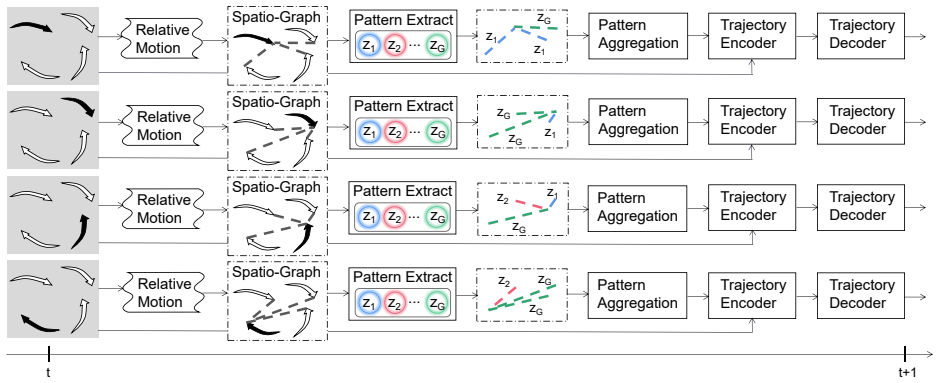
Learn to Cluster: a probabilistic latent-variable generative model trained directly on trajectory sequences that produces cluster assignments usable as interaction categories inside a downstream predictor.
If this is right
- Trajectory predictors can be trained end-to-end with automatically discovered interaction categories instead of hand-crafted social rules.
- The same latent-variable approach can be applied to any number of pedestrians without changing the model architecture.
- Prediction robustness increases because the model no longer relies on predefined interaction templates that may not cover all observed behaviors.
- The discovered categories can later be inspected to interpret which interaction types the predictor has learned to use.
Where Pith is reading between the lines
- If the latent clusters align with human-interpretable behaviors, downstream planners could condition their safety margins on the specific interaction type rather than a generic social term.
- The label-free property opens the possibility of applying the same clustering step to other sequential multi-agent datasets where interaction semantics are similarly hard to annotate.
- Because the method is generative, it may support sampling of plausible future interaction configurations rather than only point predictions.
Load-bearing premise
The latent variables recovered from trajectories correspond to distinct, causally meaningful categories of social interaction that actually shape pedestrian decisions.
What would settle it
A controlled test in which the learned latent assignments show no statistical association with observable interaction events (such as collision avoidance or group following) and yield no measurable gain in prediction accuracy when inserted into the forecasting model.
Figures


read the original abstract
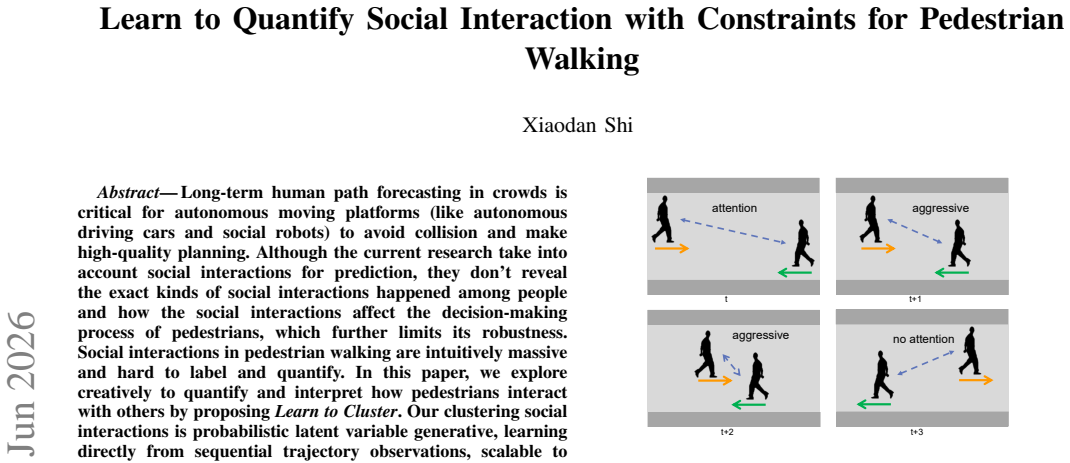
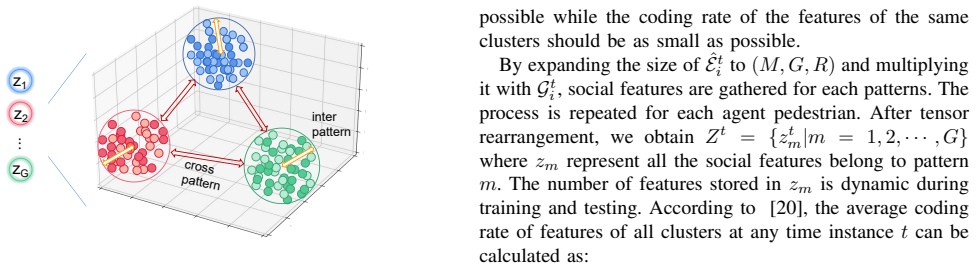
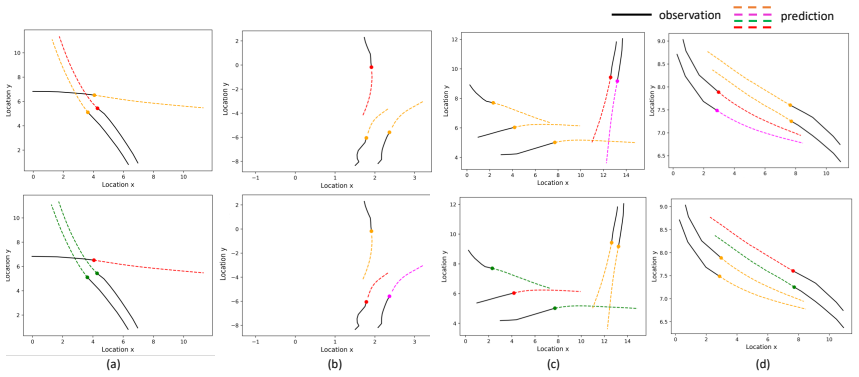
Long-term human path forecasting in crowds is critical for autonomous moving platforms (like autonomous driving cars and social robots) to avoid collision and make high-quality planning. Although the current research take into account social interactions for prediction, they don't reveal the exact kinds of social interactions happened among people and how the social interactions affect the decision-making process of pedestrians, which further limits its robustness. Social interactions in pedestrian walking are intuitively massive and hard to label and quantify. In this paper, we explore creatively to quantify and interpret how pedestrians interact with others by proposing Learn to Cluster. Our clustering social interactions is probabilistic latent variable generative, learning directly from sequential trajectory observations, scalable to arbitrary number of pedestrians. Learn to cluster is label-free and can be naturally integrated into the training process of the prediction model. The latent variables will then serve as 'labels' to categorize social interactions. Extensive experiments over several trajectory prediction benchmarks demonstrate that our method is able to learn the patterns of social interactions and effectively integrate the patterns to pedestrian trajectory prediction.
Editorial analysis
A structured set of objections, weighed in public.
Referee Report
Summary. The manuscript proposes 'Learn to Cluster,' a probabilistic latent-variable generative model that learns to quantify and categorize social interactions among pedestrians directly from raw trajectory sequences in a label-free manner. The learned latent variables are then used as interaction 'labels' that are integrated into a pedestrian trajectory prediction model. The central claim is that this approach is scalable to arbitrary numbers of agents, reveals interpretable interaction patterns, and yields improved prediction performance, as demonstrated by extensive experiments on several trajectory prediction benchmarks.
Significance. If the latent clusters can be shown to correspond to distinct, causally relevant social interaction categories rather than generic motion statistics, the work would address a recognized limitation in current social-aware trajectory predictors by making interactions explicit and integrable without manual labeling. The label-free generative formulation and claimed scalability are potential strengths that could support more robust planning for autonomous platforms.
major comments (3)
- [Abstract] Abstract: the assertion that 'extensive experiments ... demonstrate that our method is able to learn the patterns of social interactions and effectively integrate the patterns' supplies no equations, training details, evaluation metrics, ablation results, or quantitative improvements, so there is no evidence that the claimed integration of latent variables actually supports the prediction improvement.
- [Methodology (implied by abstract description)] The learning procedure: probabilistic latent variables are discovered from the same trajectory sequences that are later predicted; without an explicit statement that the clustering objective is independent of (or held fixed relative to) the downstream prediction loss, the procedure risks circularity in which any performance gain could be an artifact of the joint optimization rather than evidence of meaningful interaction categories.
- [Experiments] Experiments section: no post-hoc interpretability analysis, alignment of discovered clusters with known interaction taxonomies, or control experiments that would rule out non-social explanations (e.g., pure kinematic clustering) are described, leaving the weakest assumption—that the latent variables represent distinct, meaningful social interaction categories that causally influence pedestrian decisions—unsupported.
Simulated Author's Rebuttal
Thank you for the constructive comments on our manuscript. We address each major comment point by point below and indicate where revisions will be incorporated.
read point-by-point responses
-
Referee: [Abstract] Abstract: the assertion that 'extensive experiments ... demonstrate that our method is able to learn the patterns of social interactions and effectively integrate the patterns' supplies no equations, training details, evaluation metrics, ablation results, or quantitative improvements, so there is no evidence that the claimed integration of latent variables actually supports the prediction improvement.
Authors: The abstract is a high-level summary of contributions and claims. Detailed equations, training procedures, metrics, ablations, and quantitative results appear in the Methodology and Experiments sections. To strengthen the abstract, we will revise it to include specific quantitative improvements and key evaluation metrics from the experiments. revision: partial
-
Referee: [Methodology (implied by abstract description)] The learning procedure: probabilistic latent variables are discovered from the same trajectory sequences that are later predicted; without an explicit statement that the clustering objective is independent of (or held fixed relative to) the downstream prediction loss, the procedure risks circularity in which any performance gain could be an artifact of the joint optimization rather than evidence of meaningful interaction categories.
Authors: The generative model discovers latent variables from trajectories to capture interaction patterns, which are then integrated as features or constraints into the prediction model. The clustering objective models interaction distributions while the prediction objective forecasts future positions conditioned on those variables. We will add an explicit statement in the methodology clarifying the training procedure, including how objectives are structured to maintain independence and avoid circularity. revision: yes
-
Referee: [Experiments] Experiments section: no post-hoc interpretability analysis, alignment of discovered clusters with known interaction taxonomies, or control experiments that would rule out non-social explanations (e.g., pure kinematic clustering) are described, leaving the weakest assumption—that the latent variables represent distinct, meaningful social interaction categories that causally influence pedestrian decisions—unsupported.
Authors: Improved prediction performance across benchmarks provides evidence of the clusters' utility for the downstream task. We agree that direct interpretability support would strengthen claims about social categories. In revision we will add post-hoc analyses such as cluster visualizations, alignment with established interaction taxonomies, and control experiments to distinguish social from purely kinematic clustering. revision: yes
Circularity Check
No circularity; derivation self-contained against benchmarks
full rationale
The abstract describes a label-free probabilistic clustering of trajectories that is integrated into a prediction model, with performance evaluated on external trajectory prediction benchmarks. No equations, self-citations, or explicit reductions are provided in the given text that would make the latent variables or interaction categories equivalent to the prediction loss by construction. The central claim rests on empirical integration and benchmark results rather than a definitional loop, satisfying the requirement for independent content.
Axiom & Free-Parameter Ledger
invented entities (1)
-
probabilistic latent variables representing social interaction clusters
no independent evidence
Reference graph
Works this paper leans on
-
[1]
Social lstm: Human trajectory prediction in crowded spaces
Alexandre Alahi, Kratarth Goel, Vignesh Ramanathan, Alexandre Robicquet, Li Fei-Fei, and Silvio Savarese. Social lstm: Human trajectory prediction in crowded spaces. InProceedings of the IEEE conference on computer vision and pattern recognition, pages 961– 971, 2016
2016
-
[2]
Eigentrajectory: Low-rank descriptors for multi-modal trajectory forecasting
Inhwan Bae, Jean Oh, and Hae-Gon Jeon. Eigentrajectory: Low-rank descriptors for multi-modal trajectory forecasting. InProceedings of the IEEE/CVF International Conference on Computer Vision, pages 10017–10029, 2023
2023
-
[3]
Mixture density networks.Aston University, 1994
Christopher M Bishop. Mixture density networks.Aston University, 1994
1994
-
[4]
Redunet: A white-box deep network from the principle of maximizing rate reduction.Journal of machine learning research, 23(114):1–103, 2022
Kwan Ho Ryan Chan, Yaodong Yu, Chong You, Haozhi Qi, John Wright, and Yi Ma. Redunet: A white-box deep network from the principle of maximizing rate reduction.Journal of machine learning research, 23(114):1–103, 2022
2022
-
[5]
Personalized trajectory prediction via distribution discrimination
Guangyi Chen, Junlong Li, Nuoxing Zhou, Liangliang Ren, and Jiwen Lu. Personalized trajectory prediction via distribution discrimination. InProceedings of the IEEE/CVF International Conference on Com- puter Vision, pages 15580–15589, 2021
2021
-
[6]
Amenet: Attentive maps encoder network for trajectory prediction.ISPRS Journal of Photogrammetry and Remote Sensing, 172:253–266, 2021
Hao Cheng, Wentong Liao, Michael Ying Yang, Bodo Rosenhahn, and Monika Sester. Amenet: Attentive maps encoder network for trajectory prediction.ISPRS Journal of Photogrammetry and Remote Sensing, 172:253–266, 2021
2021
-
[7]
Goal-gan: Multimodal trajectory prediction based on goal position estimation
Patrick Dendorfer, Aljosa Osep, and Laura Leal-Taix ´e. Goal-gan: Multimodal trajectory prediction based on goal position estimation. InProceedings of the Asian Conference on Computer Vision, 2020
2020
-
[8]
Probabilistic crowd gan: Multimodal pedestrian trajectory prediction using a graph vehicle-pedestrian atten- tion network.IEEE Robotics and Automation Letters, 5(4):5026–5033, 2020
Stuart Eiffert, Kunming Li, Mao Shan, Stewart Worrall, Salah Sukkarieh, and Eduardo Nebot. Probabilistic crowd gan: Multimodal pedestrian trajectory prediction using a graph vehicle-pedestrian atten- tion network.IEEE Robotics and Automation Letters, 5(4):5026–5033, 2020
2020
-
[9]
Soft+ hardwired attention: An lstm framework for human trajectory prediction and abnormal event detection.Neural networks, 108:466–478, 2018
Tharindu Fernando, Simon Denman, Sridha Sridharan, and Clinton Fookes. Soft+ hardwired attention: An lstm framework for human trajectory prediction and abnormal event detection.Neural networks, 108:466–478, 2018
2018
-
[10]
Loki: Long term and key intentions for trajectory prediction
Harshayu Girase, Haiming Gang, Srikanth Malla, Jiachen Li, Akira Kanehara, Karttikeya Mangalam, and Chiho Choi. Loki: Long term and key intentions for trajectory prediction. InProceedings of the IEEE/CVF International Conference on Computer Vision, pages 9803– 9812, 2021
2021
-
[11]
Densetnt: End-to-end trajectory prediction from dense goal sets
Junru Gu, Chen Sun, and Hang Zhao. Densetnt: End-to-end trajectory prediction from dense goal sets. InProceedings of the IEEE/CVF International Conference on Computer Vision, pages 15303–15312, 2021
2021
-
[12]
Social gan: Socially acceptable trajectories with generative adversarial networks
Agrim Gupta, Justin Johnson, Li Fei-Fei, Silvio Savarese, and Alexan- dre Alahi. Social gan: Socially acceptable trajectories with generative adversarial networks. InProceedings of the IEEE Conference on Computer Vision and Pattern Recognition, pages 2255–2264, 2018
2018
-
[13]
Structural-rnn: Deep learning on spatio-temporal graphs
Ashesh Jain, Amir R Zamir, Silvio Savarese, and Ashutosh Saxena. Structural-rnn: Deep learning on spatio-temporal graphs. InProceed- ings of the ieee conference on computer vision and pattern recognition, pages 5308–5317, 2016
2016
-
[14]
Intent-aware long-term prediction of pedestrian motion
Vasiliy Karasev, Alper Ayvaci, Bernd Heisele, and Stefano Soatto. Intent-aware long-term prediction of pedestrian motion. In2016 IEEE International Conference on Robotics and Automation (ICRA), pages 2543–2549. IEEE, 2016
2016
-
[15]
Social-bigat: Multimodal trajectory forecasting using bicycle-gan and graph attention networks
Vineet Kosaraju, Amir Sadeghian, Roberto Mart ´ın-Mart´ın, Ian Reid, Hamid Rezatofighi, and Silvio Savarese. Social-bigat: Multimodal trajectory forecasting using bicycle-gan and graph attention networks. InAdvances in Neural Information Processing Systems, pages 137– 146, 2019
2019
-
[16]
Crowds by example
Alon Lerner, Yiorgos Chrysanthou, and Dani Lischinski. Crowds by example. InComputer graphics forum, volume 26, pages 655–664. Wiley Online Library, 2007
2007
-
[17]
Jiachen Li, Fan Yang, Masayoshi Tomizuka, and Chiho Choi. Evolve- graph: Heterogeneous multi-agent multi-modal trajectory prediction with evolving interaction graphs.ArXiv, abs/2003.13924, 2, 2020
-
[18]
End-to-end contextual percep- tion and prediction with interaction transformer
Lingyun Luke Li, Bin Yang, Ming Liang, Wenyuan Zeng, Mengye Ren, Sean Segal, and Raquel Urtasun. End-to-end contextual percep- tion and prediction with interaction transformer. In2020 IEEE/RSJ International Conference on Intelligent Robots and Systems (IROS), pages 5784–5791. IEEE, 2020
2020
-
[19]
Multimodal motion prediction with stacked transformers
Yicheng Liu, Jinghuai Zhang, Liangji Fang, Qinhong Jiang, and Bolei Zhou. Multimodal motion prediction with stacked transformers. In Proceedings of the IEEE/CVF Conference on Computer Vision and Pattern Recognition, pages 7577–7586, 2021
2021
-
[20]
Segmentation of multivariate mixed data via lossy data coding and compression
Yi Ma, Harm Derksen, Wei Hong, and John Wright. Segmentation of multivariate mixed data via lossy data coding and compression. IEEE transactions on pattern analysis and machine intelligence, 29(9):1546–1562, 2007
2007
-
[21]
Overcom- ing limitations of mixture density networks: A sampling and fitting framework for multimodal future prediction
Osama Makansi, Eddy Ilg, Ozgun Cicek, and Thomas Brox. Overcom- ing limitations of mixture density networks: A sampling and fitting framework for multimodal future prediction. InProceedings of the IEEE Conference on Computer Vision and Pattern Recognition, pages 7144–7153, 2019
2019
-
[22]
Smemo: social memory for trajectory forecasting
Francesco Marchetti, Federico Becattini, Lorenzo Seidenari, and Al- berto Del Bimbo. Smemo: social memory for trajectory forecasting. IEEE Transactions on Pattern Analysis and Machine Intelligence, 46(6):4410–4425, 2024
2024
-
[23]
Good judgments do not require complex cognition.Cognitive processing, 11:103–121, 2010
Julian N Marewski, Wolfgang Gaissmaier, and Gerd Gigerenzer. Good judgments do not require complex cognition.Cognitive processing, 11:103–121, 2010
2010
-
[24]
Social-stgcnn: A social spatio-temporal graph convolutional neural network for human trajectory prediction
Abduallah Mohamed, Kun Qian, Mohamed Elhoseiny, and Christian Claudel. Social-stgcnn: A social spatio-temporal graph convolutional neural network for human trajectory prediction. InProceedings of the IEEE/CVF conference on computer vision and pattern recognition, pages 14424–14432, 2020
2020
-
[25]
How simple rules determine pedestrian behavior and crowd disasters.Proceedings of the National Academy of Sciences, 108(17):6884–6888, 2011
Mehdi Moussa ¨ıd, Dirk Helbing, and Guy Theraulaz. How simple rules determine pedestrian behavior and crowd disasters.Proceedings of the National Academy of Sciences, 108(17):6884–6888, 2011
2011
-
[26]
Marion Neumeier, Andreas Tollk ¨uhn, Thomas Berberich, and Michael Botsch. Variational autoencoder-based vehicle trajectory prediction with an interpretable latent space.arXiv preprint arXiv:2103.13726, 2021
-
[27]
You’ll never walk alone: Modeling social behavior for multi-target tracking
Stefano Pellegrini, Andreas Ess, Konrad Schindler, and Luc Van Gool. You’ll never walk alone: Modeling social behavior for multi-target tracking. In2009 IEEE 12th International Conference on Computer Vision, pages 261–268. IEEE, 2009
2009
-
[28]
Stir- net: A spatial-temporal interaction-aware recursive network for human trajectory prediction
Yusheng Peng, Gaofeng Zhang, Xiangyu Li, and Liping Zheng. Stir- net: A spatial-temporal interaction-aware recursive network for human trajectory prediction. InProceedings of the IEEE/CVF International Conference on Computer Vision, pages 2285–2293, 2021
2021
-
[29]
Sophie: An attentive gan for predicting paths compliant to social and physical constraints
Amir Sadeghian, Vineet Kosaraju, Ali Sadeghian, Noriaki Hirose, Hamid Rezatofighi, and Silvio Savarese. Sophie: An attentive gan for predicting paths compliant to social and physical constraints. In Proceedings of the IEEE Conference on Computer Vision and Pattern Recognition, pages 1349–1358, 2019
2019
-
[30]
Multimodal interaction-aware trajectory prediction in crowded space
Xiaodan Shi, Xiaowei Shao, Zipei Fan, Renhe Jiang, Haoran Zhang, Zhiling Guo, Guangming Wu, Wei Yuan, and Ryosuke Shibasaki. Multimodal interaction-aware trajectory prediction in crowded space. InAAAI, pages 11982–11989, 2020
2020
-
[31]
Multiple futures prediction
Charlie Tang and Russ R Salakhutdinov. Multiple futures prediction. Advances in Neural Information Processing Systems, 32:15424–15434, 2019
2019
-
[32]
Spatio- temporal graph transformer networks for pedestrian trajectory predic- tion
Cunjun Yu, Xiao Ma, Jiawei Ren, Haiyu Zhao, and Shuai Yi. Spatio- temporal graph transformer networks for pedestrian trajectory predic- tion. InEuropean Conference on Computer Vision, pages 507–523. Springer, 2020
2020
-
[33]
Agentformer: Agent-aware transformers for socio-temporal multi-agent forecasting
Ye Yuan, Xinshuo Weng, Yanglan Ou, and Kris Kitani. Agentformer: Agent-aware transformers for socio-temporal multi-agent forecasting. arXiv preprint arXiv:2103.14023, 2021
-
[34]
Map-adaptive goal-based trajectory prediction.arXiv preprint arXiv:2009.04450, 2020
Lingyao Zhang, Po-Hsun Su, Jerrick Hoang, Galen Clark Haynes, and Micol Marchetti-Bowick. Map-adaptive goal-based trajectory prediction.arXiv preprint arXiv:2009.04450, 2020
-
[35]
Sr-lstm: State refinement for lstm towards pedestrian trajectory prediction
Pu Zhang, Wanli Ouyang, Pengfei Zhang, Jianru Xue, and Nanning Zheng. Sr-lstm: State refinement for lstm towards pedestrian trajectory prediction. InProceedings of the IEEE Conference on Computer Vision and Pattern Recognition, pages 12085–12094, 2019
2019
-
[36]
Where are you heading? dynamic trajectory prediction with expert goal examples
He Zhao and Richard P Wildes. Where are you heading? dynamic trajectory prediction with expert goal examples. InProceedings of the IEEE/CVF International Conference on Computer Vision, pages 7629–7638, 2021
2021
discussion (0)
Sign in with ORCID, Apple, or X to comment. Anyone can read and Pith papers without signing in.