Direct Measurement of the ²¹²Pb and ²¹⁴Pb β Decay Branching Ratios with the XENONnT Experiment
Pith reviewed 2026-06-26 22:00 UTC · model grok-4.3
The pith
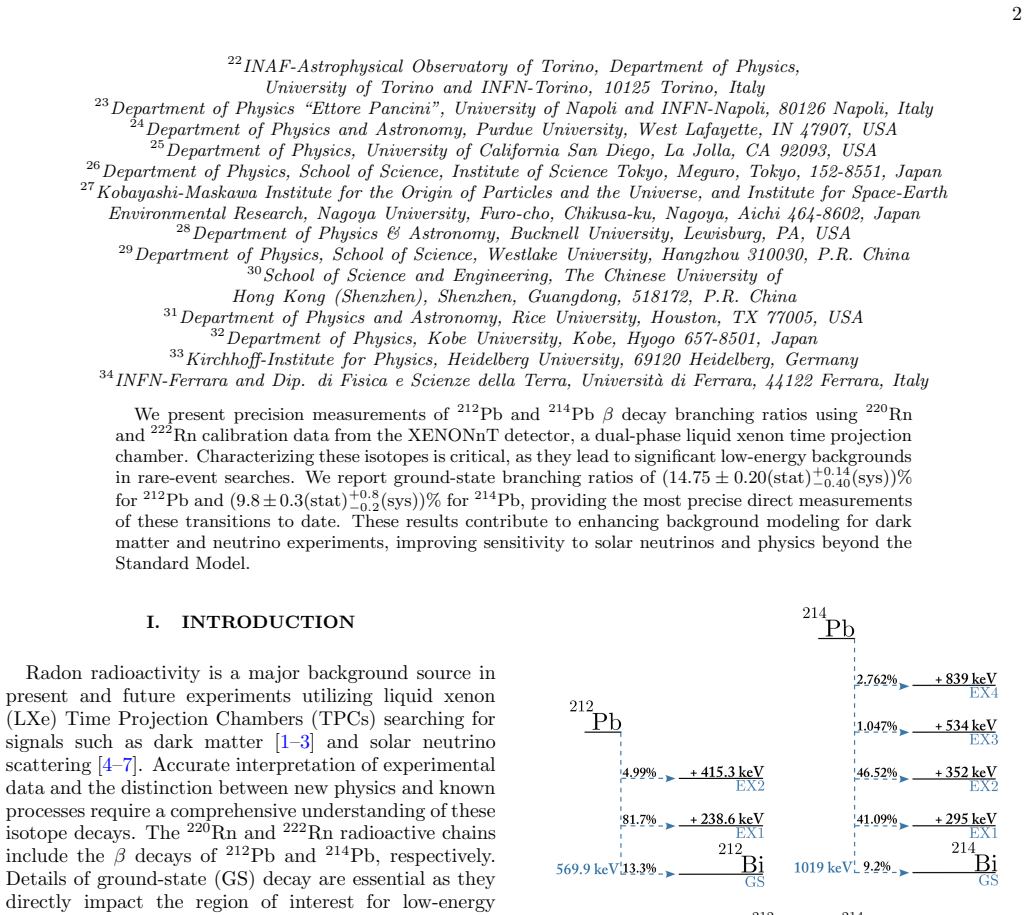
XENONnT reports ground-state beta branching ratios of 14.75% for 212Pb and 9.8% for 214Pb from radon calibration data.
A machine-rendered reading of the paper's core claim, the machinery that carries it, and where it could break.
Core claim
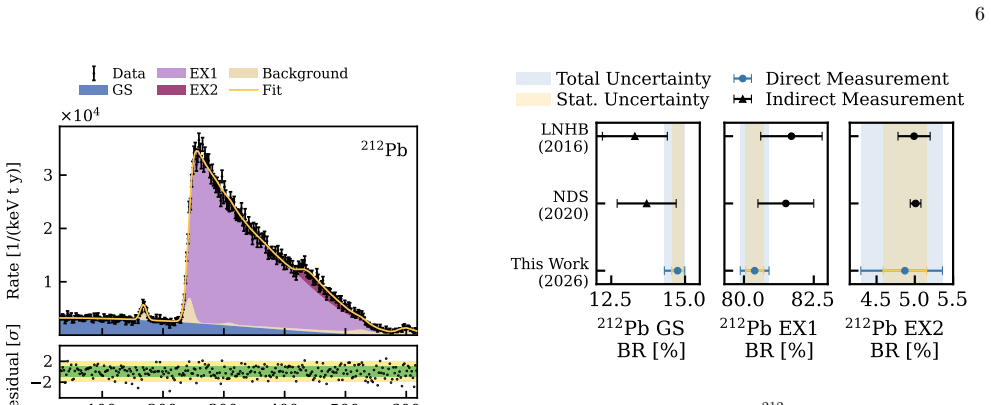
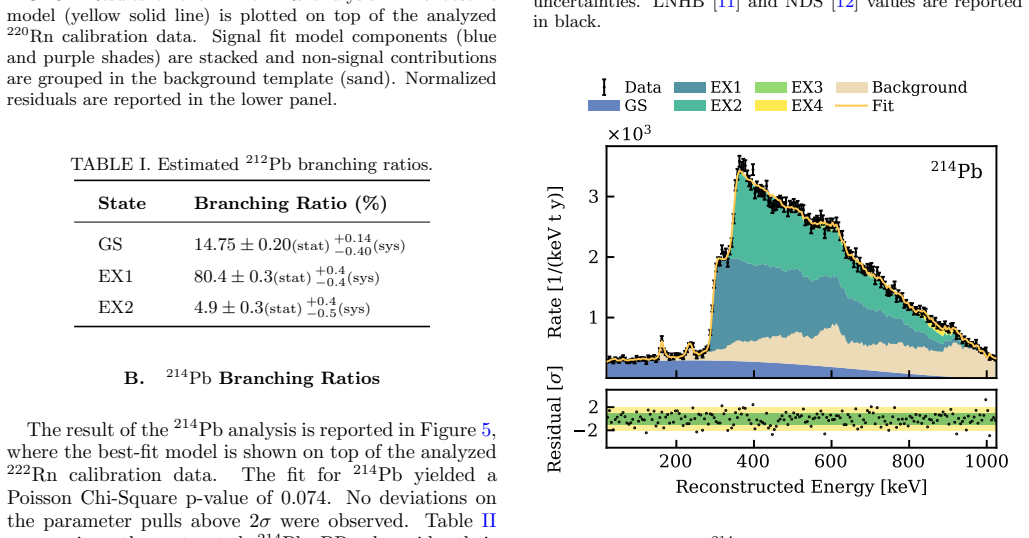
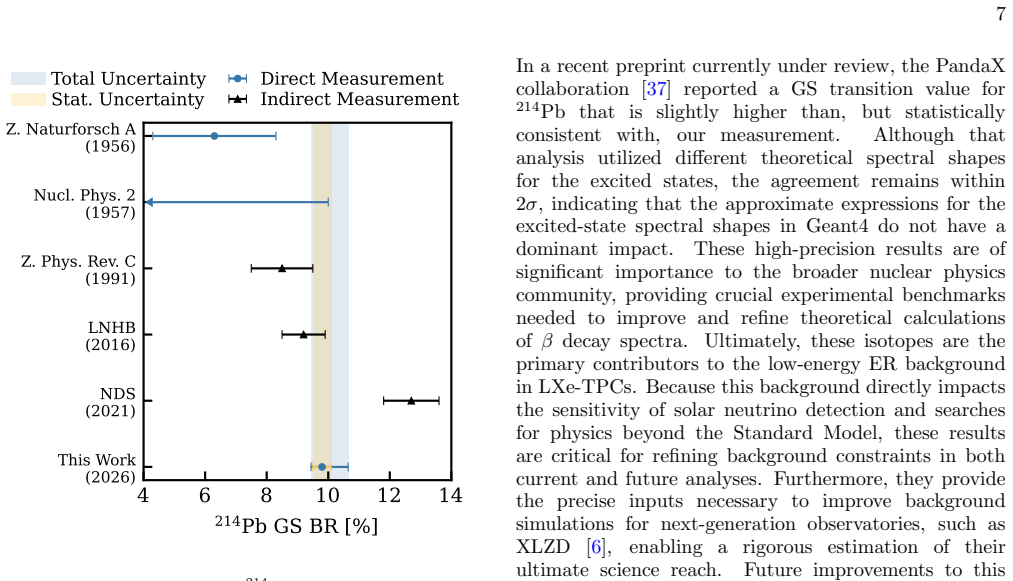
Using 220Rn and 222Rn calibration data collected in the XENONnT dual-phase liquid xenon time projection chamber, the ground-state beta decay branching ratio is measured to be (14.75 ± 0.20(stat) +0.14/-0.40(sys))% for 212Pb and (9.8 ± 0.3(stat) +0.8/-0.2(sys))% for 214Pb. These constitute the most precise direct determinations of the two transitions.
What carries the argument
Spectral fitting of low-energy events recorded during radon calibration runs inside the dual-phase liquid xenon time projection chamber.
If this is right
- Background models for low-energy events in liquid xenon dark matter detectors become more accurate.
- Projected sensitivities to solar neutrinos and other low-energy signals improve because the subtracted background is better known.
- Systematic uncertainties in searches for physics beyond the Standard Model that rely on the same low-energy region are reduced.
- Other xenon-based experiments can adopt the same calibration and fitting approach to cross-check or refine the same branching ratios.
Where Pith is reading between the lines
- The new values may shift the expected rate of single-electron or few-electron events that some experiments interpret as possible dark matter signals.
- Large-scale rare-event detectors can serve as precision instruments for nuclear data that are otherwise hard to obtain with smaller dedicated setups.
- Updated branching ratios propagate into Monte Carlo simulations used by multiple collaborations, potentially altering exclusion limits already published.
Load-bearing premise
The analysis assumes that the radon calibration data cleanly isolates the Pb beta decays in the low-energy spectrum without significant contamination from other sources or inaccuracies in the detector response model.
What would settle it
An independent measurement of either branching ratio performed with a different detector technology that falls outside the combined statistical and systematic uncertainty range reported here.
Figures
read the original abstract
We present precision measurements of $^{212}\mathrm{Pb}$ and $^{214}\mathrm{Pb}$ $\beta$ decay branching ratios using $^{220}\mathrm{Rn}$ and $^{222}\mathrm{Rn}$ calibration data from the XENONnT detector, a dual-phase liquid xenon time projection chamber. Characterizing these isotopes is critical, as they lead to significant low-energy backgrounds in rare-event searches. We report ground-state branching ratios of $(14.75 \pm 0.20(\mathrm{stat}) ^{+0.14}_{-0.40}(\mathrm{sys}))\%$ for $^{212}\mathrm{Pb}$ and $(9.8 \pm 0.3(\mathrm{stat}) ^{+0.8}_{-0.2}(\mathrm{sys}))\%$ for $^{214}\mathrm{Pb}$, providing the most precise direct measurements of these transitions to date. These results contribute to enhancing background modeling for dark matter and neutrino experiments, improving sensitivity to solar neutrinos and physics beyond the Standard Model.
Editorial analysis
A structured set of objections, weighed in public.
Referee Report
Summary. The manuscript reports direct measurements of the ground-state β-decay branching ratios of ^{212}Pb and ^{214}Pb extracted from ^{220}Rn and ^{222}Rn calibration data collected with the XENONnT dual-phase liquid xenon TPC. It gives the values (14.75 ± 0.20(stat) ^{+0.14}_{-0.40}(sys))% for ^{212}Pb and (9.8 ± 0.3(stat) ^{+0.8}_{-0.2}(sys))% for ^{214}Pb and states that these are the most precise direct measurements to date.
Significance. These branching ratios enter directly into the low-energy background model for liquid-xenon rare-event searches. A measurement performed inside the same detector technology supplies relevant input for dark-matter and solar-neutrino analyses; the use of in-situ calibration data is a methodological strength when the isolation of the signal is demonstrated.
major comments (2)
- [calibration-data analysis and spectrum fit] The central claim rests on the assumption that the low-energy spectrum recorded in the radon calibration runs is produced by the ground-state β decays of ^{212}Pb and ^{214}Pb with known selection efficiency and negligible contamination from other decays, pile-up, or detector-response mismatches. The manuscript must supply quantitative validation (e.g., side-band constraints, Monte-Carlo closure tests, or residual-background limits) that this isolation holds at the level of the quoted systematic uncertainties.
- [systematic-uncertainty evaluation] The asymmetric systematic uncertainty on the ^{212}Pb result (+0.14/-0.40)% is load-bearing for the final quoted precision; the sources that generate the downward excursion must be enumerated and shown to be independent of the branching-ratio parameter itself.
minor comments (2)
- [abstract and §1] The abstract and introduction should state the approximate energy window and the primary event-selection cuts used to isolate the Pb β spectrum.
- [throughout] Notation for the asymmetric systematic uncertainties should be written consistently (e.g., ^{+a}_{-b}) throughout the text and tables.
Simulated Author's Rebuttal
We thank the referee for the careful review and for recognizing the relevance of these branching-ratio measurements to low-energy background modeling in liquid-xenon detectors. We address each major comment below and will revise the manuscript to incorporate the requested clarifications and additional documentation.
read point-by-point responses
-
Referee: The central claim rests on the assumption that the low-energy spectrum recorded in the radon calibration runs is produced by the ground-state β decays of ^{212}Pb and ^{214}Pb with known selection efficiency and negligible contamination from other decays, pile-up, or detector-response mismatches. The manuscript must supply quantitative validation (e.g., side-band constraints, Monte-Carlo closure tests, or residual-background limits) that this isolation holds at the level of the quoted systematic uncertainties.
Authors: We agree that explicit quantitative validation strengthens the result. Our analysis already includes Monte-Carlo closure tests in which known branching ratios are injected into simulated data sets and recovered, as well as side-band constraints above 50 keV that limit residual contamination and pile-up to <1 %. These checks were used to set the quoted systematic uncertainties. We will add a dedicated subsection with the corresponding figures, tables of residual limits, and a description of how the tests confirm isolation at the level of the reported systematics. revision: yes
-
Referee: The asymmetric systematic uncertainty on the ^{212}Pb result (+0.14/-0.40)% is load-bearing for the final quoted precision; the sources that generate the downward excursion must be enumerated and shown to be independent of the branching-ratio parameter itself.
Authors: The downward excursion is driven by variations in the low-energy detection efficiency and the xenon response model (scintillation and ionization yields). We will insert a table that enumerates each contributing source together with its individual contribution to the asymmetric uncertainty. We will also add a short study showing that these variations are performed independently of the branching-ratio fit parameter, confirming that the asymmetry is not an artifact of the fit itself. revision: yes
Circularity Check
No circularity: direct experimental extraction from calibration spectra
full rationale
The paper performs a direct measurement of branching ratios by fitting the observed low-energy spectrum in 220Rn and 222Rn calibration data collected with the XENONnT TPC. The reported values are the fitted parameters themselves, with statistical and systematic uncertainties propagated from the data and detector response model. No derivation chain exists that reduces the final result to its own inputs by construction, no self-citation is invoked as a load-bearing uniqueness theorem, and no ansatz or known empirical pattern is renamed as a new prediction. The analysis is self-contained against external benchmarks (the calibration datasets) and does not rely on prior fitted values of the same quantities.
Axiom & Free-Parameter Ledger
Reference graph
Works this paper leans on
-
[1]
Aprileet al.(XENON), Phys
E. Aprileet al.(XENON), Phys. Rev. Lett.135, 221003 (2025)
2025
-
[2]
Aalberset al.(LZ), Phys
J. Aalberset al.(LZ), Phys. Rev. Lett.135, 011802 (2025)
2025
-
[3]
Boet al.(PandaX), Phys
Z. Boet al.(PandaX), Phys. Rev. Lett.134, 011805 (2025)
2025
-
[4]
Baudis, A
L. Baudis, A. Ferella, A. Kish, A. Manalaysay, T. Marrodan Undagoitia, and M. Schumann, JCAP01 (01), 044
-
[5]
Aalberset al.(DARWIN), Eur
J. Aalberset al.(DARWIN), Eur. Phys. J. C80, 1133 (2020)
2020
-
[6]
Aalberset al.(XLZD), Eur
J. Aalberset al.(XLZD), Eur. Phys. J. C85, 1192 (2025)
2025
-
[7]
Luet al.(PandaX), Chin
X. Luet al.(PandaX), Chin. Phys. C48, 091001 (2024)
2024
-
[8]
Aprileet al.(XENON), Phys
E. Aprileet al.(XENON), Phys. Rev. Lett.129, 161805 (2022)
2022
-
[9]
S. J. Haselschwardt, J. Kostensalo, X. Mougeot, and J. Suhonen, Phys. Rev. C102, 065501 (2020)
2020
-
[10]
Ramalho and J
M. Ramalho and J. Suhonen, Phys. Rev. C109, 014326 (2024)
2024
-
[11]
B´ eet al.,Table of Radionuclides, Monographie BIPM-5, Vol
M.-M. B´ eet al.,Table of Radionuclides, Monographie BIPM-5, Vol. 8 (Bureau International des Poids et Mesures, Pavillon de Breteuil, F-92310 S` evres, France, 2016)
2016
-
[12]
Auranen and E
K. Auranen and E. McCutchan, Nuclear Data Sheets 168, 117 (2020)
2020
-
[13]
Zhu and E
S. Zhu and E. McCutchan, Nuclear Data Sheets175, 1 (2021)
2021
-
[14]
Ferrari,Radon-Induced Lead Isotopes in XENONnT: Studies on Branching Ratios and Surface Background, Ph.D
C. Ferrari,Radon-Induced Lead Isotopes in XENONnT: Studies on Branching Ratios and Surface Background, Ph.D. thesis, Gran Sasso Science Institute (GSSI), L’Aquila, Italy (2025), phD Programme: Astroparticle Physics, XXXVI ciclo
2025
-
[15]
Aprileet al.(XENON), Eur
E. Aprileet al.(XENON), Eur. Phys. J. C84, 784 (2024)
2024
-
[16]
E. Aprileet al.(XENON), Phys. Rev. C113, 044303 (2026), arXiv:2510.04846 [nucl-ex]
arXiv 2026
-
[17]
Volta,Characterization and Monitoring of XENONnT Photosensors and Search for New Physics with the First XENONnT Science Data, Ph.D
G. Volta,Characterization and Monitoring of XENONnT Photosensors and Search for New Physics with the First XENONnT Science Data, Ph.D. thesis, University of Zurich, Zurich, Switzerland (2023), available at Zurich Open Repository and Archive (ZORA)
2023
-
[18]
National Institute of Standards and Technology (NIST), Stopping-power and range tables for electrons, protons, and helium ions,https://www.nist.gov/pml/stoppin g-power-range-tables-electrons-protons-and-hel ium-ions(2025), accessed: 2025-12-24
2025
-
[19]
J¨ org, S
F. J¨ org, S. Li, J. Schreiner, H. Simgen, and R. F. Lang, JINST18(11), P11009
-
[20]
J¨ org, G
F. J¨ org, G. Eurin, and H. Simgen, Appl. Radiat. Isot. 194, 110666 (2023)
2023
-
[21]
Aprileet al.(XENON), Phys
E. Aprileet al.(XENON), Phys. Rev. X15, 031079 (2025)
2025
-
[22]
Aalberset al., AxFoundation/strax: v1.6.4,https: //doi.org/10.5281/zenodo.11355772(2024)
J. Aalberset al., AxFoundation/strax: v1.6.4,https: //doi.org/10.5281/zenodo.11355772(2024)
-
[23]
XENON Collaboration, XENONnT/straxen: v2.2.4,ht tps://doi.org/10.5281/zenodo.12608732(2024)
-
[24]
Aprileet al.(XENON), Phys
E. Aprileet al.(XENON), Phys. Rev. D111, 062006 (2025)
2025
-
[25]
Aprileet al.(XENON), Phys
E. Aprileet al.(XENON), Phys. Rev. D108, 012016 (2023)
2023
-
[26]
Allisonet al., Nucl
J. Allisonet al., Nucl. Instrum. Meth. A835, 186 (2016)
2016
-
[27]
Agostinelliet al.(GEANT4), Nucl
S. Agostinelliet al.(GEANT4), Nucl. Instrum. Meth. A 506, 250 (2003)
2003
-
[28]
XENON Collaboration, XENONnT/WFSim: v1.0.2 (2022)
2022
-
[29]
Ramirez Garcia,Simulating the XENONnT dark matter experiment: backgrounds and WIMP sensitivity, Ph.D
D. Ramirez Garcia,Simulating the XENONnT dark matter experiment: backgrounds and WIMP sensitivity, Ph.D. thesis, Albert-Ludwigs-Universit¨ at Freiburg (2022)
2022
-
[30]
Baker and R
S. Baker and R. D. Cousins, Nucl. Instrum. Meth.221, 437 (1984)
1984
-
[31]
XENON Collaboration, Xenonnt/gofevaluation: v0.1.0-zenodo-init (2021)
2021
-
[32]
NNDCet al., Evaluated nuclear structure data file (ensdf) (2022)
2022
-
[33]
Geant4 Collaboration,Geant4 Physics Reference Manual, Section: Radioactive Decay - Beta Decay (2024), version 11.2, Accessed: 2026-03-30
2024
-
[34]
Daniel, Zeitschrift f¨ ur Naturforschung A11, 759 (1956)
H. Daniel, Zeitschrift f¨ ur Naturforschung A11, 759 (1956)
1956
-
[35]
Nielsen, O
K. Nielsen, O. Nielsen, and M. Waggoner, Nuclear Physics2, 476 (1956)
1956
-
[36]
Berant, R
Z. Berant, R. B. Schuhmann, D. E. Alburger, W. T. Chou, R. L. Gill, E. K. Warburton, and C. Wesselborg, Phys. Rev. C43, 1639 (1991)
1991
-
[37]
Z. Yuanet al.(PandaX), Tomographic beta-gamma spectroscopy of nuclear beta decay (2025), arXiv:2510.24612 [nucl-ex]
arXiv 2025
discussion (0)
Sign in with ORCID, Apple, or X to comment. Anyone can read and Pith papers without signing in.