Optimized filtering for pulse-shape based pile-up rejection applied to 0νββ search with ¹⁰⁰Mo
Pith reviewed 2026-06-26 21:56 UTC · model grok-4.3
The pith
An optimized digital filter reduces pile-up background by 31% at 90% efficiency in neutrinoless double beta decay searches with 100Mo detectors.
A machine-rendered reading of the paper's core claim, the machinery that carries it, and where it could break.
Core claim
The paper presents an algorithm to obtain an optimized digital filter for the discrimination of pile-up events for detectors with known signal response and stationary noise power spectral density. When applied to the search for neutrinoless double beta decay with cryogenic Li₂¹⁰⁰MoO₄ detectors, the new filter discriminant reduces the pile-up induced background by 31% at 90% efficiency compared to a reference method.
What carries the argument
The optimized digital filter discriminant, built from the known signal response and stationary noise power spectral density to separate single pulses from overlapping pile-up events.
If this is right
- The filter can be deployed in the CUPID experiment to suppress the dominant 100Mo 2νββ pile-up background.
- Energy resolution and event reconstruction accuracy improve when pile-up is correctly identified and rejected.
- The same construction method applies to other cryogenic calorimeters that satisfy the known-response and stationary-noise conditions.
- Higher signal efficiency becomes feasible without increasing the accepted background rate.
Where Pith is reading between the lines
- The method could be tested on non-cryogenic detectors such as high-purity germanium or liquid scintillators if their pulse shapes and noise spectra can be characterized.
- If noise stationarity breaks down over long runs, periodic recalibration of the filter coefficients would be needed to maintain performance.
- Integration with machine-learning pulse classifiers might produce a hybrid discriminant with further gains in separation power.
Load-bearing premise
The detector signal response must be known in advance and the noise power spectral density must remain stationary.
What would settle it
Measure the background reduction factor in real or simulated data from Li2 100MoO4 detectors at 90% signal efficiency and check whether it equals or exceeds the claimed 31% improvement over the reference method.
Figures
read the original abstract
Pile-up events, arising from the partial or complete temporal overlap of distinct signals, represent a major challenge in many areas of experimental physics where rare or low-rate processes are targeted. If not properly identified, pile-up can distort reconstructed observables, degrade energy resolution, and generate backgrounds that mimic genuine events of interest. This work presents an algorithm to obtain an optimized digital filter for the discrimination of pile-up events for detectors with known signal response and stationary noise power spectral density. It is developed in the context of the search for neutrinoless double beta decay with cryogenic Li$_{2}$$^{100}$MoO$_4$ detectors like CUPID, where pile-up induced background from $^{100}$Mo $2\nu\beta\beta$ is expected to be the leading background contribution. For this application, the new filter discriminant reduces the pile-up induced background (at 90% efficiency) by 31%, compared to an analysis with a reference method previously presented in Eur. Phys. J. C 83(5), 373 (2023). While the discussion is grounded in cryogenic calorimetric detectors, the concepts and methods described are broadly applicable to a wide class of detector technologies and experimental contexts.
Editorial analysis
A structured set of objections, weighed in public.
Referee Report
Summary. The manuscript presents an algorithm to derive an optimized digital filter for discriminating pile-up events, assuming known detector signal response and stationary noise power spectral density. Developed for cryogenic Li2^100MoO4 detectors in the CUPID 0νββ search, the filter reduces pile-up-induced background by 31% at 90% efficiency relative to the reference method of Eur. Phys. J. C 83(5), 373 (2023). The approach is positioned as applicable to a broader class of detectors.
Significance. If the performance holds, the work offers a targeted improvement in pile-up rejection for low-background rare-event searches, directly addressing the leading 2νββ pile-up background in 100Mo 0νββ experiments. The explicit quantitative comparison to an independently published reference method provides a concrete benchmark, and the method's grounding in known signal and noise properties supports its potential transferability.
minor comments (2)
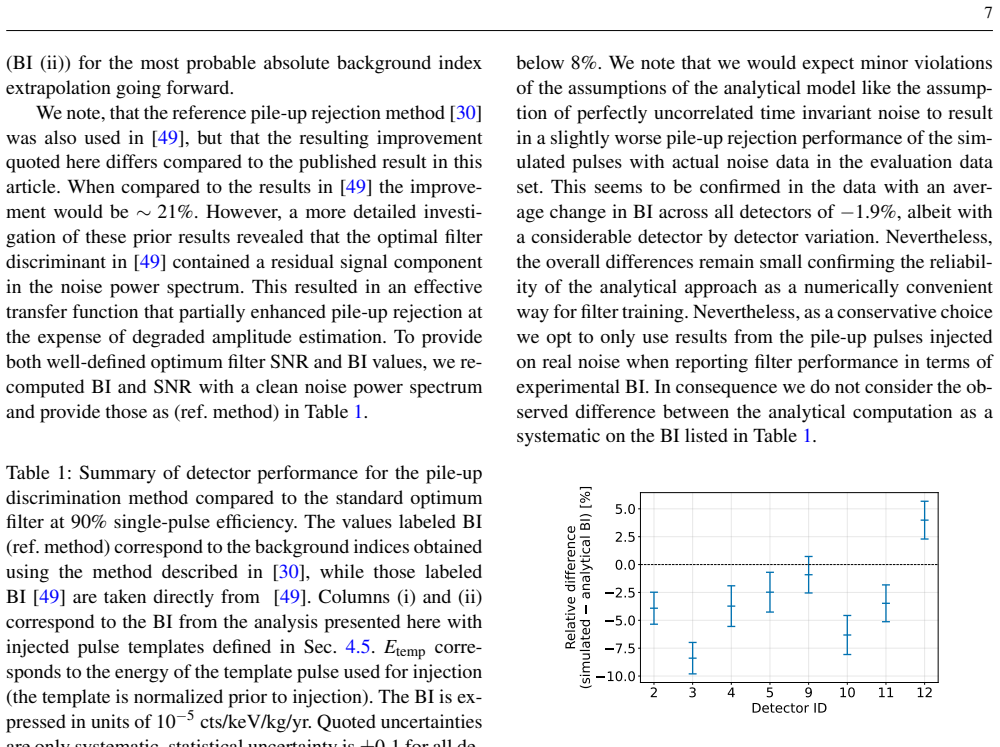
- The abstract states the 31% reduction; the main text should include the corresponding efficiency-versus-rejection curves (with uncertainties) and a clear statement of the dataset or simulation used to obtain this number.
- Clarify in the methods section how the optimized filter discriminant is constructed from the signal template and noise PSD, including any matrix inversions or frequency-domain operations.
Simulated Author's Rebuttal
We thank the referee for their positive evaluation of the manuscript, the recognition of its potential impact on pile-up rejection in 0νββ searches, and the recommendation for minor revision. No major comments were provided in the report.
Circularity Check
No significant circularity; derivation self-contained against external benchmark
full rationale
The paper states its premises explicitly (known signal response and stationary noise PSD) as the basis for deriving the optimized filter, then reports a quantitative performance gain relative to an independently published 2023 reference method. No equation or step reduces by construction to a fitted parameter defined inside the paper, no uniqueness theorem is imported via self-citation, and the comparison is to an external result rather than an internal fit renamed as prediction. The derivation chain therefore remains independent of its own outputs.
Axiom & Free-Parameter Ledger
axioms (2)
- domain assumption Detector signal response is known
- domain assumption Noise power spectral density is stationary
Reference graph
Works this paper leans on
-
[1]
Williamson, Rev
J. Williamson, Rev. Sci. Instrum.37(6), 736 (1966)
1966
-
[2]
Taguchi, E.C
K. Taguchi, E.C. Frey, X. Wang, J.S. Iwanczyk, W.C. Barber, Med. Phys.37(8), 3957 (2010)
2010
-
[3]
Ferri, et al., J
E. Ferri, et al., J. Low Temp. Phys.184(1), 405 (2016)
2016
-
[4]
Luo, et al., Nucl
X. Luo, et al., Nucl. Instr. Meth. A897, 59 (2018)
2018
-
[5]
Ahsan, et al., Plasma6(1), 58 (2023)
T. Ahsan, et al., Plasma6(1), 58 (2023)
2023
-
[6]
Knoll,Radiation Detection and Measurement, 4th edn
G.F. Knoll,Radiation Detection and Measurement, 4th edn. (Wiley, 2010)
2010
-
[7]
Borghesi, et al., Eur
M. Borghesi, et al., Eur. Phys. J. C82(5), 421 (2022)
2022
-
[8]
Chernyak, et al., Eur
D. Chernyak, et al., Eur. Phys. J. C77(1), 3 (2017)
2017
-
[9]
CUPID Collaboration, Eur. Phys. J. C85(7), 737 (2025)
2025
-
[10]
Agrawal, et al., Eur
A. Agrawal, et al., Eur. Phys. J. C85(1), 9 (2025)
2025
-
[11]
ECHo Collaboration, Phys. Rev. Lett.136, 121801 (2026)
2026
-
[12]
Alpert, et al., Eur
B. Alpert, et al., Eur. Phys. J. C75(3), 112 (2015)
2015
-
[13]
Dolinski, A.W
M.J. Dolinski, A.W. Poon, W. Rodejohann, Annu. Rev. Nucl. Part. Sci.69(1), 219 (2019)
2019
-
[14]
Bossio, M
E. Bossio, M. Agostini, J. Phys. G51(2), 023001 (2023)
2023
-
[15]
Majorana, Il Nuovo Cimento14(4), 171 (1937)
E. Majorana, Il Nuovo Cimento14(4), 171 (1937)
1937
-
[16]
Furry, Phys
W.H. Furry, Phys. Rev.56(12), 1184 (1939)
1939
-
[17]
Astrophys.641, A6 (2020)
Planck Collaboration, Astron. Astrophys.641, A6 (2020)
2020
-
[18]
KATRIN Collaboration, Nature Physics18, 160 (2022)
2022
-
[19]
Fukugita, T
M. Fukugita, T. Yanagida, Phys. Lett. B174(1), 45 (1986)
1986
-
[20]
Agostini, G
M. Agostini, G. Benato, J.A. Detwiler, J. Men ´endez, F. Vissani, Rev. Mod. Phys.95(2), 025002 (2023)
2023
-
[21]
Abe, et al., Physical Review Letters135(26), 262501 (2025)
S. Abe, et al., Physical Review Letters135(26), 262501 (2025)
2025
-
[22]
Acharya, et al., Physical review letters136(2), 022701 (2026)
H. Acharya, et al., Physical review letters136(2), 022701 (2026)
2026
-
[23]
CUORE Collaboration, Science390(6777), 1029 (2025)
2025
-
[24]
Agrawal, et al., Phys
A. Agrawal, et al., Phys. Rev. Lett.134(8), 082501 (2025)
2025
-
[25]
Armengaud, et al., Phys
E. Armengaud, et al., Phys. Rev. Lett.126(18), 181802 (2021)
2021
-
[26]
Azzolini, et al., Phys
O. Azzolini, et al., Phys. Rev. Lett.129(11), 111801 (2022)
2022
-
[27]
Stoica, M
S. Stoica, M. Mirea, Front. Phys.7, 12 (2019)
2019
-
[28]
Augier, et al., Phys
C. Augier, et al., Phys. Rev. Lett.131(16), 162501 (2023)
2023
-
[29]
Chernyak, et al., Eur
D. Chernyak, et al., Eur. Phys. J. C72(4), 1989 (2012)
1989
-
[30]
Ahmine, et al., Eur
A. Ahmine, et al., Eur. Phys. J. C83(5), 373 (2023)
2023
-
[31]
Bratrud, et al., Eur
G. Bratrud, et al., Eur. Phys. J. C85(2), 118 (2025)
2025
-
[32]
Singh, et al., Phys
V . Singh, et al., Phys. Rev. Appl.20, 064017 (2023)
2023
-
[33]
AMoRE Collaboration, Eur. Phys. J. C85(2), 172 (2025) 11
2025
-
[34]
Neganov, V .N
B.S. Neganov, V .N. Trofimov, Otkryt. Izobret.146, 215 (1985)
1985
-
[35]
P.N. Luke, J. Appl. Phys.64(12), 6858 (1988)
1988
-
[36]
Novati, et al., Nucl
V . Novati, et al., Nucl. Instr. Meth. A940, 320 (2019)
2019
-
[37]
Armatol, et al., Phys
A. Armatol, et al., Phys. Rev. C104, 015501 (2021)
2021
-
[38]
Fantini, et al., J
G. Fantini, et al., J. Low Temp. Phys.209(5-6), 1024 (2021)
2021
-
[39]
Chernyak, et al., Eur
D. Chernyak, et al., Eur. Phys. J. C74(6), 2913 (2014)
2014
-
[40]
Fourier,Th ´eorie analytique de la chaleur(Firmin Di- dot, Paris, 1822)
J. Fourier,Th ´eorie analytique de la chaleur(Firmin Di- dot, Paris, 1822)
-
[41]
Gatti, M
E. Gatti, M. Sampietro, P. Manfredi, Nucl. Instr. Meth. A287(3), 513 (1990)
1990
-
[42]
Hinkley, Biometrika56(3), 635 (1969)
D.V . Hinkley, Biometrika56(3), 635 (1969)
1969
-
[43]
CUORE Collaboration, arXiv preprint arXiv: 2510.25720 (2025)
arXiv 2025
-
[44]
Azzolini, et al., Eur
O. Azzolini, et al., Eur. Phys. J. C78(9), 734 (2018)
2018
-
[45]
Armengaud, et al., Eur
E. Armengaud, et al., Eur. Phys. J. C80(1), 1 (2020)
2020
-
[46]
Paszke, et al., Advances in Neural Information Pro- cessing Systems32, 8024 (2019)
A. Paszke, et al., Advances in Neural Information Pro- cessing Systems32, 8024 (2019)
2019
-
[47]
Kreyszig,Advanced Engineering Mathematics, 9th edn
E. Kreyszig,Advanced Engineering Mathematics, 9th edn. (Wiley, Hoboken, NJ, 2005)
2005
-
[48]
Bandac, et al., J
I. Bandac, et al., J. High Energy Phys.2020(1), 1 (2020)
2020
-
[49]
Armatol, et al., Journal of Instrumentation21(01), P01035 (2026)
A. Armatol, et al., Journal of Instrumentation21(01), P01035 (2026)
2026
-
[50]
https://docs.nersc.gov/systems/perlmutter/ architecture/(2026)
National energy research scientific computing center. https://docs.nersc.gov/systems/perlmutter/ architecture/(2026). Accessed 2026-03-16
2026
-
[51]
Carniti, C
P. Carniti, C. Gotti, G. Pessina, Nucl. Instr. Meth. A 1045, 167658 (2023)
2023
-
[52]
Haller, Infrared Phys
E. Haller, Infrared Phys. Technol.35(2-3), 127 (1994)
1994
-
[53]
Adams, C
D. Adams, C. Alduino, K. Alfonso, F. Avignone III, O. Azzolini, G. Bari, F. Bellini, G. Benato, M. Beretta, M. Biassoni, et al., Journal of Instrumentation17(11), P11023 (2022) Appendix A: Computation of Statistical Moments used in the Discriminant Parameter This appendix provides the derivations of the statistical prop- erties of the pile-up discriminant...
2022
discussion (0)
Sign in with ORCID, Apple, or X to comment. Anyone can read and Pith papers without signing in.