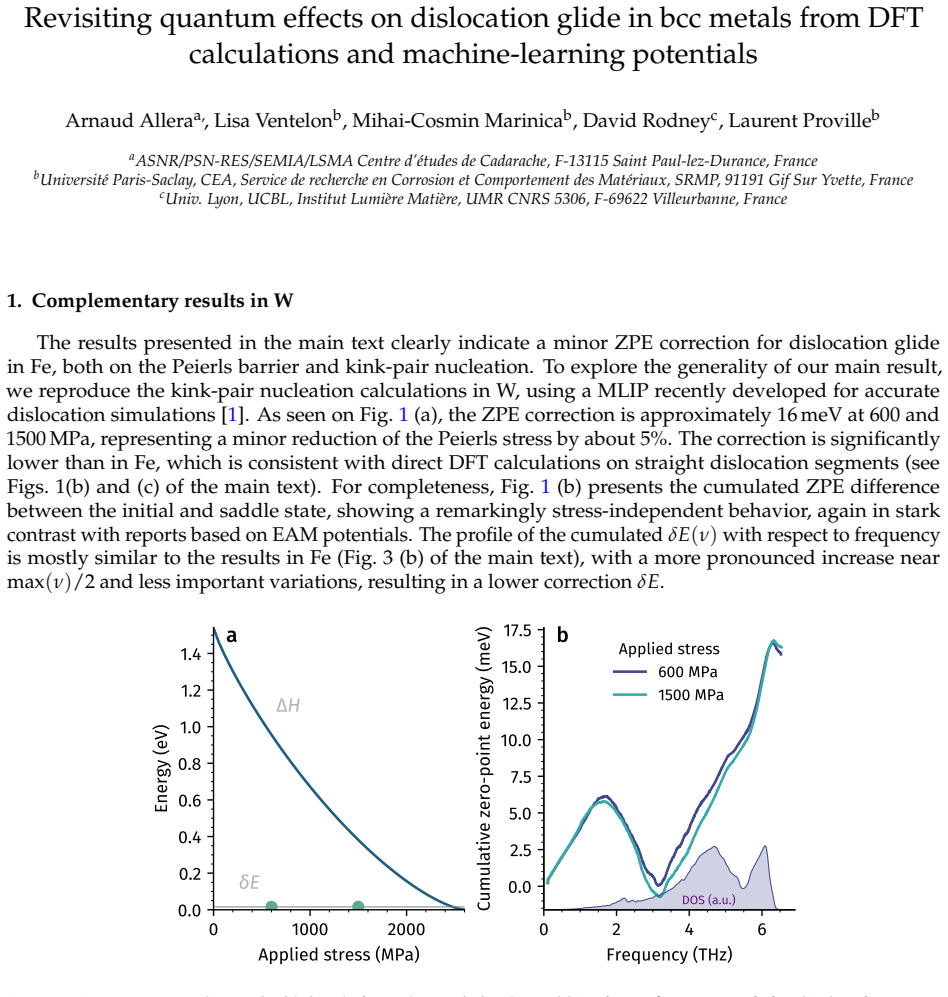
Revisiting quantum effects on dislocation glide in bcc metals from DFT calculations and machine-learning potentials
Pith reviewed 2026-06-26 23:42 UTC · model grok-4.3
The pith
Quantum zero-point effects contribute to dislocation glide in bcc metals but are too small to reconcile atomistic models with experiments.
A machine-rendered reading of the paper's core claim, the machinery that carries it, and where it could break.
Core claim
Using DFT calculations and MLIPs, the authors establish that quantum zero-point effects do contribute to dislocation glide at low temperature, but their magnitude is much lower than previously reported with empirical potentials, and insufficient to reconcile atomistic predictions with experiments.
What carries the argument
Dislocation energy landscapes computed via DFT and MLIPs, from which quantum zero-point corrections to the Peierls barrier and glide stress are evaluated.
If this is right
- Atomistic predictions of low-temperature flow stress in bcc metals remain higher than experiment even after quantum corrections.
- Empirical interatomic potentials are inadequate for reliable studies of dislocation energetics in these systems.
- The mismatch between theory and experiment on plastic flow must be addressed by other means, such as improved potentials or additional mechanisms.
- Machine-learning potentials trained on DFT data offer a better foundation than empirical models for future dislocation studies.
Where Pith is reading between the lines
- Other candidate explanations for the flow-stress discrepancy, including impurity effects or non-zero-point quantum processes, merit targeted study.
- The same DFT-MLIP workflow could be used to test quantum contributions in different crystal structures or at higher temperatures.
- Systematic benchmarking of multiple MLIPs against DFT for a wider set of dislocation configurations would strengthen or qualify the present conclusion.
Load-bearing premise
DFT calculations and MLIPs trained on them give a sufficiently accurate representation of dislocation energy landscapes in bcc metals to overturn results from empirical potentials.
What would settle it
A direct computation of the quantum-corrected critical resolved shear stress at near-zero temperature that matches measured experimental flow stresses in a bcc metal such as iron or tungsten would falsify the claim of insufficiency.
Figures
read the original abstract
Quantum zero-point effects have been long proposed to explain a well-known discrepancy between the low-temperature flow stresses of body-centered cubic metals and corresponding atomistic models of plastic flow. Previous investigations on quantum effects relied on empirical interatomic potentials, which poorly reproduce dislocation energy landscapes compared to density functional theory (DFT) calculations. Here, we revisit this problem using DFT and machine-learning interatomic potentials (MLIPs). We show that while quantum effects do contribute to dislocation glide at low temperature, their magnitude is much lower than previously reported, and insufficient to reconcile atomistic predictions with experiments. Our results thus reopen a long-standing question and challenge for predictive atomistic modeling, on a fundamental property of crystals.
Editorial analysis
A structured set of objections, weighed in public.
Referee Report
Summary. The manuscript revisits quantum zero-point effects on dislocation glide in bcc metals. Prior work using empirical potentials suggested these effects could reconcile low-T atomistic flow stresses with experiment; the authors instead employ DFT and MLIPs trained on DFT to compute the relevant energy landscapes (Peierls barriers, core structures, kink-pair formation) and conclude that quantum corrections are present at low temperature but substantially smaller than previously reported and insufficient to close the theory-experiment gap. The central claim is therefore that the discrepancy must be addressed by improvements in the underlying energy landscape rather than by quantum corrections alone.
Significance. If the central numerical result holds, the work is significant because it removes a proposed resolution to a long-standing mismatch between atomistic models and low-temperature plasticity experiments in bcc metals, thereby reopening the question of what limits predictive accuracy in dislocation modeling. The shift from empirical potentials to DFT/MLIP landscapes is a methodological advance; however, the absence of external validation of those landscapes for the precise quantities entering the quantum correction limits the strength of the conclusion.
major comments (2)
- [Abstract / §3] Abstract and §3 (results on quantum corrections): the quantitative claim that quantum effects are 'much lower than previously reported' is load-bearing for the central conclusion, yet the manuscript provides neither error bars on the computed zero-point corrections nor convergence tests with respect to supercell size, k-point sampling, or MLIP training-set size for the Peierls barrier height and shape.
- [§2 / §4] §2 (computational methods) and §4 (discussion): the argument that the DFT/MLIP landscape is demonstrably closer to reality than empirical potentials for the quantities that control the quantum correction (Peierls barrier, core polarization, kink-pair formation) rests on internal DFT-vs-MLIP consistency alone. No benchmark against all-electron or hybrid-functional DFT, quantum Monte Carlo, or low-T experimental activation volumes is reported; this validation gap directly affects whether the reduced quantum contribution can be attributed to the improved landscape.
minor comments (2)
- [§2] Notation for the quantum correction (zero-point energy difference between straight and kinked configurations) should be defined explicitly with an equation number rather than described only in prose.
- [Figure 2] Figure captions for the energy-landscape plots should state the MLIP training cutoff and the DFT functional used, to allow direct comparison with prior empirical-potential studies.
Simulated Author's Rebuttal
We thank the referee for the careful reading and constructive feedback. We respond to each major comment below, indicating revisions where we agree the manuscript can be strengthened without altering its central conclusions.
read point-by-point responses
-
Referee: [Abstract / §3] Abstract and §3 (results on quantum corrections): the quantitative claim that quantum effects are 'much lower than previously reported' is load-bearing for the central conclusion, yet the manuscript provides neither error bars on the computed zero-point corrections nor convergence tests with respect to supercell size, k-point sampling, or MLIP training-set size for the Peierls barrier height and shape.
Authors: We agree that explicit error bars and convergence documentation would strengthen the quantitative claims. In the revised manuscript we will add (i) error estimates on the zero-point corrections obtained from an ensemble of MLIPs trained on independent DFT subsets and (ii) convergence tables (supplementary material) demonstrating that Peierls barriers and kink-pair energies are stable to within 3 meV/b with respect to supercell size (tested up to 1728 atoms), k-point density, and training-set size. These tests confirm that the reported reduction relative to empirical-potential results remains robust. revision: yes
-
Referee: [§2 / §4] §2 (computational methods) and §4 (discussion): the argument that the DFT/MLIP landscape is demonstrably closer to reality than empirical potentials for the quantities that control the quantum correction (Peierls barrier, core polarization, kink-pair formation) rests on internal DFT-vs-MLIP consistency alone. No benchmark against all-electron or hybrid-functional DFT, quantum Monte Carlo, or low-T experimental activation volumes is reported; this validation gap directly affects whether the reduced quantum contribution can be attributed to the improved landscape.
Authors: We acknowledge that external benchmarks against all-electron, hybrid-functional, or QMC methods for the precise dislocation quantities are absent and, at present, computationally prohibitive for the system sizes required. In the revised §4 we will explicitly state this limitation, cite existing DFT benchmarks for bcc elastic constants, vacancy energies, and screw-dislocation core structures, and note that the MLIP–DFT agreement (force RMSE < 5 meV/Å) is substantially tighter than the discrepancy between DFT and the empirical potentials used in prior work. While this does not constitute absolute validation, the internal consistency plus the documented deficiencies of empirical potentials for core polarization support attributing the smaller quantum correction to the improved energy landscape. We will also reference available low-temperature activation-volume measurements for context. revision: partial
Circularity Check
No significant circularity in derivation chain
full rationale
The paper's central claim rests on performing new DFT calculations and training MLIPs on them to obtain dislocation energy landscapes, then computing quantum corrections (zero-point effects, kink-pair formation) on those landscapes and comparing the resulting glide stresses to both prior empirical-potential results and experiment. No equations, fitting procedures, or self-citations are described in the provided text that would make the reported quantum correction reduce by construction to a parameter already present in the input models or to a prior self-citation. The comparison is between independent calculation routes, satisfying the criteria for a self-contained derivation against external benchmarks.
Axiom & Free-Parameter Ledger
axioms (1)
- domain assumption DFT provides a sufficiently accurate electronic-structure description of dislocation cores in bcc transition metals
Reference graph
Works this paper leans on
-
[1]
Acta Metallurgica , volume = 31, number = 9, pages =
Temperature- and strain-rate dependence of the flow stress of ultrapure niobium single crystals in cyclic deformation , author =. Acta Metallurgica , volume = 31, number = 9, pages =
-
[2]
Elastic constants of monocrystal iron from 3 to 500
Adams, John J and Agosta, DS and Leisure, RG and Ledbetter, H , year = 2006, journal =. Elastic constants of monocrystal iron from 3 to 500
2006
-
[3]
Physical Review Letters , publisher =
Rate theory in solids at low temperatures , author =. Physical Review Letters , publisher =
-
[4]
Carbon-induced strengthening of bcc iron at the atomic scale , author =. Phys. Rev. Mater. , publisher =
-
[5]
Activation entropy of dislocation glide , author =
-
[6]
Nature Communications , publisher =
Activation entropy of dislocation glide in body-centered cubic metals from atomistic simulations , author =. Nature Communications , publisher =
-
[7]
Philosophical Transactions of the Royal Society of London
The mechanical properties of pure iron tested in compression over the temperature range 2 to 293 K , author =. Philosophical Transactions of the Royal Society of London. Series A, Mathematical and Physical Sciences , volume = 261, number = 1121, pages =
-
[8]
and Maras, E
Amodeo, J. and Maras, E. and Rodney, David , year = 2021, journal =
2021
-
[9]
Reports of Research Institute for Applied Mechanics , volume = 29, number = 92, pages =
PLASTIC DEFORMATION OF HIGH-PURITY IRON SINGLE CRYSTALS , author =. Reports of Research Institute for Applied Mechanics , volume = 29, number = 92, pages =
-
[10]
Reports of Research Institute for Applied Mechanics , volume = 29, number = 92, pages =
Plastic deformation of high-purity iron single crystals , author =. Reports of Research Institute for Applied Mechanics , volume = 29, number = 92, pages =
-
[11]
Argon, Ali , year = 2008, publisher =
2008
-
[12]
Dislocations in solids , publisher =
Dislocation–Obstacle Interactions at the Atomic Level , author =. Dislocations in solids , publisher =
-
[13]
Nature Communications , publisher =
Anomalous entropy-driven kinetics of dislocation nucleation , author =. Nature Communications , publisher =
-
[14]
Physical Review B , publisher =
On representing chemical environments , author =. Physical Review B , publisher =
-
[15]
Barvinschi, B and Proville, L and Rodney, D , year = 2014, journal =
2014
-
[16]
The Influence of Temperature and Strain Rate on the Flow Stress of Annealed and Decarburized Iron at Subatmospheric Temperatures , author =
-
[17]
Canadian Journal of Physics , volume = 49, number = 16, pages =
Influence of Shear Stress on Screw Dislocations in a Model Sodium Lattice , author =. Canadian Journal of Physics , volume = 49, number = 16, pages =
-
[18]
A foundation model for atomistic materials chemistry , author =. 2401.00096 , archiveprefix =
-
[19]
Reviews of Modern Physics , publisher =
Mechanical behavior of solid helium: Elasticity, plasticity, and defects , author =. Reviews of Modern Physics , publisher =
-
[20]
and Creuze, J
Berthier, F. and Creuze, J. and Gabard, T. and Legrand, B. and Marinica, M.-C. and Mottet, C. , year = 2019, month =. Physical Review B , publisher =
2019
-
[21]
Atomic scale modeling of plasticity in chromium and other body-centered cubic transition metals , author =
-
[22]
Acta Materialia , publisher =
Ab initio informed yield criterion across body-centered cubic transition metals , author =. Acta Materialia , publisher =
-
[23]
Acta Materialia , publisher =
Ab initio modeling of slip activity in body-centered cubic chromium , author =. Acta Materialia , publisher =
-
[24]
Journal of Applied Physics , volume = 130, number = 1, pages =
On the temperature and density dependence of dislocation drag from\ phonon wind , author =. Journal of Applied Physics , volume = 130, number = 1, pages =
-
[25]
Physical Review B , volume = 50, number = 24, pages =
Bl. Physical Review B , volume = 50, number = 24, pages =
-
[26]
Gaussian Processes in Machine Learning , author =
-
[27]
Physica status solidi (a) , publisher =
The use of stress-relaxation measurements for investigations on the flow stress of -iron , author =. Physica status solidi (a) , publisher =
-
[28]
and Diehl, J
Brunner, D. and Diehl, J. , year = 1991, journal =. Temperature and Strain-Rate Dependence of the Tensile Flow Stress of High-Purity -Iron below 250
1991
-
[29]
Brunner and J
D. Brunner and J. Diehl , year = 1993, booktitle =
1993
-
[30]
Materials Letters , volume = 44, number = 3, pages =
Analysis of flow-stress measurements of high-purity tungsten single crystals , author =. Materials Letters , volume = 44, number = 3, pages =
-
[31]
Materials letters , publisher =
Analysis of flow-stress measurements of high-purity tungsten single crystals , author =. Materials letters , publisher =
-
[32]
Materials Transactions, JIM , volume = 41, number = 1, pages =
Comparison of Flow-Stress Measurements on High-Purity Tungsten Single Crystals with the Kink-Pair Theory , author =. Materials Transactions, JIM , volume = 41, number = 1, pages =
-
[33]
Brunner, D and Glebovsky, V , year = 2000, journal =
2000
-
[34]
Journal of Physics: Condensed Matter , publisher =
Byggm. Journal of Physics: Condensed Matter , publisher =
-
[35]
Thermally activated mechanisms in crystal plasticity , title =
Caillard, Daniel and Martin, Jean-Luc , year = 2003, publisher =. Thermally activated mechanisms in crystal plasticity , title =
2003
-
[36]
Caillard, D , year = 2010, journal =
2010
-
[37]
Caillard, Daniel , year = 2018, journal =
2018
-
[38]
International Journal of Plasticity , publisher =
Unraveling the temperature dependence of the yield strength in single-crystal tungsten using atomistically-informed crystal plasticity calculations , author =. International Journal of Plasticity , publisher =
-
[39]
Chaussidon, Julien and Fivel, Marc and Rodney, David , year = 2006, journal =
2006
-
[40]
Chiesa, S and Derlet, PM and Dudarev, SL , year = 2009, journal =
2009
-
[41]
Clouet, Emmanuel and Bienvenu, Baptiste and Dezerald, Lucile and Rodney, David , year = 2021, journal =
2021
-
[42]
Joule , publisher =
Accelerating materials development via automation, machine learning, and high-performance computing , author =. Joule , publisher =
-
[43]
J.P Cottu and J.P Peyrade and P Chomel and P Groh , year = 1978, journal =
1978
-
[44]
Nature Materials , publisher =
The high-throughput highway to computational materials design , author =. Nature Materials , publisher =
-
[45]
npj Computational Materials , publisher =
Systematic softening in universal machine learning interatomic potentials , author =. npj Computational Materials , publisher =
-
[46]
Advanced Materials , publisher =
Machine learning interatomic potentials as emerging tools for materials science , author =. Advanced Materials , publisher =
-
[47]
Chemical Reviews , publisher =
Deringer, Volker L and Bart. Chemical Reviews , publisher =
-
[48]
Desplat, Louise and Kim, Joo-Von , year = 2020, journal =
2020
-
[49]
Reliable training and estimation of variance networks , author =
-
[50]
Computational Materials Science , publisher =
Designing hybrid descriptors for improved machine learning models in atomistic materials science simulations , author =. Computational Materials Science , publisher =
-
[51]
Dezerald, L and Ventelon, Lisa and Clouet, E and Denoual, C and Rodney, David and Willaime, F , year = 2014, journal =
2014
-
[52]
Dezerald, L and Proville, L and Ventelon, Lisa and Willaime, F and Rodney, David , year = 2015, journal =
2015
-
[53]
Dezerald, Lucile and Rodney, David and Clouet, Emmanuel and Ventelon, Lisa and Willaime, Francois , year = 2016, journal =
2016
-
[54]
Domain, Christophe and Monnet, Ghiath , year = 2005, journal =
2005
-
[55]
Physical Review Materials , publisher =
Dragoni, Daniele and Daff, Thomas D and Cs. Physical Review Materials , publisher =
-
[56]
Duesbery, MS , year = 1984, journal =
1984
-
[57]
Europhysics Letters , publisher =
Interatomic Potentials from First-Principles Calculations: The Force-Matching Method , author =. Europhysics Letters , publisher =
-
[58]
Acta Materialia , publisher =
Esteban-Manzanares, G and Santos-G. Acta Materialia , publisher =
-
[59]
Philosophical Magazine , publisher =
Frederiksen, S. Philosophical Magazine , publisher =
-
[60]
npj Computational Materials , publisher =
Quantum effects on dislocation motion from ring-polymer molecular dynamics , author =. npj Computational Materials , publisher =
-
[61]
Freitas, Rodrigo and Cao, Yifan , year = 2022, journal =
2022
-
[62]
Gelin, Simon and Champagne-Ruel, Alexandre and Mousseau, Normand , year = 2020, journal =
2020
-
[63]
Ghafarollahi, Alireza and Curtin, William A , year = 2020, journal =
2020
-
[64]
Giannattasio, Armando and Roberts, Steve G , year = 2007, journal =
2007
-
[65]
Gilbert, MR and Queyreau, S and Marian, J , year = 2011, journal =
2011
-
[66]
Gilbert, MR and Schuck, Paul and Sadigh, Babak and Marian, Jaime , year = 2013, journal =
2013
-
[67]
The creep of cadmium crystals at liquid helium temperatures , author =
XXXIX. The creep of cadmium crystals at liquid helium temperatures , author =. Philosophical Magazine , publisher =
-
[68]
Nature communications , publisher =
Reinforcing materials modelling by encoding the structures of defects in crystalline solids into distortion scores , author =. Nature communications , publisher =
-
[69]
Physical Review Materials , publisher =
Goryaeva, Alexandra M and D. Physical Review Materials , publisher =
-
[70]
Graph Atomic Cluster Expansion for Semilocal Interactions beyond Equivariant Message Passing , author =. Phys. Rev. X , publisher =
-
[71]
Philosophical Magazine Letters , publisher =
Explanation of the discrepancy between the measured and atomistically calculated yield stresses in body-centred cubic metals , author =. Philosophical Magazine Letters , publisher =
-
[72]
Philosophical Magazine , publisher =
Which stresses affect the glide of screw dislocations in bcc metals? , author =. Philosophical Magazine , publisher =
-
[73]
Guckenheimer, John and Holmes, Philip , year = 2013, publisher =
2013
-
[74]
physica status solidi (b) , volume = 15, number = 2, pages =
The Effect of Orientation on the Yielding and Flow of Molybdenum Single Crystals , author =. physica status solidi (b) , volume = 15, number = 2, pages =
-
[75]
Guyot, Pierre and Dorn, John E , year = 1967, journal =
1967
-
[76]
Hara, Shotaro and Li, Ju , year = 2010, journal =
2010
-
[77]
Henkelman, G and Jonsson, H , year =
-
[78]
The Journal of Chemical Physics , publisher =
Henkelman, Graeme and Uberuaga, Blas P and J. The Journal of Chemical Physics , publisher =
-
[79]
Hirth, John Price and Lothe, Jens , year = 1992, publisher =
1992
-
[80]
Itakura, Mitsuhiro and Kaburaki, Hideo and Yamaguchi, Masatake , year = 2012, journal =
2012
discussion (0)
Sign in with ORCID, Apple, or X to comment. Anyone can read and Pith papers without signing in.