High-Order Simulation of Particle-Laden Flows in Moving Domains Using Coupled ALE and Sliding Mesh Approaches
Pith reviewed 2026-06-26 21:58 UTC · model grok-4.3
The pith
A coupled ALE and sliding mesh method tracks Lagrangian particles with strict spatial and temporal accuracy across non-conforming interfaces in moving domains.
A machine-rendered reading of the paper's core claim, the machinery that carries it, and where it could break.
Core claim
The proposed algorithm resolves the sliding mesh tracking problem by enforcing strict spatial and temporal accuracy as Lagrangian particles cross non-conforming grid interfaces between adjacent moving zones.
What carries the argument
Radial basis function morphing integrated into the temporal evolution step of the ALE formulation, together with high-order coupling of the Lagrangian particle tracker to the sliding-mesh interfaces.
If this is right
- Particle trajectories remain high-order accurate inside rotating machinery even when the mesh is partitioned into sliding zones.
- The same time-stepping procedure can be used for both general deforming surfaces and rigid-body sliding motion without loss of formal accuracy.
- Two-way coupled simulations of solid-particle erosion become feasible at high order in compressor rotor passages.
- The framework extends directly to cases that combine upstream wake generators with downstream rotor blades.
Where Pith is reading between the lines
- The same interface treatment could be applied to other non-conforming moving-boundary problems that do not involve particles.
- If the radial-basis morphing step can be made cheaper, the method might become practical for long-time integration of many-particle systems.
- The approach opens a route to systematic grid-convergence studies of particle statistics in full-stage turbomachinery.
Load-bearing premise
Radial basis function morphing can capture the non-linear feedback between changing surface shapes and the continuous phase while still preserving the high-order accuracy of the discontinuous Galerkin scheme.
What would settle it
A convergence study in which the observed order of accuracy for particle position or velocity drops below the design order precisely when particles cross a sliding-mesh interface.
Figures



read the original abstract
In practical applications, compressible particle-laden flows in moving geometries involve complex, non-linear, and multi-scale inter-actions with turbulent structures. Resolving these dynamics numerically requires careful algorithmic treatment to accurately predict particle trajectories. This work presents a high-fidelity Euler-Lagrange framework that couples a high-order discontinuous Galerkin spectral element method for the continuous phase with a Lagrangian point-particle tracking scheme. To manage moving and deforming domains, the framework integrates two distinct mesh movement strategies: the arbitrary Lagrangian-Eulerian method for general mesh deformations such as time-resolved particle-induced surface deformations and its special interface case, the sliding mesh approach, uniquely suited for rigid rotational or translational movements. A primary focus is placed on tightly coupling the arbitrary Lagrangian-Eulerian formulation into the temporal evolution step by utilizing radial basis function morphing to capture the non-linear feedback loop between evolving surface topologies and the continuous phase. Concurrently, the framework ensures time- and high-order accurate coupling of the mesh movement algorithms with the dispersed phase. In particular, the proposed algorithm resolves the sliding mesh tracking problem by enforcing strict spatial and temporal accuracy as Lagrangian particles cross non-conforming grid interfaces between adjacent moving zones. The algorithms are rigorously validated against multiple benchmarks and subsequently applied to two challenging compressor rotor applications: the first focusing on solid-particle erosion, and the second featuring an upstream cylindrical wake generator.
Editorial analysis
A structured set of objections, weighed in public.
Referee Report
Summary. The manuscript presents a high-fidelity Euler-Lagrange framework for compressible particle-laden flows in moving domains. It couples a discontinuous Galerkin spectral element method (DGSEM) for the continuous phase with Lagrangian point-particle tracking. Mesh movement is handled by the arbitrary Lagrangian-Eulerian (ALE) method with radial basis function (RBF) morphing for general deformations and a sliding mesh approach for rigid motions. Special emphasis is placed on maintaining high-order spatial and temporal accuracy for particles crossing non-conforming interfaces in the sliding mesh. The framework is validated against benchmarks and applied to two compressor rotor applications involving solid-particle erosion and upstream wake generators.
Significance. Should the high-order accuracy and coupling be rigorously demonstrated as claimed, this work would offer an important tool for simulating complex particle-laden flows in engineering applications like turbomachinery. The combination of ALE, RBF, and sliding mesh within a high-order DGSEM context addresses a challenging problem in computational fluid dynamics with potential for broader adoption in moving domain simulations. The explicit focus on particle tracking across sliding interfaces is a practical strength.
minor comments (3)
- The abstract refers to 'rigorous validation against multiple benchmarks' but does not list them or report error norms; a summary table of benchmarks, polynomial degrees, and observed convergence rates in the results section would strengthen the presentation.
- Notation for the RBF morphing parameters and their integration into the time-stepping scheme could be clarified with an explicit equation or pseudocode in the methods section describing the temporal evolution.
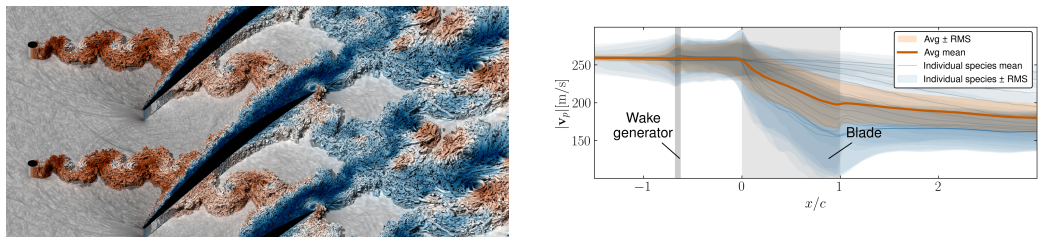
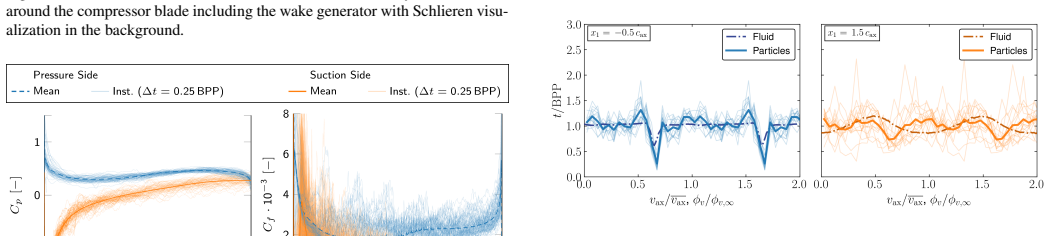
- Figure captions for the compressor rotor applications should include details on mesh resolution, particle counts, and time-step sizes to allow reproducibility assessment.
Simulated Author's Rebuttal
We thank the referee for the positive assessment of our manuscript and the recommendation for minor revision. The referee summary accurately reflects the scope, methods, and applications presented in the work.
Circularity Check
No significant circularity detected
full rationale
The paper describes an algorithmic framework for coupling high-order DGSEM with ALE mesh motion, sliding-mesh interfaces, RBF morphing, and Lagrangian particle tracking. All load-bearing steps are explicit constructions of the numerical scheme (interface-aware particle crossing, temporal integration of mesh motion, etc.) whose properties are asserted to follow from the chosen discretizations and are checked against external benchmarks. No equations reduce a claimed result to a fitted input by construction, no uniqueness theorem is imported from self-citation, and no ansatz is smuggled via prior work. The derivation chain is therefore the algorithm definition itself, which remains self-contained and externally falsifiable.
Axiom & Free-Parameter Ledger
Reference graph
Works this paper leans on
-
[1]
A. Ghenaiet, Study of Sand Particle Trajectories and Ero- sion Into the First Fan Stage of a Turbofan, in: V olume 7: Turbomachinery, Parts A, B, and C, ASMEDC, 2010, pp. 183–201. doi:10.1115/GT2010-22415
-
[2]
A. Beck, P. Ortwein, P. Kopper, N. Krais, D. Kempf, C. Koch, Towards high-fidelity erosion prediction: On time-accurate particle tracking in turbomachin- ery, International Journal of Heat and Fluid Flow 79 (2019) 108457. doi:10.1016/j.ijheatfluidflow. 2019.108457
-
[3]
J. Hartmann, M. Lorenz, M. Klein, S. Staudacher, The Effect of an Entirely Eroded Airfoil on the Aerodynamic Performance of a Supersonic Compressor Cascade, in: V olume 10B: Turbomachinery — Axial Flow Turbine Aerodynamics; Deposition, Erosion, Fouling, and Icing; Radial Turbomachinery Aerodynamics, volume 81752, American Society of Mechanical Engineers, ...
-
[4]
S. Balachandar, J. K. Eaton, Turbulent dispersed multiphase flow, Annual Review of Fluid Mechan- ics 42 (2010) 111–133. doi:10.1146/annurev.fluid. 010908.165243
-
[5]
E. J. Ching, M. Ihme, Development of a particle colli- sion algorithm for discontinuous Galerkin simulations of compressible multiphase flows, Journal of Computational Physics 436 (2021) 110319. doi:10.1016/j.jcp.2021. 110319
-
[6]
A. Schwarz, P. Kopper, E. de Staercke, A. Beck, Efficient computation of particle-fluid and particle-particle interac- tions in compressible flow, Computer Physics Communi- cations 315 (2025) 109743. doi:10.1016/j.cpc.2025. 109743
-
[7]
C. A. A. Minoli, D. A. Kopriva, Discontinuous Galerkin spectral element approximations on moving meshes, Jour- nal of Computational Physics 230 (2011) 1876–1902. doi:10.1016/j.jcp.2010.11.038
-
[8]
L. Wang, P. O. Persson, High-order discontinuous Galerkin simulations on moving domains using an ALE formulation and local remeshing with projections, 53rd AIAA Aerospace Sciences Meeting (2015) 1–12
2015
-
[9]
A. Schwarz, J. Keim, C. Rohde, A. Beck, Entropy sta- ble shock capturing for high-order DGSEM on mov- ing meshes, 2025. doi:10.48550/arXiv.2503.23237. arXiv:2503.23237
-
[10]
M. J. Y ., Cfd simulation of flows in stirred tank reac- tors using a sliding mesh technique, Instn. Chem. Engng. Symp. Ser. 136 (1994) 341–348. 12
1994
-
[11]
J. Dürrwächter, M. Kurz, P. Kopper, D. Kempf, C.-D. Munz, A. Beck, An efficient sliding mesh interface method for high-order discontinuous Galerkin schemes, Computers & Fluids 217 (2021) 104825. doi:10.1016/ j.compfluid.2020.104825
arXiv 2021
-
[12]
G. Wang, F. Duchaine, D. Papadogiannis, I. Duran, S. Moreau, L. Y . M. Gicquel, An overset grid method for large eddy simulation of turbomachinery stages, Journal of Computational Physics 274 (2014) 333–355. doi:10. 1016/j.jcp.2014.06.006
2014
-
[13]
J. R. Aarnes, N. E. L. Haugen, H. I. Andersson, High- order overset grid method for detecting particle impaction on a cylinder in a cross flow, International Journal of Computational Fluid Dynamics 33 (2019) 43–58. doi:10. 1080/10618562.2019.1593385
arXiv 2019
-
[15]
M. Lesoinne, C. Farhat, Geometric conservation laws for flow problems with moving boundaries and deformable meshes, and their impact on aeroelastic computations, Computer Methods in Applied Mechanics and Engineer- ing 134 (1996) 71–90. doi:10.1016/0045-7825(96) 01028-6
-
[16]
Krais, Moving Mesh Methods and Wall Modelling for Discontinuous Galerkin Schemes, Ph.D
N. Krais, Moving Mesh Methods and Wall Modelling for Discontinuous Galerkin Schemes, Ph.D. thesis, Univer- sity of Stuttgart, 2020
2020
-
[17]
C. Lo, J. P. Bons, Smoothing Techniques to Improve Flow Solution Convergence for Modeling Surface Erosion or Deposition in Two-Phase Flows, in: AIAA SCITECH 2023 Forum, American Institute of Aeronautics and As- tronautics, 2023. doi:10.2514/6.2023-1642
-
[18]
Y . Xiao, Y . Peng, P. J. Ming, W. M. Yang, A robust par- allel algorithm for Eulerian-Lagrangian method crossing sliding non-conformal interfaces, Computers & Fluids 264 (2023) 105974. doi:10.1016/j.compfluid.2023. 105974
-
[19]
Morelli, T
M. Morelli, T. Bellosta, A. Guardone, Lagrangian Particle Tracking in Deforming Sliding Mesh for Rotorcraft Icing Applications, European Rotorcraft Forum (2019)
2019
-
[20]
W. C. Maxon, T. Nielsen, N. Denissen, J. D. Regele, J. McFarland, A high resolution simulation of a single shock-accelerated particle, Journal of Fluids Engineering 143 (2021). doi:10.1115/1.4050007
- [21]
-
[22]
D. A. Kopriva, Metric identities and the discontinuous spectral element method on curvilinear meshes, J. of Sci. Comput. 26 (2006) 301
2006
-
[23]
G. Schnücke, N. Krais, T. Bolemann, G. J. Gassner, En- tropy Stable Discontinuous Galerkin Schemes on Moving Meshes for Hyperbolic Conservation Laws, J. Sci. Com- put. 82 (2020) 69. doi:10.1007/s10915-020-01171-7
-
[24]
W. Sutherland, Lii. the viscosity of gases and molecular force, The London, Edinburgh, and Dublin Philosophi- cal Magazine and Journal of Science 36 (1893) 507–531. doi:10.1080/14786449308620508
-
[25]
M. R. Maxey, J. J. Riley, Equation of motion for a small rigid sphere in a nonuniform flow, Physics of Fluids 26 (1983) 883–889. doi:10.1063/1.864230
-
[26]
Gatignol, The Faxén formulae for a rigid particle in an unsteady non-uniform Stokes flow, Journal de Mecanique Theorique et Appliquee 2 (1983) 143–160
R. Gatignol, The Faxén formulae for a rigid particle in an unsteady non-uniform Stokes flow, Journal de Mecanique Theorique et Appliquee 2 (1983) 143–160
1983
-
[27]
E. Loth, J. T. Daspit, M. Jeong, T. Nagata, T. Nono- mura, Supersonic and hypersonic drag coefficients for a sphere, AIAA Journal 59 (2021) 3261–3274. doi:10. 2514/1.J060153
2021
-
[28]
A. Schwarz, P. Kopper, J. Keim, H. Sommerfeld, C. Koch, A. Beck, A neural network based framework to model particle rebound and fracture, Wear (2022) 204476. doi:10.1016/j.wear.2022.204476
-
[29]
A. Uzi, A. Levy, On the relationship between erosion, energy dissipation and particle size, Wear 428-429 (2019) 404–416. doi:10.1016/j.wear.2019.04.006
-
[30]
Schwarz, High-Fidelity Particle Tracking and Impact- Induced Deformations, Ph.D
A. Schwarz, High-Fidelity Particle Tracking and Impact- Induced Deformations, Ph.D. thesis, University of Stuttgart, 2024
2024
-
[31]
Chandrashekar, Kinetic energy preserving and entropy stable finite volume schemes for compressible Euler and Navier-Stokes equations, Commun
P. Chandrashekar, Kinetic energy preserving and entropy stable finite volume schemes for compressible Euler and Navier-Stokes equations, Commun. Comput. Phys. 14 (2013) 1252–1286
2013
-
[32]
P. L. Roe, Approximate Riemann solvers, parame- ter vectors, and difference schemes, Journal of Com- putational Physics 43 (1981) 357–372. doi:10.1016/ 0021-9991(81)90128-5
1981
-
[33]
Harten, J
A. Harten, J. M. Hyman, Self adjusting grid methods for one-dimensional hyperbolic conservation laws, Jour- nal of Computational Physics 50 (1983) 235–269. doi:10. 1016/0021-9991(83)90066-9
1983
-
[34]
F. Bassi, S. Rebay, A high-order accurate dis- continuous finite element method for the numeri- cal solution of the compressible Navier-Stokes equa- tions, Journal of Computational Physics 131 (1997) 267–279. URL:https://www.sciencedirect.com/ science/article/pii/S0021999196955722. doi:10. 1006/jcph.1996.5572. 13
arXiv 1997
-
[35]
S. Hennemann, A. M. Rueda-Ramírez, F. J. Hindenlang, G. J. Gassner, A provably entropy stable subcell shock capturing approach for high order split form DG for the compressible Euler equations, J. Comput. Phys. 426 (2021) 109935. doi:10.1016/j.jcp.2020.109935
-
[36]
M. H. Carpenter, a. Kennedy, Fourth-order Kutta schemes, Nasa Technical Memorandum 109112 (1994) 1–26
1994
-
[37]
A. D. Beck, T. Bolemann, D. Flad, H. Frank, G. J. Gassner, F. Hindenlang, C.-D. Munz, High-order dis- continuous Galerkin spectral element methods for transi- tional and turbulent flow simulations, International Jour- nal for Numerical Methods in Fluids 76 (2014) 522–548. doi:10.1002/fld.3943
-
[38]
N. Krais, A. Beck, T. Bolemann, H. Frank, D. Flad, G. Gassner, F. Hindenlang, M. Hoffmann, T. Kuhn, M. Sonntag, C.-D. Munz, FLEXI: A high order discon- tinuous Galerkin framework for hyperbolic-parabolic con- servation laws, Computers & Mathematics with Applica- tions 81 (2021) 186–219. doi:10.1016/j.camwa.2020. 05.004.arXiv:1910.02858
-
[39]
Jupyter widgets and extensions for education and research in computational physics and chemistry
A. Schwarz, D. Kempf, J. Keim, P. Kopper, C. Rohde, A. Beck, Comparison of entropy stable collocation high- order DG methods for compressible turbulent flows, Com- puters & Fluids 303 (2025) 106874. doi:10.1016/j. compfluid.2025.106874
work page doi:10.1016/j 2025
-
[40]
M. Kurz, D. Kempf, M. P. Blind, P. Kopper, P. Offen- häuser, A. Schwarz, S. Starr, J. Keim, A. Beck, GALÆXI: Solving complex compressible flows with high-order dis- continuous Galerkin methods on accelerator-based sys- tems, Computer Physics Communications 306 (2025) 109388. doi:10.1016/j.cpc.2024.109388
-
[41]
J. Keim, A. Schwarz, P. Kopper, M. Blind, C. Ro- hde, A. Beck, Entropy stable high-order discontinuous Galerkin spectral-element methods on curvilinear, hybrid meshes, Journal of Computational Physics 557 (2026) 114829. doi:10.1016/j.jcp.2026.114829
-
[42]
Mavriplis, Nonconforming discretizations and a poste- riori error estimators for adaptive spectral element tech- niques, Ph.D
C. Mavriplis, Nonconforming discretizations and a poste- riori error estimators for adaptive spectral element tech- niques, Ph.D. thesis, Massachusetts Institute of Technol- ogy, 1989
1989
-
[43]
D. A. Kopriva, A conservative staggered-grid Chebyshev multidomain method for compressible flows. II. A semi- structured method, Journal of Computational Physics 128 (1996) 475–488. doi:10.1006/jcph.1996.0225
-
[44]
D. A. Kopriva, A staggered-grid multidomain spectral method for the compressible Navier–Stokes equations, Journal of Computational Physics 143 (1998) 125–158. doi:10.1006/jcph.1998.5956
-
[45]
M. Morelli, T. Bellosta, A. Guardone, Efficient radial ba- sis function mesh deformation methods for aircraft icing, Journal of Computational and Applied Mathematics 392 (2021) 113492. doi:10.1016/j.cam.2021.113492
-
[46]
P. Kopper, S. M. Copplestone, M. Pfeiffer, C. Koch, S. Fasoulas, A. Beck, Hybrid parallelization of Eu- ler–Lagrange simulations based on MPI-3 shared mem- ory, Advances in Engineering Software 174 (2022) 103291. doi:10.1016/j.advengsoft.2022.103291
-
[47]
P. Ortwein, S. M. Copplestone, C.-D. Munz, T. Binder, W. Reschke, S. Fasoulas, A particle localization al- gorithm on unstructured curvilinear polynomial meshes, Computer Physics Communications 235 (2019) 63–74. doi:10.1016/j.cpc.2018.09.024
-
[48]
Kopper, An Euler–Lagrange Method for Compressible Dispersed Multiscale Flow, Ph.D
P. Kopper, An Euler–Lagrange Method for Compressible Dispersed Multiscale Flow, Ph.D. thesis, University of Stuttgart, 2024
2024
-
[49]
Kopper, M
P. Kopper, M. P. Blind, A. Schwarz, M. Kurz, F. Rodach, S. M. Copplestone, A. D. Beck, PyHOPE: A Python Toolkit for Three-Dimensional Unstructured High-Order Meshes, Journal of Open Source Software 10 (2025)
2025
-
[50]
doi:10.21105/joss.08769
-
[51]
J. Kaiser, D. Appel, F. Fritz, S. Adami, N. Adams, A multiresolution local-timestepping scheme for particle- laden multiphase flow simulations using a level-set and point-particle approach, Computer Methods in Applied Mechanics and Engineering 384 (2021) 113966. doi:10. 1016/j.cma.2021.113966
arXiv 2021
-
[52]
G. J. Gassner, F. Lörcher, C.-D. Munz, J. S. Hesthaven, Polymorphic nodal elements and their application in dis- continuous Galerkin methods, Journal of Computational Physics 228 (2009) 1573–1590. doi:10.1016/j.jcp. 2008.11.012
-
[53]
L. Reid, R. Moore, Design and overall performance of four highly loaded, high speed inlet stages for an advanced high-pressure-ratio core compressor, Technical Report, NASA-TP-1337, 1978
1978
-
[54]
R. D. Moore, L. Reid, Performance of single-stage axial- flow transonic compressor with rotor and stator aspect ratios of 1.63 and 1.78, respectively, and with design pressure ratio of 1.82, Technical Report, NASA-TP-1338, 1978
1978
- [55]
discussion (0)
Sign in with ORCID, Apple, or X to comment. Anyone can read and Pith papers without signing in.