MoCo-AIS: A Contrastive Learning Framework for Similarity Computation of Vessel Trajectories
Pith reviewed 2026-06-27 00:46 UTC · model grok-4.3
The pith
MoCo-AIS learns vessel trajectory similarities by contrasting positive and negative pairs in a self-supervised setup.
A machine-rendered reading of the paper's core claim, the machinery that carries it, and where it could break.
Core claim
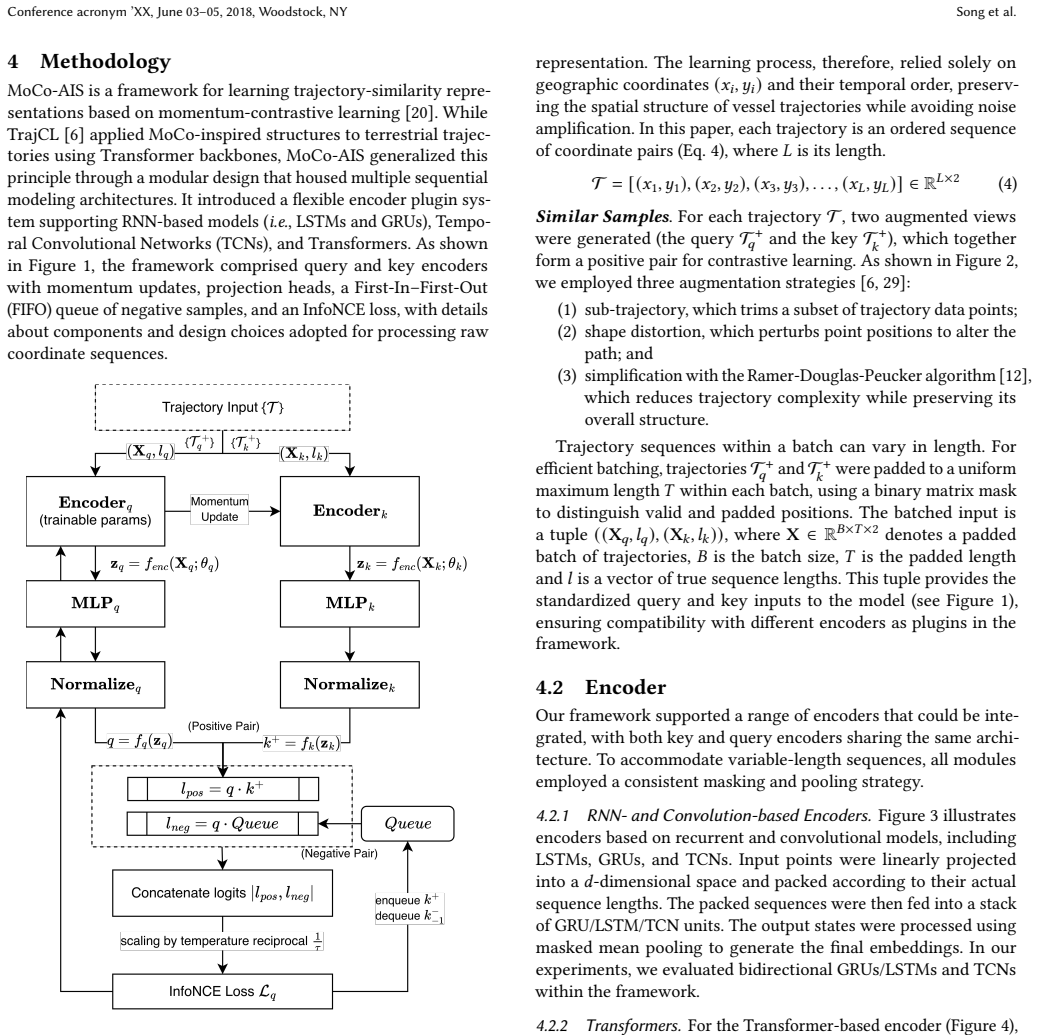
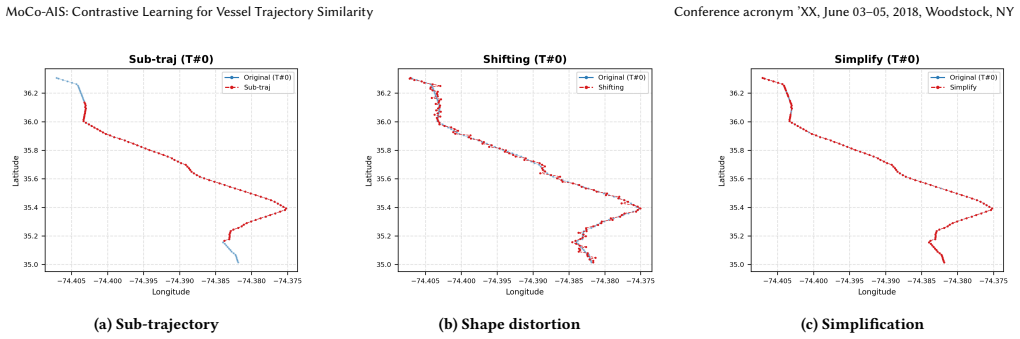
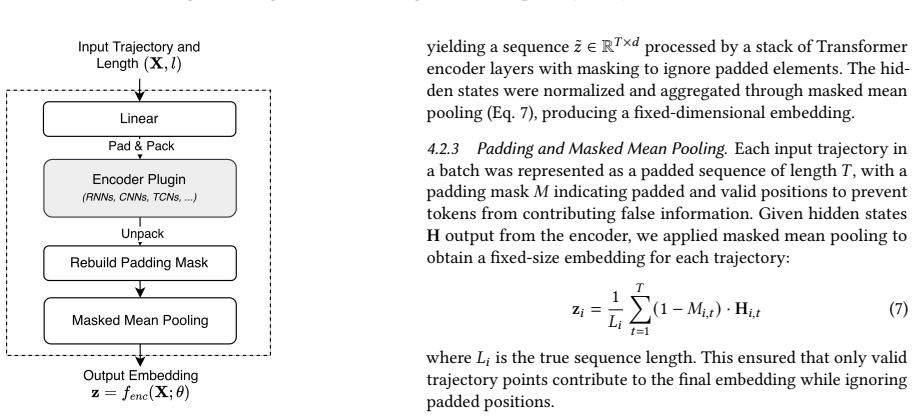
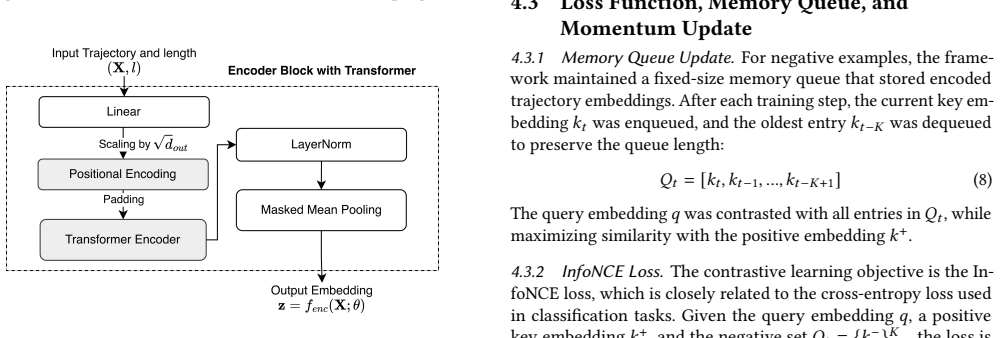
MoCo-AIS adapts the Momentum Contrast paradigm to trajectory data by generating positive pairs from the same vessel track and negative pairs from different tracks, then trains an encoder to pull positives closer and push negatives apart; when applied to large real-world AIS collections that span varied navigation conditions, the resulting embeddings yield higher similarity accuracy than prior baselines while creating a consistent platform for testing multiple deep learning architectures.
What carries the argument
The MoCo contrastive setup that maintains a momentum-updated encoder and a queue of negative trajectory samples to drive representation learning from unlabeled pairs.
If this is right
- Similarity computation for vessel trajectories improves over existing supervised and distance-based baselines on large AIS datasets.
- A standardized benchmarking platform becomes available for comparing different deep learning models on trajectory representation tasks.
- Self-supervised training removes dependence on large volumes of labels derived from traditional distance calculations.
- Models trained inside the framework handle diverse navigation behaviors and operating conditions captured in real vessel tracking data.
Where Pith is reading between the lines
- The same pair-construction logic could be applied to other mobility datasets such as road-vehicle or pedestrian tracks without redesigning the contrastive objective.
- Once embeddings are learned, downstream tasks like route clustering or anomaly flagging could run faster because they operate on fixed-length vectors rather than raw coordinate sequences.
- If the performance gain persists, training pipelines for mobility models could drop the preprocessing step that computes expensive pairwise distances altogether.
Load-bearing premise
That learning to separate positive and negative trajectory pairs will automatically produce embeddings whose similarity judgments generalize beyond the particular distance functions used in earlier supervised work.
What would settle it
A controlled test in which embeddings trained with MoCo-AIS are evaluated on a similarity ranking task whose ground truth comes from a distance measure never seen during contrastive training, and the learned model fails to beat a supervised baseline trained directly on that same measure.
Figures
read the original abstract
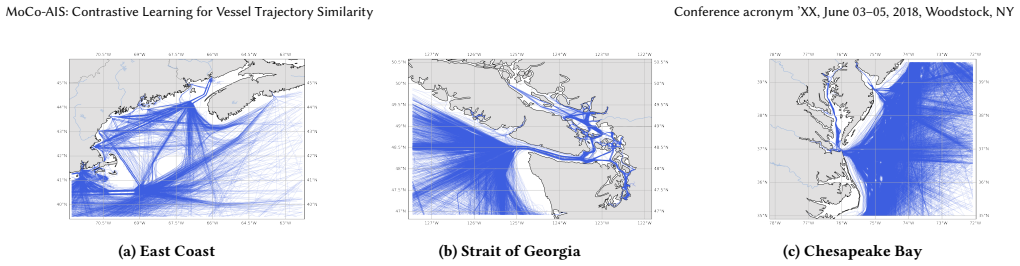
Trajectory similarity is a fundamental task in analyzing mobility patterns, essential for applications such as route pattern extraction, mobility prediction, and anomaly detection. Traditional distance-based measures for computing similarity incur high computational cost, driving the adoption of lightweight learning-based approaches. Supervised methods rely on extensive labels derived from traditional distance measures and often reproduce these metrics, which limits generalization. While self-supervised learning addresses this issue through contrastive learning, it lacks a unified framework, making it difficult to compare deep learning (DL) models for consistent trajectory representation. Accordingly, this paper presents MoCo-AIS, a unified framework for learning vessel trajectory embeddings based on the Momentum Contrast (MoCo) paradigm, which formulates similarity learning through positive and negative trajectory pairs. Within this framework, we evaluate a diverse set of leading DL models on large-scale, real-world vessel-tracking AIS datasets that capture diverse navigation behaviors and operating conditions. Results demonstrate that our framework significantly improves similarity learning over existing baselines, while providing a benchmarking platform for evaluating trajectory representation models.
Editorial analysis
A structured set of objections, weighed in public.
Referee Report
Summary. The paper introduces MoCo-AIS, a unified self-supervised framework for learning vessel trajectory embeddings based on the Momentum Contrast (MoCo) paradigm. It formulates similarity computation via positive and negative trajectory pairs to overcome limitations of traditional distance measures and supervised methods that reproduce them. The framework is used to benchmark multiple deep learning models on large-scale real-world AIS datasets capturing diverse navigation behaviors, with the central claim that it significantly improves similarity learning over baselines while serving as a benchmarking platform.
Significance. If the empirical claims hold with rigorous quantitative validation, the work could establish a standardized contrastive learning approach for maritime trajectory representation, enabling better generalization in downstream tasks such as anomaly detection and route pattern extraction. The use of an established paradigm (MoCo) applied to a new domain and the explicit benchmarking platform are positive aspects that could facilitate reproducible comparisons among DL models.
minor comments (1)
- The abstract asserts that 'results demonstrate that our framework significantly improves similarity learning over existing baselines' but supplies no quantitative metrics, dataset sizes, model names, or baseline comparisons; the full experimental section should be checked for these details to support the claim.
Simulated Author's Rebuttal
We thank the referee for reviewing our manuscript on MoCo-AIS. We appreciate the acknowledgment of the unified self-supervised framework, the application of the MoCo paradigm to vessel trajectories, and the value of the benchmarking platform for reproducible comparisons. The recommendation of 'uncertain' appears tied to the need for rigorous validation of empirical claims; we address this below in the absence of enumerated major comments.
Circularity Check
No significant circularity; framework applies external MoCo to new domain
full rationale
The provided abstract and context describe MoCo-AIS as an application of the established external Momentum Contrast paradigm (self-supervised contrastive learning via positive/negative pairs) to vessel trajectory embeddings, followed by empirical evaluation of DL models on real-world AIS data. No equations, fitted parameters, or derivations are shown that reduce any claimed result to a quantity defined by the paper's own inputs. The benchmarking claim is presented as an empirical outcome rather than a self-referential construction, and the cited MoCo foundation is independent prior work. No self-citation load-bearing steps or self-definitional reductions appear in the given text.
Axiom & Free-Parameter Ledger
Reference graph
Works this paper leans on
-
[1]
Md Mahbub Alam, Gabriel Spadon, Mohammad Etemad, Luis Torgo, and Evan- gelos Milios. 2024. Enhancing Short-Term Vessel Trajectory Prediction with Clustering for Heterogeneous and Multi-Modal Movement Patterns.Ocean Engineering308 (Sept. 2024), 118303. doi:10.1016/j.oceaneng.2024.118303
-
[2]
Md Mahbub Alam and Luis Torgo. 2022. A Clustering-based Approach for Predicting the Future Location of a Vessel.Proceedings of the Canadian Conference on Artificial Intelligence(May 2022). https://caiac.pubpub.org/pub/7rrw5ds3
2022
-
[3]
Md Mahbub Alam, Luis Torgo, and Albert Bifet. 2022. A survey on spatio-temporal data analytics systems.Comput. Surveys54, 10s (2022), 1–38
2022
-
[4]
Hanlin Cao, Haina Tang, Yulei Wu, Fei Wang, and Yongjun Xu. 2021. On Accurate Computation of Trajectory Similarity via Single Image Super-Resolution. In 2021 International Joint Conference on Neural Networks (IJCNN)(2021-07). 1–9. doi:10.1109/IJCNN52387.2021.9533802
-
[5]
Yuan Cao, Lei Li, Xiangru Chen, Xue Xu, Zuojin Huang, and Yanwei Yu. 2024. Hypergraph Hash Learning for Efficient Trajectory Similarity Computation. InProceedings of the 33rd ACM International Conference on Information and Knowledge Management(New York, NY, USA, 2024-10-21)(CIKM ’24). Association for Computing Machinery, 175–186. doi:10.1145/3627673.3679555
-
[6]
Yanchuan Chang, Jianzhong Qi, Yuxuan Liang, and Egemen Tanin. 2023. Con- trastive Trajectory Similarity Learning with Dual-Feature Attention. In2023 IEEE 39th International Conference on Data Engineering (ICDE)(2023-04). 2933–2945. doi:10.1109/ICDE55515.2023.00224
-
[7]
Yanchuan Chang, Egemen Tanin, Gao Cong, Christian S. Jensen, and Jianzhong Qi. 2024. Trajectory Similarity Measurement: An Efficiency Perspective.Proc. VLDB Endow.17, 9 (May 2024), 2293–2306. doi:10.14778/3665844.3665858
-
[8]
Lei Chen, M Tamer Özsu, and Vincent Oria. 2005. Robust and fast similarity search for moving object trajectories. InProceedings of the 2005 ACM SIGMOD international conference on Management of data. 491–502
2005
-
[9]
Yiheng Chen, Yanming Chen, Yue Cui, Xinyu Cai, Changgui Yin, and Yongxin Cheng. 2025. Optimizing Vessel Trajectories: Advanced Denoising and Inter- polation Techniques for AIS Data.Ocean Engineering327 (May 2025), 120988. doi:10.1016/j.oceaneng.2025.120988
-
[10]
Zhen Chen, Dalin Zhang, Shanshan Feng, Kaixuan Chen, Lisi Chen, Peng Han, and Shuo Shang. 2024. KGTS: Contrastive Trajectory Similarity Learning over Prompt Knowledge Graph Embedding. 38, 8 (2024), 8311–8319. doi:10.1609/aaai. v38i8.28672
-
[11]
Kyunghyun Cho, Bart van Merrienboer, Caglar Gulcehre, Dzmitry Bahdanau, Fethi Bougares, Holger Schwenk, and Yoshua Bengio. 2014. Learning Phrase Representations Using RNN Encoder-Decoder for Statistical Machine Translation. arXiv:1406.1078 [cs] doi:10.48550/arXiv.1406.1078
work page internal anchor Pith review Pith/arXiv arXiv doi:10.48550/arxiv.1406.1078 2014
-
[12]
David H Douglas and Thomas K Peucker. 1973. Algorithms for the Reduction of the Number of Points Required to Represent a Digitized Line or Its Caricature. Cartographica10, 2 (Dec. 1973), 112–122. doi:10.3138/FM57-6770-U75U-7727
-
[13]
Martha Dais Ferreira, Gabriel Spadon, Amilcar Soares, and Stan Matwin. 2022. A Semi-Supervised Methodology for Fishing Activity Detection Using the Geometry behind the Trajectory of Multiple Vessels.Sensors (Basel, Switzerland)22, 16 (Aug. 2022), 6063. doi:10.3390/s22166063
-
[14]
Carlos Andres Ferrero, Luis Otavio Alvares, Willian Zalewski, and Vania Bogorny
-
[15]
InProceedings of the 33rd Annual ACM Symposium on Applied Computing (SAC ’18)
MOVELETS: Exploring Relevant Subtrajectories for Robust Trajectory Classification. InProceedings of the 33rd Annual ACM Symposium on Applied Computing (SAC ’18). Association for Computing Machinery, New York, NY, USA, 849–856. doi:10.1145/3167132.3167225
-
[16]
Carlos Andres Ferrero, Lucas May Petry, Luis Otavio Alvares, Camila Leite da Silva, Willian Zalewski, and Vania Bogorny. 2020. MasterMovelets: Discovering Heterogeneous Movelets for Multiple Aspect Trajectory Classification.Data Mining and Knowledge Discovery34, 3 (May 2020), 652–680. doi:10.1007/s10618- 020-00676-x
-
[17]
Mélanie Fournier, R Casey Hilliard, Sara Rezaee, and Ronald Pelot. 2018. Past, present, and future of the satellite-based automatic identification system: Areas of applications (2004–2016).WMU journal of maritime affairs17, 3 (2018), 311–345
2018
-
[18]
Andre Salvaro Furtado, Despina Kopanaki, Luis Otavio Alvares, and Vania Bo- gorny. 2016. Multidimensional Similarity Measuring for Semantic Trajectories. Transactions in GIS20, 2 (2016), 280–298. doi:10.1111/tgis.12156
-
[19]
Richemond, Elena Buchatskaya, Carl Doersch, Bernardo Avila Pires, Zhao- han Daniel Guo, Mohammad Gheshlaghi Azar, Bilal Piot, Koray Kavukcuoglu, Rémi Munos, and Michal Valko
Jean-Bastien Grill, Florian Strub, Florent Altché, Corentin Tallec, Pierre H. Richemond, Elena Buchatskaya, Carl Doersch, Bernardo Avila Pires, Zhao- han Daniel Guo, Mohammad Gheshlaghi Azar, Bilal Piot, Koray Kavukcuoglu, Rémi Munos, and Michal Valko. 2020. Bootstrap Your Own Latent a New Ap- proach to Self-Supervised Learning. InProceedings of the 34th ...
2020
-
[20]
1914.Grundzüge der Mengenlehre
Felix Hausdorff. 1914.Grundzüge der Mengenlehre. Veit, Leipzig. In- troduces the Hausdorff metric (Pompeiu–Hausdorff distance). English trans- lation:Set Theory, Chelsea Publishing, 1957.. https://archive.org/details/ grundzgedermen00hausuoft
1914
-
[21]
2020.Momentum Contrast for Unsupervised Visual Representation Learning
Kaiming He, Haoqi Fan, Yuxin Wu, Saining Xie, and Ross Girshick. 2020.Momentum Contrast for Unsupervised Visual Representation Learning. arXiv:1911.05722 [cs] doi:10.48550/arXiv.1911.05722
-
[22]
Liang Huang, Chengpeng Wan, Yuanqiao Wen, Rongxin Song, and Pieter van Gelder. 2024. Generation and application of maritime route networks: overview and future research directions.IEEE Transactions on Intelligent Transportation Systems(2024)
2024
-
[23]
Eamonn Keogh and Chotirat Ann Ratanamahatana. 2005. Exact Indexing of Dynamic Time Warping.Knowledge and Information Systems7, 3 (March 2005), 358–386. doi:10.1007/s10115-004-0154-9
-
[24]
Colin Lea, Rene Vidal, Austin Reiter, and Gregory D. Hager. 2016. Tempo- ral Convolutional Networks: A Unified Approach to Action Segmentation. arXiv:1608.08242 [cs] doi:10.48550/arXiv.1608.08242
work page internal anchor Pith review Pith/arXiv arXiv doi:10.48550/arxiv.1608.08242 2016
-
[25]
HiT-JEPA: A Hierarchical Self-supervised Trajectory Embedding Framework for Similarity Computation
Lihuan Li, Hao Xue, Shuang Ao, Yang Song, and Flora Salim. 2025.HiT-JEPA: A Hierarchical Self-supervised Trajectory Embedding Framework for Similarity Computation. arXiv:2507.00028 [cs] doi:10.48550/arXiv.2507.00028
work page internal anchor Pith review Pith/arXiv arXiv doi:10.48550/arxiv.2507.00028 2025
-
[26]
Xiucheng Li, Kaiqi Zhao, Gao Cong, Christian S. Jensen, and Wei Wei. 2018. Deep Representation Learning for Trajectory Similarity Computation. In2018 IEEE 34th International Conference on Data Engineering (ICDE)(2018-04). 617–628. doi:10.1109/ICDE.2018.00062
-
[27]
Maohan Liang, Ryan Wen Liu, Ruobin Gao, Zhe Xiao, Xiaocai Zhang, and Hua Wang. 2024. A Survey of Distance-Based Vessel Trajectory Clustering: Data Pre-processing, Methodologies, Applications, and Experimental Evaluation. arXiv:2407.11084 [eess] doi:10.48550/arXiv.2407.11084
-
[28]
Maohan Liang, Ryan Wen Liu, Shichen Li, Zhe Xiao, Xin Liu, and Feng Lu. 2021. An Unsupervised Learning Method with Convolutional Auto-Encoder for Vessel Trajectory Similarity Computation.Ocean Engineering225 (April 2021), 108803. arXiv:2101.03169 [cs] doi:10.1016/j.oceaneng.2021.108803
-
[29]
Tiantian Liu, Hengyu Liu, Tianyi Li, Kristian Torp, and Christian S. Jensen. 2025. ACTIVE: Continuous Similarity Search for Vessel Trajectories. arXiv:2504.01142 [cs] doi:10.48550/arXiv.2504.01142
-
[30]
Xiang Liu, Xiaoying Tan, Yuchun Guo, Yishuai Chen, and Zhe Zhang. 2022. CSTRM: Contrastive Self-Supervised Trajectory Representation Model for Tra- jectory Similarity Computation. 185 (2022), 159–167. doi:10.1016/j.comcom.2022. 01.001
-
[31]
Sizhe Luo and Weiming Zeng. 2023. Vessel Trajectory Similarity Computation Based on Heterogeneous Graph Neural Network. 11, 7 (2023), 1318. Issue 7. doi:10.3390/jmse11071318
-
[32]
Pin Nie, Zhenjie Chen, Nan Xia, Qiuhao Huang, and Feixue Li. 2021. Trajectory Similarity Analysis with the Weight of Direction and K-Neighborhood for AIS Data.ISPRS International Journal of Geo-Information10, 11 (Nov. 2021), 757. doi:10.3390/ijgi10110757
-
[33]
Zahra Sadeghi and Stan Matwin. 2023. Anomaly Detection for Maritime Naviga- tion Based on Probability Density Function of Error of Reconstruction.Journal of Intelligent Systems32, 1 (Jan. 2023). doi:10.1515/jisys-2022-0270
-
[34]
Schuster and K.K
M. Schuster and K.K. Paliwal. 1997. Bidirectional Recurrent Neural Networks. IEEE Transactions on Signal Processing45, 11 (Nov. 1997), 2673–2681. doi:10.1109/ 78.650093
1997
-
[35]
Jianing Si, Haitao Yuan, Nan Jiang, Minxiao Chen, Xiao Ma, and Shang- guang Wang. 2025.Towards Robust Trajectory Embedding for Similarity Computation: When Triangle Inequality Violations in Distance Metrics Matter. arXiv:2504.10933 [cs] doi:10.48550/arXiv.2504.10933
-
[36]
Ana Paula Ramos Souza, Chiara Renso, Raffaele Perego, and Vania Bogorny. 2022. MAT-Index: An Index for Fast Multiple Aspect Trajectory Similarity Measuring. Transactions in GIS26, 2 (2022), 691–716. doi:10.1111/tgis.12889
-
[37]
Gabriel Spadon, Andre CPLF de Carvalho, Jose F Rodrigues-Jr, and Luiz GA Alves
-
[38]
Reconstructing commuters network using machine learning and urban indicators.Scientific reports9, 1 (2019), 11801
2019
-
[39]
Han Su, Shuncheng Liu, Bolong Zheng, Xiaofang Zhou, and Kai Zheng. 2020. A survey of trajectory distance measures and performance evaluation.The VLDB Journal29, 1 (2020), 3–32
2020
-
[40]
Yongfeng Suo, Wenke Chen, Christophe Claramunt, and Shenhua Yang. 2020. A ship trajectory prediction framework based on a recurrent neural network. Sensors20, 18 (2020), 5133
2020
-
[41]
Yaguang Tao, Alan Both, Rodrigo I Silveira, Kevin Buchin, Stef Sijben, Ross S Purves, Patrick Laube, Dongliang Peng, Kevin Toohey, and Matt Duckham. 2021. A comparative analysis of trajectory similarity measures.GIScience & Remote Sensing58, 5 (2021), 643–669
2021
-
[42]
Tarlis Tortelli Portela, Jonata Tyska Carvalho, and Vania Bogorny. 2022. HiPer- Movelets: High-Performance Movelet Extraction for Trajectory Classification. International Journal of Geographical Information Science36, 5 (May 2022), 1012–
2022
-
[43]
doi:10.1080/13658816.2021.2018593
-
[44]
Alexandros Troupiotis-Kapeliaris, Georgios Grigoropoulos, Marios Vodas, and Konstantina Bereta. 2025. Dynamic Weather-Resilient Vessel Routing Using Big AIS Data. InProceedings of the 33rd ACM International Conference on Advances in Geographic Information Systems. Association for Computing Machinery, New York, NY, USA, 706–716
2025
-
[45]
Alexandros Troupiotis-Kapeliaris, Christos Kastrisios, and Dimitris Zissis. 2025. Vessel Trajectory Data Mining: A Review.IEEE Access(2025). MoCo-AIS: Contrastive Learning for Vessel Trajectory Similarity Conference acronym ’XX, June 03–05, 2018, Woodstock, NY
2025
-
[46]
Enmei Tu, Guanghao Zhang, Lily Rachmawati, Eshan Rajabally, and Guang- Bin Huang. 2018. Exploiting AIS Data for Intelligent Maritime Navigation: A Comprehensive Survey From Data to Methodology.IEEE Transactions on Intelligent Transportation Systems19, 5 (May 2018), 1559–1582. doi:10.1109/TITS. 2017.2724551
-
[47]
Aaron Van den Oord, Yazhe Li, and Oriol Vinyals. 2019. Representation Learning with Contrastive Predictive Coding. arXiv:1807.03748 [cs] doi:10.48550/arXiv. 1807.03748
work page internal anchor Pith review Pith/arXiv arXiv doi:10.48550/arxiv 2019
-
[48]
Iraklis Varlamis, Christos Sardianos, Vania Bogorny, Luis Otavio Alvares, Jô- nata Tyska Carvalho, Chiara Renso, Raffaele Perego, and John Violos. 2021. A Novel Similarity Measure for Multiple Aspect Trajectory Clustering. In Proceedings of the 36th Annual ACM Symposium on Applied Computing (SAC ’21). Association for Computing Machinery, New York, NY, USA...
-
[49]
Ashish Vaswani, Noam Shazeer, Niki Parmar, Jakob Uszkoreit, Llion Jones, Aidan N Gomez, Łukasz Kaiser, and Illia Polosukhin. 2017. Attention Is All You Need. InAdvances in Neural Information Processing Systems, I. Guyon, U. Von Luxburg, S. Bengio, H. Wallach, R. Fergus, S. Vishwanathan, and R. Garnett (Eds.), Vol. 30. Curran Associates, Inc
2017
-
[50]
Weinberger and Lawrence K
Kilian Q. Weinberger and Lawrence K. Saul. 2009. Distance Metric Learning for Large Margin Nearest Neighbor Classification.Journal of Machine Learning Research10, 9 (2009), 207–244
2009
-
[51]
Larissa Westerdijk, M Beekveld, AE Eiben, and EN Belitser. 2019. Classifying vessel types based on AIS data.MSc, Vrije University, Amsterdam, Holland(2019), 49–61
2019
-
[52]
Peilun Yang, Hanchen Wang, Ying Zhang, Lu Qin, Wenjie Zhang, and Xuemin Lin. 2021. T3S: Effective Representation Learning for Trajectory Similarity Computation. In2021 IEEE 37th International Conference on Data Engineering (ICDE)(2021-04). 2183–2188. doi:10.1109/ICDE51399.2021.00221
-
[53]
Di Yao, Gao Cong, Chao Zhang, and Jingping Bi. 2019. Computing Trajectory Similarity in Linear Time: A Generic Seed-Guided Neural Metric Learning Ap- proach. In2019 IEEE 35th International Conference on Data Engineering (ICDE). 1358–1369. doi:10.1109/ICDE.2019.00123
-
[54]
Di Yao, Haonan Hu, Lun Du, Gao Cong, Shi Han, and Jingping Bi. 2022. Traj- GAT: A Graph-based Long-term Dependency Modeling Approach for Trajectory Similarity Computation. InProceedings of the 28th ACM SIGKDD Conference on Knowledge Discovery and Data Mining(New York, NY, USA, 2022-08-14)(KDD ’22). Association for Computing Machinery, 2275–2285. doi:10.11...
-
[55]
Hanyuan Zhang, Xinyu Zhang, Qize Jiang, Baihua Zheng, Zhenbang Sun, Wei- wei Sun, and Changhu Wang. 2020. Trajectory Similarity Learning with Aux- iliary Supervision and Optimal Matching. InProceedings of the Twenty-Ninth International Joint Conference on Artificial Intelligence. International Joint Con- ferences on Artificial Intelligence Organization, Y...
-
[56]
Liye Zhang, Qiang Meng, Zhe Xiao, and Xiuju Fu. 2018. A Novel Ship Trajectory Reconstruction Approach Using AIS Data.Ocean Engineering159 (July 2018), 165–174. doi:10.1016/j.oceaneng.2018.03.085
-
[57]
Yu Zheng. 2015. Trajectory data mining: an overview.ACM Transactions on Intelligent Systems and Technology (TIST)6, 3 (2015), 1–41. Received 20 February 2007; revised 12 March 2009; accepted 5 June 2009
2015
discussion (0)
Sign in with ORCID, Apple, or X to comment. Anyone can read and Pith papers without signing in.