A T-API-Compliant ReAct Agentic Loop for Optical Networks: Generic vs. Domain-Specific Tool Abstractions
Pith reviewed 2026-06-26 22:10 UTC · model grok-4.3
The pith
The first T-API-compliant ReAct loop for optical networks shows domain-specific composite tools reaching 90 percent oracle-validated correctness with threefold token savings over generic tools.
A machine-rendered reading of the paper's core claim, the machinery that carries it, and where it could break.
Core claim
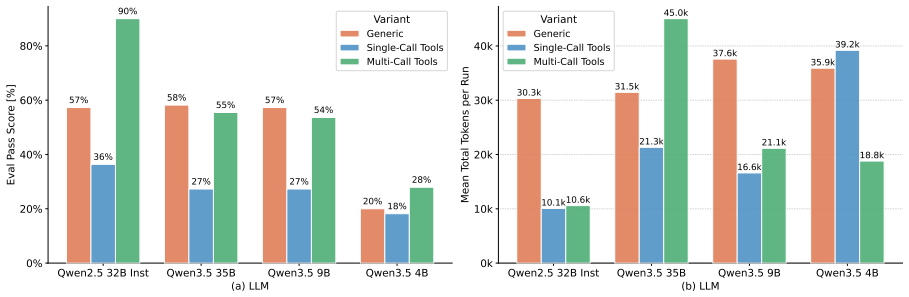
We present the first T-API-compliant reasoning and act (ReAct) loop. We show that domain-specific composite tools achieve 90% oracle-validated correctness with threefold token savings compared to generic tools.
What carries the argument
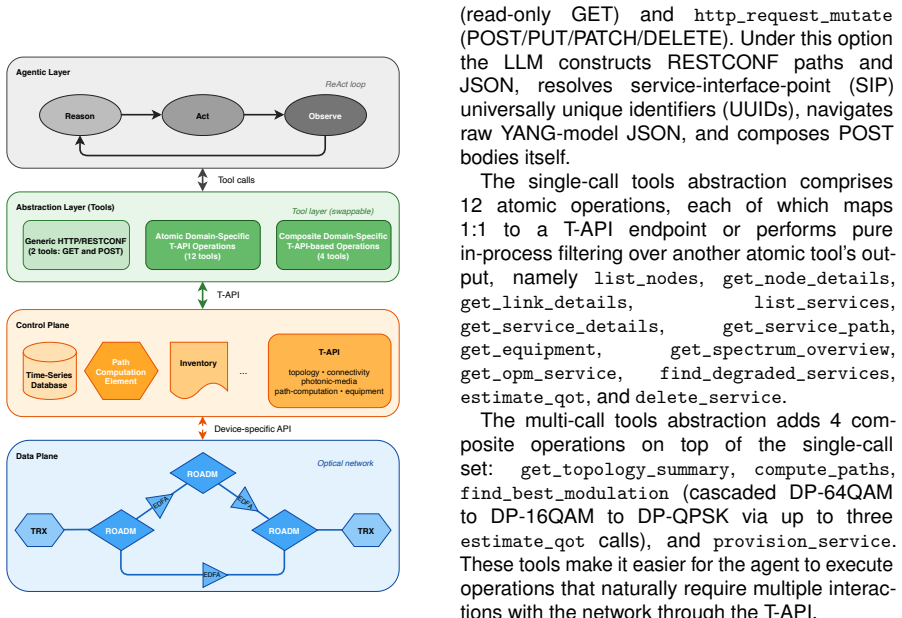
T-API-compliant ReAct loop that selects between generic tool abstractions and domain-specific composite tools to execute intent-driven closed-loop actions on optical networks.
If this is right
- Intent-driven closed-loop management becomes feasible at higher autonomy levels for optical networks.
- Domain-specific composite tools reduce operational token costs while preserving high task correctness.
- The T-API standard can serve as the interface layer for agentic control loops in production networks.
- Generic tool sets are less efficient for domain tasks and can be replaced without losing compliance.
Where Pith is reading between the lines
- The same composite-tool pattern could be tested on other standardized interfaces such as OpenConfig or ONF models to check portability.
- If oracle accuracy holds in live traffic, operators could reduce human-in-the-loop interventions for routine provisioning and recovery.
- Token savings may translate to lower inference latency and cost when the loop runs on edge or cloud LLM instances.
Load-bearing premise
The oracle used for validation provides an accurate and unbiased measure of real-world correctness, and the experimental comparison between generic and domain-specific tools controls for all relevant confounding factors such as prompt design and task selection.
What would settle it
A side-by-side run of the same ReAct loop on a live optical network testbed where domain-specific tools fall below 80 percent end-to-end success rate or show no measurable token reduction.
Figures
read the original abstract
Optical networks need intent-driven, closed-loop agentic management, a key enabler for higher autonomy levels. We present the first T-API-compliant reasoning and act (ReAct) loop. We show that domain-specific composite tools achieve 90% oracle-validated correctness with threefold token savings compared to generic tools.
Editorial analysis
A structured set of objections, weighed in public.
Referee Report
Summary. The manuscript presents the first T-API-compliant ReAct agentic loop for intent-driven optical network management. It claims that domain-specific composite tools achieve 90% oracle-validated correctness with threefold token savings relative to generic tools.
Significance. If the empirical comparison holds after proper controls and oracle definition, the result would supply concrete evidence favoring domain-specific abstractions in agentic telecom systems and could inform tool design for higher autonomy levels.
major comments (1)
- The headline quantitative claims (90% oracle-validated correctness and 3× token savings) are load-bearing for the preference of domain-specific tools, yet the manuscript provides no description of the oracle, the task dataset, prompt controls, baseline tool implementations, or error analysis. Without these, it is impossible to determine whether the oracle is independent or whether task selection and prompt wording confound the generic vs. domain-specific comparison.
Simulated Author's Rebuttal
We thank the referee for the constructive feedback on the experimental details supporting our quantitative claims. We agree these elements are necessary for rigorous evaluation and will expand the manuscript accordingly.
read point-by-point responses
-
Referee: The headline quantitative claims (90% oracle-validated correctness and 3× token savings) are load-bearing for the preference of domain-specific tools, yet the manuscript provides no description of the oracle, the task dataset, prompt controls, baseline tool implementations, or error analysis. Without these, it is impossible to determine whether the oracle is independent or whether task selection and prompt wording confound the generic vs. domain-specific comparison.
Authors: We acknowledge that the current manuscript provides insufficient detail on these elements. In the revised version we will add a new subsection in the Experiments section that explicitly defines: the oracle as an independent rule-based validator derived from T-API specifications and cross-validated by two domain experts; the task dataset of 50 intent scenarios across three topologies; prompt controls consisting of fixed system prompts, temperature=0, and identical few-shot examples (or none) for both conditions; baseline implementations with pseudocode for generic per-call tools versus the domain-specific composites; and a full error analysis breaking down failures by category (reasoning, tool invocation, oracle mismatch). These additions will permit assessment of independence and potential confounds. The reported aggregate results will be re-checked against the expanded documentation but are not expected to change. revision: yes
Circularity Check
No circularity: empirical system presentation with no derivation chain
full rationale
The paper describes an empirical implementation and evaluation of a T-API-compliant ReAct agentic loop for optical networks, reporting observed performance differences (90% oracle-validated correctness and threefold token savings) between domain-specific composite tools and generic tools. No equations, fitted parameters, predictions derived from first principles, or load-bearing self-citations appear in the abstract or described content. The central claims rest on experimental observations rather than any reduction of outputs to inputs by construction, self-definition, or imported uniqueness theorems. The work is therefore self-contained as an empirical contribution.
Axiom & Free-Parameter Ledger
Reference graph
Works this paper leans on
-
[1]
Autonomous networks: In search of best practice
R. Webb and D. Bushaus, “Autonomous networks: In search of best practice”, TM Forum, Tech. Rep., Dec. 2024, p. 51
2024
-
[2]
Framework and overall objectives of the future development of IMT for 2030 and beyond
ITU-R, “Framework and overall objectives of the future development of IMT for 2030 and beyond”, International Telecommunication Union, Geneva, Switzerland, Rec- ommendation ITU-R M.2160-0, Nov. 2023
2030
-
[3]
Zero-touch network and service man- agement (ZSM); intent-driven closed loops
ETSI ISG ZSM, “Zero-touch network and service man- agement (ZSM); intent-driven closed loops”, European Telecommunications Standards Institute, Sophia Antipo- lis, France, Group Specification ETSI GS ZSM 016 V1.1.1, Oct. 2024
2024
-
[4]
D. Wang et al., “The role of digital twin in optical com- munication: Fault management, hardware configuration, and transmission simulation”,IEEE Communications Magazine, vol. 59, no. 1, pp. 133–139, Jan. 2021.DOI: 10.1109/MCOM.001.2000727
-
[5]
X. Liu et al., “First field trial of llm-powered ai agent for lifecycle management of autonomous driving optical networks”, in2025 Optical Fiber Communications Con- ference and Exhibition (OFC), Mar. 2025, Th1A.2.DOI: 10.1364/OFC.2025.Th1A.2
-
[6]
X. Liu, Y . Zhang, Q. Qiu, Y . Cheng, W. Hu, and Q. Zhuge, “Field trial of an llm-powered ai agent for autonomous optical networks: A full-lifecycle demonstration”,Jour- nal of Optical Communications and Networking, vol. 18, no. 5, A179, May 2026.DOI:10.1364/JOCN.575402
-
[7]
Multi-agent design for llm-assisted network management
H. Zaid, P . Safari, B. Shariati, A. Jafari, M. Balanici, and J. K. Fischer, “Multi-agent design for llm-assisted network management”, in2025 Optical Fiber Commu- nications Conference and Exhibition (OFC), Mar. 2025, W1A.4.DOI:10.1364/OFC.2025.W1A.4
-
[8]
Data sovereign llm-assisted automa- tion platform for open optical and packet transport networks
B. Shariati et al., “Data sovereign llm-assisted automa- tion platform for open optical and packet transport networks”, in2025 IEEE International Conference on Machine Learning for Communication and Network- ing (ICMLCN), May 2025, pp. 1–6.DOI: 10 . 1109 / ICMLCN64995.2025.11140539
arXiv 2025
-
[9]
Large language model-driven ai agent in sdn controller towards intent-based management of optical networks
A. Zhou, Y . Song, Y . Zhang, M. Zhang, and D. Wang, “Large language model-driven ai agent in sdn controller towards intent-based management of optical networks”, inECOC 2024; 50th European Conference on Optical Communication, Sep. 2024, pp. 1595–1598
2024
-
[10]
Field trial of llm-based autonomous net- work management with ai-agent in real-time 400g/800g elastic optical network
H. Huang et al., “Field trial of llm-based autonomous net- work management with ai-agent in real-time 400g/800g elastic optical network”, in2025 European Confer- ence on Optical Communications (ECOC), Sep. 2025, p. M.03.01.3.DOI: 10 . 1109 / ECOC66593 . 2025 . 11263349
2025
-
[11]
Cross-domain orchestration with multi- agent llm framework for enhanced task automation
X. Xu et al., “Cross-domain orchestration with multi- agent llm framework for enhanced task automation”, in 2025 Optical Fiber Communications Conference and Exhibition (OFC), Mar. 2025, M3Z.10.DOI: 10.1364/ OFC.2025.M3Z.10
2025
-
[12]
Z. Wang et al.,Agentic ai for scalable and robust opti- cal systems control, Feb. 2026.DOI: 10.48550/arXiv. 2602.20144arXiv:2602.20144 [eess]
work page internal anchor Pith review doi:10.48550/arxiv 2026
-
[13]
Opticomm-gpt: A gpt-based versatile research assistant for optical fiber communication sys- tems
X. Jiang et al., “Opticomm-gpt: A gpt-based versatile research assistant for optical fiber communication sys- tems”,Optics Express, vol. 32, no. 12, pp. 20 776– 20 796, Jun. 2024.DOI:10.1364/OE.522026
-
[14]
On-premises small lan- guage model agent with physics-aware reasoning for optical network optimization
T. Tanimura and N. Kikuchi, “On-premises small lan- guage model agent with physics-aware reasoning for optical network optimization”, inOptical Fiber Communi- cation Conference (OFC), 2026, Th2A.33
2026
-
[15]
LLM-enhanced digital twin framework in optical networks
S. Shen et al., “LLM-enhanced digital twin framework in optical networks”, inOptical Fiber Communication Conference (OFC), 2026, M4A.6
2026
-
[16]
The case for a dnanf 1 pb/s trans-atlantic submarine cable
A. Jafari et al., “Llm assistant for tapi context and client code translation”, in2025 European Conference on Op- tical Communications (ECOC), Sep. 2025, p. M.03.01.2. DOI:10.1109/ECOC66593.2025.11263212
-
[17]
ACM Netw.2, DOI: 10.1145/3656296 (2024)
C. Wang, M. Scazzariello, A. Farshin, S. Ferlin, D. Kosti´c, and M. Chiesa, “NetConfEval: Can LLMs facilitate net- work configuration?”,Proceedings of the ACM on Net- working, vol. 2, no. CoNEXT2, 7:1–7:25, Jun. 2024.DOI: 10.1145/3656296
-
[18]
Toolllm: Facilitating large language models to master 16000+ real-world apis
Y . Qin et al., “Toolllm: Facilitating large language models to master 16000+ real-world apis”, inInternational Con- ference on Learning Representations, vol. 2024, May 2024, pp. 9695–9717
2024
-
[19]
Autoonbench: A benchmark for large language model agents in autonomous optical networks
Y . Zhang, Q. Qiu, J. Wu, X. Liu, W. Hu, and Q. Zhuge, “Autoonbench: A benchmark for large language model agents in autonomous optical networks”,Journal of Op- tical Communications and Networking, vol. 18, no. 9, pp. D1–D15, Sep. 2026.DOI:10.1364/JOCN.589201
-
[20]
When large language models meet opti- cal networks: Paving the way for automation
D. Wang, Y . Wang, X. Jiang, Y . Zhang, Y . Pang, and M. Zhang, “When large language models meet opti- cal networks: Paving the way for automation”,Elec- tronics, vol. 13, no. 13, Jun. 2024.DOI: 10 . 3390 / electronics13132529
2024
-
[21]
D. Yuan, H. Zhou, X. Liu, H. Chen, Y . Xin, and J. Zhang, “Enhancing large language models (LLMs) for telecom using dynamic knowledge graphs and explain- able retrieval-augmented generation”,IEEE Wireless Communications, 2026, Accepted; arXiv:2602.17529
arXiv 2026
-
[22]
Applicability of MCP for the network management
Y . Y ang, Q. Wu, D. Lopez, N. R. Moreno, and L. Tailhar- dat, “Applicability of MCP for the network management”, Internet Engineering Task Force, Internet Draft draft- yang-nmrg-mcp-nm-02, Feb. 2026
2026
-
[23]
Gnpy model of the physical layer for open and disaggregated optical networking [invited]
V. Curri, “Gnpy model of the physical layer for open and disaggregated optical networking [invited]”,Journal of Optical Communications and Networking, vol. 14, no. 6, pp. C92–C104, Jun. 2022.DOI:10.1364/JOCN.452868
-
[24]
C. Natalino et al., “Optical networking gym: An open- source toolkit for resource assignment problems in opti- cal networks”,Journal of Optical Communications and Networking, vol. 16, no. 12, G40–G51, Dec. 2024.DOI: 10.1364/JOCN.532850
discussion (0)
Sign in with ORCID, Apple, or X to comment. Anyone can read and Pith papers without signing in.