LLM Consumer Behavior Theory: Foundations of a Novel Research Field
Pith reviewed 2026-06-27 00:35 UTC · model grok-4.3
The pith
LLM-based agents making buying decisions need their own consumer behavior theory to model how they reflect human preferences and form market demand.
A machine-rendered reading of the paper's core claim, the machinery that carries it, and where it could break.
Core claim
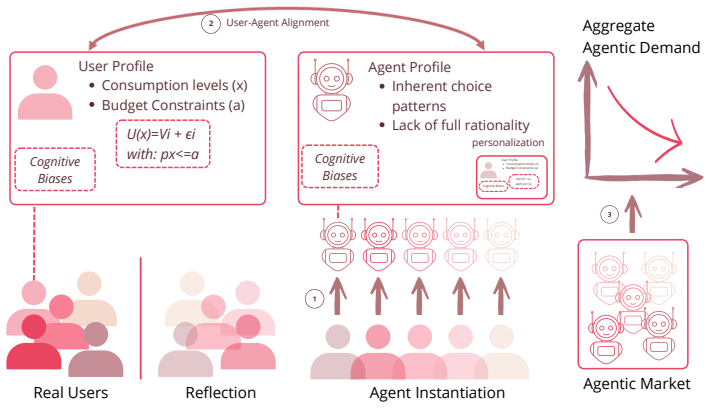
We introduce LLM Consumer Behavior Theory, a new field of study concerned with analyzing consumer behavior in agentic markets. We formalize how human preferences are reflected and acted upon by LLM-based agents, and how agent-level decisions aggregate into market demand. We unify previously fragmented literature on LLM decision-making, human behavior simulation, and preference elicitation under a common economic lens, highlighting where assumptions such as rationality and heterogeneity may fail in agentic markets. Rather than providing empirical validation, this paper outlines the scope of LLM consumer behavior and identifies open research questions related to alignment, preference represent
What carries the argument
LLM Consumer Behavior Theory, the framework that applies classical and behavioral economics to how LLM agents represent human preferences and aggregate decisions into market demand in agentic markets.
If this is right
- Agent decisions must be modeled as intermediaries that interpret and execute human preferences rather than direct maximizers.
- Market demand emerges from the collective behavior of multiple LLM agents rather than from individual human utility functions.
- Standard assumptions of rationality and preference heterogeneity require re-examination when applied to language model agents.
- Open questions include how to ensure agent actions align with user intentions at both individual and market scales.
Where Pith is reading between the lines
- This approach could enable simulation of entire markets using populations of LLM agents to test policy interventions before real-world deployment.
- It suggests new methods for eliciting consumer preferences by observing how agents respond to different framings of user instructions.
- The theory may help identify when agent behavior deviates systematically from human patterns in ways that affect market efficiency.
- Extensions could model competitive dynamics where different LLM agents interact on behalf of rival consumers or firms.
Load-bearing premise
LLM-based agents act as decision-makers whose preference representations and the aggregation of their decisions into market demand can be studied with the methods of classical and behavioral economics.
What would settle it
Empirical evidence that consumption patterns produced by LLM agents cannot be captured or predicted by any economic model adapted to their architecture would disprove the viability of the proposed field.
Figures
read the original abstract
Large language models (LLMs) are increasingly deployed as autonomous agents that make consumption decisions on behalf of users. This shift raises fundamental questions for consumer theory, which has traditionally modeled humans as the primary decision-makers. In this paper, we introduce LLM Consumer Behavior Theory, a new field of study concerned with analyzing consumer behavior in agentic markets. Drawing on classical and behavioral economics alongside recent advances in Natural Language Processing, we formalize how human preferences are reflected and acted upon by LLM-based agents, and how agent-level decisions aggregate into market demand. We unify previously fragmented literature on LLM decision-making, human behavior simulation, and preference elicitation under a common economic lens, highlighting where assumptions, such as rationality and heterogeneity, may fail in agentic markets. Rather than providing empirical validation, this paper outlines the scope of LLM consumer behavior and identifies open research questions related to alignment, preference representation, and market dynamics.
Editorial analysis
A structured set of objections, weighed in public.
Referee Report
Summary. The paper introduces 'LLM Consumer Behavior Theory' as a new field analyzing consumer behavior in agentic markets where LLM-based agents make decisions. Drawing on classical/behavioral economics and NLP, it claims to formalize how human preferences are reflected and acted upon by agents and how agent decisions aggregate into market demand; it unifies literature on LLM decision-making, simulation, and preference elicitation, highlights failures of assumptions like rationality, and identifies open questions on alignment, preference representation, and market dynamics, while explicitly stating it provides no empirical validation and instead outlines scope.
Significance. If the framing holds, the work could serve as a useful conceptual bridge between AI agent research and consumer theory, potentially catalyzing empirical studies and model adaptations at their intersection. The literature unification under an economic lens is a modest strength, though the absence of new formalisms, testable predictions, or data means significance rests on whether it prompts follow-on research rather than on immediate contributions.
major comments (2)
- [Abstract] Abstract and opening paragraphs: The central claim states that the paper 'formalize[s] how human preferences are reflected and acted upon by LLM-based agents, and how agent-level decisions aggregate into market demand,' yet the manuscript delivers only a literature mapping, scope description, and list of open questions with no equations, utility representations, aggregation functions, or equilibrium conditions. This gap between the stated formalization and the actual content is load-bearing for the contribution.
- [Formalization discussion] Section on formalization (inferred from abstract and structure): The weakest assumption—that LLM agents can be treated as decision-makers whose internal preferences and market aggregation follow patterns amenable to classical/behavioral economic analysis—is asserted without derivation or justification beyond citing existing LLM decision-making papers; no concrete mapping (e.g., adapted utility functions or heterogeneity measures) is supplied to support treating agents as economic actors.
minor comments (1)
- [Abstract] The abstract and introduction could more explicitly distinguish the paper's scoping role from a formal theory contribution to avoid reader mismatch.
Simulated Author's Rebuttal
We thank the referee for the constructive feedback. We agree that the abstract's use of 'formalize' creates a mismatch with the manuscript's actual scope as a conceptual outline and literature unification rather than a source of new mathematical models. We address each major comment below and will make targeted revisions.
read point-by-point responses
-
Referee: [Abstract] Abstract and opening paragraphs: The central claim states that the paper 'formalize[s] how human preferences are reflected and acted upon by LLM-based agents, and how agent-level decisions aggregate into market demand,' yet the manuscript delivers only a literature mapping, scope description, and list of open questions with no equations, utility representations, aggregation functions, or equilibrium conditions. This gap between the stated formalization and the actual content is load-bearing for the contribution.
Authors: We acknowledge this point is valid. The abstract language overstates the contribution by using 'formalize,' which implies mathematical derivations not present in the text. The manuscript's stated goal is to outline scope and unify literature under an economic lens without new formalisms or empirical work. We will revise the abstract (and corresponding opening paragraphs) to replace 'formalize' with 'outline a conceptual framework for' to accurately describe the content. revision: yes
-
Referee: [Formalization discussion] Section on formalization (inferred from abstract and structure): The weakest assumption—that LLM agents can be treated as decision-makers whose internal preferences and market aggregation follow patterns amenable to classical/behavioral economic analysis—is asserted without derivation or justification beyond citing existing LLM decision-making papers; no concrete mapping (e.g., adapted utility functions or heterogeneity measures) is supplied to support treating agents as economic actors.
Authors: The manuscript does not derive new mappings or utility functions, as its scope is limited to unifying existing literature and identifying where assumptions like rationality may fail for LLM agents (supported by the cited LLM decision-making studies). No new formalisms are claimed or provided. To address the concern, we will add a short clarifying paragraph in the relevant section explicitly stating that the treatment of agents as economic actors rests on prior empirical demonstrations in the cited works, without introducing concrete new representations. revision: partial
Circularity Check
No circularity: paper consists of field definition, literature unification, and open-question scoping with no derivations, equations, or predictions.
full rationale
The manuscript introduces LLM Consumer Behavior Theory by defining its scope and unifying existing literature on LLM decision-making under an economic lens. The abstract explicitly states the contribution is to outline scope and identify open questions rather than deliver formal models, empirical validation, or derivations. No equations, fitted parameters, predictions, or self-referential reductions appear in the provided text. The central claim of formalization is qualified immediately as non-empirical scoping, so no load-bearing step reduces to its own inputs by construction. This is a standard non-finding for a conceptual positioning paper.
Axiom & Free-Parameter Ledger
axioms (2)
- domain assumption Human preferences can be reflected and acted upon by LLM-based agents in ways that permit economic modeling
- domain assumption Agent-level decisions aggregate into market demand under standard economic mechanisms
invented entities (1)
-
LLM Consumer Behavior Theory
no independent evidence
Reference graph
Works this paper leans on
-
[1]
Aho and Jeffrey D
Alfred V. Aho and Jeffrey D. Ullman , title =. 1972
1972
-
[2]
Publications Manual , year = "1983", publisher =
1983
-
[3]
Ashok K. Chandra and Dexter C. Kozen and Larry J. Stockmeyer , year = "1981", title =. doi:10.1145/322234.322243
-
[4]
Scalable training of
Andrew, Galen and Gao, Jianfeng , booktitle=. Scalable training of
-
[5]
Dan Gusfield , title =. 1997
1997
-
[6]
Tetreault , title =
Mohammad Sadegh Rasooli and Joel R. Tetreault , title =. Computing Research Repository , volume =. 2015 , url =
2015
-
[7]
A Framework for Learning Predictive Structures from Multiple Tasks and Unlabeled Data , Volume =
Ando, Rie Kubota and Zhang, Tong , Issn =. A Framework for Learning Predictive Structures from Multiple Tasks and Unlabeled Data , Volume =. Journal of Machine Learning Research , Month = dec, Numpages =
-
[8]
Here's what that means for brands
AI agents are changing how people shop. Here's what that means for brands. , author =. Harvard Business Review , year =
-
[9]
Harvard Business Review , date =
Mark Purdy , title =. Harvard Business Review , date =
-
[10]
IEEE Access , year=
Agentic AI: autonomous intelligence for complex goals - a comprehensive survey , author=. IEEE Access , year=
-
[11]
, author =
The rise of `AI agents': what they are and how to manage the risks. , author =. World Economic Forum , year =
-
[12]
Marketing Science , volume=
Frontiers: can large language models capture human preferences? , author=. Marketing Science , volume=. 2024 , publisher=
2024
-
[13]
Evaluation, Implications, and Emerging Questions for Agentic E-Commerce (August 04, 2025) , year=
What is your ai agent buying? evaluation, implications, and emerging questions for agentic e-commerce , author=. Evaluation, Implications, and Emerging Questions for Agentic E-Commerce (August 04, 2025) , year=
2025
-
[14]
2025 , month =
The Agentic Commerce Opportunity: How AI Agents Are Ushering in a New Era for Consumers and Merchants , author =. 2025 , month =
2025
-
[15]
arXiv preprint arXiv:2511.22978 , year=
ShoppingComp: Are LLMs Really Ready for Your Shopping Cart? , author=. arXiv preprint arXiv:2511.22978 , year=
-
[16]
NeurIPS 2025 Workshop on Bridging Language, Agent, and World Models for Reasoning and Planning , year=
A Framework for Studying AI Agent Behavior: Evidence from Consumer Choice Experiments , author=. NeurIPS 2025 Workshop on Bridging Language, Agent, and World Models for Reasoning and Planning , year=
2025
-
[17]
arXiv preprint arXiv:2603.08853 , year=
LLM-Agent Interactions on Markets with Information Asymmetries , author=. arXiv preprint arXiv:2603.08853 , year=
-
[18]
arXiv preprint arXiv:2505.07457 , year=
Can Generative AI agents behave like humans? Evidence from laboratory market experiments , author=. arXiv preprint arXiv:2505.07457 , year=
-
[19]
Economie: Een inleiding , year =
Ooghe, Erwin and Verbeke, Tom and De Bruyne, Karolien and De Jaeger, Simon and Degryse, Hans and Eyckmans, Johan and Maes, Marjan and Rogge, Nicky and Van Cayseele, Patrick and Vanormelingen, Stijn and Verhaest, Dieter and Watteyne, Andre\'e' , address =. Economie: Een inleiding , year =. Economie Een inleiding , edition =
-
[20]
Expert Systems with Applications , pages=
Would a Large Language Model Pay Extra for a View? Inferring Willingness to Pay from Subjective Choices , author=. Expert Systems with Applications , pages=. 2026 , publisher=
2026
-
[21]
American economic review , volume=
Economic choices , author=. American economic review , volume=. 2001 , publisher=
2001
-
[22]
International Journal of Hospitality Management , volume =
Masiero, Lorenzo and Heo, Cindy Yoonjoung and Pan, Bing , title =. International Journal of Hospitality Management , volume =. 2015 , issn =. doi:https://doi.org/10.1016/j.ijhm.2015.06.001 , url =
-
[23]
Advances in Neural Information Processing Systems , volume=
Capturing failures of large language models via human cognitive biases , author=. Advances in Neural Information Processing Systems , volume=
-
[24]
arXiv preprint arXiv:2506.17367 , year=
Cash or Comfort? How LLMs Value Your Inconvenience , author=. arXiv preprint arXiv:2506.17367 , year=
-
[25]
Available at SSRN 5213130 , year=
Behavioral economics of ai: Llm biases and corrections , author=. Available at SSRN 5213130 , year=
-
[26]
arXiv preprint arXiv:2511.12319 , year=
Decision and Gender Biases in Large Language Models: A Behavioral Economic Perspective , author=. arXiv preprint arXiv:2511.12319 , year=
-
[27]
2011 , publisher=
Thinking, Fast and Slow , author=. 2011 , publisher=
2011
-
[28]
Econometrica , volume=
Prospect Theory: An Analysis of Decision under Risk , author=. Econometrica , volume=
-
[29]
arXiv preprint arXiv:2509.22818 , year=
Can Large Language Models Develop Gambling Addiction? , author=. arXiv preprint arXiv:2509.22818 , year=
-
[30]
Journal of Computational Social Science , volume=
Anchoring bias in large language models: An experimental study , author=. Journal of Computational Social Science , volume=. 2026 , publisher=
2026
-
[31]
The emergence of economic rationality of
Chen, Yiting and Liu, Tracy Xiao and Shan, You and others , journal=. The emergence of economic rationality of. 2023 , publisher=
2023
-
[32]
First Conference on Language Modeling , year=
LLM economicus? Mapping the Behavioral Biases of LLMs via Utility Theory , author=. First Conference on Language Modeling , year=
- [33]
-
[34]
The Thirteenth International Conference on Learning Representations , year=
Large language models assume people are more rational than we really are , author=. The Thirteenth International Conference on Learning Representations , year=
-
[35]
2023 , institution=
Large language models as simulated economic agents: What can we learn from homo silicus? , author=. 2023 , institution=
2023
-
[36]
arXiv preprint arXiv:2509.01063 , year=
An economy of AI agents , author=. arXiv preprint arXiv:2509.01063 , year=
-
[37]
arXiv preprint arXiv:2108.07258 , year=
On the opportunities and risks of foundation models , author=. arXiv preprint arXiv:2108.07258 , year=
-
[38]
Nature Machine Intelligence , volume=
Large language models that replace human participants can harmfully misportray and flatten identity groups , author=. Nature Machine Intelligence , volume=. 2025 , publisher=
2025
-
[39]
International conference on machine learning , pages=
Whose opinions do language models reflect? , author=. International conference on machine learning , pages=. 2023 , organization=
2023
-
[40]
arXiv preprint arXiv:2112.04359 , year=
Ethical and social risks of harm from language models , author=. arXiv preprint arXiv:2112.04359 , year=
-
[41]
Proceedings of the 3rd Workshop on Cross-Cultural Considerations in NLP (C3NLP 2025) , pages=
One world, one opinion? The superstar effect in LLM responses , author=. Proceedings of the 3rd Workshop on Cross-Cultural Considerations in NLP (C3NLP 2025) , pages=
2025
-
[42]
Nature , volume=
AI models collapse when trained on recursively generated data , author=. Nature , volume=. 2024 , publisher=
2024
-
[43]
Advances in neural information processing systems , volume=
Decision-making behavior evaluation framework for llms under uncertain context , author=. Advances in neural information processing systems , volume=
-
[44]
Proceedings of the AAAI Conference on Artificial Intelligence , author=
Can Large Language Models Serve as Rational Players in Game Theory? A Systematic Analysis , volume=. Proceedings of the AAAI Conference on Artificial Intelligence , author=. 2024 , month=. doi:10.1609/aaai.v38i16.29751 , abstractNote=
-
[45]
2026 , eprint=
Can an LLM Learn Preferences from Choice Data? , author=. 2026 , eprint=
2026
-
[46]
arXiv preprint arXiv:2505.11584 , year=
Llm agents are hypersensitive to nudges , author=. arXiv preprint arXiv:2505.11584 , year=
-
[47]
IEEE Transactions on systems science and cybernetics , volume=
Information value theory , author=. IEEE Transactions on systems science and cybernetics , volume=. 1966 , publisher=
1966
-
[48]
2000 , publisher=
Applied statistical decision theory , author=. 2000 , publisher=
2000
-
[49]
Marketing Science , volume=
Conditioning prices on purchase history , author=. Marketing Science , volume=. 2005 , publisher=
2005
-
[50]
American Economic Review , volume=
The limits of price discrimination , author=. American Economic Review , volume=. 2015 , publisher=
2015
-
[51]
1961 , publisher=
Principles of economics , author=. 1961 , publisher=
1961
-
[52]
Econometrica: Journal of the Econometric Society , pages=
Revealed preference theory , author=. Econometrica: Journal of the Econometric Society , pages=. 1966 , publisher=
1966
-
[53]
1993 , publisher=
Automobile prices in market equilibrium: Part i and ii , author=. 1993 , publisher=
1993
-
[54]
Conditional logit analysis of qualitative choice behavior , author=
-
[55]
arXiv preprint arXiv:2509.02910 , year=
The Basic B*** Effect: The Use of LLM-based Agents Reduces the Distinctiveness and Diversity of People's Choices , author=. arXiv preprint arXiv:2509.02910 , year=
-
[56]
Proceedings of the 2021 ACM conference on fairness, accountability, and transparency , pages=
On the dangers of stochastic parrots: Can language models be too big? , author=. Proceedings of the 2021 ACM conference on fairness, accountability, and transparency , pages=
2021
-
[57]
and Hart, Oliver D
Grossman, Sanford J. and Hart, Oliver D. , address =. An Analysis of the Principal-Agent Problem , abstract =. Econometrica , keywords =. 1983 , pages =
1983
-
[58]
arXiv preprint arXiv:2502.19312 , year=
Fspo: Few-shot preference optimization of synthetic preference data in llms elicits effective personalization to real users , author=. arXiv preprint arXiv:2502.19312 , year=
-
[59]
LoRe: Personalizing
Avinandan Bose and Zhihan Xiong and Yuejie Chi and Simon Shaolei Du and Lin Xiao and Maryam Fazel , booktitle=. LoRe: Personalizing. 2025 , url=
2025
-
[60]
2024 , url =
Large Language Model (. 2024 , url =
2024
-
[61]
Utilizing large language models to simulate parking search , journal =
Nir Fulman and Abdulkadir Memduhoğlu and Alexander Zipf , keywords =. Utilizing large language models to simulate parking search , journal =. 2025 , issn =. doi:https://doi.org/10.1016/j.tra.2025.104542 , url =
-
[62]
Adjunct Proceedings of the 33rd ACM Conference on User Modeling, Adaptation and Personalization , pages=
Words reveal wants: How well can simple LLM-based AI agents replicate people’s choices based on their social media posts , author=. Adjunct Proceedings of the 33rd ACM Conference on User Modeling, Adaptation and Personalization , pages=
-
[63]
Proceedings of the 16th International Workshop on Spoken Dialogue System Technology. 2026
2026
-
[64]
MAC : A Multi-Agent Framework for Interactive User Clarification in Multi-turn Conversations
Acikgoz, Emre Can and Oh, Jinoh and Jeon, Joo Hyuk and Hao, Jie and Ji, Heng and Hakkani-Tur, Dilek and Tur, Gokhan and Li, Xiang and Ma, Chengyuan and Fan, Xing. MAC : A Multi-Agent Framework for Interactive User Clarification in Multi-turn Conversations. Proceedings of the 16th International Workshop on Spoken Dialogue System Technology. 2026
2026
-
[65]
F low S witch: A State-Aware Framework for Workflow Transitions in Adaptive Dialogue Agents
Chang, Wen Yu and Qiu, Luning and Liu, Yi-Hung and Chen, Yun-Nung. F low S witch: A State-Aware Framework for Workflow Transitions in Adaptive Dialogue Agents. Proceedings of the 16th International Workshop on Spoken Dialogue System Technology. 2026
2026
-
[66]
Personality Expression in Spoken Dialogue Systems: From Text to Speech
Yamamoto, Kenta and Komatani, Kazunori. Personality Expression in Spoken Dialogue Systems: From Text to Speech. Proceedings of the 16th International Workshop on Spoken Dialogue System Technology. 2026
2026
-
[67]
Reproducing Proficiency-Conditioned Dialogue Features with Full-duplex Spoken Dialogue Models
Obi, Takao and Yoshikawa, Sadahiro and Saeki, Mao and Eguchi, Masaki and Matsuyama, Yoichi. Reproducing Proficiency-Conditioned Dialogue Features with Full-duplex Spoken Dialogue Models. Proceedings of the 16th International Workshop on Spoken Dialogue System Technology. 2026
2026
-
[68]
Automatic Evaluation of Open-Domain Real Conversations: Combining Encoder-Based, Dialogue-Based Features and Large Language Models Ratings
Conforto L \'o pez, Cristina and Estecha-Goritagoitia, Marcos and Rodriguez-Cantelar, Mario and Cordoba, Ricardo and D ' Haro, Luis Fernando. Automatic Evaluation of Open-Domain Real Conversations: Combining Encoder-Based, Dialogue-Based Features and Large Language Models Ratings. Proceedings of the 16th International Workshop on Spoken Dialogue System Te...
2026
-
[69]
Do audio and visual tokenizers capture backchannels?
Favre, Benoit and Boudin, Auriane. Do audio and visual tokenizers capture backchannels?. Proceedings of the 16th International Workshop on Spoken Dialogue System Technology. 2026
2026
-
[70]
The Context Trap: Why End-to-End Audio Language Models Fail Multi-turn Dialogues
Tam, Zhi Rui and Chang, Wen Yu and Chen, Yun-Nung. The Context Trap: Why End-to-End Audio Language Models Fail Multi-turn Dialogues. Proceedings of the 16th International Workshop on Spoken Dialogue System Technology. 2026
2026
-
[71]
Analysing Next Speaker Prediction in Multi-Party Conversation Using Multimodal Large Language Models
Mori, Taiga and Inoue, Koji and Lala, Divesh and Ochi, Keiko and Kawahara, Tatsuya. Analysing Next Speaker Prediction in Multi-Party Conversation Using Multimodal Large Language Models. Proceedings of the 16th International Workshop on Spoken Dialogue System Technology. 2026
2026
-
[72]
Exploring Emotional Nuances in Spoken Dialogue: Dataset Construction and Prediction of Emotional Dialogue Breakdown
Nakaguro, Hyuga and Yoshino, Koichiro. Exploring Emotional Nuances in Spoken Dialogue: Dataset Construction and Prediction of Emotional Dialogue Breakdown. Proceedings of the 16th International Workshop on Spoken Dialogue System Technology. 2026
2026
-
[73]
Effects of Dialogue Corpora Properties on Fine-Tuning a Moshi-Based Spoken Dialogue Model
Abe, Yuto and Saeki, Mao and Ohashi, Atsumoto and Takamichi, Shinnosuke and Fujie, Shiyna and Kobayashi, Tetsunori and Ogawa, Tetsuji and Higashinaka, Ryuichiro. Effects of Dialogue Corpora Properties on Fine-Tuning a Moshi-Based Spoken Dialogue Model. Proceedings of the 16th International Workshop on Spoken Dialogue System Technology. 2026
2026
-
[74]
Mixed-Initiative Dialogue Management for Human-Virtual Agents Interaction in Forum Theatre Inspired Training
Otofa, Samuel and Zerenini, Yacine and Bechet, Frederic and Favre, Benoit and Pergandi, Jean-Marie and Ochs, Magalie. Mixed-Initiative Dialogue Management for Human-Virtual Agents Interaction in Forum Theatre Inspired Training. Proceedings of the 16th International Workshop on Spoken Dialogue System Technology. 2026
2026
-
[75]
Analyzing Utterance Selection for Unnoticeable Topic Induction in Target-Guided Conversation Systems
Yoshida, Kai and Yoshino, Koichiro. Analyzing Utterance Selection for Unnoticeable Topic Induction in Target-Guided Conversation Systems. Proceedings of the 16th International Workshop on Spoken Dialogue System Technology. 2026
2026
-
[76]
Development of an Evaluation System for a Fan-Engagement Chat Application Using LLM -as-a-Judge
Fujita, Yuki and Sasaki, Yasunobu and Arashi, Ryota and Ototake, Hokuto and Takahashi, Shinya. Development of an Evaluation System for a Fan-Engagement Chat Application Using LLM -as-a-Judge. Proceedings of the 16th International Workshop on Spoken Dialogue System Technology. 2026
2026
-
[77]
A Dialogue Agent to Let Users Experience and Gently Enhance the ``Gyaru-Mind''
Ikegami, Momoka and Kato, Takuya and Aoyagi, Saizo and Hirai, Tatsunori. A Dialogue Agent to Let Users Experience and Gently Enhance the ``Gyaru-Mind''. Proceedings of the 16th International Workshop on Spoken Dialogue System Technology. 2026
2026
-
[78]
Towards a proactive cooking companion for the elderly
Esteve, Katarina and Fredriksson, Morgan and Gustafson, Joakim and Kontogiorgos, Dimosthenis and Mashiyi-Veikkola, Timo. Towards a proactive cooking companion for the elderly. Proceedings of the 16th International Workshop on Spoken Dialogue System Technology. 2026
2026
-
[79]
Conversational AI for Virtual Standardized Patients using a Speech-to-Speech LLM
Emerson, Andrew and Evanini, Keelan and Somay, Su and Frome, Kevin and Ha, Le An and Harik, Polina. Conversational AI for Virtual Standardized Patients using a Speech-to-Speech LLM. Proceedings of the 16th International Workshop on Spoken Dialogue System Technology. 2026
2026
-
[80]
Can Small-Scale LLM s Balance Content Accuracy and Speaker Faithfulness in Noisy F rench Dialogue Summarization?
Abrougui, Rim and Lechien, Guillaume and Savatier, Elisabeth and Laurent, Beno \^i t. Can Small-Scale LLM s Balance Content Accuracy and Speaker Faithfulness in Noisy F rench Dialogue Summarization?. Proceedings of the 16th International Workshop on Spoken Dialogue System Technology. 2026
2026
discussion (0)
Sign in with ORCID, Apple, or X to comment. Anyone can read and Pith papers without signing in.