REVIEW 2 major objections 2 minor 2 cited by
On-sky binary source hypothesis testing beyond the diffraction limit using spatial mode demultiplexing based detection
T0 review · 2 major / 2 minor · reviewed 2026-06-26 · grok-4.3
Pith's one-line read A spatial mode demultiplexing instrument detects binary stars below the diffraction limit on-sky in the photon-starved regime.
desk verdict First on-sky binary-SPADE test is a useful proof-of-principle step, but the coupler loss leaves the claimed error-rate edge over direct imaging unverified without more detail. read the letter →
The pith
A machine-rendered reading of the paper's core claim, the machinery that carries it, and where it could break.
The reading
What carries the argument
Binary-SPADE hypothesis testing via spatial mode demultiplexing in a double-clad fiber coupler, which partitions incoming light into orthogonal modes to test for a secondary source.
What would settle it
A direct comparison in which the measured type II error rate exceeds that of an ideal direct-imaging detector under the same photon counts and source parameters.
Extended reading notes
Core claim
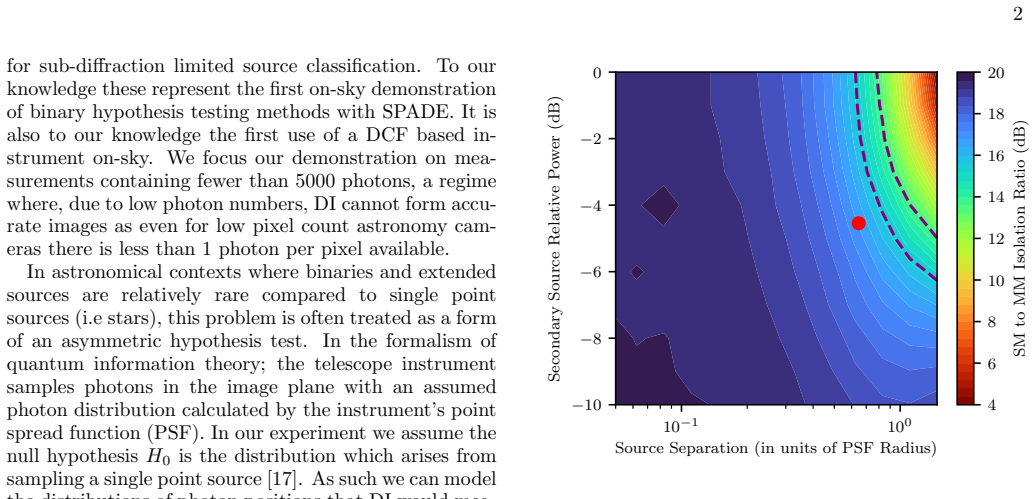
We present the first demonstration of a binary-SPADE based hypothesis testing instrument deployed on-sky. In our proof-of-principle experiment, based on mode demultiplexing with a double clad fiber coupler, we demonstrate detection of a binary star system separated below the diffraction limit. We perform measurements in the photon-starved regime where no image can be formed by traditional direct imaging. Despite unbalanced loss, the evaluated type II error is always lower than a perfect direct imaging measurement.
Load-bearing premise
Unbalanced loss in the double-clad fiber coupler can be tolerated without invalidating the hypothesis test outcome and on-sky conditions introduce no unaccounted confounding factors.
Editorial extensions
If this is right
- Type II error remains lower than perfect direct imaging across the tested photon-starved regime.
- Unbalanced coupler loss sets the dominant limit on error-rate improvement.
- Atmospheric turbulence on larger-aperture telescopes is expected to degrade performance further.
- Binary-source detection succeeds without forming a conventional image.
Reading between the lines
- Correcting the coupler loss imbalance would allow the error rate to move closer to the fundamental quantum limit for binary hypothesis testing.
- The same mode-sorting approach could extend to searches for faint companions around stars where photon counts preclude direct imaging.
- Controlled tests that vary turbulence strength would quantify the practical ceiling for ground-based deployments.
Editorial analysis
A structured set of objections, weighed in public.
Referee Report
Summary. The manuscript reports the first on-sky demonstration of binary-source hypothesis testing via spatial mode demultiplexing (SPADE) implemented with a double-clad fiber coupler. It claims successful detection of a sub-diffraction binary star in the photon-starved regime where direct imaging forms no image, and states that the measured type II error (binary-source miss probability) remains lower than that of an idealized perfect direct-imaging measurement despite performance being heavily limited by unbalanced coupler loss.
Significance. If the central experimental claim holds after proper accounting for instrument losses, the work would constitute a meaningful proof-of-principle milestone for quantum-inspired imaging methods in astronomy. It supplies the first on-sky data point for SPADE-based hypothesis testing and directly compares error rates to direct imaging under realistic low-photon conditions, which is a concrete strength of the experimental approach.
major comments (2)
- [Abstract] Abstract: the claim that 'the evaluated type II error is always lower than a perfect direct imaging measurement' is load-bearing for the headline result, yet the text states that unbalanced loss in the double-clad fiber coupler 'heavily limited' scaling. No explicit statement appears that the measured mode-dependent transmissions were propagated through the likelihood model used for the hypothesis test; if the decision statistic assumes balanced loss, the comparison to an ideal (lossless) direct-imaging benchmark is not secured.
- [Experimental methods / results] Experimental methods / results: the photon-starved on-sky data are presented as demonstrating detection below the diffraction limit, but the error budget and any correction for the coupler imbalance must be shown to confirm that the reported type II error rates are not mis-estimated due to differential loss between the fundamental and higher-order modes.
minor comments (2)
- The abstract would be clearer if it quantified the binary separation in units of the diffraction limit (e.g., 0.3 λ/D) and stated the total detected photon number or integration time for the reported runs.
- Figure captions and text should explicitly label which curves correspond to the measured SPADE data, the modeled SPADE performance with measured loss, and the ideal direct-imaging benchmark.
Simulated Author's Rebuttal
We thank the referee for their thoughtful review and for identifying points that require clarification in our presentation of the experimental analysis. We address each major comment below and will incorporate the requested details into a revised manuscript.
read point-by-point responses
-
Referee: [Abstract] Abstract: the claim that 'the evaluated type II error is always lower than a perfect direct imaging measurement' is load-bearing for the headline result, yet the text states that unbalanced loss in the double-clad fiber coupler 'heavily limited' scaling. No explicit statement appears that the measured mode-dependent transmissions were propagated through the likelihood model used for the hypothesis test; if the decision statistic assumes balanced loss, the comparison to an ideal (lossless) direct-imaging benchmark is not secured.
Authors: We agree that an explicit statement is needed. The measured mode-dependent transmissions of the double-clad fiber coupler were propagated through the likelihood model when computing the type II error rates; the decision statistic therefore already incorporates the observed imbalance rather than assuming balanced loss. We will revise the abstract and add a dedicated paragraph in the methods section that states this propagation explicitly, together with the measured transmission values, so that the comparison to the ideal direct-imaging benchmark is fully secured. revision: yes
-
Referee: [Experimental methods / results] Experimental methods / results: the photon-starved on-sky data are presented as demonstrating detection below the diffraction limit, but the error budget and any correction for the coupler imbalance must be shown to confirm that the reported type II error rates are not mis-estimated due to differential loss between the fundamental and higher-order modes.
Authors: We will expand the experimental methods and results sections to include a quantitative error budget. This will show the measured differential losses between the fundamental and higher-order modes, how those losses were folded into the likelihood function, and the resulting impact on the reported type II error rates. The revised text will demonstrate that the quoted error rates already reflect the correction for coupler imbalance and are therefore not mis-estimated. revision: yes
Circularity Check
Experimental report; no derivation chain or fitted predictions present
full rationale
The paper is a proof-of-principle experimental demonstration of an on-sky binary-SPADE instrument. Central claims rest on direct measurements of detection performance and type II error rates in the photon-starved regime, with explicit comparison to an idealized (lossless) direct-imaging benchmark. No equations, ansatzes, uniqueness theorems, or parameter fits are described that reduce by construction to the paper's own inputs. The abstract and reported results contain no self-definitional steps, no renaming of known results as new derivations, and no load-bearing self-citations. The work is therefore self-contained as an empirical validation against external idealized benchmarks.
Assumptions & free parameters
assumptions (1)
- domain assumption Standard quantum-optics mode-demultiplexing theory and idealized loss-free performance bounds apply to the double-clad fiber coupler.
Cite this review
Pith. "Pith review of On-sky binary source hypothesis testing beyond the diffraction limit using spatial mode demultiplexing based detection." pith.science (2026). https://pith.science/paper/X373RMBP
@misc{pith2026260618025,
  author       = {Pith},
  title        = {Pith review of: On-sky binary source hypothesis testing beyond the diffraction limit using spatial mode demultiplexing based detection},
  year         = {2026},
  howpublished = {\url{https://pith.science/paper/X373RMBP}},
  note         = {Machine review of arXiv:2606.18025}
}
read the original abstract
Improving the resolution of telescope systems will provide the opportunity to study new physical phenomena in previously unobserved environments. Spatial mode de-multiplexing (SPADE) based imaging is a promising and rapidly evolving technique for pushing the resolution of optical telescopes beyond the diffraction limit. A key application of this technique is for near-optimal hypothesis testing for the presence of secondary and extended sources in the sub-diffraction regime. We present the first demonstration of a binary-SPADE based hypothesis testing instrument deployed on-sky. In our proof-of-principle experiment, based on mode demultiplexing with a double clad fiber coupler, we demonstrate detection of a binary star system separated below the diffraction limit. We perform measurements in the photon-starved regime where no image can be formed by traditional direct imaging. We find the scaling of the system's type II error rate (the ``binary source miss" chance) was heavily limited by unbalanced loss in our double-clad fiber coupler when compared to the idealized quantum limits. Despite this the evaluated type II error is always lower than a perfect direct imaging measurement. We expect that if this instrument is scaled to larger aperture telescope systems the effects of atmospheric turbulence will further degrade this system's performance.
Figures

Forward citations
Cited by 2 Pith papers
-
Noise-robust discrimination of incoherent point sources with spatial-mode demultiplexing
Under uniform background noise, two-mode SPADE outperforms direct imaging for one-vs-two-source discrimination and approaches the quantum Chernoff limit in the sub-Rayleigh regime, as shown experimentally.
-
Unified theory of classical and quantum semiparametric efficiency
A unified semiparametric efficiency theory for classical and quantum models, with singular-value analysis of channels, shows spatial-mode demultiplexing approaches the quantum limit for subdiffraction incoherent imaging.
Reference graph
Works this paper leans on
-
[1]
The pointing model was acquired through the cam- era with residual rms error of<1 arc-second
During this experiment the instrument was man- ually aligned to optimize the single-mode detection rate and then the targets were observed for 100 seconds using open-loop tracking on a motorized mount (PlaneWave L- 350). The pointing model was acquired through the cam- era with residual rms error of<1 arc-second. During this time period the single-mode an...
-
[2]
Akiyama, A
K. Akiyama, A. Alberdi, W. Alef, K. Asada, R. Azulay, A.-K. Baczko, D. Ball, M. Balokovi´ c, J. Barrett, D. Bint- ley,et al., The Astrophysical Journal Letters875, L1 (2019)
2019
-
[3]
Tsang, R
M. Tsang, R. Nair, and X.-M. Lu, Phys. Rev. X6, 031033 (2016)
2016
-
[4]
X.-M. Lu, H. Krovi, R. Nair, S. Guha, and J. H. Shapiro, npj Quantum Information4, 64 (2018)
2018
-
[5]
Boucher, C
P. Boucher, C. Fabre, G. Labroille, and N. Treps, Optica 7, 1621 (2020)
2020
-
[6]
Santamaria, F
L. Santamaria, F. Sgobba, and C. Lupo, Optica Quantum 2, 46 (2024)
2024
-
[7]
Rouvi` ere, D
C. Rouvi` ere, D. Barral, A. Grateau, I. Karuseichyk, G. Sorelli, M. Walschaers, and N. Treps, Optica11, 166 (2024)
2024
-
[8]
X.-J. Tan, L. Qi, L. Chen, A. J. Danner, P. Kanchana- wong, and M. Tsang, Optica10, 1189 (2023)
2023
Show all 22 references
-
[9]
J. S. Wallis, D. R. Gozzard, A. M. Frost, J. J. Collier, N. Maron, and B. P. Dix-Matthews, Opt. Express33, 34651 (2025)
2025
-
[10]
D. R. Gozzard, J. S. Wallis, A. M. Frost, J. J. Collier, N. Maron, B. P. Dix-Matthews, and K. Vinsen, Sensors 25, 10.3390/s25175395 (2025)
2025 doi
-
[11]
Santamaria, D
L. Santamaria, D. Pallotti, M. S. de Cumis, D. Dequal, and C. Lupo, Opt. Express31, 33930 (2023)
2023
-
[12]
Grateau, A
A. Grateau, A. Boeschoten, T. Favin-L´ evˆ eque, I. Her- rera, and N. Treps, Multiparameter estimation for the superresolution of two incoherent sources (2026), arXiv:2601.14876 [quant-ph]
2026
-
[13]
S. U. Shringarpure, Y. S. Teo, H. Jeong, M. Evans, L. L. Sanchez-Soto, A. Grateau, A. Boeschoten, and N. Treps, Experimental evidence-based sub-rayleigh source dis- crimination (2026), arXiv:2601.13972 [quant-ph]
2026
-
[14]
Y. J. Kim, M. P. Fitzgerald, S. Vievard, J. Lin, Y. Xin, M. Lucas, O. Guyon, J. Lozi, V. Deo, E. Huby, S. La- cour, M. Lallement, R. Amezcua-Correa, S. Leon-Saval, B. Norris, M. Nowak, S. Sallum, J. Sarrazin, A. Taras, S. Yerolatsitis, and N. Jovanovic, The Astrophysical Journ...
2025
-
[15]
B. R. M. Norris, S. G. Leon-Saval, J. Wei, C. H. Bet- ters, A. Taras, J. Lin, Y. Xin, Y. J. Kim, M. Fitzger- ald, S. Sallum, A. Sengupta, P. Gatkine, N. Jovanovic, D. Mawet, J. Lozi, S. Vievard, V. Deo, M. Lallement, D. Levinstein, and O. Guyon, inAdaptive Optics Systems IX, V...
2024
-
[16]
Pushkina, G
A. Pushkina, G. Maltese, J. Costa-Filho, P. Patel, and A. Lvovsky, Physical review letters127, 253602 (2021)
2021
-
[17]
F. Yang, A. Tashchilina, E. S. Moiseev, C. Simon, and A. I. Lvovsky, Optica3, 1148 (2016)
2016
-
[18]
Huang and C
Z. Huang and C. Lupo, Phys. Rev. Lett.127, 130502 (2021)
2021
-
[19]
Schlichtholz, T
K. Schlichtholz, T. Linowski, M. Walschaers, N. Treps, L. Rudnicki, and G. Sorelli, Optica Quantum2, 29 (2024)
2024
-
[20]
Linowski, K
T. Linowski, K. Schlichtholz, and G. Sorelli, Phys. Rev. Appl.24, 044052 (2025)
2025
-
[21]
J. S. Wallis, D. R. Gozzard, A. M. Frost, B. P. Dix- Matthews, N. Maron, and J. J. Collier, Opt. Lett.50, 7191 (2025)
2025
-
[22]
K. B. Burdge, K. El-Badry, E. Kara, C. Canizares, D. Chakrabarty, A. Frebel, S. C. Millholland, S. Rap- paport, R. Simcoe, and A. Vanderburg, Nature635, 316 (2024)
2024
Reviewed June 26, 2026 · model on record in the stance chip above.
Discussion (0). Continue with ORCID to comment.