ConTex: Reformulating Counterfactual Generation For Time Series Forecasting
Pith reviewed 2026-06-27 01:27 UTC · model grok-4.3
The pith
ConTex reformulates counterfactual generation for time series forecasting as learning one shared intervention function instead of per-instance optimization.
A machine-rendered reading of the paper's core claim, the machinery that carries it, and where it could break.
Core claim
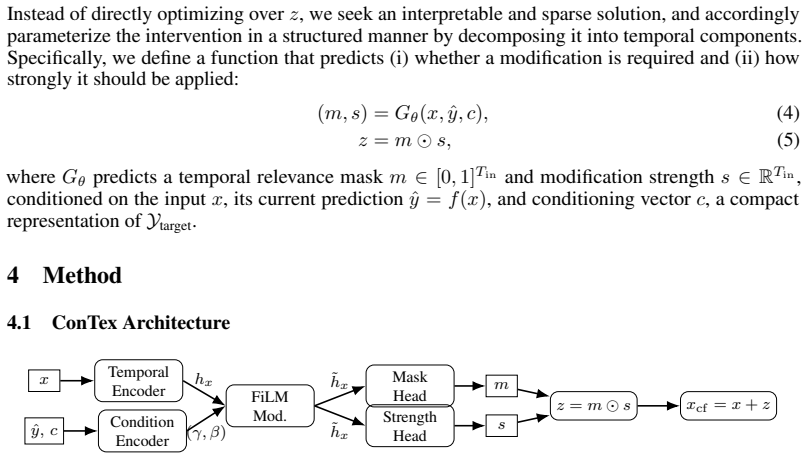
We reformulate counterfactual generation for time series forecasting as the problem of learning a globally consistent intervention strategy, allowing counterfactuals to be generated through a single shared function. We propose ConTex, a model-agnostic, decomposed architecture comprising a temporal context encoder and a conditional encoder, followed by two heads that capture interventions in terms of temporal relevance and modification strength. This structure overcomes the instability and inconsistency of instance-based approaches by producing targeted, interpretable interventions across time and feature dimensions in a single forward pass.
What carries the argument
The central mechanism is the globally consistent intervention strategy implemented as a single shared function in the ConTex architecture, which decomposes into temporal context and conditional encoders plus intervention heads for temporal relevance and modification strength.
If this is right
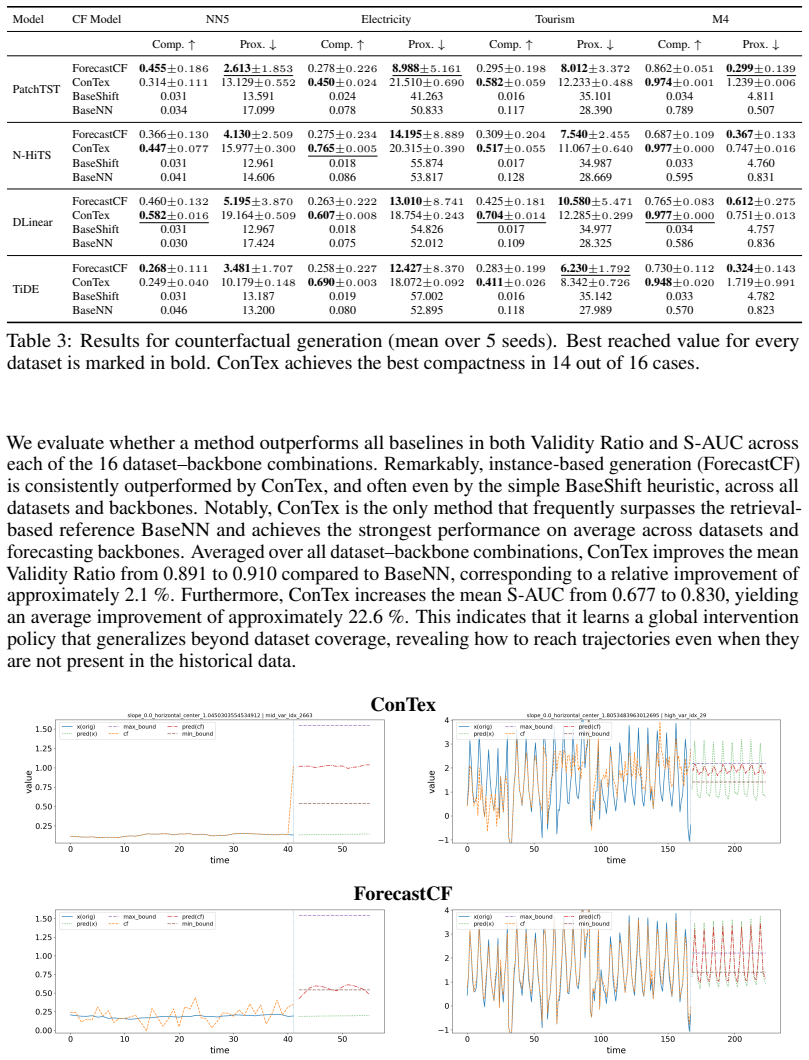
- Counterfactuals achieve state-of-the-art validity on multiple datasets and forecasting architectures.
- Generated counterfactuals are sparse, minimizing the number of necessary interventions.
- Computational cost is reduced by at least 12-36x compared to instance-wise generation.
- Real-time inference is supported at approximately 0.007 seconds per example.
Where Pith is reading between the lines
- The shared function's consistency across instances could make repeated explanations more reliable in ongoing monitoring applications.
- This approach might allow the intervention function to be trained jointly with the base forecaster for tighter alignment.
- The single-pass design opens use in streaming settings where forecasts update continuously and explanations must keep pace.
Load-bearing premise
A single shared function learned across instances can produce valid, minimal counterfactual interventions that match or exceed the quality of per-instance optimization without introducing systematic bias or missing instance-specific nuances.
What would settle it
If testing on new time series data shows that the shared function's counterfactuals change the prediction less often or require more modifications than individually optimized ones, the reformulation would not hold.
Figures
read the original abstract
Decision-making with deep learning-based time series forecasting requires not only accurate predictions but also actionable insights. However, current architectures do not inherently provide such information. Specifically, guidance is needed on how current conditions must be modified to shift from a predicted outcome to a desired future scenario. Counterfactual explanations provide a natural framework for this task, as they represent minimal input changes that alter the model's prediction, indicating when and how intervention is required. Existing approaches rely on instance-wise optimization, leading to inconsistency across instances, high computational costs, and limited applicability in real-time settings. To address these limitations, we reformulate counterfactual generation for time series forecasting as the problem of learning a globally consistent intervention strategy, allowing counterfactuals to be generated through a single shared function. We propose Counterfactual Time Series Explanations (ConTex), a model-agnostic, decomposed architecture comprising a temporal context encoder and a conditional encoder, followed by two heads that capture interventions in terms of temporal relevance and modification strength. This structure overcomes the instability and inconsistency of instance-based approaches by producing targeted, interpretable interventions across time and feature dimensions in a single forward pass, making it suitable for real-time applications. Across multiple forecasting architectures and benchmark datasets, ConTex achieves state-of-the-art validity while generating sparse counterfactuals that minimize the number of necessary interventions. Additionally, our approach reduces computational cost by at least 12-36x compared to instance-wise generation and supports real-time inference at approximately 0.007 seconds.
Editorial analysis
A structured set of objections, weighed in public.
Referee Report
Summary. The paper claims to reformulate counterfactual generation for time series forecasting as learning a single globally consistent intervention strategy, implemented via the ConTex architecture (temporal context encoder + conditional encoder + two heads for temporal relevance and modification strength). This model-agnostic approach is asserted to deliver SOTA validity and sparsity while achieving 12-36x speedup and real-time inference (~0.007s) over instance-wise optimization methods across forecasting architectures and benchmarks.
Significance. If the empirical claims hold, the work would meaningfully advance practical interpretability for deep time-series forecasters by replacing slow, inconsistent per-instance optimization with a fast, consistent shared function. The decomposed encoder-head design and emphasis on global consistency are constructive contributions that could influence real-time decision-support systems.
major comments (2)
- [Abstract] Abstract: the central claim that a single shared function produces valid, minimal interventions matching or exceeding instance-wise optimization rests on the unverified assumption that the conditional encoder fully captures instance-specific dynamics (e.g., varying seasonality or trend shifts); without explicit loss terms or constraints enforcing per-instance minimality, averaged outputs risk violating validity or increasing intervention count for some instances.
- [Abstract] Abstract: the reported 12-36x speedup and SOTA validity are load-bearing for the reformulation's practical value, yet the abstract supplies no quantitative tables, ablation results, or error analysis comparing ConTex to per-instance baselines; this absence prevents verification that the shared architecture does not introduce systematic bias.
minor comments (1)
- [Abstract] The abstract would benefit from a brief statement of the training objective or regularization used to promote sparsity.
Simulated Author's Rebuttal
We thank the referee for the thoughtful comments on our work. We address each major comment below, providing clarifications based on the manuscript content and indicating where revisions may be appropriate.
read point-by-point responses
-
Referee: [Abstract] Abstract: the central claim that a single shared function produces valid, minimal interventions matching or exceeding instance-wise optimization rests on the unverified assumption that the conditional encoder fully captures instance-specific dynamics (e.g., varying seasonality or trend shifts); without explicit loss terms or constraints enforcing per-instance minimality, averaged outputs risk violating validity or increasing intervention count for some instances.
Authors: The conditional encoder processes instance-specific inputs (current time series values and desired target) alongside the temporal context encoder, enabling capture of varying dynamics such as seasonality without relying on averaging. Section 3.2 details the training objective, which includes an explicit validity loss (ensuring prediction shift for each instance) and a sparsity regularization term that penalizes intervention count per sample. These are not post-hoc averages but optimized end-to-end for the shared function. We disagree that this is unverified, as empirical results in Section 4 confirm per-instance validity and sparsity matching or exceeding baselines; however, we will add a clarifying sentence on the per-instance nature of the losses in the revised introduction. revision: partial
-
Referee: [Abstract] Abstract: the reported 12-36x speedup and SOTA validity are load-bearing for the reformulation's practical value, yet the abstract supplies no quantitative tables, ablation results, or error analysis comparing ConTex to per-instance baselines; this absence prevents verification that the shared architecture does not introduce systematic bias.
Authors: Abstracts conventionally provide high-level summaries without tables or detailed ablations due to space constraints. The full manuscript includes comprehensive quantitative comparisons, tables, and ablations in Sections 4.1-4.3 and 5, covering validity, sparsity, speedup (12-36x), and error analysis across multiple forecasting models and datasets, with no evidence of systematic bias from the shared architecture. We will consider a minor expansion of key result highlights in the abstract if permitted by the venue format. revision: no
Circularity Check
No circularity in derivation chain
full rationale
The paper's central contribution is a modeling reformulation and a new decomposed architecture (temporal context encoder + conditional encoder + two heads) for generating counterfactuals via a single shared function. This is presented as an independent design choice rather than a derivation that reduces to fitted parameters or self-referential definitions. No equations are supplied that equate a 'prediction' to an input by construction, and no load-bearing self-citations or uniqueness theorems are invoked. Empirical claims of SOTA validity and speedup rest on external benchmarks, not internal redefinitions, making the work self-contained against the listed circularity patterns.
Axiom & Free-Parameter Ledger
axioms (1)
- domain assumption A globally consistent intervention strategy can be learned from data to produce valid counterfactuals across instances without per-instance optimization.
Reference graph
Works this paper leans on
-
[1]
doi: https://doi.org/10.1016/j.ijforecast.2022.06.001
ISSN 0169-2070. doi: https://doi.org/10.1016/j.ijforecast.2022.06.001. URL https: //www.sciencedirect.com/science/article/pii/S0169207022000929. Robert R. Andrawis, Amir F. Atiya, and Hisham El-Shishiny. Forecast combinations of computa- tional intelligence and linear models for the nn5 time series forecasting competition.International Journal of Forecast...
-
[2]
doi: https://doi.org/10.1016/ j.ijforecast.2010.09.005
ISSN 0169-2070. doi: https://doi.org/10.1016/ j.ijforecast.2010.09.005. URL https://www.sciencedirect.com/science/article/pii/ S0169207010001445. Special Section 1: Forecasting with Artificial Neural Networks and Com- putational Intelligence Special Section 2: Tourism Forecasting. Emre Ate¸ s, Burak Aksar, Vitus Leung, and Ayse Coskun. Counterfactual expl...
2070
-
[3]
Omar Bahri, Soukaina Filali Boubrahimi, and Shah Muhammad Hamdi
doi: 10.1109/ICAPAI49758.2021.9462056. Omar Bahri, Soukaina Filali Boubrahimi, and Shah Muhammad Hamdi. Shapelet-based counter- factual explanations for multivariate time series,
-
[4]
João Bento, Pedro Saleiro, André F
URL https://arxiv.org/abs/1803.01271. João Bento, Pedro Saleiro, André F. Cruz, Mário A.T. Figueiredo, and Pedro Bizarro. Timeshap: Explaining recurrent models through sequence perturbations. InProceedings of the 27th ACM SIGKDD Conference on Knowledge Discovery & Data Mining, KDD ’21, page 2565–2573. ACM, August
-
[5]
URL http://dx.doi.org/10.1145/3447548
doi: 10.1145/3447548.3467166. URL http://dx.doi.org/10.1145/3447548. 3467166. Cristian Challu, Kin G. Olivares, Boris N. Oreshkin, Federico Garza, Max Mergenthaler-Canseco, and Artur Dubrawski. N-hits: Neural hierarchical interpolation for time series forecasting,
-
[6]
Shuang Dai, Fanlin Meng, Hongsheng Dai, Qian Wang, and Xizhong Chen
URLhttps://arxiv.org/abs/2201.12886. Shuang Dai, Fanlin Meng, Hongsheng Dai, Qian Wang, and Xizhong Chen. Electrical peak demand forecasting- a review,
-
[7]
Abhimanyu Das, Weihao Kong, Andrew Leach, Shaan Mathur, Rajat Sen, and Rose Yu
URLhttps://arxiv.org/abs/2108.01393. Abhimanyu Das, Weihao Kong, Andrew Leach, Shaan Mathur, Rajat Sen, and Rose Yu. Long-term forecasting with tide: Time-series dense encoder,
-
[8]
URLhttps://arxiv.org/abs/2009.13211. A. Ferchichi, A.B. Abbes, V . Barra, and I.R. Farah. Trustworthy AI for Spatio- Temporal Forecasting via Counterfactual Causality. pages 10–17,
arXiv 2009
-
[9]
doi: 10.1109/ICTAI66417.2025.00010. URL https://www.scopus.com/inward/record.uri? eid=2-s2.0-105031887993&doi=10.1109%2FICTAI66417.2025.00010&partnerID=40& md5=d6de56c36f3abd80813868f0f54b221b. Rakshitha Godahewa, Christoph Bergmeir, Geoff Webb, Rob Hyndman, and Pablo Montero-Manso. Electricity Hourly Dataset, June 2020a. URLhttps://zenodo.org/record/3889...
-
[10]
Sepp Hochreiter and Jürgen Schmidhuber
URL https://arxiv.org/abs/ 2602.13087. Sepp Hochreiter and Jürgen Schmidhuber. Long short-term memory.Neural Comput., 9(8): 1735–1780, November
-
[11]
Long short-term memory.Neural Computation, 9(8): 1735–1780, 1997
ISSN 0899-7667. doi: 10.1162/neco.1997.9.8.1735. URL https://doi.org/10.1162/neco.1997.9.8.1735. 17 Jongseon Kim, Hyungjoon Kim, HyunGi Kim, Dongjun Lee, and Sungroh Yoon. A compre- hensive survey of deep learning for time series forecasting: architectural diversity and open challenges.Artificial Intelligence Review, 58(7):216, April
-
[12]
doi: 10.1007/ s10462-025-11223-9
ISSN 1573-7462. doi: 10.1007/ s10462-025-11223-9. URL https://link.springer.com/10.1007/s10462-025-11223-9 . Ryoung-Eun Ko, Zero Kim, Bomi Jeon, Migyeong Ji, Chi Ryang Chung, Gee Young Suh, Myung Jin Chung, and Baek Hwan Cho. Deep Learning-Based Early Warning Score for Predicting Clinical Deterioration in General Ward Cancer Patients.Cancers, 15(21):5145, October
-
[13]
ISSN 2072-6694. doi: 10.3390/cancers15215145. URL https://www.mdpi.com/2072-6694/15/ 21/5145. Bryan Lim, Sercan O. Arik, Nicolas Loeff, and Tomas Pfister. Temporal fusion transformers for interpretable multi-horizon time series forecasting,
-
[14]
URL https://arxiv.org/abs/1912. 09363. X. Luo and W. Yin. Counterfactual Explanation-Based Cryptocurrency Price Prediction.En- tropy, 28(1),
1912
-
[15]
doi: 10.3390/e28010065. URL https://www.scopus.com/inward/ record.uri?eid=2-s2.0-105028503537&doi=10.3390%2Fe28010065&partnerID=40& md5=76f11583c4b6477488a22a29f85fa8c4. Spyros Makridakis, Evangelos Spiliotis, and Vassilios Assimakopoulos. The m4 competition: 100,000 time series and 61 forecasting methods.International Journal of Forecasting, 36(1):54–74,
-
[16]
International Journal of Forecasting 36, 54–74
ISSN 0169-2070. doi: https://doi.org/10.1016/j.ijforecast.2019.04.014. URL https://www. sciencedirect.com/science/article/pii/S0169207019301128. M4 Competition. Amin Nayebi, Sindhu Tipirneni, Chandan K Reddy, Brandon Foreman, and Vignesh Subbian. Windowshap: An efficient framework for explaining time-series classifiers based on shapley values,
-
[17]
Thach Le Nguyen and Georgiana Ifrim
URLhttps://arxiv.org/abs/2211.06507. Thach Le Nguyen and Georgiana Ifrim. Tshap: Fast and exact shap for explaining time series classification and regression. In Rita P. Ribeiro, Bernhard Pfahringer, Nathalie Japkowicz, Pedro Larrañaga, Alípio M. Jorge, Carlos Soares, Pedro H. Abreu, and João Gama, editors,Machine Learning and Knowledge Discovery in Datab...
-
[18]
David Salinas, Valentin Flunkert, Jan Gasthaus, and Tim Januschowski
URLhttps://arxiv.org/abs/1709.07871. David Salinas, Valentin Flunkert, Jan Gasthaus, and Tim Januschowski. Deepar: Probabilistic forecasting with autoregressive recurrent networks.International Journal of Forecasting, 36(3): 1181–1191,
-
[19]
International Journal of Forecasting 36, 1181–1191
ISSN 0169-2070. doi: https://doi.org/10.1016/j.ijforecast.2019.07.001. URL https://www.sciencedirect.com/science/article/pii/S0169207019301888. Udo Schlegel and Thomas Seidl. What-if explanations over time: Counterfactuals for time series classification,
-
[20]
Andreas Theissler, Francesco Spinnato, Udo Schlegel, and Riccardo Guidotti
URLhttps://arxiv.org/abs/2603.27792. Andreas Theissler, Francesco Spinnato, Udo Schlegel, and Riccardo Guidotti. Explainable ai for time series classification: a review, taxonomy and research directions.Ieee Access, 10:100700–100724,
-
[21]
doi: 10.1109/ICDM58522.2023.00180. URL https: //www.scopus.com/inward/record.uri?eid=2-s2.0-85185401353&doi=10.1109% 2FICDM58522.2023.00180&partnerID=40&md5=206d3e362e2089be0f73b3aeca43966c. 18 Z. Wang, I. Samsten, I. Miliou, and P. Papapetrou. COMET: Constrained Counterfactual Explanations for Patient Glucose Multivariate Forecasting. pages 502–507,
-
[22]
doi: 10.1109/CBMS61543.2024.00089. URL https://www.scopus.com/inward/record.uri? eid=2-s2.0-85200437241&doi=10.1109%2FCBMS61543.2024.00089&partnerID=40& md5=a224e4dfcecfaf00ad2130609bd91307. Jingquan Yan and Hao Wang. Self-interpretable time series prediction with counterfactual explana- tions,
-
[23]
Ailing Zeng, Muxi Chen, Lei Zhang, and Qiang Xu
URLhttps://arxiv.org/abs/2306.06024. Ailing Zeng, Muxi Chen, Lei Zhang, and Qiang Xu. Are transformers effective for time series forecasting?,
-
[24]
URLhttps://arxiv.org/abs/2205.13504. G. Zuin and A. Veloso. Navigating Time’s Possibilities: Plausible Counterfactual Explanations for Multivariate Time-Series Forecast through Genetic Algorithms. Number 2024, pages 2575–2582,
arXiv 2024
-
[25]
doi: 10.1109/TrustCom63139.2024.00359. URL https://www.scopus. com/inward/record.uri?eid=2-s2.0-105006506164&doi=10.1109%2FTrustCom63139. 2024.00359&partnerID=40&md5=6a1191858aa7346ef48d19159a09185f. 19
discussion (0)
Sign in with ORCID, Apple, or X to comment. Anyone can read and Pith papers without signing in.