Blended Chart Surfaces: A Seamless Explicit Representation for Smooth Surface Fitting
Pith reviewed 2026-06-26 21:49 UTC · model grok-4.3
The pith
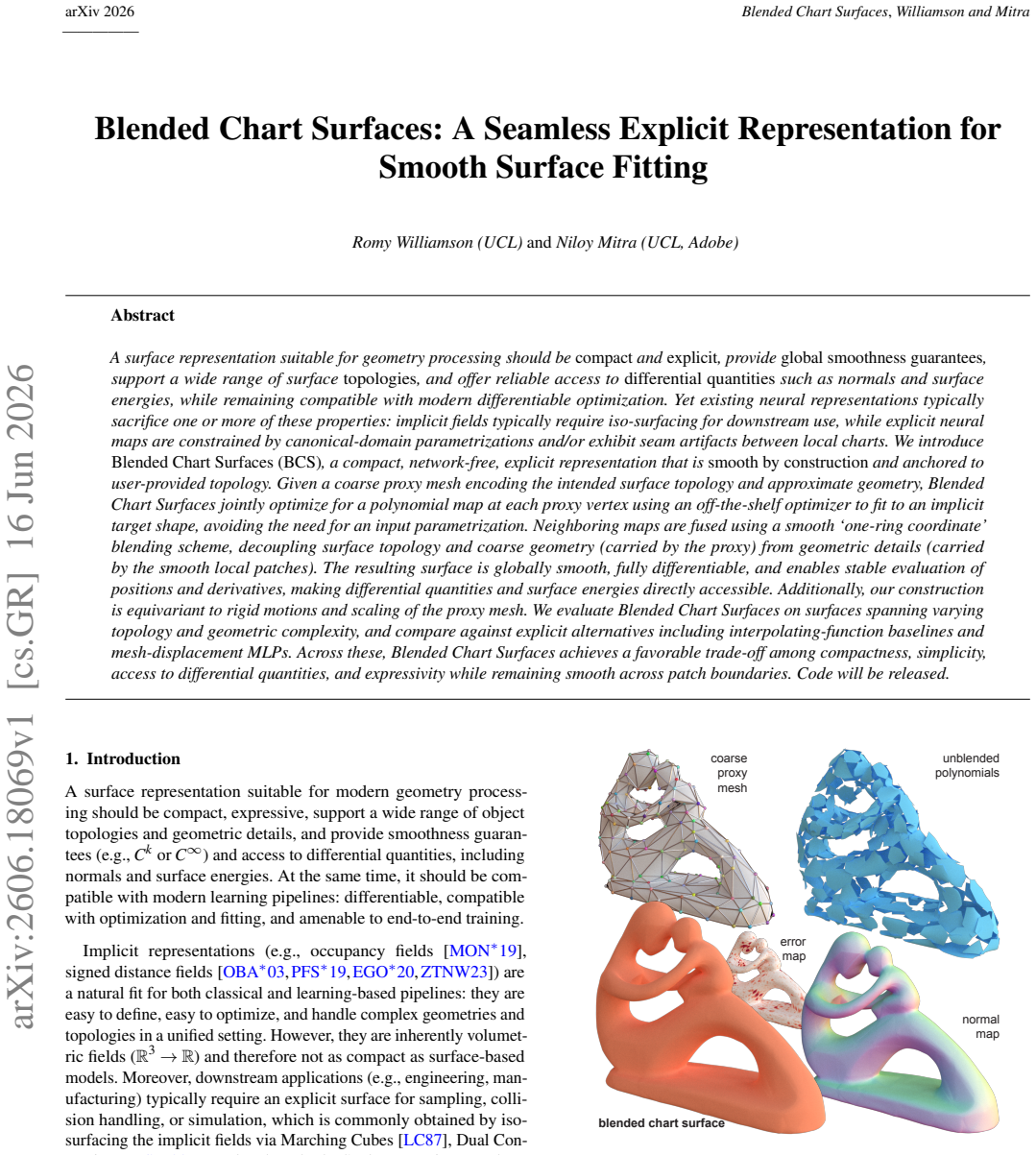
Blended Chart Surfaces jointly optimize per-vertex polynomial maps on a proxy mesh and fuse them with one-ring coordinate blending to produce globally smooth explicit surfaces without parametrizations or seams.
A machine-rendered reading of the paper's core claim, the machinery that carries it, and where it could break.
Core claim
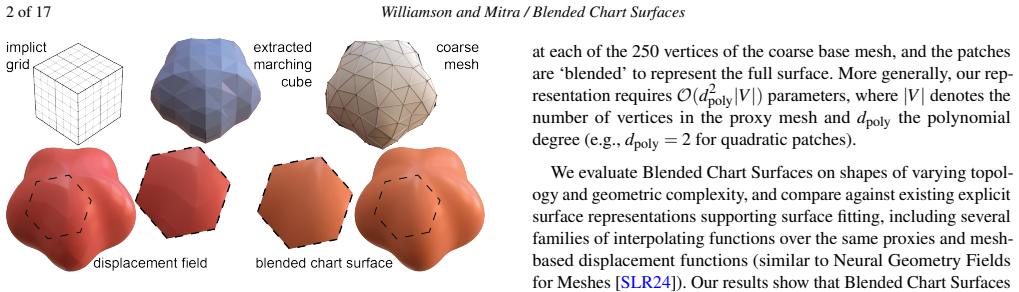
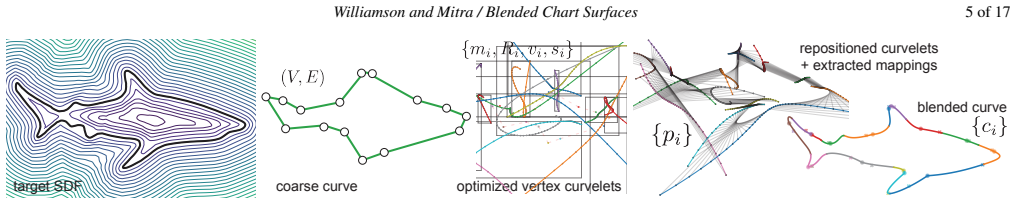
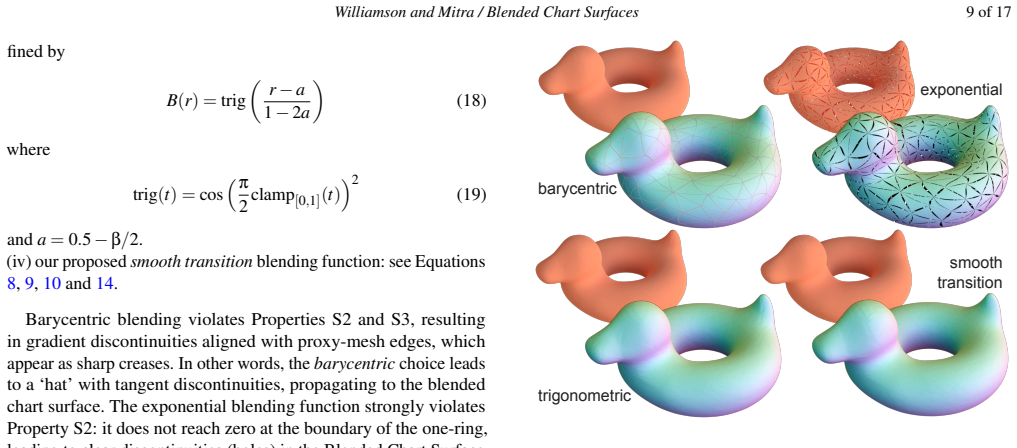
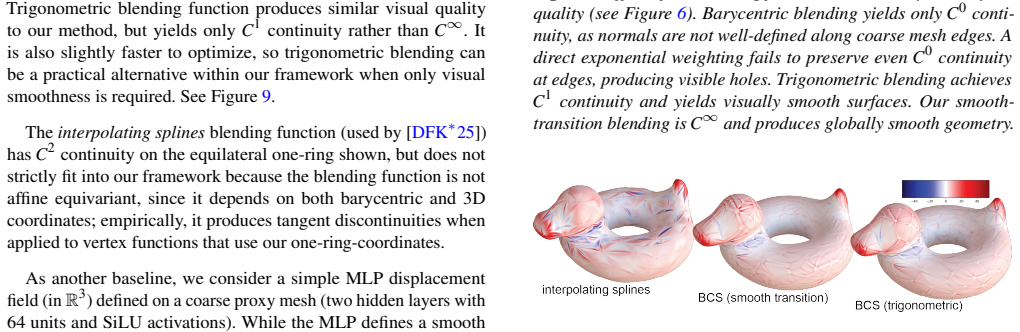
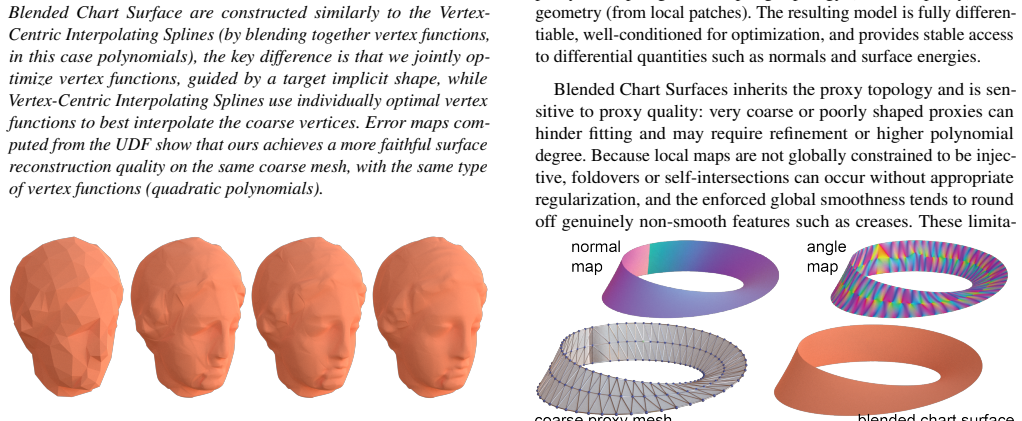
Given a coarse proxy mesh that encodes intended topology and approximate geometry, Blended Chart Surfaces optimize a polynomial map at each proxy vertex to fit an implicit target, then fuse neighboring maps with a smooth one-ring coordinate blending scheme. The resulting surface is globally smooth and fully differentiable by construction, equivariant to rigid motions and scaling of the proxy, and directly supplies differential quantities without requiring an input parametrization or post-processing.
What carries the argument
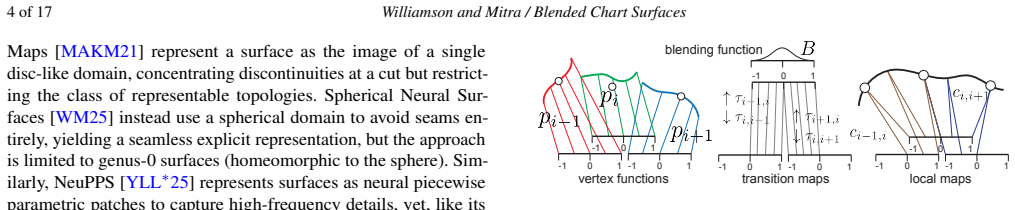
The one-ring coordinate blending scheme that fuses neighboring per-vertex polynomial maps to guarantee continuity and differentiability across chart boundaries.
If this is right
- The surface remains globally smooth and C1-continuous across all patch boundaries by construction.
- Differential quantities such as normals and surface energies become directly accessible without extra computation.
- The representation supports arbitrary surface topologies supplied by the proxy mesh.
- No input parametrization is required because the optimization fits directly to the implicit target.
- The construction is equivariant under rigid motions and uniform scaling of the proxy mesh.
Where Pith is reading between the lines
- The decoupling of topology from detail could let modelers edit coarse connectivity independently of fine geometry in interactive design tools.
- Because the method is network-free and uses an off-the-shelf optimizer, it may integrate more readily into existing geometry-processing codebases than neural alternatives.
- Higher-degree polynomials per chart could be substituted to increase local expressivity while retaining the same blending framework.
Load-bearing premise
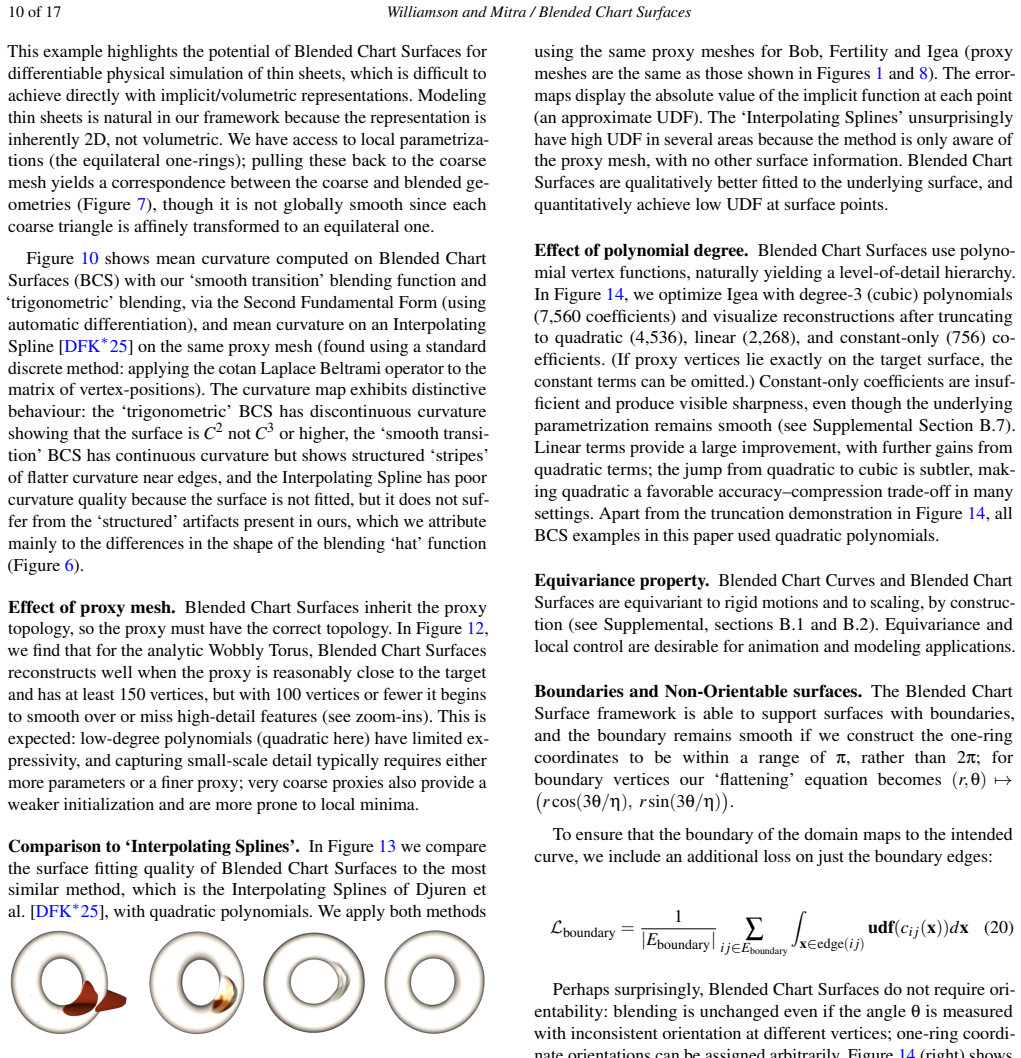
The proxy mesh must correctly encode the intended surface topology and lie close enough to the target geometry that the independent per-vertex polynomial optimizations converge to a single consistent surface.
What would settle it
Visible jumps in position or first derivatives when the surface is evaluated along paths that cross from one polynomial patch into a neighboring patch would show that the blending scheme fails to produce global smoothness.
Figures

read the original abstract
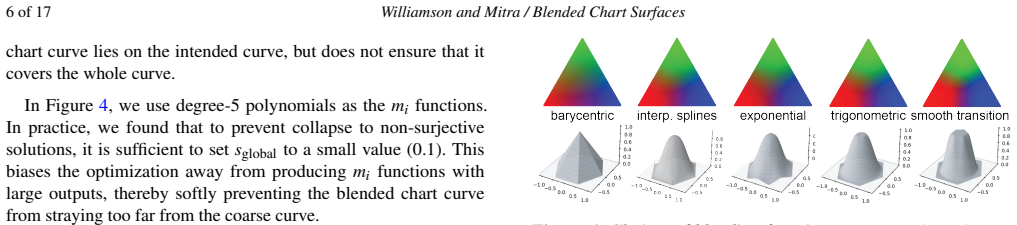
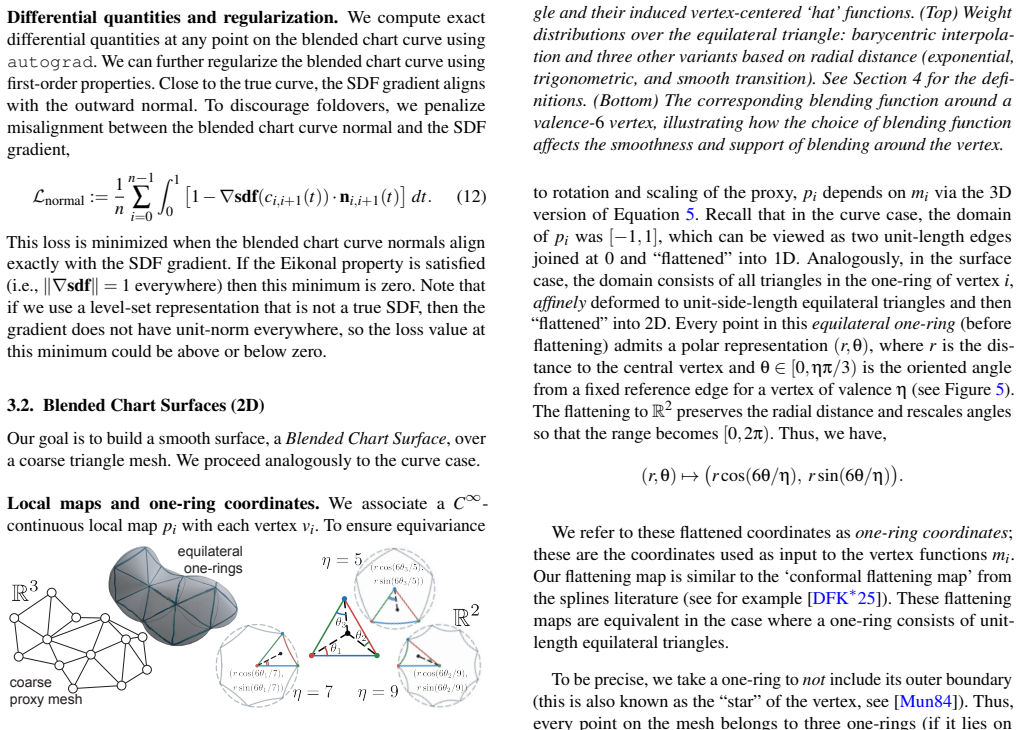
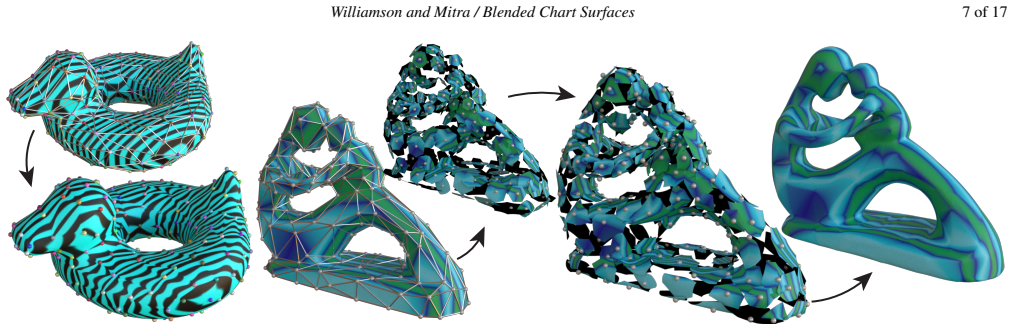
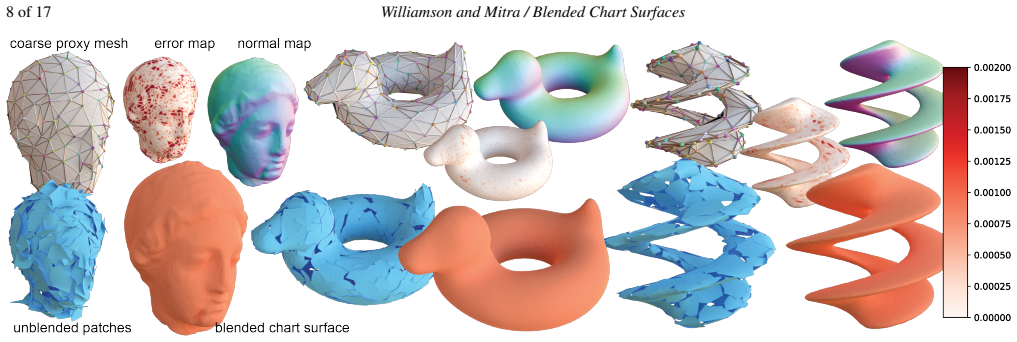
A surface representation suitable for geometry processing should be compact and explicit, provide global smoothness guarantees, support a wide range of surface topologies, and offer reliable access to differential quantities such as normals and surface energies, while remaining compatible with modern differentiable optimization. Existing neural representations typically sacrifice one or more of these properties: implicit fields typically require iso-surfacing for downstream use, while explicit neural maps are constrained by canonical-domain parametrizations or exhibit seam artifacts between local charts. We introduce Blended Chart Surfaces, a compact, network-free, explicit representation that is smooth by construction and anchored to user-provided topology. Given a coarse proxy mesh encoding the intended surface topology and approximate geometry, Blended Chart Surfaces jointly optimize for a polynomial map at each proxy vertex using an off-the-shelf optimizer to fit to an implicit target shape, avoiding the need for an input parametrization. Neighboring maps are fused using a smooth 'one-ring coordinate' blending scheme, decoupling topology and coarse geometry (carried by the proxy) from geometric details (carried by the local patches). The surface is globally smooth, fully differentiable, and enables stable evaluation of derivatives, making differential quantities and surface energies directly accessible. Additionally, our construction is equivariant to rigid motions and scaling of the proxy mesh. We evaluate Blended Chart Surfaces on various topologies and geometric complexity, and compare against explicit alternatives including interpolating-function baselines and mesh-displacement MLPs. Across these, Blended Chart Surfaces achieve a favorable trade-off among compactness, simplicity, access to differential quantities, and expressivity while remaining smooth across patch boundaries.
Editorial analysis
A structured set of objections, weighed in public.
Referee Report
Summary. The paper introduces Blended Chart Surfaces, a compact explicit surface representation anchored to a user-provided coarse proxy mesh. Polynomial maps are jointly optimized per proxy vertex via an off-the-shelf optimizer to fit an implicit target shape; neighboring maps are then fused via a smooth one-ring coordinate blending scheme. The construction is claimed to be globally smooth and differentiable by design, equivariant to rigid motions and scaling, and to decouple topology/coarse geometry (from the proxy) from fine details (from the patches), while avoiding input parametrizations and providing direct access to differential quantities.
Significance. If the central claims hold, the representation offers a network-free explicit alternative that guarantees smoothness across charts and supports stable derivative evaluation, which would be useful for geometry-processing tasks requiring differentiable energies or optimization. The decoupling of topology from details and the avoidance of seam artifacts are potentially valuable strengths.
major comments (2)
- [Abstract / construction description] The central smoothness-by-construction claim depends on the optimized per-vertex polynomials producing consistent values and derivatives under the one-ring blending weights. No analysis, convergence criteria, or regularization terms are supplied to guarantee that the joint optimization reaches such an alignment when the proxy mesh deviates from the target; the abstract only states that the proxy supplies 'approximate geometry.'
- [Abstract / evaluation description] The weakest assumption—that the proxy mesh encodes correct topology and lies sufficiently close for off-the-shelf optimization to converge without topology changes or additional regularization—is load-bearing for the 'globally consistent smooth surface' claim, yet no supporting experiments, failure cases, or sensitivity analysis appear.
minor comments (2)
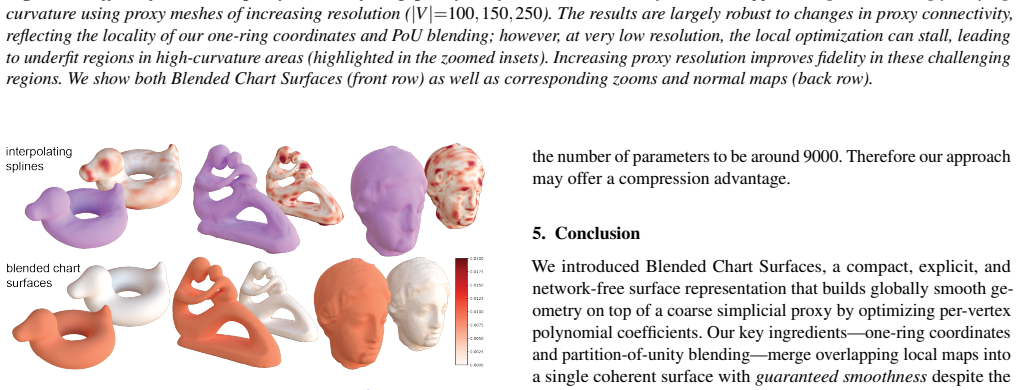
- [Abstract] The abstract mentions comparisons to 'interpolating-function baselines and mesh-displacement MLPs' but does not specify the exact baselines, metrics, or quantitative results; these details are needed to assess the claimed favorable trade-off.
- [Abstract] The free parameters (polynomial degree per chart, blending function parameters) are listed but their selection procedure and sensitivity are not discussed.
Simulated Author's Rebuttal
We thank the referee for the constructive feedback. We address each major comment below, indicating planned revisions where appropriate.
read point-by-point responses
-
Referee: [Abstract / construction description] The central smoothness-by-construction claim depends on the optimized per-vertex polynomials producing consistent values and derivatives under the one-ring blending weights. No analysis, convergence criteria, or regularization terms are supplied to guarantee that the joint optimization reaches such an alignment when the proxy mesh deviates from the target; the abstract only states that the proxy supplies 'approximate geometry.'
Authors: The joint optimization minimizes a global fitting objective across all per-vertex polynomials simultaneously. Because the one-ring blending weights are smooth and the loss is evaluated over the entire surface, this process encourages alignment of values and derivatives in overlap regions. We agree that the manuscript does not supply formal convergence analysis or additional regularization terms beyond the base fitting loss. In revision we will expand the method section with a description of the loss, optimizer settings, and empirical checks for boundary consistency to better substantiate the smoothness claim. revision: yes
-
Referee: [Abstract / evaluation description] The weakest assumption—that the proxy mesh encodes correct topology and lies sufficiently close for off-the-shelf optimization to converge without topology changes or additional regularization—is load-bearing for the 'globally consistent smooth surface' claim, yet no supporting experiments, failure cases, or sensitivity analysis appear.
Authors: The manuscript states that the proxy supplies approximate geometry and correct topology, and the reported experiments use user-provided proxies that satisfy this condition. We acknowledge the absence of explicit sensitivity tests or failure-case analysis. In the revision we will add a new subsection with experiments that vary proxy quality (e.g., small perturbations) and discuss observed failure modes when the proxy deviates substantially or carries incorrect topology. revision: yes
Circularity Check
No significant circularity in derivation chain
full rationale
The paper describes an optimization procedure that fits per-vertex polynomial maps to an external implicit target shape using an off-the-shelf optimizer, followed by a one-ring coordinate blending construction to enforce smoothness. No load-bearing step reduces by definition, by fitted-input renaming, or by self-citation chain to the inputs themselves; the smoothness guarantee is produced by the explicit blending weights rather than presupposed, and the fitting objective is independent of the final surface representation. The proxy-mesh assumption is an empirical precondition for convergence, not a circular definitional step.
Axiom & Free-Parameter Ledger
free parameters (2)
- polynomial degree per chart
- blending function parameters
axioms (2)
- domain assumption A user-provided coarse proxy mesh correctly encodes topology and approximate geometry.
- domain assumption Polynomial maps can be optimized independently per vertex and then blended without introducing discontinuities.
invented entities (1)
-
one-ring coordinate blending scheme
no independent evidence
Reference graph
Works this paper leans on
-
[1]
J. M. Buhmann and D. W. Fellner and M. Held and J. Ketterer and J. Puzicha , TITLE =. 1998 , PAGES =. doi:10.1111/1467-8659.00269 , NOTE =
-
[2]
and Helmberg, Christoph , TITLE =
Fellner, Dieter W. and Helmberg, Christoph , TITLE =. 1993 , PAGES =
1993
-
[3]
L. Kobbelt and M. Stamminger and H.-P. Seidel , title =. doi:10.1111/1467-8659.16.3conferenceissue.36 , note =
-
[4]
Lafortune and Sing-Choong Foo and Kenneth E
Eric P. Lafortune and Sing-Choong Foo and Kenneth E. Torrance and Donald P. Greenberg , title =. Proc. SIGGRAPH '97 , volume = 31, pages =
-
[5]
: Blended barycentric coordinates
Anisimov D., Panozzo D., Hormann K. : Blended barycentric coordinates. Computer Aided Geometric Design 52-53 (2017), 205--216
2017
-
[6]
: Reconstruction and representation of 3d objects with radial basis functions
Carr J., Beatson R., Cherrie J., Mitchell T., Fright W., McCallum B., Evans T. : Reconstruction and representation of 3d objects with radial basis functions. In Proc. Annual Conference on Computer Graphics and Interactive Techniques (2001)
2001
-
[7]
: Digital geometry processing with discrete exterior calculus
Crane K., de Goes F., Desbrun M., Schröder P. : Digital geometry processing with discrete exterior calculus. In ACM SIGGRAPH 2013 courses (New York, NY, USA, 2013), SIGGRAPH '13, ACM
2013
-
[8]
: Algebraic smooth occluding contours
Capouellez R., Dai J., Hertzmann A., Zorin D. : Algebraic smooth occluding contours. In Proc. SIGGRAPH (2023)
2023
-
[10]
: Learning implicit fields for generative shape modeling
Chen Z., Zhang H. : Learning implicit fields for generative shape modeling. In Proc. IEEE/CVF Conf. on Computer Vision & Pattern Recognition (June 2019), pp. 5939--5948
2019
-
[11]
: Better patch stitching for parametric surface reconstruction
Deng Z., Bednarik J., Salzmann M., Fua P. : Better patch stitching for parametric surface reconstruction. In Proc. 3DV (11 2020), pp. 593--602
2020
-
[12]
: Interpolating splines over triangulated surfaces by blending vertex-centric local geometries
Djuren T., Finnendahl U., Kohlbrenner M., Worchel M., Alexa M. : Interpolating splines over triangulated surfaces by blending vertex-centric local geometries. Computers and Graphics 131 (2025), 104316
2025
-
[13]
: Discrete differential geometry - an applied introduction
Desbrun M., Polthier K., Schröder P., Stern A. : Discrete differential geometry - an applied introduction. In ACM SIGGRAPH course notes (2006)
2006
-
[14]
J., Wimmer M
Erler P., Guerrero P., Ohrhallinger S., Mitra N. J., Wimmer M. : Points2Surf : Learning implicit surfaces from point clouds. In Proc. Euro. Conf. on Computer Vision (2020)
2020
-
[15]
: A generalized blending scheme for arbitrary order of continuity
Fang X. : A generalized blending scheme for arbitrary order of continuity. Preprint (2023)
2023
-
[16]
G., Russell B., Aubry M
Groueix T., Fisher M., Kim V. G., Russell B., Aubry M. : Atlasnet: A papier-m\^ach\'e approach to learning 3d surface generation. In Proc. IEEE/CVF Conf. on Computer Vision & Pattern Recognition (2018)
2018
-
[17]
M., Hughes J
Grimm C. M., Hughes J. F. : Modeling surfaces of arbitrary topology using manifolds. In Proc. Annual Conference on Computer Graphics and Interactive Techniques (1995), p. 359–368
1995
-
[18]
J., Riesenfeld R
Gordon W. J., Riesenfeld R. F. : B-spline curves and surfaces. In Computer Aided Geometric Design. Academic Press, 1974, pp. 95--126
1974
-
[19]
Gallier J., Xu D., Siqueira M. : Parametric pseudo-manifolds. Differential Geometry and its Applications 30 (12 2012), 702--736. https://doi.org/10.1016/j.difgeo.2012.09.002 doi:10.1016/j.difgeo.2012.09.002
-
[20]
: Functional networks for b-spline surface reconstruction
Iglesias A., Echevarr \' a G., G \'a lvez A. : Functional networks for b-spline surface reconstruction. Future Generation Computer Systems 20, 8 (2004), 1337--1353
2004
-
[21]
: G ^2 interpolating spline with local maximum curvature
Jiang B., Chen R. : G ^2 interpolating spline with local maximum curvature. ACM Trans. on Graphics 44, 6 (2025), 1--13
2025
-
[22]
: Dual contouring of hermite data
Ju T., Losasso F., Schaefer S., Warren J. : Dual contouring of hermite data. In Proc. Annual Conference on Computer Graphics and Interactive Techniques (July 2002), vol. 21, p. 339–346
2002
-
[23]
: Adam: A method for stochastic optimization
Kingma D., Ba J. : Adam: A method for stochastic optimization. International Conference on Learning Representations (2015)
2015
-
[24]
: Poisson Surface Reconstruction
Kazhdan M., Bolitho M., Hoppe H. : Poisson Surface Reconstruction . In Symposium on Geometry Processing (2006), Sheffer A., Polthier K., (Eds.)
2006
-
[25]
: Provably good moving least squares
Kolluri R. : Provably good moving least squares. ACM Trans. Algorithms 4, 2 (May 2008)
2008
-
[26]
: Relu fields: The little non-linearity that could
Karnewar A., Ritschel T., Wang O., Mitra N. : Relu fields: The little non-linearity that could. In Proc. SIGGRAPH (2022)
2022
-
[27]
E., Cline H
Lorensen W. E., Cline H. E. : Marching cubes: A high resolution 3d surface construction algorithm. In Proc. Annual Conference on Computer Graphics and Interactive Techniques (1987), p. 163–169
1987
-
[28]
Lee J. M. : Introduction to Smooth Manifolds, 2 ed., vol. 218 of Graduate Texts in Mathematics. Springer, 2013
2013
- [30]
-
[31]
: Mash: Masked anchored spherical distances for 3d shape representation and generation
Li C., Xin Y., Zhou X., Shamir A., Zhang H., Liu L., Hu R. : Mash: Masked anchored spherical distances for 3d shape representation and generation. Proc. SIGGRAPH (2025), 11 pages
2025
-
[32]
Morreale L., Aigerman N., Kim V., Mitra N. J. : Neural surface maps. In Proc. IEEE/CVF Conf. on Computer Vision & Pattern Recognition (2021)
2021
-
[33]
: Instant neural graphics primitives with a multiresolution hash encoding
M\" u ller T., Evans A., Schied C., Keller A. : Instant neural graphics primitives with a multiresolution hash encoding. ACM Trans. on Graphics 41, 4 (July 2022)
2022
-
[34]
: Occupancy networks: Learning 3d reconstruction in function space
Mescheder L., Oechsle M., Niemeyer M., Nowozin S., Geiger A. : Occupancy networks: Learning 3d reconstruction in function space. In Proc. IEEE/CVF Conf. on Computer Vision & Pattern Recognition (2019), pp. 4460--4470
2019
-
[35]
: Polyhedral control-net splines for analysis
Mishra B., Peters J. : Polyhedral control-net splines for analysis. Computers & Mathematics with Applications 151 (2023), 215--221
2023
-
[36]
P., Tancik M., Barron J
Mildenhall B., Srinivasan P. P., Tancik M., Barron J. T., Ramamoorthi R., Ng R. : Nerf: representing scenes as neural radiance fields for view synthesis. Commun. ACM 65, 1 (Dec. 2021), 99–106
2021
-
[37]
Munkres J. R. : Elements of Algebraic Topology. Addison-Wesley Publishing Company, 1984
1984
-
[38]
: Smooth Manifolds and Observables, vol
Nestruev J. : Smooth Manifolds and Observables, vol. 220 of Graduate Texts in Mathematics. Springer-Verlag, New York, 2003
2003
-
[39]
: Multi-level partition of unity implicits
Ohtake Y., Belyaev A., Alexa M., Turk G., Seidel H.-P. : Multi-level partition of unity implicits. In ACM Trans. Graph. (July 2003), vol. 22, p. 463–470
2003
-
[40]
: Applications of Lie Groups to Differential Equations
Olver P. : Applications of Lie Groups to Differential Equations. Graduate Texts in Mathematics. Springer New York, 1993. URL: https://books.google.co.uk/books?id=sI2bAxgLMXYC
1993
-
[41]
: Smooth free-form surfaces over irregular meshes generalizing quadratic splines
Peters J. : Smooth free-form surfaces over irregular meshes generalizing quadratic splines. Computer Aided Geometric Design 10, 3 (1993), 347--361
1993
-
[42]
J., Florence P., Straub J., Newcombe R., Lovegrove S
Park J. J., Florence P., Straub J., Newcombe R., Lovegrove S. : Deepsdf: Learning continuous signed distance functions for shape representation. In Proc. IEEE/CVF Conf. on Computer Vision & Pattern Recognition (2019), pp. 165--174
2019
-
[44]
: Polyhedral design with blended n -sided interpolants
Salvi P. : Polyhedral design with blended n -sided interpolants. http://arxiv.org/abs/2601.19322 arXiv:2601.19322
-
[45]
: Neural geometry fields for meshes
Sivaram V., Li T.-M., Ramamoorthi R. : Neural geometry fields for meshes. In Proc. SIGGRAPH (2024)
2024
-
[46]
Sitzmann V., Martel J. N. P., Bergman A. W., Lindell D. B., Wetzstein G. : Implicit neural representations with periodic activation functions. In Proc. Conf. on Neural Information Processing Systems (2020)
2020
-
[47]
Saupe D., Vrani \'c D. V. : 3d model retrieval with spherical harmonics and moments. In Joint Pattern Recognition Symposium (2001), Springer, pp. 392--397
2001
-
[48]
: Neural geometric level of detail: Real-time rendering with implicit 3D shapes
Takikawa T., Litalien J., Yin K., Kreis K., Loop C., Nowrouzezahrai D., Jacobson A., McGuire M., Fidler S. : Neural geometric level of detail: Real-time rendering with implicit 3D shapes. In Proc. IEEE/CVF Conf. on Computer Vision & Pattern Recognition (2021)
2021
-
[49]
P., Mildenhall B., Fridovich-Keil S., Raghavan N., Singhal U., Ramamoorthi R., Barron J
Tancik M., Srinivasan P. P., Mildenhall B., Fridovich-Keil S., Raghavan N., Singhal U., Ramamoorthi R., Barron J. T., Ng R. : Fourier features let networks learn high frequency functions in low dimensional domains. Proc. Conf. on Neural Information Processing Systems (2020)
2020
-
[50]
Williamson R., Mitra N. J. : Neural geometry processing via spherical neural surfaces. Proc. Eurographics (2025)
2025
-
[51]
: Subdivision Methods for Geometric Design: A Constructive Approach
Warren J., Weimer H. : Subdivision Methods for Geometric Design: A Constructive Approach. Morgan Kaufmann, 2002
2002
-
[52]
: Neupps: Neural piecewise parametric surfaces
Yang L., Liang Y., Li X., Zhang C., Lin G., Lin C., Sheffer A., Schaefer S., Keyser J., Wang W. : Neupps: Neural piecewise parametric surfaces. vol. 45
-
[53]
: A simple manifold-based construction of surfaces of arbitrary smoothness
Ying L., Zorin D. : A simple manifold-based construction of surfaces of arbitrary smoothness. 271–275
-
[54]
: 3dshape2vecset: A 3d shape representation for neural fields and generative diffusion models
Zhang B., Tang J., Nie ner M., Wonka P. : 3dshape2vecset: A 3d shape representation for neural fields and generative diffusion models. ACM Trans. Graph. 42, 4 (jul 2023)
2023
-
[55]
CAD-Assistant: Tool-Augmented VLLMs as Generic
Dimitrios Mallis and Ahmet Serdar Karadeniz and Sebastian Cavada and Danila Rukhovich and Niki Maria Foteinopoulou and Kseniya Cherenkova and Anis Kacem and Djamila Aouada , year =. CAD-Assistant: Tool-Augmented VLLMs as Generic. 2412.13810 , archiveprefix =
-
[56]
Deepsdf: Learning continuous signed distance functions for shape representation , author=
-
[57]
2019 , pages =
Chen, Zhiqin and Zhang, Hao , title =. 2019 , pages =
2019
-
[58]
MASH: Masked Anchored SpHerical Distances for 3D Shape Representation and Generation , author =
-
[59]
Occupancy Networks: Learning 3D Reconstruction in Function Space , author=
-
[60]
2024 , booktitle = SIGGRAPH, articleno =
Sivaram, Venkataram and Li, Tzu-Mao and Ramamoorthi, Ravi , title =. 2024 , booktitle = SIGGRAPH, articleno =
2024
-
[61]
Neural Geometry Processing via Spherical Neural Surfaces , author =
-
[62]
Neural Surface Maps , author=
-
[63]
AtlasNet: A Papier-M\^ach\'e Approach to Learning 3D Surface Generation , author=
-
[64]
and Hughes, John F
Grimm, Cindy M. and Hughes, John F. , title =. 1995 , booktitle = SIGGRAPH_old, pages =
1995
-
[65]
Neural Implicit Surface Evolution , author=
-
[66]
Exploring differential geometry in neural implicits , volume =
Tiago Novello and Guilherme Schardong and Luiz Schirmer and Vinícius. Exploring differential geometry in neural implicits , volume =. Computers and Graphics , pages =
-
[67]
Shape Reconstruction by Learning Differentiable Surface Representations , author=
-
[68]
2013 , publisher =
Introduction to Smooth Manifolds , author =. 2013 , publisher =
2013
-
[69]
1984 , publisher =
Elements of Algebraic Topology , author =. 1984 , publisher =
1984
-
[70]
2017 , publisher=
Scalable locally injective mappings , author=. 2017 , publisher=
2017
-
[71]
SSD-C: Smooth Signed Distance Colored Surface Reconstruction
Calakli, Fatih and Taubin, Gabriel. SSD-C: Smooth Signed Distance Colored Surface Reconstruction. Expanding the Frontiers of Visual Analytics and Visualization. 2012
2012
-
[72]
1992 , booktitle = SIGGRAPH_old, pages =
Hoppe, Hugues and DeRose, Tony and Duchamp, Tom and McDonald, John and Stuetzle, Werner , title =. 1992 , booktitle = SIGGRAPH_old, pages =
1992
-
[73]
Symposium on Geometry Processing , editor =
Kazhdan, Michael and Bolitho, Matthew and Hoppe, Hugues , year =. Symposium on Geometry Processing , editor =
-
[74]
Lin, Siyou and Xiao, Dong and Shi, Zuoqiang and Wang, Bin , title =. 2022 , issue_date =. doi:10.1145/3554730 , journal =
-
[75]
2024 , journal =
Jia-Mu Sun and Tong Wu and Lin Gao , title =. 2024 , journal =
2024
-
[76]
Learning Implicit Fields for Generative Shape Modeling , author=
-
[77]
2019 , volume=
Mescheder, Lars and Oechsle, Michael and Niemeyer, Michael and Nowozin, Sebastian and Geiger, Andreas , booktitle= CVPR, title=. 2019 , volume=
2019
-
[78]
2020 , organization=
Convolutional occupancy networks , author=. 2020 , organization=
2020
-
[79]
1974 , author =
B-Spline Curves and Surfaces , booktitle =. 1974 , author =
1974
-
[80]
Future Generation Computer Systems , volume=
Functional networks for B-spline surface reconstruction , author=. Future Generation Computer Systems , volume=. 2004 , publisher=
2004
-
[81]
Joint Pattern Recognition Symposium , pages=
3D model retrieval with spherical harmonics and moments , author=. Joint Pattern Recognition Symposium , pages=. 2001 , organization=
2001
-
[82]
and Cline, Harvey E
Lorensen, William E. and Cline, Harvey E. , title =. 1987 , booktitle = SIGGRAPH_old, pages =
1987
-
[83]
2002 , volume =
Ju, Tao and Losasso, Frank and Schaefer, Scott and Warren, Joe , title =. 2002 , volume =
2002
discussion (0)
Sign in with ORCID, Apple, or X to comment. Anyone can read and Pith papers without signing in.