Double quantum spin Hall phase in bilayer ZrTe₅
Pith reviewed 2026-06-26 23:28 UTC · model grok-4.3
The pith
Bilayer ZrTe5 realizes a double quantum spin Hall phase hosting two pairs of helical edge states.
A machine-rendered reading of the paper's core claim, the machinery that carries it, and where it could break.
Core claim
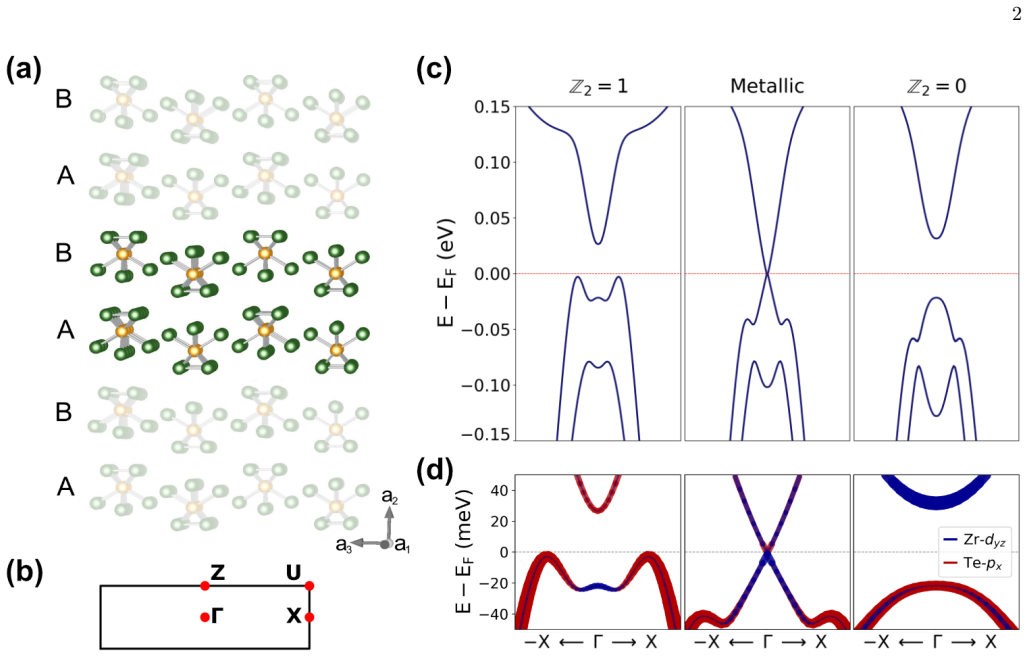
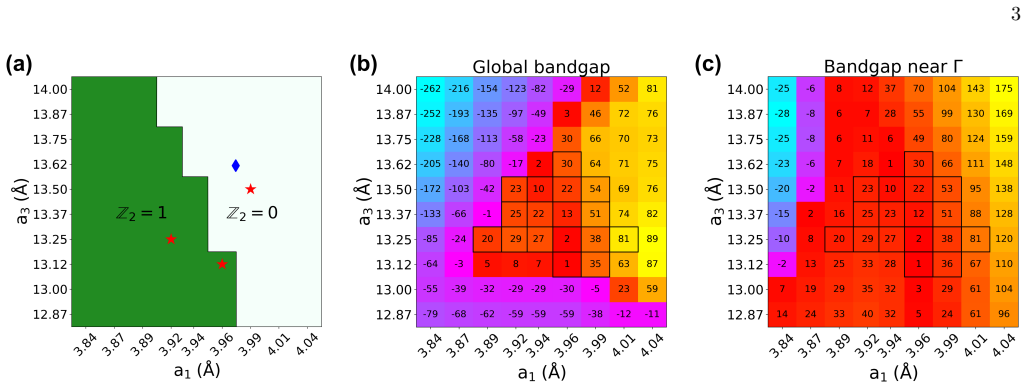
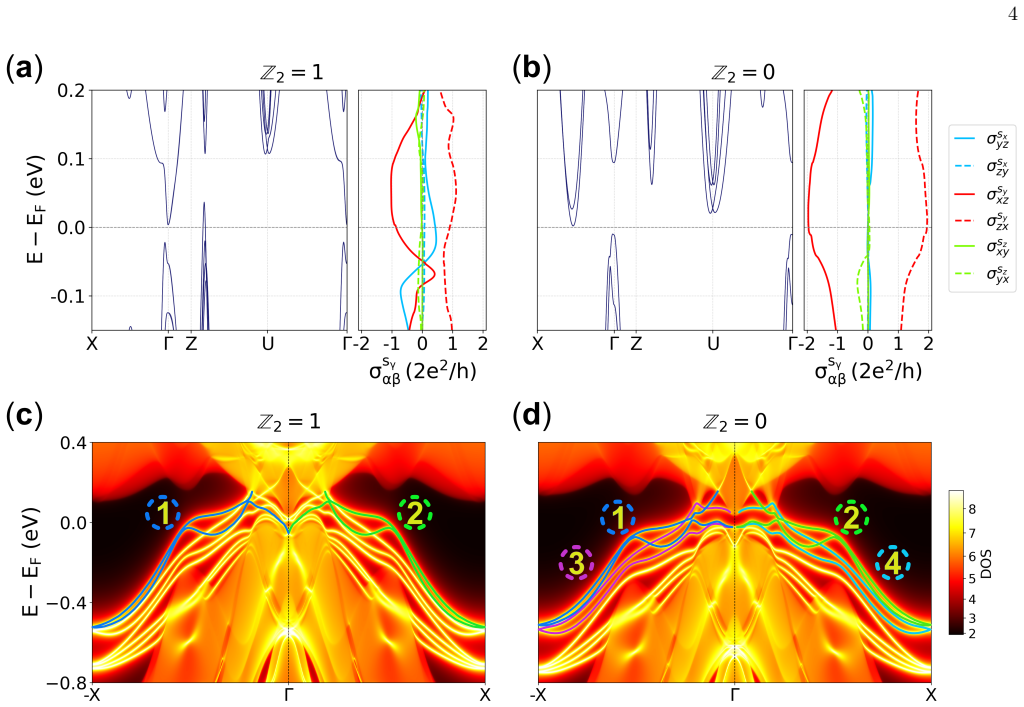
Bilayer ZrTe5 realizes a double quantum spin Hall phase in its energetically most stable structure. Using first principles calculations, uniaxial strain drives a transition from this phase to a conventional single pair QSH phase with Z2 = 1. The double QSH phase hosts two pairs of helical edge states, resulting in enhanced edge conductance and a quantized spin Hall response that remains robust over an energy window of up to ~100 meV.
What carries the argument
The double quantum spin Hall phase, which hosts two pairs of helical edge states protected by a spin Chern number rather than the conventional Z2 invariant.
If this is right
- The double QSH phase exhibits enhanced edge conductance due to the presence of two pairs of helical states.
- The quantized spin Hall response is robust over an energy window of up to 100 meV.
- Uniaxial strain induces a transition to a conventional single-pair QSH phase with Z2 = 1.
- Bilayer ZrTe5 serves as a tunable platform connecting conventional and double QSH phases.
- Untwisted van der Waals bilayers can host topological phases beyond the conventional Z2 classification.
Where Pith is reading between the lines
- If the calculations hold, similar double QSH phases may exist in other bilayer transition metal tellurides under appropriate stacking.
- Experimental transport measurements could detect the enhanced conductance and its robustness.
- The strain-induced transition offers a way to switch between different topological responses in a single device.
- Broader searches for even-channel topological insulators in van der Waals systems could be motivated by this example.
Load-bearing premise
First-principles calculations correctly identify the ground-state bilayer stacking and the topological invariants without significant errors from exchange-correlation functional choice or van der Waals corrections.
What would settle it
Direct experimental observation of two pairs of helical edge states in the stable bilayer structure, or measurement of the strain-driven transition between enhanced and standard edge conductance.
Figures
read the original abstract
Quantum spin Hall insulators (QSH) are topological materials that host helical edge states protected against backscattering, making them ideal candidates for dissipationless spin transport. Within the conventional $\mathbb{Z}_2$ classification, only phases with an odd number of edge state pairs ($\mathbb{Z}_2 = 1$) are topologically nontrivial, whereas even-channel systems ($\mathbb{Z}_2 = 0$) lie beyond this framework but can host robust edge transport characterized by a spin Chern number. Experimentally accessible realizations of such phases remain rare, particularly in systems with sizeable band gaps. Here, we show that bilayer ZrTe$_5$ realizes a double quantum spin Hall phase in its energetically most stable structure. Using first principles calculations, we demonstrate that uniaxial strain drives a transition from this phase to a conventional single pair QSH phase with $\mathbb{Z}_2 = 1$. The double QSH phase hosts two pairs of helical edge states, resulting in enhanced edge conductance and a quantized spin Hall response that remains robust over an energy window of up to $\sim$100 meV. These results establish bilayer ZrTe$_5$ as a tunable platform connecting conventional and double QSH phases within a single material. More broadly, they demonstrate that untwisted van der Waals bilayers can host topological phases beyond the conventional $\mathbb{Z}_2$ classification.
Editorial analysis
A structured set of objections, weighed in public.
Referee Report
Summary. The manuscript claims that the energetically most stable bilayer structure of ZrTe5 realizes a double quantum spin Hall phase hosting two pairs of helical edge states (spin Chern number 2), yielding enhanced edge conductance and a quantized spin Hall response robust over an energy window of ~100 meV. First-principles calculations are used to show that uniaxial strain drives a transition to a conventional single-pair QSH phase with Z2=1, positioning the material as a tunable platform connecting conventional and beyond-Z2 topological phases in untwisted van der Waals bilayers.
Significance. If the numerical results hold after verification, the work identifies a rare, experimentally accessible realization of a double QSH phase in a stable vdW bilayer with a sizeable robustness window, offering enhanced transport properties and a strain-tunable switch between Z2=1 and spin-Chern=2 regimes within one material. This extends the scope of topological phases in simple bilayer systems beyond the conventional Z2 classification.
major comments (2)
- [Computational details / Methods] The central claim that the ground-state bilayer stacking hosts the double QSH phase (two pairs of helical edges) rests entirely on first-principles results, yet the abstract provides no information on the exchange-correlation functional, van der Waals correction scheme, k-point mesh, or convergence criteria for total energies and band structures. These choices routinely alter interlayer binding by 10-50 meV and can invert the relative stability of stackings or change the parity of edge-state pairs in ZrTe5-like systems.
- [Edge-state calculations / Results] The reported ~100 meV robustness window and assignment of spin Chern number 2 require explicit documentation of the edge-state calculation protocol (slab thickness, termination, and how the two pairs are distinguished from finite-size artifacts or trivial states). Without this, it is impossible to assess whether the double-pair counting is robust or sensitive to the same vdW/XC variations that affect the bulk stacking order.
minor comments (1)
- [Abstract] The abstract would benefit from stating the specific strain value or range at which the single-to-double QSH transition occurs.
Simulated Author's Rebuttal
We thank the referee for the careful reading of our manuscript and the constructive comments. We address each major comment below and will incorporate revisions to improve clarity and reproducibility.
read point-by-point responses
-
Referee: [Computational details / Methods] The central claim that the ground-state bilayer stacking hosts the double QSH phase (two pairs of helical edges) rests entirely on first-principles results, yet the abstract provides no information on the exchange-correlation functional, van der Waals correction scheme, k-point mesh, or convergence criteria for total energies and band structures. These choices routinely alter interlayer binding by 10-50 meV and can invert the relative stability of stackings or change the parity of edge-state pairs in ZrTe5-like systems.
Authors: We agree that explicit documentation of these parameters is necessary for assessing the robustness of the stacking order and topological assignments. The Methods section of the manuscript specifies the exchange-correlation functional, van der Waals correction, k-point mesh, and convergence criteria. To make this information immediately accessible, we will add a brief summary of the key computational settings to the abstract in the revised version. revision: yes
-
Referee: [Edge-state calculations / Results] The reported ~100 meV robustness window and assignment of spin Chern number 2 require explicit documentation of the edge-state calculation protocol (slab thickness, termination, and how the two pairs are distinguished from finite-size artifacts or trivial states). Without this, it is impossible to assess whether the double-pair counting is robust or sensitive to the same vdW/XC variations that affect the bulk stacking order.
Authors: We agree that a more detailed description of the edge-state protocol is required to substantiate the double-pair counting and the ~100 meV window. The manuscript already employs slab models with specific terminations and spin projections to identify the helical pairs, but we will expand the relevant Results and Methods sections to explicitly report slab thickness, termination details, and the criteria used to distinguish physical edge states from finite-size or trivial artifacts (including convergence checks with increasing slab thickness). revision: yes
Circularity Check
No circularity; claims rest on external first-principles DFT computations of structure and topology.
full rationale
The paper's central result—that the lowest-energy bilayer stacking hosts a double QSH phase with two helical edge pairs—is obtained by direct first-principles calculation of total energies, band structures, and topological invariants (Z2 or spin Chern numbers). No equation or claim reduces a derived quantity to a fitted input by construction, no uniqueness theorem is imported from the authors' prior work, and no ansatz is smuggled via self-citation. The derivation chain is therefore self-contained against external numerical benchmarks rather than tautological.
Axiom & Free-Parameter Ledger
Reference graph
Works this paper leans on
-
[1]
Qi and S.-C
X.-L. Qi and S.-C. Zhang, Rev. Mod. Phys.83, 1057 (2011)
2011
-
[2]
C. L. Kane and E. J. Mele, Phys. Rev. Lett.95, 146802 (2005)
2005
-
[3]
B. A. Bernevig, T. L. Hughes, and S.-C. Zhang, Science 314, 1757 (2006)
2006
-
[4]
K¨ onig, S
M. K¨ onig, S. Wiedmann, C. Br¨ une, A. Roth, H. Buh- mann, L. W. Molenkamp, X.-L. Qi, and S.-C. Zhang, Science318, 766 (2007)
2007
-
[5]
X. Qian, J. Liu, L. Fu, and J. Li, Science346, 1344 (2014)
2014
-
[6]
D. N. Sheng, Z. Y. Weng, L. Sheng, and F. D. M. Hal- dane, Phys. Rev. Lett.97, 036808 (2006)
2006
-
[7]
Prodan, Phys
E. Prodan, Phys. Rev. B80, 125327 (2009)
2009
-
[8]
Ezawa, Sci
M. Ezawa, Sci. Rep.3, 3435 (2013)
2013
-
[9]
Y. Bai, L. Cai, N. Mao, R. Li, Y. Dai, B. Huang, and C. Niu, Phys. Rev. B105, 195142 (2022)
2022
-
[10]
L. Liu, Y. Liu, J. Li, H. Wu, and Q. Liu, Phys. Rev. B 110, 035161 (2024)
2024
-
[11]
Sheng, D
L. Sheng, D. N. Sheng, C. S. Ting, and F. D. M. Haldane, Phys. Rev. Lett.95, 136602 (2005)
2005
-
[12]
Y. Yang, Z. Xu, L. Sheng, B. Wang, D. Y. Xing, and D. N. Sheng, Phys. Rev. Lett.107, 066602 (2011)
2011
-
[13]
K. Kang, Y. Qiu, K. Watanabe, T. Taniguchi, J. Shan, and K. F. Mak, Nano Lett.24, 14901 (2024)
2024
-
[14]
K. Kang, B. Shen, Y. Qiu, Y. Zeng, Z. Xia, K. Watanabe, T. Taniguchi, J. Shan, and K. F. Mak, Nature628, 522 (2024)
2024
-
[15]
Weber, M
B. Weber, M. S. Fuhrer, X.-L. Sheng, S. A. Yang, R. Thomale, S. Shamim, L. W. Molenkamp, D. Cobden, D. Pesin, H. J. W. Zandvliet, P. Bampoulis, R. Claessen, F. R. Menges, J. Gooth, C. Felser, C. Shekhar, A. Tadich, M. Zhao, M. T. Edmonds, J. Jia, M. Bieniek, J. I. V¨ ayrynen, D. Culcer, B. Muralidharan, and M. Nadeem, J. Phys. Mater.7, 022501 (2024)
2024
-
[16]
H. Weng, X. Dai, and Z. Fang, Phys. Rev. X4, 011002 (2014)
2014
-
[17]
Manzoni, L
G. Manzoni, L. Gragnaniello, G. Aut` es, T. Kuhn, A. Sterzi, F. Cilento, M. Zacchigna, V. Enenkel, I. Vobornik, L. Barba, F. Bisti, P. Bugnon, A. Ma- grez, V. N. Strocov, H. Berger, O. V. Yazyev, M. Fonin, F. Parmigiani, and A. Crepaldi, Phys. Rev. Lett.117, 237601 (2016)
2016
-
[18]
Z.-G. Chen, R. Y. Chen, R. D. Zhong, J. Schneeloch, C. Zhang, Y. Huang, F. Qu, R. Yu, Q. Li, G. D. Gu, and N. L. Wang, Proc. Natl. Acad. Sci. U.S.A.114, 816 (2017)
2017
-
[19]
F. Tang, Y. Ren, P. Wang, R. Zhong, J. Schneeloch, S. A. Yang, K. Yang, P. A. Lee, G. Gu, Z. Qiao, and L. Zhang, Nature569, 537 (2019)
2019
-
[20]
Galeski, T
S. Galeski, T. Ehmcke, R. Wawrzy´ nczak, P. M. Lozano, K. Cho, A. Sharma, S. Das, F. K¨ uster, P. Sessi, M. Brando, R. K¨ uchler, A. Markou, M. K¨ onig, P. Swekis, C. Felser, Y. Sassa, Q. Li, G. Gu, M. V. Zimmermann, 6 O. Ivashko, D. I. Gorbunov, S. Zherlitsyn, T. F¨ orster, S. S. P. Parkin, J. Wosnitza, T. Meng, and J. Gooth, Nat. Commun.12, 3197 (2021)
2021
-
[21]
F. Tang, P. Wang, M. He, M. Isobe, G. Gu, Q. Li, L. Zhang, and J. H. Smet, Nano Lett.21, 5998 (2021)
2021
-
[22]
J. Wang, Y. Jiang, T. Zhao, Z. Dun, A. L. Miettinen, X. Wu, M. Mourigal, H. Zhou, W. Pan, D. Smirnov, and Z. Jiang, Nat. Commun.12, 6758 (2021)
2021
-
[23]
Chen Ye, Y
C. Chen Ye, Y. Kreminska, J. Ye, and J. S lawi´ nska, Phys. Rev. Materials9, 054204 (2025)
2025
-
[24]
Fan, Q.-F
Z. Fan, Q.-F. Liang, Y. B. Chen, S.-H. Yao, and J. Zhou, Sci. Rep.7, 45667 (2017)
2017
-
[25]
Mutch, W.-C
J. Mutch, W.-C. Chen, P. Went, T. Qian, I. Z. Wilson, A. Andreev, C.-C. Chen, and J.-H. Chu, Sci. Adv.5, eaav9771 (2019)
2019
-
[26]
B. Xu, L. X. Zhao, P. Marsik, E. Sheveleva, F. Lyzwa, Y. M. Dai, G. F. Chen, X. G. Qiu, and C. Bernhard, Phys. Rev. Lett.121, 187401 (2018)
2018
-
[27]
Zhang, R
P. Zhang, R. Noguchi, K. Kuroda, C. Lin, K. Kawaguchi, K. Yaji, A. Harasawa, M. Lippmaa, S. Nie, H. Weng, V. Kandyba, A. Giampietri, A. Barinov, Q. Li, G. D. Gu, S. Shin, and T. Kondo, Nat. Commun.12, 406 (2021)
2021
-
[28]
Tajkov, D
Z. Tajkov, D. Nagy, K. Kandrai, J. Koltai, L. Oroszl´ any, P. S¨ ule, Z. E. Horv´ ath, P. Vancs´ o, L. Tapaszt´ o, and P. Nemes-Incze, npj Comput. Mater.8, 177 (2022)
2022
-
[29]
G. Qiu, Y. Du, A. Charnas, H. Zhou, S. Jin, Z. Luo, D. Y. Zemlyanov, X. Xu, G. J. Cheng, and P. D. Ye, Nano Lett.16, 7364 (2016)
2016
-
[30]
Y.-J. Xu, G. Cao, Q.-Y. Li, C.-L. Xue, W.-M. Zhao, Q.- W. Wang, L.-G. Dou, X. Du, Y.-X. Meng, Y.-K. Wang, Y.-H. Gao, Z.-Y. Jia, W. Li, L. Ji, F.-S. Li, Z. Zhang, P. Cui, D. Xing, and S.-C. Li, Nat. Commun.15, 4784 (2024)
2024
- [31]
-
[32]
Hernandez, V
Y. Hernandez, V. Nicolosi, M. Lotya, F. M. Blighe, Z. Sun, S. De, I. T. McGovern, B. Holland, M. Byrne, Y. K. Gun’ko, J. J. Boland, P. Niraj, G. S. Duesberg, S. Krishnamurthy, R. Goodhue, J. Hutchison, V. Scar- daci, A. C. Ferrari, and J. N. Coleman, Nature Nanotech- nology3, 563 (2008)
2008
-
[33]
J. N. Coleman, M. Lotya, A. O’Neill, S. D. Bergin, P. J. King, U. Khan, K. Young, A. Gaucher, S. De, R. J. Smith, I. V. Shvets, S. K. Arora, G. Stanton, H. Y. Kim, K. Lee, G. T. Kim, G. S. Duesberg, T. Hallam, J. J. Boland, J. J. Wang, J. F. Donegan, J. C. Grunlan, G. Moriarty, A. Shmeliov, R. J. Nicholls, J. M. Perkins, E. M. Grieveson, K. Theuwissen, D....
2011
-
[34]
C. Backes, D. Campi, B. M. Szydlowska, K. Synnatschke, E. Ojala, F. Rashvand, A. Harvey, A. Griffin, Z. Sofer, N. Marzari, D. D. O’Regan, and J. N. Coleman, ACS Nano 10.1021/acsnano.0c01333 (2020)
-
[35]
Z. Wang, X. Yan, Q. Hou, Y. Liu, X. Zeng, Y. Kang, W. Zhao, X. Li, S. Yuan, R. Qiu, M. H. Uddin, R. Wang, Y. Xia, M. Jian, Y. Kang, L. Gao, S. Liang, J. Z. Liu, H. Wang, and X. Zhang, Nat. Commun.14, 236 (2023)
2023
-
[36]
J. P. Perdew, K. Burke, and M. Ernzerhof, Phys. Rev. Lett.77, 3865 (1996)
1996
-
[37]
Hummer, J
K. Hummer, J. Harl, and G. Kresse, Phys. Rev. B80, 115205 (2009)
2009
-
[38]
A. Roy, M. H. D. Guimar˜ aes, and J. S lawi´ nska, Phys. Rev. Materials6, 045004 (2022)
2022
-
[39]
C.-Y. Tan, P. Feng, Z.-F. Gao, F. Ma, P.-J. Guo, and Z.-Y. Lu, arXiv:2508.05365 (2025)
arXiv 2025
-
[40]
St¨ uhler, A
R. St¨ uhler, A. Kowalewski, F. Reis, D. Jungblut, F. Dominguez, B. Scharf, G. Li, J. Sch¨ afer, E. M. Han- kiewicz, and R. Claessen, Nat. Commun.13, 3480 (2022)
2022
-
[41]
Kresse and J
G. Kresse and J. Hafner, Phys. Rev. B47, 558 (1993)
1993
-
[42]
Kresse and J
G. Kresse and J. Furthm¨ uller, Phys. Rev. B54, 11169 (1996)
1996
-
[43]
Kresse and J
G. Kresse and J. Furthm¨ uller, Comp. Mat. Sci.6, 15 (1996)
1996
-
[44]
P. E. Bl¨ ochl, Phys. Rev. B50, 17953 (1994)
1994
-
[45]
Kresse and D
G. Kresse and D. Joubert, Phys. Rev. B59, 1758 (1999)
1999
-
[46]
A. A. Mostofi, J. R. Yates, Y.-S. Lee, I. Souza, D. Van- derbilt, and N. Marzari, Comput. Phys. Commun.178, 685 (2008)
2008
-
[47]
Pizzi, V
G. Pizzi, V. Vitale, R. Arita, S. Bl¨ ugel, F. Freimuth, G. G´ eranton, M. Gibertini, D. Gresch, C. Johnson, T. Koretsune, J. Iba˜ nez-Azpiroz, H. Lee, J.-M. Lihm, D. Marchand, A. Marrazzo, Y. Mokrousov, J. I. Mustafa, Y. Nohara, Y. Nomura, L. Paulatto, S. Ponc´ e, T. Pon- weiser, J. Qiao, F. Th¨ ole, S. S. Tsirkin, M. Wierzbowska, N. Marzari, D. Vanderbi...
2020
-
[48]
A. A. Soluyanov and D. Vanderbilt, Phys. Rev. B83, 235401 (2011)
2011
-
[49]
Gresch, G
D. Gresch, G. Aut` es, O. V. Yazyev, M. Troyer, D. Van- derbilt, B. A. Bernevig, and A. A. Soluyanov, Phys. Rev. B95, 075146 (2017)
2017
-
[50]
Q. Wu, S. Zhang, H.-F. Song, M. Troyer, and A. A. Soluyanov, Comput. Phys. Commun.224, 405 (2018)
2018
-
[51]
M. P. L´ opez Sancho, J. M. L´ opez Sancho, J. M. L. L´ opez Sancho, and J. Rubio, J. Phys. F: Met. Phys.15, 851 (1985)
1985
-
[52]
Buongiorno Nardelli, F
M. Buongiorno Nardelli, F. T. Cerasoli, M. Costa, S. Cur- tarolo, R. De Gennaro, M. Fornari, L. Liyanage, A. R. Supka, and H. Wang, Comp. Mat. Sci.143, 462 (2018)
2018
-
[53]
F. T. Cerasoli, A. R. Supka, A. Jayaraj, M. Costa, I. Siloi, J. S lawi´ nska, S. Curtarolo, M. Fornari, D. Ceresoli, and M. Buongiorno Nardelli, Comp. Mat. Sci.200, 110828 (2021)
2021
-
[54]
A. Togo, K. Shinohara, and I. Tanaka, Sci. Technol. Adv. Mater: Meth.4, 2384822 (2024)
2024
-
[55]
Iraola, J
M. Iraola, J. L. Ma˜ nes, B. Bradlyn, M. K. Horton, T. Ne- upert, M. G. Vergniory, and S. S. Tsirkin, Comput. Phys. Commun.272, 108226 (2022)
2022
discussion (0)
Sign in with ORCID, Apple, or X to comment. Anyone can read and Pith papers without signing in.