Stochastic signal sensing with finite energy and dead time at the fundamental quantum limit
Pith reviewed 2026-06-27 00:05 UTC · model grok-4.3
The pith
Two-mode squeezed vacuum is the optimal probe state for stochastic signal sensing under finite mean energy and dead time.
A machine-rendered reading of the paper's core claim, the machinery that carries it, and where it could break.
Core claim
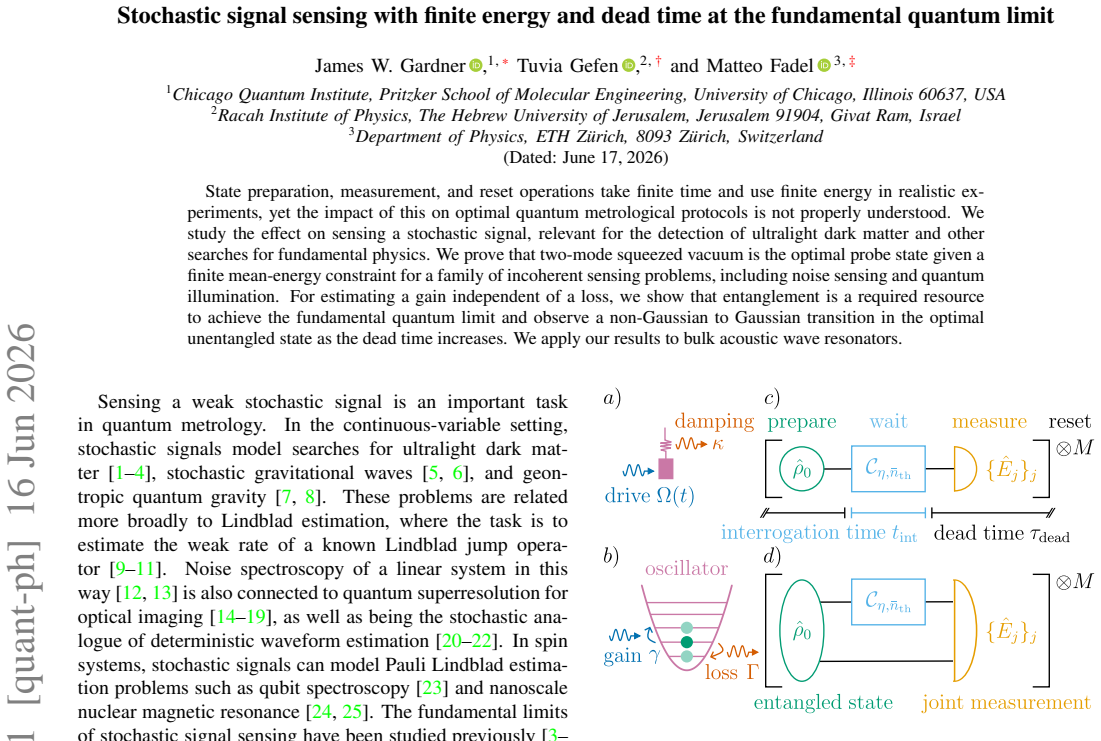
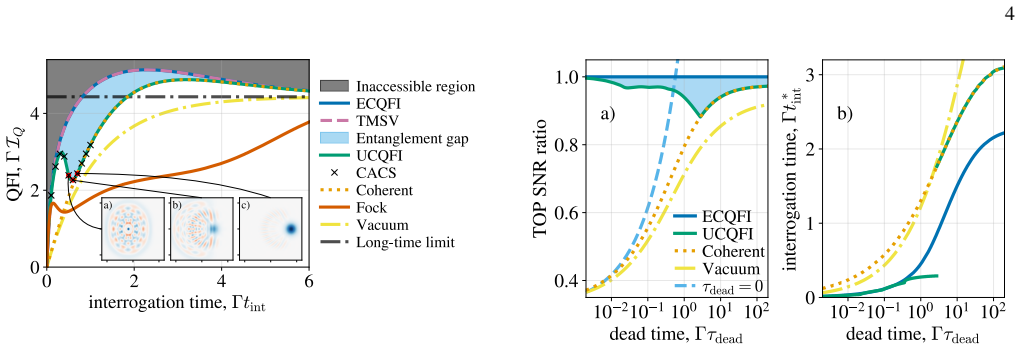
We prove that two-mode squeezed vacuum is the optimal probe state given a finite mean-energy constraint for a family of incoherent sensing problems, including noise sensing and quantum illumination. For estimating a gain independent of a loss, entanglement is required to achieve the fundamental quantum limit, and the optimal unentangled state undergoes a non-Gaussian to Gaussian transition as dead time increases.
What carries the argument
Two-mode squeezed vacuum state, proven optimal under a finite mean-energy constraint for the family of incoherent sensing problems with dead time.
If this is right
- Entanglement becomes a required resource to reach the fundamental quantum limit when estimating a gain independent of loss.
- The optimal unentangled probe state changes from non-Gaussian to Gaussian as dead time increases.
- The same optimality holds for noise sensing and quantum illumination tasks.
- The results can be applied directly to bulk acoustic wave resonators used in stochastic signal searches.
Where Pith is reading between the lines
- Prioritizing two-mode squeezed vacuum preparation could improve sensitivity in dark matter searches that already operate near energy and timing limits.
- The dead-time model could be tested by adding controlled pauses in existing quantum illumination setups and measuring performance drop relative to the TMSV prediction.
- Similar optimality arguments might extend to other metrology tasks that combine stochastic signals with periodic reset operations.
Load-bearing premise
The family of sensing problems remains incoherent and the finite-energy plus dead-time model fully captures the dominant experimental constraints without unmodeled losses or decoherence channels.
What would settle it
An experiment that prepares two-mode squeezed vacuum and alternative probe states with the same mean energy, applies controlled dead time after each cycle, senses a stochastic signal, and checks whether the TMSV case alone reaches the predicted quantum limit while others fall short.
Figures
read the original abstract
State preparation, measurement, and reset operations take finite time and use finite energy in realistic experiments, yet the impact of this on optimal quantum metrological protocols is not properly understood. We study the effect on sensing a stochastic signal, relevant for the detection of ultralight dark matter and other searches for fundamental physics. We prove that two-mode squeezed vacuum is the optimal probe state given a finite mean-energy constraint for a family of incoherent sensing problems, including noise sensing and quantum illumination. For estimating a gain independent of a loss, we show that entanglement is a required resource to achieve the fundamental quantum limit and observe a non-Gaussian to Gaussian transition in the optimal unentangled state as the dead time increases. We apply our results to bulk acoustic wave resonators.
Editorial analysis
A structured set of objections, weighed in public.
Referee Report
Summary. The manuscript studies the impact of finite energy and dead time in preparation, measurement, and reset on optimal quantum metrology for stochastic signal sensing. It proves that two-mode squeezed vacuum is the optimal probe under a finite mean-energy constraint for a family of incoherent channels (noise sensing, quantum illumination). It further shows entanglement is required to reach the quantum limit when estimating a gain independent of loss, identifies a non-Gaussian-to-Gaussian transition in the optimal unentangled state with increasing dead time, and applies the results to bulk acoustic wave resonators.
Significance. If the central optimality proof holds, the work supplies a concrete, experimentally relevant bound on probe states for quantum sensing under realistic timing and energy constraints. The explicit treatment of dead-time reset operations and the demonstration that entanglement remains necessary even with these constraints are strengths; the application to bulk acoustic resonators provides a direct link to ongoing dark-matter searches.
major comments (2)
- [§4, Eq. (27)] §4, Eq. (27): the optimality proof for TMSV assumes the channel family remains strictly incoherent after composition with the dead-time reset map; a concrete counter-example or bound showing that any coherent leakage would violate the finite-energy constraint would strengthen the claim.
- [§5.2, Fig. 3] §5.2, Fig. 3: the reported quantum-limit gap for the gain-estimation task shrinks to <5% only for dead times >10 τ; the manuscript should state whether this threshold is robust to small unmodeled loss channels not included in the model.
minor comments (2)
- [§2] Notation for the dead-time reset operator R_τ is introduced in §2 but used without re-definition in §6; a single-line reminder would improve readability.
- [Table I] Table I lists numerical values for the BAW resonator parameters but omits the source of the quoted energy constraint E_max = 10 ħω; a brief citation or derivation would help.
Simulated Author's Rebuttal
We thank the referee for the careful review and the recommendation of minor revision. We address each major comment below.
read point-by-point responses
-
Referee: [§4, Eq. (27)] the optimality proof for TMSV assumes the channel family remains strictly incoherent after composition with the dead-time reset map; a concrete counter-example or bound showing that any coherent leakage would violate the finite-energy constraint would strengthen the claim.
Authors: We agree that an explicit bound would strengthen the presentation. The reset map is a trace-preserving CP map that returns the probe to a thermal state consistent with the finite-energy constraint. Any coherent leakage would introduce a displacement term whose energy cost exceeds the mean-photon-number bound for the same total energy when compared to the TMSV, thereby taking the state outside the allowed set. We will add this short bounding argument to the revised §4. revision: yes
-
Referee: [§5.2, Fig. 3] the reported quantum-limit gap for the gain-estimation task shrinks to <5% only for dead times >10 τ; the manuscript should state whether this threshold is robust to small unmodeled loss channels not included in the model.
Authors: The threshold is derived inside the model that contains only the specified dead-time reset and the gain/loss channel. Small additional losses would degrade both the entangled and unentangled strategies, but the necessity of entanglement for reaching the quantum limit is expected to persist. A quantitative robustness study would require extending the channel family with extra parameters and is outside the present scope. We will insert a clarifying sentence in §5.2 noting the idealized-model assumption. revision: partial
Circularity Check
No significant circularity; optimality proven by direct optimization over explicit constraints
full rationale
The manuscript derives the optimality of TMSV via mathematical optimization of probe states (including non-Gaussian) subject to explicit finite-mean-energy and dead-time reset models for the stated family of incoherent channels. No step reduces a prediction to a fitted input by construction, no load-bearing uniqueness theorem is imported via self-citation, and no ansatz is smuggled in. The derivation is self-contained against the paper's own channel composition and energy bounds.
Axiom & Free-Parameter Ledger
axioms (1)
- domain assumption Sensing problems belong to the incoherent family and are subject only to a finite mean-energy constraint plus dead time.
Reference graph
Works this paper leans on
-
[1]
Lamoreaux, K
S. Lamoreaux, K. Van Bibber, K. Lehnert, and G. Carosi, Anal- ysis of single-photon and linear amplifier detectors for mi- crowave cavity dark matter axion searches, PRD88, 035020 (2013)
2013
-
[2]
A. V . Dixit, S. Chakram, K. He, A. Agrawal, R. K. Naik, D. I. Schuster, and A. Chou, Searching for dark matter with a super- conducting qubit, PRL126, 141302 (2021)
2021
-
[3]
Shi and Q
H. Shi and Q. Zhuang, Ultimate precision limit of noise sensing and dark matter search, npj Quantum Information9, 27 (2023)
2023
-
[4]
H. Shi, A. J. Brady, W. G ´orecki, L. Maccone, R. Di Candia, and Q. Zhuang, Quantum-enhanced dark matter detection with in-cavity control: mitigating the rayleigh curse, npj Quantum Information11, 48 (2025)
2025
-
[5]
J. W. Gardner, T. Gefen, S. A. Haine, J. J. Hope, J. Preskill, Y . Chen, and L. McCuller, Stochastic waveform estimation 6 at the fundamental quantum limit, PRX Quantum6, 030311 (2025)
2025
-
[6]
A. I. Renzini, B. Goncharov, A. C. Jenkins, and P. M. Meyers, Stochastic gravitational-wave backgrounds: Current detection efforts and future prospects, Galaxies10, 34 (2022)
2022
-
[7]
L. McCuller, Single-photon signal sideband detection for high-power michelson interferometers, arXiv:2211.04016 10.48550/arXiv.2211.04016 (2022)
-
[8]
S. M. Vermeulen, T. Cullen, D. Grass, I. A. MacMillan, A. J. Ramirez, J. Wack, B. Korzh, V . S. Lee, K. M. Zurek, C. Stoughton, et al., Photon-counting interferometry to de- tect geontropic space-time fluctuations with gquest, PRX15, 011034 (2025)
2025
-
[9]
J. W. Gardner, S. A. Haine, J. J. Hope, Y . Chen, and T. Gefen, Lindblad estimation with fast and precise quantum control, Physical Review Applied24, 044055 (2025)
2025
-
[10]
Sekatski and M
P. Sekatski and M. Perarnau-Llobet, Optimal nonequilibrium thermometry in markovian environments, Quantum6, 869 (2022)
2022
-
[11]
A. Das, W. G ´orecki, and R. Demkowicz-Dobrza´nski, Universal time scalings of sensitivity in markovian quantum metrology, Physical Review A111, L020403 (2025)
2025
-
[12]
Tsang and R
M. Tsang and R. Nair, Fundamental quantum limits to wave- form detection, PRA86, 042115 (2012)
2012
-
[13]
S. Ng, S. Z. Ang, T. A. Wheatley, H. Yonezawa, A. Furusawa, E. H. Huntington, and M. Tsang, Spectrum analysis with quan- tum dynamical systems, PRA93, 042121 (2016)
2016
-
[14]
Tsang, Quantum noise spectroscopy as an incoherent imag- ing problem, PRA107, 012611 (2023)
M. Tsang, Quantum noise spectroscopy as an incoherent imag- ing problem, PRA107, 012611 (2023)
2023
-
[15]
Tsang, R
M. Tsang, R. Nair, and X.-M. Lu, Quantum theory of superres- olution for two incoherent optical point sources, PRX6, 031033 (2016)
2016
-
[16]
Nair and M
R. Nair and M. Tsang, Far-field superresolution of thermal elec- tromagnetic sources at the quantum limit, PRL117, 190801 (2016)
2016
-
[17]
C. Oh, S. Zhou, Y . Wong, and L. Jiang, Quantum limits of su- perresolution in a noisy environment, PRL126, 120502 (2021)
2021
-
[18]
Huang and C
Z. Huang and C. Lupo, Quantum hypothesis testing for exo- planet detection, Phys. Rev. Lett.127, 130502 (2021)
2021
-
[19]
J. W. Gardner, F. Belliardo, G. Lee, T. Gefen, and L. Jiang, Quantum superresolution and noise spectroscopy with quantum computing, arXiv preprint arXiv:2602.17862 10.48550/arXiv.2602.17862 (2026)
-
[20]
Tsang, H
M. Tsang, H. M. Wiseman, and C. M. Caves, Fundamen- tal quantum limit to waveform estimation, PRL106, 090401 (2011)
2011
-
[21]
J. W. Gardner, T. Gefen, S. A. Haine, J. J. Hope, and Y . Chen, Achieving the fundamental quantum limit of linear waveform estimation, Phys. Rev. Lett.132, 130801 (2024)
2024
-
[22]
J. Ding, J. W. Gardner, T. Gefen, and Y . Chen, Gaussian quantum metrology with realistic linear sensors, In preparation (2026)
2026
-
[23]
S. L. Mouradian, N. Glikin, E. Megidish, K.-I. Ellers, and H. Haeffner, Quantum sensing of intermittent stochastic signals, PRA103, 032419 (2021)
2021
-
[24]
Gefen, A
T. Gefen, A. Rotem, and A. Retzker, Overcoming resolution limits with quantum sensing, Nature communications10, 4992 (2019)
2019
-
[25]
Cohen, T
D. Cohen, T. Gefen, L. Ortiz, and A. Retzker, Achieving the ul- timate precision limit with a weakly interacting quantum probe, npj QI6, 83 (2020)
2020
-
[26]
G ´orecki, F
W. G ´orecki, F. Albarelli, S. Felicetti, R. Di Candia, and L. Mac- cone, Interplay between time and energy in bosonic noisy quan- tum metrology, PRX Quantum6, 020351 (2025)
2025
-
[27]
Nagourney, J
W. Nagourney, J. Sandberg, and H. Dehmelt, Shelved optical electron amplifier: Observation of quantum jumps, Physical Review Letters56, 2797 (1986)
1986
-
[28]
M. Sanz, U. Las Heras, J. J. Garc ´ıa-Ripoll, E. Solano, and R. Di Candia, Quantum estimation methods for quantum illu- mination, Phys. Rev. Lett.118, 070803 (2017)
2017
-
[29]
Fadel, N
M. Fadel, N. Roux, and M. Gessner, Quantum metrology with a continuous-variable system, Reports on Progress in Physics88, 106001 (2025)
2025
-
[30]
See the Supplemental Material for proofs of the results in the main text and additional details about the numerics
-
[31]
Jonsson and R
R. Jonsson and R. Di Candia, Gaussian quantum estimation of the loss parameter in a thermal environment, Journal of Physics A: Mathematical and Theoretical55, 385301 (2022)
2022
-
[32]
S. M. Kay, Statistical signal processing: estimation theory, Prentice Hall1, Chapter (1993)
1993
-
[33]
S. L. Braunstein and C. M. Caves, Statistical distance and the geometry of quantum states, Phys. Rev. Lett.72, 3439 (1994)
1994
-
[34]
Dooley, W
S. Dooley, W. J. Munro, and K. Nemoto, Quantum metrology including state preparation and readout times, Physical Review A94, 052320 (2016)
2016
-
[35]
Y . Chu, X. Li, and J. Cai, Strong quantum metrological limit from many-body physics, Physical Review Letters130, 170801 (2023)
2023
-
[36]
Herb and C
K. Herb and C. L. Degen, Quantum speed limit in quantum sensing, Physical Review Letters133, 210802 (2024)
2024
-
[37]
Latune, B
C. Latune, B. Escher, R. de Matos Filho, and L. Davidovich, Quantum limit for the measurement of a classical force cou- pled to a noisy quantum-mechanical oscillator, Physical Re- view A—Atomic, Molecular, and Optical Physics88, 042112 (2013)
2013
-
[38]
Demkowicz-Dobrza ´nski, K
R. Demkowicz-Dobrza ´nski, K. Banaszek, and R. Schnabel, Fundamental quantum interferometry bound for the squeezed- light-enhanced gravitational wave detector geo 600, Phys. Rev. A88, 041802 (2013)
2013
-
[39]
Demkowicz-Dobrza ´nski, J
R. Demkowicz-Dobrza ´nski, J. Czajkowski, and P. Sekatski, Adaptive quantum metrology under general markovian noise, Physical Review X7, 041009 (2017)
2017
-
[40]
S. Zhou, M. Zhang, J. Preskill, and L. Jiang, Achieving the heisenberg limit in quantum metrology using quantum error correction, Nature communications9, 78 (2018)
2018
-
[41]
Escher, R
B. Escher, R. L. de Matos Filho, and L. Davidovich, General framework for estimating the ultimate precision limit in noisy quantum-enhanced metrology, Nature Physics7, 406 (2011)
2011
-
[42]
Phase space formalism for quantum estimation of Gaussian states
A. Monras, Phase space formalism for quantum estima- tion of gaussian states, arXiv preprint arXiv:1303.3682 10.48550/arXiv.1303.3682 (2013)
work page internal anchor Pith review Pith/arXiv arXiv doi:10.48550/arxiv.1303.3682 2013
-
[43]
A. J. Brady, Y .-X. Wang, L. P. Garc ´ıa-Pintos, and A. V . Gorshkov, Precision limits of multiparameter markovian-noise metrology, arXiv preprint arXiv:2604.14298 (2026)
Pith/arXiv arXiv 2026
-
[44]
Y .-X. Wang, J. Bringewatt, A. Seif, A. J. Brady, C. Oh, and A. V . Gorshkov, Exponential entanglement advantage in sens- ing correlated noise, arXiv preprint arXiv:2410.05878 (2024)
arXiv 2024
-
[45]
A. S. Holevo, One-mode quantum gaussian channels: Structure and quantum capacity, Problems of Information Transmission 43, 1 (2007)
2007
-
[46]
Q. R. Rahman, I. Kladari ´c, M.-E. Kern, L. Lachman, Y . Chu, R. Filip, and M. Fadel, Genuine Quantum Non-Gaussianity and Metrological Sensitivity of Fock States Prepared in a Mechani- cal Resonator, Physical Review Letters134, 180801 (2025)
2025
-
[47]
Schrinski, Y
B. Schrinski, Y . Yang, U. von L¨upke, M. Bild, Y . Chu, K. Horn- berger, S. Nimmrichter, and M. Fadel, Macroscopic quantum test with bulk acoustic wave resonators, Phys. Rev. Lett.130, 133604 (2023). 7
2023
-
[48]
Omahen, S
A. Omahen, S. Storz, M. Bild, D. Scheiwiller, M. Fadel, and Y . Chu, Ultracold Mechanical Quantum Sensor for Tests of New Physics, Physical Review Letters136, 180802 (2026)
2026
-
[49]
B. Freiman, X. You, A. C. Li, R. Cervantes, T. Kim, A. Gras- selino, R. Harnik, and Y . Lu, Quantum enhanced dark-matter search with entangled fock states in high-quality cavities, arXiv preprint arXiv:2510.26754 10.48550/arXiv.2510.26754 (2025)
-
[50]
M. Shin, J. Lee, and C. Oh, Heisenberg-limited hamil- tonian learning without short-time control, arXiv preprint arXiv:2604.27838 (2026), arXiv:2604.27838 [quant-ph]
Pith/arXiv arXiv 2026
-
[51]
slipperierslider, J. W. Gardner. slipperierslider. 2026.https: //github.com/daccordeon/slipperierslider
2026
-
[52]
Rivas and S
A. Rivas and S. F. Huelga, Open quantum systems, V ol. 10 (Springer, 2012)
2012
-
[53]
D. A. Lidar, Lecture notes on the theory of open quantum sys- tems, arXiv preprint arXiv:1902.00967 (2019). Signal scenario Parameter,θFixed Short dead timet ∗ int Long dead timet ∗ int Gap Coherent signalΩ 0 κ[1−(3κτ dead)2/3/4]× 4Ω2 0T κ 2 3τdead κ2 1/3 16Ω2 0T κ2τdead 2 κ log(κτdead)× Noise sensing √γ κ 1−2 p κ ¯Nτdead ×4γT( ¯N+1) q τdead κ ¯N 4γT κτde...
arXiv 1902
discussion (0)
Sign in with ORCID, Apple, or X to comment. Anyone can read and Pith papers without signing in.