Energy-energy correlators in p-Pb collisions at sqrt{s_(rm NN)} = 5.02 TeV
Pith reviewed 2026-06-26 21:39 UTC · model grok-4.3
The pith
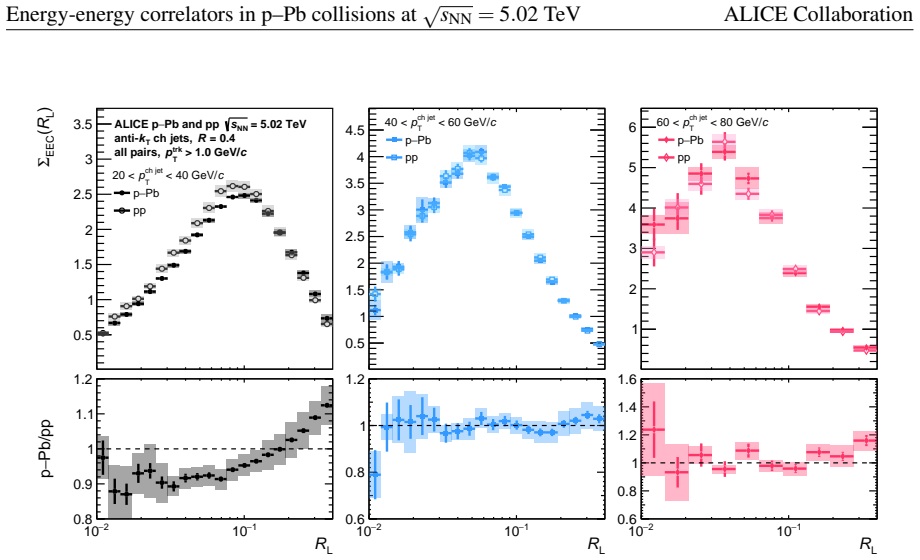
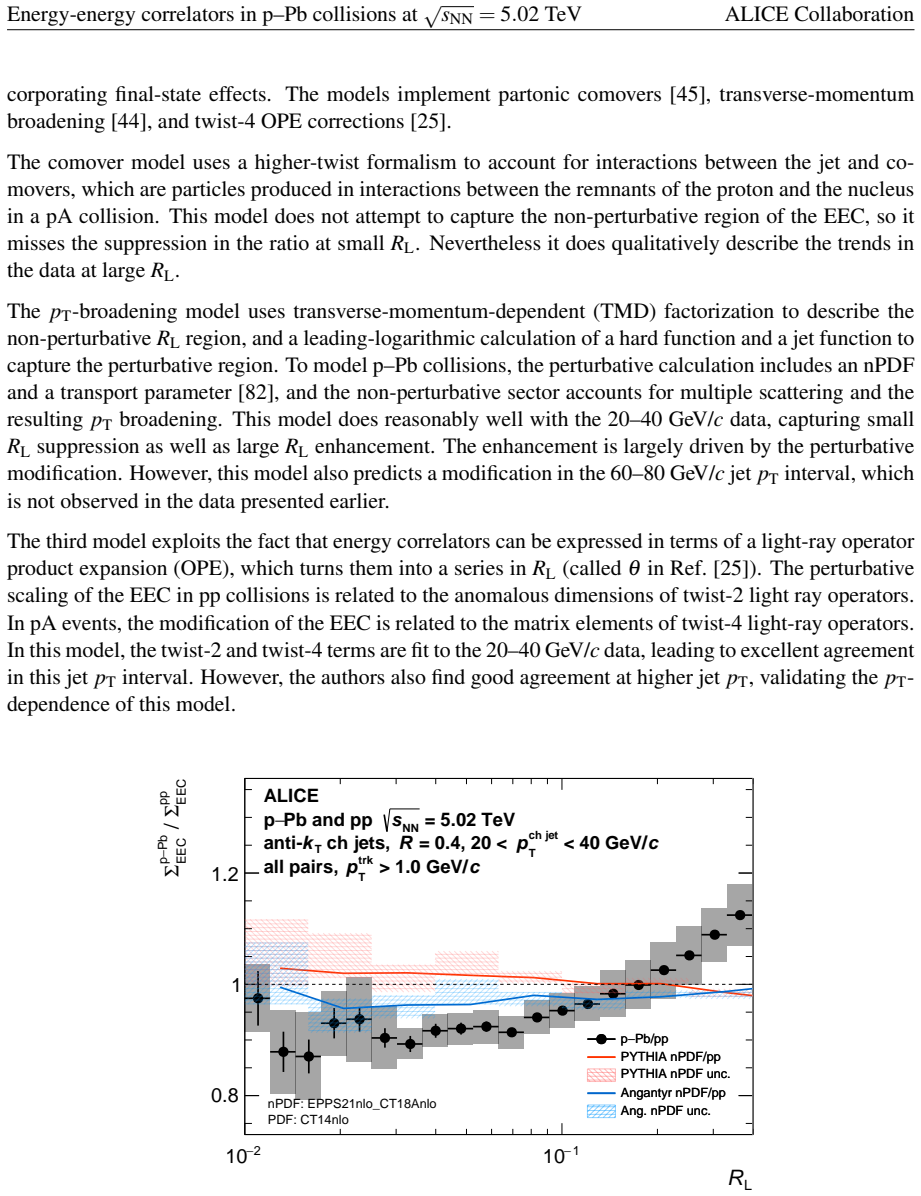
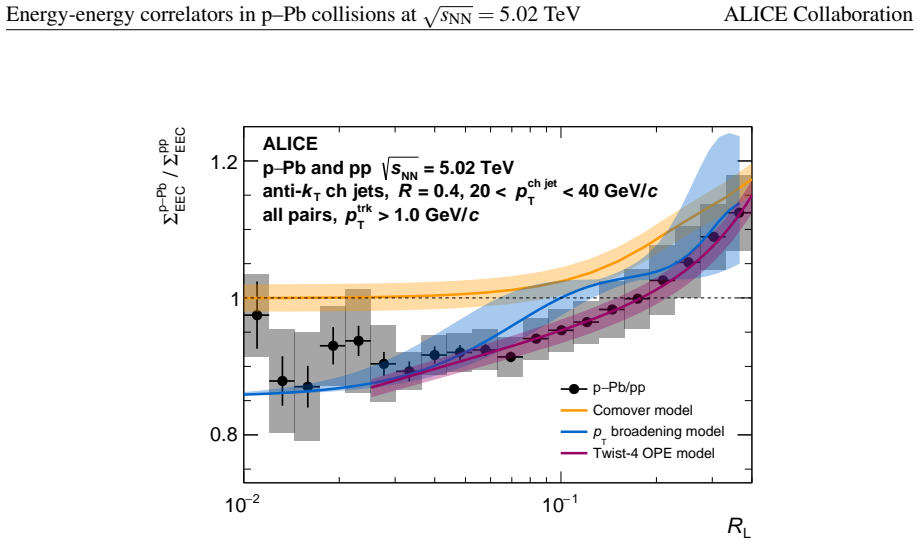
The two-point energy-energy correlator in p-Pb jets shows an enhancement at large angles and suppression at small angles relative to pp collisions in the 20-40 GeV/c range.
A machine-rendered reading of the paper's core claim, the machinery that carries it, and where it could break.
Core claim
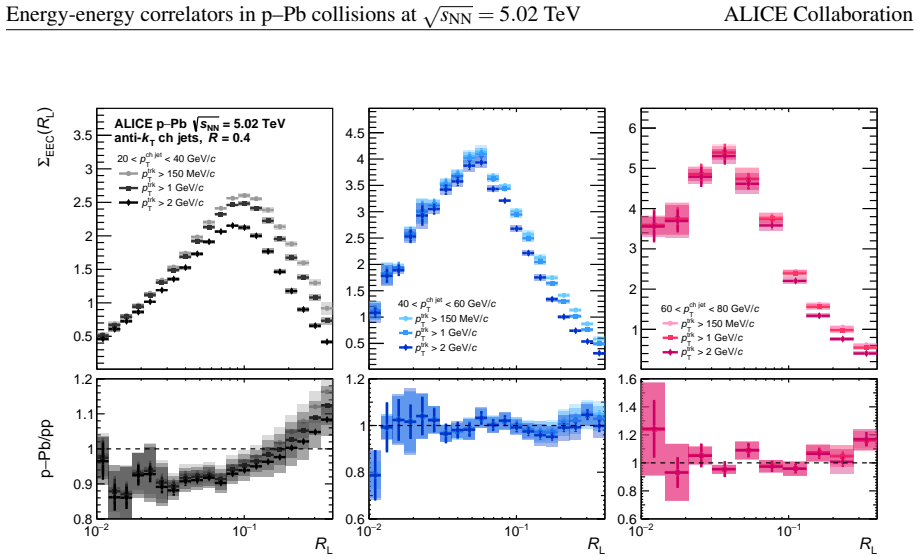
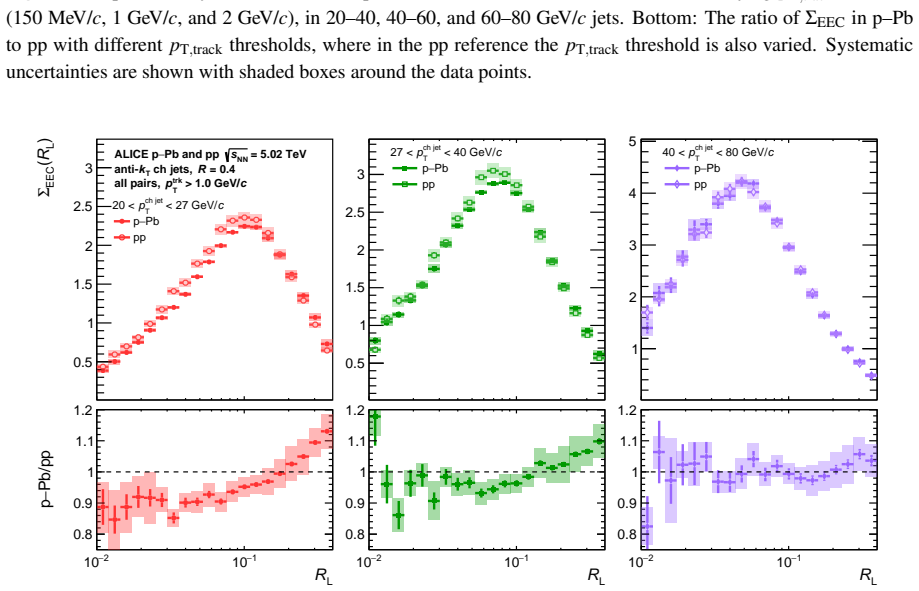
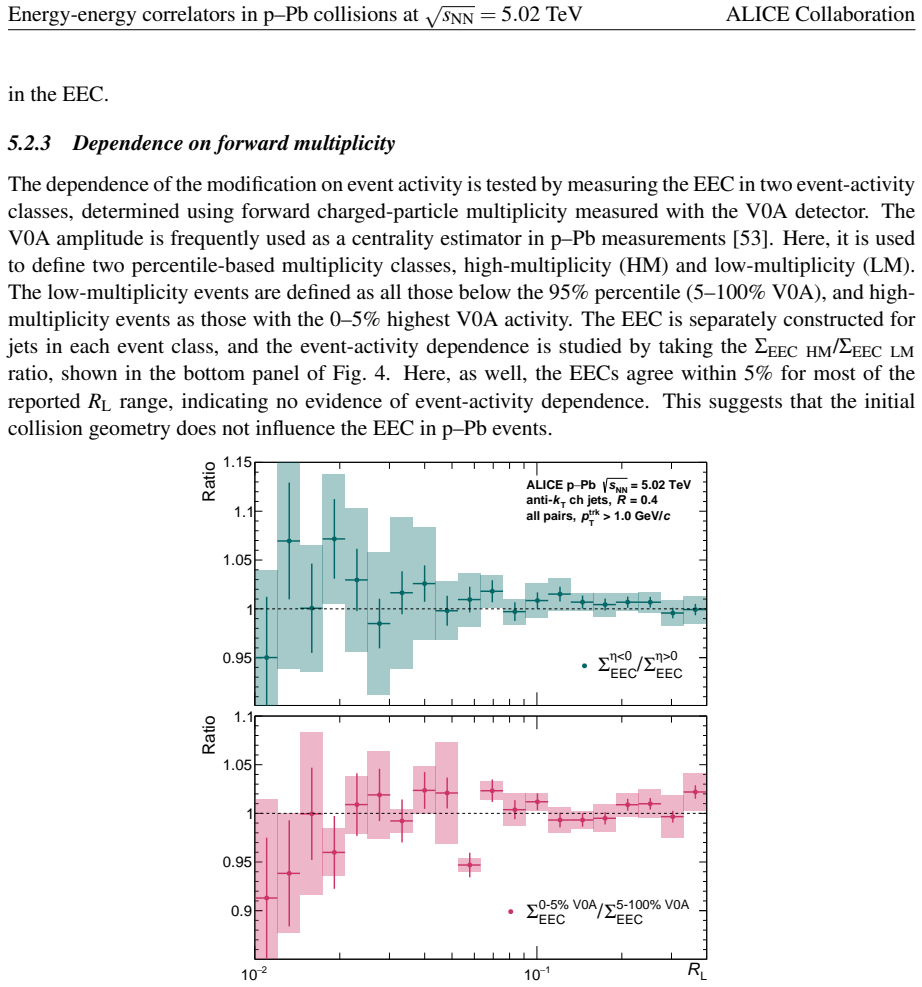
The two-point energy-energy correlator measured inside charged-particle jets in p-Pb collisions at √s_NN = 5.02 TeV exhibits a modification relative to pp collisions at the same energy, specifically in the 20-40 GeV/c jet transverse momentum interval, consisting of an enhancement at large opening angles and a suppression at small angles; this difference is studied as a function of jet pT, rapidity, and forward activity to constrain cold nuclear matter effects.
What carries the argument
The two-point energy-energy correlator (EEC), an infrared- and collinear-safe measure of angular energy flow within jets.
If this is right
- The observed modification depends on jet transverse momentum.
- The size of the difference also varies with jet rapidity and forward activity.
- The results supply new experimental constraints on cold nuclear matter effects in jet structure.
- These constraints are relevant for separating initial-state and final-state contributions when interpreting EEC data in heavy-ion collisions.
Where Pith is reading between the lines
- If the same angular pattern appears in other jet substructure observables, it would suggest a broad impact of cold nuclear matter on jet evolution.
- Measurements at different collision energies could test whether the modification scales with the available center-of-mass energy per nucleon.
- The rapidity and forward-activity dependence offers a handle to separate effects from the nuclear wave function versus final-state interactions.
Load-bearing premise
The pp reference at the same center-of-mass energy supplies an accurate baseline free of nuclear effects and all detector, reconstruction, and unfolding corrections have been applied identically in both systems.
What would settle it
A new or re-unfolded measurement of the EEC distributions in pp collisions at 5.02 TeV that agrees with the p-Pb distributions within uncertainties in the 20-40 GeV/c interval would falsify the reported modification.
Figures
read the original abstract
This paper presents the first measurement of the two-point energy-energy correlator (EEC) inside charged-particle jets in p-Pb collisions at $\sqrt{s_{\rm NN}} = 5.02$ TeV with the ALICE experiment. The two-point EEC, an infrared- and collinear-safe measure of angular energy flow within jets, is used to probe both perturbative and non-perturbative stages of the jet evolution. The EEC is reported in 20-80 GeV/$c$ jets in p-Pb collisions and compared to a measurement of the EEC in pp events at $\sqrt{s} = 5.02$ TeV. A modification is observed in the 20-40 GeV/$c$ interval, with an enhancement at large opening angles and a suppression at small angles relative to pp collisions. The dependence of this modification on jet transverse momentum, rapidity, and forward activity is investigated. These results provide new constraints on cold nuclear matter effects relevant for disentangling initial- and final-state contributions to jet-structure modifications. An understanding of these cold nuclear matter effects is also relevant for interpreting EEC measurements in heavy-ion collisions.
Editorial analysis
A structured set of objections, weighed in public.
Referee Report
Summary. The manuscript reports the first measurement of the two-point energy-energy correlator (EEC) inside charged-particle jets in p-Pb collisions at √s_NN = 5.02 TeV using the ALICE detector. The EEC is measured for jets in the 20-80 GeV/c range and compared to a pp reference at the same center-of-mass energy per nucleon, with a modification observed specifically in the 20-40 GeV/c interval (enhancement at large angles, suppression at small angles). Dependencies on jet p_T, rapidity, and forward activity are also examined to constrain cold-nuclear-matter effects.
Significance. If the reported difference is robust, the result supplies a valuable experimental baseline for cold-nuclear-matter modifications to jet substructure using an infrared- and collinear-safe observable. This is directly relevant for interpreting EEC measurements in heavy-ion collisions and for separating initial- from final-state effects. The direct comparison to a pp data set at matching √s is the conventional approach and avoids circularity.
minor comments (3)
- The abstract states that the pp reference is at √s = 5.02 TeV; the manuscript should explicitly confirm in the methods section that the identical jet-finding, track selection, and unfolding procedures were applied to both systems (as implied by the comparison).
- Figure captions and text should clarify the precise definition of the EEC observable (e.g., the normalization and the angular variable range) to allow direct comparison with future theoretical calculations.
- The dependence on forward activity is mentioned; a brief statement on how the centrality or multiplicity estimator is defined and whether it correlates with the observed modification would improve clarity.
Simulated Author's Rebuttal
We thank the referee for the positive assessment of our manuscript, the recognition of its significance as the first EEC measurement in p-Pb collisions, and the recommendation for minor revision. No major comments were raised in the report.
Circularity Check
No significant circularity
full rationale
This is a direct experimental measurement of the two-point energy-energy correlator in charged-particle jets in p-Pb collisions, compared to a separate pp reference dataset at matching per-nucleon energy. The reported modification is an observational result obtained via standard detector corrections, unfolding, and identical analysis procedures applied to both systems; no equations, ansatze, or fitted parameters are derived that reduce by construction to the inputs. The pp baseline is an independent measurement, not a self-referential fit. The derivation chain is therefore self-contained against external data benchmarks with no load-bearing self-citation loops or definitional circularity.
Axiom & Free-Parameter Ledger
Reference graph
Works this paper leans on
-
[1]
G. P. Salam, “Towards Jetography”,Eur . Phys. J. C67(2010) 637–686,arXiv:0906.1833 [hep-ph]
Pith/arXiv arXiv 2010
-
[2]
A. J. Larkoski, I. Moult, and B. Nachman, “Jet Substructure at the Large Hadron Collider: A Review of Recent Advances in Theory and Machine Learning”,Phys. Rept.841(2020) 1–63, arXiv:1709.04464 [hep-ph]
arXiv 2020
-
[3]
H. Chen, I. Moult, X. Zhang, and H. X. Zhu, “Rethinking jets with energy correlators: Tracks, 14 Energy-energy correlators in p–Pb collisions at √sNN =5.02 TeV ALICE Collaboration resummation, and analytic continuation”,Phys. Rev. D102(2020) 054012,arXiv:2004.11381 [hep-ph]
arXiv 2020
-
[4]
Analyzing N-Point Energy Correlators inside Jets with CMS Open Data
P. T. Komiske, I. Moult, J. Thaler, and H. X. Zhu, “Analyzing N-Point Energy Correlators inside Jets with CMS Open Data”,Phys. Rev. Lett.130(2023) 051901,arXiv:2201.07800 [hep-ph]
arXiv 2023
-
[5]
Conformal collider physics meets LHC data
K. Lee, B. Meçaj, and I. Moult, “Conformal collider physics meets LHC data”,Phys. Rev. D111 (2025) L011502,arXiv:2205.03414 [hep-ph]
arXiv 2025
-
[6]
Energy Correlations in Electron-Positron Annihilation: Testing Quantum Chromodynamics
C. L. Basham, L. S. Brown, S. D. Ellis, and S. T. Love, “Energy Correlations in Electron-Positron Annihilation: Testing Quantum Chromodynamics”,Phys. Rev. Lett.41(1978) 1585. [7]OPALCollaboration, P. Actonet al., “An improved measurement ofα S (M0 Z) using energy correlations with the OPAL detector at LEP”,Phys. Lett. B276(1992) 547–564. [8]OPALCollaborat...
1978
-
[7]
A. Kardos, S. Kluth, G. Somogyi, Z. Tulipánt, and A. Verbytskyi, “Precise determination of αS(MZ)from a global fit of energy–energy correlation to NNLO+NNLL predictions”,Eur . Phys. J. C78(2018) 498,arXiv:1804.09146 [hep-ph]
Pith/arXiv arXiv 2018
-
[8]
Towards a standard jet definition
D. Y . Grigoriev, E. Jankowski, and F. V . Tkachov, “Towards a standard jet definition”,Phys. Rev. Lett.91(2003) 061801,arXiv:hep-ph/0301185
Pith/arXiv arXiv 2003
-
[9]
N. A. Sveshnikov and F. V . Tkachov, “Jets and quantum field theory”,Phys. Lett. B382(1996) 403–408,arXiv:hep-ph/9512370
Pith/arXiv arXiv 1996
-
[10]
D. Y . Grigoriev, E. Jankowski, and F. V . Tkachov, “Optimal jet finder”,Comput. Phys. Commun. 155(2003) 42–64,arXiv:hep-ph/0301226
Pith/arXiv arXiv 2003
-
[11]
F. V . Tkachov, “A Theory of jet definition”,Int. J. Mod. Phys. A17(2002) 2783–2884, arXiv:hep-ph/9901444
Pith/arXiv arXiv 2002
-
[12]
Energy Correlators: A Journey From Theory to Experiment
I. Moult and H. X. Zhu, “Energy Correlators: A Journey From Theory to Experiment”, arXiv:2506.09119 [hep-ph]
-
[13]
NNLL resummation for projected three-point energy correlator
W. Chen, J. Gao, Y . Li, Z. Xu, X. Zhang, and H. X. Zhu, “NNLL resummation for projected three-point energy correlator”,JHEP05(2024) 043,arXiv:2307.07510 [hep-ph]
arXiv 2024
-
[14]
Resolving the Scales of the Quark-Gluon Plasma with Energy Correlators
C. Andres, F. Dominguez, R. Kunnawalkam Elayavalli, J. Holguin, C. Marquet, and I. Moult, “Resolving the Scales of the Quark-Gluon Plasma with Energy Correlators”,Phys. Rev. Lett.130 (2023) 262301,arXiv:2209.11236 [hep-ph]
arXiv 2023
-
[15]
A coherent view of the quark-gluon plasma from energy correlators
C. Andres, F. Dominguez, J. Holguin, C. Marquet, and I. Moult, “A coherent view of the quark-gluon plasma from energy correlators”,JHEP09(2023) 088,arXiv:2303.03413 [hep-ph]
arXiv 2023
-
[16]
Towards an interpretation of the first measurements of energy correlators in the quark-gluon plasma
C. Andres, F. Dominguez, J. Holguin, C. Marquet, and I. Moult, “Towards an interpretation of the first measurements of energy correlators in the quark-gluon plasma”,JHEP03(2025) 166, arXiv:2407.07936 [hep-ph]
arXiv 2025
-
[17]
Minimizing Selection Bias in Inclusive Jets in Heavy-Ion Collisions with Energy Correlators
C. Andres, J. Holguin, R. Kunnawalkam Elayavalli, and J. Viinikainen, “Minimizing Selection Bias in Inclusive Jets in Heavy-Ion Collisions with Energy Correlators”,Phys. Rev. Lett.134 (2025) 082303,arXiv:2409.07514 [hep-ph]. 15 Energy-energy correlators in p–Pb collisions at √sNN =5.02 TeV ALICE Collaboration
arXiv 2025
-
[18]
C. Andres and J. Holguin, “Minimizing Selection Bias in Inclusive Jets in Heavy-Ion Collisions with Energy Correlators – arXiv note”,arXiv:2409.07526 [hep-ph]
-
[19]
Advancing the understanding of energy-energy correlators in heavy-ion collisions
J. Barata, P. Caucal, A. Soto-Ontoso, and R. Szafron, “Advancing the understanding of energy-energy correlators in heavy-ion collisions”,JHEP11(2024) 60
2024
-
[20]
Picturing QCD jets in anisotropic matter: from jet shapes to energy energy correlators
J. Barata, J. Milhano, and A. V . Sadofyev, “Picturing QCD jets in anisotropic matter: from jet shapes to energy energy correlators”,Eur . Phys. J. C84(2024) 174,arXiv:2308.01294 [hep-ph]
arXiv 2024
-
[21]
Probing the Short-Distance Structure of the Quark-Gluon Plasma with Energy Correlators
Z. Yang, Y . He, I. Moult, and X.-N. Wang, “Probing the Short-Distance Structure of the Quark-Gluon Plasma with Energy Correlators”,Phys. Rev. Lett.132(2024) 011901, arXiv:2310.01500 [hep-ph]
arXiv 2024
-
[22]
Imaging the wakes of jets with energy-energy-energy correlators
H. Bossi, A. S. Kudinoor, I. Moult, D. Pablos, A. Rai, and K. Rajagopal, “Imaging the wakes of jets with energy-energy-energy correlators”,JHEP12(2024) 073,arXiv:2407.13818 [hep-ph]
arXiv 2024
-
[23]
Simple Scaling Laws for Energy Correlators in Nuclear Matter
C. Andres, F. Dominguez, J. Holguin, C. Marquet, and I. Moult, “Simple Scaling Laws for Energy Correlators in Nuclear Matter”,Phys. Rev. Lett.136(2026) 122301,arXiv:2411.15298 [hep-ph]
arXiv 2026
-
[24]
Dissecting Jet Modification in the QGP with Multi-Point Energy Correlators
J. Barata, I. Moult, A. V . Sadofyev, and J. M. Silva, “Dissecting Jet Modification in the QGP with Multi-Point Energy Correlators”,arXiv:2503.13603 [hep-ph]. [27]ALICECollaboration, S. Acharyaet al., “Exposing the parton-hadron transition within jets with energy-energy correlators in pp collisions at √s=5.02 TeV”,arXiv:2409.12687 [hep-ex]. [28]ATLASColla...
arXiv 2023
-
[25]
Jet measurements in heavy ion physics
M. Connors, C. Nattrass, R. Reed, and S. Salur, “Jet measurements in heavy ion physics”,Rev. Mod. Phys.90(2018) 025005,arXiv:1705.01974 [nucl-ex]
Pith/arXiv arXiv 2018
-
[26]
A Decade of Collectivity in Small Systems
J. F. Grosse-Oetringhaus and U. A. Wiedemann, “A Decade of Collectivity in Small Systems”, arXiv:2407.07484 [hep-ex]
-
[27]
Predictions for Cold Nuclear Matter Effects inp+Pb Collisions at√sNN =8.16 TeV
J. L. Albaceteet al., “Predictions for Cold Nuclear Matter Effects inp+Pb Collisions at√sNN =8.16 TeV”,Nucl. Phys. A972(2018) 18–85,arXiv:1707.09973 [hep-ph]. [35]ALICECollaboration, S. Acharyaet al., “The ALICE experiment: a journey through QCD”,Eur . Phys. J. C84(2024) 813,arXiv:2211.04384 [nucl-ex]. 16 Energy-energy correlators in p–Pb collisions at √s...
Pith/arXiv arXiv 2018
-
[28]
Energy-Energy Correlator for Jet Production in pp and pA Collisions
J. Barata, Z.-B. Kang, X. Mayo López, and J. Penttala, “Energy-Energy Correlator for Jet Production in pp and pA Collisions”,Phys. Rev. Lett.134(2025) 251903,arXiv:2411.11782 [hep-ph]
arXiv 2025
-
[29]
Modification of the Jet Energy-Energy Correlator in Cold Nuclear Matter
Y . Fu, B. Müller, and C. Sirimanna, “Modification of the Jet Energy-Energy Correlator in Cold Nuclear Matter”,Phys. Rev. Lett.135(2025) 112302,arXiv:2411.04866 [nucl-th]
arXiv 2025
-
[30]
Renormalization group evolution for in-medium energy correlators
W. Ke, B. Mecaj, and I. Vitev, “Renormalization group evolution for in-medium energy correlators”,JHEP04(2026) 155,arXiv:2512.11952 [hep-ph]. [47]ALICECollaboration, K. Aamodtet al., “Alignment of the ALICE Inner Tracking System with cosmic-ray tracks”,Journal of Instrumentation5(2010) P03003,arXiv:1001.0502 [physics.ins-det]
arXiv 2026
-
[31]
J. Almeet al., “The ALICE TPC, a large 3-dimensional tracking device with fast readout for ultra-high multiplicity events”,Nucl. Instrum. Meth. A622(2010) 316–367,arXiv:1001.1950 [physics.ins-det]. [49]ALICECollaboration, S. Acharyaet al., “Energy-energy correlators in charm-tagged jets in proton-proton collisions at √s=13TeV”,arXiv:2504.03431 [hep-ex]. [...
Pith/arXiv arXiv 2010
-
[32]
The anti-kt jet clustering algorithm
M. Cacciari, G. P. Salam, and G. Soyez, “The anti-kt jet clustering algorithm”,JHEP04(2008) 063,arXiv:0802.1189 [hep-ph]
Pith/arXiv arXiv 2008
-
[33]
M. Cacciari, G. P. Salam, and G. Soyez, “FastJet User Manual”,Eur . Phys. J. C72(2012) 1896, arXiv:1111.6097 [hep-ph]. [59]CMSCollaboration, S. Chatrchyanet al., “Measurement of the Underlying Event Activity inpp Collisions at √s=0.9 and 7 TeV with the Novel Jet-Area/Median Approach”,JHEP08(2012) 130,arXiv:1207.2392 [hep-ex]
Pith/arXiv arXiv 2012
-
[34]
Pileup subtraction using jet areas
M. Cacciari and G. P. Salam, “Pileup subtraction using jet areas”,Phys. Lett. B659(2008) 119–126,arXiv:0707.1378 [hep-ph]
Pith/arXiv arXiv 2008
-
[35]
M. Cacciari, G. P. Salam, and G. Soyez, “The Catchment Area of Jets”,JHEP04(2008) 005, arXiv:0802.1188 [hep-ph]
Pith/arXiv arXiv 2008
-
[36]
Jet Reconstruction in Heavy Ion Collisions
M. Cacciari, J. Rojo, G. P. Salam, and G. Soyez, “Jet Reconstruction in Heavy Ion Collisions”, Eur . Phys. J. C71(2011) 1539,arXiv:1010.1759 [hep-ph]. [63]ALICECollaboration, B. B. Abelevet al., “Charged jet cross sections and properties in proton-proton collisions at √s=7 TeV”,Phys. Rev. D91(2015) 112012,arXiv:1411.4969 [nucl-ex]. [64]ALICECollaboration,...
Pith/arXiv arXiv 2011
-
[37]
The Monte Carlo event generator DPMJET-III
S. Roesler, R. Engel, and J. Ranft, “The Monte Carlo event generator DPMJET-III”, in International Conference on Advanced Monte Carlo for Radiation Physics, Particle Transport Simulation and Applications (MC 2000), pp. 1033–1038. 12, 2000.arXiv:hep-ph/0012252
Pith/arXiv arXiv 2000
-
[38]
R. Brun, F. Bruyant, M. Maire, A. C. McPherson, and P. Zanarini,GEANT 3: user’s guide. CERN, Geneva, 1987.https://cds.cern.ch/record/1119728
arXiv 1987
-
[39]
Dual parton model
A. Capella, U. Sukhatme, C.-I. Tan, and J. Tran Thanh Van, “Dual parton model”,Phys. Rept.236 (1994) 225–329. 18 Energy-energy correlators in p–Pb collisions at √sNN =5.02 TeV ALICE Collaboration
1994
-
[40]
T. Sjöstrand, S. Ask, J. R. Christiansen, R. Corke, N. Desai, P. Ilten, S. Mrenna, S. Prestel, C. O. Rasmussen, and P. Z. Skands, “An introduction to PYTHIA 8.2”,Comput. Phys. Commun.191 (2015) 159–177,arXiv:1410.3012 [hep-ph]
Pith/arXiv arXiv 2015
-
[41]
Tuning PYTHIA 8.1: the Monash 2013 Tune
P. Skands, S. Carrazza, and J. Rojo, “Tuning PYTHIA 8.1: the Monash 2013 Tune”,Eur . Phys. J. C74(2014) 3024,arXiv:1404.5630 [hep-ph]. [71]ALICECollaboration, S. Acharyaet al., “Azimuthally-differential pion femtoscopy relative to the third harmonic event plane in Pb-Pb collisions at √sNN = 2.76 TeV”,Phys. Lett. B785(2018) 320–331,arXiv:1803.10594 [nucl-ex]
Pith/arXiv arXiv 2013
-
[42]
A Multidimensional unfolding method based on Bayes’ theorem
G. D’Agostini, “A Multidimensional unfolding method based on Bayes’ theorem”,Nucl. Instrum. Meth. A362(1995) 487–498
1995
-
[43]
Unfolding algorithms and tests using RooUnfold
T. Adye, “Unfolding algorithms and tests using RooUnfold”, inPHYSTAT 2011, pp. 313–318. CERN, Geneva, 2011.arXiv:1105.1160 [physics.data-an]. [74]ALICECollaboration, S. Acharyaet al., “Measurement of charged jet cross section inpp collisions at √s=5.02 TeV”,Phys. Rev. D100(2019) 092004,arXiv:1905.02536 [nucl-ex]
Pith/arXiv arXiv 2011
-
[44]
HIJING: A Monte Carlo model for multiple jet production in pp, pA and AA collisions
X.-N. Wang and M. Gyulassy, “HIJING: A Monte Carlo model for multiple jet production in pp, pA and AA collisions”,Phys. Rev. D44(1991) 3501–3516
1991
-
[45]
Herwig 7.0/Herwig++ 3.0 release note
J. Bellmet al., “Herwig 7.0/Herwig++ 3.0 release note”,Eur . Phys. J. C76(2016) 196, arXiv:1512.01178 [hep-ph]. [77]ALICECollaboration, B. Abelevet al., “Pseudorapidity density of charged particles inp+ Pb collisions at √sNN =5.02 TeV”,Phys. Rev. Lett.110(2013) 032301,arXiv:1210.3615 [nucl-ex]
Pith/arXiv arXiv 2016
-
[46]
LHAPDF6: parton density access in the LHC precision era
A. Buckley, J. Ferrando, S. Lloyd, K. Nordström, B. Page, M. Rüfenacht, M. Schönherr, and G. Watt, “LHAPDF6: parton density access in the LHC precision era”,Eur . Phys. J. C75(2015) 132,arXiv:1412.7420 [hep-ph]
Pith/arXiv arXiv 2015
-
[47]
New parton distribution functions from a global analysis of quantum chromodynamics
S. Dulat, T.-J. Hou, J. Gao, M. Guzzi, J. Huston, P. Nadolsky, J. Pumplin, C. Schmidt, D. Stump, and C. P. Yuan, “New parton distribution functions from a global analysis of quantum chromodynamics”,Phys. Rev. D93(2016) 033006,arXiv:1506.07443 [hep-ph]
Pith/arXiv arXiv 2016
-
[48]
EPPS21: a global QCD analysis of nuclear PDFs
K. J. Eskola, P. Paakkinen, H. Paukkunen, and C. A. Salgado, “EPPS21: a global QCD analysis of nuclear PDFs”,Eur . Phys. J. C82(2022) 413,arXiv:2112.12462 [hep-ph]
arXiv 2022
-
[49]
The Angantyr model for Heavy-Ion Collisions in PYTHIA8
C. Bierlich, G. Gustafson, L. Lönnblad, and H. Shah, “The Angantyr model for Heavy-Ion Collisions in PYTHIA8”,JHEP10(2018) 134,arXiv:1806.10820 [hep-ph]
Pith/arXiv arXiv 2018
-
[50]
Global extraction of the jet transport coefficient in cold nuclear matter
P. Ru, Z.-B. Kang, E. Wang, H. Xing, and B.-W. Zhang, “Global extraction of the jet transport coefficient in cold nuclear matter”,Phys. Rev. D103(2021) L031901,arXiv:1907.11808 [hep-ph]. 19 Energy-energy correlators in p–Pb collisions at √sNN =5.02 TeV ALICE Collaboration A The ALICE Collaboration D.A.H. Abdallah 134, I.J. Abualrob 112, S. Acharya 49, K. ...
arXiv 2021
discussion (0)
Sign in with ORCID, Apple, or X to comment. Anyone can read and Pith papers without signing in.