Closest Accessible Symmetry reduction: a tool for Hamiltonian interpolation analysis
Pith reviewed 2026-06-26 23:57 UTC · model grok-4.3
The pith
Closest Accessible Symmetry reduction projects interpolation Hamiltonians onto nearest symmetry sectors to capture quantum phase transition signatures without discretizing the path parameter.
A machine-rendered reading of the paper's core claim, the machinery that carries it, and where it could break.
Core claim
At each interpolation point the Hamiltonian is projected onto the sectors of the accessible symmetry that is closest to being satisfied, producing a hierarchy of weakly coupled pseudo-eigenspaces together with explicit residual couplings; this representation captures qualitative signatures of quantum phase transitions, supplies estimates of their location, and supplies insights into their nature.
What carries the argument
Closest Accessible Symmetry reduction, which selects the nearest certifiable reflection from a problem-class family and projects the interpolation Hamiltonian onto its symmetry sectors to generate weakly coupled pseudo-eigenspaces.
If this is right
- The method supplies estimates of quantum phase transition locations along the interpolation path.
- It identifies qualitative signatures and the character of those transitions through the sector structure.
- Explicit residual couplings between pseudo-eigenspaces quantify the mixing that occurs near transitions.
- The framework extends to any Hamiltonian phase diagram study that can be cast as an interpolation.
- The approximation quality is governed by the match between the accessible symmetry family and the instance.
Where Pith is reading between the lines
- The same projection technique could accelerate ground-state tracking in larger systems when combined with variational methods on the individual sectors.
- Models with known exact solutions offer direct benchmarks for how residual couplings scale with system size.
- Extending the family of accessible symmetries to include approximate rather than exact reflections might broaden applicability to disordered systems.
Load-bearing premise
The chosen family of accessible symmetries must be sufficiently compatible with the specific interpolation instance for the projected sectors to remain a useful approximation.
What would settle it
Apply the reduction to the transverse-field Ising chain interpolation using a parity symmetry family and check whether the predicted transition point in the parameter deviates from the known exact critical value.
Figures

read the original abstract
We introduce a framework for analysing the spectrum of Hamiltonian interpolations without heavily relying on discretising the interpolation parameter. The method is based on the concept of accessible symmetries: a problem-class-dependent family of certifiable reflections that induce bipartitions of the Hilbert space. At each step, the interpolation Hamiltonian is projected onto the sectors of the accessible symmetry that is closest to being satisfied, yielding a hierarchy of weakly coupled pseudo-eigenspaces together with explicit residual couplings between them. We show that this representation captures qualitative signatures of quantum phase transitions, provides estimates of their location, and offers insights into their nature. The quality of the approximation is controlled by the compatibility between the accessible symmetry family and the problem instance. Although motivated in spirit by adiabatic quantum computation, our approach applies more broadly to the study of Hamiltonian phase diagrams, providing a new perspective on the spectral reorganisation of many-body quantum systems.
Editorial analysis
A structured set of objections, weighed in public.
Referee Report
Summary. The paper introduces the Closest Accessible Symmetry (CAS) reduction framework for analyzing spectra of Hamiltonian interpolations without heavy discretization of the interpolation parameter. Accessible symmetries are defined as a problem-class-dependent family of certifiable reflections that bipartition the Hilbert space. At each interpolation step, the Hamiltonian is projected onto sectors of the closest accessible symmetry, producing a hierarchy of weakly coupled pseudo-eigenspaces together with explicit residual couplings. The authors claim this representation captures qualitative signatures of quantum phase transitions (QPTs), provides estimates of their locations, and offers insights into their nature, with approximation quality controlled by the compatibility between the accessible symmetry family and the problem instance. The approach is motivated by adiabatic quantum computation but applies more broadly to Hamiltonian phase diagrams.
Significance. If the central claims hold under the stated compatibility condition, the method supplies a new projection-based tool for spectral reorganization in many-body systems that avoids full diagonalization at every parameter value and yields explicit residual couplings. This could complement existing techniques for locating and characterizing QPTs in interpolated Hamiltonians. The manuscript does not report machine-checked proofs or reproducible code, but the explicit construction of residual couplings is a potential strength if demonstrated on concrete examples.
major comments (3)
- [Abstract and method description] Abstract, final sentence, and the description of the projection step: the central claim that the pseudo-eigenspace hierarchy reveals QPT signatures and locations is stated to hold only when the chosen accessible symmetry family is sufficiently compatible with the interpolated Hamiltonian. No general algorithm or verification procedure is supplied for constructing or certifying such a family for an arbitrary interpolation; this compatibility requirement is load-bearing for the method's claimed broad applicability beyond problem-specific insight.
- [Method section (projection and residual couplings)] The definition of 'closest accessible symmetry' and the projection onto its sectors: without a quantitative measure of closeness or a proof that the resulting residual couplings remain perturbative near a QPT, it is unclear whether the hierarchy reliably indicates transition points rather than artifacts of the chosen bipartition. This needs explicit bounds or counter-examples in the main text.
- [Results or examples section] No concrete examples, numerical benchmarks, or comparison against exact diagonalization or other QPT indicators (e.g., fidelity susceptibility) are referenced in the abstract; if the full manuscript contains such verification, it must be highlighted to substantiate the qualitative-signature claim.
minor comments (2)
- [Introduction/Method] Notation for the accessible symmetry family and the projection operator should be introduced with explicit equations rather than high-level description only.
- [Method] Clarify whether the method requires the family of reflections to be supplied by the user or whether an automated search is part of the framework.
Simulated Author's Rebuttal
We thank the referee for the constructive feedback. We address each major comment below, providing clarifications and indicating revisions to strengthen the manuscript where the points identify areas for improvement.
read point-by-point responses
-
Referee: [Abstract and method description] Abstract, final sentence, and the description of the projection step: the central claim that the pseudo-eigenspace hierarchy reveals QPT signatures and locations is stated to hold only when the chosen accessible symmetry family is sufficiently compatible with the interpolated Hamiltonian. No general algorithm or verification procedure is supplied for constructing or certifying such a family for an arbitrary interpolation; this compatibility requirement is load-bearing for the method's claimed broad applicability beyond problem-specific insight.
Authors: We agree that the central claims are conditioned on sufficient compatibility between the accessible symmetry family and the interpolated Hamiltonian; this is explicitly stated in the manuscript. The framework is intended for problem classes where such families can be identified from the problem structure (as in adiabatic quantum computation contexts), rather than supplying a universal construction algorithm for arbitrary interpolations. We will revise the abstract and method sections to emphasize this scope more clearly and remove any phrasing that could imply broader applicability without the compatibility condition. revision: yes
-
Referee: [Method section (projection and residual couplings)] The definition of 'closest accessible symmetry' and the projection onto its sectors: without a quantitative measure of closeness or a proof that the resulting residual couplings remain perturbative near a QPT, it is unclear whether the hierarchy reliably indicates transition points rather than artifacts of the chosen bipartition. This needs explicit bounds or counter-examples in the main text.
Authors: The definition of closeness is based on selecting the accessible symmetry (from the certifiable family) that minimizes the incompatibility with the current Hamiltonian at each interpolation step, with the projection and residual couplings then constructed explicitly. We acknowledge that the manuscript does not supply general quantitative bounds on the perturbative character of residuals near QPTs or a formal proof against artifacts. We will add a dedicated discussion subsection addressing this, including any available estimates from the explicit couplings and, where possible, illustrative counter-examples or limitations. revision: partial
-
Referee: [Results or examples section] No concrete examples, numerical benchmarks, or comparison against exact diagonalization or other QPT indicators (e.g., fidelity susceptibility) are referenced in the abstract; if the full manuscript contains such verification, it must be highlighted to substantiate the qualitative-signature claim.
Authors: The full manuscript contains concrete numerical examples on specific Hamiltonian interpolations demonstrating the capture of QPT signatures via the pseudo-eigenspace hierarchy, along with comparisons to exact results where feasible. These will be explicitly referenced and highlighted in a revised abstract and introduction to better support the claims. revision: yes
Circularity Check
No circularity: new projection framework with explicit compatibility assumption
full rationale
The abstract presents a projection onto sectors of closest accessible symmetries as a new analysis tool for Hamiltonian interpolations. The quality of the resulting pseudo-eigenspaces is explicitly stated to be controlled by compatibility between the chosen symmetry family and the instance; this is an input assumption rather than a derived claim. No equations, fitted parameters, self-citations, or self-definitional reductions are visible in the provided text. The claims about capturing QPT signatures are presented as demonstrations of the method, not as quantities forced by construction from the inputs. The derivation chain is therefore self-contained.
Axiom & Free-Parameter Ledger
axioms (1)
- domain assumption There exist problem-class-dependent families of certifiable reflections that induce bipartitions of the Hilbert space
invented entities (1)
-
accessible symmetries
no independent evidence
Reference graph
Works this paper leans on
-
[1]
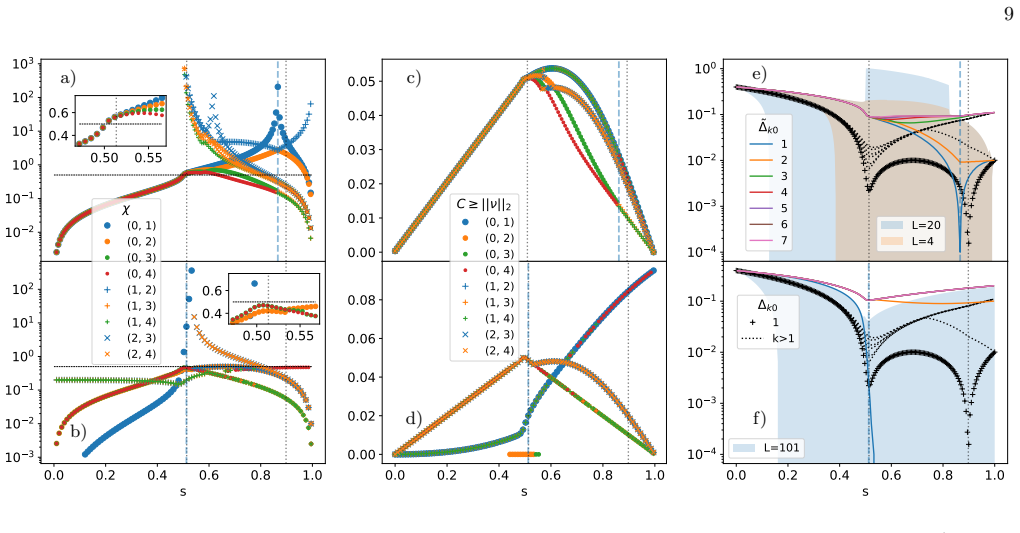
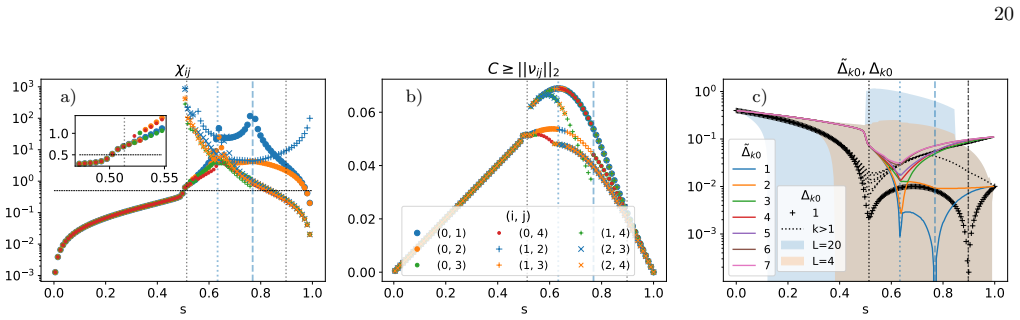
Bounds on the spectral gap The pseudo-spectrum ˜Λ ={µ ξ}is our raw approxima- tion of the true spectrum ofH(s), and from it we ob- tain a prediction ˜∆(s) of the instantaneous gap between ground and first excited states. This raw estimate is, of course, unreliable; for one, since the pseudo-levelsµ ξ are non-interacting (with the exception of their pair w...
-
[2]
original
Feature inheritance of the pseudo-spectrum In general, the bounds of Eqs. (26) and (30) to (32) will be rather loose, especially in the presence of clus- ters, leaving us unable to rule out gap closings. How- ever, can we still use the pseudo-eigenspectrum to learn something about their presence and, perhaps more inter- estingly, their nature? Let us firs...
-
[3]
thermalisation
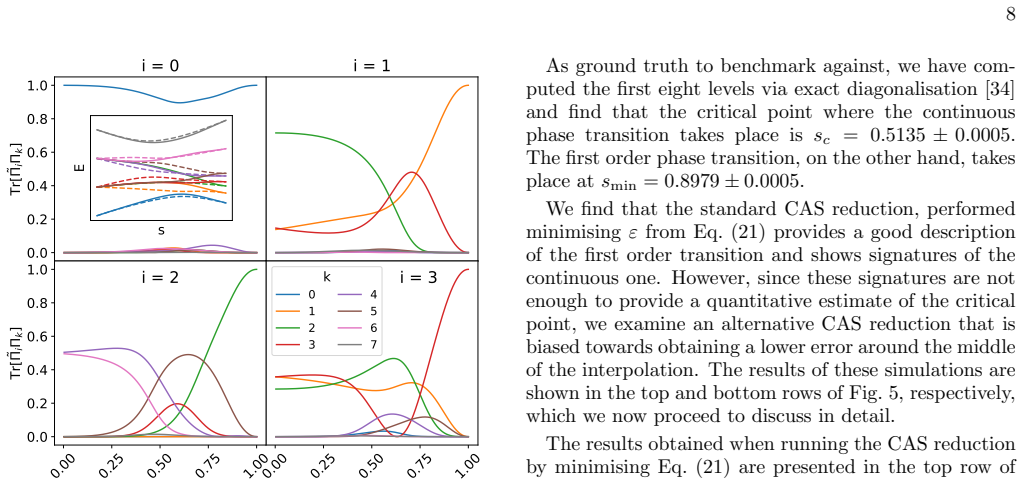
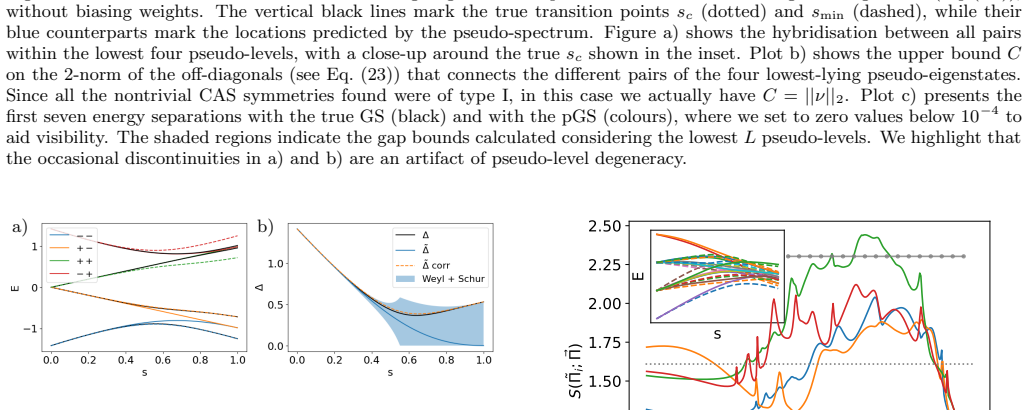
Numerical results We first illustrate our approach on a small instance where we can compute the pseudo-eigenspaces in order to provide a more complete picture of the approximation of the CAS reduction. Fig. 3 shows the instantaneous fideli- ties of the pseudo-eigenspaces with the true eigenspaces for a smallN= 3 random Ising problem. For this in- stance, ...
-
[4]
Thus, we haveχ 0k <1/2 and χ1k <1/2 for anyk >1
Proof of Eq.(26) We now proceed to derive the bounds in the base case of weak hybridisation where only two pseudo-levels are relevant to the gap. Thus, we haveχ 0k <1/2 and χ1k <1/2 for anyk >1. In this scenario, we can bound the error|∆(s)− ˜∆(s)|via the straight-forward appli- cation of Weyl’s inequalities, which are a standard tool in linear algebra (s...
-
[5]
Proof of Eqs.(30)and(31) We now consider the scenario corresponding to the excited-state cluster regime, where 0/∈κwithκdenoting the strongly hybridised connected component containing the first pseudo-level. The true interactions within the cluster are described by the matrixV int, (Vint)ij =⟨µ i|ν|µj⟩, i, j∈κ .(49) Since the entries ofV int are not effic...
-
[6]
In this case, the lower 13 bound is automatically fixed to 0, since we have no guar- antee that the gap doesn’t close
Proof of Eq.(32) We now consider that the lowest-lying hybridised clus- terκcontains the pGS, i.e., 0∈κ. In this case, the lower 13 bound is automatically fixed to 0, since we have no guar- antee that the gap doesn’t close. For the upper bound we could still apply Weyl directly, but since||v int||2 is extensive in cluster size this will provide very unrea...
-
[7]
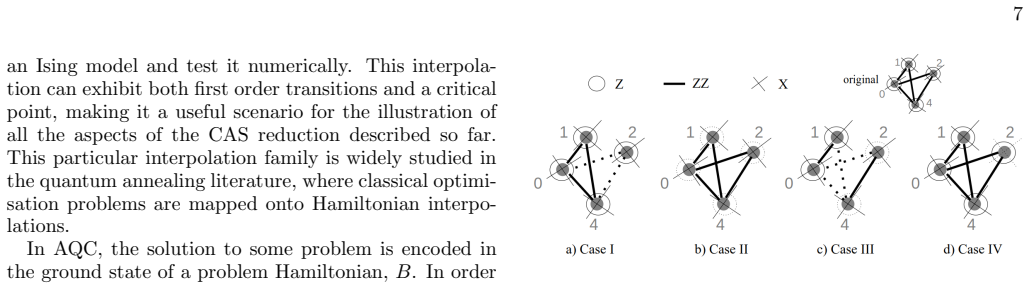
Case I: remove all couplings to a single qubit If we disconnect thek-th qubit from the rest, the re- sulting symmetry is the operator along the remaining local field in the now isolated qubit. The explicit shape of the CAS is thus TI =(cosφX k + sinφZ k) = (64) = (1−s)h x kp ((1−s)h x k)2 + (shz k)2 Xk+ + shz kp ((1−s)h x k)2 + (shz k)2 Zk (65) where cosφ...
-
[8]
Case II: remove allz-fields When coupling energies dominate, we can have the case where removing all single-qubit terms inzis the cheapest option with respect to the costεin Eq. (21), which then endowsH(s) with a symmetryT II in the pro- jected CAS basis TII = N−1Y i=0 Xi (76) that renders off-diagonal contributions MA = 0,(77) MB = N−1X i=0 hz i Zi .(78)...
-
[9]
Case III: remove somez-fields and some couplings As an extension of case II, we can consider symmetries of the typeT III, with shape TIII = Y i̸=M Xi ,(82) where the excluded variables belong to the setM= {pk}m−1 k=0 for 1< m < N−2. This CAS type corresponds to the case in which we can split the problem graph into two complementary sets of variables which...
-
[10]
Case IV: remove a single x-field on some qubit The last way to induce aZ2 symmetry is a rather trivial one: if we remove thex-component to some qubitk, we will eliminate its dynamics. Thus, the CAST IV is simply TIV =Z k ,(89) which induces off-diagonal parts MA =h x kXk ,(90) MB = 0,(91) and corresponding identity contributions IA = 0,(92) IB =h z k .(93...
-
[11]
+” and “−
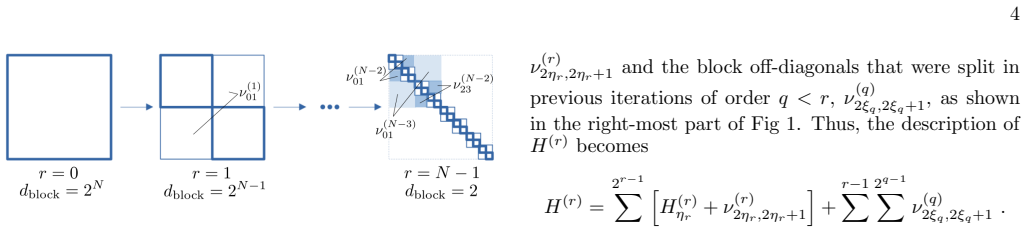
Complexity of the recursive CAS reduction We now analyse the time and memory complexity of this specific CAS reduction pipeline in detail. Gathering the information of the sections above, the brute-force search for the CAS at a given recursion order rtakes time ζbf(r) = (N−r) + 2 + (N−r)/2X m=2 N−r m ,(96) which is reduced to ζ(r) = (N−r) + 2 +O((N−r) 3) ...
-
[12]
Born and V
M. Born and V. Fock, Beweis des Adiabatensatzes, Zeitschrift f¨ ur Physik51, 165 (1928)
1928
-
[13]
T. Kato, On the Adiabatic Theorem of Quantum Me- chanics, Journal of the Physical Society of Japan5, 435 (1950), eprint: https://doi.org/10.1143/JPSJ.5.435
-
[14]
Bounds for the adiabatic approximation with applications to quantum computation
S. Jansen, M.-B. Ruskai, and R. Seiler, Bounds for the adiabatic approximation with applications to quan- tum computation, Journal of Mathematical Physics48, 102111 (2007), arXiv: quant-ph/0603175
work page internal anchor Pith review Pith/arXiv arXiv 2007
-
[15]
Comparat, General conditions for quantum adiabatic evolution, Phys
D. Comparat, General conditions for quantum adiabatic evolution, Phys. Rev. A80, 012106 (2009)
2009
-
[16]
M. H. S. Amin, Consistency of the Adiabatic Theorem, Physical Review Letters102, 220401 (2009)
2009
-
[17]
Bachmann, W
S. Bachmann, W. De Roeck, and M. Fraas, Adiabatic theorem for quantum spin systems, Phys. Rev. Lett.119, 060201 (2017)
2017
-
[18]
Albash and D
T. Albash and D. A. Lidar, Adiabatic quantum compu- tation, Reviews of Modern Physics90, 015002 (2018). 17
2018
-
[19]
S. R. White, Density-matrix algorithms for quantum renormalization groups, Phys. Rev. B48, 10345 (1993)
1993
-
[20]
Verstraete, D
F. Verstraete, D. Porras, and J. I. Cirac, Density matrix renormalization group and periodic boundary conditions: A quantum information perspective, Phys. Rev. Lett.93, 227205 (2004)
2004
-
[21]
Paeckel, T
S. Paeckel, T. K¨ ohler, A. Swoboda, S. R. Manmana, U. Schollw¨ ock, and C. Hubig, Time-evolution meth- ods for matrix-product states, Ann. Phys. (N. Y.)411, 167998 (2019)
2019
-
[22]
J. I. Cirac, D. P´ erez-Garc´ ıa, N. Schuch, and F. Ver- straete, Matrix product states and projected entangled pair states: Concepts, symmetries, theorems, Rev. Mod. Phys.93, 045003 (2021)
2021
-
[23]
Z.-Y. Wei, D. Malz, and J. I. Cirac, Efficient adiabatic preparation of tensor network states, Phys. Rev. Res.5, L022037 (2023)
2023
-
[24]
Zanardi and N
P. Zanardi and N. Paunkovi´ c, Ground state overlap and quantum phase transitions, Physical Review E74, 031123 (2006)
2006
-
[25]
Zanardi, P
P. Zanardi, P. Giorda, and M. Cozzini, Information- Theoretic Differential Geometry of Quantum Phase Transitions, Physical Review Letters99, 100603 (2007)
2007
-
[26]
A. T. Rezakhani, D. F. Abasto, D. A. Lidar, and P. Za- nardi, Intrinsic geometry of quantum adiabatic evolution and quantum phase transitions, Physical Review A82, 012321 (2010)
2010
-
[27]
Kumar, S
P. Kumar, S. Mahapatra, P. Phukon, and T. Sarkar, Geodesics in information geometry: Classical and quan- tum phase transitions, Physical Review E86, 051117 (2012)
2012
-
[28]
Jansen, D
D. Jansen, D. Farina, L. Mortimer, T. Heightman, A. Lei- therer, P. Mujal, J. Wang, and A. Ac´ ın, Mapping phase diagrams of quantum spin systems through semidefinite- programming relaxations, Phys. Rev. Lett.136, 050401 (2026)
2026
-
[29]
J. R. Schrieffer and P. A. Wolff, Relation between the anderson and kondo hamiltonians, Phys. Rev.149, 491 (1966)
1966
-
[30]
Bravyi, D
S. Bravyi, D. P. DiVincenzo, and D. Loss, Schrieffer– Wolff transformation for quantum many-body systems, Ann. Phys. (N. Y.)326, 2793 (2011)
2011
-
[31]
Kondor, N
R. Kondor, N. Teneva, and V. Garg, Multiresolution ma- trix factorization, inProceedings of the 31st International Conference on Machine Learning, Proceedings of Ma- chine Learning Research, Vol. 32, edited by E. P. Xing and T. Jebara (PMLR, Bejing, China, 2014) pp. 1620– 1628
2014
-
[32]
J. L. Cardy,Scaling and renormalization in statistical physics(Cambridge University Press, Cambridge, Eng- land, 1996)
1996
-
[33]
D. S. Fisher, Critical behavior of random transverse-field ising spin chains, Phys. Rev. B51, 6411 (1995)
1995
-
[34]
D’Alessandro,Introduction to Quantum Control and Dynamics, 2nd ed
D. D’Alessandro,Introduction to Quantum Control and Dynamics, 2nd ed. (Chapman and Hall/CRC, Boca Ra- ton, 2021)
2021
-
[35]
Larocca, P
M. Larocca, P. Czarnik, K. Sharma, G. Muraleedharan, P. J. Coles, and M. Cerezo, Diagnosing Barren Plateaus with Tools from Quantum Optimal Control, Quantum6, 824 (2022)
2022
-
[36]
Fontana, D
E. Fontana, D. Herman, S. Chakrabarti, N. Kumar, R. Yalovetzky, J. Heredge, S. H. Sureshbabu, and M. Pis- toia, Characterizing barren plateaus in quantum ans¨ atze with the adjoint representation, Nature Communications 15, 7171 (2024)
2024
-
[37]
Ragone, B
M. Ragone, B. N. Bakalov, F. Sauvage, A. F. Kemper, C. Ortiz Marrero, M. Larocca, and M. Cerezo, A lie al- gebraic theory of barren plateaus for deep parameter- ized quantum circuits, Nature Communications15, 7172 (2024)
2024
-
[38]
M. L. Goh, M. Larocca, L. Cincio, M. Cerezo, and F. Sauvage, Lie-algebraic classical simulations for quan- tum computing, Phys. Rev. Res.7, 033266 (2025)
2025
-
[39]
Wiersema, E
R. Wiersema, E. K¨ okc¨ u, A. F. Kemper, and B. N. Bakalov, Classification of dynamical Lie algebras of 2- local spin systems on linear, circular and fully connected topologies, npj Quantum Information10, 110 (2024)
2024
-
[40]
E. Kokcu, R. Wiersema, A. F. Kemper, and B. N. Bakalov, Classification of dynamical Lie algebras gener- ated by spin interactions on undirected graphs, arXiv.org (2024), arXiv:2409.19797v1
-
[41]
G. Aguilar, S. Cichy, J. Eisert, and L. Bittel, Full classification of pauli lie algebras, arXiv.org (2024), arxiv:2408.00081
-
[42]
Bhatia,Matrix Analysis, Graduate Texts in Mathe- matics, Vol
R. Bhatia,Matrix Analysis, Graduate Texts in Mathe- matics, Vol. 169 (Springer, New York, NY, 1997)
1997
-
[43]
Zhang, ed.,The schur complement and its applica- tions, 2005th ed., Numerical Methods and Algorithms (Springer, New York, NY, 2005)
F. Zhang, ed.,The schur complement and its applica- tions, 2005th ed., Numerical Methods and Algorithms (Springer, New York, NY, 2005)
2005
-
[44]
Griesemer and D
M. Griesemer and D. Hasler, On the smooth feshbach– schur map, J. Funct. Anal.254, 2329 (2008)
2008
-
[45]
Roberts, L
D. Roberts, L. Cincio, A. Saxena, A. Petukhov, and S. Knysh, Noise amplification at spin-glass bottlenecks of quantum annealing: A solvable model, Physical Re- view A101, 042317 (2020)
2020
-
[46]
Kato,Perturbation Theory for Linear Operators, Clas- sics in Mathematics, Vol
T. Kato,Perturbation Theory for Linear Operators, Clas- sics in Mathematics, Vol. 132 (Springer, Berlin, Heidel- berg, 1995)
1995
-
[47]
Fujii, K
T. Fujii, K. Komuro, Y. Okudaira, and M. Sawada, Eigenvalue-Invariant Transformation of Ising Problem for Anti-Crossing Mitigation in Quantum Annealing, Jour- nal of the Physical Society of Japan92, 044001 (2023)
2023
-
[48]
Palacios, A
A. Palacios, A. Garcia-Saez, B. Juli´ a-D´ ıaz, and M. P. Estarellas, Scalable 2-local architecture for quantum an- nealing of Ising models with arbitrary dimensions, Phys- ical Review Applied23, 054070 (2025)
2025
-
[49]
Ahuja, T
R. Ahuja, T. Magnanti, and J. Orlin,Network flows : the- ory, algorithms, and applications(Pearson, Upper Saddle River, NJ, 1993)
1993
-
[50]
J. B. Orlin, Max flows in o(nm) time, or better, in Proceedings of the Forty-Fifth Annual ACM Symposium on Theory of Computing, STOC ’13 (Association for Computing Machinery, New York, NY, USA, 2013) p. 765–774
2013
-
[51]
D. P. Kingma and J. Ba, Adam: A Method for Stochastic Optimization, inInternational Conference on Learning Representations(2015). Appendix A: Simultaneous Hamiltonian compression in Pauli space In this section we discuss an additional step in the CAS set construction for the general case where the eigenbases ofAandBare not mutually orthogonal in projectiv...
2015
discussion (0)
Sign in with ORCID, Apple, or X to comment. Anyone can read and Pith papers without signing in.