Dynamical properties of ab initio water from machine-learning potentials
Pith reviewed 2026-06-26 22:15 UTC · model grok-4.3
The pith
RPBE-D3/zd density functional matches experimental water diffusion, viscosity, and relaxation times most closely when used with machine-learning potentials.
A machine-rendered reading of the paper's core claim, the machinery that carries it, and where it could break.
Core claim
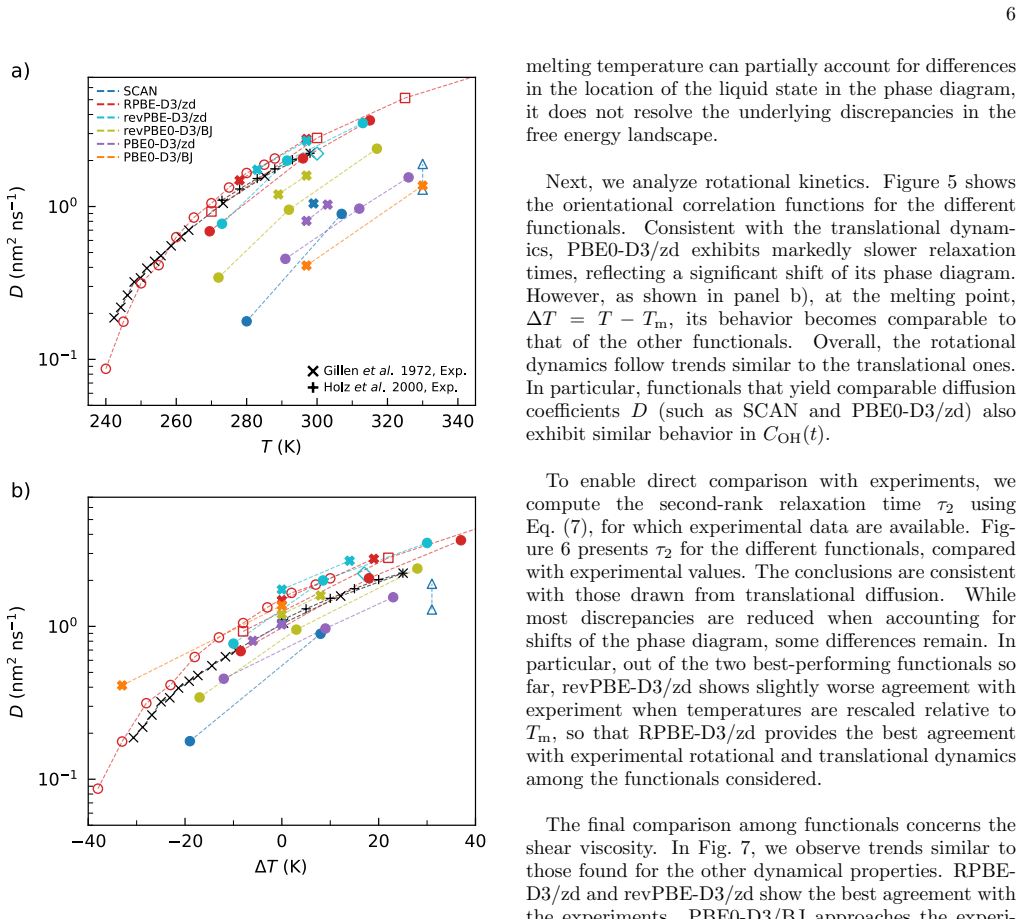
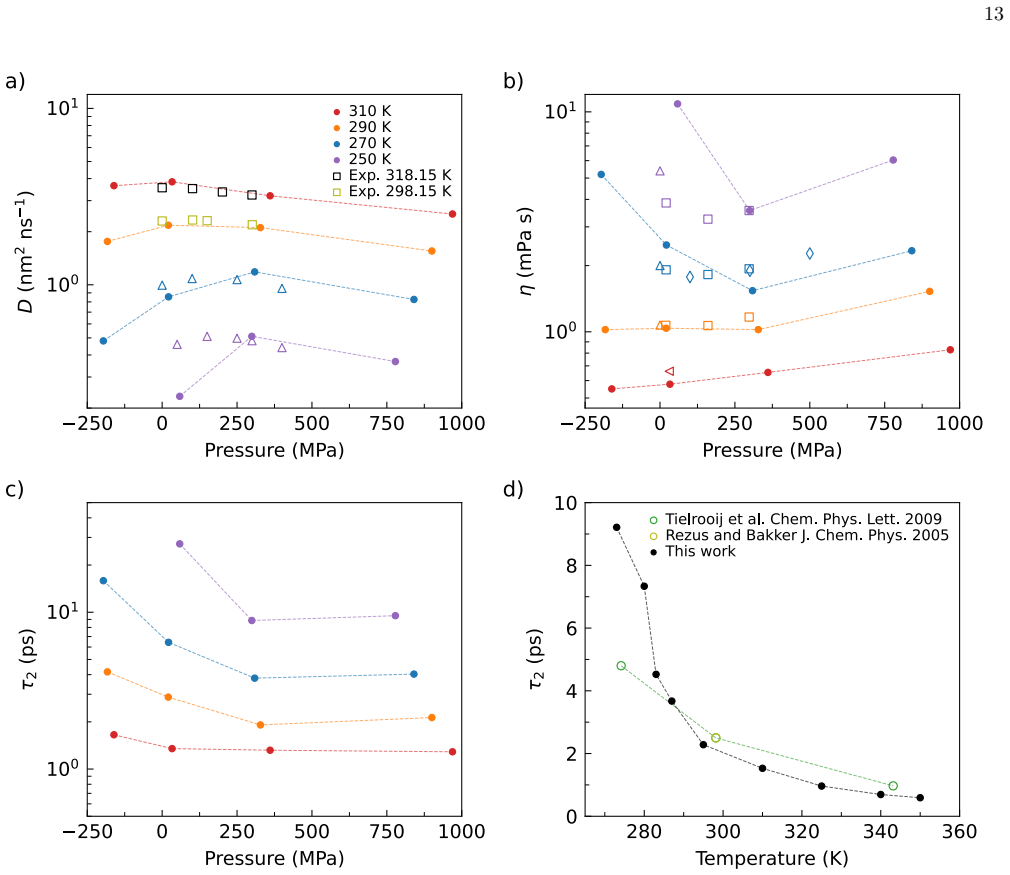
Among the functionals considered, RPBE-D3/zd provides the best overall agreement with experiment. The Behler-Parrinello neural-network potential with this functional reproduces the magnitude and anomalous pressure dependence of the diffusion coefficient, gives generally good viscosities, and captures the temperature dependence of the rotational relaxation time.
What carries the argument
Machine-learning interatomic potentials (MACE and Behler-Parrinello) trained on ab initio molecular dynamics trajectories from different density functionals, used to evaluate time-correlation functions and long-time kinetic coefficients for dynamics.
If this is right
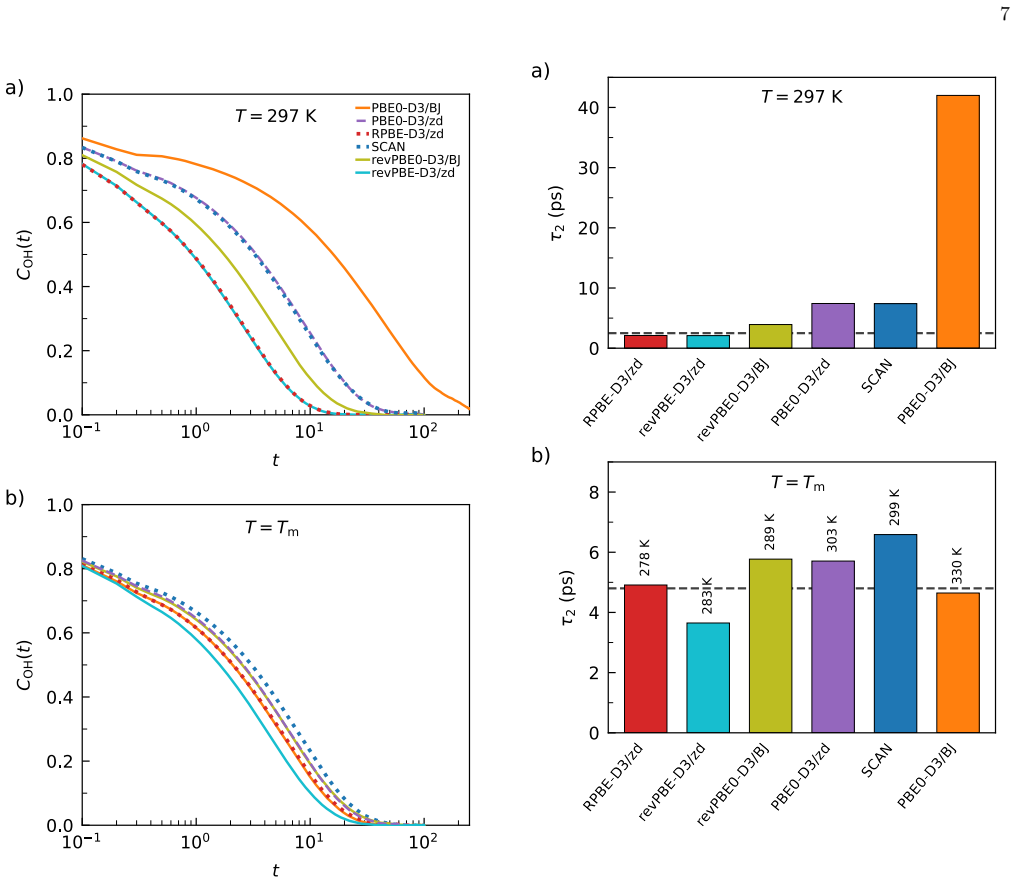
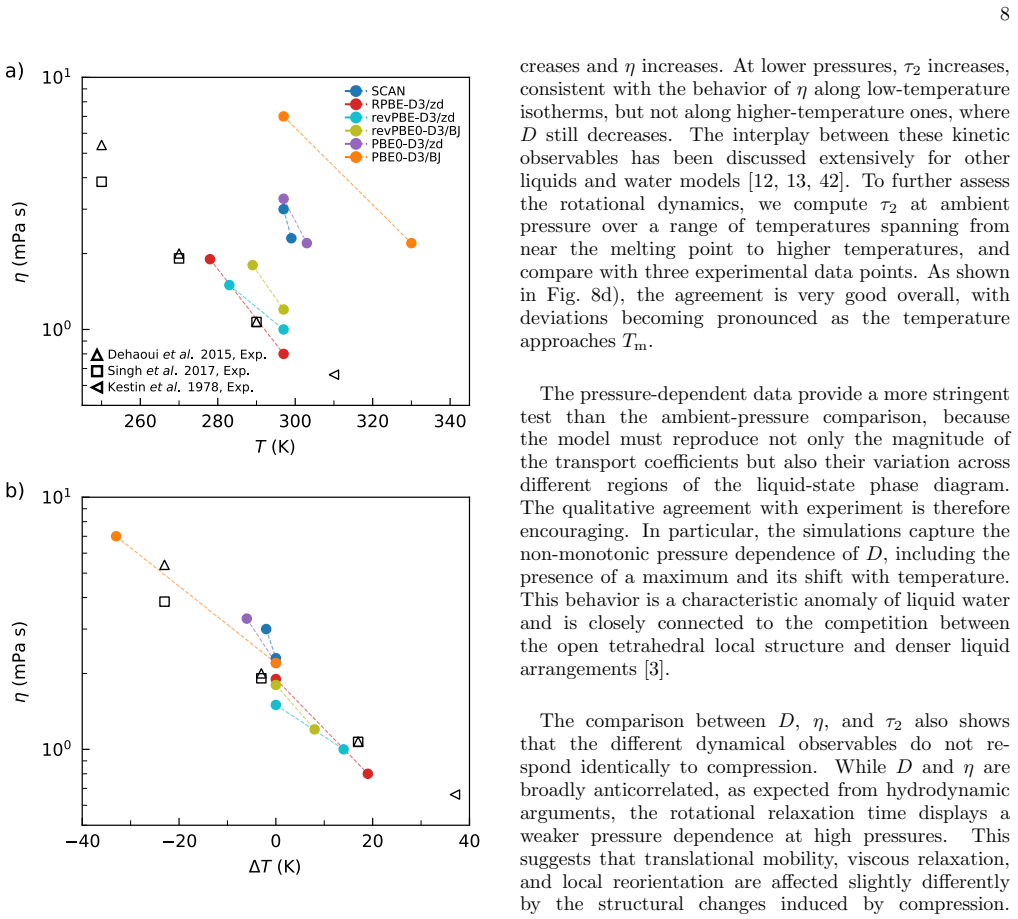
- Differences in dynamical observables among functionals partly reflect shifts along the phase diagram, as relative comparisons to each functional's melting temperature reduce the spread.
- The diffusion coefficient, second-rank orientational relaxation time, and shear viscosity exhibit systematic differences across the tested functionals.
- A Behler-Parrinello potential trained on RPBE-D3/zd data enables validation of dynamical properties over wide ranges of temperature, density, and pressure.
Where Pith is reading between the lines
- The approach could be extended to test whether the same functional ordering holds for other transport properties such as thermal conductivity.
- If the melting-temperature normalization generalizes, it might simplify functional selection for other liquids by focusing on relative rather than absolute temperatures.
- The anomalous pressure dependence of diffusion captured here suggests the model could be used to explore water behavior in high-pressure regimes without direct ab initio cost.
Load-bearing premise
The machine-learning potentials reproduce the dynamical properties of the underlying ab initio simulations without significant loss of accuracy in transport coefficients.
What would settle it
An ab initio molecular dynamics run at a state point where the Behler-Parrinello RPBE-D3/zd model predicts a specific diffusion coefficient value would need to match that value within statistical error to confirm the claim.
Figures
read the original abstract
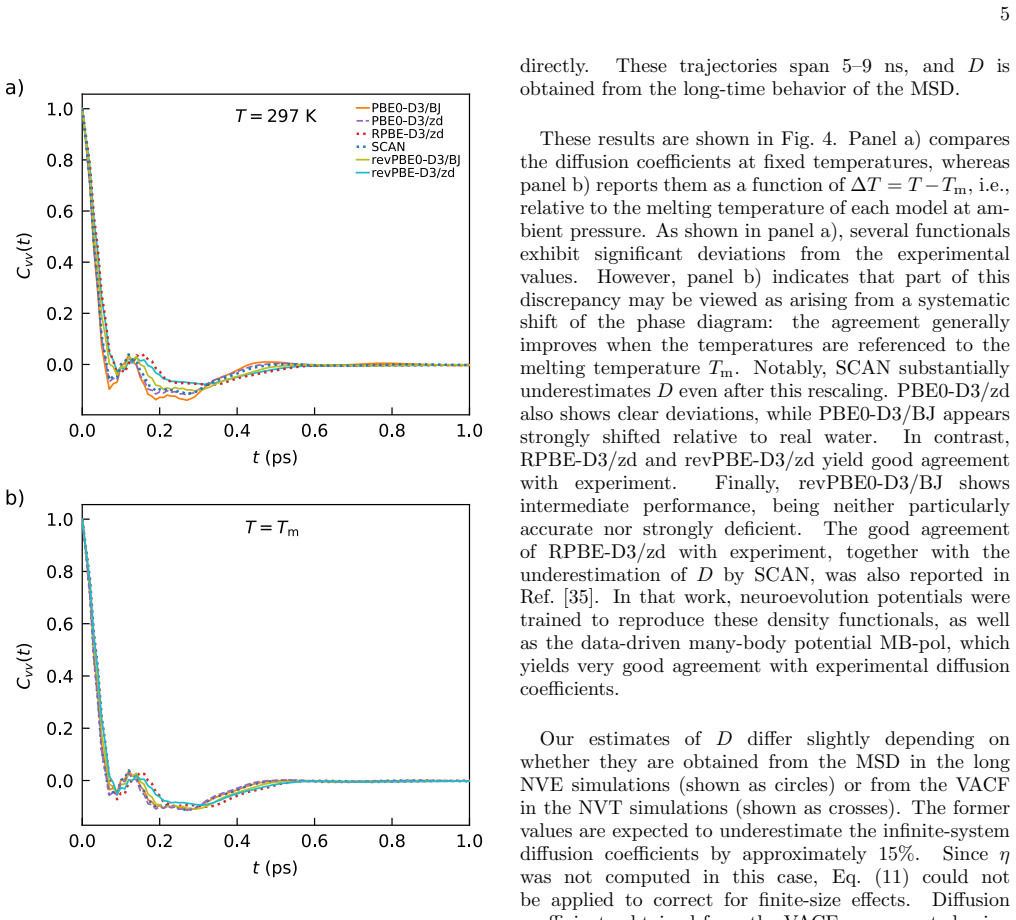
We assess the dynamical properties of liquid water predicted by several density functionals using machine-learning interatomic potentials. MACE models were trained for SCAN, RPBE-D3/zd, revPBE-D3/zd, revPBE0-D3/BJ, PBE0-D3/zd, and PBE0-D3/BJ using previously reported ab initio datasets. We compare translational, rotational, and viscous dynamics through time-correlation functions, which resolve relaxation processes across different timescales, and through the corresponding long-time kinetic coefficients. The diffusion coefficient, second-rank orientational relaxation time, and shear viscosity reveal systematic differences among functionals. Part of these differences can be rationalized as shifts along the phase diagram, as comparisons relative to each functionals melting temperature reduce the spread in the dynamical observables. Among the functionals considered, RPBE-D3/zd provides the best overall agreement with experiment. We therefore perform a broader validation of RPBE-D3/zd using a Behler--Parrinello neural-network potential over a wide range of temperatures, densities, and pressures. The model reproduces the magnitude and anomalous pressure dependence of the diffusion coefficient, gives generally good viscosities, and captures the temperature dependence of the rotational relaxation time.
Editorial analysis
A structured set of objections, weighed in public.
Referee Report
Summary. The manuscript evaluates dynamical properties of liquid water (diffusion coefficient, shear viscosity, second-rank orientational relaxation time) predicted by several density functionals via machine-learning interatomic potentials. MACE models are trained on existing AIMD datasets for SCAN, RPBE-D3/zd, revPBE-D3/zd, revPBE0-D3/BJ, PBE0-D3/zd, and PBE0-D3/BJ; a Behler-Parrinello neural-network potential is then trained and validated more broadly for the best-performing functional (RPBE-D3/zd). The central claim is that RPBE-D3/zd yields the best overall agreement with experiment, that differences among functionals can be partly rationalized by shifts relative to each functional's melting temperature, and that the Behler-Parrinello model faithfully reproduces the magnitude, anomalous pressure dependence, and temperature trends of the dynamical observables.
Significance. If the results hold, the work is significant for computational studies of water because it supplies a systematic, dynamics-focused ranking of common functionals and demonstrates that ML potentials can extend AIMD trajectories to transport coefficients without introducing detectable fitting artifacts. The explicit validation of the Behler-Parrinello potential against the underlying AIMD data for RPBE-D3/zd, together with the reproduction of experimental pressure and temperature trends, strengthens the practical utility of the recommended model.
minor comments (2)
- [Abstract and melting-temperature section] The abstract and § on melting-temperature comparisons would benefit from a brief statement of how the melting temperatures themselves were obtained (independent calculation or same ML potential) to clarify whether the adjustment is purely descriptive.
- [Figures showing time-correlation functions] Figure captions for the time-correlation functions should explicitly note the number of independent trajectories and total sampling time used to compute the long-time limits of the diffusion, viscosity, and relaxation coefficients.
Simulated Author's Rebuttal
We thank the referee for the positive assessment of our manuscript and the recommendation to accept. We appreciate the recognition of the work's significance in providing a dynamics-focused comparison of density functionals for water and in validating the utility of ML potentials for transport properties.
Circularity Check
No significant circularity; dynamical results are independent of fitted targets
full rationale
The paper trains MACE and Behler-Parrinello neural-network potentials on existing ab initio datasets (energies/forces from AIMD with various functionals) and then computes dynamical observables (diffusion, viscosity, orientational relaxation) from long trajectories generated with those potentials. These computed coefficients are compared directly to independent experimental data; the training targets are microscopic forces, not the macroscopic transport coefficients. No self-citation chain, fitted-input-as-prediction, or self-definitional step is present in the reported workflow. The central claim therefore rests on external benchmarks rather than reducing to its own inputs by construction.
Axiom & Free-Parameter Ledger
axioms (1)
- standard math Time-correlation functions yield transport coefficients via Green-Kubo relations
Reference graph
Works this paper leans on
-
[1]
M. J. Gillan, D. Alfe, and A. Michaelides,Perspective: How good is DFT for water?,J. Chem. Phys., vol. 144, no. 13, 2016
2016
-
[2]
Omranpour, P
A. Omranpour, P. Montero De Hijes, J. Behler, and C. Dellago,Perspective: Atomistic simulations of water and aqueous systems with machine learning potentials, J. Chem. Phys., vol. 160, no. 17, 2024
2024
-
[3]
Morawietz, A
T. Morawietz, A. Singraber, C. Dellago, and J. Behler, How van der waals interactions determine the unique properties of water,Proc. Natl. Acad. Sci. U.S.A., vol. 113, no. 30, pp. 8368–8373, 2016
2016
-
[4]
Lambros, S
E. Lambros, S. Dasgupta, E. Palos, S. Swee, J. Hu, and F. Paesani,General many-body framework for data- driven potentials with arbitrary quantum mechanical ac- curacy: Water as a case study,J. Chem. Theory Com- put., vol. 17, no. 9, pp. 5635–5650, 2021
2021
-
[5]
Palos, S
E. Palos, S. Dasgupta, E. Lambros, and F. Paesani, Data-driven many-body potentials from density func- tional theory for aqueous phase chemistry,Chem. Phys. Rev., vol. 4, no. 1, 2023
2023
-
[6]
Montero de Hijes, C
P. Montero de Hijes, C. Dellago, R. Jinnouchi, and G. Kresse,Density isobar of water and melting tem- perature of ice: Assessing common density functionals, J. Chem. Phys., vol. 161, no. 13, 2024
2024
-
[7]
Buˇckov´ a, N
N. Buˇckov´ a, N. Unglert, J. Sch¨ orghuber, E. Heid, K. Berland, and G. K. Madsen,The density isobar of water: a comparative study of vdW-DF-cx and RPBE- D3,J. Chem. Phys., vol. 163, no. 10, 2025
2025
-
[8]
T. Hilpert and G. Kresse,Accurate thermophysical properties of water using machine-learned potentials, arXiv preprint arXiv:2601.21103, 2026
-
[9]
Dasgupta, E
S. Dasgupta, E. Lambros, J. P. Perdew, and F. Paesani, Elevating density functional theory to chemical accu- racy for water simulations through a density-corrected many-body formalism,Nat. Commun., vol. 12, no. 1, p. 6359, 2021
2021
-
[10]
Herrero, M
C. Herrero, M. Pauletti, G. Tocci, M. Iannuzzi, and L. Joly,Connection between water’s dynamical and structural properties: Insights from ab initio simula- tions,Proc. Natl. Acad. Sci. U.S.A., vol. 119, no. 21, p. e2121641119, 2022
2022
-
[11]
Villard, M
J. Villard, M. P. Bircher, and U. Rothlisberger,Struc- ture and dynamics of liquid water from ab initio simu- lations: adding minnesota density functionals to jacob’s ladder,Chem. Sci., vol. 15, no. 12, pp. 4434–4451, 2024
2024
-
[12]
Meyer, V
N. Meyer, V. Piquet, J.-F. Wax, H. Xu, and C. Millot, Rotational and translational dynamics of the spc/e wa- ter model,J. Mol. Liq., vol. 275, pp. 895–908, 2019
2019
-
[13]
Montero de Hijes, E
P. Montero de Hijes, E. Sanz, L. Joly, C. Valeriani, and F. Caupin,Viscosity and self-diusion of supercooled and stretched water from molecular dynamics simula- tions,J. Chem. Phys., vol. 149, no. 9, 2018
2018
-
[14]
Batatia, D
I. Batatia, D. P. Kovacs, G. Simm, C. Ortner, and G. Cs´ anyi,MACE: higher order equivariant mes- sage passing neural networks for fast and accurate forceelds,Adv. Neural Inf. Process. Syst., vol. 35, pp. 11423–11436, 2022
2022
-
[15]
Behler and M
J. Behler and M. Parrinello,Generalized neural-network representation of high-dimensional potential-energy sur- faces,Phys. Rev. Lett., vol. 98, no. 14, p. 146401, 2007
2007
-
[16]
Dehaoui, B
A. Dehaoui, B. Issenmann, and F. Caupin,Viscosity of deeply supercooled water and its coupling to molecular diusion,Proc. Natl. Acad. Sci. U.S.A., vol. 112, no. 39, pp. 12020–12025, 2015
2015
-
[17]
Kestin, H
J. Kestin, H. E. Khalifa, H. Sookiazian, and W. A. Wake- ham,Experimental investigation of the eect of pressure on the viscosity of water in the temperature range 10– 150°c,Ber. Bunsenges. Phys. Chem., vol. 82, no. 2, pp. 180–188, 1978
1978
-
[18]
Bakker, S
H. Bakker, S. Woutersen, and H.-K. Nienhuys,Reorien- tational motion and hydrogen-bond stretching dynamics in liquid water,Chem. Phys., vol. 258, no. 2-3, pp. 233– 245, 2000
2000
-
[19]
Tielrooij, C
K. Tielrooij, C. Petersen, Y. Rezus, and H. Bakker,Re- orientation of HDO in liquid H 2O at dierent tempera- tures: comparison ofrst- and second-order correlation functions,Chem. Phys. Lett., vol. 471, no. 1-3, pp. 71– 74, 2009
2009
-
[20]
L. P. Singh, B. Issenmann, and F. Caupin,Pressure de- pendence of viscosity in supercooled water and a unied approach for thermodynamic and dynamic anomalies of water,Proc. Natl. Acad. Sci. U.S.A., vol. 114, no. 17, pp. 4312–4317, 2017
2017
-
[21]
A. P. Thompson, H. M. Aktulga, R. Berger, D. S. Bolin- tineanu, W. M. Brown, P. S. Crozier, P. J. In’t Veld, A. Kohlmeyer, S. G. Moore, T. D. Nguyen,et al., LAMMPS-aexible simulation tool for particle-based materials modeling at the atomic, meso, and continuum scales,Comput. Phys. Commun., vol. 271, p. 108171, 2022
2022
-
[22]
R. W. Kennard and L. A. Stone,Computer aided design of experiments,Technometrics, vol. 11, no. 1, pp. 137– 148, 1969
1969
-
[23]
A. P. Bart´ ok, R. Kondor, and G. Cs´ anyi,On repre- senting chemical environments,Phys. Rev. B, vol. 87, p. 184115, May 2013
2013
-
[24]
D. P. Kingma and J. Ba,Adam: A method for stochas- tic optimization,2017
2017
-
[25]
S. J. Reddi, S. Kale, and S. Kumar,On the convergence of adam and beyond,CoRR, vol. abs/1904.09237, 2019
work page internal anchor Pith review Pith/arXiv arXiv 1904
-
[26]
Hansen and I
J.-P. Hansen and I. R. McDonald,Theory of simple liq- uids: with applications to soft matter. Academic press, 2013
2013
-
[27]
M. P. Allen and D. J. Tildesley,Computer simulation of liquids. Oxford university press, 2017
2017
- [28]
-
[29]
Rezus and H
Y. Rezus and H. Bakker,On the orientational relaxation of HDO in liquid water,J. Chem. Phys., vol. 123, no. 11, 2005
2005
-
[30]
Laage, G
D. Laage, G. Stirnemann, F. Sterpone, R. Rey, and J. T. Hynes,Reorientation and allied dynamics in water and aqueous solutions,Annual review of physical chemistry, vol. 62, no. 1, pp. 395–416, 2011
2011
-
[31]
Yeh and G
I.-C. Yeh and G. Hummer,System-size dependence of diusion coecients and viscosities from molecular dy- namics simulations with periodic boundary conditions, 12 J. Phys. Chem. B, vol. 108, no. 40, pp. 15873–15879, 2004
2004
-
[32]
R. Z. Khaliullin and T. D. K¨ uhne,Microscopic proper- ties of liquid water from combined ab initio molecular dy- namics and energy decomposition studies,Phys. Chem. Chem. Phys., vol. 15, no. 38, pp. 15746–15766, 2013
2013
-
[33]
S. Tazi, A. Bot ¸an, M. Salanne, V. Marry, P. Turq, and B. Rotenberg,Diusion coecient and shear viscosity of rigid water models,J. Phys.: Condens. Matter, vol. 24, no. 28, p. 284117, 2012
2012
-
[34]
Singraber, J
A. Singraber, J. Behler, and C. Dellago,Library-based LAMMPS implementation of high-dimensional neural network potentials,J. Chem. Theory Comput., vol. 15, no. 3, pp. 1827–1840, 2019
2019
-
[35]
K. Xu, T. Liang, N. Xu, P. Ying, S. Chen, N. Wei, J. Xu, and Z. Fan,NEP-MB-pol: a unied machine-learned framework for fast and accurate prediction of water’s thermodynamic and transport properties,npj Comput. Mater., vol. 11, no. 1, p. 279, 2025
2025
-
[36]
K. T. Gillen, D. Douglass, and M. Hoch,Self-diusion in liquid water to−31 ◦C,J. Chem. Phys., vol. 57, no. 12, pp. 5117–5119, 1972
1972
-
[37]
M. Holz, S. R. Heil, and A. Sacco,Temperature- dependent self-diusion coecients of water and six se- lected molecular liquids for calibration in accurate 1H NMR PFG measurements,Phys. Chem. Chem. Phys., vol. 2, no. 20, pp. 4740–4742, 2000
2000
-
[38]
Montero de Hijes, S
P. Montero de Hijes, S. Romano, A. Gorfer, and C. Del- lago,The kinetics of the ice–water interface from ab initio machine learning simulations,J. Chem. Phys., vol. 158, no. 20, 2023
2023
-
[39]
Montero de Hijes, C
P. Montero de Hijes, C. Dellago, R. Jinnouchi, B. Schmiedmayer, and G. Kresse,Comparing machine learning potentials for water: Kernel-based regression and behler–parrinello neural networks,J. Chem. Phys., vol. 160, no. 11, 2024
2024
-
[40]
Marsalek and T
O. Marsalek and T. E. Markland,Quantum dynamics and spectroscopy of ab initio liquid water: The inter- play of nuclear and electronic quantum eects,J. Phys. Chem. Lett., vol. 8, no. 7, pp. 1545–1551, 2017
2017
-
[41]
Zheng, M
L. Zheng, M. Chen, Z. Sun, H.-Y. Ko, B. Santra, P. Dhu- vad, and X. Wu,Structural, electronic, and dynamical properties of liquid water by ab initio molecular dynamics based on SCAN functional within the canonical ensem- ble,J. Chem. Phys., vol. 148, no. 16, 2018
2018
-
[42]
M. G. Mazza, N. Giovambattista, H. E. Stanley, and F. W. Starr,Connection of translational and rotational dynamical heterogeneities with the breakdown of the Stokes–Einstein and Stokes–Einstein–Debye relations in water,Phys. Rev. E, vol. 76, no. 3, p. 031203, 2007
2007
-
[43]
Prielmeier, E
F. Prielmeier, E. Lang, R. Speedy, and H.-D. L¨ udemann, The pressure dependence of self diusion in supercooled light and heavy water,Ber. Bunsenges. Phys. Chem., vol. 92, no. 10, pp. 1111–1117, 1988
1988
-
[44]
K. R. Harris and L. A. Woolf,Pressure and tempera- ture dependence of the self diusion coecient of water and oxygen-18 water,J. Chem. Soc., Faraday Trans. 1, vol. 76, pp. 377–385, 1980
1980
-
[45]
DeFries and J
T. DeFries and J. Jonas,Pressure dependence of NMR proton spin–lattice relaxation times and shear viscosity in liquid water in the temperature range -15–10 ◦C,J. Chem. Phys., vol. 66, no. 3, pp. 896–901, 1977. 13 FIG. 8. a) Self-diusion coecientD, b) viscosityη, and c) second-rank rotational relaxation timeτ 2 of water as functions of pressure along d...
1977
discussion (0)
Sign in with ORCID, Apple, or X to comment. Anyone can read and Pith papers without signing in.