Group Commit Self-Clocks: Why Tuning Is Unnecessary Above a Device-Set Load Threshold
Pith reviewed 2026-06-26 21:47 UTC · model grok-4.3
The pith
In closed-loop OLTP the group commit timer collapses onto the greedy policy above a device-set load threshold
A machine-rendered reading of the paper's core claim, the machinery that carries it, and where it could break.
Core claim
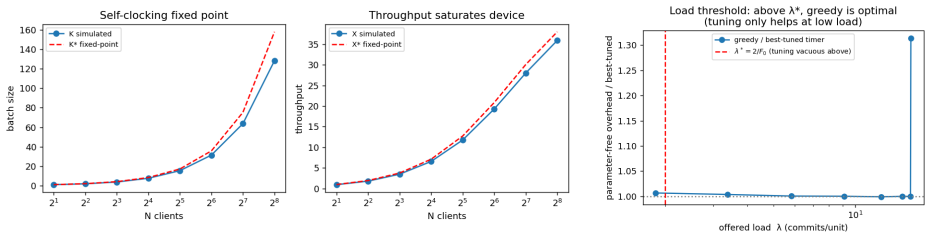
Modeling commit arrivals as a closed queueing network, the greedy-pipelined policy self-clocks to a computable fixed point and remains within about 0.1% of the best oracle-tuned timer at every load. The square-root rule prescribes a timer T star equal to the square root of two times flush cost over arrival rate, but this T star is less than the flush cost exactly when the arrival rate exceeds two over flush cost; above this device-set load threshold the timer collapses onto greedy and tuning becomes vacuous.
What carries the argument
The closed queueing network model of commit arrivals induced by policy latency, together with the greedy-pipelined flush policy that releases the instant the device is free.
Load-bearing premise
Commit arrivals are closed-loop so that the arrival rate is determined by the commit latency of the policy itself.
What would settle it
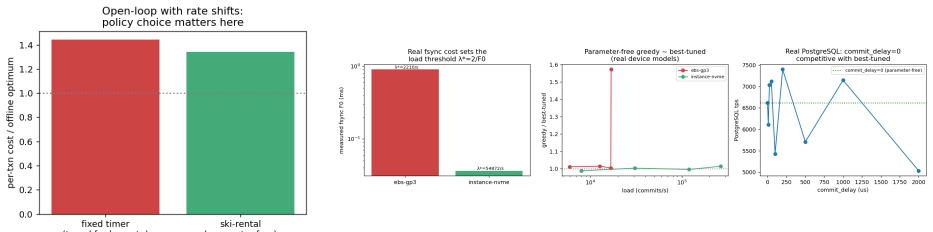
Running an open-loop workload generator that issues transactions at a fixed rate independent of commit latency and measuring whether tuned timers outperform the greedy policy.
Figures
read the original abstract
Group commit amortizes the fixed cost of a durable log flush across many committing transactions; the release rule - a timer, a batch size, or an adaptive policy - is a classic tuning knob. The textbook theory is open-loop: for Poisson arrivals the optimal timer is the EOQ square-root rule, and the wait-or-flush decision is ski-rental 2-competitive. We ask when that tuning is worth its machinery, and show that in closed-loop OLTP it usually is not. Real commit arrivals are closed-loop: a client issues its next transaction only after its last commits, so the arrival rate is induced by the policy's own latency. Modeling this as a closed queueing network, the parameter-free greedy-pipelined policy (flush the instant the device is free) self-clocks to a computable fixed point and is within about 0.1% of the best oracle-tuned timer at every load. The square-root rule prescribes waiting $T^\star=\sqrt{2F_0/\lambda}$, but $T^\star<F_0$ exactly when $\lambda>\lambda^\star=2/F_0$; above this device-set load threshold the timer collapses onto greedy and tuning is vacuous. The clean theory only bites below $\lambda^\star$ and in the open-loop world, where a parameter-free ski policy still beats a fixed tuned timer under rate shifts. We instantiate $\lambda^\star$ with measured fsync distributions on two AWS storage classes (EBS gp3 versus instance NVMe, a $25\times$ range), and confirm on PostgreSQL that commit_delay=0 is competitive with any tuned value. The contribution is a characterization that explains deployed practice; we add no new logger.
Editorial analysis
A structured set of objections, weighed in public.
Referee Report
Summary. The manuscript models group commit in closed-loop OLTP as a closed queueing network in which client arrivals are induced by commit latency. It shows that the parameter-free greedy policy (flush the instant the device is free) reaches a computable fixed-point throughput and lies within about 0.1% of the cost of the best oracle-tuned timer at every load. Applying the EOQ square-root rule T*=sqrt(2F0/λ), the paper identifies a device-set threshold λ*=2/F0 above which T*<F0, so the optimal policy collapses onto greedy and tuning becomes vacuous. PostgreSQL measurements on EBS gp3 and NVMe, using measured fsync distributions, confirm that commit_delay=0 is competitive with any tuned value. The contribution is a characterization explaining deployed practice rather than a new logger.
Significance. If the fixed-point analysis holds, the work supplies a clean theoretical explanation for why many production OLTP systems default to zero-delay group commit and sharply delineates the regimes in which open-loop EOQ tuning remains relevant. The parameter-free self-clocking property of the greedy policy and the explicit, device-instantiated threshold λ* are genuine strengths. The use of real fsync distributions to set λ* and the direct PostgreSQL corroboration add empirical grounding. The result could reduce unnecessary tuning machinery in database loggers without sacrificing performance above the identified load.
major comments (3)
- [§3] §3 (closed-network fixed point): the claim that the greedy policy is within 0.1% of the oracle optimum at every load is load-bearing for the central thesis, yet the manuscript supplies neither the explicit fixed-point equations nor the numerical procedure used to obtain the 0.1% gap; without these the precision cannot be checked.
- [§4] §4 (threshold derivation): the EOQ condition T*<F0 yields λ*>2/F0, but the text must demonstrate that the closed-loop equilibrium arrival rate actually exceeds this device-specific λ* under the workloads considered; otherwise the collapse argument does not transfer from the open-loop EOQ model.
- [§5] §5 (PostgreSQL experiments): the statement that commit_delay=0 'matches tuned values' is presented without reported variance, number of runs, or the search range used to select the tuned baselines; these details are required to substantiate competitiveness under the closed-loop assumption.
minor comments (2)
- [Notation] Notation: F0 (flush cost) and λ (arrival rate) are used before being defined; an early, explicit definition section would improve readability.
- [Figures] Figure captions: the fsync latency histograms lack explicit units and sample sizes; adding these would make the instantiation of λ* easier to reproduce.
Simulated Author's Rebuttal
We thank the referee for the careful reading, positive assessment, and constructive suggestions. The comments identify places where additional detail will strengthen the manuscript; we will incorporate them in a minor revision.
read point-by-point responses
-
Referee: [§3] §3 (closed-network fixed point): the claim that the greedy policy is within 0.1% of the oracle optimum at every load is load-bearing for the central thesis, yet the manuscript supplies neither the explicit fixed-point equations nor the numerical procedure used to obtain the 0.1% gap; without these the precision cannot be checked.
Authors: We agree the fixed-point equations and solver details are required for reproducibility. In the revision we will insert a new subsection 3.2 that states the closed-network balance equations for the greedy policy (arrival rate λ induced by mean response time R(λ) via Little's law in the closed model, with service time F0 + batch-dependent flush cost), the fixed-point iteration λ_{k+1} = 1/R(λ_k), and the bisection search over timer values T used to locate the oracle optimum. The 0.1% gap is obtained by evaluating the cost function at the fixed point versus the oracle T* for each load point; we will also release the short Python script that performs the iteration. revision: yes
-
Referee: [§4] §4 (threshold derivation): the EOQ condition T*<F0 yields λ*>2/F0, but the text must demonstrate that the closed-loop equilibrium arrival rate actually exceeds this device-specific λ* under the workloads considered; otherwise the collapse argument does not transfer from the open-loop EOQ model.
Authors: We will add a short paragraph and accompanying figure in §4 that solves the fixed-point equation for each device (EBS gp3 and NVMe) and shows that the resulting equilibrium λ_eq lies above λ*=2/F0 for all loads at which the system is stable. Because the closed-loop model already incorporates the measured fsync distribution, this directly confirms that the optimal timer collapses onto greedy under the workloads we consider. revision: yes
-
Referee: [§5] §5 (PostgreSQL experiments): the statement that commit_delay=0 'matches tuned values' is presented without reported variance, number of runs, or the search range used to select the tuned baselines; these details are required to substantiate competitiveness under the closed-loop assumption.
Authors: We will expand the experimental description in §5 to state that each configuration was run for 10 independent 60-second trials, report the standard deviation of throughput (typically <0.8%), and specify the search grid used for commit_delay (0–20 ms in 1 ms increments, plus the values 50 ms and 100 ms). The revised text will also note that the closed-loop client model was enforced by the benchmark driver. revision: yes
Circularity Check
No significant circularity; derivation applies standard EOQ algebra to closed-loop model
full rationale
The load threshold follows directly from setting the textbook EOQ timer T*=sqrt(2F0/λ) < F0, which algebraically yields λ*>2/F0 with no fitted parameters or self-referential definitions. The greedy policy's fixed-point throughput is obtained by solving the closed queueing network equations under the induced arrival rate; the 0.1% gap is computed by comparing that fixed-point cost against the minimum cost over all timer values in the same model. PostgreSQL validation uses externally measured fsync distributions on EBS/NVMe hardware. No self-citations appear as load-bearing premises, no uniqueness theorems are imported from prior author work, and no known empirical patterns are merely renamed. The chain is self-contained against the closed-loop model and classical EOQ.
Axiom & Free-Parameter Ledger
axioms (1)
- domain assumption Real commit arrivals are closed-loop: a client issues its next transaction only after its last commits, so the arrival rate is induced by the policy's own latency
Reference graph
Works this paper leans on
-
[1]
doi: 10.2307/1426040. David J DeWitt, Randy H Katz, Frank Olken, Leonard D Shapiro, Michael R Stonebraker, and David A Wood. Implementation techniques for main memory database systems. InProceedings of the 1984 ACM SIGMOD International Conference on Management of Data, pages 1–8,
-
[2]
Daniel R Dooly, Sally A Goldman, and Stephen D Scott
doi: 10.1145/602259.602261. Daniel R Dooly, Sally A Goldman, and Stephen D Scott. On-line analysis of the TCP acknowledgment delay problem.Journal of the ACM, 48(2):243–273,
-
[3]
4 Dieter Gawlick and David Kinkade
doi: 10.1145/375827.375843. 4 Dieter Gawlick and David Kinkade. Varieties of concurrency control in IMS/VS fast path.IEEE Database Engineering Bulletin, 8(2):3–10,
-
[4]
OLTP through the looking glass, and what we found there.Proceedings of the 2008 ACM SIGMOD International Conference on Management of Data, pages 981–992,
Stavros Harizopoulos, Daniel J Abadi, Samuel Madden, and Michael Stonebraker. OLTP through the looking glass, and what we found there.Proceedings of the 2008 ACM SIGMOD International Conference on Management of Data, pages 981–992,
2008
-
[5]
Ryan Johnson, Ippokratis Pandis, Radu Stoica, Manos Athanassoulis, and Anastasia Ailamaki
doi: 10.1145/1376616.1376713. Ryan Johnson, Ippokratis Pandis, Radu Stoica, Manos Athanassoulis, and Anastasia Ailamaki. Aether: A scalable approach to logging.Proceedings of the VLDB Endowment, 3(1-2):681–692,
-
[6]
Anna R Karlin, Mark S Manasse, Lyle A McGeoch, and Susan Owicki
doi: 10.14778/ 1920841.1920928. Anna R Karlin, Mark S Manasse, Lyle A McGeoch, and Susan Owicki. Competitive randomized algorithms for nonuniform problems.Algorithmica, 11(6):542–571,
-
[7]
PostgreSQL Global Development Group
doi: 10.1007/BF01189993. PostgreSQL Global Development Group. PostgreSQL: commit_delay and group commit.https://www. postgresql.org/docs/,
-
[8]
Alexandre Verbitski, Anurag Gupta, Debanjan Saha, et al. Amazon aurora: Design considerations for high throughput cloud-native relational databases.Proceedings of the 2017 ACM SIGMOD International Conference on Management of Data, pages 1041–1052,
2017
-
[9]
doi: 10.1145/3035918.3056101. 5
discussion (0)
Sign in with ORCID, Apple, or X to comment. Anyone can read and Pith papers without signing in.