PAHSPECS: Polycyclic aromatic hydrocarbon properties at cosmic noon with JWST/MIRI MRS
Pith reviewed 2026-06-26 23:57 UTC · model grok-4.3
The pith
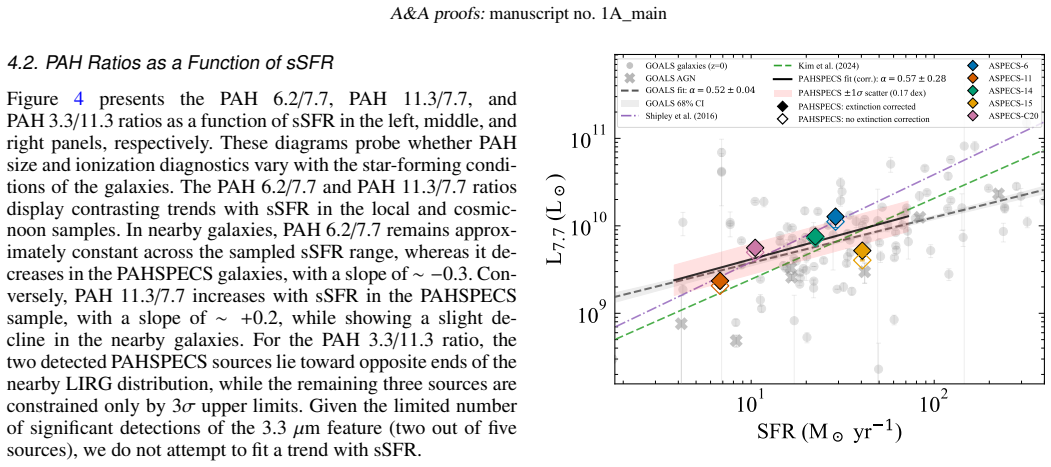
PAH band ratios in z~1 galaxies indicate more intense radiation fields than local starbursts, yet the 7.7 micron feature tracks star formation rate reliably.
A machine-rendered reading of the paper's core claim, the machinery that carries it, and where it could break.
Core claim
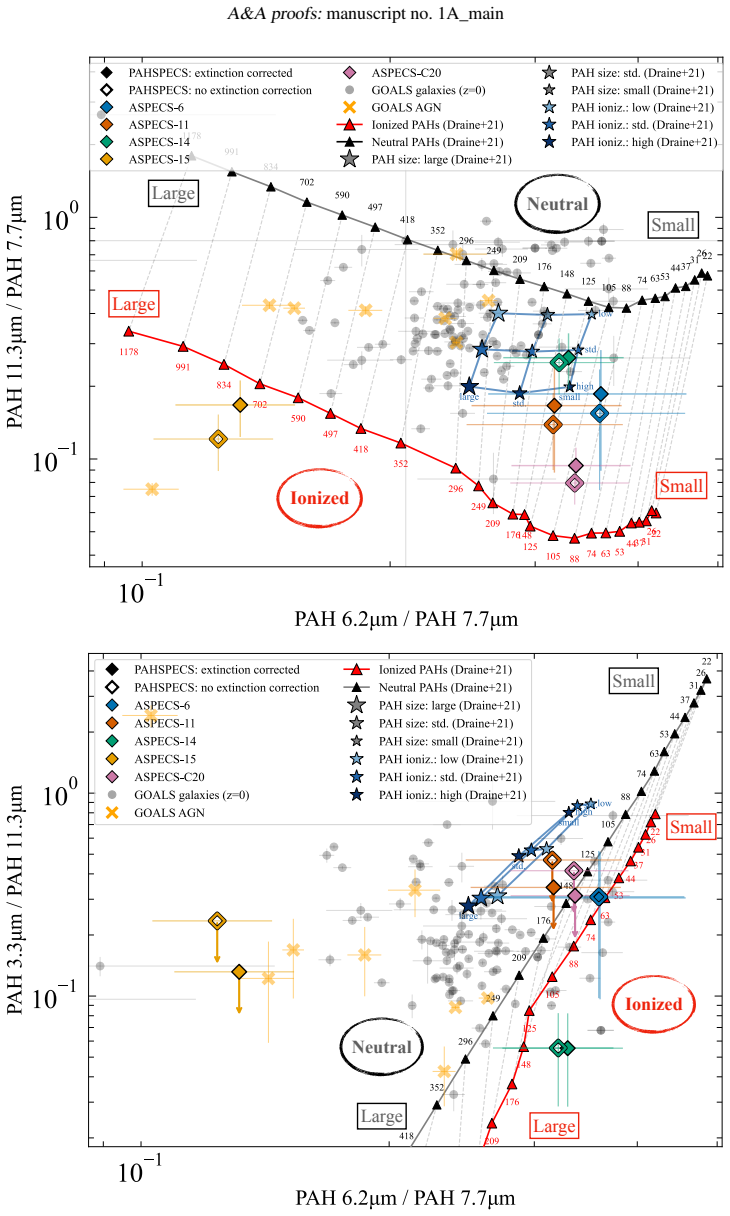
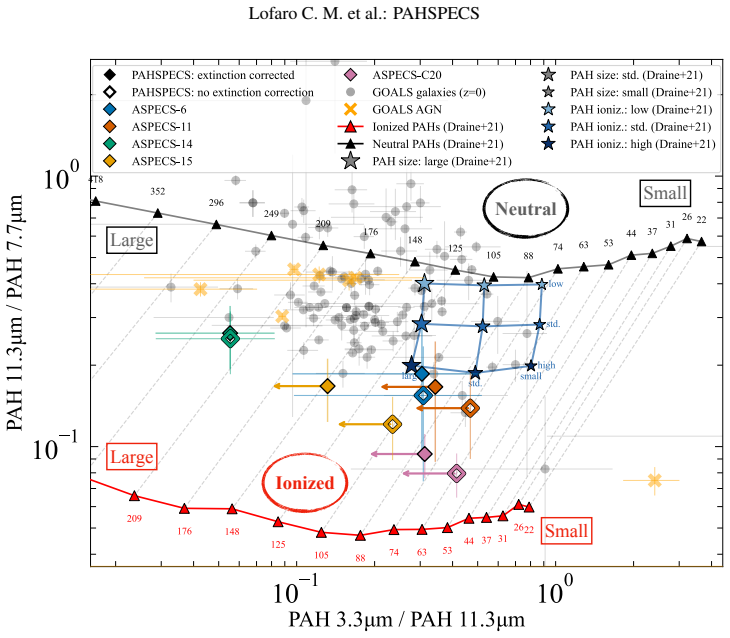
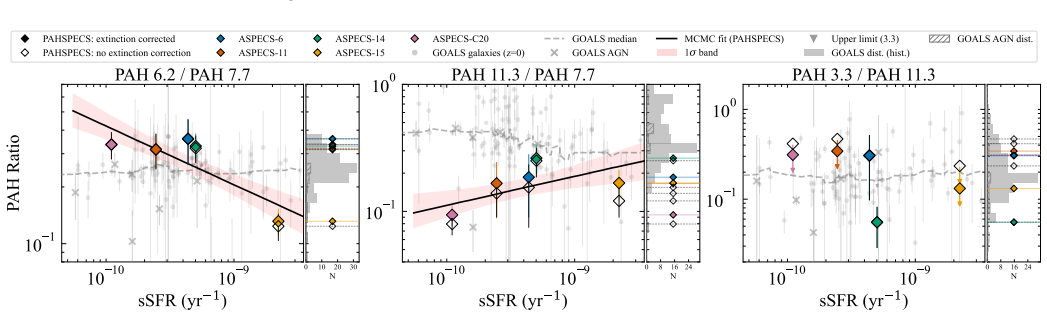
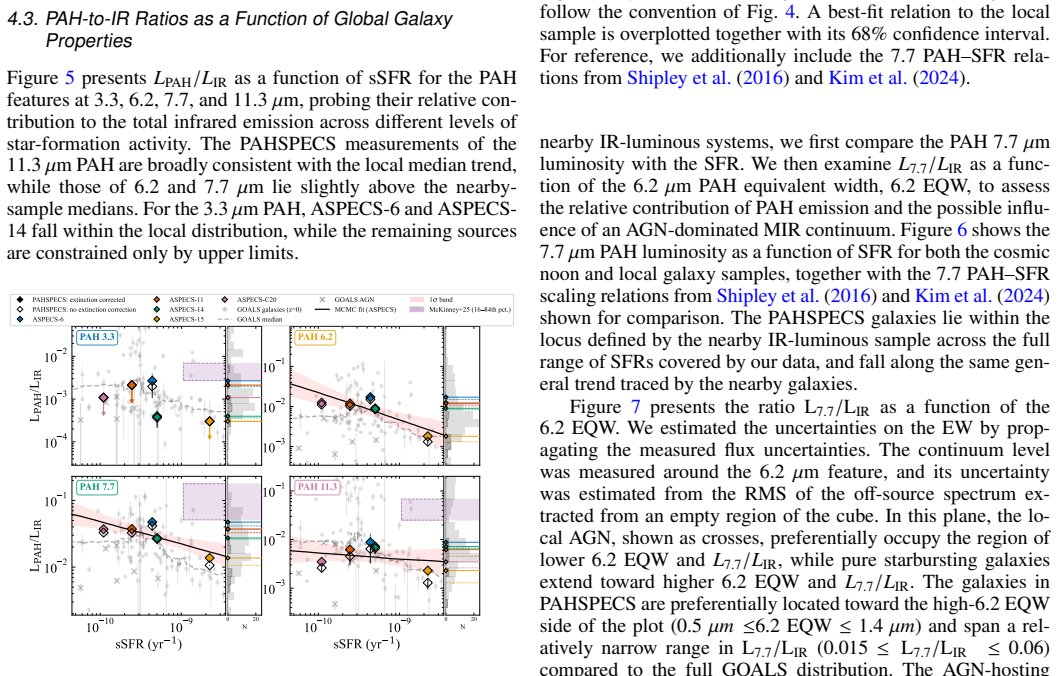
Compared to local LIRGs, most PAHSPECS sources show higher 6.2/7.7 and lower 11.3/7.7 ratios, suggesting an ionized PAH component weighted toward smaller grains. The 7.7 micron luminosity follows the local L7.7-SFR relation, supporting its use as a star-formation tracer at z ~ 1. PAH emission at cosmic noon appears shaped by different ISM conditions than in nearby starburst galaxies, likely reflecting more intense radiation fields.
What carries the argument
PAH band intensity ratios (6.2/7.7 and 11.3/7.7) extracted via CAFE spectral decomposition of integrated MIRI MRS spectra, which trace PAH charge state, grain size, and local radiation-field intensity.
If this is right
- The 7.7 micron feature can be used as a star-formation rate tracer for galaxies at redshift ~1 without full spectral modeling.
- PAH populations at cosmic noon experience preferential processing of small ionized carriers under more intense radiation fields than in local starbursts.
- Galaxies with higher specific star formation rates show lower 6.2/7.7 ratios, consistent with destruction or ionization shifts in small PAH grains.
- The AGN-hosting source displays the lowest 6.2/7.7 ratio, suggesting AGN activity can further suppress the small-PAH contribution.
Where Pith is reading between the lines
- If the offset in band ratios persists across larger samples, chemical evolution models at peak cosmic star formation must incorporate systematically stronger radiation fields when predicting dust emission.
- The continued reliability of the 7.7 micron tracer simplifies SFR estimates in high-redshift infrared surveys that lack complete mid-infrared spectra.
- Better detection of the 3.3 micron feature in future observations could test whether the same radiation-field effects appear across additional PAH bands.
Load-bearing premise
The observed PAH band ratios are assumed to directly and primarily reflect PAH charge, size, and radiation-field conditions with only minor contamination from other emission mechanisms or decomposition uncertainties.
What would settle it
Finding that a larger sample of z~1 galaxies exhibits 6.2/7.7 and 11.3/7.7 ratios matching those of local LIRGs, or that the 7.7 micron luminosity deviates from the local SFR relation, would undermine the claim of systematically different ISM conditions.
Figures
read the original abstract
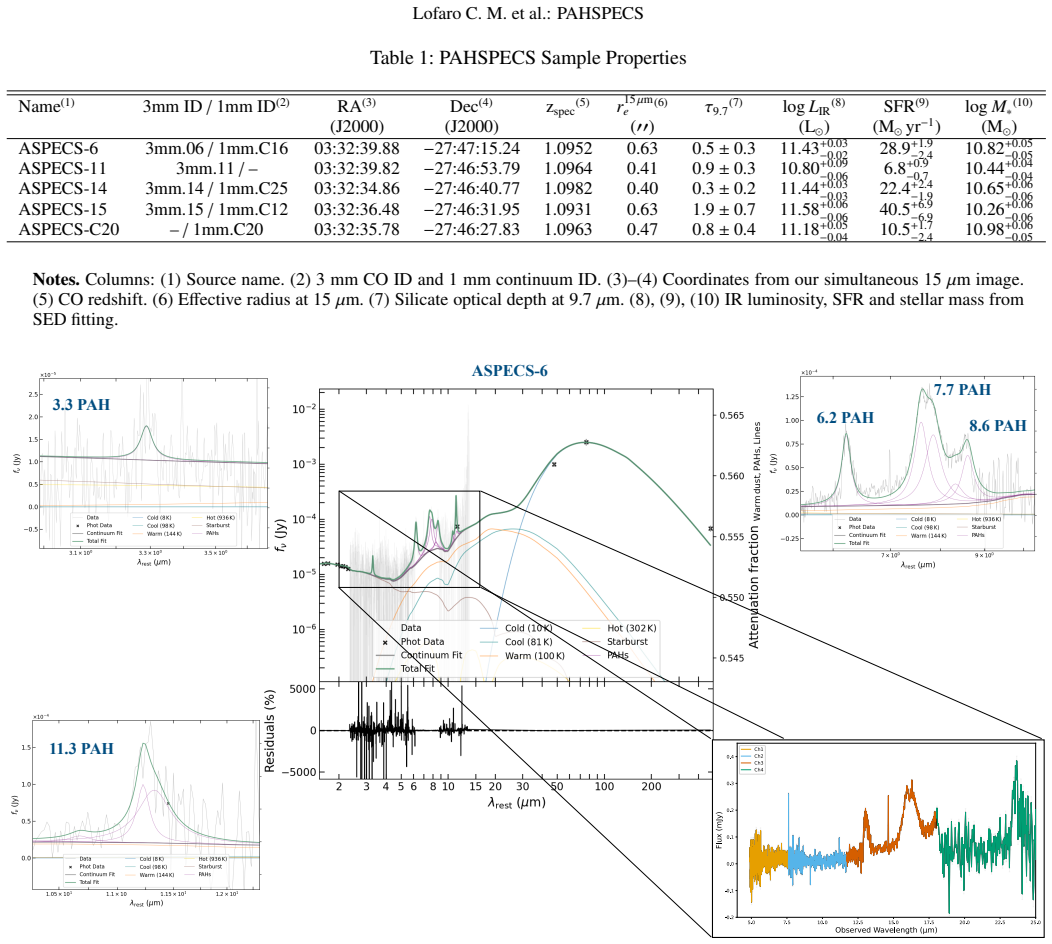
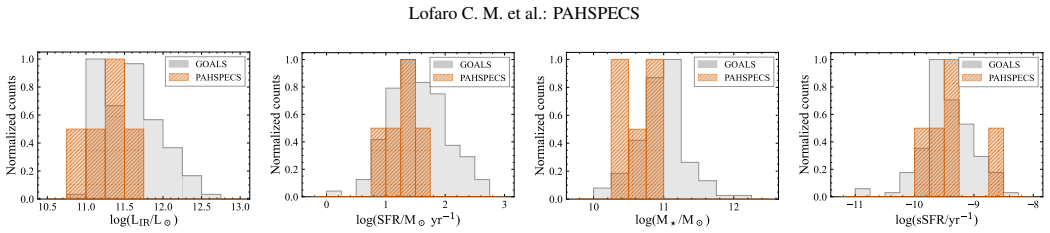
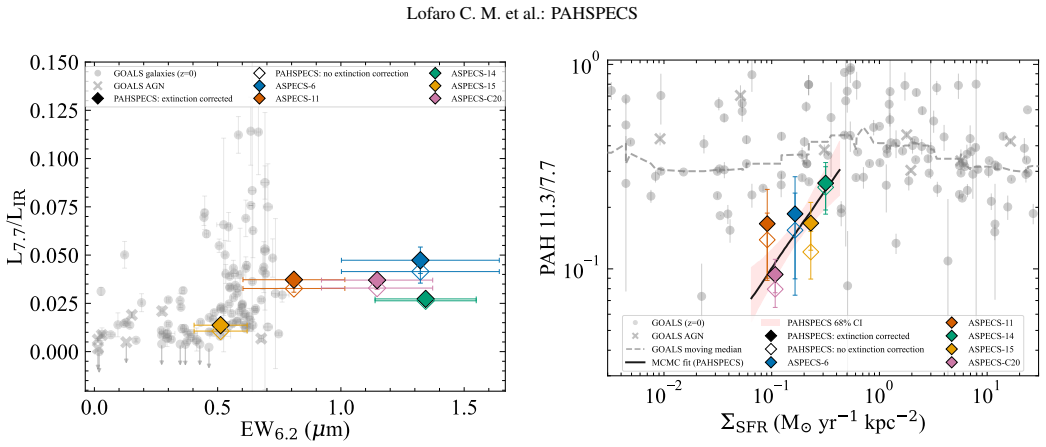
Context. Cosmic noon (z ~ 1-3) marks the peak of the cosmic star-formation rate density, when dust-obscured star formation dominated galaxy growth. Mid-infrared spectroscopy probes the interstellar medium through PAH emission, whose band ratios trace PAH charge, size, and local radiation-field conditions. Aims. We characterize the PAH properties of five z ~ 1.1 star-forming galaxies from the PAHSPECS survey and investigate how their PAH luminosities and band ratios relate to global galaxy properties. We compare them with local luminous infrared galaxies (LIRGs) to assess whether PAH emission at cosmic noon differs from that nearby. Methods. We analyze JWST/MIRI MRS observations of five ASPECS galaxies in the HUDF. Integrated spectra are extracted with wavelength-dependent apertures and modeled with CAFE, including ancillary photometry to constrain the dust emission. Stellar masses and SFRs are derived with Prospector. Results. Compared to local LIRGs, most PAHSPECS sources show higher 6.2/7.7 and lower 11.3/7.7 ratios, suggesting an ionized PAH component weighted toward smaller grains. The 3.3/11.3 ratio is less constrained, since the 3.3 micron feature is detected in only two sources. Within the sample, 11.3/7.7 increases with sSFR and star-formation surface density, while 6.2/7.7 decreases with sSFR, consistent with preferential processing of small ionized PAH carriers. ASPECS-15, the AGN-hosting source, has the lowest 6.2/7.7 ratio and highest sSFR, suggesting a reduced contribution from small PAHs, potentially due to AGN activity. The 7.7 micron luminosity follows the local L7.7-SFR relation, supporting its use as a star-formation tracer at z ~ 1. Conclusions. PAH emission at cosmic noon appears shaped by different ISM conditions than in nearby starburst galaxies, likely reflecting more intense radiation fields, while the 7.7 micron feature remains a robust SFR tracer.
Editorial analysis
A structured set of objections, weighed in public.
Referee Report
Summary. The paper analyzes JWST/MIRI MRS spectra of five z~1.1 star-forming galaxies from the PAHSPECS/ASPECS sample in the HUDF. Spectra are extracted with wavelength-dependent apertures and decomposed using the CAFE code (with ancillary photometry to constrain the continuum); stellar masses and SFRs are derived via Prospector SED fitting. PAH band ratios (primarily 6.2/7.7 and 11.3/7.7) are compared to local LIRGs, revealing higher 6.2/7.7 and lower 11.3/7.7 values interpreted as evidence for smaller, more ionized PAHs under stronger radiation fields at cosmic noon. Within the sample, 11.3/7.7 increases and 6.2/7.7 decreases with sSFR and star-formation surface density; the 7.7 μm luminosity follows the local L7.7–SFR relation. One source hosts an AGN.
Significance. If the spectral decomposition proves robust, the work supplies some of the first JWST-based constraints on PAH grain properties and ISM conditions at cosmic noon, where dust-obscured star formation peaks. The finding that L7.7 remains a reliable SFR tracer at z~1.1 has immediate utility for high-redshift galaxy studies, while the reported band-ratio offsets motivate follow-up with larger samples to test radiation-field and metallicity effects.
major comments (2)
- [§3] §3 (spectral modeling): PAH band ratios are obtained exclusively from single CAFE decompositions of the five MRS spectra. No Monte-Carlo realizations, alternative continuum shapes, or cross-checks against a second decomposition code are described, so the systematic uncertainty on the reported 6.2/7.7 and 11.3/7.7 offsets relative to local LIRGs is unquantified. This is load-bearing for the central claim that ISM conditions differ at cosmic noon.
- [§5.1] §5.1 and Table 2 (trends): The reported correlations of band ratios with sSFR and ΣSFR rest on a sample of n=5 (one of which is AGN-hosting). No formal error bars on the ratios, bootstrap tests, or assessment of how plausible changes in CAFE parameters would move the points are provided, weakening the statistical support for the within-sample trends.
minor comments (2)
- [Figure 2] Figure 2: The caption should explicitly state the wavelength-dependent aperture sizes used for spectral extraction and whether any aperture correction was applied.
- [Abstract] Abstract and §6: The phrase 'most PAHSPECS sources' is imprecise for a sample of five; replace with the exact count (e.g., 'four of five').
Simulated Author's Rebuttal
We thank the referee for their careful reading and constructive comments, which highlight important aspects of robustness and statistical support. We address each major comment below, indicating planned revisions where appropriate.
read point-by-point responses
-
Referee: [§3] §3 (spectral modeling): PAH band ratios are obtained exclusively from single CAFE decompositions of the five MRS spectra. No Monte-Carlo realizations, alternative continuum shapes, or cross-checks against a second decomposition code are described, so the systematic uncertainty on the reported 6.2/7.7 and 11.3/7.7 offsets relative to local LIRGs is unquantified. This is load-bearing for the central claim that ISM conditions differ at cosmic noon.
Authors: We agree that the lack of quantified systematic uncertainties from the CAFE modeling is a limitation for the robustness of the reported band-ratio offsets. In the revised manuscript we will add Monte Carlo realizations by perturbing the spectra within the noise and re-running CAFE fits, as well as tests with alternative continuum parameterizations. These will be used to derive systematic error bars on the 6.2/7.7 and 11.3/7.7 ratios and will be presented in an expanded §3. We will also briefly discuss why cross-checks with a second code were not performed (CAFE is the standard tool for this type of MRS data). revision: yes
-
Referee: [§5.1] §5.1 and Table 2 (trends): The reported correlations of band ratios with sSFR and ΣSFR rest on a sample of n=5 (one of which is AGN-hosting). No formal error bars on the ratios, bootstrap tests, or assessment of how plausible changes in CAFE parameters would move the points are provided, weakening the statistical support for the within-sample trends.
Authors: The small sample size (n=5) is inherent to the current PAHSPECS MRS data and limits the strength of any statistical claims; we will explicitly note this and soften the language describing the trends as suggestive rather than definitive. We will add formal uncertainties on the band ratios derived from the spectral fits (including the Monte Carlo results from the §3 revision) to Table 2 and the figures. Bootstrap resampling is not statistically meaningful for n=5, but we will include a sensitivity test showing how plausible CAFE parameter variations affect the points. The AGN source will be flagged more clearly in the trend discussion. revision: partial
Circularity Check
Purely observational comparison with no circular derivations
full rationale
The paper extracts integrated spectra from JWST/MIRI MRS data on five z~1.1 galaxies, fits them using the external CAFE code plus ancillary photometry, derives stellar masses/SFRs via the external Prospector code, computes observed PAH band ratios (6.2/7.7, 11.3/7.7, etc.), and compares the ratios and L_7.7-SFR relation directly to literature values for local LIRGs. No equations, predictions, or uniqueness claims are present that reduce by construction to fitted parameters or self-citations within the paper. The central claims rest on the observational measurements and external comparisons rather than any internal derivation chain.
Axiom & Free-Parameter Ledger
axioms (1)
- domain assumption PAH band ratios trace PAH charge, size, and local radiation-field conditions
Forward citations
Cited by 1 Pith paper
-
PAHSPECS: Spatially Resolved PAH Spectroscopy at cosmic noon with JWST MIRI MRS
JWST observations of z~1.1 galaxies produce PAH ratio maps showing larger and more neutral PAHs at larger radii, opposite local trends, linked to UV hardness via photo-destruction.
Reference graph
Works this paper leans on
-
[1]
2024, ApJ, 976, 224
Alberts, S., Lyu, J., Shivaei, I., et al. 2024, ApJ, 976, 224
2024
-
[2]
1995, Ap&SS, 224, 417
Allain, T., Sedlmayr, E., & Leach, S. 1995, Ap&SS, 224, 417
1995
-
[3]
J., Hudgins, D
Allamandola, L. J., Hudgins, D. M., & Sandford, S. A. 1999, ApJ, 511, L115
1999
-
[4]
J., Tielens, A
Allamandola, L. J., Tielens, A. G. G. M., & Barker, J. R. 1985, ApJ, 290, L25
1985
-
[5]
J., Tielens, A
Allamandola, L. J., Tielens, A. G. G. M., & Barker, J. R. 1989, ApJS, 71, 733
1989
-
[6]
G., Alexander, D
Alonso-Herrero, A., Pérez-González, P. G., Alexander, D. M., et al. 2006, ApJ, 640, 167 Article number, page 11 of 15 A&A proofs:manuscript no. 1A_main
2006
-
[7]
2020, ApJ, 901, 79
Aravena, M., Boogaard, L., Gónzalez-López, J., et al. 2020, ApJ, 901, 79
2020
-
[8]
2019, ApJ, 882, 136
Aravena, M., Decarli, R., Gónzalez-López, J., et al. 2019, ApJ, 882, 136
2019
-
[9]
2007, ApJ, 656, 148
Armus, L., Charmandaris, V ., Bernard-Salas, J., et al. 2007, ApJ, 656, 148
2007
-
[10]
M., Evans, A
Armus, L., Mazzarella, J. M., Evans, A. S., et al. 2009, PASP, 121, 559
2009
-
[11]
K., Williams, T
Belfiore, F., Leroy, A. K., Williams, T. G., et al. 2023, A&A, 678, A129
2023
-
[12]
Boersma, C., Bregman, J., & Allamandola, L. J. 2016, ApJ, 832, 51
2016
-
[13]
Boersma, C., Bregman, J., & Allamandola, L. J. 2018, ApJ, 858, 67
2018
-
[14]
Boogaard, L. et al. 2026, in preparation
2026
-
[15]
A., Decarli, R., González-López, J., et al
Boogaard, L. A., Decarli, R., González-López, J., et al. 2019, ApJ, 882, 140
2019
-
[16]
A., van der Werf, P., Weiss, A., et al
Boogaard, L. A., van der Werf, P., Weiss, A., et al. 2020, ApJ, 902, 109
2020
-
[17]
R., Bernard-Salas, J., Spoon, H
Brandl, B. R., Bernard-Salas, J., Spoon, H. W. W., et al. 2006, ApJ, 653, 1129
2006
-
[18]
2022, JWST Calibration Pipeline
Bushouse, H., Eisenhamer, J., Dencheva, N., & et al. 2022, JWST Calibration Pipeline
2022
-
[19]
2019, MNRAS, 482, 1618
Cortzen, I., Garrett, J., Magdis, G., et al. 2019, MNRAS, 482, 1618
2019
-
[20]
2019, ApJ, 882, 138 Díaz-Santos, T., Armus, L., Charmandaris, V ., et al
Decarli, R., Walter, F., Gónzalez-López, J., et al. 2019, ApJ, 882, 138 Díaz-Santos, T., Armus, L., Charmandaris, V ., et al. 2017, ApJ, 846, 32 Díaz-Santos, T., Charmandaris, V ., Armus, L., et al. 2010, ApJ, 723, 993
2019
-
[21]
Diaz-Santos, T., Lai, T. S. Y ., Finnerty, L., et al. 2025, CAFE: Continuum And Feature Extraction tool, Astrophysics Source Code Library, record ascl:2501.001
2025
-
[22]
2007, ApJ, 660, 167
Herrero, A. 2007, ApJ, 660, 167
2007
-
[23]
Donnan, F. et al. 2026, submitted
2026
-
[24]
P., Smith, J
Donnelly, G. P., Smith, J. D. T., Draine, B. T., et al. 2024, ApJ, 965, 75
2024
-
[25]
Draine, B. T. & Li, A. 2001, ApJ, 551, 807
2001
-
[26]
Draine, B. T. & Li, A. 2007, ApJ, 657, 810
2007
-
[27]
T., Li, A., Hensley, B
Draine, B. T., Li, A., Hensley, B. S., et al. 2021, ApJ, 917, 3
2021
-
[28]
Galliano, F., Galametz, M., & Jones, A. P. 2018, ARA&A, 56, 673
2018
-
[29]
C., Tielens, A
Galliano, F., Madden, S. C., Tielens, A. G. G. M., Peeters, E., & Jones, A. P. 2008, ApJ, 679, 310 García-Bernete, I., Rigopoulou, D., Alonso-Herrero, A., et al. 2022, MNRAS, 509, 4256 García-Bernete, I., Rigopoulou, D., Donnan, F. R., et al. 2024, A&A, 691, A162 González-López, J., Decarli, R., Pavesi, R., et al. 2019, ApJ, 882, 139 González-López, J., N...
2008
-
[30]
2026, ApJ, 997, 20
Gregg, B., Calzetti, D., Adamo, A., et al. 2026, ApJ, 997, 20
2026
-
[31]
2021, ApJ, 919, 143
Henry, A., Rafelski, M., Sunnquist, B., et al. 2021, ApJ, 919, 143
2021
-
[32]
H., Armus, L., Mazzarella, J
Howell, J. H., Armus, L., Mazzarella, J. M., et al. 2010, The Astrophysical Jour- nal, 715, 572
2010
-
[33]
2018, A&A, 617, A130
Inami, H., Armus, L., Matsuhara, H., et al. 2018, A&A, 617, A130
2018
-
[34]
W., Baumgärtel, H., & Leach, S
Jochims, H. W., Baumgärtel, H., & Leach, S. 1999, The Astrophysical Journal, 512, 500
1999
-
[35]
D., Leja, J., Conroy, C., & Speagle, J
Johnson, B. D., Leja, J., Conroy, C., & Speagle, J. S. 2021, ApJS, 254, 22
2021
-
[36]
2018, Monthly Notices of the Royal Astronomical Society, 477, 5568
Kaasinen, M., Kewley, L., Bian, F., et al. 2018, Monthly Notices of the Royal Astronomical Society, 477, 5568
2018
-
[37]
K., Malkan, M
Kim, H. K., Malkan, M. A., Takagi, T., et al. 2024, ApJ, 974, 253
2024
-
[38]
E., Reddy, N
Kriek, M., Shapley, A. E., Reddy, N. A., et al. 2015, ApJS, 218, 15
2015
-
[39]
S.-Y ., Armus, L., Bianchin, M., et al
Lai, T. S.-Y ., Armus, L., Bianchin, M., et al. 2023, ApJ, 957, L26
2023
-
[40]
S.-Y ., Armus, L., U, V ., et al
Lai, T. S.-Y ., Armus, L., U, V ., et al. 2022, ApJ, 941, L36
2022
-
[41]
S.-Y ., Smith, J
Lai, T. S.-Y ., Smith, J. D. T., Baba, S., Spoon, H. W. W., & Imanishi, M. 2020, ApJ, 905, 55
2020
-
[42]
F., Charmandaris, V ., et al
Laurent, O., Mirabel, I. F., Charmandaris, V ., et al. 2000, A&A, 359, 887
2000
-
[43]
1986, Journal of Electron Spectroscopy and Related Phenomena, 41, 427
Leach, S. 1986, Journal of Electron Spectroscopy and Related Phenomena, 41, 427
1986
-
[44]
Leger, A., D’Hendecourt, L., Boissel, P., & Desert, F. X. 1989, A&A, 213, 351
1989
-
[45]
& Puget, J
Leger, A. & Puget, J. L. 1984, A&A, 137, L5
1984
-
[46]
K., Bolatto, A
Leroy, A. K., Bolatto, A. D., Sandstrom, K., et al. 2023, ApJ, 944, L10
2023
-
[47]
2007, in Astronomical Society of the Pacific Conference Series, V ol
Li, A. 2007, in Astronomical Society of the Pacific Conference Series, V ol. 373, The Central Engine of Active Galactic Nuclei, ed. L. C. Ho & J. W. Wang, 561
2007
-
[48]
& Draine, B
Li, A. & Draine, B. T. 2001, ApJ, 554, 778
2001
-
[49]
D., Daddi, E., et al
Liu, Z., Silverman, J. D., Daddi, E., et al. 2025, MNRAS, 542, 397
2025
-
[50]
Lofaro, C. M. et al. 2026, submitted
2026
-
[51]
& Dickinson, M
Madau, P. & Dickinson, M. 2014, ARA&A, 52, 415
2014
-
[52]
& Mannucci, F
Maiolino, R. & Mannucci, F. 2019, A&A Rev., 27, 3
2019
-
[53]
D., & Allamandola, L
Maragkoudakis, A., Boersma, C., Temi, P., Bregman, J. D., & Allamandola, L. J. 2022, ApJ, 931, 38
2022
-
[54]
2018, MNRAS, 481, 5370
Maragkoudakis, A., Ivkovich, N., Peeters, E., et al. 2018, MNRAS, 481, 5370
2018
-
[55]
2020, MNRAS, 494, 642
Maragkoudakis, A., Peeters, E., & Ricca, A. 2020, MNRAS, 494, 642
2020
-
[56]
A., Herter, T
Marshall, J. A., Herter, T. L., Armus, L., et al. 2007, The Astrophysical Journal, 670, 129
2007
-
[57]
2021, ApJ, 908, 238
McKinney, J., Armus, L., Pope, A., et al. 2021, ApJ, 908, 238
2021
-
[58]
2025, arXiv e-prints, arXiv:2510.07365 Menéndez-Delmestre, K., Blain, A
McKinney, J., Eleazer, M., Pope, A., et al. 2025, arXiv e-prints, arXiv:2510.07365 Menéndez-Delmestre, K., Blain, A. W., Smail, I., et al. 2009, ApJ, 699, 667
arXiv 2025
-
[59]
R., Alexander, D
Mullaney, J. R., Alexander, D. M., Goulding, A. D., & Hickox, R. C. 2011, Monthly Notices of the Royal Astronomical Society, 414, 1082
2011
-
[60]
2015, A&A, 581, A114
Murata, K., Koyama, Y ., Tanaka, M., Matsuhara, H., & Kodama, T. 2015, A&A, 581, A114
2015
-
[61]
Peeters, E., Spoon, H. W. W., & Tielens, A. G. G. M. 2004, ApJ, 613, 986
2004
-
[62]
H., et al
Pereira-Santaella, M., Alonso-Herrero, A., Rieke, G. H., et al. 2010, ApJS, 188, 447 Planck Collaboration, Aghanim, N., Akrami, Y ., et al. 2020, A&A, 641, A6
2010
-
[63]
M., et al
Pope, A., Chary, R.-R., Alexander, D. M., et al. 2008, ApJ, 675, 1171
2008
-
[64]
H., Alberts, S., Shivaei, I., et al
Rieke, G. H., Alberts, S., Shivaei, I., et al. 2024, ApJ, 975, 83
2024
-
[65]
C., et al
Rigopoulou, D., Barale, M., Clary, D. C., et al. 2021, MNRAS, 504, 5287
2021
-
[66]
2024, ApJ, 970, 61
Ronayne, K., Papovich, C., Yang, G., et al. 2024, ApJ, 970, 61
2024
-
[67]
2007, ApJ, 664, 713
Sajina, A., Yan, L., Armus, L., et al. 2007, ApJ, 664, 713
2007
-
[68]
L., Shapley, A
Sanders, R. L., Shapley, A. E., Jones, T., et al. 2021, ApJ, 914, 19
2021
-
[69]
L., Shapley, A
Sanders, R. L., Shapley, A. E., Reddy, N. A., et al. 2020, MNRAS, 491, 1427
2020
-
[70]
2017, ApJ, 837, 150
Scoville, N., Lee, N., Vanden Bout, P., et al. 2017, ApJ, 837, 150
2017
-
[71]
2025, The Astrophysical Journal Let- ters, 980, L45
Shen, L., Papovich, C., Matharu, J., et al. 2025, The Astrophysical Journal Let- ters, 980, L45
2025
-
[72]
V ., Papovich, C., Rieke, G
Shipley, H. V ., Papovich, C., Rieke, G. H., Brown, M. J. I., & Moustakas, J. 2016, ApJ, 818, 60
2016
-
[73]
2024, A&A, 690, A89
Shivaei, I., Alberts, S., Florian, M., et al. 2024, A&A, 690, A89
2024
-
[74]
& Boogaard, L
Shivaei, I. & Boogaard, L. A. 2024, A&A, 691, L2
2024
-
[75]
A., Shapley, A
Shivaei, I., Reddy, N. A., Shapley, A. E., et al. 2017, ApJ, 837, 157
2017
-
[76]
Shivaei, I. et al. 2026, in preparation
2026
-
[77]
Smith, J. D. T., Draine, B. T., Dale, D. A., et al. 2007, ApJ, 656, 770
2007
-
[78]
Spoon, H. W. W., Marshall, J. A., Houck, J. R., et al. 2007, ApJ, 654, L49
2007
-
[79]
2005, ApJ, 631, 163
Stern, D., Eisenhardt, P., Gorjian, V ., et al. 2005, ApJ, 631, 163
2005
-
[80]
2014, ApJ, 790, 124
Stierwalt, S., Armus, L., Charmandaris, V ., et al. 2014, ApJ, 790, 124
2014
discussion (0)
Sign in with ORCID, Apple, or X to comment. Anyone can read and Pith papers without signing in.