PAHSPECS: Spatially Resolved PAH Spectroscopy at cosmic noon with JWST MIRI MRS
Pith reviewed 2026-06-26 23:53 UTC · model grok-4.3
The pith
In galaxies at z~1.1, PAHs become larger and more neutral at larger galactocentric radii, the opposite of local galaxy trends.
A machine-rendered reading of the paper's core claim, the machinery that carries it, and where it could break.
Core claim
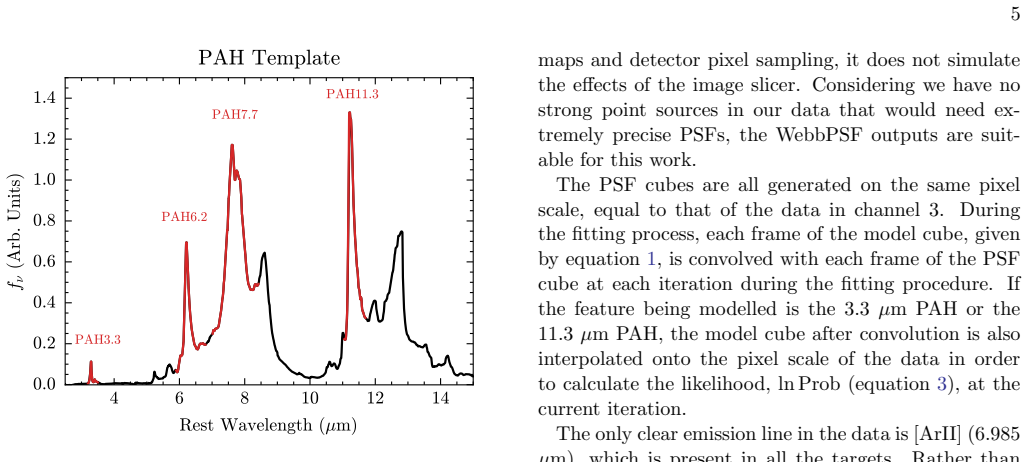
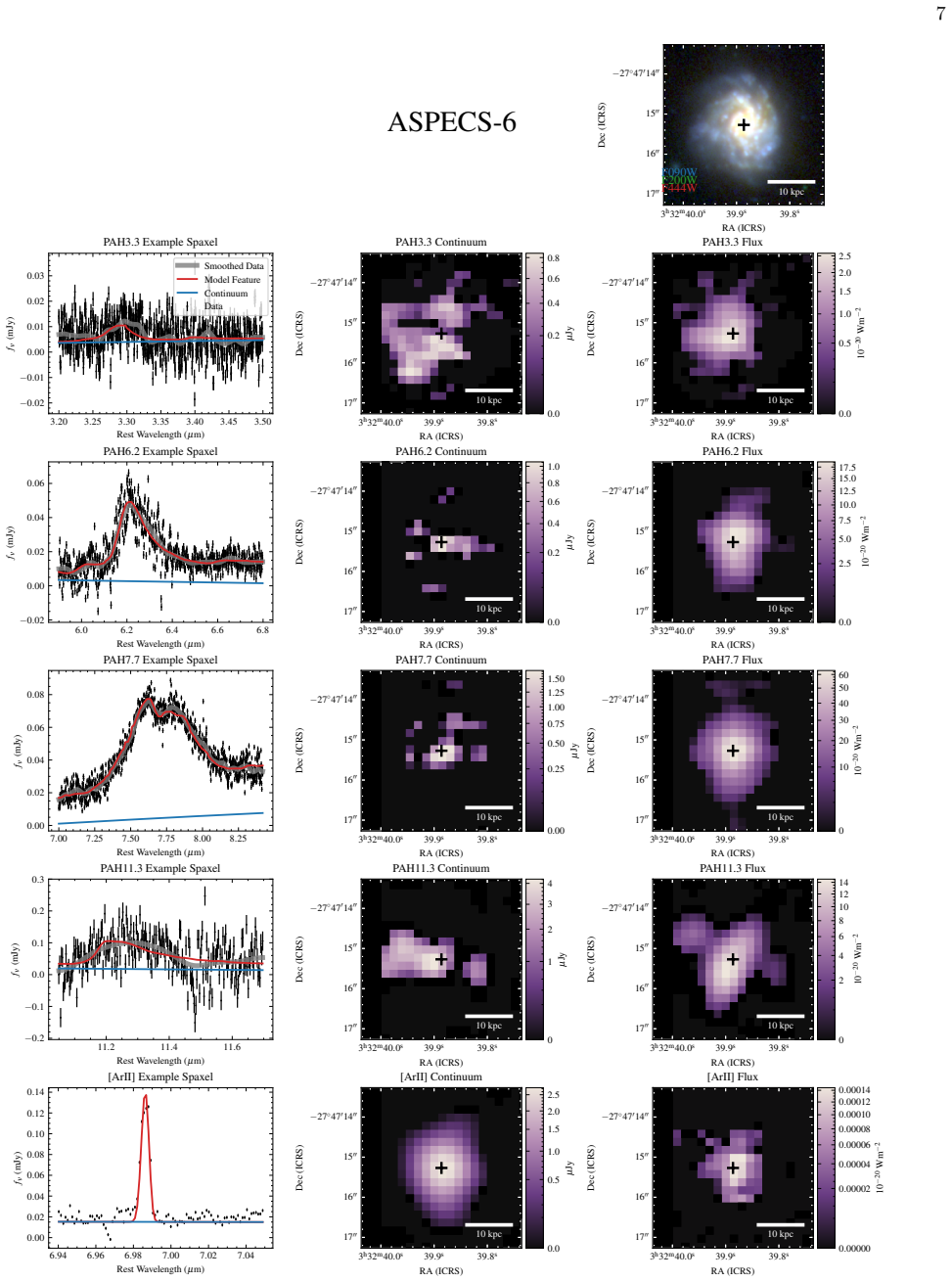
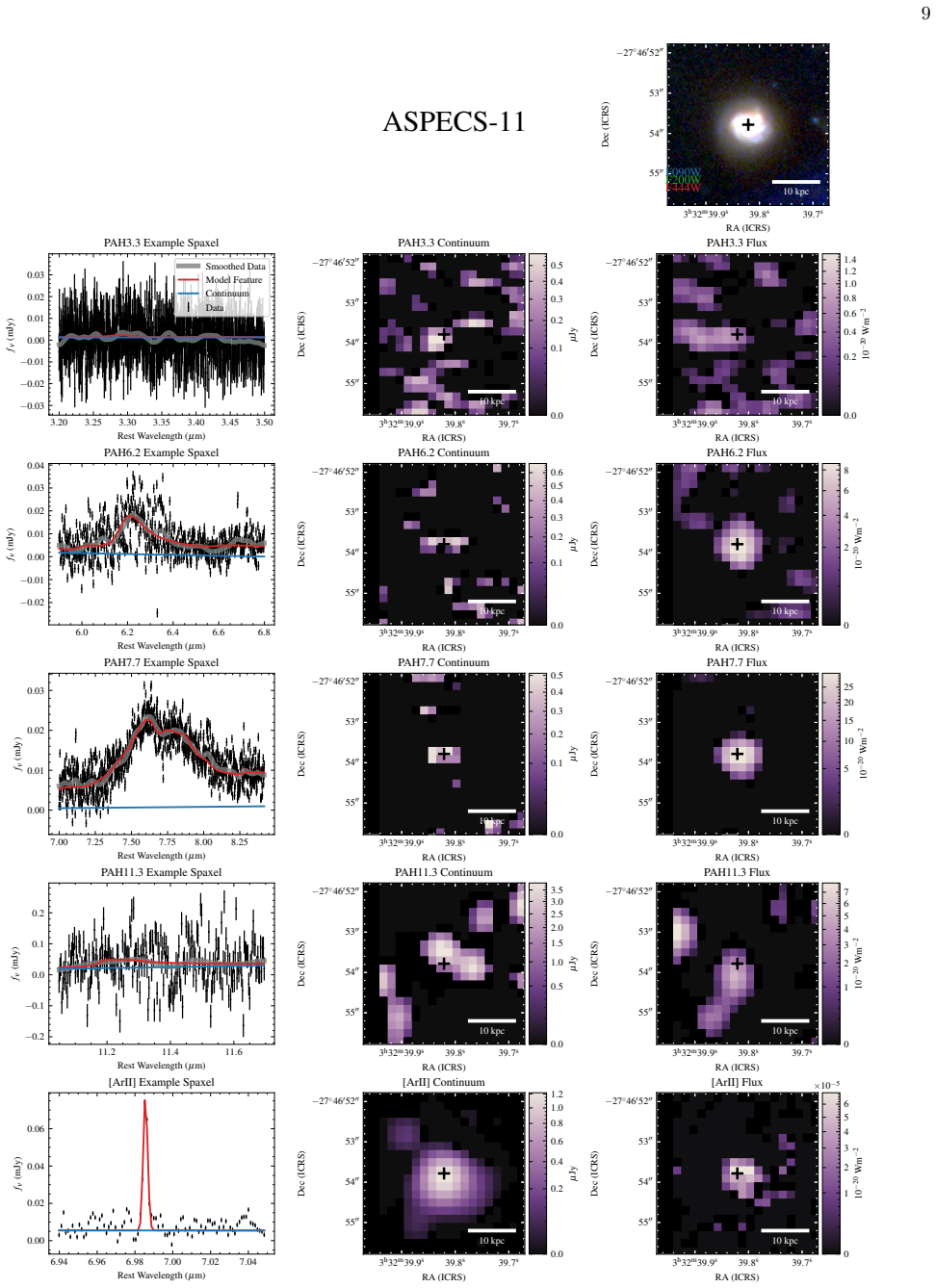
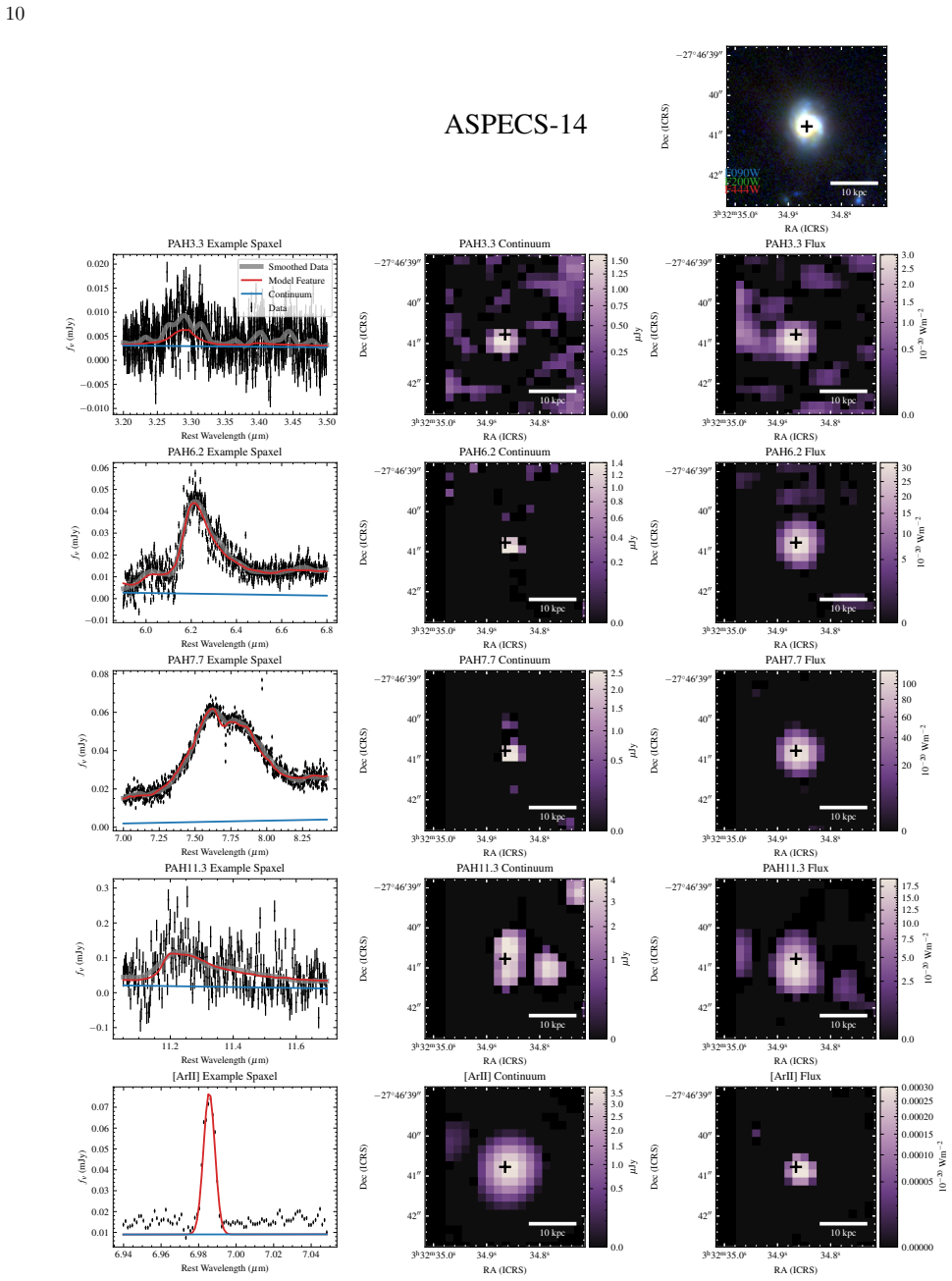
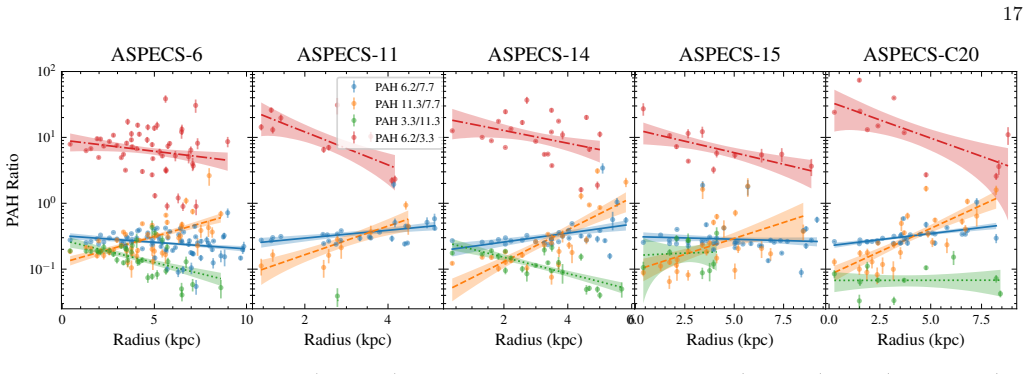
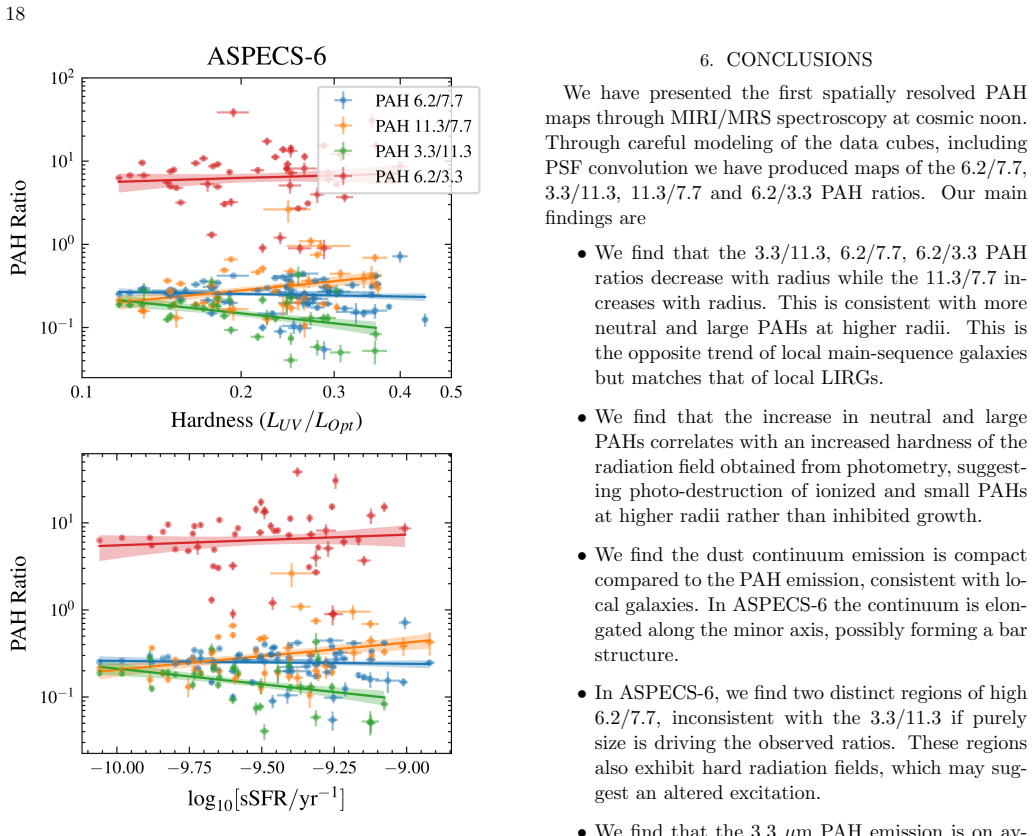
Using forward modeling of JWST/MIRI MRS data cubes with non-parametric spatial distributions, the authors extract spatially resolved PAH emission and produce ratio maps showing that PAHs become larger and more neutral with increasing galactocentric radius in z~1.1 star-forming galaxies. This is the opposite of local galaxy trends, indicating different radial ISM gradients at cosmic noon. They also link the trends to UV radiation field hardness via SED fitting, suggesting photo-destruction of small and ionized PAHs.
What carries the argument
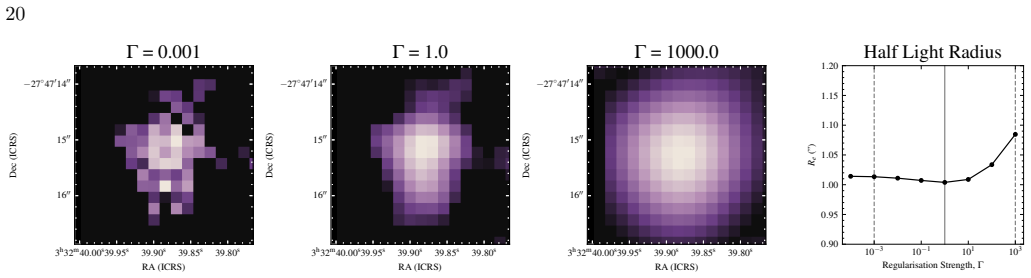
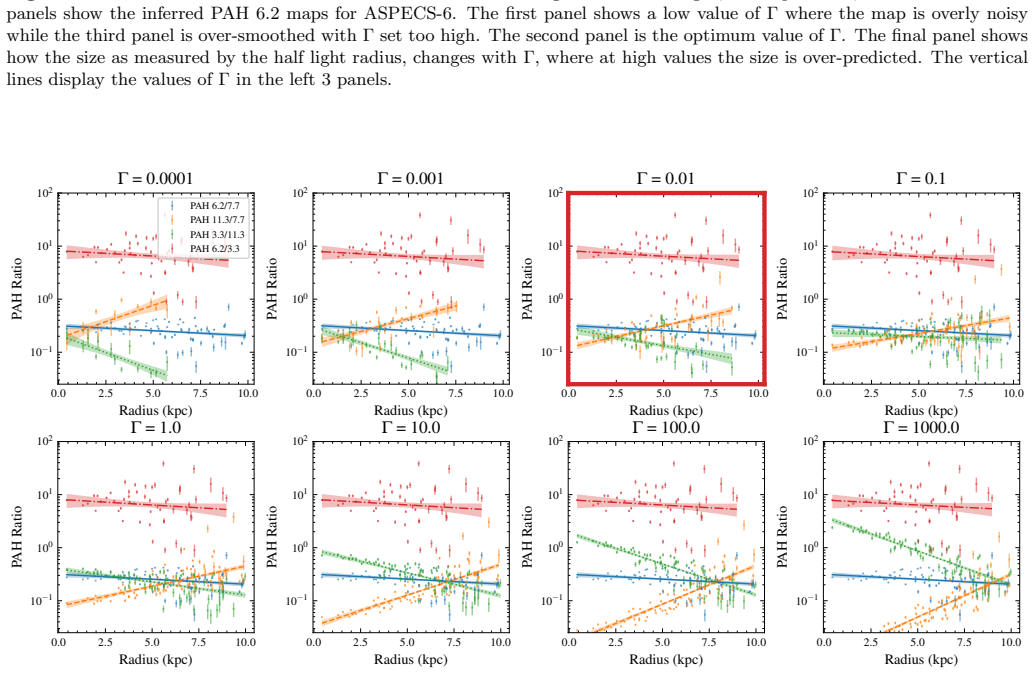
Forward modeling of data cubes with non-parametric spatial distributions to recover unbiased PAH spatial profiles after PSF convolution.
If this is right
- PAH ratio trends with radius indicate different ISM gradients in high-redshift galaxies compared to local ones.
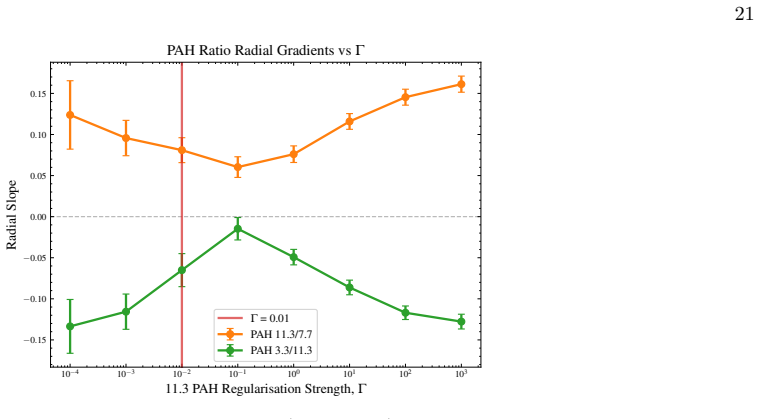
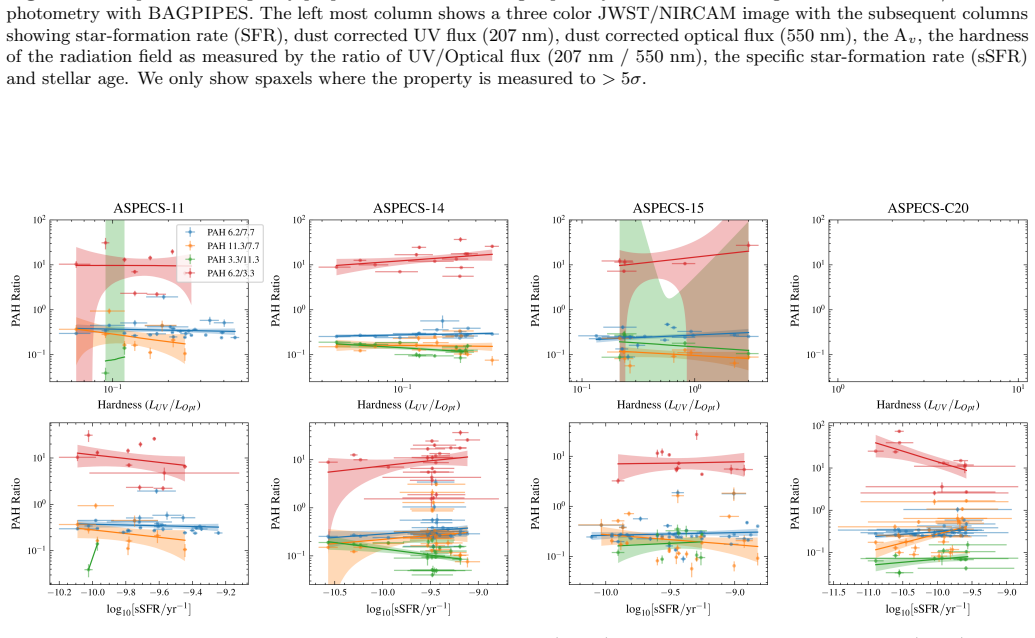
- The 3.3/11.3 PAH ratio decreases with increasing UV radiation field hardness while 11.3/7.7 increases.
- Photo-destruction of small and ionized PAHs may drive the radial trends and the overall lower 3.3/11.3 ratio at cosmic noon.
- PAH properties encode crucial information on the resolved ISM physics in galaxies at cosmic noon.
Where Pith is reading between the lines
- Observations at a range of redshifts could show when the reversal in radial PAH trends occurred.
- The forward-modeling approach may be applied to other spectral lines to map additional ISM components at high redshift.
- If confirmed, the result implies that dust grain processing or radiation environments in galaxies change systematically with cosmic time.
Load-bearing premise
The forward-modeling procedure with non-parametric spatial distributions fully recovers unbiased PAH spatial profiles after accounting for PSF convolution, without residual systematics that could mimic or erase the reported radial trends.
What would settle it
Repeating the PAH ratio analysis on similar high-redshift galaxies with an independent extraction method and recovering either flat ratios or the local-universe trend with radius would falsify the claim of reversed gradients.
Figures
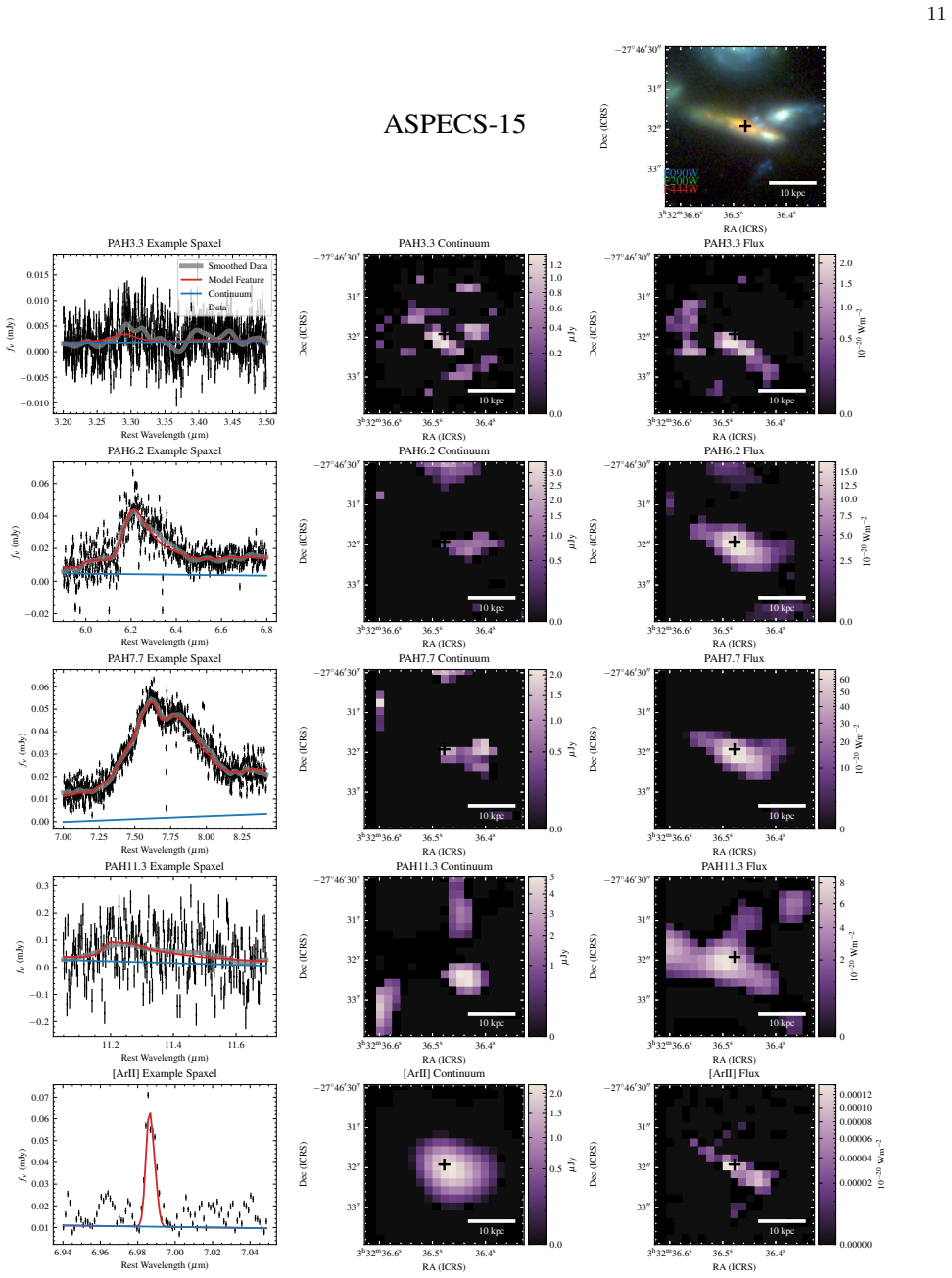
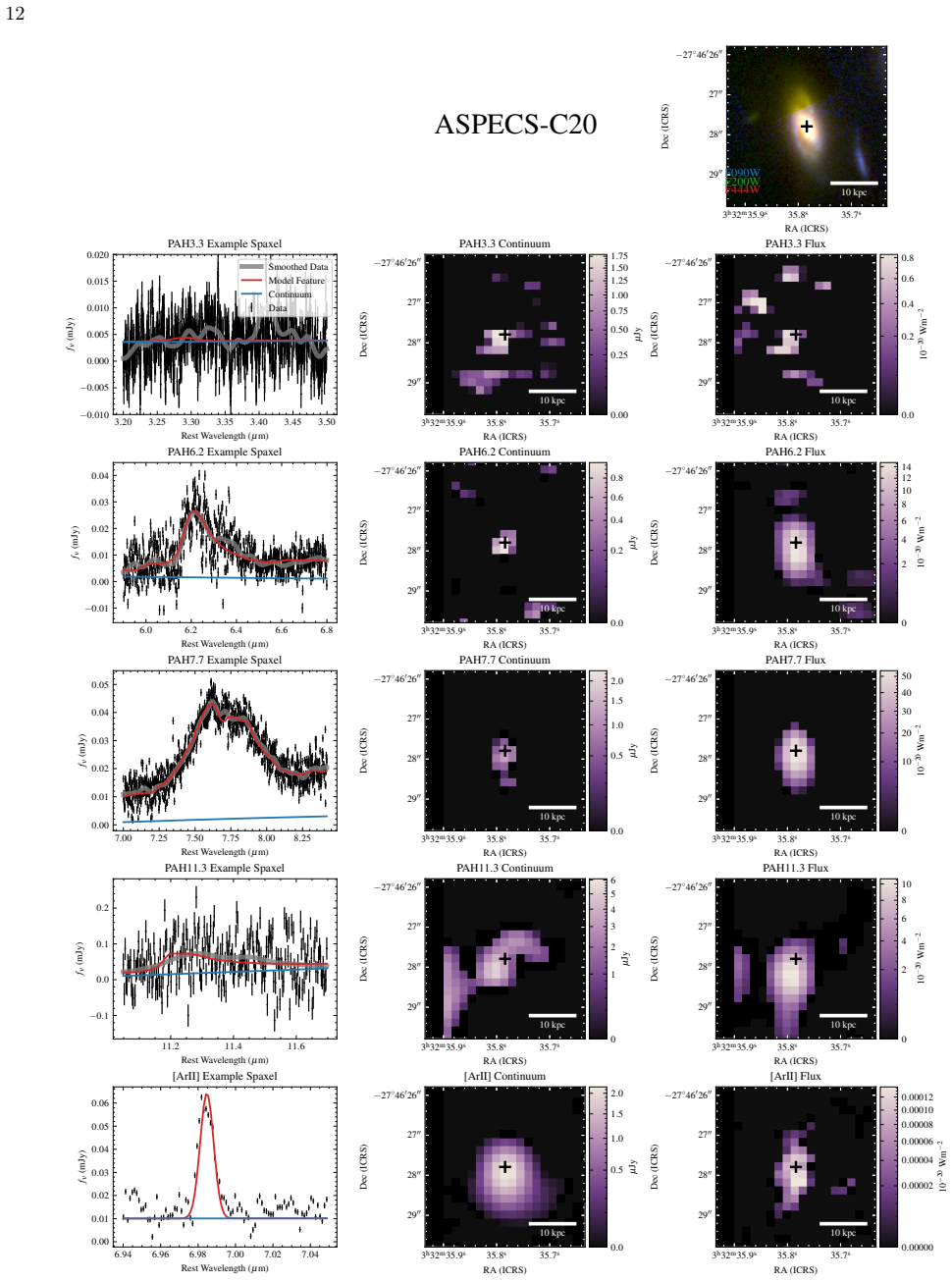
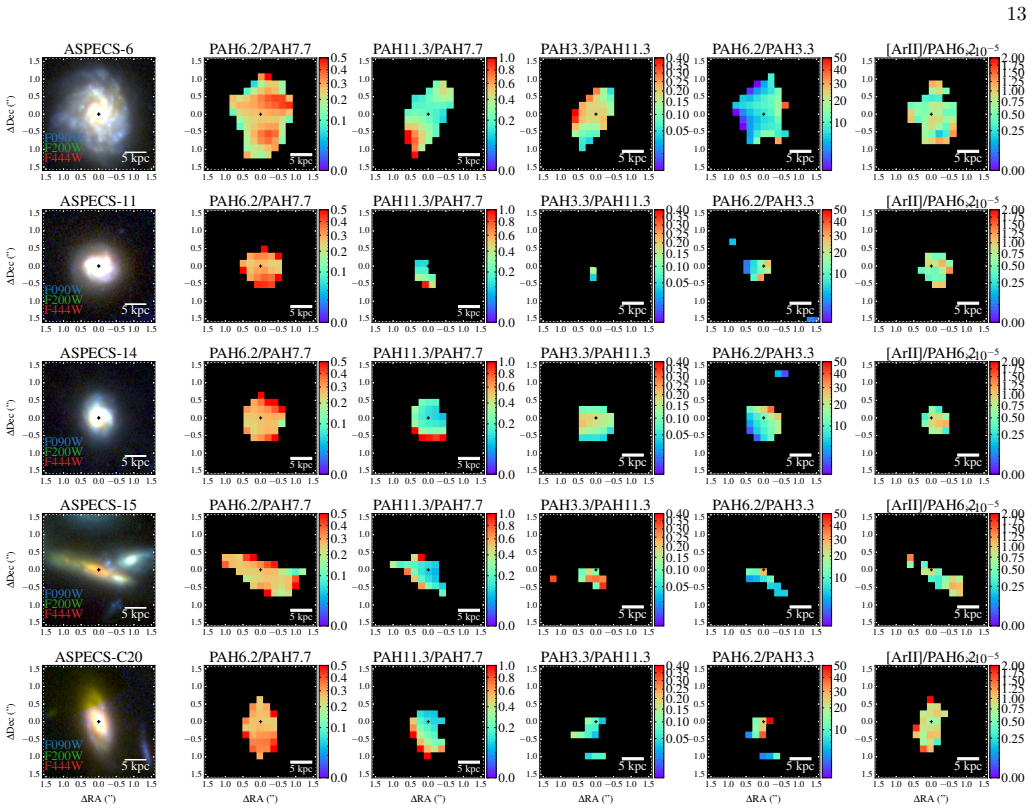
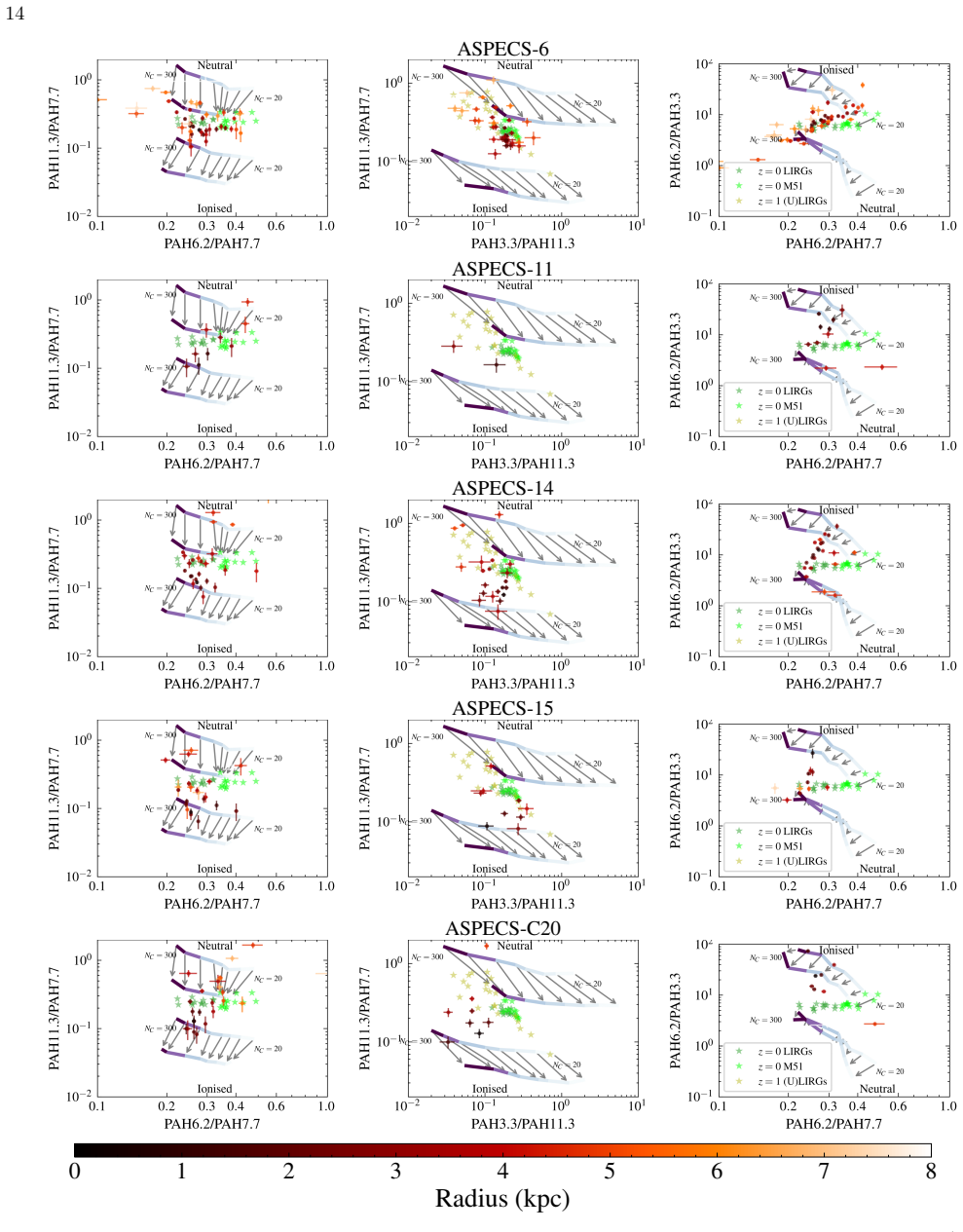
read the original abstract
We present spatially resolved spectroscopy with JWST/MIRI MRS of a representative sample of normal star-forming galaxies at $z\sim1.1$ as part of the PAHSPECS program. To extract emission from Polycyclic Aromatic Hydrocarbon (PAH) features, we forward model the data cubes with non-parametric spatial distributions, accounting for convolution with the PSF. With this method we are able to recover accurate spatial profiles of the 3.3 $\mu$m, 6.2 $\mu$m, 7.7 $\mu$m, 11.3 $\mu$m PAHs and [ArII] (6.98 $\mu$m) emission and produce PAH ratio maps at cosmic noon. From the PAH ratio maps we find that PAHs become larger and more neutral with increasing galactocentric radius, which is the opposite of trends in local galaxies, indicating radial ISM gradients in normal star-forming galaxies are different at cosmic noon. Through spatially resolved SED fitting of HST and JWST photometry we measure the UV radiation field hardness through the intrinsic ratio of UV to optical flux and find the 3.3/11.3 PAH ratio to decrease with increasing hardness and the 11.3/7.7 to increase. This may suggest photo-destruction of small/ionized PAHs is driving the observed PAH ratio trends and may explain the overall lower 3.3/11.3 PAH at cosmic noon compared to the local universe. This work demonstrates that PAH properties hold crucial information on the resolved ISM physics of galaxies at cosmic noon.
Editorial analysis
A structured set of objections, weighed in public.
Referee Report
Summary. The paper presents JWST/MIRI MRS spatially resolved spectroscopy of PAH features in a sample of normal star-forming galaxies at z~1.1 from the PAHSPECS program. It describes a forward-modeling approach using non-parametric spatial distributions to account for PSF convolution when extracting the 3.3, 6.2, 7.7, and 11.3 μm PAH and [Ar II] emission, producing ratio maps. The central result is that PAH ratios indicate larger and more neutral PAHs with increasing galactocentric radius (opposite to local-universe trends), with supporting SED fitting showing correlations between PAH ratios and UV radiation field hardness that the authors attribute to photo-destruction.
Significance. If the reported radial PAH ratio gradients are shown to be free of residual PSF systematics, the result would indicate that ISM conditions and radial gradients in normal star-forming galaxies at cosmic noon differ from those in the local universe, with implications for PAH processing and galaxy evolution models. The work also demonstrates the utility of resolved mid-IR spectroscopy for high-redshift ISM studies.
major comments (2)
- [Abstract] Abstract/Methods (forward-modeling description): The claim that non-parametric spatial distributions recover accurate, unbiased PAH spatial profiles after PSF convolution is load-bearing for all reported radial trends, yet the abstract provides no quantitative validation, simulated-data tests, or error budgets demonstrating that residuals do not bias ratios at the 0.3–1 arcsec scales of the measured gradients.
- [Results] Results (PAH ratio maps and radial trends): The headline finding that PAHs become larger and more neutral with radius (opposite local trends) assumes the extracted 3.3/11.3, 11.3/7.7, and 6.2/7.7 maps reflect intrinsic profiles; the finite flexibility of the non-parametric distributions plus wavelength-dependent MIRI MRS PSF and sparse cube sampling can produce correlated residuals that preferentially affect central vs. outer annuli, potentially inverting the sign of the gradient.
minor comments (2)
- The abstract refers to 'a representative sample' without stating the number of galaxies, their selection criteria, or redshift distribution.
- Notation for the PAH ratios (e.g., exact wavelength ranges or feature definitions used for 3.3/11.3 etc.) should be defined explicitly when first introduced.
Simulated Author's Rebuttal
We thank the referee for their constructive comments, which highlight important aspects of our forward-modeling approach and its validation. We address each major comment below and will revise the manuscript to incorporate additional quantitative tests and discussion.
read point-by-point responses
-
Referee: [Abstract] Abstract/Methods (forward-modeling description): The claim that non-parametric spatial distributions recover accurate, unbiased PAH spatial profiles after PSF convolution is load-bearing for all reported radial trends, yet the abstract provides no quantitative validation, simulated-data tests, or error budgets demonstrating that residuals do not bias ratios at the 0.3–1 arcsec scales of the measured gradients.
Authors: We agree that the abstract does not include quantitative validation of the non-parametric forward-modeling method. In the revised manuscript we will update the abstract to reference the validation approach and add a dedicated subsection in the Methods section (with supporting figures in an appendix) that presents simulated-data tests. These tests will quantify recovery accuracy, residual levels, and error budgets specifically at the 0.3–1 arcsec scales relevant to the reported gradients. revision: yes
-
Referee: [Results] Results (PAH ratio maps and radial trends): The headline finding that PAHs become larger and more neutral with radius (opposite local trends) assumes the extracted 3.3/11.3, 11.3/7.7, and 6.2/7.7 maps reflect intrinsic profiles; the finite flexibility of the non-parametric distributions plus wavelength-dependent MIRI MRS PSF and sparse cube sampling can produce correlated residuals that preferentially affect central vs. outer annuli, potentially inverting the sign of the gradient.
Authors: We acknowledge that wavelength-dependent PSF effects and sparse sampling could in principle introduce correlated residuals capable of biasing central versus outer annuli. The non-parametric distributions are fit independently per wavelength while explicitly including the measured MIRI MRS PSF, which is intended to minimize such biases. Nevertheless, to directly address the possibility of gradient inversion, the revised manuscript will include mock-cube tests with injected radial gradients (both positive and negative) to quantify any residual bias in the recovered PAH ratios and to demonstrate that the observed trends are not artifacts of the method. revision: yes
Circularity Check
No circularity: observational extraction of PAH ratio maps from JWST data
full rationale
The paper reports direct observational results from JWST/MIRI MRS spectroscopy of z~1.1 galaxies. PAH spatial profiles are recovered via forward modeling with non-parametric distributions that explicitly account for PSF convolution; the resulting ratio maps (3.3/11.3, 11.3/7.7, 6.2/7.7) and their radial trends are presented as empirical measurements, not as predictions or derivations that reduce to fitted inputs by construction. Spatially resolved SED fitting for UV hardness is likewise an independent photometric analysis. No self-definitional quantities, fitted-input predictions, or load-bearing self-citations appear in the central claims. The analysis chain is self-contained against external data and does not rely on internal tautologies.
Axiom & Free-Parameter Ledger
axioms (1)
- domain assumption Standard assumptions in PAH feature extraction and SED fitting hold without significant bias at z~1.1
Reference graph
Works this paper leans on
-
[1]
Algera, H. S. B., Inami, H., Oesch, P. A., et al. 2023, MNRAS, 518, 6142, doi: 10.1093/mnras/stac3195
-
[2]
2019, ApJ, 882, 136, doi: 10.3847/1538-4357/ab30df
Aravena, M., Decarli, R., G´ onzalez-L´ opez, J., et al. 2019, ApJ, 882, 136, doi: 10.3847/1538-4357/ab30df
-
[3]
2020, ApJ, 901, 79, doi: 10.3847/1538-4357/ab99a2
Aravena, M., Boogaard, L., G´ onzalez-L´ opez, J., et al. 2020, ApJ, 901, 79, doi: 10.3847/1538-4357/ab99a2
-
[4]
Baron, D., Sandstrom, K. M., Sutter, J., et al. 2025, ApJ, 978, 135, doi: 10.3847/1538-4357/ad972a
-
[5]
Barrera-Ballesteros, J. K., Heckman, T. M., Zhu, G. B., et al. 2016, MNRAS, 463, 2513, doi: 10.1093/mnras/stw1984
-
[6]
A., Decarli, R., Gonz´ alez-L´ opez, J., et al
Boogaard, L. A., Decarli, R., Gonz´ alez-L´ opez, J., et al. 2019, ApJ, 882, 140, doi: 10.3847/1538-4357/ab3102
-
[7]
A., van der Werf, P., Weiss, A., et al
Boogaard, L. A., van der Werf, P., Weiss, A., et al. 2020, ApJ, 902, 109, doi: 10.3847/1538-4357/abb82f 12 https://github.com/FergusDonnan/SPIRIT/
-
[8]
Bruzual, G., & Charlot, S. 2003, MNRAS, 344, 1000, doi: 10.1046/j.1365-8711.2003.06897.x
-
[9]
Calzetti, D., Armus, L., Bohlin, R. C., et al. 2000, ApJ, 533, 682, doi: 10.1086/308692
work page internal anchor Pith review doi:10.1086/308692 2000
-
[10]
Calzetti, D., Kennicutt, R. C., Engelbracht, C. W., et al. 2007, ApJ, 666, 870, doi: 10.1086/520082
-
[11]
Improving the full spectrum fitting method: accurate convolution with Gauss-Hermite functions
Cappellari, M. 2017, MNRAS, 466, 798, doi: 10.1093/mnras/stw3020
work page internal anchor Pith review doi:10.1093/mnras/stw3020 2017
-
[12]
2023, MNRAS, 526, 3273, doi: 10.1093/mnras/stad2597
Cappellari, M. 2023, MNRAS, 526, 3273, doi: 10.1093/mnras/stad2597
-
[13]
Carnall, A. C., McLure, R. J., Dunlop, J. S., & Dav´ e, R. 2018, MNRAS, 480, 4379, doi: 10.1093/mnras/sty2169
work page internal anchor Pith review doi:10.1093/mnras/sty2169 2018
-
[14]
Chown, R., Leroy, A. K., Bolatto, A. D., et al. 2025, ApJ, 987, 91, doi: 10.3847/1538-4357/add73a
-
[15]
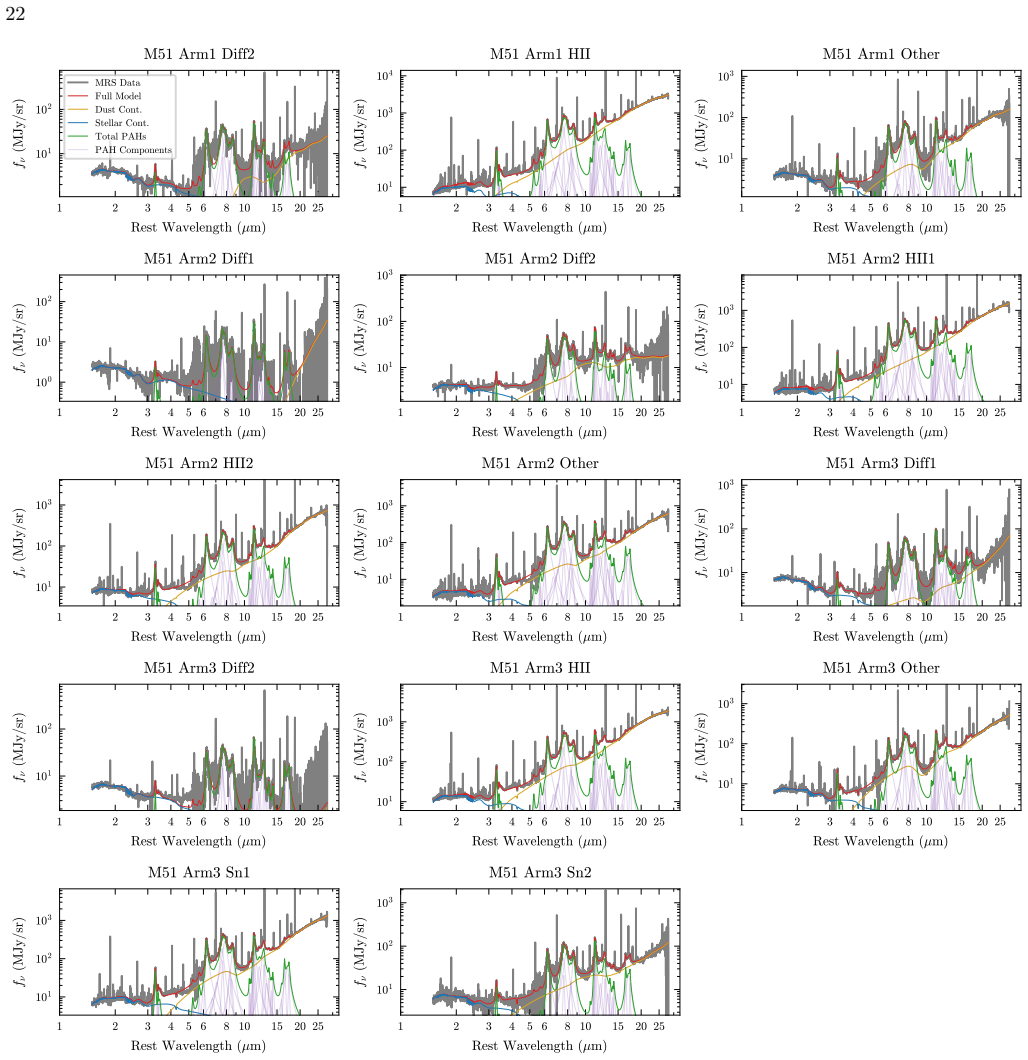
Cortzen, I., Garrett, J., Magdis, G., et al. 2019, MNRAS, 482, 1618, doi: 10.1093/mnras/sty2777 22 1 2 3 4 5 6 8 10 15 20 25 Rest Wavelength (µm) 101 102 fν (MJy/sr) M51 Arm1 Diff2 MRS Data Full Model Dust Cont. Stellar Cont. Total PAHs PAH Components 1 2 3 4 5 6 8 10 15 20 25 Rest Wavelength (µm) 101 102 103 104 fν (MJy/sr) M51 Arm1 HII 1 2 3 4 5 6 8 10 ...
-
[16]
2020, MNRAS, 492, 821, doi: 10.1093/mnras/stz3379
Curti, M., Maiolino, R., Cirasuolo, M., et al. 2020, MNRAS, 492, 821, doi: 10.1093/mnras/stz3379
-
[17]
Decarli, R., Walter, F., G´ onzalez-L´ opez, J., et al. 2019, ApJ, 882, 138, doi: 10.3847/1538-4357/ab30fe
-
[18]
Decarli, R., Aravena, M., Boogaard, L., et al. 2020, ApJ, 902, 110, doi: 10.3847/1538-4357/abaa3b del Valle-Espinosa, M. G., Mingozzi, M., James, B., et al. 2026, ApJL, 998, L45, doi: 10.3847/2041-8213/ae43ed D´ ıaz-Santos, T., Charmandaris, V., Armus, L., et al. 2010, ApJ, 723, 993, doi: 10.1088/0004-637X/723/2/993 D´ ıaz-Santos, T., Charmandaris, V., Ar...
-
[19]
S.-Y., Finnerty, L., et al
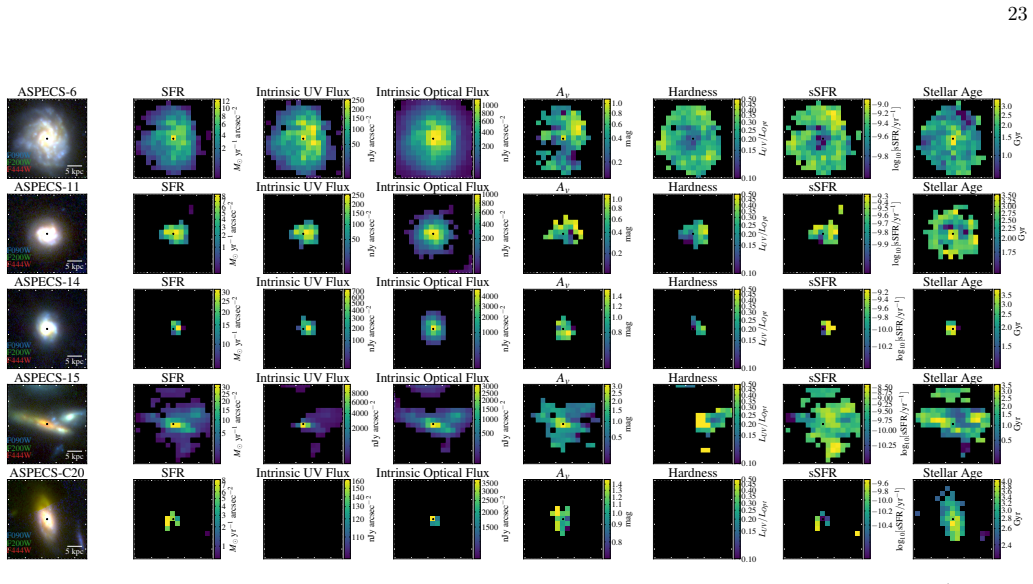
Diaz-Santos, T., Lai, T. S.-Y., Finnerty, L., et al. 2025, CAFE: Continuum And Feature Extraction tool,, Astrophysics Source Code Library, record ascl:2501.001 http://ascl.net/2501.001 23 F444W F200W F090W ASPECS-6 5 kpc SFR 2 4 6 8 10 12 M⊙ yr−1 arcsec−2 Intrinsic UV Flux 50 100 150 200 250 nJy arcsec−2 Intrinsic Optical Flux 200 400 600 800 1000 nJy arc...
2025
-
[20]
R., Garc´ ıa-Bernete, I., Rigopoulou, D., et al
Donnan, F. R., Garc´ ıa-Bernete, I., Rigopoulou, D., et al. 2024a, MNRAS, 529, 1386, doi: 10.1093/mnras/stae612
-
[21]
R., Rigopoulou, D., & Garc´ ıa-Bernete, I
Donnan, F. R., Rigopoulou, D., & Garc´ ıa-Bernete, I. 2024b, MNRAS, 532, L75, doi: 10.1093/mnrasl/slae050
-
[22]
Donnan, F. R., Garc´ ıa-Bernete, I., Rigopoulou, D., et al. 2026, arXiv e-prints, arXiv:2603.12200, doi: 10.48550/arXiv.2603.12200
work page internal anchor Pith review Pith/arXiv arXiv doi:10.48550/arxiv.2603.12200 2026
-
[23]
Draine, B. T., & Li, A. 2007, ApJ, 657, 810, doi: 10.1086/511055
work page internal anchor Pith review doi:10.1086/511055 2007
-
[24]
Draine, B. T., Li, A., Hensley, B. S., et al. 2021, ApJ, 917, 3, doi: 10.3847/1538-4357/abff51
-
[25]
Engelbracht, C. W., Rieke, G. H., Gordon, K. D., et al. 2008, ApJ, 678, 804, doi: 10.1086/529513
-
[26]
Ferland, G. J., Chatzikos, M., Guzm´ an, F., et al. 2017, RMxAA, 53, 385, doi: 10.48550/arXiv.1705.10877 F¨ orster Schreiber, N. M., & Wuyts, S. 2020, ARA&A, 58, 661, doi: 10.1146/annurev-astro-032620-021910 Garc´ ıa-Bernete, I., Rigopoulou, D., Alonso-Herrero, A., et al. 2022, A&A, 666, L5, doi: 10.1051/0004-6361/202244806 Garc´ ıa-Bernete, I., Rigopoulo...
-
[27]
Hughes, A., Meidt, S. E., Colombo, D., et al. 2013, ApJ, 779, 46, doi: 10.1088/0004-637X/779/1/46
-
[28]
Hunt, L. K., Thuan, T. X., Izotov, Y. I., & Sauvage, M. 2010, ApJ, 712, 164, doi: 10.1088/0004-637X/712/1/164
-
[29]
Illingworth, G. D., Magee, D., Oesch, P. A., et al. 2013, ApJS, 209, 6, doi: 10.1088/0067-0049/209/1/6
-
[30]
Jones, A. P., Tielens, A. G. G. M., & Hollenbach, D. J. 1996, ApJ, 469, 740, doi: 10.1086/177823
-
[31]
Kennicutt, Jr., R. C. 1998, ARA&A, 36, 189, doi: 10.1146/annurev.astro.36.1.189
work page internal anchor Pith review doi:10.1146/annurev.astro.36.1.189 1998
-
[32]
Kim, J., Leroy, A. K., Sandstrom, K., et al. 2026, ApJ, 1001, 67, doi: 10.3847/1538-4357/ae4599
-
[33]
S.-Y., Armus, L., Bianchin, M., et al
Lai, T. S.-Y., Armus, L., Bianchin, M., et al. 2023, ApJL, 957, L26, doi: 10.3847/2041-8213/ad0387
-
[34]
Lai, T. S.-Y., Duval, S., Smith, J. D. T., et al. 2025, ApJL, 991, L56, doi: 10.3847/2041-8213/ae0467
-
[35]
Lange, K., Dominik, C., & Tielens, A. G. G. M. 2025, A&A, 702, A14, doi: 10.1051/0004-6361/202347722
-
[36]
Leach, S. 1986, Journal of Electron Spectroscopy and Related Phenomena, 41, 427, doi: 10.1016/0368-2048(86)85020-4
-
[37]
Lebouteiller, V., Brandl, B., Bernard-Salas, J., Devost, D., & Houck, J. R. 2007, ApJ, 665, 390, doi: 10.1086/519014
-
[38]
K., Lee, C., Schruba, A., et al
Leroy, A. K., Lee, C., Schruba, A., et al. 2013, ApJL, 769, L12, doi: 10.1088/2041-8205/769/1/L12
-
[39]
Leroy, A. K., Bolatto, A. D., Sandstrom, K., et al. 2023, ApJL, 944, L10, doi: 10.3847/2041-8213/acab01
-
[40]
2020, Nature Astronomy, 4, 339, doi: 10.1038/s41550-020-1051-1
Li, A. 2020, Nature Astronomy, 4, 339, doi: 10.1038/s41550-020-1051-1
-
[41]
2026 A&A, doi: 10.1051/0004-6361/202659369
Lofaro, C., et al. 2026 A&A, doi: 10.1051/0004-6361/202659369
-
[42]
PAHSPECS: Polycyclic aromatic hydrocarbon properties at cosmic noon with JWST/MIRI MRS
Lofaro, C. M., D´ ıaz Santos, T., Shivaei, I., et al. 2026, arXiv e-prints, arXiv:2606.18230, doi: 10.48550/arXiv.2606.18230
work page internal anchor Pith review Pith/arXiv arXiv doi:10.48550/arxiv.2606.18230 2026
-
[43]
2025, arXiv e-prints, arXiv:2510.07365
McKinney, J., Eleazer, M., Pope, A., et al. 2025, arXiv e-prints, arXiv:2510.07365. https://arxiv.org/abs/2510.07365
arXiv 2025
-
[44]
Micelotta, E. R., Jones, A. P., & Tielens, A. G. G. M. 2010, A&A, 510, A36, doi: 10.1051/0004-6361/200911682
-
[45]
Moustakas, J., Kennicutt, Jr., R. C., Tremonti, C. A., et al. 2010, ApJS, 190, 233, doi: 10.1088/0067-0049/190/2/233 O’Dowd, M. J., Schiminovich, D., Johnson, B. D., et al. 2009, ApJ, 705, 885, doi: 10.1088/0004-637X/705/1/885
-
[46]
Patapis, P., Argyriou, I., Law, D. R., et al. 2024, A&A, 682, A53, doi: 10.1051/0004-6361/202347339
-
[47]
Pathak, D., Leroy, A. K., Thompson, T. A., et al. 2024, AJ, 167, 39, doi: 10.3847/1538-3881/ad110d
-
[48]
Peeters, E., Spoon, H. W. W., & Tielens, A. G. G. M. 2004, ApJ, 613, 986, doi: 10.1086/423237
-
[49]
Shapley, A. E. 2010, ApJ, 712, 1070, doi: 10.1088/0004-637X/712/2/1070
-
[50]
Regan, M. W., Thornley, M. D., Vogel, S. N., et al. 2006, ApJ, 652, 1112, doi: 10.1086/505382
-
[51]
Rieke, M. J., Robertson, B., Tacchella, S., et al. 2023, ApJS, 269, 16, doi: 10.3847/1538-4365/acf44d
-
[52]
Rigopoulou, D., Spoon, H. W. W., Genzel, R., et al. 1999, ApJ, 118, 2625, doi: 10.1086/301146
-
[53]
Rigopoulou, D., Barale, M., Clary, D. C., et al. 2021, MNRAS, 504, 5287, doi: 10.1093/mnras/stab959
-
[54]
R., Garc´ ıa-Bernete, I., et al
Rigopoulou, D., Donnan, F. R., Garc´ ıa-Bernete, I., et al. 2024, MNRAS, 532, 1598, doi: 10.1093/mnras/stae1535
-
[55]
2011, A&A, 534, A81, doi: 10.1051/0004-6361/201116950 S´ anchez, S
Riguccini, L., Le Floc’h, E., Ilbert, O., et al. 2011, A&A, 534, A81, doi: 10.1051/0004-6361/201116950 S´ anchez, S. F., Rosales-Ortega, F. F., Jungwiert, B., et al. 2013, A&A, 554, A58, doi: 10.1051/0004-6361/201220669 S´ anchez, S. F., Rosales-Ortega, F. F., Iglesias-P´ aramo, J., et al. 2014, A&A, 563, A49, doi: 10.1051/0004-6361/201322343 25
-
[56]
Sandstrom, K. M., Bolatto, A. D., Bot, C., et al. 2012, ApJ, 744, 20, doi: 10.1088/0004-637X/744/1/20
-
[57]
M., Chastenet, J., Sutter, J., et al
Sandstrom, K. M., Chastenet, J., Sutter, J., et al. 2023, ApJL, 944, L7, doi: 10.3847/2041-8213/acb0cf
-
[58]
Seok, J. Y., Hirashita, H., & Asano, R. S. 2014, MNRAS, 439, 2186, doi: 10.1093/mnras/stu120
-
[59]
Shipley, H. V., Papovich, C., Rieke, G. H., Brown, M. J. I., & Moustakas, J. 2016, ApJ, 818, 60, doi: 10.3847/0004-637X/818/1/60
-
[60]
Shivaei, I., & Boogaard, L. A. 2024, A&A, 691, L2, doi: 10.1051/0004-6361/202451826
-
[61]
Shivaei, I., Reddy, N. A., Shapley, A. E., et al. 2017, ApJ, 837, 157, doi: 10.3847/1538-4357/aa619c
-
[62]
2024, A&A, 690, A89, doi: 10.1051/0004-6361/202449579
Shivaei, I., Alberts, S., Florian, M., et al. 2024, A&A, 690, A89, doi: 10.1051/0004-6361/202449579
-
[63]
Smith, J. D. T., Draine, B. T., Dale, D. A., et al. 2007, ApJ, 656, 770, doi: 10.1086/510549
-
[64]
Stierwalt, S., Armus, L., Surace, J. A., et al. 2013, ApJS, 206, 1, doi: 10.1088/0067-0049/206/1/1
-
[65]
2014, ApJ, 790, 124, doi: 10.1088/0004-637X/790/2/124
Stierwalt, S., Armus, L., Charmandaris, V., et al. 2014, ApJ, 790, 124, doi: 10.1088/0004-637X/790/2/124
-
[66]
J., Neri, R., Genzel, R., et al
Tacconi, L. J., Neri, R., Genzel, R., et al. 2013, ApJ, 768, 74, doi: 10.1088/0004-637X/768/1/74
-
[67]
Tacconi, L. J., Genzel, R., Saintonge, A., et al. 2018, ApJ, 853, 179, doi: 10.3847/1538-4357/aaa4b4
-
[68]
J., Roman-Duval, J., Sandstrom, K
Tarantino, E. J., Roman-Duval, J., Sandstrom, K. M., et al. 2025, arXiv e-prints, arXiv:2512.04060. https://arxiv.org/abs/2512.04060
arXiv 2025
-
[69]
Tielens, A. G. G. M. 2005, The Physics and Chemistry of the Interstellar Medium
2005
-
[70]
Tielens, A. G. G. M. 2008, ARA&A, 46, 289, doi: 10.1146/annurev.astro.46.060407.145211
-
[71]
Tremonti, C. A., Heckman, T. M., Kauffmann, G., et al. 2004, ApJ, 613, 898, doi: 10.1086/423264 Van De Putte, D., Peeters, E., Gordon, K. D., et al. 2025, A&A, 701, A111, doi: 10.1051/0004-6361/202554991
work page internal anchor Pith review doi:10.1086/423264 2004
-
[72]
Vila-Costas, M. B., & Edmunds, M. G. 1992, MNRAS, 259, 121, doi: 10.1093/mnras/259.1.121
-
[73]
Voit, G. M. 1992, MNRAS, 258, 841, doi: 10.1093/mnras/258.4.841
-
[74]
2016, ApJ, 833, 67, doi: 10.3847/1538-4357/833/1/67
Walter, F., Decarli, R., Aravena, M., et al. 2016, ApJ, 833, 67, doi: 10.3847/1538-4357/833/1/67
-
[75]
Whitcomb, C. M., Smith, J.-D. T., Sandstrom, K., et al. 2024, ApJ, 974, 20, doi: 10.3847/1538-4357/ad66c8
-
[76]
Whitcomb, C. M., Smith, J. D. T., Tarantino, E., et al. 2025, arXiv e-prints, arXiv:2509.18347, doi: 10.48550/arXiv.2509.18347
-
[77]
Zavala, J. A., Casey, C. M., Manning, S. M., et al. 2021, ApJ, 909, 165, doi: 10.3847/1538-4357/abdb27
-
[78]
Zhang, L., Ho, L. C., & Li, A. 2022, ApJ, 939, 22, doi: 10.3847/1538-4357/ac930f
-
[79]
2024, ApJL, 975, L2, doi: 10.3847/2041-8213/ad81d0
Zhang, L., Garc´ ıa-Bernete, I., Packham, C., et al. 2024, ApJL, 975, L2, doi: 10.3847/2041-8213/ad81d0
-
[80]
Zhen, J., Castellanos, P., Paardekooper, D. M., et al. 2015, ApJL, 804, L7, doi: 10.1088/2041-8205/804/1/L7
discussion (0)
Sign in with ORCID, Apple, or X to comment. Anyone can read and Pith papers without signing in.